Today’s lesson suggests that all families have stories. We study in this formation, a simple analysis of one of the most beautiful prayers authored by St. Francis and how it demonstrates Francis’ most spiritual yearnings. This prayer may have led you to become a Franciscan It is part of our story as a Franciscan Family. Peace, Dona
++++++++++++++++++++++++++++++++++++++++++++++++++++++++++++++++++++++++++++++
Formation Friday May 7, 2021 (en español abajo)
We are all part of a history and a story. We are part of the story of our families, of our religion, of the time in which we live. As Franciscans, we are also part of the Franciscan story. There are traditions, stories, devotions, prayers, and sayings involved with all of these groups. Knowing about them helps us to be part of the family. The prayer before the Crucifix of San Damiano is one of the prayers that is very important to us as Franciscans.
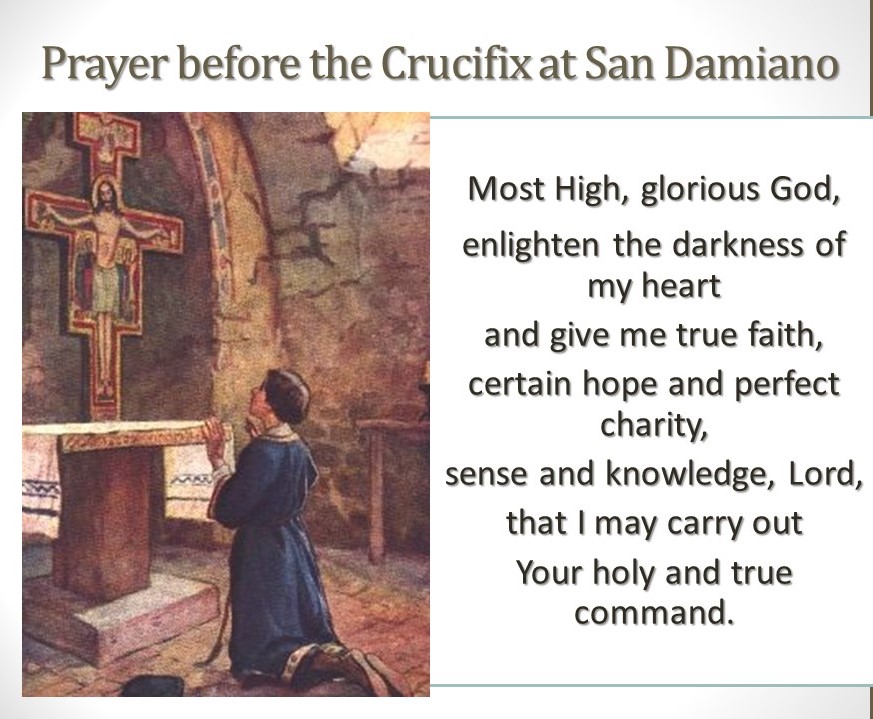
The Prayer before the Crucifix (1205-1206)
“While Thomas of Celano and Saint Bonaventure characterize the early years of Francis’s life as a struggle to discern God’s will, the author of The Legend of the Three Companions, according to two manuscripts, summarizes Francis’s yearnings in this simple prayer and places it on his lips as he kneels before the Crucifix of the crumbling church of San Damiano in Assisi. The prayer may have been influenced by the liturgical opening prayer of the Eucharistic liturgy. This version of the prayer is based on the simple text found in the majority of Latin manuscripts. As it became more popular, the prayer was embellished and lost some of its simplicity.”
FA:ED, vol. 1, 40 https://franciscantradition.org/francis-of-assisi-early-documents/the-saint/writings-of-francis/the-prayer-before-the-crucifix/58-fa-ed-1-page-40Most High, glorious God,
enlighten the darkness of my heart
and give me
true faith,
certain hope,
and perfect charity,
sense and knowledge,
Lord,
that I may carry out
Your holy and true command.As St. Francis knelt before the crucifix of San Damiano, he put himself in God’s hands. It was the beginning for him. Franciscans can pray this prayer every day, but it is especially meaningful for those who are at the “beginning,” those who are discerning a vocation to the Order.
Pray this prayer alone or in a group. Take time to think about the words. Each line has questions for discussion and for commenting on in your journal.
MOST HIGH, GLORIOUS GOD, (Praise)
+How did St. Francis see God? How did he praise him?
++How do you see God? Where do you find him? How do you praise God?
ENLIGHTEN THE DARKNESS OF MY HEART (Repentance)
+What was the “darkness” of his heart? What was he asking to have revealed?
++What is the darkness in your heart? What do you seek? What do you need God to show you?
AND GIVE ME TRUE FAITH, CERTAIN HOPE, AND PERFECT CHARITY, SENSE AND KNOWLEDGE, LORD, (Petition)
+What was Francis asking for? Why are these qualities significant in the spiritual life?
++What will you need to strengthen you spiritually as you discern? Give examples of the roles these virtues play in your life.
THAT I MAY CARRY OUT YOUR HOLY AND TRUE COMMAND. (Resolution)
+Francis stops and listens. Then he resolves to carry out God’s will in his life. What did he do?
++When you pray, do you take time to listen? Do you resolve to imitate Christ? How do you put God’s will into practice?
++++++++++++++++++
Todos somos parte de una historia y una leyenda. Somos parte de la historia de nuestras familias, de nuestra religión, de la época en que vivimos. Como franciscanos también somos parte de la historia franciscana. Hay tradiciones, cuentos, devociones, oraciones y dichos relacionados con todos estos grupos. Conocerlos nos ayuda a ser parte de la familia.
La oración ante el crucifijo (1205-1206) es una de las oraciones de San Francisco que nos afecta mucho.
“Mientras Tomás de Celano y San Buenaventura caracterizan los primeros años de la vida de Francisco como una lucha por discernir la voluntad de Dios, el autor de La leyenda de los tres compañeros, según dos manuscritos, resume los anhelos de Francisco en esta sencilla oración y la coloca en su labios mientras se arrodilla ante el crucifijo de la desmoronada iglesia de San Damián en Asís. La oración puede haber sido influenciada por la oración litúrgica de apertura de la liturgia eucarística. Esta versión de la oración se basa en el texto simple que se encuentra en la mayoría de los manuscritos latinos. A medida que se hizo más popular, la oración se embelleció y perdió algo de su simplicidad .”
FA:ED, vol. 1, 40 https://franciscantradition.org/francis-of-assisi-early-documents/the-saint/writings-of-francis/the-prayer-before-the-crucifix/58-fa-ed-1-page-40
Oración ante el Crucifijo de San Damián [OrSD]
https://www.franciscanos.org/esfa/escritossf.html#orsd
Sumo, glorioso Dios,
ilumina las tinieblas de mi corazón
y dame fe recta,
esperanza cierta
y caridad perfecta,
sentido y conocimiento, Señor,
para que cumpla tu santo y verdadero mandamiento.
Cuando San Francisco se arrodilló ante el crucifijo de San Damián, se puso en las manos de Dios. Fue el comienzo para él. Los franciscanos pueden rezar esta oración todos los días, pero es especialmente significativa para aquellos que están en el “comienzo” de su jornada, aquellos que están discerniendo una vocación a la Orden.
Ore esta oración solo o en grupo. Tómese un tiempo para pensar en las palabras. Cada línea tiene preguntas para platicar y comentar en su diario.
SUMO, GLORIOSO DIOS, (Alabanza)
+¿Cómo veía San Francisco a Dios? ¿Cómo lo elogió?
++¿Cómo ve Ud. a Dios? ¿Dónde lo encuentra? ¿Cómo alaba Ud. a Dios?
ILUMINA LAS TINIEBLAS DE MI CORAZÓN (Arrepentimiento)
+¿Cuál era la “oscuridad” del corazón de Francisco? ¿Qué estaba pidiendo que se le revelara?
++¿Cuáles son las tinieblas de su corazón? ¿Qué busca? ¿Qué necesita que Dios le muestre?
Y DAME FE RECTA, ESPERANZA CIERTA Y CARIDAD PERFECTA, SENTIDO Y CONOCIMIENTO, SEÑOR, (Petición)
+¿Qué estaba pidiendo Francisco? ¿Por qué estas cualidades son importantes en la vida espiritual?
++¿Qué necesitará Ud. para fortalecerse espiritualmente mientras discierne? Dé ejemplos del papel que juegan estas virtudes en su vida.
PARA QUE CUMPLA TU SANTO Y VERDADERO MANDAMIENTO. (Resolución)
+Francisco se detiene y escucha. Entonces decide llevar a cabo la voluntad de Dios en su vida. ¿Qué hizo él?
++Cuando rezas, ¿se toma el tiempo para escuchar? ¿Decide imitar a Cristo? ¿Cómo se pone en práctica la voluntad de Dios?
—
Our Life in Christ and Our Public Life
(This article original appeared in the Winter 2021 TAU-USA Issue 102)
By Fr. Jerome Wolbert, OFM, CSNA
Fr. Jerome Wolbert, OFM, CNSA President
I don’t remember hearing about abortion until it was brought up for discussion in my high school English class. Abortion remains a hot topic after all these years, in spite of several commentators claiming decades ago that other issues would squeeze it out, but it still gets modest attention in many elections. Over my years as a priest, I’ve heard several confessions from women and a few from men, about how their choice for abortion has hurt their lives. As long as abortion is with us, it will continue to affect us.
My parents did an end-run around the public schools’ family life education, which started in fifth grade. When each of us reached fourth grade, Mom took my sisters, and Dad took my brothers and me to the local museum, where father-son and mother- daughter classes learned about human physiology and development. Our entire family watched the development of the child from conception to birth on NOVA on PBS. We were watching the rerun when our grandparents were watching us. My grandmother entered the room just as the mother was giving birth. Her reaction: “What would your parents say if they knew you were watching this?” “Well,” we said, “they already saw it with us.” Seeing the development of a child a stage at a time pulls back the curtain from the mystery of pregnancy and makes it just “common sense” that there is a child developing inside the mother. There is no magic point of a “formless blob” suddenly becoming “a human being.”
When my high school English teacher brought up the topic for discussion, I was relieved to find out that the Church already acknowledged that abortion is the taking of human life. I was relieved that the Church was on the side of what, to my eyes, was clearly science.
There are many scientists who would frame things differently. But the simple, direct view of the development of a child in the womb is so powerful that many women leaning toward an abortion choose differently when they see an ultrasound.
Only three of us in that class thought abortion was at all questionable. The simple, direct proclamation of a woman’s so-called “right to choose” is so powerful that it affects how people today interpret even the photography that clearly demonstrates there is a growing being. We learn how to interpret who is favorable or beautiful or trustworthy in part from those around us and the way they interpret and interact with others.
The Secular Franciscan Rule tells us to “be in the forefront in promoting justice by the testimony of [our] human lives and [our] courageous initiatives. Especially in the field of public life, [we] should make definite choices in harmony with [our] faith.” (15)
Our public role extends far beyond the voting booth. My parents’ direct and respectful approach to human life and development had a profound and lasting impact on me. Everything has a proper name, can be discussed with respect and without fear or shame. We can have a great impact when we deal openly, honestly, and without fear about every topic with each person.
For your reflection: What has helped form your Gospel-centered approach to engaging in public life? Is there a challenge you still need to take up? How do you pray about this? What kind of choices do you make that are contrary to social norms but in harmony with our faith?
https://secularfranciscansusa.org/2021/05/03/our-life-in-christ-and-our-public-life/
FORMATION FRIDAY – April 30, 2021 – WHO DO WE SAY WE ARE?
Today’s formation lesson is Part 2 of Understanding our RULE.and how we are living our vocation. This lesson helps us relay to others what Secular Franciscans are and what they are supposed to be and do. I would use this for Come and See events and with our ongoing formation lessons. Important to review and live. Peace, Dona+++++++++++++++++++++++++++++++++++++++++++++++++++++++++++Please share with your local fraternity (En español Abajo) Secular Franciscans: Who Do We Say We Are? (PART TWO—Articles 11-18)According to the Rule of the Secular Franciscan Order:
• We are detached from possessions and power (Art. 11)
• We are pure of heart (Art. 12)
• We are accepting of others (Art. 13)
• We are called to build a more fraternal and evangelical world. (Art. 14)
• We are promoters of justice (Art. 15)
• We are sharers in the creation, redemption, and service of the human community. (Art. 16)
• We are peacemakers (Arts. 17 and 19)
• We are lovers of all creatures and all creation (Art. 18)
• We are detached from possessions and power (Art. 11)
+We simplify our material needs. But not only that—we are detached from our own opinions and agendas—We allow ourselves to listen to others even when we don’t agree with what they are saying. We listen to others with empathy.
• We are pure of heart (Art. 12)
+Pure of Heart: Clear-sighted, willing to deal with reality in a faith-filled way. We see the presence of God in all.
• We are accepting of others (Art. 13)
+ Gentle and courteous spirit—accept all people as a gift from God—we are joyful and place ourselves on an equal basis with all people, especially the lowly
• We are called to build a more fraternal and evangelical world. (Art. 14)
+We strive to close our mouths and open our ears and our hearts to see what is needed.
• We are promoters of justice (Art. 15)
+We strive to be at the forefront of promoting justice. Politics can be a distraction and cause us to lose sight of what is being asked of us. Dialogue is key.
• We are sharers in the creation, redemption, and service of the human community. (Art. 16)
+We see the imprint of the Creator in all things, we participate in the saving power of our Incarnate Lord, we imitate His example as servant leaders among our brothers and sisters.
• We are peacemakers (Arts. 17 and 19)
+ We do not leave a trail of criticism, cynicism, and selfishness behind us. Our speech is honest and without duplicity. We realize that not everyone agrees with us. We are willing to listen.
• We are lovers of all creatures and all creation (Art. 18)
+As Franciscans, we are called to be stewards of the environment. We do what we can to love the earth and its creatures.
Questions for discussion or to answer in your journal:
+ In what ways do I follow articles 11-19 of the OFS Rule?
+ Which of these articles do I find most difficult?
+ Through my living of the Rule, how do others recognize me as a follower of Christ and St. Francis? Give examples from articles 11-19.
++++++++++++++++++++
Los Franciscanos seglares: ¿Quiénes decimos que somos? (La segunda parte)
Según la Regla de la Orden Franciscana Seglar:
• Estamos desapegados de las posesiones y el poder (Art. 11)
• Somos puros de corazón (Art. 12)
• Aceptamos a los demás (Art. 13)
• Estamos llamados a construir un mundo más fraterno y evangélico. (Art. 14)
• Somos promotores de justicia (Art. 15)
• Somos partícipes de la creación, redención y servicio de la comunidad humana. (Art. 16)
• Somos pacificadores (arts. 17 y 19)
• Somos amantes de todas las criaturas y de toda la creación (Art. 18)
• Estamos desapegados de las posesiones y el poder (Art. 11)
+ Simplificamos nuestras necesidades materiales. Pero no sólo eso, nos separamos de nuestras propias opiniones y agendas, nos permitimos escuchar a los demás incluso cuando no estamos de acuerdo con lo que están diciendo. Escuchamos a los demás con empatía.
• Somos puros de corazón (Art. 12)
+ Puro de corazón: clarividente, dispuesto a lidiar con la realidad de una manera llena de fe. Vemos la presencia de Dios en todos.
• Aceptamos a los demás (Art. 13)
+ Espíritu amable y cortés: aceptamos a todas las personas como un don de Dios, estamos alegres y nos colocamos en pie de igualdad con todas las personas, especialmente con los humildes.
• Estamos llamados a construir un mundo más fraterno y evangélico. (Art. 14)
+ Nos esforzamos por cerrar la boca y abrir los oídos y el corazón para ver qué se necesita.
• Somos promotores de justicia (Art. 15)
+ Nos esforzamos por estar a la vanguardia en la promoción de la justicia. Tendemos a perder de vista lo que se nos pide por la distracción de la política. El diálogo es clave.
• Somos partícipes de la creación, redención y servicio de la comunidad humana. (Art. 16)
+ Vemos la huella del Creador en todas las cosas, participamos del poder salvador de nuestro Señor Encarnado, imitamos Su ejemplo como líderes servidores entre nuestros hermanos y hermanas.
• Somos pacificadores (arts. 17 y 19)
+ No dejamos un rastro de críticas, cinismo y egoísmo detrás de nosotros. Nuestro discurso es honesto y sin duplicidad. Nos damos cuenta de que no todo el mundo está de acuerdo con nosotros. Estamos dispuestos a escuchar.
• Somos amantes de todas las criaturas y de toda la creación (Art. 18)
+ Como franciscanos, estamos llamados a ser administradores del medio ambiente. Debemos hacer lo que podamos para amar la tierra y sus criaturas.
Preguntas para platicar o para responder en su diario:
+ ¿De qué manera sigo los artículos 11-19 de la Regla OFS?
+ ¿Cuál de estos artículos me resulta más difícil?
+ A través de mi vivir la Regla, ¿cómo me reconocen los demás como seguidor de Cristo y de San Francisco? Dé
ejemplos procedentes de los artículos 11-19.
Diane F. Menditto, OFSChair, National Formation Commission
Minister, Our Lady of the Angels Region
Local Fraternity is the Heart of the Order
(This article original appeared in the Winter 2021 TAU-USA Issue 102)
By SHARON WINZELER, OFS
Calling the local fraternity the “heartbeat of the order,” National Formation Commission Chair Diane Menditto, OFS, pointed to the commitment Secular Franciscans make at profession “to accompany and take care of one another on our journey to the Father.”
In her presentation titled “Fraternity: Our Way of Life,” Menditto elaborated on five key elements to living in communion with one another — collaboration, community, communication, commitment, and conversion.
While explaining the art of Franciscan collaboration, she cited a report by former Minister General Emanuela DeNunzio, OFS, that represents the identity of Secular Franciscans in a triple dimension: Personal (inner life); Fraternal (co-responsibility); and Universal (the mission).
“The mission itself needs to be reflected not only in Gospel values, but in order to work for the fraternity, it also needs to be based on the gifts of its members,” Menditto said.
By championing the lives of our brothers and sisters in fraternity, we strengthen each other, she said, citing the General Constitutions, Article 30.2 on how fraternity should be lived.
“The sense of co-responsibility of the members requires personal presence, witness, prayer and active collaboration in accordance with each one’s situation and possible obligations for the animation of the fraternity,” Menditto said.
The challenge of the community element means the “acceptance of and empathy for our brothers and sisters,” she said.
“We can go out and support others because we know we are loved and supported,” she said.
“We are not looking for others to serve us, but we are looking for ways to serve one another. We want to give everything we have until we have given everything, until we are poor enough to be generous.”
The communication element means listening with patience and humility, even when one doesn’t agree. Menditto encouraged regional ministers and councilors to communicate directly with the local fraternities they represent.
“This is one of the ways the local fraternities will know that we are listening to them,” she said. Listening as a method of communication applies to every level of fraternity.
“If we truly want to serve one another and others in fraternity, listening to the needs of others should, no must, be the basis for whatever we do for one another,” Menditto said.
The fourth challenge of a Secular Franciscan is commitment to what one promised at profession.
“By profession we are committed to God, to one another and to all creation. This is called universal kinship.”
Living the Gospel life as a Secular Franciscan is a full-time experience, she said.
Finally, the biggest challenge of all is daily conversion.
“It is the only way we will accomplish the rest,” Menditto said, citing Article 7 of the Rule: “United by their vocation as brothers and sisters of penance, and motivated by the dynamic power of the gospel, let them conform their thoughts and deeds to those of Christ by means of that radical interior change which the Gospel itself calls conversion.”
Daily conversion helps us to strengthen our mission outlined in the Gospel.
“This requires constant self-examination to be sure we reach out to others because we are not attached to ourselves.”
Using extensive quotes from “Belonging to the SFO” by Emanuela DeNunzio, OFS, (General Chapter 2008), Menditto recommended that fraternities:
- create a School of sanctity — “Fraternity can promote in its members full development of the interior life: an intense liturgical life, sacramental and charitable life through practices such as fraternity prayer, Mass, Liturgy of the Hours, retreats and days of recollection.”
- create a School of formation — “The spirit of belonging is nurtured when the Rule becomes the life of the brothers and sisters. It will assure a kind of assimilation of the spirit of the Rule in the life and in the history of each person. Those who are assiduous readers of the writings of Francis and of Clare and of the ancient biographies will be strengthened in their Franciscan identity. Therefore, Secular Franciscans should regularly read spiritual readings from the sources. We are agents of our own formation. We form ourselves so that we can form others.”
- be a Witness of ecclesial communion — “It is essential that everyone make the decision to make himself/herself present in the lives of the brothers and sisters: rejoicing with those who participate, being mindful of those that do not come, trying to find the reasons for which someone has lost the motivation. In order to promote the desire to gather in fraternity, the Council should plan meetings that are pleasant, productive and enriching.”
- participate in the apostolic purpose of the Church — “The Rule recommends being creative in our apostolic activity — examine our ministries. Society has changed, and the Church has renewed itself and is renewing itself again. The Gospel is always the same, but new approaches and new encounters with the Gospel and history are necessary.”
- be a Presence in society — “In light of the social doctrine of the church, every fraternity should question its priorities in its own missionary commitment.”
- ••
RECOMMENDED RESOURCES
“The Secular Franciscan Order for an
Evangelizing Mission Together with all the Franciscan Family.” (Benedetto Lino, OFS, at the First International Congress for Missions and Evangelization-OFM-2014)
“How Should An Order Like the OFS Be
Managed at All Its Levels?” (Benedetto Lino,
OFS, XIV General Chapter, November 2014)
“Belonging to the SFO” (Emanuela DeNunzio, OFS, General Chapter 2008)
https://secularfranciscansusa.org/2021/04/26/local-fraternity-is-the-heart-of-the-order/
Formation Friday, April 23, 2021
Dear Brothers and Sisters, it is always important to review our goals and consider how we are living our lives. Today is Part I that discusses the basics of what Secular Franciscans are supposed to be about. Please share and discuss with your fraternity. Peace, Dona
+++++++++++++++++++++++++++++++++++++++++++++++++++++++++++++++++
Secular Franciscans: Who Do We Say We Are? (PART ONE—Articles 4-9)
According to the Rule of the Secular Franciscan Order:
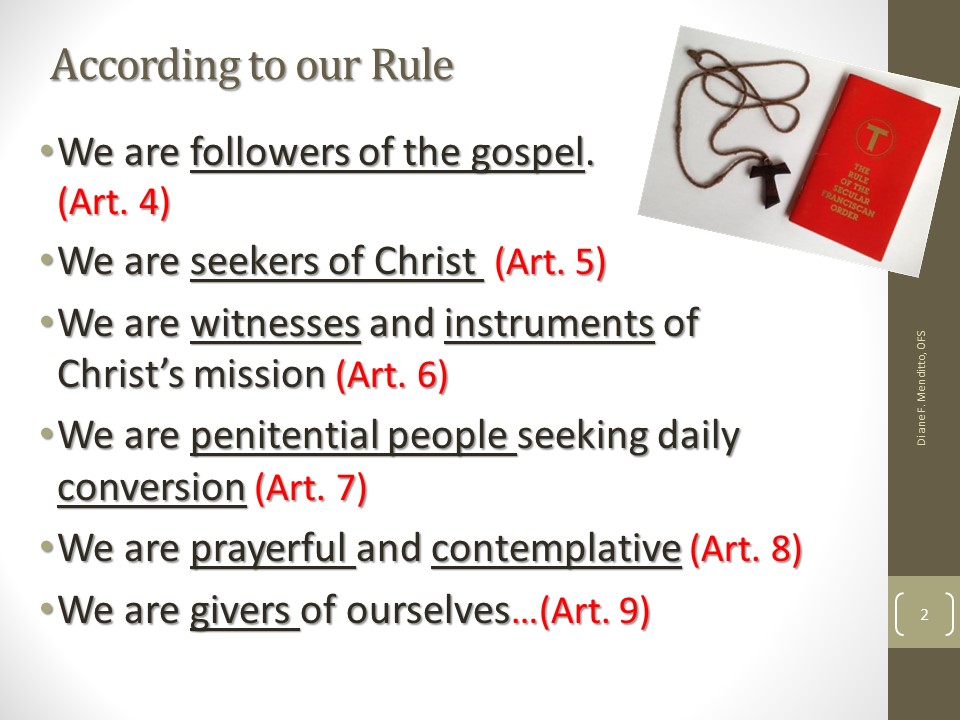
• We are followers of the gospel. (Art. 4)
• We are seekers of Christ (Art. 5)
• We are witnesses and instruments of Christ’s mission (Art. 6)
• We are penitential people seeking daily conversion (Art. 7)
• We are prayerful and contemplative (Art. 8)
• We are givers of ourselves…(Art. 9)
• We are witnesses to the poor and crucified Christ even in difficulties and persecutions. (Art. 10)
• We are followers of the gospel. (Art. 4)
+ Going from Gospel to Life and life to the Gospel is not just a saying. We read the Gospel seriously and see how it applies to our lives. Following what Jesus asks in the Gospel is not particularly easy because it requires risk.
• We are seekers of Christ (Art. 5)
+ Seekers of Christ—does the Communion on our tongues lead us to open our hearts to Christ and to others?
Do we seek Jesus in our brothers and sisters—even in those who appear not to “deserve” it?
• We are witnesses and instruments of Christ’s mission (Art. 6)
- +We proclaim Christ’s mission through our words and actions—we need to THINK about what we say to others and what we post online.
• We are penitential people seeking daily conversion (Art. 7)
- + We are the “brothers and sisters of penance”…this is the hallmark of the Secular Franciscan. We are on a road and the fuel that propels us is DAILY CONVERSION. Everything we say and do should be opening us to the transforming power of the Holy Spirit.
• We are prayerful and contemplative (Art. 8)
- +Eucharist, daily prayer—l
- liturgy of the hours—spending time with God—allowing the Holy Spirit to act on us and in us—give us softened hearts.
- The Trinity is the perfect example of RELATIONSHIP in love. This love is given to us through the Holy Spirit.
- But, we must actively ask and listen for His presence in our lives. How? We are called to take time out for prayer and quiet time with God.
• We are givers of ourselves…(Art. 9)
- + We are (or should be) willing to give of ourselves. But do we give as Jesus gave, as Mary his mother gave?
- This is a self-emptying—It is not a giving that asks for thanks or waits for recompense.
• We are witnesses to the poor and crucified Christ even in difficulties and persecutions. (Art. 10)
- +“Our friends, therefore, are all those who unjustly inflict upon us distress and anguish, shame and injury, sorrow and punishment, martyrdom and death. 4We must love them greatly for we shall possess eternal life because of what they bring us.” St. Francis, Earlier Rule FA:ED, vol. 1, 79
Questions for discussion or to answer in your journal:
- + In what ways do I follow articles 4-10 of the OFS Rule?
- + Which of these articles do I find most difficult?
- + Through my living of the Rule, how do others recognize me as a follower of Christ and St. Francis? Give examples from articles 4-10.
++++++++++++++++++++++++++++++++++++++++++++++++++++++++++
Los Franciscanos seglares: ¿Quiénes decimos que somos? (Primera parte—Artículos 4-10)
Según la Regla de la Orden Franciscana Seglar:
• Somos seguidores del evangelio. (Art. 4)
• Somos buscadores de Cristo (Art. 5)
• Somos testigos e instrumentos de la misión de Cristo (Art. 6)
• Somos personas penitenciales que buscan la conversión diaria (Art. 7)
• Somos orantes y contemplativos (Art. 8)
• Somos dadores de nosotros mismos… (Art. 9)
• Somos testigos del Cristo pobre y crucificado incluso en las dificultades y persecuciones. (Art. 10)
• Somos seguidores del evangelio. (Art. 4)
+ Pasar del Evangelio a la Vida y de la vida al Evangelio no es solo un dicho. Necesitamos leer el Evangelio con seriedad y ver cómo se aplica a nuestras vidas. Seguir lo que Jesús pide en el Evangelio no es particularmente fácil porque requiere riesgo. Es posible que tengamos que estar en desacuerdo con algunos de nuestros amigos y familiares.
• Somos buscadores de Cristo (Art. 5)
+ Buscadores de Cristo: ¿La Sagrada Hostia en nuestra lengua nos lleva a abrir nuestro corazón a Cristo y a los demás?
¿Buscamos a Jesús en nuestros hermanos y hermanas, incluso en aquellos que parecen no “merecerlo?”
• Somos testigos e instrumentos de la misión de Cristo (Art. 6)
+ Proclamamos la misión de Cristo a través de nuestras palabras y acciones; necesitamos PENSAR en lo que les decimos a los demás y en lo que publicamos en línea.
• Somos personas penitenciales que buscan la conversión diaria (Art. 7)
+ Somos los “hermanos y hermanas de la penitencia”… este es el sello del Franciscano Seglar. Estamos en un camino y el combustible que nos impulsa es la CONVERSIÓN DIARIA. Todo lo que decimos y hacemos debería abrirnos al poder transformador del Espíritu Santo.
• Somos orantes y contemplativos (Art. 8)
+ La eucaristía, la oración diaria, la liturgia de las horas, pasar tiempo con Dios, permitir que el Espíritu Santo actúe sobre nosotros y en nosotros, nos da corazones ablandados. La Trinidad es el ejemplo perfecto de la RELACIÓN en el amor. Este amor se nos da el Espíritu Santo. Pero debemos pedir y escuchar activamente Su presencia en nuestras vidas. ¿Cómo? Tómese un tiempo para orar y estar a solas con Dios.
• Somos dadores de nosotros mismos… (Art. 9)
+ Estamos (o deberíamos estar) dispuestos a dar de nosotros mismos. Pero, ¿damos como dio Jesús, como dio María su madre? Esto es un auto vaciamiento, no es un dar que pide gracias o espera una recompensa.
• Somos testigos del Cristo pobre y crucificado incluso en las dificultades y persecuciones. (Art. 10)
+ “3Por lo tanto, son amigos nuestros todos aquellos que injustamente nos acarrean tribulaciones y angustias, afrentas e injurias, dolores y tormentos, martirio y muerte; 4a los cuales debemos amar mucho, porque, por lo que nos acarrean, tenemos la vida eterna.” San Francisco de Asís, Regla no bulada, Cap. XXII, https://www.franciscanos.org/esfa/escritossf.html#rnb1r
Preguntas para platicar o para responder en su diario:
+ ¿De qué manera sigo los artículos 4-10 de la Regla OFS?
+ ¿Cuál de estos artículos me resulta más difícil?
+ A través de mi vivir la Regla, ¿cómo me reconocen los demás como seguidor de Cristo y de San Francisco? Dé ejemplos procedentes de los artículos 4-10.
Diane F. Menditto, OFSChair, National Formation Commission
Minister, Our Lady of the Angels Region