National Spiritual Assistants Focus on Impact of Pandemic

(This article originally from TAU-USA Issue 102 Winter 2021)

By Mary Stronach, OFS

Fr. Jerome Wolbert, OFM, CNSA President

Not surprisingly, the Conference of National Spiritual Assistants, understanding the impact that the pandemic has had on the brothers and sisters, took the opportunity to address the issues of this new reality.

“In these isolating moments, where can God be found?,” asked President- in-turn Fr. Christopher Panogoplos, TOR. “What has isolation meant to you in these areas — social, spiritual, emotional and political?”

Spiritual Impact of Pandemic

Br. Alexander Escaleras, OFM Cap, pointed to our responsibility to others. “We must consider the welfare of others who surround us even if our own life is not going the way we want it.”

He shared a personal story about his brother, Deacon Steven, who died from liver disease complications in October 2019. A few days before his death, a cleaning lady shared with him, and family members present, her own suffering having just discovered that her daughter had diabetes and other problems. His brother, who had a tracheotomy and could not speak, raised his hands in the form of prayer. “Translation: ‘I’m going to pray for

you.’ Even as he lay there dying, my brother was given the grace by God to think of others in their need.”

“Be safe and healthy,” he closed, “and may God give you His grace to think of and help the other.”

Social Effects of Pandemic

Fr. Chris Shorrock, OFM Conv, noted that social distancing goes against our psyche and our human tendencies. It can “easily lead to a sense of isolation and unrest, especially if

we are in what has been described as being vulnerable due to age or any pre- existing medical conditions.”

Quoting David Couturier OFM Cap, he said, “the challenge we face in this time of pandemic is how to deal creatively, contemplatively, and constructively with distance.”

Individuals and fraternities are discovering new ways to meet virtually on plenty of online video platforms,
he said. Prayer searches on the internet have skyrocketed. We’ve been attending Eucharist on-line; virtual groups have formed, some spiritual and others strictly social.

“Religious and spiritual practices

deliver something special when they are done socially – a deep sense of community and connection with something larger than us,” he continued.

“While these technological changes have shown promise in meeting people’s more immediate spiritual concerns, months of self-isolation, rising unemployment and mounting death tolls will surely present fresh challenges.”

Fr. Chris suggested that as we go forward, these on-line communities “will likely not be enough.” And “what about our members who are not so technically minded?” he asked. “…and not being able to honor loved ones in funeral rites? The lack of these rituals, which bring people together, will surely affect the process of grieving.”

“It is difficult to replace in-person human connection when we are at our most vulnerable,” he added.

While we may someday return to our in-person celebrations and rituals, “some things will be forever changed by the crisis. And the new skills and online practices learned at this time

will impact the ways Franciscans engage with the religious and spiritual into the future,” he said.

He concluded: “Now is the time
to be physically apart but spiritually connected, appreciative of the deepest bonds we have, in touch with the integral peace we have with God, with creation, and with one another. It is time to become ever more aware that Jesus is the God of all nearness and He is the Lord of every distance and in Him we live, move, and have our being.”

Emotional Impact of Pandemic

Fr. Jerome Wolbert, OFM, who became president-in-turn at the end of the chapter, took the conversation further by noting:

“God created us with emotions, and he saw that it was very good.”

Emotions such as anger, sorrow, confusion, anxiety or distress “play a role for us,” he said. “They can help us

to develop a greater connection and to deepen our love. Conflict, in fact, can actually help us grow in love.”

Depression is a kind of anger; anxiety can lead to anger. We have to consider the blessings of anger, he said. The question is, “how do we express it?”

“Emotions are a gift. We have to learn to unwrap them,” he added.

As an example, he identified the work of Mothers Against Drunk Drivers, who, in an “incredibly courageous act” found a way to address their anger in a positive pro-active way. We must search for “creative solutions.” He reminded attendees that while emotions such as anger are natural responses, sometimes our reactions need to be adjusted.

Political Impact of Pandemic

We develop a well-formed conscience through prayer, Fr. Christopher noted. “Don’t jump to

conclusions. Listen to what God wants. Test what we feel. Listen to what the Church has to say historically.” He added that we need quiet to listen to one another – to experience the beauty of dialogue.

He said: “Franciscans are called
to take seriously the demands of the Gospel, to be agents of reconciliation and peace. (We are called to) alleviate suffering; extend hope; provide for
the well-being of others. There can
be no two sides of this divide. All of us need to do better at encountering and accompanying one another on the journey of life.”

“Politics is something nobler than posturing, marketing, and media
spin,” he said. These sow nothing but division, conflict, and a bleak cynicism incapable of mobilizing people to pursue a common goal…In thinking of the future, we do well to ask political leaders: ‘Why are you doing this? What is your real aim?’

https://secularfranciscansusa.org/2021/04/19/national-spiritual-assistants-focus-on-impact-of-pandemic/

Open post

FORMATION FRIDAY – APRIL 16,2021


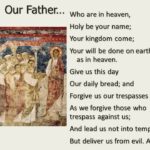
Dear Brothers and Sisters, Today’s formation lesson is a beautiful analysis of the Our Father, the prayer given to us by Jesus, Himself.  Let us meditate and study this with our fraternities. There are PDF attachments to download and print that will help with your lesson.  Peace, Dona

++++++++++++++++++++++++++++++++++++++++++++++++++++++++++++++++++++++++++++++++++++++++++++++++++++++++++++++++


Please share with your local fraternities.  The entire piece is attached in PDF for easy printing.

A Prayer Inspired by the Our Father

“Two thirteenth-century examples of this type of commentary on the Lord’s Prayer suggest that this style of prayer forms a “catechism of prayer” offering strong attitudes toward, as well as images of, God. In fact, this writing is perhaps the only instance in which we find an example of how Francis responded to his brothers’ request to teach them how to pray.” FA: ED, vol. 1, 158  https://franciscantradition.org/francis-of-assisi-early-documents/the-saint/writings-of-francis/the-undated-writings/a-prayer-inspired-by-the-our-father/174-fa-ed-1-page-158 


1Our Father Mt 6:9 most holy:
Our Creator, Redeemer, Consoler, and Savior:

2Who are in heaven: Mt 6:9
In the angels and the saints,
enlightening them to know, for You, Lord, are light; 1 Jn 1:5
inflaming them to love, for You, Lord, are love;
dwelling in them and filling them with happiness,
for You, Lord, are Supreme Good, the Eternal Good,
from Whom all good comes
without Whom there is no good.

3Holy be Your Name: Mt 6:9
May knowledge of You become clearer in us
that we may know
the breadth of Your blessings,
the length of Your promises,
the height of Your majesty,
the depth Eph 3:18 of Your judgments.

4Your kingdom come: Mt 6:10
That You may rule in us through Your grace
and enable us to come to Your kingdom Lk 23:42
where there is clear vision of You,
perfect love of You,
blessed companionship with You,
eternal enjoyment of You.

5Your will be done on earth as in heaven: Mt 6:10 
That we may love You

with our whole heart by always thinking of You, Dt 6:5
with our whole soul by always desiring You,
with our whole mind by always directing all our intentions to You,
and by seeking Your glory in everything,
with all our whole strength by exerting
all our energies and affections of body and soul Lk 10:27
in the service of Your love and of nothing else;
and we may love our neighbor as ourselves
by drawing them all to Your love with our whole strength,
by rejoicing in the good of others as in our own,
by suffering with others at their misfortunes,
and by giving offense to no one. 2 Cor 6:3


6Give us this day: Mt 6:11
in remembrance, understanding, and reverence
of that love which [our Lord Jesus Christ] had for us
and of those things that He said and did and suffered for us.

Our daily Bread: Mt 6:11
Your own beloved Son, our Lord Jesus Christ.

7Forgive us our trespasses: Mt 6:12
through Your ineffable mercy
through the power of the passion of Your beloved Son
and through the merits and intercession
of the ever-blessed Virgin and all Your elect.

8As we forgive those who trespass against us: Mt 6:12
And what we do not completely forgive,
make us, Lord, forgive completely
that we may truly love our enemies because of You
and we may fervently intercede for them before You,
returning no one evil for evil 1 Thes 5:15
and we may strive to help everyone in You.
9And lead us not into temptation: Mt 6:13
hidden or obvious,
sudden or persistent.

10But deliver us from evil: Mt 6:13
past,
present,
and to come.

++++++++++++++++++++++++++++++

Read the meditation twice alone or with a prayer partner.


Questions to discuss or to answer in your journal.


·        How does Francis regard God the Father? How do I think of God the Father? What effect does this have on me?

·        How does he wish to behave in order to be closer to the Father? What part of this is difficult for me?

·        How are we to treat others? How can I improve my efforts to love myself and others?

·        How does Francis regard Jesus? How do I think of Jesus? What surprises me about what Jesus said and did?

·        Are there times when I have difficulty forgiving? How can I overcome this difficulty?

·        From what evil tendency do you pray that God will deliver you?


+++++++++++

EXPOSICIÓN DEL PADRE NUESTRO  http://www.franciscanos.org/esfa/escritossf.html#exppn

“Dos ejemplos del siglo XIII de este tipo de comentario sobre el Padrenuestro sugieren que este estilo de oración forma un “catecismo de oración” que ofrece fuertes actitudes hacia Dios, así como imágenes de él. De hecho, este escrito es quizás el único caso en el que encontramos un ejemplo de cómo Francisco respondió a la solicitud de sus hermanos de enseñarles a orar.” (véase el enlace de arriba)

1Oh santísimo Padre nuestro:
creador, redentor, consolador y salvador nuestro.


2Que estás en el cielo:
en los ángeles y en los santos; iluminándolos para el conocimiento, porque tú, Señor, eres luz; inflamándolos para el amor, porque tú, Señor, eres amor; habitando en ellos y colmándolos para la bienaventuranza, porque tú, Señor, eres sumo bien, eterno bien, del cual viene todo bien, sin el cual no hay ningún bien.


3Santificado sea tu nombre:
clarificada sea en nosotros tu noticia, para que conozcamos cuál es la anchura (cf. Ef 3,18) de tus beneficios, la largura de tus promesas, la sublimidad de la majestad y la profundidad de los juicios.


4Venga a nosotros tu reino:
para que tú reines en nosotros por la gracia y nos hagas llegar a tu reino, donde la visión de ti es manifiesta, la dilección de ti perfecta, la compañía de ti bienaventurada, la fruición de ti sempiterna.


5Hágase tu voluntad en la tierra como en el cielo:
 
para que te amemos con todo el corazón (cf. Lc 10,27), pensando siempre en ti; con toda el alma, deseándote siempre a ti;

con toda la mente, dirigiendo todas nuestras intenciones a ti, buscando en todo tu honor;

y con todas nuestras fuerzas, gastando todas nuestras fuerzas y los sentidos del alma y del cuerpo en servicio de tu amor y no en otra cosa;

y para que amemos a nuestro prójimo como a nosotros mismos, atrayéndolos a todos a tu amor según nuestras fuerzas, alegrándonos del bien de los otros como del nuestro y compadeciéndolos en sus males y no dando a nadie ocasión alguna de tropiezo (cf. 2 Cor 6,3).


6Danos hoy nuestro pan de cada día:
 tu amado Hijo, nuestro Señor Jesucristo: para memoria e inteligencia y reverencia del amor que tuvo por nosotros, y de lo que por nosotros dijo, hizo y padeció.


7Perdona nuestras ofensas:
por tu misericordia inefable, por la virtud de la pasión de tu amado Hijo y por los méritos e intercesión de la beatísima Virgen y de todos tus elegidos.


8Como también nosotros perdonamos a los que nos ofenden:
 y lo que no perdonamos plenamente, haz tú, Señor, que lo perdonemos plenamente, para que, por ti, amemos verdaderamente a los enemigos, y ante ti por ellos devotamente intercedamos, no devolviendo a nadie mal por mal (1 Tes 5,15), y nos apliquemos a ser provechosos para todos en ti.


9No nos dejes caer en la tentación:

oculta o manifiesta, súbita o importuna.


10Y líbranos del mal:
pasado, presente y futuro. 
Gloria al Padre, etc.


++++++++++++++++++++++++

Lea la meditación dos veces solo o con un compañero de oración.


Preguntas para platicar o responder en su diario.


• ¿Cómo considera Francisco a Dios Padre? ¿Cómo pienso yo en Dios Padre? ¿Qué efecto tiene esto en mí?

• ¿Cómo quiere Francisco comportarse para estar más cerca del Padre? ¿Qué parte de esto me resulta difícil?

• ¿Cómo debemos tratar a los demás? ¿Cómo puedo mejorar mis esfuerzos por amarme a mí mismo y a los demás?

• ¿Cómo considera Francisco a Jesús? ¿Cómo pienso yo en Jesús? ¿Qué me sorprende de lo que dijo e hizo Jesús?

• ¿Hay momentos en los que tengo dificultades para perdonar? ¿Cómo puedo superar esta dificultad?

• ¿De qué tendencia maligna ora Ud. para que Dios le libere?


Diane F. Menditto, OFS

Chair, National Formation Commission

Minister, Our Lady of the Angels Region


NATIONAL MINISTER ADDRESSES STATE OF THE ORDER

(This article originally from TAU-USA Issue 102 Winter 2021)

By MARY STRONACH, OFS

National Minister Jan Parker, OFS provided historical perspective as she inspired and challenged the 47 regional ministers, delegates and guests during her State of the Order message.

Responding to Signs of Times

“You cannot quarantine the Holy Spirit” she said.

“In spite of the pandemic and all the upheaval, the work of prayer, peacemaking and building up of the Kingdom has continued in a thousand beautiful ways… We are moving forward in new ways, responding in faith to the signs of the times.”

She quoted the General Constitutions (26.1): “…Secular Franciscans affirm their hope and their joy in living. They make a contribution to counter widespread distress and pessimism, preparing a better future.” Then she added, “The pandemic is not squelching our desire for fraternity – it is strengthening it.”

A Course of Renewal

She then took the attendees on an historical perspective of the Order in the United States from the development of the Pauline Rule of 1978 to the recent “season of visioning” when youth, formation and JPIC leaders, and  spiritual assistants came together to help take the Order “on a course to renewal.”  She exhorted the brothers and sisters: “we must continue to look for the unexpected joy and open our hearts to this holy newness. We cannot stop now, and we won’t. The Holy Spirit impels us.”

“We are beginning to see the fruit from of our ‘season of visioning’.”

  • In Formation, new initial formation texts are in the process of being written and “wonderful” resources such as “Formation Friday” have been assisting Regional Formation Directors.
  • In the area of Justice, Peace and Integrity of Creation, there has  been a “real awakening.” JPIC focus groups have formed, and there is more involvement by members at large. A “Franciscan-looking JPIC vision” is being developed, one that we need LIVE and SPEAK “justly, courteously, in peace and with charity.”
  • In the area of Franciscan Youth and Young Adults, “there is new energy and momentum for outreach to youth and young adults.” An animator training on Zoom has provided new tools for outreach to support and establish YouFra fraternities.

She recognized the work of all committees, saying that “we have made great strides, but we have farther to go.”

Future Plans

She said there were projects that she and the council would like to “make a reality.” These included: a Communications Summit to “explore new ways for Public Relations, Website, Social Media, Database and TAU-USA folks to work together”; continued work on the database; “widening our embrace of culture”; updating the National Statutes, National Guidelines and the Spiritual Assistant Handbook; support of the newly formed “Franciscan Family Forum.”

At the international level, the working document for the next General Chapter, called the Instrumentum Laboris, shines a “bright light on the path ahead.” Announcing the theme: “Animate and Guide with Servant Leadership,” she emphasized that “servant leadership and co-responsibility truly is the way to move our Order forward.” She explained that the Instrumentum Laboris is organized “according to the challenges of leadership.”

She challenged the ministers to take the Instrumentum Laboris, review it and respond, considering what it means to animate and guide, to be co-responsible, to be a minister or council member, to lead collegially, to listen, to collaborate. She said that each region would be receiving the complete document with instructions on how to respond.

In closing, she urged, “live a life worthy of your call,” and quoted Francis’ Psalm 7 from the Office of the Passion: “Cast off the weight of sin, and take up the Lord’s holy cross, and follow the Lord’s most holy commands to the very end. So be it. Amen.”

https://secularfranciscansusa.org/2021/04/12/national-minister-addresses-state-of-the-order/

 
Open post

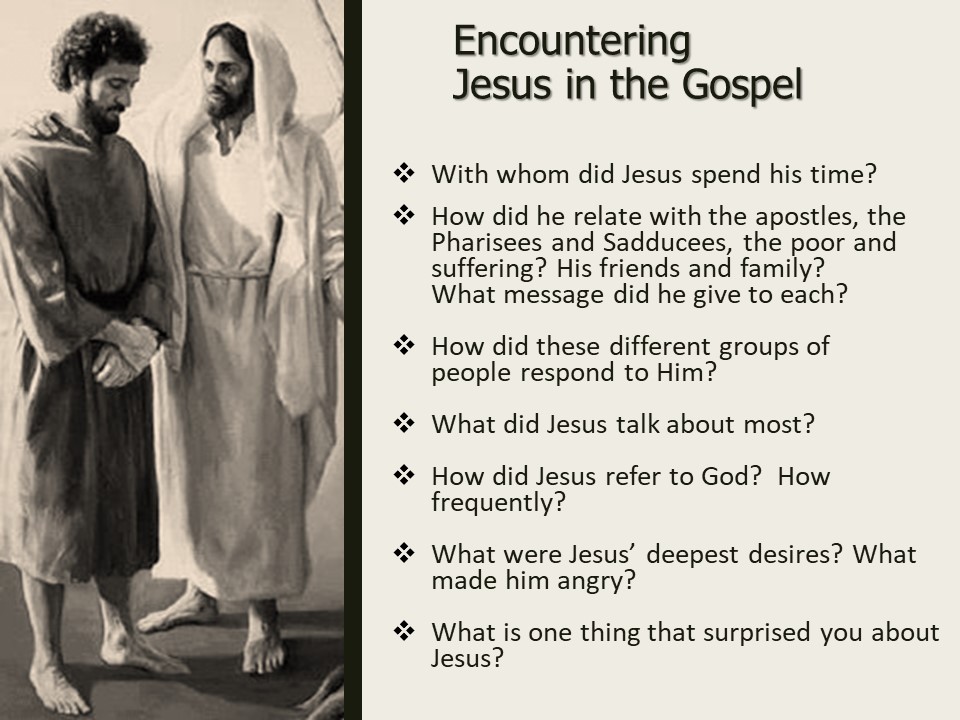
FORMATION FRIDAY – April 9, 2021 – Encountering Jesus in the Gospel

Dear Brothers and Sisters,  
Today’s formation lesson is a little sample of what is in store for us in the National Formation Commission’s new formation materials.  I hope you think it is as wonderful as I do.  You can use lesson this right now as your ongoing formation lesson.  
We want to thank the National Formation Commission for their tremendous efforts in creating an exciting curriculum for us. (see attachment below) Peace, Dona
+++++++++++++++++++++++++++++++++++++++++++++++++++++++++++++++++
 

St. Francis came to know Christ by becoming “fluent” in Scripture, especially the Gospels. As Secular Franciscans, we are called to make Scripture an integral part of our prayer life.


Thomas of Celano, Francis’ first biographer, wrote, Francis used to recall with regular meditation the words of Christ and recollect His deeds with most attentive perception. Indeed, so thoroughly did the humility of the Incarnation and the charity of the Passion occupy his memory that he scarcely wanted to think of anything else. (FA:ED Vol.1, p. 254)

Articles 4 and 5 of the Secular Franciscan Rule


4. The rule and life of the Secular Franciscans is this: to observe the gospel of our Lord Jesus Christ by following the example of Saint Francis of Assisi, who made Christ the inspiration and the center of his life with God and people.


Christ, the gift of the Father’s love, is the way to him, the truth into which the Holy Spirit leads us, and the life which he has come to give abundantly.  
Secular Franciscans should devote themselves especially to careful reading of the gospel, going from gospel to life and life to the gospel.

5. Secular Franciscans, therefore, should seek to encounter the living and active person of Christ in their brothers and sisters, in Sacred Scripture, in the Church, and in liturgical activity. The faith of Saint Francis, who often said “I see nothing bodily of the Most High Son of God in this world except his most holy body and blood”, should be the inspiration and pattern of their eucharistic life.


+The following is a wonderful way to get to know Jesus better. You can do it alone during your prayer time; with a prayer partner; with your fraternity as an ongoing formation series.


+Read one of the synoptic gospels (Matthew, Mark, or Luke). While reading, focus on the person of Jesus and then discuss or answer these questions in your journal:
 

  1. With whom did Jesus spend his time?
  2. How did he relate with the apostles, the Pharisees, and Sadducees, the poor and suffering? His friends and family?
    What message did he give to each?
  3. How did these different groups of people respond to Him?
  4. What did Jesus talk about most?
  5. How did Jesus refer to God?  How frequently?
  6. What were Jesus’ deepest desires? What made him angry?
  7. What is one thing that surprised you about Jesus?


Thank you to the National Formation Commission for sharing an activity that will be found in our new formation materials.

++++++++++++++++++++


Formation Friday  9 de Abril de 2021

Encontrando a Jesús en el Evangelio (Por favor, comparta con su fraternidad local)

San Francisco llegó a conocer a Cristo adquiriendo “fluidez” en las Escrituras, especialmente en los Evangelios. Como franciscanos seglares, estamos llamados a hacer de las Escrituras una parte integral de nuestra vida de oración.


Tomás de Celano, el primer biógrafo de Francisco, escribió: “Francisco solía recordar con meditación regular las palabras de Cristo y recordar sus hechos con la más atenta percepción. De hecho, la humildad de la Encarnación y la caridad de la Pasión ocuparon tan profundamente su memoria que apenas quiso pensar en otra cosa.” (FA:ED Vol.1, p. 254)


Artículos 4 y 5 de la Regla Franciscana Seglar


4. La Regla y la vida de los Franciscanos seglares es ésta: guardar el santo Evangelio de nuestro Señor Jesucristo siguiendo el ejemplo de San Francisco de Asís, que hizo de Cristo el inspirador y centro de su vida con Dios y con los hombres.


Cristo, don del amor del Padre, es el camino hacia Él, es la verdad en la cual nos introduce el Espíritu Santo, es la vida que
Él ha venido a dar abundantemente.

Los Franciscanos seglares dedíquense asiduamente a la lectura del Evangelio, pasando del Evangelio a la vida y de la vida al Evangelio.

 5. Los Franciscanos seglares, pues, busquen la persona viviente y operante de Cristo en los hermanos, en la Sagrada Escritura, en la Iglesia y en las acciones litúrgicas. La fe de San


Francisco que dictó estas palabras: “En este mundo nada veo corporalmente del mismo Altísimo Hijo de Dios sino su santísimo cuerpo y sangre”, sea para ellos inspiración y guía de su vida eucarística.


 + La siguiente es una manera maravillosa de conocer mejor a Jesús. Puede hacerlo solo durante su tiempo de oración; con un compañero de oración; con su fraternidad como serie de formación permanente.


+Lea uno de los evangelios sinópticos (Mateo, Marcos o Lucas). Mientras lees, concéntrese en la persona de Jesús y luego platique o responda a estas preguntas en su diario:

1. ¿Con quién pasó Jesús su tiempo?

2. ¿Cómo se relacionaba con los apóstoles, los fariseos y saduceos, los pobres y los que sufrían? ¿Sus amigos y familiares? ¿Qué mensaje les dio a cada uno?

3. ¿Cómo le respondieron estos diferentes grupos de personas?

4. ¿De qué habló más Jesús?

5. ¿Cómo se refería Jesús a Dios? ¿Con que frecuencia?

6. ¿Cuáles eran los deseos más profundos de Jesús? ¿Qué le hizo enojar?

7. ¿Qué es lo que le sorprendió de Jesús?


Diane F. Menditto, OFS
Chair, National Formation Commission
Minister, Our Lady of the Angels Region


‘Where there is a need, there is a Franciscan’

Carolyn Townes, OFS, National JPIC animator, presented Monica Olivera, OFS, with the JPIC award at the virtual Chapter meeting.

(This article originally appeared in the TAU-USA Winter 2021 Issue 102)

By Sharon Winzeler, OFS

Monica Olivera, OFS, is the 2020 recipient of the Justice, Peace and Integrity of Creation (JPIC) Award.

Olivera founded First Nations Outreach that serves remote Native American communities (as far as a 24-hour drive from the home of her Brother Jacoba Fraternity in Lawrence, KS).

Carolyn Townes, OFS, National JPIC animator, presented the annual award at the National Chapter on Oct. 22. “It has been said, where there is a need, there is a Franciscan,” Townes said, calling Olivera’s service “love in action.”

Reaching the Isolated

“I always had a vision to serve the poorest of the poor… I always assumed it was going to be in my country of origin, Peru,” Olivera said. “I never imagined that my journey of faith would lead me to poor, remote communities in America.”

She said the reservations are so remote that many of them do not appear on maps. Yet the need for help is great.

“I was moved when I saw the lack of appropriate clothing in the middle of winter and the lack of accessibility to basic needs,” Olivera said.

After a visit to a Sioux community in South Dakota, she asked for donations from friends and filled a truck with toys and clothing. As First Nations continued its service, members found more isolated reservations in Arizona, Nebraska and Montana. “Our goal is to be led by the Holy Spirit to where we need to go.”

Many of the communities have no stores, restaurants or banks, no access to running water, little medical service and limited job opportunities, Olivera said. Depending on the location, 50-85 percent of adults are unemployed.

Life expectancy is low and there is a high rate of diabetes, addiction, suicide and crime.

Building Trust

“Yet they are people with undisputed strength and profound spirituality,” Olivera said. “They have survived and lived this way for centuries to protect their culture and do not welcome outsiders. It took years to earn their trust to be invited to their communities.”

She said access to the reservation was the first miracle she experienced.

“The second miracle is how, with so little money available, we have been able to bring Christmas to so many.”

What We Do, Not What We Say

“We do not talk about our faith. People understand the Gospel message through what we do rather than what we say,” Olivera said.

“We don’t just collect toys and deliver them. We ask each child what they want for Christmas. We gather them and wrap them with Christmas paper and ribbon,” she said.  “We know the gift we bring to them is the only gift they will receive for Christmas.”

Many miraculous interventions have graced the program, according to Olivera. One included fulfilling the expectations of a principal at St. Charles Mission School in Montana. “He made it clear that we could not bring gifts for just one classroom. If we were going to do it, we had to provide them for the entire school of 240 children.”

She returned to Kansas and visited the principal of a local school about sponsorship.

“I asked, ‘how many children would you be willing to sponsor?’ With a big smile on her face, she said, ‘all of them’.”

https://secularfranciscansusa.org/2021/04/04/where-there-is-a-need-there-is-a-franciscan/

Scroll to top
Juan de Padilla