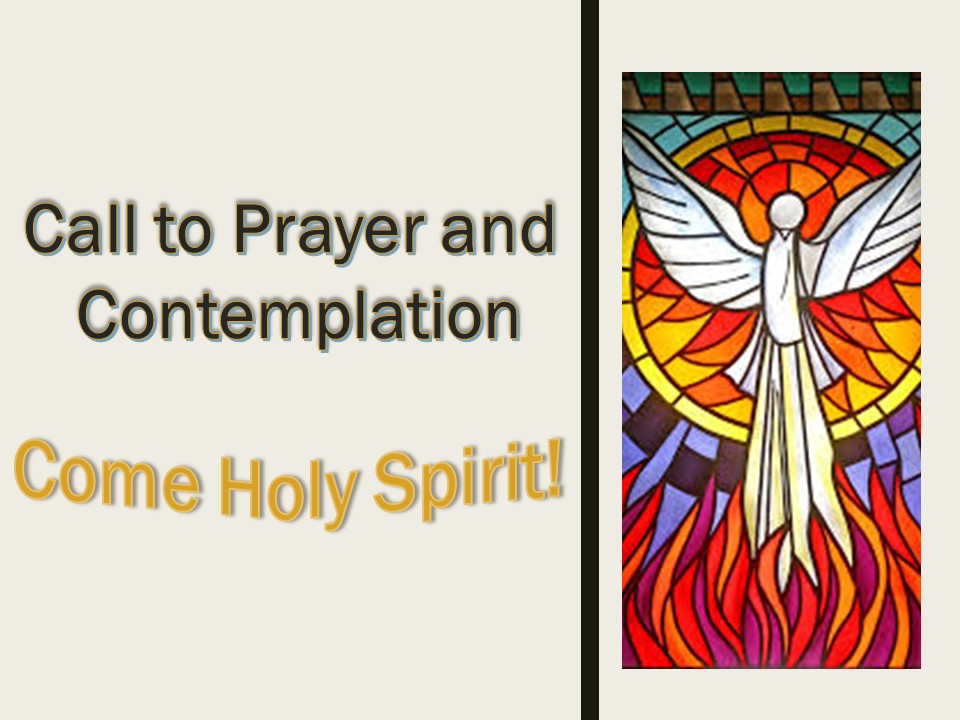
Come Holy Spirit, Come. Pentecost is the perfect time to nurture our calling to Franciscanism. Today’s lesson focuses upon Article 8 of our Rule, which deals with prayer and contemplation. Let us learn to “listen” to the Spirit’s guidance. Peace, Dona
++++++++++++++++++++++++++++++++++++++++++++++++++++++++++++++++++++++++++++++++++++++++
Call to Prayer and Contemplation
Prayer and contemplation form the hearts of all Franciscans. A formator must impress the importance of both speaking and listening to God on those in their care. Article 8 of our Rule states that prayer and contemplation is … the soul of all [we] are and do. Most of us find it easier to talk to God rather than listen to him. While God wants to hear our hopes and needs, it is through contemplation that the Spirit of God speaks to us. Just as attentive listening is the heart of a healthy, human relationship so, too, listening to God’s voice enhances our relationship with the Divine.
Listening in silence to the Spirit speaking to our hearts is a major means God uses to convert us to the Gospel life. St. Paul tells us, “In the same way, the Spirit too comes to the aid of our weakness; for we do not know how to pray as we ought, but the Spirit itself intercedes with inexpressible groanings.” (Romans 8:26) The Spirit wants to speak to us and for us. To test what we hear in contemplation, remember that the Spirit will never contradict Scripture and truth.
Not everyone is a good listener. It takes desire, effort and practice. Before you ask those you serve to enter into the “listening” portion of prayer and contemplation, do the following exercise for the next couple of weeks so that you can speak from personal experience.
· Find a quiet, secluded place for prayer and contemplation.
· Be aware that you are in the presence of the Holy One.
· Ask the Holy Spirit to help you stay attentive and focused and to speak to you.
· When thoughts or distractions occur, gently disengage from them and return to the presence of God.
· Reflect on your experience. What did you feel? What do you hear? Was silent listening difficult? Did you experience anything? You will now be able to relate experientially with those in formation.
Thank you to Anne Mulqueen, OFS, for allowing us to use her work.
++++++++++++++++++
Llamado a la oración y la contemplación
La oración y la contemplación forman el corazón de todos los franciscanos. Un formador debe inculcar la importancia de hablar y escuchar a Dios en aquellos a su cargo. El artículo 8 de nuestra Regla establece que la oración y la contemplación es … el alma de todo lo que [somos] y hacemos. A la mayoría de nosotros nos resulta más fácil hablar con Dios que escucharlo. Si bien Dios quiere escuchar nuestras esperanzas y necesidades, es a través de la contemplación que el Espíritu de Dios nos habla. Así como escuchar atentamente es el corazón de una relación humana sana, también escuchar la voz de Dios mejora nuestra relación con lo Divino.
Escuchar en silencio al Espíritu que habla a nuestro corazón es un medio importante que Dios usa para convertirnos a la vida del Evangelio. San Pablo nos dice: “De la misma manera, también el Espíritu viene en ayuda de nuestra debilidad; porque no sabemos orar como conviene, pero el Espíritu mismo intercede con gemidos inefables .” (Romanos 8:26) El Espíritu quiere hablarnos y por nosotros. Para probar lo que escuchamos en la contemplación, recuerde que el Espíritu nunca contradecirá la Escritura y la verdad.
No todo el mundo sabe escuchar. Requiere deseo, esfuerzo y práctica. Antes de pedirles a aquellos a quienes sirve que entren en la parte de “escuchar” de oración y contemplación, haga el siguiente ejercicio durante las próximas dos semanas para que pueda hablar desde su experiencia personal.
• Encuentre un lugar tranquilo y apartado para la oración y la contemplación.
• Sea consciente de que está en presencia de Dios.
• Pídale al Espíritu Santo que lo ayude a mantenerse atento y concentrado y que le hable.
• Cuando surjan pensamientos o distracciones, aléjese suavemente de ellos y regrese a la presencia de Dios.
• Reflexione sobre su experiencia. ¿Qué sintió? ¿Qué oye? ¿Fue difícil escuchar en silencio? ¿Experimentó algo? Ahora podrá relacionarse experiencialmente con aquellos en formación.
Gracias a Anne Mulqueen, OFS, por permitirnos usar su trabajo.
Diane F. Menditto, OFSChair, National Formation Commission
Minister, Our Lady of the Angels Region
A Pentecost Message from the Minister General

Translation Disclaimer: SecularFranciscansUSA.org offers translations of the content through Google Translate. Because Google Translate is an external website, SecularFranciscansUSA.org does not control the quality or accuracy of the translated content. The text, which is filtered through Google Translate, may sometimes result in incorrect translations. There may also be some unexpected degradation of the general appearance of translated pages.
https://secularfranciscansusa.org/2021/05/19/a-pentecost-message-from-the-minister-general/
A FRANCISCAN CULTURE OF CARE
(This article originally appeared in the TAU-USA Winter 2021 Issue #102)
by Carolyn D. Townes, OFS, National Animator
Carolyn Townes
Moreover they should respect all creatures, animate and inanimate, which “bear the imprint of the Most High,” and they should strive to move from the temptation of exploiting creation to the Franciscan concept of universal kinship. (OFS Rule, Art. 18)
There is no doubt that we have come out of one of the most challenging and unprecedented years as a global family. Indeed, 2020 was challenging, yet it was a year in which we as a people of faith were called to a much higher standard. We were called to a place of deeper understanding and care for our brothers and sisters, as well as for Mother Sister Earth. Having to shelter at home did wonders for our environment – fewer cars on the roads, less carbon emissions, less pollution in the air. Although that is great news for our common home, it was not an intentional care.
In his message for the 54th World Day of Peace, Pope Francis speaks of this culture of care as a path to peace. There is no doubt that 2020 was a year when there was very little peace. In the midst of a global pandemic, we also experienced racial upheaval and economic unrest, not to mention political tensions during a contentious presidential campaign. We also witnessed our first responders and front-line workers giving care to the hundreds of patients suffering from COVID-19. These caring men and women put their own lives on the line to give care to those who were unable to care for themselves.
In his World Day of Peace message, Pope Francis reflects on the story of Cain and Abel from the book of Genesis: After killing his brother Abel, Cain answers God’s question by saying: “Am I my brother’s keeper?” (Gen 4:9). Cain, like all of us, was called to be “his brother’s keeper.” “These ancient stories, full of symbolism, bear witness to a conviction that we share today, that everything is interconnected and that genuine care for our own lives and our relationship with nature is inseparable from fraternity, justice, and faithfulness to others”.
God created all as relational beings because God models the ultimate relationship – the Holy Trinity. It is in that relationship that the culture of care is made fully known. As the Holy Spirit is the love and care between God the Father and God the Son, we too are called to show that intentional spirit of care and understanding. Not judging, not criticizing, and not pointing the finger of blame; but caring, understanding and showing mercy and compassion.
In his latest encyclical, Fratelli Tutti, Pope Francis reflects on another very familiar story from the Scriptures – the famous parable of the Good Samaritan. This parable reveals the ultimate spirit of care and compassion – and to someone who is considered an outsider. This example of the culture of care is truly what leads to the path of peace. Just think about that poor man who was left beaten and unable to attend to his own needs. Religious leaders passed the man on the side of the road and quickly dismissed him, not even taking the time to see if he needed any care. What if you were that poor man? Our medical workers are the Samaritans during this pandemic. The original Samaritan in the parable did not even think about whether or not those robbers were still lying in wait. He immediately and intentionally cared for the beaten man, even taking him to an inn to give him better care.
Saint Francis was moved to care for the lepers, knowing they were the outcasts of the day. Our Holy Rule states: Secular Franciscans, together with all people of goodwill, are called to build a more fraternal and evangelical world so that the kingdom of God may be brought about more effectively (Art. 14). To build that world, we must intentionally and mindfully create a culture of care. Our Rule also states: A sense of community will make them joyful and ready to place themselves on an equal basis with all people, especially with the lowly for whom they shall strive to create conditions of life worthy of people redeemed by Christ (Art. 13).
Personally, I have felt this most strongly during this past year, as I became a full-time caregiver to my mother, who suffered a stroke in 2019 and a second stroke in 2020. I have experienced the mindful and compassionate care from my Franciscan brothers and sisters. One of the most compassionate acts is to give care to a caregiver. I have truly felt this. When I am ready to give in to the burnout, to the tiredness, I am kept going by my Franciscan family. It reminds me of the story of Moses when he was too tired to raise his arms so his armed forces would gain the upper hand in the battle against Amalek. When his arms grew tired, his people propped them up so the army had the victory (cf. Exodus 17:8-13).
I am truly blessed by the culture of care of the Franciscan family. Let us always keep our arms raised toward Jesus, and when our brother’s or sister’s arms are getting tired, may we always be there, in care and compassion, to hold them up.
Good and gracious God,
may you always grant us the grace
to create and maintain a culture of care that leads to the path of peace.
We pray in the name of Jesus our Lord. Amen.
https://secularfranciscansusa.org/2021/05/16/a-franciscan-culture-of-care/
Formation Friday – May 14, 2021 – Formators
++++++++++++++++++++++++++++++++++++++++++++++++++++++++++++++++++++++++++
Formation Friday: Local Formation Directors May 14, 2021 (en español abajo)
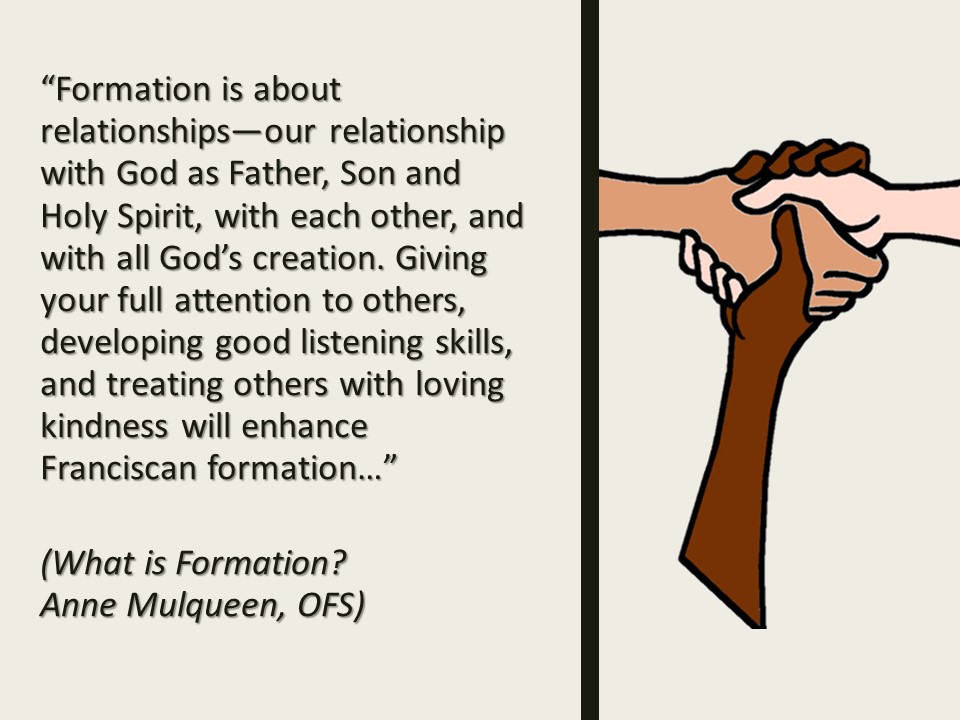
Some things to think about when choosing a local formation director or when discerning if you are called to serve as a formator.“Formation is about relationships—our relationship with God as Father, Son, and Holy Spirit, with each other, and with all God’s creation. Giving your full attention to others, developing good listening skills, and treating others with loving kindness will enhance Franciscan formation…” (What is Formation? Anne Mulqueen, OFS)
The ideal OFS Formator should:
· Be mature; have good judgment; be open to dialogue; possess good communication skills, and be able to convey knowledge well.
· Possess a good grasp of the Catholic faith and the teachings of the Church.
· Be a good witness of the Catholic faith
· Be committed to ongoing conversion; be familiar with Sacred Scripture; be faithful to the Franciscan charism; have good discernment skills.
· Be thoroughly familiar with our essential governing documents-the Rule, the General Constitutions, the National Statutes, and the OFS Ritual.
· Be well-versed in the lives of Saints Francis and Clare and live out the Franciscan charism in their daily lives.
Formators have a special relationship with those who wish to enter the Order. It is their love and enthusiasm for the Franciscan way of life that will deeply influence how inquirers and candidates become part of the Franciscan family.
Thank you to Anne Mulqueen, OFS, Spiritual Assistant to the National Formation Commission, for allowing us to use material that will be included in our new formation materials.Resources: The Guidelines for Formation of the OFS, issued by the Presidency of the International Council of the Secular Franciscan Order, Rome 2001, and Guidelines for Initial Formation, SFO, [sic] published by the National Formation Commission, the USA in 1985.
Questions for discussion or to answer in your journal
+ Think about formators you have known. What were some of their outstanding qualities?
+ Which of the qualities listed above do you possess? Discern if you might be a good formator or member of the team.
+ If your fraternity is about to have an election, which members possess the qualities listed above? Ask if they might accept a nomination to serve.
+++++++++++++++++++++
Algunas cosas en las que pensar al elegir un director de formación local o al discernir si está llamado a servir como formador.
“La formación se trata de relaciones: nuestra relación con Dios como Padre, Hijo y Espíritu Santo, entre nosotros y con toda la creación de Dios. Dar toda su atención a los demás, desarrollar buenas habilidades para escuchar y tratar a los demás con bondad amorosa mejorará la formación franciscana … ”(¿Qué es la formación? Anne Mulqueen, OFS)
El formador OFS ideal debería:
•Ser maduro; tener buen juicio; estar abierto al diálogo; poseer buenas habilidades de comunicación; y ser capaz de transmitir bien los conocimientos.
• Poseer una buena comprensión de la fe católica y las enseñanzas de la Iglesia.
• Ser un buen testigo de la fe católica
• Estar comprometido con la conversión continua; familiarizarse con la Sagrada Escritura; ser fiel al carisma franciscano; tener buenas habilidades de discernimiento.
• Familiarizarse a fondo con nuestros documentos esenciales: la Regla, las Constituciones Generales, los Estatutos Nacionales y el Ritual OFS.
• Conocer la vida de SS. Francisco y Clara y vivir el carisma franciscano en su vida diaria.
Los formadores tienen una relación especial con quienes desean ingresar a la Orden. Es su amor y entusiasmo por el estilo de vida franciscano lo que influirá profundamente en cómo los investigadores y candidatos se convierten en parte de la familia franciscana.
Gracias a Anne Mulqueen, OFS, Asistente espiritual de la Comisión Nacional de Formación, por permitirnos utilizar el material que se incluirá en nuestros nuevos materiales de formación.
Recursos: Las Directrices para la Formación de la OFS, emitidas por la Presidencia del Consejo Internacional de la Orden Franciscana Seglar, Roma 2001, y las Directrices para la Formación Inicial, OFS, publicadas por la Comisión Nacional de Formación, EE.UU. en 1985.
Preguntas para platicar o para responder en su diario
+ Piense en los formadores que haya conocido. ¿Cuáles fueron algunas de sus cualidades sobresalientes?
+ ¿Cuáles de las cualidades enumeradas anteriormente posee usted? Discernir si usted podría ser un buen formador o miembro del equipo.
+ Si su fraternidad está a punto de tener una elección, ¿qué miembros poseen las cualidades enumeradas anteriormente? Pregúnteles si podrían aceptar una nominación para servir.
Diane F. Menditto, OFSChair, National Formation Commission
Minister, Our Lady of the Angels Region

Formation Commission – TAU-USA Issue # 102
(This article originally appeared in the TAU-USA Winter 2021 Issue #102)
by Anne Mulqueen OFS
Spiritual Assistant, National Formation Commission
This issue of TAU-USA is dedicated to our most recent National Chapter—the first of its kind to be conducted virtually. May God grant that this is the first and the last virtual chapter we will ever have to experience.
We are familiar with the line from William Shakespeare’s play Romeo and Juliet, where Juliet says to Romeo, “A rose by any other name would smell as sweet.” Adapting Juliet’s line I say, “A chapter by any other name would be called a meeting.” But what kind of a meeting? It is not simply a regularly scheduled meeting. A chapter is a special time of gathering.
The word chapter originally came to us from the Benedictines in around the 12th or 13th century. When the monks gathered, they would read and meditate on a chapter of their rule; hence the gathering took on the name chapter. Apparently, St. Francis was familiar with the term and used it.
What exactly is a chapter? What is involved when we call the membership to gather for a religious chapter? You might think this is an unusual topic for a formation article, and you would be correct. It is an unusual topic. However, I believe one of the objectives of formation is to help us understand why we do what we do. As agents of formation, we assist by feeding the mind as well as the soul of a person.
Basically, a canonical, ordinary chapter is a gathering of members who have the authority to govern a religious organization that meets at regular intervals. This governing body makes decisions and sets direction, bearing in mind the official guiding documents.
In the United States, there we are most familiar with two types of chapters: the annual national and regional chapter and the triennial elective chapter. If unusual circumstances were to occur that required convening the National or Regional Frater nity, it would be considered an extraordinary chapter.
The International Fraternity (CIOFS) calls a general chapter every three years and gathers representatives from the entire Secular Franciscan Order throughout the world. The general chapter is a sign of our worldwide unity. CIOFS meets in elective chapter every six years.
Periodically, St. Francis called his brothers back to enjoy fraternity and to share their experiences on the road. He called these gatherings chapters of mats. While the brothers were still small enough in number to gather in one place, all the brothers came to the chapter of mats. Our Quinquennial celebrations are modern-day chapters of mats. All Secular Franciscans are called, and all are welcome.
Finally, since a chapter is a type of meeting, it is not necessary to refer to it as a “chapter meeting.” Using the word chapter is sufficient.
Now let’s move from the head, our intellectual understanding of chapter, to the heart, our formative, affective understanding of chapter.
Whenever Franciscans gather, they form fraternity. As an example, when the regional ministers and the national executive council come together, they form the National Fraternity Council. The same ideals and components of a healthy, vibrant fraternity apply to chapters. Therefore, much of what I write in this portion about chapters also applies to your local fraternity gatherings and council meetings.
Is governance, or business, a chapter’s primary focus? I don’t think so, but you may disagree. Yes, there is an agenda with many issues that must be discussed and voted on; issues that will affect Secular Franciscans not in attendance. However, I believe the governing body has an obligation that takes precedence over issues and votes. Their first obligation is to come together in prayer to discern the will of God for the Order and the people they represent. Only by turning first to God for direction can they hope for the oneness of heart and mind to accomplish the tasks set before them.
Therefore, it naturally follows that every day of the chapter must be saturated in prayer; prayer in common and private prayer. Quoting our former National Minister and brother Tom Bello,
“Leadership should never sacrifice the spiritual to business,” to which I add, prayer is our connection to God, and it is the Almighty who actually calls us together and blesses our work.
Just as every fraternity gathering should engage in ongoing formation, so too every chapter should allot time for ongoing formation.
Sometimes I think we use terms such as ongoing formation so often that we become immunized as to what the terms really mean. If ongoing formation is necessary, and we all believe it is, that means we are not yet fully formed. And if we are not yet the person we want to give back to God, that means ongoing formation is crucial. And if ongoing formation is that important, it must be a part of every Secular Franciscan gathering.
Have you ever noticed that during a discussion after a presentation, not everyone will comment on the same thing? People hear what they need to hear. That is the movement of the Holy Spirit, meeting the unique needs of each person. And that is what ongoing formation is meant to accomplish. And so it follows that we must be attentive and involved in our own ongoing formation.
Finally, not all ongoing formation occurs during its designated timeframe. God uses countless encounters and experiences to form us. These aha moments are the reward of being open to the
Spirit.
All chapters set aside time for social and fraternal interaction. From the very first time I attended a gathering larger than my local fraternity, I wished every Secular Franciscan could have my experience. I was a newly elected local formation director, and I was attending the first National Formation Commission workshop. Some of you may remember that Commission led by Donna Marie Kaminsky, OFS. It was the first time I met Fr. Steve Gross, OFM Conv. My eyes were opened. It wasn’t the information shared that changed everything for me. It was the people I met; people just like me who were doing extraordinary things, and I knew I would never be the same. My vocation took on a new and deeper meaning.
I believe God wants that for all of us. God wants us to enjoy the life He gave us. God wants us to laugh and find joy in life. Social times enhance our sense of belonging. The human part of us needs to feel connected to others. Social times strengthen that connection and increase our own commitment. Gatherings larger than our local fraternities allow us to meet people we would normally never meet and develop lifelong fraternal connections.
We will have an opportunity to enter into and experience all of this at the forthcoming Quinquennial Chapter of Mats in 2022! And I promise you, there will be a minimum of business, if any. See you there.
https://secularfranciscansusa.org/2021/05/10/formation-commission-tau-usa-issue-102/