Open post

FORMATION FRIDAY – June 18, 2021 – Call to Discipleship

Dear Brothers and Sisters,  

Today’s lesson refers to the role of the formation to form disciples of Christ.  During our Gatherings each month, formators work to provide solid and hopefully inspirational lessons that help to convert our hearts.  All must be open to listening and praying to the Holy Spirit.  Strong disciples are important and so needed in the world today.   Peace, Dona

++++++++++++++++++++++++++++++++++++++++ +++++++++++++++

The call to discipleship is essentially a call to be formed into Christ Jesus.  

  • In Article 1 of our Rule, Secular Franciscans are “… called to follow Christ in the footsteps of Saint Francis of Assisi. Who calls? Who is called? Jesus calls all to follow him. In John 14:15-17, Jesus promises that if we love him and keep his command, he will send the advocate to help us and to be with us forever. Jesus calls the advocate “the Spirit of truth.”


The ultimate goal of formation is forming disciples, Alter Christi, to go forth into the marketplace to continue Christ’s mission.  Quite simply put, Secular Franciscans bear witness to Christ by living the Gospel.  The formator’s responsibility is to cultivate an awareness and desire to be formed into Christ in those they serve.


Each person has multiple formative moments in life.  These moments are uniquely personal and life-altering.  For St. Francis, the decisive moment was his encounter with Christ in the kiss of the leper. That was the moment he realized what had once seemed bitter to him became “… sweetness of soul and body.” He gave his life to Christ. These spiritual incidents are moments when the divine breaks into our lives and thereafter, nothing is the same. 


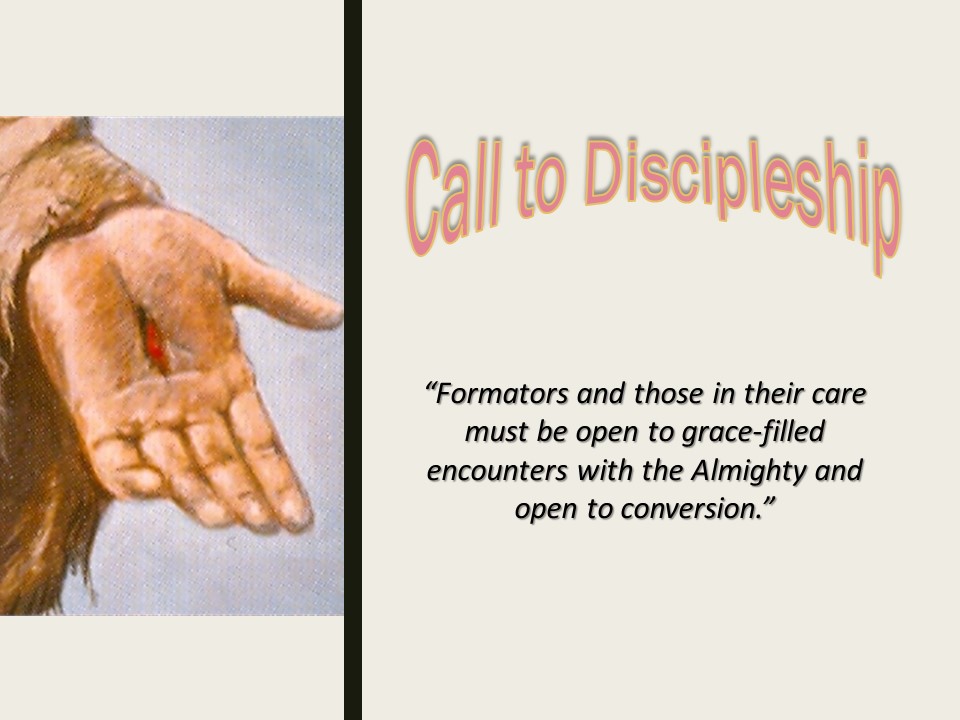
  • Formators and those in their care must be open to grace-filled encounters with the Almighty and open to conversion
  • To respond as a disciple requires prayer and listening.  In John 14:6 Jesus states unequivocally “I am the way and the truth and the life. 
  • No one comes to the Father except through me.” The only way to know the way and the truth and the life is to base our beliefs and actions on the Gospel. 


The only lasting way to follow Christ is to be formed into Christ. Then we can do our part in transforming the world by the power of the Holy Spirit.


For Further Study:  

  • Read the first two chapters of Acts of the Apostles and consider what caused the transformation among the apostles.


Thank you to Anne Mulqueen, OFS, Spiritual Assistant to the National Formation Commission, for allowing us to use her work.


Questions for discussion or to comment on in your journal:


+What transformational moments have you experienced in your life?

+How has the Holy Spirit transformed you since you became a Secular Franciscan?

+How do we as Secular Franciscans bear witness to Christ by living the Gospel?


+++++++++++++++


Llamado al discipulado

Por favor, compartir con su fraternidad local


El llamado al discipulado es esencialmente un llamado a ser formados en Cristo Jesús. En el artículo 1 de nuestra Regla, los franciscanos seglares están “… llamados a seguir a Cristo en los pasos de San Francisco de Asís. ¿Quien llama? ¿Quien es llamado? Jesús llama a todos a seguirlo. En Juan 14: 15-17, Jesús promete que si lo amamos y guardamos su mandato, él enviará al abogado para que nos ayude y esté con nosotros para siempre. Jesús llama al abogado “el Espíritu de verdad”.


El objetivo final de la formación es formar discípulos, Alter Christi, para salir al mercado y continuar la misión de Cristo. En pocas palabras, los franciscanos seglares dan testimonio de Cristo viviendo el Evangelio. La responsabilidad del formador es cultivar la conciencia y el deseo de formarse en Cristo en aquellos a quienes sirve.


Cada persona tiene múltiples momentos formativos en la vida. Estos momentos son exclusivamente personales y que cambian la vida. Para San Francisco, el momento decisivo fue su encuentro con Cristo en el beso del leproso. Ese fue el momento en que se dio cuenta de que lo que una vez le había parecido amargo se convirtió en “… dulzura de alma y cuerpo”. Dio su vida a Cristo. Estos incidentes espirituales son momentos en los que lo divino irrumpe en nuestras vidas y, a partir de entonces, nada es igual.


Los formadores y los que están a su cargo deben estar abiertos a encuentros llenos de gracia con el Todopoderoso y abiertos a la conversión. Responder como discípulo requiere oración y escucha. En Juan 14: 6 Jesús declara inequívocamente “Yo soy el camino y la verdad y la vida. Nadie viene al Padre sino por mí ”. La única forma de conocer el camino y la verdad y la vida es basar nuestras creencias y acciones en el Evangelio.


La única manera duradera de seguir a Cristo es ser formado en Cristo. Entonces podremos hacer nuestra parte para transformar el mundo por el poder del Espíritu Santo.


Para estudio adicional: lea los dos primeros capítulos de Hechos de los Apóstoles y considere qué causó la transformación entre los apóstoles.


Gracias a Anne Mulqueen, OFS, Asistente espiritual de la Comisión Nacional de Formación, por permitirnos utilizar su trabajo.


Preguntas para debatir o comentar en su diario:


+ ¿Qué momentos transformadores has experimentado en tu vida?

+ ¿Cómo te ha transformado el Espíritu Santo desde que te convertiste en Franciscano Seglar?

+ ¿Cómo los franciscanos seglares damos testimonio de Cristo viviendo el Evangelio?


Diane F. Menditto, OFS

Chair, National Formation Commission

Minister, Our Lady of the Angels Region


THE ROAD TO EMMAUS: A PERFECT MODEL TO FOLLOW

(This article originally appeared in the TAU-USA Winter 2021 Issue #102)

by Kathleen Molaro, OFS

National OFS Youth and Young Adult Commission Chair

Sharing the Good News with others is a mission set forth for all baptized people. The responsibility of inviting others into a Christ-centered gospel life, is one Secular Franciscans are especially called to when we say the words “Yes, this is what I want” at our profession. The gift of fraternity supports us as we come together to renew our own faith and grow in holiness through ongoing formation and shared ministries.

Our mission doesn’t stop with fraternity life. We are called to go out into the secular world with our Franciscan spirituality, especially in reaching out to youth and young adults. The familiar story of Emmaus (Luke 24:13-35) gives us a perfect model to follow. Jesus walked with the disciples as they talked, debated, grieved, and asked questions. He listened to their pain and anguish, offered his friendship, and broke bread with them, which opened their eyes and instilled in their hearts a burning desire for more. Hopefully, this is what happens in fraternity—we build relationships that allow an atmosphere of trust, love, and openness, encouraging members in their quest for holiness.

Our Hearts Were Burning Within Us, a statement of the U.S. Conference of Catholic Bishops regarding adult faith formation, suggests that “to be effective ministers of adult faith formation we will first, like Jesus, join people in their daily concerns and walk side by side with them on the pathway of life. We will ask them questions and listen attentively as they speak of their joys, hopes, griefs, and anxieties.” They use the Emmaus story as the basis of their document.

Since its inception, the Youth and Young Adult Commission has promoted the Emmaus method. We recognize that it’s important to share the gospel with young people through prayer and formation, but mainly by the work we do with attitudes of peace, joy, compassion, and love. Working together “can touch their hearts and minds and unfold the deep meaning of their experience in the light of all that Jesus said and did.” Like the disciples walking with Jesus, young people, through a relationship with us, can “catch a glimpse into the heart of God and find a world made new.” We learn a lesson when thinking about what happened to the disciples on the road to Emmaus. “The pathway of their lives opened from confusion and despair into conviction and hope, and they began to grasp the height and depth of God’s mysterious love.”  A relationship with young people will likewise touch our hearts and help us see Jesus more clearly! In getting to know us and the Franciscan way of life, they may eventually want to form a YouFra (Youth Fraternity) or enter formation to discern a calling as a Secular Franciscan.

As you are aware, there are many young people who for a variety of reasons have walked away from the Church and even from a relationship with God? The book Going, Going, Gone: The Dynamics of Disaffiliation in Young Catholics, reminds us that “Each person who disaffiliates has a name, a story, and longings of the heart and mind, and all are grateful for the opportunity to have their story heard.” We can’t do that unless we walk with our young people with a determination to build authentic relationships.

How do we do this during our time of isolation?
The commission has a few ideas that might inspire you to come up with your own!

  1. Heather Cherniack has begun “Holy Spirits” evening gatherings for dialogue among young adults. Her program is based on a philosophy like “Theology on Tap,” which suggests we need to meet young adults where they are (which right now is on social media!). Check it out by contacting Heather at youngfranciscan@gmail.com.
  2. Young people are particularly drawn to nature. Many parks or hiking trails are still open if participants abide by social distancing and mask guidelines. Offer to host “pizza in the park,” a backpacking trip, or a river clean-up. Use the opportunity to listen to their stories and share your own.
  3. We can help fulfill a great desire to serve. Ask a group of young people to meet virtually and come up with a common project, such as providing backpacks for foster children, filling socks with hygiene needs for homeless teens, or making simple blankets to give to trauma victims. Each person can work at home while visiting across the airways.
  4. Prayer experiences appeal to young folks. With churches closed, invite others to experience a virtual prayer service. Each participant can create their own sacred space using a common element such as a candle to provide a feeling of unity. Sites such as www.crs.org have many prayers available, and after modeling young people will be capable of designing their own.
  5. Create together! Each person will come to a virtual gathering with art supplies. Read and discuss Ephesians 6:10-17, then spend time using the supplies to make a breastplate, helmet of salvation, sword of peace, or whichever item from the passage they can relate to best. Share the creations.
  6. Contact the commission if you have or know of a group of young people who are interested in meeting others. We have several YouFras (Youth Fraternities) who would love to connect with other young people in different parts of the country. kmmolaro@gmail.com

The St. Francis of Assisi YouFra works together on a Habitat for Humanity project. Here they helped frame the house. Notice the Franciscan joy in working together

The “family” bond was so great in the St. Francis of Assisi Fraternity in Arizona, two of the members were married! Both the bride and groom had spent several years together in YouFra.

https://secularfranciscansusa.org/2021/06/14/the-road-to-emmaus-a-perfect-model-to-follow/

Open post

FORMATION FRIDAY – June 11, 2021 – The Call to Love

Dear Brothers and Sisters,

Today’s lesson was written by Anne Mulqueen, OFS, Spiritual Assistant to the National Formation Commission.    She discusses the importance of love in our fraternity.  This lesson helps us to reflect on our own experiences in our fraternity and remember what made us feel joy.  There will challenges, but these must be handled with purity of heart and love.  Yes, it takes time to learn how to master relationships, but worth the time.  I hope you enjoy this as much as I did.  Peace, Dona

++++++++++++++++++++++++++++++++++++++++++++++++++++++++++++++++++++

The Call to Love


Anyone who has been processed for a significant amount of time knows that fraternity can be a source of great joy and great pain and a lot of emotions in between and, yet, it is our community of love. The virtue that allows us to experience great joy and overcome emotional pain is love.  I like to think of love as the activating agent that enables the other virtues to flourish.  Love is the balm for broken hearts and the wings to lift souls to God.

The Beatles once sang, “All you need is love.” And that’s a true statement, but what kind of love do we need? The Beatles may have been referring to Eros, sensual love, but Eros will never deliver balm to the soul or transcendence to the spirit.

Our rule speaks of love many times. Article 12 asks us to “acquire purity of heart …” so that we are free “… to love God and our brothers and sisters.”  Article 19 asks us to honor the divine seed in everyone and to believe in the “…transforming power of love and pardon.” Article 22 identifies our fraternities as communities of love.

The love our Rule speaks of is warm, familial, spiritual, selfless, sacrificial, and unconditional. That is a tall order and one we grow into through conversion.  Those of you familiar with the children’s book, The Velveteen Rabbit, know that becoming real—and for us, that means becoming holy—takes a long time. Blessedly, we have a God who loves us unconditionally. Now, what we have to do is believe it, respond to that love, and share it.


It would be unwise to end this Formation Friday message without mentioning that in addition to fraternal love, healthy boundaries are indispensable in human relationships. Healthy boundaries allow love to grow and thrive.  Every person deserves respect and if someone is challenging the dignity of another, in love it must stop. Initially, it is best for those involved—not the whole fraternity—to settle the matter privately.  (See Matthew 18:15-17) If this fails, pray and forgive that person, but maintain safe emotional boundaries.


When we follow Christ as Secular Franciscans, we resolve to love our brothers and sister even when it is inconvenient or possibly painful. Ponder these questions for personal reflection.

·        Reflect on the love you may have experienced in fraternity.

o   What effect did it have on you?

o   Who in your fraternity could use a dose of fraternal love?

o   Are you willing to supply it?

·        Reflect on the pain or betrayal you may have experienced in fraternity.

o   How did you handle it?

o   Did you handle it at all?

o   Has it changed you? In what way?

·        What role does forgiveness play in our healing and our ability to love?


Thank you to Anne Mulqueen, OFS, Spiritual Assistant to the National Formation Commission, for allowing us to use her work.


+++++++++++++++++++++++++

El llamado al amor  11 de junio, 2021

Por favor, compartir con la fraternidad local.


Cualquiera que haya sido profesado por una cantidad significativa de tiempo sabe que la fraternidad puede ser una fuente de gran alegría y gran dolor y muchas emociones en medio y, sin embargo, es nuestra comunidad de amor. La virtud que nos permite experimentar una gran alegría y superar el dolor emocional es el amor. Me gusta pensar en el amor como el agente activador que permite que florezcan las demás virtudes. El amor es el bálsamo para los corazones quebrantados y las alas para elevar las almas hacia Dios.


Los Beatles cantaron una vez: “Todo lo que necesitas es amor.” Y esa es una afirmación verdadera, pero ¿qué tipo de amor necesitamos? Puede que los Beatles se hayan referido a Eros, el amor sensual, pero Eros nunca ofrecerá bálsamo para el alma ni trascendencia para el espíritu.


Nuestra regla habla del amor muchas veces. El artículo 12 nos pide “adquirir pureza de corazón …” para que seamos libres “… de amar a Dios y a nuestros hermanos y hermanas.” El artículo 19 nos pide que honremos la semilla divina en todos y que creamos en el “… poder transformador del amor y el perdón”. El artículo 22 identifica nuestras fraternidades como comunidades de amor.


El amor del que habla nuestra Regla es cálido, familiar, espiritual, desinteresado, sacrificado e incondicional. Esa es una tarea difícil y en la que crecemos a través de la conversión. Aquellos de ustedes familiarizados con el libro para niños, El conejo de terciopelo, saben que volverse real, y para nosotros eso significa volverse santo, lleva mucho tiempo. Afortunadamente, tenemos un Dios que nos ama incondicionalmente. Ahora, lo que tenemos que hacer es creerlo, responder a ese amor y compartirlo.


No sería prudente terminar este mensaje del viernes de formación sin mencionar que además del amor fraterno, los límites saludables son indispensables en las relaciones humanas. Los límites saludables permiten que el amor crezca y prospere. Toda persona merece respeto y si alguien está desafiando la dignidad de otro, en el amor debe detenerse. Inicialmente, es mejor para los involucrados, no para toda la fraternidad, resolver el asunto en privado. (Ver Mateo 18: 15-17) Si esto falla, ore y perdone a esa persona, pero mantenga límites emocionales seguros.


Cuando seguimos a Cristo como franciscanos seglares, decidimos amar a nuestros hermanos y hermanas incluso cuando sea inconveniente o posiblemente doloroso. Reflexione sobre estas preguntas para una reflexión personal.

• Reflexione sobre el amor que puede haber experimentado en la fraternidad.

o ¿Qué efecto tuvo en usted?

o ¿A quién en su fraternidad le vendría bien una dosis del amor fraterno?

o ¿Está dispuesto a suministrarlo?

• Reflexione sobre el dolor o la traición que puede haber experimentado en la fraternidad.

o ¿Cómo lo manejó?

o ¿Lo manejó en absoluto?

o ¿Le ha cambiado? ¿En qué manera?

• ¿Qué papel juega el perdón en nuestra curación y nuestra capacidad de amar?


Gracias a Anne Mulqueen, OFS, Asistente espiritual de la Comisión Nacional de Formación, por permitirnos utilizar su trabajo.


Diane F. Menditto, OFS
Chair, National Formation Commission
Minister, Our Lady of the Angels Region
 
 
Open post

Formation Friday – June 4, 2021 – Admonitions of Francis

 
Dear Brothers and Sisters, 
This Sunday is the feast of Corpus Christi when we pay homage to the most Precious Gift Jesus gave to us, the Body and Blood of Our Lord, Jesus Christ,   In today’s lesson, let us reflect on the Admonitions of Francis and how he felt about the Eucharist.  Let’s refer to Scripture and the writings of this great saint.  You may have an opportunity to show your belief in the Real Presence by participating in a Corpus Christ Procession in your parish or diocese.  Peace, Dona
++++++++++++++++++++++++++++++++++++++++++++++++++++++++++.


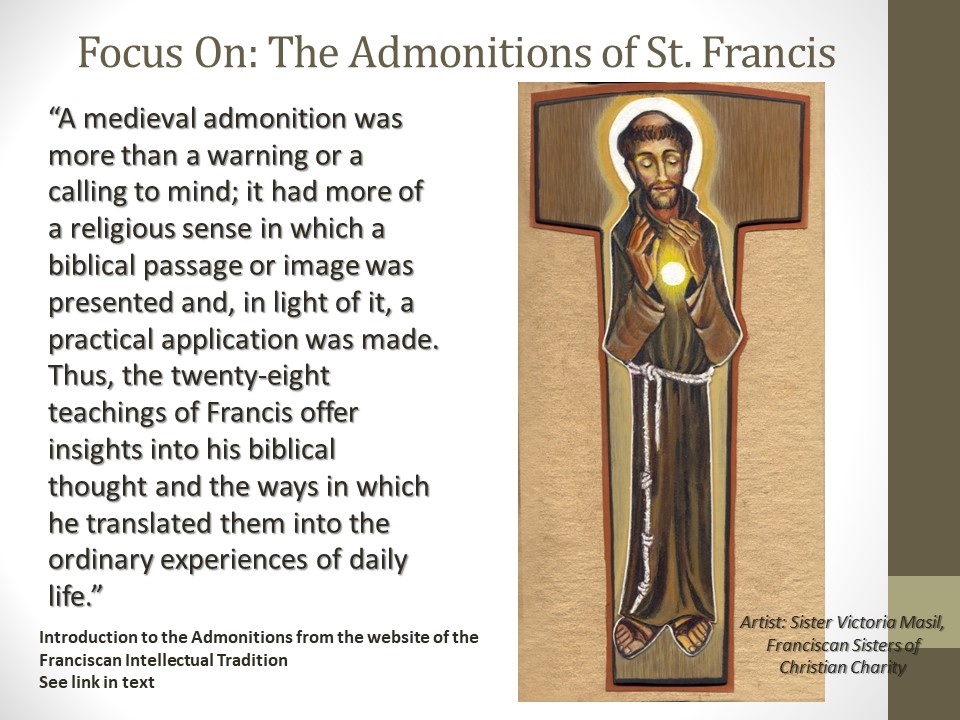
Focus on the Admonitions  (#I) 

https://www.franciscantradition.org/francis-of-assisi-early-documents/the-saint/writings-of-francis/the-undated-writings/the-admonitions/144-fa-ed-1-page-128

[I. The Body of Christ]

1The Lord Jesus says to his disciples: I am the way, the truth, and the life; no one comes to the Father except through me. 2If you knew me, you would also know my Father; and from now on, you do know him and have seen him. 3Philip says to him: Lord, show us the Father and it will be enough for us. 4Jesus says to him: Have I been with you for so long a time and you have not known me? Philip, whoever sees me sees my Father as well. Jn 14:6-9

5The Father dwells in inaccessible light, 1 Tm 6:16 and God is spirit, Jn 4:24 and no one has ever seen God. Jn 1:18 6Therefore He cannot be seen except in the Spirit because it is the Spirit that gives life; the flesh has nothing to offer. Jn 6:63 7But because He is equal to the Father, the Son is not seen by anyone other than the Father or other than the Holy Spirit.

8All those who saw the Lord Jesus according to humanity, therefore, and did not see and believe according to the Spirit and the Divinity that He is the true Son of God were condemned. 9Now in the same way, all those who see the sacrament sanctified by the words of the Lord upon the altar at the hands of the priest in the form of bread and wine, and who do not see and believe according to the Spirit and the Divinity that it is truly the Body and Blood of our Lord Jesus Christ, are condemned.10[This] is affirmed by the Most High Himself Who says:

This is my Body and the Blood of my new covenant [which will be shed for many]; Mk 14:22 11and Whoever eats my flesh and drinks my blood has eternal life. Mk 14:24 12It is the Spirit of the Lord, Jn 6:55 therefore, That lives in Its faithful, That receives the Body and Blood of the Lord. 13All others who do not share in this same Spirit and presume to receive Him eat and drink judgment on themselves. 1 Cor 11:29

14Therefore: children, how long will you be hard of heart? Ps 4:3 15Why do you not know the truth and believe in the Son of God? Jn 9:35 16Behold, each day He humbles Himself as when He came from the royal throne Phil 2:8 into the Virgin’s womb; Wis 18:15 17each day He Himself comes to us, appearing humbly; 18each day He comes down from the bosom of the Father Jn 1:18 upon the altar in the hands of a priest. a

19As He revealed Himself to the holy apostles in true flesh, so He reveals Himself to us now in sacred bread. 20And as they saw only His flesh by an insight of their flesh, yet believed that He was God as they contemplated Him with their spiritual eyes, 21let us, as we see bread and wine with our bodily eyes, see and firmly believe that they are His most holy Body and Blood living and true. 22And in this way the Lord is always with His faithful, as He Himself says: Behold I am with you until the end of the age.

Questions to discuss or to answer in your journal

+ After reading this admonition carefully, note what Francis’s feelings are about the Eucharist.

+What do you believe about the Eucharist? What part does receiving the Eucharist play in your spiritual life?


A good video by Bishop Barron on the Eucharist:

https://www.youtube.com/watch?v=sgy_TFeIyiM&t=126s   (Real Presence)


++++++++++++++++++

Enfoque en las admoniciones de San Francisco  (Admonición I)

https://www.franciscanos.org/esfa/escritossf.html#adm

Cap. I: Del cuerpo del Señor

1Dice el Señor Jesús a sus discípulos: Yo soy el camino, la verdad y la vida; nadie va al Padre sino por mí2Si me conocierais a mí, ciertamente conoceríais también a mi Padre; y desde ahora lo conoceréis y lo habéis visto3Le dice Felipe: Señor, muéstranos al Padre y nos basta4Le dice Jesús: ¿Tanto tiempo hace que estoy con vosotros y no me habéis conocido? Felipe, el que me ve a mí, ve también a mi Padre (Jn 14,6-9). 

5El Padre habita en una luz inaccesible (cf. 1 Tim 6,16), y Dios es espíritu (Jn 4,24), y a Dios nadie lo ha visto jamás (Jn 1,18). 6Por eso no puede ser visto sino en el espíritu, porque el espíritu es el que vivifica; la carne no aprovecha para nada (Jn 6,64). 7Pero ni el Hijo, en lo que es igual al Padre, es visto por nadie de otra manera que el Padre, de otra manera que el Espíritu Santo. 

8De donde todos los que vieron al Señor Jesús según la humanidad, y no vieron y creyeron según el espíritu y la divinidad que él era el verdadero Hijo de Dios, se condenaron. 9Así también ahora, todos los que ven el sacramento, que se consagra por las palabras del Señor sobre el altar por mano del sacerdote en forma de pan y vino, y no ven y creen, según el espíritu y la divinidad, que sea verdaderamente el santísimo cuerpo y sangre de nuestro Señor Jesucristo, se condenan, 10como lo atestigua el mismo Altísimo, que dice: Esto es mi cuerpo y mi sangre del nuevo testamento, [que será derramada por muchos] (cf. Mc 14,22.24); 11y: Quien come mi carne y bebe mi sangre, tiene vida eterna (cf. Jn 6,55). 12De donde el espíritu del Señor, que habita en sus fieles, es el que recibe el santísimo cuerpo y sangre del Señor. 13Todos los otros que no participan del mismo espíritu y se atreven a recibirlo, comen y beben su condenación (cf. 1 Cor 11,29).

14De donde: Hijos de los hombres, ¿hasta cuándo seréis de pesado corazón? (Sal 4,3). 15¿Por qué no reconocéis la verdad y creéis en el Hijo de Dios? (cf. Jn 9,35). 16Ved que diariamente se humilla (cf. Fil 2,8), como cuando desde el trono real (Sab 18,15) vino al útero de la Virgen; 17diariamente viene a nosotros él mismo apareciendo humilde; 18diariamente desciende del seno del Padre (cf. Jn 1,18) sobre el altar en las manos del sacerdote. 

19Y como se mostró a los santos apóstoles en carne verdadera, así también ahora se nos muestra a nosotros en el pan sagrado. 20Y como ellos, con la mirada de su carne, sólo veían la carne de él, pero, contemplándolo con ojos espirituales, creían que él era Dios, 21así también nosotros, viendo el pan y el vino con los ojos corporales, veamos y creamos firmemente que es su santísimo cuerpo y sangre vivo y verdadero. 22Y de este modo siempre está el Señor con sus fieles, como él mismo dice: Ved que yo estoy con vosotros hasta la consumación del siglo (cf. Mt 28,20).


Preguntas para discutir o responder en su diario

+ Después de leer esta Admonición con atención, apunte cuáles son los sentimientos de Francisco sobre la Eucaristía.

+ ¿Qué cree usted sobre la Eucaristía? ¿Qué papel juega el recibir la Eucaristía en su vida espiritual?


Un buen video (en inglés) del obispo Barron sobre la Eucaristía:

https://www.youtube.com/watch?v=sgy_TFeIyiM&t=126s  (Presencia real)

 
Sent from Mail for Windows 10
Diane F. Menditto, OFS
Chair, National Formation Commission
Minister, Our Lady of the Angels Region


Open post

FORMATION FRIDAY – MAY 28 – THE TRINITY AND THE OFS

 
Dear Brothers and Sisters, 
May 30th is Trinity Sunday.  Today’s formation lesson is a review of a previous lesson on the OFS and the Trinity.  
It is so helpful to see how much work has been done for us by the National Formation Commission in each week’s lessons – half of the work has already been done for us!  Resources, sources for further study, visual aids and discussion questions are always included.  I hope that you share this lesson with your fraternity.  Peace, Dona
+++++++++++++++++++++++++++++++++++++++++++++++++++++++++++++++++++++


We repeat this post from November 2020 in honor of the Blessed Trinity.


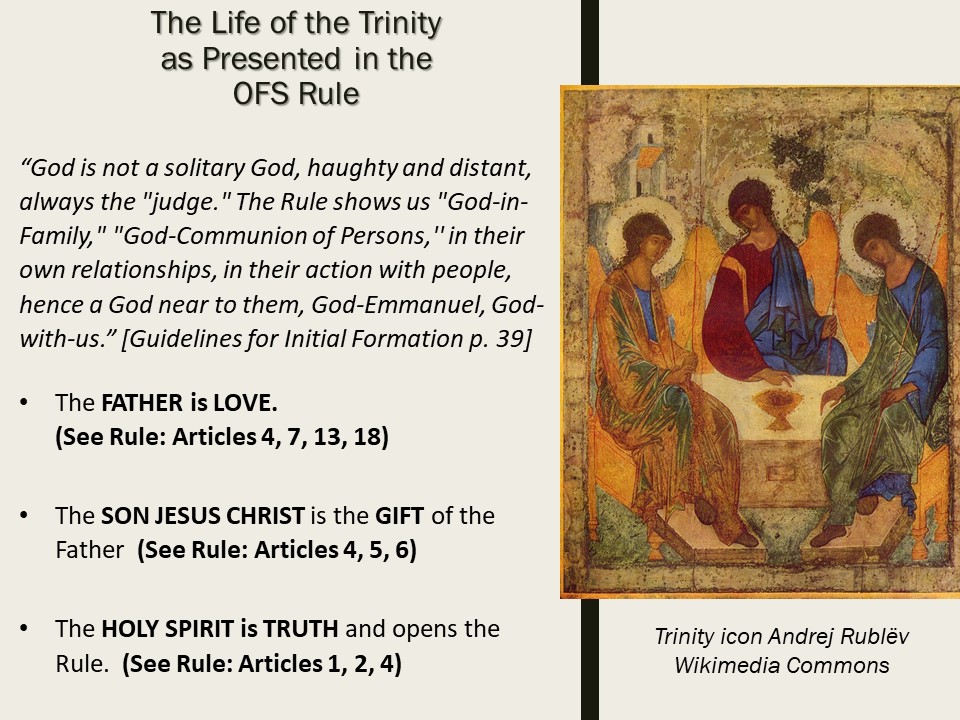
The life of the Trinity
is presented in the OFS Rule.

God is not a solitary God, haughty and distant, always the “judge.” The Rule shows us “God-in-Family,” “God-Communion of Persons,” in their own relationships, in their action with people, hence a God near to them, God-Emmanuel, God-with-us.


  • The FATHER is LOVE. He gives us his own Son (SFO Rule, #4). He is mercy in the face of our weakness; he gives us the grace of strength (#7). In every person, the Father sees the features of his Son (#13). The Father calls all people to build a more fraternal and evangelical world that proclaims his kingdom (#14), and all creation bears the imprint of the Most High (#18).
  • The SON JESUS CHRIST is the GIFT of the Father and becomes for all people the WAY to the Father, their LIFE, their TRUTH. Therefore, Christ must be the inspiration and center of their life (#4). Christ has risen and lives and works in our brothers and sisters (#5). He makes us members of His Body, the Church (#6).
  • The HOLY SPIRIT is TRUTH and opens the Rule. Already the first line speaks of the Spirit’s action. The Holy Spirit gives rise to spiritual families in the Church (#1); calls the faithful to follow Christ (#1); prompts them to strive for the perfection of charity (#2); and introduces them to the Truth (#4).


[Guidelines for Initial Formation p. 39]

Questions for discussion or to answer in your journal

+ Read the articles of the Rule mentioned above. How do they apply to your life as a Secular Franciscan?

+ Give some examples of Francis’s devotion to the Trinity in his writings and in how he prayed. (To read the writings of St. Francis visit: https://franciscantradition.org/early-sources#francis-the-saint

+The Praises to be Said at all the Hours  FA: ED, vol. 1, 161

https://franciscantradition.org/francis-of-assisi-early-documents/the-saint/writings-of-francis/the-undated-writings/the-praises-to-be-said-at-all-the-hours/177-fa-ed-1-page-161


+ How does your life demonstrate a devotion to the Blessed Trinity?

+++++++++++++++++++++++++++

La vida de la Trinidad como se presenta en la Regla de la OFS.  (Repetida desde Noviembre 2020)

“Dios no es un Dios solitario, soberbio y distante, actuando siempre como el “juez.” La Regla nos muestra “Dios-en-Familia”, “Dios-Comunión de las Personas”, en sus propias relaciones, en sus acciones con la gente. Por consiguiente  un Dios cercano a ellas, Dios-Emmanuel, Dios-con-nosotros.”

El PADRE es AMOR. Él nos da su propio Hijo (Regla OFS, # 4). Él es misericordioso ante nuestra debilidad; nos da la gracia de la fuerza (# 7). En cada persona, el Padre ve los rasgos de su Hijo (# 13). El Padre llama a todas las personas a construir un mundo más fraterno y evangélico que proclame su reino (# 14), y toda la creación lleva la huella del Altísimo (# 18).

El HIJO JESUCRISTO es el DON del Padre, y se convierte para todas las personas en el CAMINO al Padre, su VIDA, su VERDAD. Por lo tanto, Cristo debe ser la inspiración y el centro de su vida (# 4). Cristo ha resucitado y vive y obra en nuestros hermanos y hermanas (# 5). Nos hace miembros de su Cuerpo, la Iglesia (# 6).

El ESPÍRITU SANTO es la VERDAD y abre la Regla. La primera línea ya habla de la acción del Espíritu. El Espíritu Santo suscita familias espirituales en la Iglesia (# 1); llama a los fieles a seguir a Cristo (# 1); les impulsa a luchar por la perfección de la caridad (# 2); y les presenta la Verdad (# 4).

[Guía para la formación inicial en la Orden franciscana seglar en los Estados Unidos – Smoky Valley Press pp. 31-32]

Preguntas para platicar o para responder en su diario

+ Lea los artículos de la Regla mencionados anteriormente. ¿Cómo se aplican a su vida como franciscano seglar?

+ Da algunos ejemplos de la devoción de Francisco a la Trinidad en sus escritos y en cómo oraba. (Para leer los escritos de San Francisco en español, visite: https://www.franciscanos.org/esfa/escritossf.html )

+ ¿Cómo demuestra su vida una devoción a la Santísima Trinidad?

 
Diane F. Menditto, OFS
Chair, National Formation Commission
Minister, Our Lady of the Angels Region
 
 
Scroll to top
Juan de Padilla