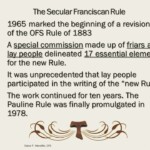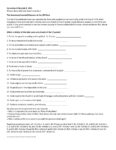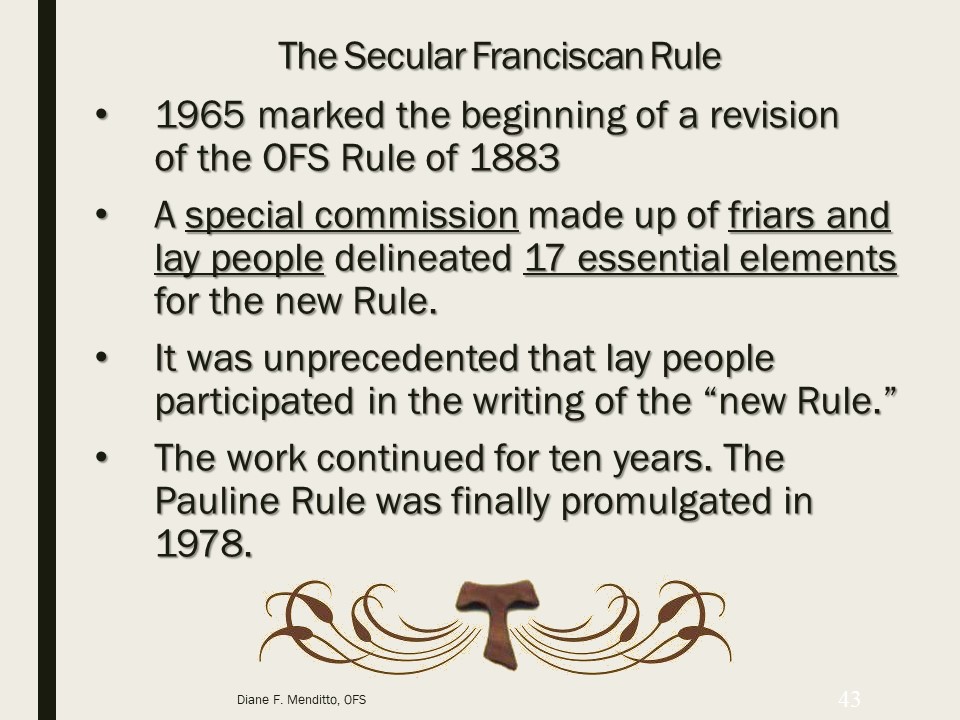
It is important to know our Rule so that we can better follow Francis in our daily lives. Today let’s have some fun and see if we (or our fraternity) can find the essentials points in our Rule. There are attachments to this post. Peace, Dona+++++++++++++++++++++++++++++++++++++++++++++++++++++++++++++++++++++++++++++++++++++++++++++++++++++++++++++++The Seventeen Essential Elements of the OFS Rule
This list of essential elements was compiled by those who worked on and eventually wrote the Rule of 1978. Read through our Rule and note which articles came out of each of the 17 points. Some elements appear in more than one article. (If you are interested to see the answers a group of those studying the Rule gave, please see below. But, please try it yourself first.)
Which article(s) of the Rule came out of each of the 17 points?
1. To live the gospel according to the spirit of St. Francis ________________________
2. To be converted continually (metanoia) ________________________
3. To live as brothers and sisters to all people and all creation __________________________
4. To live in communion with Christ ___________________________
5. To follow the poor and crucified Christ _________________________
6. To share in the life and mission of the Church _______________________
7. To share in the love of the Father _______________________
8. To be instruments of peace _______________________
9. To have a life of prayer that is personal, communal and liturgical _____________________
10. To live in joy __________________11. To have a spirituality of a secular character ___________________
12. To be pilgrims on the way to the father ______________________
13. To participate in the Apostolate of the Laity ____________________
14. To be at the service of the less fortunate __________________
15. To be loyal to the Church in an attitude of dialogue and collaboration with her ministers _________
16. To be open to the action of the Spirit _______________________
17. To live in simplicity, humility, and minority _____________________
For discussion or to comment on in your journal.
+ Why is it important for us to study our Rule of Life often?
+ Choose three articles from the Rule: How do you live out each article in your daily life? How could you live these articles better?
+ Which articles of the Rule present you with the greatest challenges?
Responses previously given: #1- Articles 1, 2, and 4; #2- Prologue and article 7; #3- Articles 5, 13, and 18; #4- Articles 4, 5, 6, and 8; #5- Articles 4, 10, and 14; #6- Articles 5, 6, and 22; #7- Articles 4 and 12; #8- Articles 17 and 19; #9- Articles 2, 8, and 9; #10- Articles 13 and 19; #11- Articles 5 and 8; #12- Article 11; #13- Articles 1 and 15; #14- Articles 13 and 14; #15- Article 6; #16- Articles 4, 14, and 19; #17- Article 11.
++++++++++++++++++++++++++++
Los diecisiete elementos esenciales de la regla OFS
Esta lista de elementos esenciales fue compilada por aquellos que trabajaron y finalmente escribieron la Regla de 1978.
Lea nuestra Regla y observe qué artículos surgieron de cada uno de los 17 puntos. Algunos elementos aparecen en más de un artículo. (Si tiene interés en ver las respuestas que dio un grupo de los que estudiaban la Regla, consulte a continuación. Pero, primero pruébelo usted mismo).
¿Qué artículo (s) de la Regla surgió de cada uno de los 17 puntos?
1. Vivir el evangelio según el espíritu de San Francisco ________________________
2. Convertirse continuamente (metanoia) ________________________
3. Vivir como hermanos y hermanas de todas las personas y de toda la creación __________________________
4. Vivir en comunión con Cristo ___________________________
5. Seguir al Cristo pobre y crucificado _________________________
6. Participar en la vida y misión de la Iglesia _______________________
7. Para compartir el amor del Padre _______________________
8. Ser instrumentos de paz _______________________
9. Tener una vida de oración personal, comunitaria y litúrgica _____________________
10. Vivir con alegría __________________
11. Tener una espiritualidad de carácter secular ___________________
12. Ser peregrinos en el camino del padre ______________________
13. Participar en el Apostolado de los Laicos ____________________
14. Estar al servicio de los menos afortunados __________________
15. Ser fiel a la Iglesia en actitud de diálogo y colaboración con sus ministros _________
16. Estar abierto a la acción del Espíritu _______________________
17. Vivir con sencillez, humildad y minoría _____________________
Para platicar o comentar en su diario.
+ ¿Por qué es importante para nosotros estudiar nuestra Regla de Vida con frecuencia?
+ Elija tres artículos de la Regla: ¿Cómo vive cada artículo en su vida diaria? ¿Cómo podría vivir mejor estos artículos?
+ ¿Qué artículos de la Regla le presentan los mayores desafíos?
Respuestas dadas anteriormente: #1- Artículos 1, 2 y 4; #2- Prólogo y artículo 7; #3- Artículos 5, 13 y 18; #4- Artículos 4, 5, 6 y 8; #5- Artículos 4, 10 y 14; #6- Artículos 5, 6 y 22; #7- Artículos 4 y 12; #8- Artículos 17 y 19; #9- Artículos 2, 8 y 9; #10- Artículos 13 y 19; #11- Artículos 5 y 8; #12- Artículo 11; #13- Artículos 1 y 15; #14- Artículos 13 y 14; #15- Artículo 6; #16- Artículos 4, 14 y 19; #17- Artículo 11.
Diane F. Menditto, OFSChair, National Formation Commission
Minister, Our Lady of the Angels Region
STEADY, FRANCISCANS
(This article originally appeared in the Winter 2021 Issue #102 of the TAU-USA)
By Josh Molidor, OFS
Many might remember the cute poster popular in the 70’s that pictured a cat desperately hanging on to a branch with its claws! The depiction underneath was “Hang on, Baby!”, and it became a common catchphrase, often used to this day. Words of wisdom for the struggles we are dealing with now.
About one year ago, the Covid virus started to circulate through the United States and the world, with the first national shutdown in April, and the virus is really raging now. Most fraternities have cancelled in-person meetings, and virtual gatherings are now the norm. That close connection we once enjoyed, that intimate gathering with family, is now replaced with something much less. Yes, thank God for the technology, but a Zoom meeting just doesn’t fulfill our need to continue to grow the bonds between our favorite sisters and brothers in fraternity! Oh, what to do?
Well, let us make prayer and contemplation the soul of all we are and do. It’s a good (Art.8) Rule of Life! Most have more alone time to pray for the suffering and pain around us, so use your time fruitfully. Finally, we have the spare moments to delve into the Gospels, as we always said we wished we did! Now the opportunity for contemplating His Wonderous Love is here for the taking. It seems we even have extra moments to study our Rule and Constitution. How many of us have gone in that direction?
While we cannot yet give those needed hugs to our sisters and brothers, we must still try to build fraternal bonds! Most all of us have phones, so let’s more readily reach out and touch somebody, and less texting. Call everybody in your fraternity and spend time that way. Thank your council, both Local and Regional, for keeping it together. Share your stories, offer your talents up, never forget the shut-ins and suffering of our fraternities.
These plagues and pandemics come and go, but Our Lord’s Love remains. Just over 100 years after Francis’ passing, the Black Death hit Europe, and claimed 60 percent of the population. Franciscans have survived to this day! One hundred years ago, the Spanish Flu claimed 50 million worldwide, and we still are here to serve others in Christ Jesus! We have sadly lost many to this virus in the last year, but our light must grow only brighter. We are called to be that Hope that the suffering are looking for, the word of encouragement and help for those who have lost their livelihood, and the joyful message of the Risen Lord to all around us.
God has gifted us with the knowledge to produce a vaccine to overcome this virus. Never in the history of the world has this happened so quickly, Thank You, Jesus! Our fraternities will go back to gathering in a short while, we will once again hold visits and elections, and lots of love and hugs will happen at meetings once more. We will get through this with His Strength, and so in the words of St. Padre Pio…Pray, Hope, and Don’t Worry!
https://secularfranciscansusa.org/2021/07/05/steady-franciscans/
FORMATION FRIDAY – July 2, 2021 – Living the Beatitudes
Dear Brothers and Sisters,
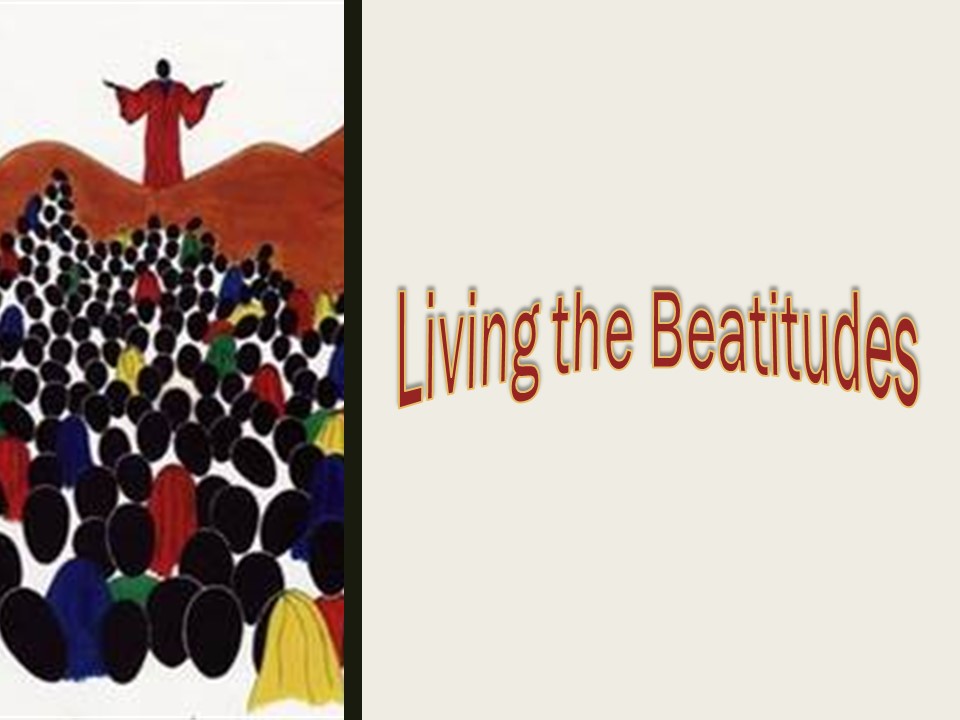
Today’s formation lesson is about the Beatitudes. If you have not used the Franciscan Journey PDFs or Powerpoints on the Regional Website, you might find them to be great visual support for this material on the Beatitudes. I have added a link to our website at the bottom of this lesson. Peace, Dona++++++++++++++++++++++++++++++++++++++++++++++++++Living the Beatitudes: Matthew 5: 3-12
Read prayerfully each of the Beatitudes (Matthew 5: 3-12) and think about the comments below. Also, read the indicated pages in the Franciscan Journey.
3 “Blessed are the poor in spirit, for theirs is the kingdom of heaven.”
· Do not cling to material goods or personal opinions.
· This brings freedom to follow the path of conversion.
+Read Franciscan Journey p. 211
4 ”Blessed are they who mourn, for they will be comforted.”
· Mourn for personal and societal sinfulness; Discover our mistakes in relationships
· Conversion brings comfort.
+Read Franciscan Journey pp. 211-212; Refer to article 11 of our Rule
5 “Blessed are the meek, for they will inherit the land.”
· Those who are meek (gentle) see what needs to be done and do it without arrogance or dominance.
· This spirit shows us what good relationships can accomplish.
+Read Franciscan Journey p. 212
6 “Blessed are they who hunger and thirst for righteousness, for they will be satisfied.”
· We are faithful to building a world where all people are treated with dignity.
+Read Franciscan Journey p. 212; Refer to article 15 of our Rule.
7 ”Blessed are the merciful, for they will be shown mercy.”
· This reflects the spirit of Francis and Clare. We offer the hand of mercy because this is what Jesus did.
· “Show mercy and seek reconciliation.”
+Read Franciscan Journey p. 212; Refer to article 7 of our Rule
8 “Blessed are the clean of heart, for they will see God.”
· We are willing to deal with reality in a faith-filled way—we are clear-sighted.
· We see the presence of God in all.
+Read Franciscan Journey p. 213; Refer to articles 5, 12, 13 of our Rule
9 “Blessed are the peacemakers, for they will be called children of God.”
· We seek “both/and” solutions rather than “either/or.”
· We listen to one another.
+ Read Franciscan Journey p. 213; Refer to article 19 of our Rule
10 “Blessed are they who are persecuted for the sake of righteousness, for theirs is the kingdom of heaven.
11Blessed are you when they insult you and persecute you and utter every kind of evil against you [falsely] because of me. “
12 “Rejoice and be glad, for your reward will be great in heaven. Thus they persecuted the prophets who were before you.”
· If we follow the Gospel, we may find that others will persecute us.
· We can rejoice because our reward will be great in heaven.
+ Read Franciscan Journey p. 213; Refer to the Prologue to our Rule
To discuss or to comment on in your journal.
+ Which of the Beatitudes most reflects your personal commitment as a Secular Franciscan?
+ After reading the articles of the Rule mentioned above, how do Franciscans live the Beatitudes in a special way?
++++++++++++++++++
Comparta con su fraternidad local.
Vivir las Bienaventuranzas: Mateo 5: 3-12
Lea con espíritu de oración cada una de las Bienaventuranzas (Mateo 5: 3-12) y piense en los comentarios a continuación. Lea también las páginas indicadas en el Camino Franciscano.
3 “Bienaventurados los pobres de espíritu, porque de ellos es el reino de los cielos”.
• No se aferre a bienes materiales ni a opiniones personales.
• Esto trae libertad para seguir el camino de la conversión.
+ Leer La jornada franciscana p. 225
4 “Bienaventurados los que lloran, porque ellos recibirán consolación.”
• Llorar por la pecaminosidad personal y social; Descubrir nuestros errores en las relaciones
• La conversión trae consuelo.
+ Leer Jornada franciscana págs. 225-226; Consulte el artículo 11 de nuestra regla.
5 “Bienaventurados los mansos, porque ellos heredarán la tierra”.
• Aquellos que son mansos (gentiles) ven lo que hay que hacer y lo hacen sin arrogancia ni dominio.
• Este espíritu nos muestra lo que pueden lograr las buenas relaciones.
+ Leer Jornada franciscana p. 226
6 “Bienaventurados los que tienen hambre y sed de justicia, porque ellos serán saciados”.
• Somos fieles a la construcción de un mundo donde todas las personas sean tratadas con dignidad.
+ Leer Jornada franciscana p. 226; Consulte el artículo 15 de nuestra Regla.
7 “Bienaventurados los misericordiosos, porque se les mostrará misericordia”.
• Esto refleja el espíritu de Francisco y Clara. Ofrecemos la mano de la misericordia porque esto es lo que hizo Jesús.
• “Muestren misericordia y busquen la reconciliación”.
+ Leer Jornada franciscana p. 226; Consulte el artículo 7 de nuestra regla.
8 “Bienaventurados los limpios de corazón, porque ellos verán a Dios”.
• Estamos dispuestos a lidiar con la realidad de una manera llena de fe: somos lúcidos.
• Vemos la presencia de Dios en todos.
+ Leer Jornada franciscana p. 227; Consulte los artículos 5, 12, 13 de nuestra Regla.
9 “Bienaventurados los pacificadores, porque ellos serán llamados hijos de Dios”.
• Buscamos soluciones de “ambos / y” en lugar de “uno u otro”.
• Nos escuchamos unos a otros.
+ Leer Jornada franciscana p. 226; Consulte el artículo 19 de nuestra regla.
10 “Bienaventurados los que padecen persecución por causa de la justicia, porque de ellos es el reino de los cielos.
11 Bienaventurado eres cuando te insultan, te persiguen y profieren todo tipo de mal contra ti [falsamente] por mi causa. “
12 “Alégrense y muéstrense contentos, porque su recompensa será grande en los cielos. Así persiguieron a los profetas que fueron antes de ustedes ”.
• Si seguimos el Evangelio, es posible que otros nos persigan.
• Podemos regocijarnos porque nuestra recompensa será grande en el cielo.
+ Leer Jornada franciscana p. 226; Consulte el prólogo de nuestra regla
Para discutir o comentar en su diario.
+ ¿Cuál de las Bienaventuranzas refleja más su compromiso personal como franciscano seglar?
+ Después de leer los artículos de la Regla antes mencionados, ¿cómo viven los franciscanos las Bienaventuranzas de una manera especial?
Diane F. Menditto, OFSChair, National Formation Commission
Minister, Our Lady of the Angels Region
MY STORY: UNITY IN A MULTICULTURAL FRATERNITY
Willie Guadalupe, OFS
I got involved in Multicultural and Diversity on November 3, 2012, when I was an REC councilor in my region. Our Regional Spiritual Assistant at that time asked whether I could assist with a newly forming bi-lingual group by helping with the formation for the Hispanic members. I knew that it was going to be a challenge, but not how challenging it was going to be.
Over the course of a year, I began observing a pattern. Each member stayed within their own social group and without conscious intent, self-segregated. The English speaking sat on one side of the group and the Spanish speaking on the other side.
During the gathering’s social time there was always a pleasant exchange of, “Hello, Hola” from each side. It became quite evident that the language barrier was preventing kindhearted, compassionate members from bonding in this group.
In one of our gatherings an orientee told the English-speaking leader she would no longer be able to attend formation because she had been diagnosed with cancer. I was out of the room and when I got back, I noticed that the English-speaking group was in a circle surrounding the member getting ready to pray over her and the Spanish group was just sitting at their table. When I approach them, I asked, “why are you sitting there”? and they replied “Oh Señora Guadalupe, you know we cannot speak English,” and I responded “please get up and let us go and pray over her in Spanish. God understands all languages.”
As we prayed together and were united in prayer as brothers and sisters, it was a God moment. It was not just for one group or the other, because at that moment, everyone in that room felt the power of the Holy Spirit while being surrounded by prayers in different languages in unity as a Franciscan community.
At the next gathering, I was not sure what to expect after such a powerful spiritual encounter the previous month. As I entered the room, I immediately noticed the atmosphere was different⎯it was no longer “Hello and Hola.” The power of prayer had bonded the separate groups right before my eyes.
Through prayer, they were able to establish trust and love for one another. Unity was underway, and the language barrier was no match for God’s divine mercy.
I am blessed and thankful to have experienced this profound God moment.
However, it is important to note that this is not just my story⎯this is all our stories. At some point in all our spiritual journeys and our various walks of life, we either have or will experience the power of God’s love and unity.
I would like to leave you with this reflection to keep the bond of unity in your diverse communities.
✦ Recognize the abundant diversity of cultures.
✦ Respect the differences.
✦ Acknowledge the validity of different cultural expressions and contributions.
✦ Value what other cultures offer.
✦ Encourage the contribution of diverse groups.
✦ Empower people to strengthen themselves and others to achieve their maximum potential by being critical of their own biases.
✦Celebrate rather than just tolerating the differences to bring about “Unity” through diversity. Be proactive in listening, accepting, and welcoming people and ideas that are different from your own.
Paz y bien!
https://secularfranciscansusa.org/2021/06/27/my-story-unity-in-a-multicultural-diversity-fraternity/
Formation Friday – June 25, 2021 – Conversion and Discernment
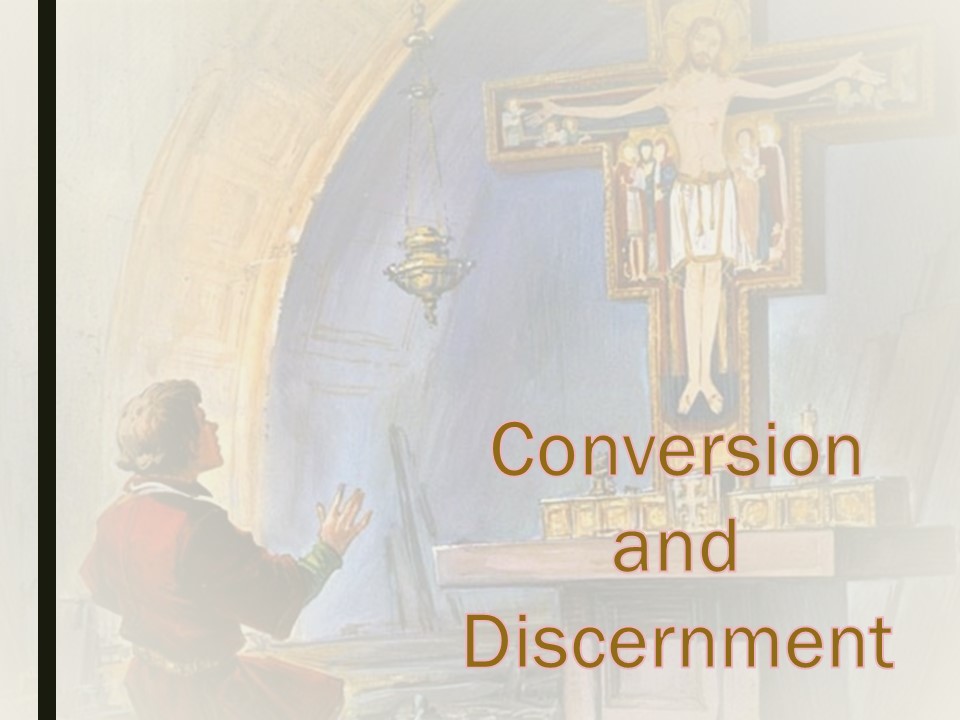
Today we discuss the conversion process of St. Francis and how we might reflect on our own conversion process. You may remember that Father Mike told us to always be reading some book on St. Francis so that we aware of his efforts to live the Gospel life and keep in mind how we are to live as well. There are several suggestions on books to read on St Francis, if you are looking for a good one now. Hope you enjoy this lesson. Peace, Dona+++++++++++++++++++++++++++++++++++++++++++++++++++++++++++++++++++++++++++If you have read a good biography of St. Francis, it is easy to see different steps of a conversion process as they apply to different events in the life of Francis. During the time of discernment in the period of initial formation, or as professed members seek to strengthen their vocation, it is important to ponder the events of Francis’ conversion and vocation process and see how these might relate with your own conversion and vocation process.
As a help, you might use the following steps in a conversion process as they apply to the life of St. Francis, and then ask yourself how they might also apply in your own life:
· Darkness that can lead to openness (Questions and ambiguity can propel us
to God). [Think about: Francis’ desire to be a knight; his restlessness; his time in prison; his illnesses and dreams]
· Listening and hearing (Prayer) [Think about: Francis’ encounter with the leper and how he began to think about the poor Christ; after traveling to Rome, he returns home and prays and waits for an answer] –the voice in the dream; the voice from the San Damiano Cross; the time in solitude listening to the Lord
· Choosing to follow –[Think about: Francis realizes that his true bride is Lady Poverty; Hears the voice from the San Damiano cross and responds immediately; Hears the voice in his dream “Who do you want to follow, the servant or the master?” St. Clare and Bro. Sylvester counsel Francis to preach instead of becoming a hermit]
· Signs which strengthen our decisions and our walk – [Kissing the leper; trading clothes with the beggar in Rome; He hears the voice from the San Damiano crucifix]
· Finding new direction [All of the above begin to move him in a new direction. He begins the “rebuilding” process.]
· Life of Christ/Gospel as point of contact and reference
· Finding support in this newness
· Walking in faith [“The Lord gave me brothers…]
· Trusting even in darkness
· Darkness that can lead to openness
· As conversion is ongoing, we “begin again”, returning to the top
From For Up to Now: Franciscan Movement Part 1 “The Journey of Francis” by Jan Parker, OFS
As you think about each of the above points, comment in your journal or share with your formation group.
Looking for a biography of St. Francis? Here are a few suggestions:
—-St. Francis of Assisi: Passion, Poverty, and the Man who Transformed the Catholic Church. by Bret Thoman OFS
— St. Francis of Assisi: A Biography by Omer Englebert— Francis: The Journey and the Dream by Murray Bodo O.F.M. and John Michael Talbot—Francis of Assisi: The Life and Afterlife of a Medieval Saint by André Vauchez+++++++++++++++++++++++++++++++++++++++++++++++++++++++++++++++++++++++++++++++++++++++++++++++++++++++++++++++++++++
Comparta con su fraternidad local. Conversión y discernimiento
Si ha leído una buena biografía de San Francisco, es fácil ver los diferentes pasos de un proceso de conversión que se aplican a diferentes eventos en la vida de Francisco. Durante el tiempo de discernimiento en el período de formación inicial, o cuando los miembros profesos buscan fortalecer su vocación, es importante reflexionar sobre los eventos del proceso de conversión y vocación de Francisco, y ver cómo estos pueden relacionarse con su propio proceso de conversión y vocación.
Como ayuda, puede utilizar los siguientes pasos en un proceso de conversión según se apliquen a la vida de San Francisco, y luego preguntarse cómo podrían aplicarse también en su propia vida:
• Oscuridad que puede conducir a la apertura (las preguntas y la ambigüedad pueden impulsarnos
a Dios) [Piense en: el deseo de Francisco de ser caballero; su inquietud; su tiempo en prisión; sus enfermedades y sueños]
• Escuchar y oír (oración) [Piense en: el encuentro de Francisco con el leproso y cómo empezó a pensar en el Cristo pobre; después de viajar a Roma, regresa a casa y reza y espera una respuesta] –la voz en el sueño; la voz de la Cruz de San Damián; el tiempo en soledad escuchando al señor
• Elegir seguir [Piense en: Francisco se da cuenta de que su verdadera esposa es Lady Poverty; Oye la voz desde la cruz de San Damiano y responde de inmediato; Oye la voz en su sueño: “¿A quién quieres seguir, al sirviente o al amo?” St. Clare y Bro. Sylvester aconseja a Francisco que predique en lugar de convertirse en ermitaño]
• Señales que fortalecen nuestras decisiones y nuestro caminar [Besar al leproso; intercambiar ropa con el mendigo en Roma; Oye la voz del crucifijo de San Damián]
• Encontrar una nueva dirección [Todo lo anterior comienza a moverlo en una nueva dirección. Comienza el proceso de “reconstrucción”.]
• Vida de Cristo / Evangelio como punto de contacto y referencia
• Encontrar apoyo en esta novedad
• Caminando en fe [“El Señor me dio hermanos…]
• Confiar incluso en la oscuridad
• Oscuridad que puede conducir a la apertura.
• A medida que la conversión está en curso, “comenzamos de nuevo”, volviendo a la parte superior
Desde el hasta ahora: Movimiento franciscano Parte 1 “El viaje de Francisco” por Jan Parker, OFS
Mientras piensa en cada uno de los puntos anteriores, comente en su diario o comparta con su grupo de formación.
Buscando una biografía de San Francisco? Aqui hay algunas sugerencias:
Biografia de San Francisco de Asis: Francisci Assisensis vita et miracula (Spanish Edition) by Tomás de Celano
San Francisco de Asís (Spanish Edition) by G. K. Chesterton
Diane F. Menditto, OFS
Chair, National Formation Commission
Minister, Our Lady of the Angels Region