Q is coming and here is why

Why attend a “Q”?   Article 7 of the National Statutes of the Secular Franciscan Order in the United States (OFSUSA) states that the “National Fraternity shall celebrate a National Congress at least once every five years.” (https://secularfranciscansusa.org/wp-content/uploads/2017/12/OFS_National_Statutes_FINAL_07_24_13_OFS_withSignatures.pdf)

Plus, it’s a booster shot for your vocation.  Every Q has food, fun, formation, family, fraternity, formal prayer and of course – Franciscans!  This one, in particular, will be very special as we will be celebrating the JUBILEE of our Order’s 800th anniversary of Memoriale Propositi (the Rule of 1221), and the 100th anniversary of our National Quinquennial Congress!  (COVID got us off schedule a little….but better late than never!)  General Information has been prepared to answer many questions.  It covers registration costs, registration questions, hotel and travel information and much more.

The Q committee is counting down the days until we will be together.  Reduced registration costs available for “Early Birds”.  Registration opens on August 1.  Enter your email address at the Q Registration Countdown to be notified when Registration opens.

https://secularfranciscansusa.org/2021/07/28/q-is-coming-and-here-is-why/

2022 Quinquennial Congress is coming

When Mike and Michelle moved in across the street two years ago, I welcomed them to the neighborhood. Since then, we take time to chat when we see each other outside. Last fall, when I was diagnosed with cancer, I let my neighbors know that I would be away a few weeks, as I would be recovering from surgery at my son’s house. […]https://secularfranciscansusa.org/2021/07/27/2022-quinquennial-congress-is-coming/

National Minister’s Message: Chosen for Each Other

(This article originally appeared in the Summer 2021 Issue #103 of the TAU-USA)

By Jan Parker, OFS

Enjoying some homemade chicken soup at Jake and Megan’s after surgery.

When Mike and Michelle moved in across the street two years ago, I welcomed them to the neighborhood. Since then, we take time to chat when we see each other outside. Last fall, when I was diagnosed with cancer, I let my neighbors know that I would be away a few weeks, as I would be recovering from surgery at my son’s house. Mike and Michelle immediately wanted to know what they could do to help me. I asked if they could keep an eye on the house and water my plants. Michelle quickly replied, “We’d be happy to do that. Please let us know if there’s anything else, ok?”

Shortly after I returned home, Mike and Michelle walked over to say hello and see how I was doing. I shared that things were going well, but I had started chemotherapy and was tired much of the time. They again assured me that if I needed anything, they were there for me. Michelle said, “Jan, even if you just need a drink of water and you are too tired to get up, just call me, ok?” Then Mike, who has always struck me as more reserved, warmly added, “We’re supposed to love our neighbor, so let us do that.” To this day, their words remain in my heart. Those Gospel words spoke to me.

A book that has accompanied me during this past year poses this question: “Has it ever occurred to you that the people that surround you have, in some way, been sent to you by God?” It goes on to say, “They have been chosen, and you have been chosen to circle through one another’s lives as a welcoming presence, a constant blessing.”(1)  I believe God chose Mike and Michelle to be in my life at this time, not simply because of my need for help, but for their witness of living and sharing the Gospel message. There is now a wonderful bridge of caring between their home and mine, a bridge built upon the words of Jesus.

Being chosen for each other has great significance for us as Franciscans, both in our fraternities and in our
everyday lives. When we focus on others as “a gift of the Lord and an image of Christ” we will approach them with a certain reverence. Our encounters and interactions will be marked by holiness, conversion, and transformation. Without this perspective, we miss the blessing of others whom God has chosen to be part of our lives. We close ourselves off to grace-filled possibilities.

I found a good example of this in the film series The Chosen. (2 ) The early episodes unfold the call of the apostles, and we clearly see how these first followers of Jesus were real people, with distinct personalities and quite different backgrounds. We see how the apostles question why Jesus chose this person or that person. In particular, we see Simon struggling when Matthew, the tax collector, is invited to follow. While the apostles realize they have been chosen to follow Jesus, they do not yet see how they have also been chosen for each other. It would take Pentecost and the coming of the Holy Spirit to unite them.

We can experience a similar situation in fraternity life as we struggle with the faults and shortcomings we see the Father sees in every person the features of his Son, the firstborn of many brothers and sisters, so the Secular Franciscans with a gentle and courteous spirit accept all people as a gift of the Lord and an image of Christ. OFS Rule, Art. 13  in our sisters or brothers. The temptation is to shake our heads, look up to heaven and say, “Lord, you are certainly giving me many opportunities to practice patience!” But is this really what God desires, that we put up with each other?

If we genuinely believe that we are chosen for each other, we will look at our sisters and brothers much differently. We will no longer see their faults and shortcomings, but we will connect at a deeper level. Spiritual growth does not come from putting up with each other, but from our openness to the presence of the Spirit among us, conforming us to the way of love. It is for this we were chosen.

1 Macrina Wiederkehr in The Flowing Grace of Now, p. 98
2 The Chosen is a television drama based on the life of Jesus Christ, created, directed, and co-written by American filmmaker Dallas Jenkins. It is the first multi-season series about the life of Christ, and season one was the highest crowd-funded TV series or film project of all time. The series portrays Jesus through the eyes of those who met him. (Wikipedia)

https://secularfranciscansusa.org/2021/07/25/national-ministers-message-chosen-for-each-other/

Open post

FORMATION FRIDAY – July 23, 2021 – Going from Gospel to Life

Dear Brothers and Sisters,  
Today’s lesson goes back to the very beginning of Francis’ vision for his Order to live the Gospels each day.  We should study and meditate on the Gospels each day.  Fr. Mike has several books that help one meditate on the Gospels each day.  Hopefully, we will have some to share at the Summer Gathering.  God bless you all.  Peace, Dona
+++++++++++++++++++++++++++++++++++++++++++++++++++++++++++++++++++++++++++
 

“And after the Lord gave me some brothers, no one showed me what I had to do, but the Most High Himself revealed to me that I should live according to the pattern of the Holy Gospel.”

The Testament – Francis of Assisi – The Saint – Vol I – Page 125

“The rule and life of the Secular Franciscans is this: to observe the gospel of our Lord Jesus Christ by following the example of Saint Francis of Assisi, who made Christ the inspiration and the center of his life with God and people.

Christ, the gift of the Father’s love, is the way to him, the truth into which the Holy Spirit leads us, and the life which he has come to give abundantly.

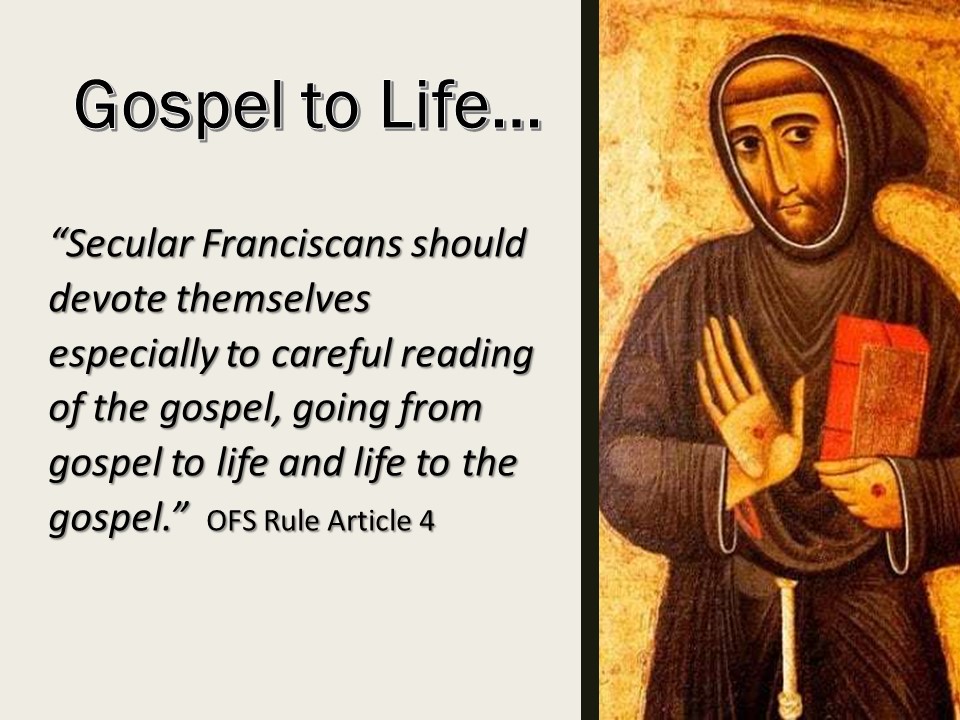
Secular Franciscans should devote themselves especially to careful reading of the gospel, going from gospel to life and life to the gospel.”  OFS Rule Article 4

All Franciscans have a close relationship with Scripture in general and the Gospels in particular. As Secular Franciscans, we are called to show that the gospel can be lived in the world.

In “Come and See,” by Fr. Lester Bach, OFM Cap, and Theresa Baker, OFS, we are set on the path to “go from gospel to life and life to the gospel.” (See page 9 of Come and See)

“We are gospel people and the Sacred Scriptures are vital to our lives. Since we desire to implement the

Gospel, we have to know the Gospel. Bible knowledge does not come magically. It takes work. We

expect such work from Secular Franciscans. We are NOT fundamentalists who can quote chapter and

verse. Instead, we show the implications of the Gospel by the way we live.


Our goal is not to be intellectual biblical scholars but people who practice what we learn from the Bible.

We avoid using the Bible as a club to judge and punish others or win arguments. It is not an exercise to

see how many texts we can memorize. That is not our way. We will never exhaust the full meaning of

Scripture. Hence our lifelong commitment is to continue the journey of learning and applying the Gospel

in daily life.

A number of things are required of Secular Franciscans in relation to the Bible:

·        Our guidebook is the Bible – we use it!

·        Jesus and his words have special value to us. We listen to him.

·        In fraternal gatherings, we share insights and reflections for implementing the Gospel in everyday life.

·        When we are puzzled about texts, we seek competent help.

·        We avoid fundamentalist attitudes that limit the power of Scripture.

·        We work to deepen our understanding of Scripture.

·        We avoid attitudes that use Scripture to condemn others or identify them as non-salvageable.

·        The circle of our love must never become narrow. We seek to include rather than exclude people.

·        We use Scripture for prayer as well as study, letting its power touch us and soak into our lives.”


For discussion or to comment on in your journal:

1- Why was Scripture so important to St. Francis?

2-In what ways do you apply the gospels to your life?

3-How has Sacred Scripture helped you in your efforts to achieve daily conversion?

4- Discuss with your formator or formation team ways in which your fraternity can work together to become more familiar with Scripture.


+++++++++++

Del Evangelio a la vida…


“Y después que el Señor me dio algunos hermanos, nadie me mostró lo que tenía que hacer, pero el Altísimo mismo me reveló que debía vivir según el modelo del Santo Evangelio.” Testamento – San Francisco de Asís


“La Regla y la vida de los Franciscanos seglares es ésta: guardar el santo Evangelio de nuestro Señor Jesucristo siguiendo el ejemplo de San Francisco de Asís, que hizo de Cristo el inspirador y centro de su vida con Dios y con los hombres6.

Cristo, don del amor del Padre, es el camino hacia Él, es la verdad en la cual nos introduce el Espíritu Santo, es la vida que Él ha venido a dar abundantemente.

Los Franciscanos seglares dedíquense asiduamente a la lectura del Evangelio, pasando del Evangelio a la vida y de la vida al Evangelio.”  Regla OFS Artículo 4


Todos los franciscanos tienen una estrecha relación con la Escritura en general y los Evangelios en particular. Como franciscanos seglares estamos llamados a mostrar que el evangelio se puede vivir en el mundo.

En “Ven a ver,” del P. Lester Bach, OFM Cap, y Theresa Baker, OFS, estamos en el camino de “pasar del Evangelio a la vida y de la vida al Evangelio.”  (Consulte la página 9 de Ven a ver)


“Somos gente del evangelio y las Sagradas Escrituras son vitales para nuestras vidas. Dado que deseamos implementar el Evangelio, tenemos que conocer el Evangelio. El conocimiento de la Biblia no viene por arte de magia. Requiere trabajo. Nosotros esperamos tal trabajo de los Franciscanos Seglares. NO somos fundamentalistas que puedan citar capítulos y verso. En cambio, mostramos las implicaciones del Evangelio por la forma en que vivimos.


Nuestro objetivo no es ser eruditos bíblicos intelectuales, sino personas que practican lo que aprendemos de la Biblia.

Evitamos usar la Biblia como un mazo para juzgar y castigar a otros o ganar discusiones. No es un ejercicio para

ver cuántos textos podemos memorizar. Ese no es nuestro camino. Nunca agotaremos el significado completo de

Sagrada Escritura. Por eso, nuestro compromiso de toda la vida es continuar el camino de aprendizaje y aplicación del Evangelio en la vida diaria.


Se requieren varias cosas de los franciscanos seglares en relación con la Biblia:


• Nuestra guía es la Biblia, ¡la usamos!

• Jesús y sus palabras tienen un valor especial para nosotros. Lo escuchamos.

• En los encuentros fraternos compartimos visiones y reflexiones para implementar el Evangelio en la vida cotidiana.

• Cuando nos desconciertan los textos, buscamos ayuda competente.

• Evitamos actitudes fundamentalistas que limitan el poder de las Escrituras.

• Trabajamos para profundizar nuestro entendimiento de las Escrituras.

• Evitamos actitudes que usan las Escrituras para condenar a otros o identificarlos como no salvables.

• El círculo de nuestro amor nunca debe reducirse. Buscamos incluir más que excluir a las personas.

• Usamos las Escrituras tanto para la oración como para el estudio, dejando que su poder nos toque y penetre en nuestras vidas.”


Para platicar o comentar en su diario:


1- ¿Por qué la Escritura era tan importante para San Francisco?

2-¿De qué formas aplicas los evangelios a tu vida?

3-¿Cómo te ha ayudado la Sagrada Escritura en tus esfuerzos por lograr la conversión diaria?

4- Discuta con su formador o equipo de formación las formas en que su fraternidad puede trabajar en conjunto para familiarizarse más con las Escrituras.


Diane F. Menditto, OFS
Chair, National Formation Commission
Minister, Our Lady of the Angels Region
 
Open post

FORMATION FRIDAY – July 16, 2021 – Admonitions

 
Dear Brothers and Sisters,  
Today’s lesson uses the early writings of St. Francis.  One of the best ways to learn about the soul of a saint is to read their original writings.  
Reminder:  if you click on the first link to Franciscan Traditions – you will find tons of material for ongoing formation.  Just read the material, create questions and you are ready to go to the next gathering with a plan for your members to learn together.  Or you can purchase a book with the questions at the end of each Chapter such as For All The Saints: St. Francis’s Five Point Plan for Salvation by Tom Bellos OFS, former National Minister, (Published by Tau Publishing)
 If you are looking for some ideas, just send an email, and I will get back to you.  Peace, Dona
 

++++++++++++++++++++++++++++++++++++++++++++++++++


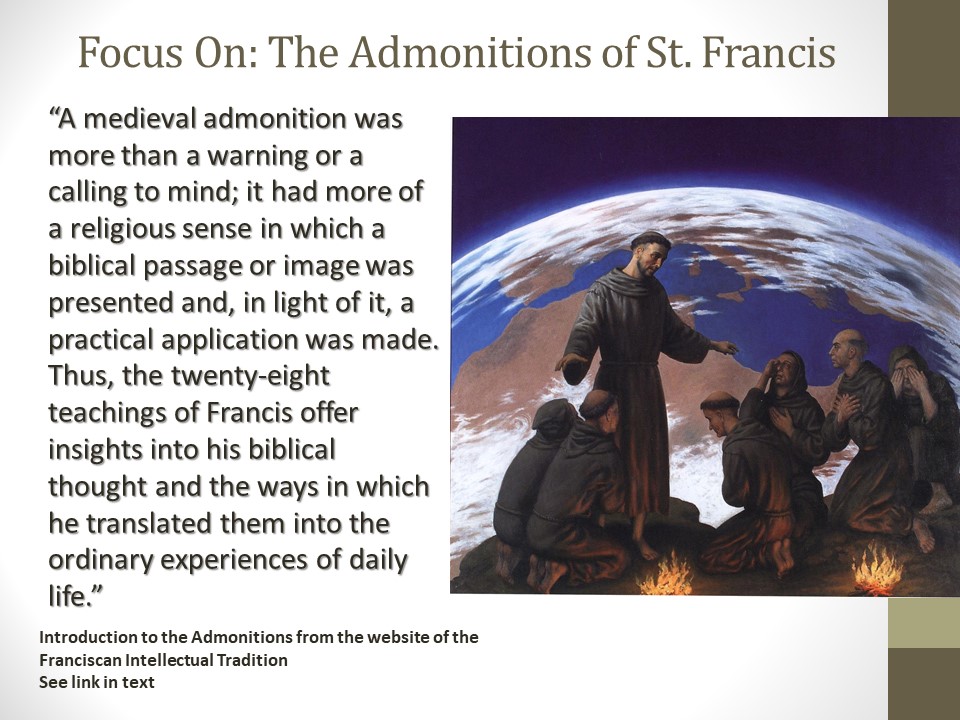
Focus on the Admonitions  (#11 and 12) 

https://www.franciscantradition.org/francis-of-assisi-early-documents/the-saint/writings-of-francis/the-undated-writings/the-admonitions/149-fa-ed-1-page-133

[XI: Let No One Be Corrupted by the Evil of Another]

1Nothing should displease a servant of God except for sin. 2And no matter how another person may sin if a servant of God becomes disturbed and angry because of this and not because of charity, he is storing up guilt for himself. Rom 2:5 3That servant of God who does not become angry or disturbed at anyone lives correctly without anything of his own. a 4Blessed is the one for whom nothing remains except for him to return to Caesar what is Caesar’s and to God what is God’s. Mt 22:21

[XII: Knowing the Spirit of the Lord]

1A servant of God can be known to have the Spirit of the Lord in this way: 2if, when the Lord performs some good through him, his flesh does not, therefore, exalt itself, because it is always opposed to every good. 3Instead he regards himself the more worthless and esteems himself less than all others.


Questions to discuss or to answer in your journal

+ Come, Holy Spirit! Open my mind and heart as I contemplate Admonition XI.

·        When have I focused on another person’s sin and judged them because of it?

·        What do I find most difficult about not becoming “angry or disturbed at anyone?”

·        Why do you think Francis ends this admonition with the sentence from Matthew about “returning to Caesar what is Caesar’s and to God what is God’s?”


+ Admonition XII—Those of us who are, or aspire to be, servant leaders should pay close attention to this one!

·        Why do you think St. Francis asks his followers to esteem themselves less when the Lord accomplishes something through them?

·        Do you think he wants us to have low self-esteem? Why or why not?

·        Do you think he is asking us to stop trying to do great things?


++++++++++++++++++++++++++++++++++++

Enfoque en las admoniciones de San Francisco  (Admoniciones 11 y 12)

https://www.franciscanos.org/esfa/escritossf.html#adm

Cap. XI: Que nadie se altere por el pecado de otro

1Al siervo de Dios nada debe desagradarle, excepto el pecado. 2Y de cualquier modo que una persona peque, si por esto el siervo de Dios se turba y se encoleriza, y no por caridad, atesora para sí una culpa (cf. Rom 2,5). 3El siervo de Dios que no se encoleriza ni se conturba por cosa alguna, vive rectamente sin propio. 4Y bienaventurado aquel que no retiene nada para sí, devolviendo al César lo que es del César, y a Dios lo que es de Dios (Mt 22,21).


Cap. XII: De cómo conocer el espíritu del Señor

1Así se puede conocer si el siervo de Dios tiene el espíritu del Señor: 2si, cuando el Señor obra por medio de él algún bien, no por eso su carne se exalta, porque siempre es contraria a todo lo bueno, 3sino que, más bien, se tiene por más vil ante sus propios ojos y se estima menor que todos los otros hombres.


Preguntas para platicar o responder en su diario

+ ¡Ven, Espíritu Santo! Abre mi mente y mi corazón mientras contemplo la Admonición XI.

• ¿Cuándo me he concentrado en el pecado de otra persona y la he juzgado por ello?

• ¿Qué me resulta más difícil de no “enojarme o molestarme con nadie?”

• ¿Por qué cree usted que Francisco termina esta advertencia con la frase de Mateo sobre “devolver al César lo que es del César y a Dios lo que es de Dios?”


+ Admonición XII: ¡Aquellos de nosotros que somos, o aspiramos a ser, líderes siervos debemos prestar mucha atención a esta admonición!

• ¿Por qué cree que San Francisco pide a sus seguidores que se estimen menos a sí mismos cuando el Señor logra algo a través de ellos?

• ¿Cree usted que él quiere que tengamos baja autoestima? ¿Por qué o por qué no?

• ¿Cree que nos está pidiendo que dejemos de intentar a hacer grandes cosas?


Diane F. Menditto, OFS
Chair, National Formation Commission
Minister, Our Lady of the Angels Region
 
Scroll to top
Juan de Padilla