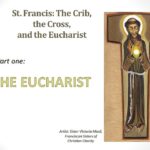
Dear Brothers and Sisters,St. Francis centered his life and spirituality on the Incarnation, the humanity of Christ. He was in awe that God “bent down” to be with us through his birth; through his suffering and death on the cross; and through the Eucharist by which he remains with us for all time. Usually, we speak about the Crib, the Cross, and the Eucharist in that order. As we move toward Advent, let’s reverse the order. Over the next three weeks, we will consider these three anchors of Franciscan Spirituality through the words of and about St. Francis taken from the sources beginning with the Eucharist.This lesson has two attachments that are ready to print and take to your next gathering. Questions are included so you should be ready to go. It is always good to have the Sources available to reference. Peace, Dona++++++++++++++++++++++++++++++++++++++++++++++++++++++++++++++++++++++++St. Francis and the Eucharist, the Cross, and the Crib. (Part one THE EUCHARIST)
- 26 Let everyone be struck with fear, let the whole world tremble, and let the heavens exult when Christ, the Son of the living God, is present on the altar in the hands of a priest.
- 27 O wonderful loftiness and stupendous dignity! O sublime humility! O humble sublimity! The Lord of the universe, God and the Son of God, so humbles Himself that for our salvation He hides Himself under an ordinary piece of bread!
- 28 Brothers, look at the humility of God, and pour out your hearts before Him! Ps 62:9 [Vulgate, Ps 61:9] Humble yourselves that you may be exalted by Him! 1 Pt 5:6 Jas 4:10 29 Hold back nothing of yourselves for yourselves, that He Who gives Himself totally to you may receive you totally!” (A Letter to the Entire Order: FA:ED, vol. 1, p. 118)
- 10 And I act in this way because, in this world, I see nothing corporally of the most high Son of God except His most holy Body and Blood which they receive, and they alone administer to others. 11I want to have these most holy mysteries honored and venerated above all things and I want to reserve them in precious places.” (The Testament: FA:ED, vol. 1, p. 125)
- 2 With all that is in me and more I beg you that, when it is fitting and you judge it expedient, you humbly beg the clergy to revere above all else the most holy Body and Blood of our Lord Jesus Christ…” (The First Letter to the Custodians (1220): FA:ED, vol. 1, p. 56)
- “I implore all of you brothers to show all possible reverence and honor to the most holy Body and Blood of our Lord Jesus Christ 13in Whom that which is in heaven and on earth has been brought to peace and reconciled to Almighty God.” Col 1:20
(A Letter to the Entire Order: FA:ED, vol. 1, p. 117)“This is my Body and the Blood of my new covenant [which will be shed for many] ;{snippet Mk 14:22} 11 and Whoever eats my flesh and drinks my blood has eternal life. {snippet Mk 14:24} 12 It is the Spirit of the Lord,{snippet Jn 6:55} therefore, That lives in Its faithful, That receives the Body and Blood of the Lord. 13 All others who do not share in this same Spirit and presume to receive Him eat and drink judgment on themselves. {snippet 1 Cor 11:29}”(The Admonitions: FA: ED, vol. 1, p. 129)“We must, of course, confess all our sins to a priest and receive the Body and Blood of our Lord Jesus Christ from him. b 23 Whoever does not eat His flesh and drink His blood cannot enter the kingdom of God. {snippet Jn 6:54} {snippet J… (Later Admonition and Exhortation: FA: ED, vol. 1, p. 47)“Francis speaks most often about the Eucharist, even more than about poverty. For him, the Eucharist is not only a mystery, a sacrament, it is a living person: it is Christ completely given into the hands of a man, fragile and defenseless, just as he was in Bethlehem. From this come his tender feelings for everything to do with the Sacrament of the altar, and his preoccupation with the dignity and cleanliness of the church and sacred vessels.” (Raniero Cantalamessa, O.F.M. Cap “It Is Not Good For Man to Be Alone”: Clare and Francis: CA:ED, p. 11)Questions for discussion or to answer in your journalRead and think about the quotes above. As you think about what St. Francis said (and what was said about his devotion to the Eucharist) consider your feelings about the Eucharist.+Why is the Eucharist important to you as a Catholic? As a Franciscan?+How do you prepare to receive the Body and Blood of Christ?+How is the Eucharist tied to our Franciscan spirituality?+Where is the Eucharist mentioned in the OFS Rule? (Also refer to the Prologue)++++++++++++++++++++++++++++++++++++++++++++++++San Francisco y la Eucaristía, la Cruz y el Pesebre. (Primera parte LA EUCARISTÍA)San Francisco centró su vida y espiritualidad en la Encarnación, la humanidad de Cristo. Estaba asombrado de que Dios “se inclinara” para estar con nosotros por su nacimiento; por su sufrimiento y muerte en la cruz; y a través de la Eucaristía por la que permanece con nosotros para siempre. Por lo general, hablamos del Pesebre, la Cruz y la Eucaristía en ese orden. A medida que avanzamos hacia el Adviento, invirtamos el orden. Durante las próximas tres semanas, consideraremos estos tres pilares de la espiritualidad franciscana a través de las palabras de y sobre San Francisco tomadas de las fuentes que comienzan con la Eucaristía.26¡Tiemble el hombre entero, que se estremezca el mundo entero, y que el cielo exulte, cuando sobre el altar, en las manos del sacerdote, está Cristo, el Hijo del Dios vivo (Jn 11,27)! 27¡Oh admirable celsitud y asombrosa condescendencia! ¡Oh humildad sublime! ¡Oh sublimidad humilde, pues el Señor del universo, Dios e Hijo de Dios, de tal manera se humilla, que por nuestra salvación se esconde bajo una pequeña forma de pan! 28Ved, hermanos, la humildad de Dios y derramad ante él vuestros corazones (Sal 61,9); humillaos también vosotros para que seáis ensalzados por él (cf. 1 Pe 5,6; Sant 4,10). 29Por consiguiente, nada de vosotros retengáis para vosotros, a fin de que os reciba todo enteros el que se os ofrece todo entero.10Y lo hago por esto, porque nada veo corporalmente en este siglo del mismo altísimo Hijo de Dios, sino su santísimo cuerpo y su santísima sangre, que ellos reciben y ellos solos administran a los otros. 11Y quiero que estos santísimos misterios sean sobre todas las cosas honrados, venerados y colocados en lugares preciosos. 1 EL TESTAMENTO2Os ruego, más que si se tratara de mí mismo, que, cuando os parezca bien y veáis que conviene, supliquéis humildemente a los clérigos que veneren sobre todas las cosas el santísimo cuerpo y sangre de nuestro Señor Jesucristo…10…como lo atestigua el mismo Altísimo, que dice: Esto es mi cuerpo y mi sangre del nuevo testamento, [que será derramada por muchos] (cf. Mc 14,22.24); 11y: Quien come mi carne y bebe mi sangre, tiene vida eterna (cf. Jn 6,55). 12De donde el espíritu del Señor, que habita en sus fieles, es el que recibe el santísimo cuerpo y sangre del Señor. 13Todos los otros que no participan del mismo espíritu y se atreven a recibirlo, comen y beben su condenación (cf. 1 Cor 11,29).22Ciertamente debemos confesar al sacerdote todos nuestros pecados; y recibamos de él el cuerpo y la sangre de nuestro Señor Jesucristo. 23Quien no come su carne y no bebe su sangre (cf. Jn 6,55. 57), no puede entrar en el reino de Dios (Jn 3,5). CARTA A LOS FIELES II“Francisco habla más a menudo de la Eucaristía, incluso más que de la pobreza. Para él, la Eucaristía no es solo un misterio, un sacramento, es una persona viva: es Cristo entregado por completo en manos de un hombre, frágil e indefenso, como lo fue en Belén. De ahí su ternura por todo lo que tiene que ver con el sacramento del altar, y su preocupación por la dignidad y limpieza de la iglesia y los vasos sagrados ”. (Raniero Cantalamessa, O.F.M. Cap “It Is Not Good For Man to Be Alone”: Clare and Francis: CA:ED, p. 11)Preguntas para platicar o para responder en su diarioLea y piense en las citas anteriores. Al pensar en lo que dijo San Francisco (y lo que se dijo sobre su devoción a la Eucaristía), considere sus propios sentimientos sobre la Eucaristía.+ ¿Por qué la Eucaristía es importante para usted como católico? ¿Como franciscano?+ ¿Cómo se prepara para recibir el Cuerpo y la Sangre de Cristo?+ ¿Cómo está ligada la Eucaristía a nuestra espiritualidad franciscana?+ ¿Dónde se menciona la Eucaristía en la Regla OFS? (consulte también el Prólogo)Diane F. Menditto, OFSChair, National Formation Commission
Formation Director, Our Lady of the Angels Region
Formation Director, St. Francis Fraternity, Hackensack, NJ
FORMATION FRIDAY – Focus on the Admonitions (XIII and XXVII) – November 5, 2021
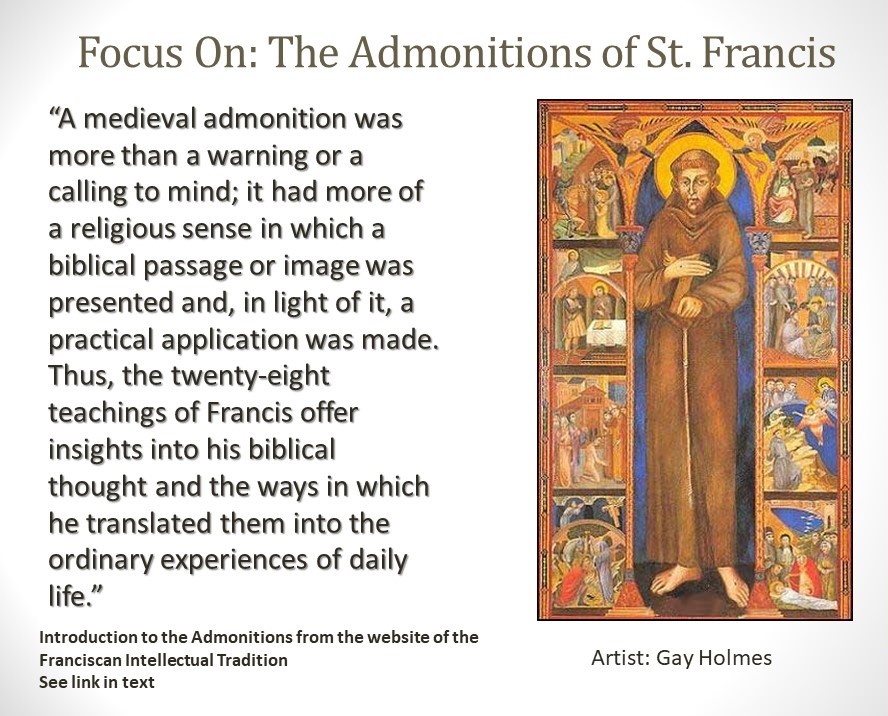
Dear Brothers and Sisters,A medieval Admonition was more than a warning or a calling to mind, it had more of a religious sense in which a Biblical passage or image was presented, an in light of it, a practical application was made. The 28 teaching of St. Francis offers insights into his biblical thought and the ways in which he translated them into ordinary experiences. Today’s formation lesson is so important. An example is that we are attracted to the idea of Peace, but when tested, it is not that easy to always be peaceful or peacemakers. So let us focus upon Francis’ Admonitions below to review where we stand…and to resolve to do better in the future. 🙏 Peace, Dona+++++++++++++++++++++++++++++++++++++++++++++++++++++++++++++++++++++++++++++++++++++++++++++++++++Focus on the Admonitions (XIII and XXVII)
[XIII: Patience]
1Blessed are the peacemakers, for they will be called children of God. Mt 5:9
A servant of God cannot know how much patience and humility he has within himself as long as he is content. 2When the time comes, however, when those who should make him content do the opposite, he has as much patience and humility as he has at that time and no more.
[XXVII: Virtue Puts Vice to Flight]
1Where there is charity and wisdom,
there is neither fear nor ignorance.2Where there is patience and humility,
there is neither anger nor disturbance.3Where there is poverty with joy,
there is neither greed nor avarice.a4Where there is restb and meditation,
there is neither anxiety nor restlessness.5Where there is fear of the Lord to guard an entrance, Lk 11:21
there the enemy cannot have a place to enter.6Where there is a heart full of mercyc and discernment,
there is neither excess nor hardness of heart.
To discuss or answer in your journal:
- How does Admonition XIII inspire me in my dealings with others? (Family; friends; on social media; in political discussions)
- How does Admonition XXVII address our lives in fraternity (verses 1-3) and our spiritual lives (verses 4-6)? How do these verses overlap? Give examples.
- Which Franciscan qualities do we need to fulfill both of these Admonitions?
++++++++++++++++++++++
Enfoque en las admoniciones de San Francisco (XIII y XXVII)
(Por favor, compartir con la fraternidad local)http://www.franciscanos.org/esfa/adm-ae.html
[Cap. XIII: De la paciencia]
1Bienaventurados los pacíficos, porque serán llamados hijos de Dios (Mt 5,9). El siervo de Dios no puede conocer cuánta paciencia y humildad tiene en sí, mientras todo le suceda a su satisfacción. 2Pero cuando venga el tiempo en que aquellos que deberían causarle satisfacción, le hagan lo contrario, cuanta paciencia y humildad tenga entonces, tanta tiene y no más.
[Cap. XXVII: De la virtud que ahuyenta al vicio]
1Donde hay caridad y sabiduría,
allí no hay temor ni ignorancia.
2Donde hay paciencia y humildad,
allí no hay ira ni perturbación.
3Donde hay pobreza con alegría,
allí no hay codicia ni avaricia.
4Donde hay quietud y meditación,
allí no hay preocupación ni vagancia.
5Donde está el temor de Dios para custodiar su atrio (cf. Lc 11,21),
allí el enemigo no puede tener un lugar para entrar.
6Donde hay misericordia y discreción,
allí no hay superfluidad ni endurecimiento.
Para platicar o contestar en su diario:
• ¿Cómo me inspira la Admonición XIII en mi trato con los demás? (Familia; amigos; en las redes sociales; en discusiones políticas)
• ¿Cómo aborda la Admonición XXVII nuestras vidas en fraternidad (versículos 1-3) y nuestras vidas espirituales (versículos 4-6)? ¿Cómo se superponen estos versículos? Dar ejemplos.
• ¿Qué cualidades franciscanas necesitamos para cumplir con estas dos admoniciones?
Diane F. Menditto, OFSChair, National Formation Commission
Formation Director, Our Lady of the Angels Region
Formation Director, St. Francis Fraternity, Hackensack, NJ
Transcendence or Immanence?

(This article originally appeared in the TAU-USA Spring/Summer Issue #103)
By Bret Thoman, OFS
Anyone who has spent much time visiting different Franciscan fraternities is aware that there are different ways of understanding how to live out our Franciscan life.
On the one hand, there are those whose focus is “other-worldly.” They value correct liturgy and worship, morality, virtue, and doctrine. In prayer, they tend to be highly reverent, they value traditional rites, they are partial to mystery and wonder. They are deferential to religious authorities to whom they look to clarify Church teachings and quell disputes.
On the other hand, there are those whose focus is on this life and this world. They dedicate their time, resources, and energy to social issues and injustices. They are concerned with peace, racism, the marginalized, and ecology. In issues of faith and morals, they believe in the primacy of the conscience. Their liturgies tend to be more casual, oriented toward the community, with a high amount of lay participation.
On the surface, it would appear that these groups could be labeled as either conservative or liberal, traditionalists or progressives.
Instead, there are better words to describe them: “transcendent” and “immanent.”
Transcendence focuses on the otherness of God. It emphasizes God’s existence outside of the world, before creation and beyond humanity. It is the belief that God surpasses the physical world and is independent of it. God transcends the material world, indeed the entire universe and is, therefore, beyond the grasp of the human mind.
On the other hand, immanence focuses on the incarnate Christ who revealed himself “down here” – in the world with humanity. In this seemingly contrasting view of God, God reaches down – stoops down – from heaven to be with mankind. God does not remain aloof up in the heavens, he is down here with us.
The question is whether Christ came to save humanity and bring man up to heaven (transcendent)? Or did Christ lower himself to be with humanity where man is (immanent)?
Which side is right? In fact, both reflect the nature of God.
As Catholic Christians, and as Franciscans, we accept by faith that God is almighty, holy, and cannot be approached or seen. The God in whom we believe existed before the creation of the world and is distinct and fully independent of the material world.
Yet that same God – the Word, Second Person of the Holy Trinity who existed before all creation and through which all creation was created – came down and became man. He became incarnate as the God-man, Jesus the Christ. “For your sake he became poor although he was rich, so that by his poverty you might become rich” (2 Cor 8:9).
So transcendence and immanence are really one and the same: the transcendent and immanent nature of God meet in the mysterious revelation that Christ is both God and man. It is paradoxically Christ himself, both fully divine and fully human, who unites transcendent divinity and the immanent humanity. God is both transcendent and immanent. “Love and truth will meet; justice and peace will kiss” (Psalm 85:10).
In this, we can draw on the example of St. Francis of Assisi, who bridged the seemingly insurmountable divide of transcendence and immanence through his rightful worship of God and his dedication to love of neighbor.
St. Bonaventure wrote:
It was a custom for the angelic man Francis never to rest from the good, rather, like the heavenly spirits on Jacob’s ladder, he either ascended into God or descended to his neighbor. For he had so prudently learned to divide the time given to him for merit, that he spent some of it working for his neighbor’s benefit and dedicated the rest to the tranquil excesses of contemplation. (St. Bonaventure, Major Legend, Chapter XIII, 1)
https://secularfranciscansusa.org/2021/11/01/transcendence-or-immanence/
Did You Know – Prayer page

There were so many good titles to choose for this article, but I felt compelled to choose this one. It came from Tom Ha, OFS, our Korean brother from Saint Elizabeth of Hungary Fraternity in Houston, Texas. This message has resonated with me so many times this past year. It is so true that Diversity is a Gift to us from God, and what we do with that Gift is especially important. … […]https://secularfranciscansusa.org/2021/10/30/did-you-know-prayer-page/
FORMATION FRIDAY – Identity as a Secular Franciscan (Part 3 or 3) – October 29, 2021
Dear Brothers and Sisters,Today is Part 3 of the series on our identity as Secular Franciscans. The lesson is rich in material for an intimate discussion of our own conversion journey as a Secular Franciscan. Francis strove to live the Gospels in all things, by focusing upon being less, sacrifice, poverty, and penance. Secular Franciscans also strive for continual conversion (metanoia) following Francis’ footsteps.This is the 3rd part of the 3-part lesson on our Identity as Secular Franciscans and if you are doing this as an ongoing formation lesson, it is best to use all three parts together at one formation session. Peace, Dona++++++++++++++++++++++++++++++++++++++++++++++++++++++++++++++++++++++++++++++++++++[For personal formation take each part separately. For ongoing formation, all three parts will be useful when presented together and discussed.]Refer to Anne Mulqueen, OFS-FUN Manual-Our Identity as a Secular Franciscan and The Franciscan Journey by Lester Bach, OFM.The hallmarks of the three branches of the Franciscan family all spring from the charism of our Seraphic Father. However, the spiritual emphasis of the three orders falls in different areas. The
- First Order of friars has a focus on minority;
- Second Order of Poor Clares has its focus on poverty;
- Third Order-the Secular Franciscan Order-has its focus on penance and conversion.
The roots of the Secular Franciscan Order come from the penitential movement that existed in the 13th century. It is thought that Francis joined the Order of Penitents early in his conversion.This penitential movement called for:• Continual conversion (metanoia)• Radical interior change (See Rule article #7)• A turning away from self-centeredness• Turning toward Christ, being conformed to Christ• Loving and serving the Church and all that is created through the Word of God“The term Penance in Franciscanism is equivalent to the biblical meaning of metanoia, understood as an intimate conversion of the heart to God, as a vital attitude, a continuous state of being. It is not a question of doing penance but of being penitent.” (Fr. Lino Temperini, TOR—Penitential Spirituality in the Franciscan Sources, p. 41)Each article in Chapter II of the Secular Franciscan Rule calls for continual conversion. Because of our human frailty, conversion must be carried out daily.Our identity as Secular Franciscans is shaped by the fact that Francis showed that the gospel could be lived. In following this spirituality we are called to:• Live the Gospel according to the Spirit of St. Francis, and, therefore, be convertedcontinually (metanoia), live in simplicity, humility, and minority• Live as sisters and brothers of all people and of all creation• Follow the poor and crucified Christ• Live in communion with Christ and share in the life and mission of the Church. We areto be loyal to the church in an attitude of dialogue and collaboration with herministers.• Share in the love of the Father• Be instruments of peace• Have a life of prayer that is personal, communal, and liturgical• Live in joy• Have a spirituality of a secular nature• Participate in the apostolate of the laity; be at the service of the less fortunate• Be pilgrims on the way toward the Father• Be open to the action of the Holy SpiritQuestions for discussion or to answer in your journal:+How does our identity as Secular Franciscans intensify our baptismal promises?+Of the points in the bullets above, which are the most difficult for you to follow?+Re-read Chapter II of our Rule. Which articles reflect the points made above?+++++++++++++++++++++++Comparta con su fraternidad local.Nuestra identidad como franciscanos seglares: del bautismo a la profesión (Parte 3 de 3)[Para la formación personal tomar cada parte por separado. Para la formación permanente, las tres partes serán útiles cuando se presenten juntas y se discutan.]Consulte Anne Mulqueen, OFS-FUN Manual-Our Identity as a Secular Franciscan and The Franciscan Journey por Lester Bach, OFM.Las señas de identidad de las tres ramas de la familia franciscana brotan todas del carisma de nuestro Seráfico Padre. Sin embargo, el énfasis espiritual de las tres órdenes recae en diferentes áreas. La Primera Orden de frailes se centra en la minoría; la Segunda Orden de Clarisas se centra en la pobreza; y la Tercera Orden, la Orden Franciscana Seglar, se centra en la penitencia y la conversión.Las raíces de la Orden Franciscana Seglar provienen del movimiento penitencial que existió en el siglo XIII. Se cree que Francisco se unió a la Orden de los Penitentes al principio de su conversión.Este movimiento penitencial requería:• La conversión continua (metanoia)• El cambio interior radical (ver artículo 7 de la regla)• Un alejamiento del egocentrismo• Volverse hacia Cristo, conformarse a Cristo• Amar y servir a la Iglesia y todo lo que se crea a través de la Palabra de Dios.“El término Penitencia en el franciscanismo equivale al significado bíblico de metanoia, entendida como conversión íntima del corazón a Dios, como actitud vital, estado continuo del ser. No se trata de hacer penitencia sino de ser penitente ”. (P. Lino Temperini, TOR – Espiritualidad penitencial en las fuentes franciscanas, p. 41)Cada artículo del Capítulo II de la Regla Franciscana Seglar pide una conversión continua. Debido a nuestra fragilidad humana, la conversión debe realizarse a diario.Nuestra identidad como franciscanos seglares está determinada por el hecho de que Francisco demostró que el evangelio se puede vivir. Al seguir esta espiritualidad estamos llamados a:• Vivir el Evangelio según el Espíritu de San Francisco y, por tanto, convertirnos de continuo (metanoia), vivir consencillez, humildad y minoridad.• Vivir como hermanos y hermanas de todas las personas y de toda la creación.• Seguir al Cristo pobre y crucificado• Vivir en comunión con Cristo y compartir la vida y misión de la Iglesia. Debemos ser leales a la iglesia en una actitud dediálogo y colaboración con sus ministros.• Compartir el amor del Padre• Ser instrumentos de paz• Tener una vida de oración personal, comunitaria y litúrgica.• Vivir con alegría• Tener una espiritualidad de carácter secular.• Participar en el apostolado de los laicos; estar al servicio de los menos afortunados• Ser peregrinos en el camino hacia el Padre.• Estar abierto a la acción del Espíritu Santo.Preguntas para platicar o para responder en su diario:+ ¿Cómo nuestra identidad como franciscanos seglares intensifica nuestras promesas bautismales?+ De los puntos de las viñetas anteriores, ¿cuáles son los más difíciles de seguir para ti?+ Releer el Capítulo II de nuestra Regla. ¿Qué artículos reflejan los puntos mencionados anteriormente?Diane F. Menditto, OFSChair, National Formation Commission
Formation Director, Our Lady of the Angels Region
Formation Director, St. Francis Fraternity, Hackensack, NJ