The Blessed Virgin Mary and St. Francis of Assisi

(This article originally appeared in the TAU-USA Fall Issue #104)

Fr. Chris Shorrock, OFM Conv., CNSA

Fr. Chris Shorrock, OFM Conv.

During the months of September and October, we celebrate a number of significant Marian feast days – the Nativity of the Blessed Virgin Mary (8 September), Our Lady of Sorrows (15 September), Our Lady of the Rosary (7 October).

It should be self-evident that the Franciscan Order, with its tradition of devotion to the Blessed Mother of God, certainly received its love for Mary from Francis of Assisi.

This becomes more evident as scholars continually uncover, or establish with more certainty, texts relating to Francis and thus confirm that the “Poor man of Assisi” (the poverello) was not only the “herald of the great King” but also the faithful “Knight of the great Queen.”

Of course, we have to avoid the risk of unduly applying to Francis of Assisi everything that later generations would have liked to admire in him. For this reason, we will rely on Francis’ own writings and those of the earliest biographers such as Thomas of Celano, who wrote his first biography at the insistence of Pope Gregory IX for the canonization of Francis in 1228/29 and his “second life” in 1247.

There is also the tendency to view Francis’ devotion to Mary as somewhat of an isolated entity, unrelated to his spiritual life as a whole. Yet, Francis’ love for Mary was so much a part of him that it is almost impossible to separate his Marian devotion from his daily life.

I am sure we are all aware that Francis was not a theologian, particularly as we understand the term today, and therefore we should not expect to find in his writings a clearly-defined Marian doctrine.

Francis was a man of his time, and “with his childlike faith he absorbed the Church’s teaching on the Mother of God and nourished his Marian spirituality on it.”1 For Francis, prayer and meditation introduced him ever more deeply to the heart of the Marian mysteries and gave him a greater understanding of her pre-eminent role in God’s plan of salvation. His words and writings show us the fruit of his prayer in a way so personal, so original, and so unique that they can still move us today, eight centuries later. Franciscans of every time have valued the words of Bernardine de Bustis (d. about 1515), which offer some insight into this aspect of the Franciscan tradition:

The seraphic father himself admonished his brethren that they should attribute to the blessed Mother of God every privilege which may be appropriate to her excellence, and that they should exalt her with all the praise that is appropriate for such a pure human creature.2

Let us then turn to some rather general remarks about Francis and his love and devotion to Mary. Francis endeavored to follow Christ as closely as possible by surrendering his life into the hands of his loving Father and therefore could not help loving in a special way the pure and most holy Virgin who was chosen by the Father to be the mother of his divine Son. Francis clearly perceived and presented Mary as the model of every Christian who responds to the presence of God in their lives.

According to St. Bonaventure (d. 1274), one of Francis’ early biographers, Francis placed himself and his order under the protection and guidance of Mary for all time.

On one side we should show Mary in all her poverty of Bethlehem placing the most sweet son of God upon the rough straw of the manger. In the other half of our painting, we would portray Mary, the Immaculate Mother of God, and Queen of the Seraphic Order, in the chapel of Mary of the Angels stretching forth her arms in motherly protection over all her Franciscan sons and daughters.3

From his earliest days, according to the biographer Thomas of Celano, Francis “burned with devotion toward the mother of all good.” When Francis abandoned the world, he placed himself under the loving care and protection of his heavenly Mother. He asked her to be his guide and advocate in his new life of poverty after the pattern of her Son. Thomas of Celano tells us:

He embraced the Mother of Jesus with inexpressible love, since she made the Lord of Majesty a brother to us. He honoured her with his own Praises, poured out prayers to her, and offered her his love in a way that no human tongue can express. But what gives us greatest joy is that he appointed her the Advocate of the Order and placed under her wings the sons he left behind, that she might protect and cherish them to the end.4 Recalling the words of Thomas of Celano, “he embraced the Mother of Jesus with an inexpressible love, since she made the Lord of Majesty a brother to us,” Bonaventure adds “and, through her, we have obtained mercy.”5

In these simple words of the early biographers, we see the deepest foundation for the reverence Francis showed toward Mary. For him, the Incarnation was the basis of his whole spiritual life, and he would go out of his way to follow in every way the example of the word made flesh. Therefore, it would seem only natural that he “owed” a special love to this unique woman, who brought God within our reach and “made the Lord of Majesty a brother to us.”

1 Cajetan Esser, Repair My House. Chicago: Franciscan Herald Press, 1963, p. 132.
2 Cited by Geoffrey Bridges, “Mary’s Mediation in the Franciscan Tradition,” The Cord IV (1954), 217.
3 Mark Sheehan, “Mary’s Troubadour,” The Cord VII (1957)
4 Cel 198 (FA:ED 2:374)
5 LM 9:3, FA:ED, 2:598

https://secularfranciscansusa.org/2021/11/28/the-blessed-virgin-mary-and-st-francis-of-assisi/

Open post

FORMATION FRIDAY- St. Francis & the Eucharist, the Cross and the Crib – Part III – November 26, 2021


Dear Brothers and Sisters, 

We come to the final part of a three-part series on Francis which focuses upon the Crib just as we enter Advent.  Francis was always in awe that God would be so humble as to take on human flesh in the Incarnation.  He was amazed that God would love us so much and demonstrate such humility.  How can we not follow his example of humility by serving our neighbors in love and respect? These last three Formation Fridays are important to meditate on as we prepare for the birth of Christ during this Advent season.  Peace, Dona

++++++++++++++++++++++++++++++++++++++++++++++++++++++++++++++++++++++++++++++++++++++++++++++++++++++++++++++++++++++++++++++++++++++++++++++++++++++

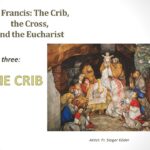
St. Francis centered his life and spirituality on the Incarnation, the humanity of Christ. He was in awe that God “bent down” to be with us through his birth; through his suffering and death on the cross; and through the Eucharist by which he remains with us for all time. Usually, we speak about the Crib, the Cross, and the Eucharist in that order. Now, as we are about to begin Advent, let’s reverse the order. For week three of our series of three reflections, we will consider the key anchor of the three, through the words of and about St. Francis taken from the sources: THE CRIB.

++ “3We thank You for as through Your Son You created us, so through Your holy love with which You loved us Jn 17:26
You brought about His birth as true God and true man by the glorious, ever-virgin, most blessed, holy Mary and You willed to redeem us captives through His cross and blood and death.”   FA:ED, vol. 1, 82    The Earlier Rule
++ “Francis used to recall with regular meditation the words of Christ and recollect His deeds with most attentive perception. Indeed, so thoroughly did the humility of the Incarnation and the charity of the Passion occupy his memory
that he scarcely wanted to think of anything else. FA:ED, vol. 1, 254 The Life of Saint Francis by Thomas of Celano

++“As usual, blessed Francis had John summoned to him some fifteen days prior to the birthday of the Lord. ‘If you desire to celebrate the coming feast of the Lord together at Greccio,’ he said to him, ‘hurry before me and carefully make ready Prv 24:27 the things I tell you. For I wish to enact the memory of that babe who was born in Bethlehem: to see as much as is possible with my own bodily eyes the discomfort of his infant needs, how he lay in a manger, Lk 2:7 and how, with an ox and an ass standing by, he rested on hay.’” FA:ED, vol. 1, 255 The Life of Saint Francis by Thomas of Celano

++ “Moreover, burning with excessive love, he often calls Christ the ‘babe from Bethlehem’ whenever he [Francis] means to call Him Jesus. Saying the word ‘Bethlehem’ in the manner of a bleating sheep, he fills his whole mouth with sound but even more with sweet affection. He seems to lick his lips whenever he uses the expressions ‘Jesus’ or ‘babe from Bethlehem,’ tasting the word on his happy palate and savoring the sweetness of the word.” FA:ED, vol. 1, 256  The Life of Saint Francis by Thomas of Celano

++ “Humility enabled Francis to celebrate the birth of the Incarnate Word that he heard, preached, and lived throughout his life.” The Life of Saint Francis by Thomas of Celano  FA:ED, vol. 1, p. 177

Questions to discuss or to answer in your journal

+Why do you think St. Francis was so in awe of the Incarnation of Christ?
+Give some examples of how St. Francis imitated Jesus.
+How do we see the Incarnate Lord? In His birth and in His passion and death?

++++++++++++++++

San Francisco y la Eucaristía, la Cruz y el Pesebre. (Tercera parte: EL PESEBRE) Por favor, compartir con la fraternidad.

San Francisco centró su vida y espiritualidad en la Encarnación, la humanidad de Cristo. Estaba asombrado de que Dios “se inclinara” para estar con nosotros durante su nacimiento; por su sufrimiento y muerte en la cruz; y através de la Eucaristía por la que permanece con nosotros para siempre. Por lo general, hablamos del Pesebre, la Cruz y la Eucaristía en ese orden. Ahora, cuando estamos a punto de comenzar el Adviento, invirtamos el orden. Para la tercera semana de nuestra serie de tres reflexiones, consideraremos el ancla clave de las tres, a través de las palabras de y sobre San Francisco tomadas de las fuentes: LA CUNA – EL PESEBRE.

++ “3Y te damos gracias porque, así como por tu Hijo nos creaste, así, por tu santo amor con el que nos amaste (cf. Jn 17,26), hiciste que él, verdadero Dios y verdadero hombre, naciera de la gloriosa siempre Virgen la beatísima santa María, y quisiste que nosotros, cautivos, fuéramos redimidos por su cruz y sangre y muerte.”  Regla no bulada Capítulo XXIII

++ “En asidua meditación recordaba sus palabras y con agudísima consideración repasaba sus obras. Tenía tan presente en su memoria la humildad de la encarnación y la caridad de la pasión, que difícilmente quería pensar en otra cosa.
 1 Celano Capítulo XXX (84)

++ “ Francisco le llamó (a Juan), como solía hacerlo con frecuencia, y le dijo: «Si quieres que celebremos en Greccio esta fiesta del Señor, date prisa en ir allá y prepara prontamente lo que te voy a indicar. Deseo celebrar la memoria del niño que nació en Belén y quiero contemplar de alguna manera con mis ojos (28) lo que sufrió en su invalidez de niño, cómo fue reclinado en el pesebre y cómo fue colocado sobre heno entre el buey y el asno»” 1 Celano Capítulo XXX (84)

++ “Muchas veces, al querer mencionar a Cristo Jesús, encendido en amor, le dice «el Niño de Bethleem», y, pronunciando «Bethleem» como oveja que bala, su boca se llena de voz; más aún, de tierna afección. Cuando le llamaba «niño de Bethleem» o «Jesús», se pasaba la lengua por los labios como si gustara y saboreara en su paladar la dulzura de estas palabras.” 1 Celano Capítulo XXX (86)

Preguntas para platicar o responder en su diario
+ ¿Por qué crees que San Francisco estaba tan asombrado por la Encarnación de Cristo?
+ ¿Dar algunos ejemplos de cómo San Francisco imitó a Jesús.
+ ¿Cómo vemos al Señor Encarnado? ¿En su nacimiento y en su pasión y muerte?


Diane F. Menditto, OFS
Chair, National Formation Commission
Formation Director, Our Lady of the Angels Region
Formation Director, St. Francis Fraternity, Hackensack, NJ
 

Pope Francis addresses Secular Franciscans

General Audience with Pope Francis Mazur/catholicnews.org.uk Flikr

Calling Secular Franciscans “true penitents,” Pope Francis cited penance as the path to joy and conversion in his address at the General Chapter of the Secular Franciscan order on Nov. 15.

“God leads the penitent to places where he would never have wanted to go,” Pope Francis said.  “The penitent responds by accepting to place himself at the service of others and by using mercy with them.  And the result is happiness.”

Pope Francis praised the Franciscan practice of penance as a way of opening one’s heart to God.

“Please, let us not confuse “doing penance” with “works of penance.”  These–fasting, almsgiving, mortification, are consequences of the decision to open one’s heart to God.  Open your heart to God!  To open one’s heart to Christ, living in the midst of ordinary people, in the style of St. Francis.  Just a Francis was a “mirror of Christ,” so may you too become “mirrors of Christ.”

You can read the full text of Pope Francis’s talk at the following link.

 Full text of Address of Pope Francis at the General Chapter of the Secular Franciscan Order

https://secularfranciscansusa.org/2021/11/20/pope-francis-addresses-secular-franciscans/

Open post

FORMATION FRIDAY – St. Francis & the Eucharist, the Cross & the Crib – Part II (the Cross) – November 19, 2021

 
Dear Brothers and Sisters, 
Francis always strove to conform himself to Jesus.  He meditated on the passion with careful attention.  Every single deed of Jesus, he examined in detail.  “The Cross of Jesus was his heart’s food, in which he delighted”.  
In today’s lesson on the Cross, we will meditate on the Cross through Francis’ perspective and discuss our thoughts at the end of the lesson with our fraternities.  If you want to learn more about the Cross go to Franciscan Intellectual Tradition www.franciscantradition.org/resources/other-resources which is loaded with tons of materials on St Francis.  Peace, Dona
 

+++++++++++++++++++++++++++++++++++++++++++++++++++++++++++++++++++++++++++++++

St. Francis centered his life and spirituality on the Incarnation, the humanity of Christ. He was in awe that God “bent down” to be with us through his birth; through his suffering and death on the cross; and through the Eucharist by which he remains with us for all time. Usually, we speak about the Crib, the Cross, and the Eucharist in that order. As we move toward Advent, let’s reverse the order. For week two of our series of three reflections, we will consider the middle anchor of the three, through the words of and about St. Francis taken from the sources: THE CROSS.

+++++++++++

++“O Lord Jesus Christ, two graces do I ask of thee before I die; 


  • the first, that in my lifetime I may feel, as far as possible, both in my soul and body, that pain which thou, sweet Lord, didst endure in the hour of thy most bitter Passion;
  • the second, that I may feel in my heart as much as possible of that excess of love by which thou, O Son of God, were inflamed to suffer so cruel a Passion for us sinners.” 
From The Little Flowers of St. Francis of Assisi-Third Consideration on the Stigmata (p. 167). Kindle Edition.


++“ A few days had passed when, while he was walking by the church of San Damiano, he was told in the Spirit to go inside for a prayer. Once he entered, he began to pray intensely before an image of the Crucifieda which spoke to him in a tender and kind voice: “Francis, don’t you see that my house is being destroyed? Go, then, and rebuild it for me.” Stunned and trembling, he said: “I will do so gladly, Lord.” For he understood that it was speaking about that church, which was near collapse because of its age. He was filled with such joy and became so radiant with light over that message, that he knew in his soul that it was truly Christ crucified who spoke to him.

14From that hour, therefore, his heart was wounded and it melted when remembering the Lord’s passion. While he lived, he always carried the wounds of the Lord Jesus in his heart. This was brilliantly shown afterward in the renewal of those wounds that were miraculously impressed on and most clearly revealed in his body.

Once he was walking by himself near the church of Saint Mary of the Portiuncula, weeping and wailing loudly. A spiritual man, overhearing him, though he was suffering some sickness or pain. Moved by pity for him,c he asked why he was crying. “I am crying because of the Passion of my Lord,” he said, “for whom I should not be ashamed to go throughout the world crying in a loud voice.” From The Legend of the Three Companions FA: ED, vol. 2, 76  

Frequently, even when he got up from prayer, his eyes seemed full of blood because he was crying with such bitterness. But, in memory of the Lord’s passion, not only did he afflict himself in tears, but he also did so by abstaining from food and drink.” From The Legend of the Three Companions FA: ED, vol. 2, 76  

++11” His Father’s will was such that His blessed and glorious Son, Whom He gave to us and Who was born for us, should offer Himself through His own blood as a sacrifice and oblation on the altar of the cross: 12not for Himself through Whom all things were made, Jn 1:3 but for our sins, 13leaving us an example that we might follow His footprints.”  1 Pt 2:21
 FA: ED, vol. 1, 46    Later Admonition and Exhortation

++“Francis perceived the cross to be the highest expression of the humility – the minority – of God. The cross represented the lowest, humblest act of divinity in that Christ lowered himself all the way to the crucifixion at Calvary: “and being found in the appearance of a man, he humbled himself, and became obedient unto death, even the death of the cross (Philippians 2:8).”  From Thoman, Bret. A Knight and a Lady: A Journey into the Spirituality of Saints Francis and Clare (Kindle Locations 1052-1055). Kindle Edition.

++7” In the same way, even if you were more handsome and richer than everyone else, and even if you worked miracles so that you put demons to flight: all these things are contrary to you; nothing belongs to you; you can boast in none of these things. 8But we can boast in our weaknesses 2 Cor 12:5 and in carrying each day the holy cross of our Lord Jesus Christ. Lk 14:27”   FA: ED, vol. 1, 131 Admonition V- Let No One Be Proud, but Boast in the Cross of the Lord


To discuss or comment on in your journal.


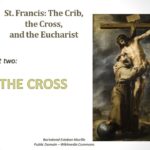
  • +Consider the picture: Francis and the Crucified Christ by Esteban Murillo and the quotes given above.
  • Comment on:


   –The passion and death of Christ in Francis’s life

   –The cross in our lives as Secular Franciscans


  • +When you contemplate the cross, how do you see yourself in that “mirror?


+++++++++++++++++++++++++++++++

San Francisco y la Eucaristía, la Cruz y el Pesebre. (Segunda parte: LA CRUZ)  (Si quiere seguir los enlaces, abra el documento PDF adjunto)

San Francisco centró su vida y espiritualidad en la Encarnación, la humanidad de Cristo. Estaba asombrado de que Dios “se inclinara” para estar con nosotros durante su nacimiento; por su sufrimiento y muerte en la cruz; y a través de la Eucaristía por la que permanece con nosotros para siempre. Por lo general, hablamos del Pesebre, la Cruz y la Eucaristía en ese orden. A medida que avanzamos hacia el Adviento, invirtamos el orden. Para la segunda semana de nuestra serie de tres reflexiones, consideraremos el ancla intermedia de las tres, a través de las palabras de y sobre San Francisco tomadas de las fuentes: LA CRUZ.

++ “Señor mío Jesucristo, dos gracias te pido me concedas antes de mi muerte: la primera, que yo experimente en vida, en el alma y en el cuerpo, aquel dolor que tú, dulce Jesús, soportaste en la hora de tu acerbísima pasión; la segunda, que yo experimente en mi corazón, en la medida posible, aquel amor sin medida en que tú, Hijo de Dios, ardías cuando te ofreciste a sufrir tantos padecimientos por nosotros pecadores.” http://franciscanos.org/florecillas/llagas2.htm

++ “A los pocos días, cuando se paseaba junto a la iglesia de San Damián, percibió en espíritu que le decían que entrara a orar en ella. Luego que entró se puso a orar fervorosamente ante una imagen del Crucificado, que piadosa y benignamente le habló así: «Francisco, ¿no ves que mi casa se derrumba? Anda, pues, y repárala». Y él, con gran temblor y estupor, contestó: «De muy buena gana lo haré, Señor». Entendió que se le hablaba de aquella iglesia de San Damián, que, por su vetusta antigüedad, amenazaba inminente ruina. Con estas palabras fue lleno de tan gran gozo e iluminado de tanta claridad, que sintió realmente en su alma que había sido Cristo crucificado el que le había hablado.

Saliendo de la iglesia, encontró a un sacerdote sentado junto a ella, y, metiendo la mano en su bolsa, le ofreció cierta cantidad de dinero, diciéndole: «Te ruego, señor, que compres aceite y cuides de que luzca continuamente una lámpara ante este crucifijo. Y, cuando se acabe este dinero, yo te daré de nuevo lo que fuere necesario para lo mismo».

14. Desde aquel momento quedó su corazón llagado y derretido de amor ante el recuerdo de la pasión del Señor Jesús, de modo que mientras vivió llevó en su corazón las llagas del Señor Jesús, como después apareció con toda claridad en la renovación de las mismas llagas admirablemente impresas en su cuerpo y comprobadas con absoluta certeza.

Un día iba solo cerca de la iglesia de Santa María de la Porciúncula llorando y sollozando en alta voz. Un hombre espiritual que lo oyó, pensó que sufriría alguna enfermedad o dolor. Y, movido de compasión, le preguntó por qué lloraba. Y él le contestó: «Lloro la pasión de mi Señor, por quien no debería avergonzarme de ir gimiendo en alta voz por todo el mundo». Y el buen hombre comenzó, asimismo, a llorar, juntamente con él, también en alta voz.

Muchas veces, cuando se levantaba de orar, aparecían sus ojos recargados de sangre, porque había llorado amargas lágrimas. Y no sólo se afligía llorando, sino que se privaba de comida y de bebida en memoria de la pasión del Señor.
http://www.franciscanos.org/fuentes/leyendatrescom01.html

++ 1Y la voluntad del Padre fue que su Hijo bendito y glorioso, que él nos dio y que nació por nosotros, se ofreciera a sí mismo por su propia sangre como sacrificio y hostia en el ara de la cruz; 12no por sí mismo, por quien fueron hechas todas las cosas (cf. Jn 1,3), sino por nuestros pecados, 13dejándonos ejemplo, para que sigamos sus huellas (cf. 1 Pe 2,21). http://franciscanos.org/esfa/ctaf2.html (Carta a los fieles)

++ “Francisco percibió la cruz como la máxima expresión de la humildad – la minoría – de Dios. La cruz representó el acto de divinidad más bajo y humilde en el sentido de que Cristo descendió hasta la crucifixión en el Calvario: “y habiéndose hallado en la apariencia de un hombre, se humilló a sí mismo y se hizo obediente hasta la muerte, la muerte de la cruz (Filipenses 2: 8) “. De Thoman, Bret. Un caballero y una dama: un viaje a la espiritualidad de los santos Francisco y Clara (ubicaciones de Kindle 1052-1055). Versión Kindle. (Sólo en inglés)

++7De igual manera, aunque fueras más hermoso y más rico que todos, y aunque también hicieras maravillas, de modo que ahuyentaras a los demonios, todas estas cosas te son contrarias, y nada te pertenece, y no puedes en absoluto gloriarte en ellas; 8por el contrario, en esto podemos gloriarnos: en nuestras enfermedades (cf. 2 Cor 12,5) y en llevar a cuestas a diario la santa cruz de nuestro Señor Jesucristo (cf. Lc 14,27).[Admoniciones Cap. V: Que nadie se ensoberbezca, sino que se gloríe en la cruz del Señor] http://franciscanos.org/esfa/adm-ae.html

Para platicar o comentar en su diario.

+ Considere la imagen: Francisco y Cristo crucificado de Esteban Murillo y las citas que se dan arriba.
Comentar en
   –La pasión y muerte de Cristo en la vida de Francisco
   –La cruz en nuestras vidas como franciscanos seglares
+ Cuando contemplas la cruz, ¿cómo te ves en ese “espejo?”


Diane F. Menditto, OFS
Chair, National Formation Commission
Formation Director, Our Lady of the Angels Region
Formation Director, St. Francis Fraternity, Hackensack, NJ
 

Franciscan Living – God Alone

(This Article originally appeared in the Spring/Summer 2021 Issue #103)

By Francine Gikow, OFS

Hear O Israel: The Lord our God is one Lord; and you shall love the Lord your God with all your heart, and with all your soul, and with all your might. (Deut: 6:4-5)

So begins the “Shema,” commonly known as the most important prayer in the Jewish faith. It identifies that God alone is the only God, and we should love Him with all that we are and do―but so many of our prayers seem to be meditating about God rather than praying to Him.

For the Lord is a great God,

and a great King above all gods,

In His hand are the depths of the earth;

the heights of the mountains are his…

O come, let us worship and bow down,

let us kneel before the Lord, our Maker!

For He is our God…. (Psalm 95:)

The emphasis of our God being worthy of the highest praise, adoration, and love reiterates the first and greatest Commandment: “I am the Lord your God…and you shall have no other gods before me.” (Ex: 20: 2-3)

This commandment warns us that we should guard ourselves against making anything else a “god” in our life, such as money, power, status, wealth, material goods, self image, job, reputation, “toys” or even our time. Any “thing” can take the place of God if we allow it to do so, by limiting our attention, time, and love for God. We can make any ”thing” an idol―a false god.

It’s easy to deny that we worship idols, yet on closer examination, we may find an idol taking root in our lives. Review what topics/things/ issues occupy your mind during the day. What do you worry about? What are your preoccupations? What are you constantly thinking about? If these are inordinate desires―something that preoccupies us, then they have become an idol. They take up that special “space” in our lives that correctly belongs to God. By those thoughts/ idols, we push God out of our lives.

It is so easy to shift our focus away from God when the evil one entices us, little by little, to where we may not want to be. Nonetheless, constantly refocusing on God alone takes persistence and discipline―with a constant review of our priorities and efforts in putting God first.

Unfortunately, even in our spiritual life, we must be on guard. Sometimes we can mistake God’s works and gifts for God Himself. We may initially be attracted to the spiritual life with God’s gifts of beauty, creation, and even His consolations, but eventually, God doesn’t just want us to love Him only for his gifts or the works he performs. He wants us  to  love Him, desire Him, and  spend time with Him alone. He hungers for our love in relationship. He wants pure love, not conditional love.

St. Francis emphasizes the priority to love God purely and unconditionally when he writes in his early Rule: “let us desire nothing else, let us want nothing else, let nothing else please us and cause us delight except our Creator, Redeemer and Savior, the only true God…Let nothing else hinder us, nothing else separate us, nothing come between us. (ER:9-10)

To love God alone is our goal: to praise Him and to love Him.

All powerful, most holy, most high and supreme God, all good, supreme good, total good, you who alone are good: we give you all praise, all glory, all thanks, all honor, all blessing and every good. So be it! So be it! Amen. (OfP: Praises to Be Said at All Hours:11)

https://secularfranciscansusa.org/2021/11/15/franciscan-living-god-alone/

Scroll to top
Juan de Padilla