
(PDF copy is attached for printing)
Five Important Spiritual Thoughts from the Liturgy of the Word
…and follow up for the Secular Franciscan
November 3 – November 9
1 — “You justify yourselves in the sight of others, but God knows your hearts; for what is of human esteem is an abomination in the sight of God.” (Lk 16:15)**
…God knows my heart;
what is the general direction of my life right now?
2 — “Things that cause sin will inevitably occur, but woe to the one through whom they occur.” (Lk 17:1)**
…What kind of an example am I showing?
3
– “When you have done all you have been commanded, say, ‘We are unprofitable servants; we have done what we were obliged to do.’” (Lk 17;10)**…Extended Meditation
Hypocrisy
is an interesting phenomenon to talk about. It is an automatic trap or problem
area for anyone who gives direction to others: priests, ministers, teachers,
parents, legislators, anyone showing leadership of others. In our case, it is
anyone who chooses to do something good that others see, and therefore anyone understands
the importance of God in our lives. For whatever reason, we say to the world:
“I believe in God through Jesus Christ.” We must listen to Jesus in the Gospel.
It is possible to say ‘I believe’, and not put it into practice.We should be very interested in what we say in Church. We say strong words during
the service, words like, we believe, we will, we do. We
must truly listen to what we say and do. We receive the Lord in the words of
the Gospel and in the Eucharist. How can someone receive the Lord and with the
same mouth tear down someone else or allow foul language to come out of it? How
can someone receive the Lord and continue a life-style that makes a shambles of
a marriage or parenting? How can we miss the sacredness of life itself by being
bitter and angry most of the time? Or refusing to see the good in life?How?—according to Jesus, we have allowed religion to be nothing more than something to be seen
or performed.What’s the antidote to hypocrisy, how do we stay away from it? The Gospel gives us
that as well. Jesus says:The greatest among you must be your servant.
Service—we have heard that before from Jesus, in
fact a number of times. The way to keep ourselves from the hypocrisy of saying
one thing and doing another is to work on behalf of others. Serve people, give
to them without expecting anything in return, make others feel important
because they are—really.By the very fact that we say we believe in God, we are making a statement to the world
outside. We must realize that we could be hypocrites… or if we carry through,
we could be people who are helping this world.
4 – “You are God’s building.” (1 Cor 3:9)
…Do my thoughts, words and actions prove this?
5 – “Stop making my Father’s house a marketplace.” (Jn 2:16)**
…Prayer is not bargaining with God; it is giving our very selves to God.
THE GIFT OF TAU-USA
(This article originally appeared in the TAU-USA Summer Issue #106)
A Testimonial by Thomas McNamara, OFS

It is 7pm Sunday evening. A few hours ago, we got home from our first fraternity meeting after being on hiatus for about half a year. Currently, our fraternity is awaiting visitation from our Region. At that visit, our Regional leadership will determine whether we have successfully regrouped after experiencing the most difficult challenge to our fraternity since its formation. While there have been several challenges over our century of fraternity life, what we experienced a few years ago was truly unique, difficult, and formative. It has been a time of much prayer, discernment, mutuality, and work. We have a new council who have individually and as a team responded well and helped us in more ways than anyone can list.
In our difficulties, we lost about two-thirds of our active membership. Many of our Inquirers decided to look elsewhere for their needs. Back then, no one seemed at all certain whether we had a future as a fraternity. We seemed to be “catching it” from every direction.
But we kept moving forward, driven by something none of us could see but all of us could feel—a sense of purpose that eludes description and a sense of positive learning and growth. Maybe this is the spirit of fraternity. Maybe we found we truly care for each other.
At today’s meeting, we were joined by nearly a dozen newcomers sharing our prayers, instructions and formation. By the end of our fraternity meeting, we were mixing very well, sharing a spirit of community, and demonstrating how, with enough motivation, strangers can always find things to talk about. It was a very wonderful feeling.
What I am most thankful for, however, is the most recent issue of TAU-USA. We received our copies just as we were finalizing plans for our “comeback meeting.” We chose to use the “Fraternity Life” article, which included a letter from Pope Francis, as our focus for our gathering. As we discussed his article, he seemed to be saying exactly what we needed to hear and talk about. We went through half of the reflection questions today and will finish the second half at our next fraternity meeting. We talked about how our vocation to fraternity is a gift. We recalled the Gospel where we hear about the Master giving each of us a gold coin… and expecting us to use it well. Fraternity is that kind of gift.
Our discussions were just what we needed, a blend of hearing each other’s perspectives and of building a common idea about what Pope Francis taught about fraternity life. The TAU-USA couldn’t have come at a better time. We went home with renewed hope and real gratefulness.
TAU-USA is a physical expression of our combined blessings of vocation, fraternity, and conversion. I am very thankful for this wonderful tool from our National Fraternity. Please keep publishing TAU-USA—it works

https://www.secularfranciscansusa.org/2022/11/07/the-gift-of-tau-usa/
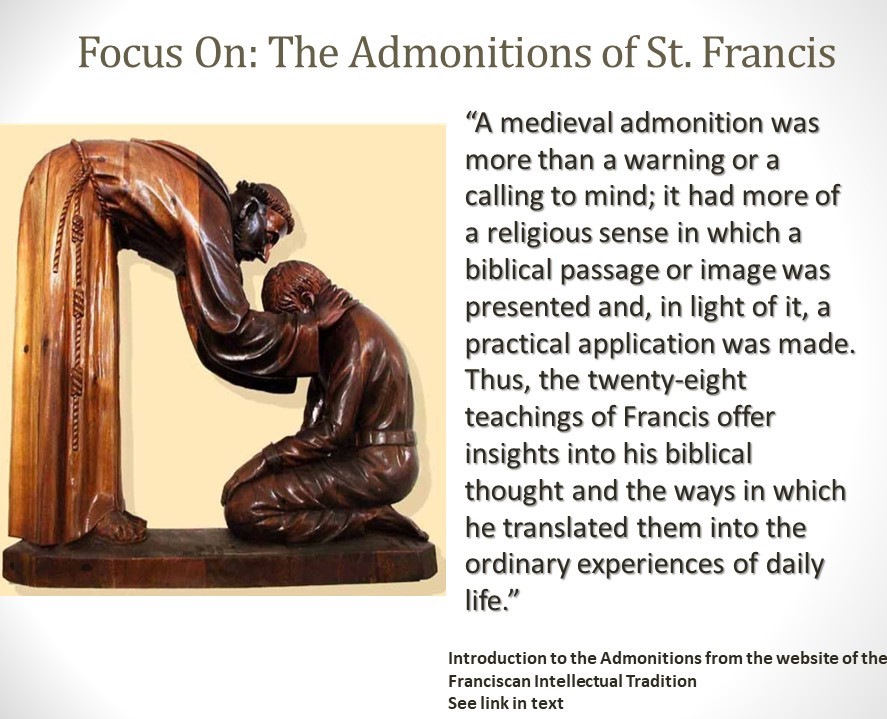
FORMATION FRIDAY – Focus on the Admonition (#23.24. and 25) – November 4, 2022
[XXIII: Humility]1Blessed is the servant who has been found as humble among his subjects as he was among his masters.
2Blessed is the servant who always remains under the rod of correction.
3Faithful and prudent is the servant Mt 24:45 who does not delay in punishing himself for all his offenses, inwardly through contrition and outwardly through confession and penance for what he did.
[XXIV: True Love]
1Blessed is the servant who loves his brother as much when he is sick and cannot repay him as when he is well and can repay him.
[XXV: The Same Point]
1Blessed is the servant who loves and respects his brother as much when he is far away from him as when he is with him, and who would not say anything behind his back that he would not say with charity in his presence.
Questions to discuss or to answer in your journal
+ Come, Holy Spirit! Open my mind and heart as I contemplate Admonition XXIII.
· When I am in a position of leadership, how do I treat those who are working with me?
· How can I prevent “power” from going to my head?
· In what way can I examine my day to help my daily conversion?
· Do I make frequent use of the Sacrament of Reconciliation? How do I prepare myself?
+ Admonitions XXIV and XXV—
· How do I love my brothers and sisters?
· How do I love the brothers and sisters whom I don’t particularly like?
· How do I resist gossip or just talking about others’ shortcomings?
++++++++++++++++++++++++++++++++++++
Enfoque en las admoniciones de San Francisco (Admoniciones 23, 24 y 25)
https://www.franciscanos.org/esfa/escritossf.html#adm
Cap. XXIII: De la humildad
1Bienaventurado el siervo a quien se encuentra tan humilde entre sus súbditos, como si estuviera entre sus señores. 2Bienaventurado el siervo que permanece siempre bajo la vara de la corrección. 3Es siervo fiel y prudente (cf. Mt 24,45) el que, en todas sus ofensas, no tarda en castigarse interiormente por la contrición y exteriormente por la confesión y la satisfacción de obra.
Cap. XXIV: Del verdadero amor
Bienaventurado el siervo que ama tanto a su hermano cuando está enfermo, que no puede recompensarle, como cuando está sano, que puede recompensarle.
Cap. XXV: De nuevo sobre lo mismo
Bienaventurado el siervo que ama y respeta tanto a su hermano cuando está lejos de él, como cuando está con él, y no dice nada detrás de él, que no pueda decir con caridad delante de él.
Preguntas para platicar o responder en su diario
+ ¡Ven, Espíritu Santo! Abre mi mente y mi corazón mientras contemplo la Admonición XXIII.
• Cuando estoy en una posición de liderazgo, ¿cómo trato a los que trabajan conmigo?
• ¿Cómo puedo evitar que el “poder” se me suba a la cabeza?
• ¿De qué manera puedo examinar mi día para ayudar a mi conversión diaria?
• ¿Hago uso frecuente del Sacramento de la Reconciliación? ¿Cómo me preparo?
+ Advertencias XXIV y XXV—
• ¿Cómo amo a mis hermanos y hermanas?
• ¿Cómo amo a los hermanos y hermanas que no me agradan particularmente?
• ¿Cómo resisto los chismes o simplemente hablar de las deficiencias de los demás?
Diane F. Menditto, OFSChair, National Formation Commission
Formation Director, Our Lady of the Angels Region
Formation Director, St. Francis Fraternity, Hackensack, NJ
SHAPING THE FRANCISCAN FOOTPRINT – October 27 – November 2 2022
(a PDF copy for printing is attached)
Five Important Spiritual Thoughts from the Liturgy of the Word
…and follow up for the Secular Franciscan
October 27 – November 2
1 – “Draw your strength from the Lord and from his mighty power.” (Eph 6:10)
…Do I?
2 – “Jesus spent the night in prayer to God.” (Lk 6:12)**
…I should set up a program of prayer for each day.
3 – “For everyone who exalts himself will be humbled, but the one humbles himself will be exalted.” (Lk 14:11)**
…Humility is a virtue that is difficult to learn.
4 – The Beatitudes (Mt 5:1-12a)**
a. Jesus addresses the words to the crowds and therefore to me. Do I truly listen to all of the words that the Lord gives me?
b. Poor in spirit: do I allow material things to dominate my life?
c. Mourn: there is pain in my life, but Jesus and what he teaches is the answer to that pain.
d. Meek: this is a direct statement against power and the people who want more power. Do I try to be more important than others?
e. Righteousness: do I really work at prayer and closeness to the Lord, and desire to be a holy person?
f. Mercy: do I reach out to the hurting people around me and help them if I can?
g. Clean of heart: am I honest, sincere, chaste, and do I lie to protect myself?
h. Peacemakers: do I really try to reconcile the factions that divide us?
i. Suffer insult: I should expect criticism for trying to be a good person, but I should be a good person anyway.
5. – ”I will not reject anyone who comes to me.” (Jn 6:37)**
…Do I thank the Lord enough for this great privilege?
**one of the most important passages in the Gospels
Franciscan Living – Why After You?
(This article originally appeared in the TAU-USA Summer Issue 2022 #106)
by Francine Gikow, OFS
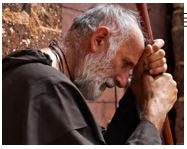 “Brother Masseo, wanting to test how humble he [Francis] was, went up to him and, as if joking, said, ‘Why after you, why after you, why after you?’ Masseo goes on to say in clarification: ‘I’m saying why does the whole world come after you, and everyone seems to desire to see you and hear you? You aren’t a handsome man in body, you aren’t someone of great learning, you’re not noble; so why does the whole world come after you?’”[1]
Francis’ response to Masseo may not seem to shed much light on this question, however. In fact, Francis states that God has chosen him because of his vileness and insufficiency. Francis expands this thought when he continues, saying: “…so that it may be known that every virtue and every good is from Him, and not from the creature, and no person may boast in his sight. But whoever boasts must boast in the Lord to whom is every honor and glory forever.”
God gave Francis great gifts. He gave Francis, an ordinary person born in the Middle Ages, great gifts of preaching, humility, and courage, not only because Francis made use of them, but also because Francis became a conduit for God’s love for us: The Lord and Creator shone through his creation of Francis. Truly, Francis became an “instrument” for God to work through so He could reach out and touch others through the human face of Francis.
God can work through us as well when he gives us “gifts” to use so that we can attract others to Christ. Thaddée Matura, OFM, warns us, however, “What one must beware of above all is the temptation to appropriate for oneself the good that belongs to God… one must acknowledge the origin of these gifts, rejoice over them, promote them; but once this is done, one must ‘render’ them, restore them to the One to whom they belong in an act of praise and thanksgiving.” [2]
Perhaps one of us has been given the grace to actually “see” God working through us, but detachment from personal ownership of our gifts is needed. We must be fully aware that we have been given everything by our loving God. We cannot appropriate that which is God’s, and we “own” nothing apart from Him.
We can still rejoice over these gifts we have used for God’s benefit, mindful that their Source is our loving God and not ourselves. These gifts are reminders of the intimate care and love of the Father who gives us all good things. He loves us!
We should also promote and use the gifts God has given and not “hide them under a bushel basket,” because it is by these gifts that people can come to know Christ through us. Like Francis, we can become a conduit to God, since these gifts are really God’s gifts, not our own. We can become the “face” of God to others and evangelize by our actions.
Acknowledging the true Source of any of the gifts we “appear” to own, we should return all praise and thanksgiving to the One who is GIFT Himself and the Source of any gift He has given us to use. Instead of accepting accolades for ourselves, we refer to the true Giver of Gifts in rejoicing and praise! Franciscan joy!
People were attracted to Francis because they were attracted to God’s gifts that they saw in Francis. Francis was well aware that he was not the owner of the gifts, but “He [God] has chosen me to confound the nobility and the greatness and the strength and beauty and wisdom of the world…”[3] Do likewise with joy!
[1] LFl:10 in FA:ED II, p. 583
[2] Thaddée Matura, OFM. Francis of Assisi: Writer and Spiritual Master. transl. Paul Lachance, OFM. (Cincinatti OH: St. Anthony Messenger Press, 2005), 49
[3] LFl:10 in FA:ED II, 0.583.
https://www.secularfranciscansusa.org/2022/10/31/franciscan-living-why-after-you/