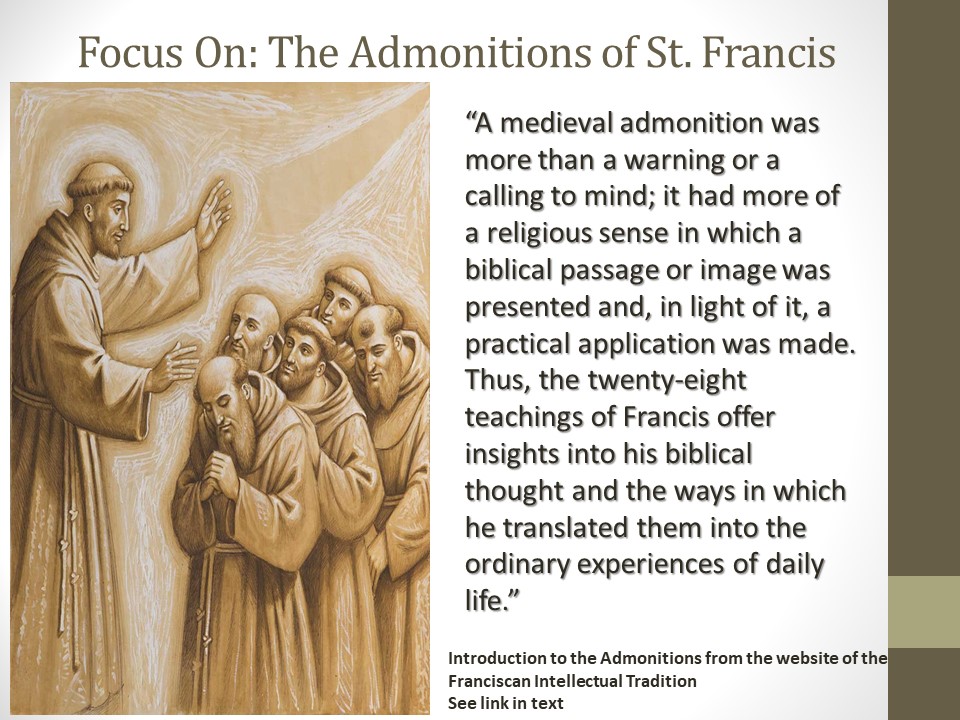
[XX: The Good and the Vain Religious]1Blessed is that religious who has no pleasure and delight except in the most holy words and deeds of the Lord 2and, with these, leads people to the love of God with gladness and joy. Ps 51:10 [Vulgate, Ps 50:10]
3Woe to that religious who delights in idle and empty words and leads people to laughter with them.
[XXI: The Frivolous and the Talkative Religious]
1Blessed is the servant who, when he speaks, does not disclose everything about himself under the guise of a reward and is not quick to speak, but who is wisely cautious about what he says and how he responds. Prv 29:20
2Woe to that religious who does not hold in his heart the good things the Lord reveals to him and does not reveal them by his behavior, but, under the guise of a reward, wishes instead to reveal them with his words. 3He receives his reward Lk 2:19 Lk 2:51 Mt 6:2 Mt 6:16 and his listeners carry away little fruit.
Questions to discuss or to answer in your journal
+ Come, Holy Spirit! Open my mind and heart as I contemplate Admonition XX.
· How often do you read Scripture? What is your focus when you read Scripture?
· Following Article 4 of our Rule, what does going “from gospel to life and life to the gospel” mean to you? Does what you read influence how you treat others?
· Try using Lectio Divina or Clare’s gazing (see graphic for steps). How did this change how Scripture influences you?
· How often have you “delighted in idle and empty words?” How will you change this habit?
+ Admonition XXI—”We talk too much!”
· What is the line between allowing others to get to know us and talking about ourselves in order to impress?
· Although social media did not exist in St. Francis’s time, how does this admonition apply to “selfies” and what we post about ourselves on social media?
· God has given us many graces. How can we use them to set a good example for others?
· What else do you see in this admonition that can be applied to our lives in the modern world?
++++++++++++++++++++++++++++++++++++
Enfoque en las admoniciones de San Francisco (Admoniciones 20 y 21)
https://www.franciscanos.org/esfa/escritossf.html#adm
Cap. XX: Del religioso bueno y del religioso vano
1Bienaventurado aquel religioso que no encuentra placer y alegría sino en las santísimas palabras y obras del Señor, 2y con ellas conduce a los hombres al amor de Dios con gozo y alegría (cf. Sal 50,10). 3¡Ay de aquel religioso que se deleita en las palabras ociosas y vanas y con ellas conduce a los hombres a la risa!
Cap. XXI: Del religioso frívolo y locuaz
1Bienaventurado el siervo que, cuando habla, no manifiesta todas sus cosas con miras a la recompensa, y no es ligero para hablar (cf. Prov 29,20), sino que prevé sabiamente lo que debe hablar y responder. 2¡Ay de aquel religioso que no guarda en su corazón los bienes que el Señor le muestra (cf. Lc 2,19.51) y no los muestra a los otros con obras, sino que, con miras a la recompensa, ansía más bien mostrarlos a los hombres con palabras! 3Él recibe su recompensa (cf. Mt 6,2.16), y los oyentes sacan poco fruto.
+ ¡Ven, Espíritu Santo! Abre mi mente y mi corazón mientras contemplo la Admonición XX.
• ¿Con qué frecuencia lee las Escrituras? ¿Cuál es su enfoque cuando lee las Escrituras?
• Siguiendo el artículo 4 de nuestra Regla, ¿qué significa para usted ir “del evangelio a la vida y de la vida al evangelio”? ¿Lo que lee influye en cómo trata a los demás?
• Trate de usar “Lectio Divina” o “la mirada de Clara” (vea los pasos en el gráfico). ¿Cómo cambió esto la forma en que las Escrituras le influencian?
• ¿Con qué frecuencia se ha “deleitado en palabras ociosas y vacías?” ¿Cómo cambiará este hábito?
+ Advertencia XXI—“¡Hablamos demasiado!”
• ¿Cuál es la línea entre permitir que otros nos conozcan y hablar de nosotros mismos para impresionar?
• Aunque las redes sociales no existían en la época de San Francisco, ¿cómo se aplica esta admonición a los “selfies” y a lo que publicamos sobre nosotros mismos en las redes sociales?
• Dios nos ha dado muchas gracias. ¿Cómo podemos usarlas para dar un buen ejemplo a los demás?
• ¿Qué más ve en esta admonición que pueda aplicarse a nuestra vida en el mundo moderno?
Diane F. Menditto, OFSChair, National Formation Commission
Formation Director, Our Lady of the Angels Region
Formation Director, St. Francis Fraternity, Hackensack, NJ

SHAPING THE FRANCISCAN FOOTPRINT – October 19 – October 26 2022
(a PDF copy for printing is attached)
Five Important Spiritual Thoughts from the Liturgy of the Word
…and follow up for the Secular Franciscan
October 19 – October 26
1
– “Live in a manner worthy of the call you have received.” (Eph 4:1)…I have made profession as
a Secular Franciscan: that is my “call.”
2
– “Why do you not know how to interpret the present time? (Lk 12:56)**Extended meditation:
There was a convention
of athletic coaches, athletic directors and some accomplished athletes at Estes
Park, CO in the mid-70’s. The presence
of God is usually not a topic at such gatherings; most of the talk deals with
strong schedules, great athletes and coaches and great sports stories. The main speaker for the event was marked on
the program “to be announced.”When
it came time for him to speak, the lights were turned off and a movie projector
began. It was a film of 1963
super-athlete Brian Sternberg (University of Washington, died in 2013) as he
was executing a pole vault that turned out to be the world record for pole
vaulting at that time with a commentary by one of the network sports people. As a result of that, Brian Sternberg was
recognized at that moment, literally, as the world’s greatest pole vaulter.That’s
all that was shown, took about a minute.
Then a spotlight came on stage centered on an empty chair. Someone carried out an obviously handicapped
human being and placed him on the chair in the spotlight and gave him a
microphone. The handicapped person began
to speak in a raspy voice. He said: Hi,
I’m Brian Sternberg. And he told his
story.He called
himself a selfish person. He knew he was
a great pole vaulter. He did most of his
practicing on the trampoline as was common with pole vaulting. Not needing others, since he was a natural
athlete, he didn’t have much use for others.
He worked out alone away from the rest of the young people in the gym. Gradually, he became quite cocky with what he
could do. One day he was doing a double
somersault twist on the trampoline and he came down off center, landing dangerously
on the trampoline, hitting his head in an awkward way.He
was paralyzed him immediately, confined to a wheelchair forever, and quite bitter
about life. With the help of a
girlfriend, he only gradually came to understand some things.In
his speech, then, he paused so that it became deathly quiet in the auditorium,
and said:“My friends, I pray to God that what has happened to me will never
happen to one of you. I pray that you’ll
never know the humiliation, the shame of not being able to perform one human
act. I pray to God that you will never
know the pain that I live with daily…Then he paused again. And finally continued
“…unless,
my friends, that’s what it takes for you to put God in the center of your
life.”Brian
Sternberg went on to explain how he had neglected the important things in
life. And now he had come to see that
God was the only important thing.
3
– “For whoever exalts himself will be humbled, and the one who humbles himself will be exalted.” (Luke 18:14)**…Once again, we need to look
at ourselves and our desire for power over others.
4 — Be kind to one another, compassionate, forgiving one another as God has forgiven you in Christ. (Eph 4:32)
…Am I kind,
compassionate and forgiving?
5 — “Strive to enter through the narrow gate.” (Lk 13:34)**
…How strong is my own spiritual life?
**indicates one of the most important passages of the Gospels

Francis And Clare And Peace
(This article originally appeared in the Summer TAU-USA Issue #106)
by Bret Thoman, OFS
Blessed are the peacemakers, for they will be called children of God. (Matthew 5:9)
 As the war in Eastern Europe continues, Secular Franciscans – like everyone else – are looking for answers. Perhaps we can turn to Sts. Francis and Clare, as their lives were also affected by the tragedies of war and violence.
In 1215, Pope Innocent III launched the Fourth Lateran Council, at which he called for a fifth crusade. St. Francis was likely present at the council, and he heard the call. After two failed attempts, in 1219, he arrived in the Holy Land. However, he was there as a different sort of crusader. He did not arrive with arms; he had a different plan.
The earliest account of this well-known encounter comes from the first biography of St. Francis by Thomas of Celano. Written in 1228, just two years after the saint’s death, it was commissioned by the pope as the first official life story of St. Francis.
According to Thomas, Francis “would not rest from carrying out fervently the holy impulse of his spirit” – that is, martyrdom. Therefore, in the “thirteenth year of his conversion” (1219), he journeyed to Syria by ship and walked courageously with an unnamed companion across the battle lines to confront the “Sultan of the Saracens.”
While details of the exchange are not recorded, Thomas indicates that the sultan was struck by Francis’s witness, demeanor, and disdain for wealth, and he recognized that there was something unique about him. The account concludes with a statement that Francis did not receive his sought-after martyrdom, though he suggests that God was saving the moment for his later reception of the stigmata.
St. Bonaventure, a Franciscan theologian, and later Minister General of the order, also wrote a biography of St. Francis, in 1263. Bonaventure’s account mirrors Thomas’s almost verbatim but differs primarily in the addition of Francis challenging the sultan’s priests to a trial by fire: “so that [the sultan] will recognize which faith deserves to be held as the holier and more certain.”
While Frances’s desire f or martyrdom may strike some today as antiquated, it is consistent with the historic person of St. Francis. St. Francis was so devoted to Christ crucified on the cross that he sought to imitate him in every way – even going to the “cross” of martyrdom.
When Francis converted to the life of a penitent and signed his tunic with a cross, he became a “cross bearer” like the crusaders, who also wore a cross over their armor. He had laid down his own arms, but he was still a warrior at heart, though he was fighting a spiritual crusade. His arms were now the Word and the cross, his armor the penitential tunic.
It is not likely that Francis supported the crusades, as he never mentioned them in any of his writings. Moreover, his own experience in battle before his conversion and his renunciation of arms is telling. His life trajectory makes it clear that he had rejected every form of violence. He had become fully nonviolent.
Though the sultan did not convert, and Francis was not martyred, the encounter led to a significant breakthrough. According to Thomas, Francis was received “very graciously” by the sultan, who “honored him as much as he could, offering him many gifts.” Two of those gifts – an ivory horn and an Islamic prayer mat – are preserved in the Basilica of St. Francis in Assisi to this day.
More importantly, after the encounter, the witness of Francis led the sultan to turn over the administration of the Christian sites in his territory to Francis and his order. This was an extraordinary gesture, in that safe passage for Christians in the Holy Land was one of the primary motives the crusades had been launched in the first place.
St. Clare of Assisi also came of age in a milieu marked by violence. After an uprising in 1199, Clare, just eight years old, was exiled to Perugia with the other noble families of Assisi. Her father, uncles, and cousins were all knights. It is likely they had experience in battle. When they went out, they would have been armed with swords and scabbards on their hips. Weaponry including lances, shields, and battle axes would have been fixtures within the castle where Clare grew up.
When she was 18 years old, Clare had an experience with Jesus Christ. She, too, posed the same question to the Lord as the rich young man who inquired how to inherit eternal life. But she listened and did what He said, “Go, sell what you have, give the money to the poor, and come and follow me” (see Matthew 19:16-30; Mark 10:17-31; Luke 18:18-30).
Throughout her life, Clare reflected and meditated on the crucifixion and what her Lord had sacrificed for her. She yearned to imitate the crucified Christ and to offer herself, like Him, as a sacrifice to save others. In the Process of Canonization, three sisters testified that Clare had a desire to be a martyr in the Holy Land.
Clare had her opportunity toward the end of her life, in Assisi, when an army of Saracen soldiers tried to attack San Damiano.
The year was 1240, the hour tierce (9:00 AM), when they appeared suddenly “swarming like bees.” Though the sisters were terrified, Clare told them not to fear and to have confidence in Christ, because he would defend them.
Taking to heart the words of Jesus, “Greater love has no man than this, that a man lay down his life for his friends” (John 15:13), she said to her sisters, “I wish to be your ransom; if it should happen that the enemies come into [San Damiano], place me before them.”
Clare did not know what would happen to her as she asked the friars to bring to her the Holy Eucharist reposed in a silver pyx inside an ivory box. Before the door to the refectory, Clare lay prostrate before the Lord in the Eucharist while awaiting what she believed would be her martyrdom.
When the Saracens broke through the gate and entered the enclosure, they stopped in their tracks. They were disarmed by this mysterious, veiled woman. She was not afraid of them. Clare possessed a strength infinitely more powerful than they with their weapons and physical force.
St. Clare was practicing perhaps the most challenging imperative of the Gospel: “Love your enemies, do good to those who hate you, bless those who curse you, pray for those who abuse you. To him who strikes you on the cheek, offer the other also; and from him who takes away your coat do not withhold even your shirt” (Luke 6:27-29.
The Saracens were so disoriented that they fled. There was no violence that day.
In their approach to peacemaking and peace, Sts. Francis and Clare did not counter violence with more violence. Instead, they sought to imitate Christ.
When Christ was being arrested, he rebuked Peter, who sought to defend him, saying, “Put your sword back into its place; for all who take the sword will perish by the sword” (Matthew 26:52).
Later, during his interrogation with Pontius Pilate, he said, “My kingship is not of this world; if my kingship were of this world, my servants would fight, that I might not be handed over to the Jews; but my kingship is not from the world” (John 18:36).
Christ makes it clear that his Kingdom is heavenly, beyond the world. Though the Catholic Church allows legitimate defense (see CCC 2263-2267) and “just war” under some circumstances (see CCC 2307-2317), the way Saints Francis and Clare sought to imitate Christ shows a radical way of confronting war.
In Bret Thoman’s book, A Knight and a Lady: A Journey into the Spirituality of Saints Francis and Clare, he writes about peace and peacemaking and other elements of Franciscan spirituality.
https://www.secularfranciscansusa.org/2022/10/24/francis-and-clare-and-peace/
FORMATION FRIDAY – Secular Franciscans and the Eucharist – October 21, 2022
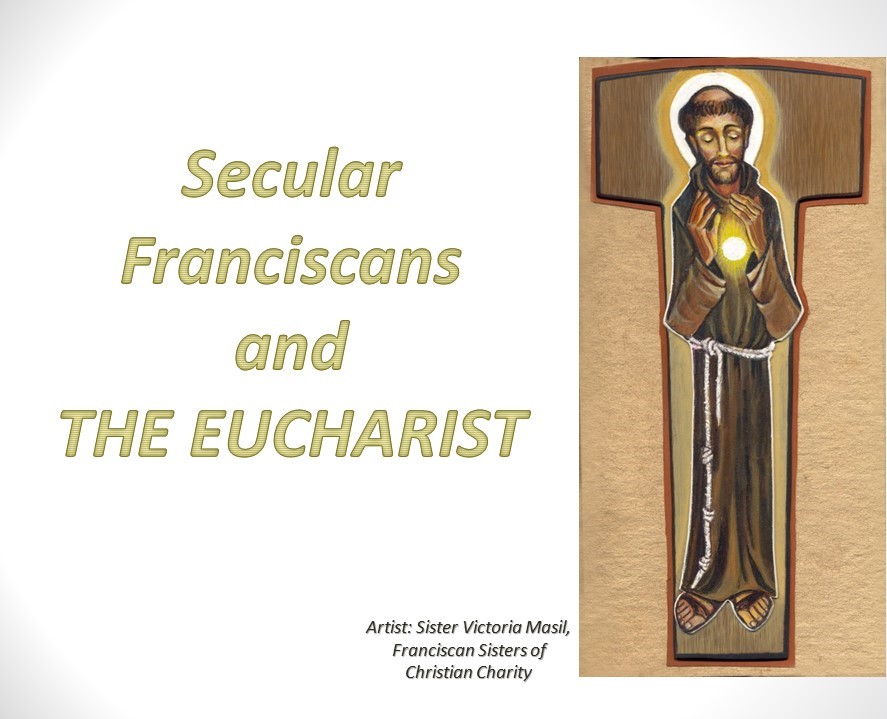
Secular Franciscans and the Eucharist – Please share with your local fraternity.
St. Francis was devoted to the Eucharist. In the first Admonition, he says. “This is my Body and the Blood of my new covenant [which will be shed for many] ;{snippet Mk 14:22} 11 and Whoever eats my flesh and drinks my blood has eternal life .{snippet Mk 14:24} 12 It is the Spirit of the Lord,{snippet Jn 6:55} therefore, That lives in Its faithful, That receives the Body and Blood of the Lord. 13 All others who do not share in this same Spirit and presume to receive Him eat and drink judgment on themselves .{snippet 1 Cor 11:29}”(The Admonitions: FA:ED, vol. 1, p. 129)
As we follow in the footsteps of our Seraphic Father, we, too, are devoted to the most precious Body and Blood of our Lord Jesus in the Eucharist. Let’s take a look at our Rule and Constitutions.
Rule Article 8: … “Let them participate in the sacramental life of the Church, above all the Eucharist….”
General Constitutions Article 14.2: (Refers to Art. 8 of the Rule) “The Eucharist is the center of the life of the Church. Christ unites us to himself and to one another as a single body in it. Therefore, the Eucharist should be the center of the life of the fraternity. The brothers and sisters should participate in the Eucharist as frequently as possible, being mindful of the respect and love shown by Francis, who, in the Eucharist, lived all the mysteries of the life of Christ.”
“The Holy Spirit builds up, animates, and sanctifies the Church. He prepares us to go out and bring others to Christ. He opens our minds to understand Christ’s death and Resurrection. He makes present for us the mystery of Christ, especially in the Eucharist, and brings us to communion with God that we may bear much fruit. (Cf. CCC
– no. 737) United States Catholic Catechism for Adults – USCCB – Page 109
GC Article 53.2 & 4 (Refers to Articles 6 & 8 of the Rule) 2.”The fraternity should come together periodically, also as a Church community to celebrate the Eucharist in a climate which strengthens the fraternal bond and characterizes the identity of the Franciscan family. Where, for whatever reason, this particular celebration may not be possible, they should participate in the celebration of the larger Church community.”
N.B. “The Eucharist, celebrated with parish members, draws us to the Church. It keeps us in touch with the local
parish and diocesan community. The fraternity may periodically celebrate Eucharist at their fraternity gatherings.
This celebration is recommended for special occasions – e.g. Professions, jubilees of profession, a memorial Eucharist for the deceased of the SFO or other important occasions.” Cf. Benedict XVI’s quote from Sacramentum
Caritatis on page 184-185 (Franciscan Journey p. 177)
“Within the Church the Eucharist is the center of our lives. Attending a parish Eucharist is highly encouraged. We need to be consistently present at the gathering of the People of God. It reminds us of our union with the Church.”
(Franciscan Journey p. 178)
Through our example, we help others to realize that Jesus is truly present in the Eucharist under the appearance of bread and wine. Please think about your relationship with Jesus in the Eucharist as you answer the questions below.
+Why is the Eucharist important to you as a Catholic? As a Franciscan?
+How do you prepare to receive the Body and Blood of Christ?
+How is the Eucharist tied to our Franciscan spirituality?
+Think about what our Rule and Constitutions say about the Eucharist. How are you opened up by these words to allow the Holy Spirit to transform you?+In what ways can you show special reverence for the Eucharist?
++++++++++++++++++++++++++
Los Franciscanos Seglares y la Eucaristía – Por favor, comparta con su fraternidad local.
San Francisco era devoto de la Eucaristía. En la primera Admonición, dice.”…como lo atestigua el mismo Altísimo, que dice: Esto es mi cuerpo y mi sangre del nuevo testamento, [que será derramada por muchos] (cf. Mc 14,22.24); 11y: Quien come mi carne y bebe mi sangre, tiene vida eterna (cf. Jn 6,55). 12De donde el espíritu del Señor, que habita en sus fieles, es el que recibe el santísimo cuerpo y sangre del Señor. 13Todos los otros que no participan del mismo espíritu y se atreven a recibirlo, comen y beben su condenación (cf. 1 Cor 11,29). (Admoniciones http://franciscanos.org/esfa/adm-ae.html )
Mientras seguimos los pasos de nuestro Seráfico Padre, nosotros también somos devotos del Cuerpo y la Sangre más preciados de nuestro Señor Jesús en la Eucaristía. Echemos un vistazo a nuestra Regla y Constituciones.
Regla Artículo 8: … “Participen de la vida sacramental de la Iglesia, epecialmente la Eucaristía… ”.
Constituciones Generales Artículo 14.2: (Véase Regla Art. 8.) “ La Eucaristía es el centro de la vida de la Iglesia. En ella Cristo nos une a Él y entre nosotros como un único cuerpo. Por lo tanto, la Eucaristía sea el centro de la vida de la Fraternidad; los hermanos participen en la Eucaristía con la mayor frecuencia posible, conscientes del respeto y amor de San Francisco, que en la Eucaristía vivió todos los misterios de la vida de Cristo.”
“El Espíritu Santo edifica, anima y santifica a la Iglesia. Él nos prepara para salir y llevar a otros a Cristo. Él abre nuestras mentes para comprender la muerte y resurrección de Cristo. Nos hace presente el misterio de Cristo, especialmente en la Eucaristía, y nos lleva a la comunión con Dios para que demos mucho fruto. (Cf. CCC
– no. 737) Catecismo Católico de los Estados Unidos para Adultos – USCCB – Página 109
CCGG, artículo 53.2 y 4 (Se refiere a los artículos 6 y 8 de la Regla) 2. (Regla 6; 8). “La Fraternidad se reúna periódicamente, como comunidad eclesial, para celebrar la Eucaristía en un clima que consolide el vínculo fraterno y exprese la identidad de la Familia Franciscana. Donde no sea posible la celebración particular, particípese en la de una más amplia comunidad eclesial.”
NB “La Eucaristía, celebrada con los feligreses, nos acerca a la Iglesia. Nos mantiene en contacto con la
comunidad local parroquial y diocesana. La fraternidad podrá celebrar periódicamente la Eucaristía en sus reuniones de fraternidad. Esta celebración se recomienda para ocasiones especiales, por ejemplo, profesiones, jubileos de profesión, una eucaristía en memoria de los difuntos de la OFS u otras ocasiones importantes”. Cf. Cita de Benedicto XVI de Sacramentum Caritatis en la página 184-185 (Jornada franciscana p. 177)
“Dentro de la Iglesia la Eucaristía es el centro de nuestra vida. Se recomienda encarecidamente asistir a una Eucaristía parroquial. Necesitamos estar constantemente presentes en la reunión del Pueblo de Dios. Nos recuerda nuestra unión con la Iglesia”. (Jornada franciscana p. 178)
A través de nuestro ejemplo, ayudamos a otros a darse cuenta de que Jesús está realmente presente en la Eucaristía bajo la apariencia del pan y el vino. Piense en su relación con Jesús en la Eucaristía mientras responda las siguientes preguntas.
+¿Por qué la Eucaristía es importante para usted como católico? ¿Como franciscano?
+¿Cómo se prepara para recibir el Cuerpo y la Sangre de Cristo?+¿Cómo se vincula la Eucaristía a nuestra espiritualidad franciscana?
+ Piense en lo que dicen nuestra Regla y Constituciones sobre la Eucaristía. ¿Cómo estas palabras le abren para permitir que el Espíritu Santo lo transforme?
+¿De qué maneras puede mostrar reverencia especial por la Eucaristía?
Diane F. Menditto, OFSChair, National Formation Commission
Formation Director, Our Lady of the Angels Region
Formation Director, St. Francis Fraternity, Hackensack, NJ
SHAPING THE FRANCISCAN FOOTPRINT – October 13 – October 19 2022
(a PDF copy for printing is attached)
Five Important Spiritual Thoughts from the Liturgy of the Word
…and follow up for the Secular Franciscan
October 13 – October 19
1 — “Beware of the
leaven–that is, the hypocrisy–of the Pharisees.” (Lk 12:1)**…Am
I hypocritical in my speech or actions?
2 – “But when the Son of Man comes, will
he find faith on earth?” (Lk 18:8)**…A resolution today:
pray the Nicene Creed slowly.Extended meditation
[see Matthew 15:28]She
had reason to dislike, hate almost, the people who had settled in her
area. Never really agreeing with the
religion they taught, she had more than enough to do to keep her family healthy
without calling on any god. Her husband
had passed away early, and her daughter had something wrong with her. She didn’t really know what it was, but she
almost thought that the devil himself had possessed her at times. She had tried the so-called professional
people who try to heal such things, but was not able to find any help for her.Then
she heard about this man who had the power to heal. He was of that faith of many of the people
around her, although she didn’t really believe it. After she heard of him and found that he was
near where she lived, she had followed him around, and watched what he was
capable of doing.So,
with a feeling that it couldn’t hurt anything, she brought her daughter to him,
but he and his school of followers refused to listen to her. She was discouraged, but finally had a chance
to speak to him directly. Her
conversation with him was at first hostile.
He had called her a name, but she answered back with her usual
straightforward way of speaking, demanding almost that he listen to her.He
finally did, and he healed her daughter.
She immediately saw what kind of man he was, and what kind of faith he
was asking of others. She accepted what
he said, becoming one of the many people who were accepting what he said. He even complimented her on her faith in him.
3 — “Take care to guard against all greed, for though one may be rich, one’s life does not consist of possessions.” (Lk 12:15)**
…Are
there some possessions that I should give away?
4 — “The Kingdom of
God is at hand for you.” (Lk 10:9)**…Do
I act as though I am proclaiming the Kingdom of God?
5 – “Much will be
required of the person entrusted with much, and still more will be demanded of the person
entrusted with more.” (Lk 12:48)**…God
has given me so much; can I name an area in particular in which I am giving
back to God?
**one of the most important passages of the Gospels