Open post

Formation Friday – Careful Reading of the Gospel – January 13, 2023

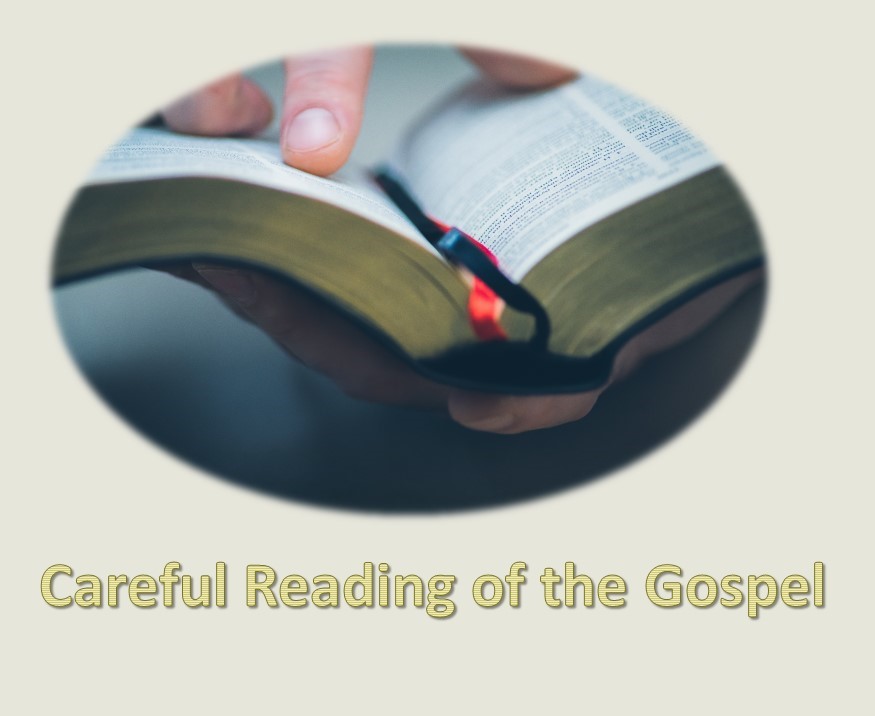
Careful Reading of the Gospel

Prepared by Justin Carisio, OFS, member, National Formation Commission

Secular Franciscan life is grounded in the gospel. This is underscored at Profession when the minister gives the newly professed a copy of the Holy Gospels as a symbolic reminder that profession is a lifelong commitment to “go from gospel to life and life to the gospel.” Article 4 of the Rule further emphasizes the continuing importance of Sacred Scripture by enjoining the brothers and sisters to “devote themselves especially to careful reading of the gospel.”

There are many ways to read, study, and pray with Scripture. I have long been a student of literature and also a writer. Here is a simple approach to “careful reading” of the four Gospels that I developed based on my experience. I’ve used it reading alone and in a group. It may be helpful to you.

Character. The Gospels tell the story of Jesus Christ, “true God and true man” (CCC 480), who walked the earth and interacted with people. They are full of memorable characters. When reading one of the Gospels, either in whole or in part, select a character. Try to picture him or her. Reflect on the drama and the experiences of that person.

Story. Each Gospel is replete with “stories.” Mary visiting Elizabeth. The marriage at Cana. Jesus calming the storm. When carefully reading a Gospel, choose a story that speaks to you and dwell on its significance and meaning.

Setting. Imagine you are a painter, photographer, or filmmaker. The Gospels present many “scenes.” Feeding the five thousand. The Transfiguration. Jesus before Pilate. In your reading, which scene would you capture? What makes it particularly vivid for you?

Beauty. The Word of God is beautiful! Consider the prologue of the Gospel of St. John. The centurion acknowledging his unworthiness. The Beatitudes. Focus on a passage simply for the inspiration and beauty of its words. Speak the passage aloud.

Franciscan spirit. Select a passage in your reading that specifically resonates with Franciscan heritage, spirituality, or way of life. What makes it Franciscan? How will it help you live the Rule this day as you go from gospel to life and life to the gospel?

The Rule says Secular Franciscans “should seek to encounter the living and active person of Christ…in Sacred Scripture” (Article 5) and go forth “proclaiming Christ by their life and words.” (Article 6) Careful reading of the Gospels will strengthen and prepare us to do both.

******************

From the OFS Rule: “The rule and life of the Secular Franciscans is this: to observe the gospel of our Lord Jesus Christ by following the example of Saint Francis of Assisi, who made Christ the inspiration and the center of his life with God and people. Christ, the gift of the Father’s love, is the way to him, the truth into which the Holy Spirit leads us, and the life which he has come to give abundantly. Secular Franciscans should devote themselves especially to careful reading of the gospel, going from gospel to life and life to the gospel.” (Article 4)

For discussion with your fraternity or a prayer partner:

· From your reading of the Gospels, you may already have a favorite character, story, or inspirational passage. Share (with a partner or in your journal) how that has helped you go “from gospel to life.”

· For ongoing formation:

o Gospel readings may be pre-chosen and read ahead of time at home.

o Follow the steps above to prepare for a fraternity discussion

o At the gathering, divide up into groups or partners (depending on the size of your fraternity.)

o Follow the steps again for the discussion. Share your ideas.

+++++++++++++++++++++++++++++++++++++

Lectura cuidadosa del Evangelio
Preparado por Justin Carisio , OFS, miembro, Comisión Nacional de Formación
(Por favor, comparta con su fraternidad)


La vida franciscana seglar se basa en el evangelio. Esto se subraya en la Profesión cuando el ministro entrega al recién profeso una copia de los Santos Evangelios como un recordatorio simbólico de que la profesión es un compromiso de por vida de “ir del evangelio a la vida y de la vida al evangelio”. El artículo 4 de la Regla enfatiza aún más la importancia continua de la Sagrada Escritura al ordenar a los hermanos y hermanas que “se dediquen especialmente a la lectura cuidadosa del evangelio”.

Hay muchas maneras de leer, estudiar y orar con las Escrituras. Durante mucho tiempo he sido estudiante de literatura y también escritor. Aquí hay un enfoque simple para la “lectura cuidadosa” de los cuatro Evangelios que desarrollé en base a mi experiencia. Lo he usado leyendo solo y en grupo. Puede ser útil para usted.

Personaje-Los Evangelios cuentan la historia de Jesucristo, “verdadero Dios y verdadero hombre” (CCC 480), que caminó sobre la tierra e interactuó con la gente. Están llenos de personajes memorables. Cuando lea uno de los Evangelios, ya sea en su totalidad o en parte, seleccione un personaje. Trate de imaginarlo. Reflexione sobre el drama y las vivencias de esa persona.

Historia-Cada Evangelio está repleto de “historias”. María visitando a Isabel. Las bodas de Caná. Jesús calmando la tormenta. Cuando lea cuidadosamente un Evangelio, elija una historia que le hable y reflexione sobre su importancia y significado.

Escenario-Imagine que es pintor, fotógrafo o cineasta. Los Evangelios presentan muchas “escenas”. Alimentando a los cinco mil. La Transfiguración. Jesús ante Pilato. En su lectura, ¿qué escena capturaría? ¿Qué lo hace particularmente vívida para usted?

Belleza-¡La Palabra de Dios es hermosa! Considere el prólogo del Evangelio de San Juan. El centurión reconociendo su indignidad. Las Bienaventuranzas. Concéntrese en un pasaje simplemente por la inspiración y la belleza de sus palabras. Lea el pasaje en voz alta.

Espíritu franciscano-Seleccione un pasaje en su lectura que resuene específicamente con la herencia, espiritualidad o forma de vida franciscana. ¿Qué lo hace franciscano? ¿Cómo le ayudará a vivir la Regla hoy al pasar del evangelio a la vida y de la vida al evangelio?

La Regla dice que los franciscanos seglares “deben buscar el encuentro con la persona viva y activa de Cristo… en la Sagrada Escritura” (artículo 5) y salir “proclamando a Cristo con su vida y sus palabras”. (Artículo 6) La lectura cuidadosa de los Evangelios nos fortalecerá y preparará para hacer ambas cosas.

******************

De la Regla OFS: “La Regla y la vida de los Franciscanos seglares es ésta: guardar el santo Evangelio de nuestro Señor Jesucristo siguiendo el ejemplo de San Francisco de Asís, que hizo de Cristo el inspirador y centro de su vida con Dios y con los hombres. Cristo, don del amor del Padre, es el camino hacia Él, es la verdad en la cual nos introduce el Espíritu Santo, es la vida que Él ha venido a dar abundantemente. Los Franciscanos seglares dedíquense asiduamente a la lectura del Evangelio, pasando del Evangelio a la vida y de la vida al Evangelio.“ (Artículo 4)

Para platicar en la su fraternidad o con un compañero de oración:

  • De su lectura de los Evangelios, es posible que ya tenga un personaje, una historia o un pasaje inspirador favorito. Comparta (con un compañero o en su diario) cómo eso le ha ayudado a ir “del evangelio a la vida”.
  • Para la formación permanente:
    • Las lecturas del Evangelio pueden elegirse previamente y leerse con anticipación en casa.
    • Siga los pasos anteriores para prepararse para la discusión de fraternidad
    • En la reunión, divídanse en grupos o parejas (dependiendo del tamaño de su fraternidad).
    • Siga los pasos nuevamente para la discusión. Comparta sus ideas.

Diane F. Menditto, OFS

Vice Minister, National Fraternity, Secular Franciscan Order USA
Listen – Discern – Go Forth National Theme 2022-2025

Open post

SHAPING THE FRANCISCAN FOOTPRINT – January 5 – January 11 2023


(PDF of the article attached for printing)


Five Important Spiritual Thoughts from the Liturgy of the
Word

…and follow up for the Secular Franciscan

January 5 – January 11


1 — “There is no duplicity in him.” (Jn 1:47)

NO
DUPLICITY


“Here is a true child of Israel. There is no duplicity in him.”

(John 1:47)


“May it be done to me according to your word.”

(Luke 1:38)


Duplicity is an interesting English word. Our dictionary defines it to be “deceitfulness or double dealing.” It comes ultimately from the Latin duplicitas meaning two-fold. Jesus calls Nathanael
to be a person with no duplicity.

In Jesus’ mind, he was a person of openness and sincerity. Mary in her “Yes” to God shows no duplicity, but only sincerity.

Much like a person described this way. A person with no duplicity would be a person who wants to teach the world to sing in perfect harmony. He would snuff out all fires of hatred and the lie.

He wants to launch an all-out love attack which may indeed be out of style but he wants to put it back in vogue. He tells the world: “Don’t delay, act now, supplies are running out.

There might be a tomorrow, but if the offer is shunned, you might as well be walking on the sun. It is not a joke: when a mother’s handkerchief is soaked with tears because her child has died because
of his/her own free will.

Don’t sit back, kick back and watch the world get bushwhacked. Watch the news at 10:00, your neighborhood is under attack. You need to be around when your own child is old enough to relate to you.”
(see “Walkin on the Sun,” Smash Mouth)


Or in the words of John F. Kennedy:

Of those to whom much is given, much is required.

And when at some future date, the high court of history sits in judgment of
each of us—

recording whether in our brief span of service,

we fulfilled our responsibilities to the state—

our success or failure, in whatever office we may hold,

will be measured by
the answers to four questions—

were we truly men of courage…

were we truly men of judgment…

were we truly men of integrity…

were we truly men of dedication?

And directed to the Christian, were we
truly people of sincerity as Jesus looked at our lives?


2 — “Do whatever he tells you.” (Jn 2:5)

…Do I always listen and follow the words of the Lord?


3 – “Then they opened their treasures and offered
him gifts.”
(Mt 2:11)

…Have I given myself completely to the Lord?


4 – “A new teaching with authority.” (Mk 1:27)

…Have I allowed the Vision of Jesus teaching to permeate my whole life?


5 – “Rising very early before dawn, he left and went off to a deserted place, where he prayed.” (Mk 1:35)

…What percentage of my day (week) is spent in prayer?


Centenaries – Part 2 Celebrating the Rule 1223-2023

(Part 2 Centenaries – This article originally appeared in the TAU-USA Fall 2022 Issue 107 pages 7-9)

Celebrating the Rule 1223-2023

Texts

Later Rule 1:1, FF 75; Rule of St. Clare 1:1, FF 2750; Rule of the Brothers and Sisters of the Third Order Regular 1:1; Rule of the Brothers and Sisters of the Secular Franciscan Order 2:4, FF 3424; Testament 14-15, FF 116; Anonymous of Perugia 11, FF 1497.

All members of the Franciscan Family profess a Rule that becomes a pattern of life and consists in observing the Gospel. As we celebrate the Later Rule, we are reminded that for Francis of Assisi, the nucleus of his Rule was the Gospel, as he stated in his Testament: “The Most High Himself revealed to me that I should live according to the pattern of the Holy Gospel. And I had this written down simply and, in a few words, and the Lord Pope confirmed it for me” (Testament 14- 15, FF 116). Having listened prayerfully to the words of Jesus Christ, Francis and his first brothers exclaimed: “‘This is what we want; this is what we were seeking.’ And blessed Francis said: ‘This will be our rule’” (The Anonymous of Perugia 11, FF 1497).

No member of the Franciscan Family professes his own Rule privately, because he is called to live the Gospel in fraternity. It is important to remember that Francis composed the Later Rule at a time in his life when he was dealing with a lot of tension and crises at the fraternal level, but he never renounced the prophetic vision of living as a brother to all and he invites us to do the same. Today the Church, in promoting its synodal and communal dimensions, points to Francis of Assisi as a model of fraternity, calling him the “saint of fraternal love” (Fratelli tutti 2). His words and deeds can again, after eight hundred years, illuminate the path of an ecclesial community that seeks to become an outgoing, synodal Church, listening to all, in solidarity with the least, bearing the good news that has the power to fill the lives of those who accept it with joy and meaning (cf. Evangelii gaudium 21).

Celebrating the Later Rule as a Franciscan Family gives us an opportunity to get to know each other better. It promotes communion and fosters mutual trust among ourselves. It lets us rediscover the importance of dreaming together, it opens new evangelical paths that help us become a more open and outgoing fraternity, a fraternity that can generate a new culture of encounter and social friendship, a fraternity that strives to reach out to all members of society, “each of us bringing the richness of his or her beliefs and convictions, each of us with his or her own voice, brothers and sisters all” (Fratelli tutti 8).

Our being in Christ

The Rule consists in “observing the Holy Gospel of Our Lord Jesus Christ” (Later Rule 1:1, FF 75).

Objective

To love and better understand the Rule we have professed.

Activities

  • Assess the impact of the Gospel and the Rule we have professed in our daily lives.
  • Use passages from the Rule to enrich our prayer life.
  • Constantly evaluate ourselves in the light of the Rule, in such a way that it can illuminate personal and fraternal discernment.

Our bring brothers and sisters

“For if a mother loves and cares for her son according to the flesh, how much more diligently must someone love and care for his brother according to the Spirit!” (Later Rule 6: 8, FF 91).

Objective

To rediscover the fundamental importance of the Rule for protecting and nurturing fraternal life.

Activities

  • Organize study days and reflections about our Rule in order to seek together, in fraternity, the most suitable ways to embody it in our daily activities.
  • Encourage time for meetings that allow us to improve the quality of relationships within our families, our fraternities, our work areas, etc.
  • Promote initiatives, in collaboration with other members of the Franciscan Family, which foster mutual knowledge and increase fraternal communion.

Our being in communion

“Steadfast in the Catholic Faith, we may observe poverty, humility, and the Holy Gospel of our Lord Jesus Christ as we have firmly promised.” (Later Rule 12: 4, FF 109).

Objective

To restore meaning and significance to our way of living the Rule in the Church, promoting fraternity and synodality as ecclesial styles.

Activities

  • Confirm whether the way we live our Rule, which we have professed in the Church, prompts us to carry out our pastoral work and our apostolic activities in communion with the local and universal Church.
  • Participate in the synodal journey undertaken in our local Churches, valuing the variety of gifts and charisms that the Holy Spirit arouses to benefit the entire human family.
  • Where possible, publicly renew the profession of our Rule.

Our being in the world

[They are] “not to quarrel or argue or judge others when they go about in the world” (Later Rule 3: 10, FF 85).

Objective

Starting from our witness of fraternity and minority in living our Rule, collaborate in building bonds of unity within society and the institutions that comprise it.

Activities

  • Promote proposals aimed at reinvigorating relationships among members of Christian communities, as well as between those communities and other social and religious groups, nurturing a culture of encounter and social friendship.
  • Enhance the evangelizing power of the cultural and artistic heritage that belongs to the Franciscan Family, in such a way that it becomes an instrument of encounter and dialogue with contemporary society.

Part 1 Posted January 2, 2023 pages 4-6; Part 3 next)

https://www.secularfranciscansusa.org/2023/01/09/centenaries-part-2-celebrating-the-rule-1223-2023/

Open post

FORMATION FRIDAY – Exam 2022-23 (continued from Dec. 30) – January 6, 2023

Examen 2022-23 [Continued from December 30, 2022] Please share with your local fraternity


Past and present Formation Fridays can be found here: https://www.dmf-ofs.org/

A Litany and Examination of Conscience based on the Rule of the Secular Franciscan Order


Thank you to Judith W. Tyrrell, OFS, for giving us permission to use her work

St. Margaret of Cortona Region

Response: Lord, have mercy.

21. For the times I did not simplify my own material needs after Christ’s example of poverty…R:

22. For the times I failed to be a good steward of God’s gifts…R:

23. For the times I did not believe that living the Beatitudes would make me happy…R:

24. For the times I have not embraced my vocation with purity of heart…R:

25.For the times I have not gently and courteously welcomed every person as a gift from the Lord and as an image of Christ…R:

26. For the times I have not wanted to place myself on an equal basis with all people…R:

27. For the times I have lacked a sense of community and chosen isolation…R:

28. For the times I have not strived to create better conditions of life for the lowly and needy…R:

29. For the times I have lacked a spirit of selfless service…R:

30. For the times I have not used my talents to build the Kingdom of God…R:

31. For the ways I failed to promote justice both privately and publicly…R:

32. For the times when I have failed to make choices in harmony with my faith…R:

33. For the times I have not esteemed work both as a gift and as a sharing in the creation, redemption, and service of the human community by bringing the love of Christ to the marketplace…R:

34. For the times I have not cultivated a spirit of peace, fidelity, and respect for life in my family…R:

35. For the times as husband and wife we have not borne witness to the love of Christ for His Church to our children…R:

36. For the times I have not shown respect for all God’s creatures …R:

37. For the times I have not encouraged the proper use and protection of natural resources- . .R:

38. For the times I have not been a peacemaker, seeking ways of unity and harmony through dialogue…R:

39. For the times I have not been a messenger of perfect joy, striving to bring joy and hope to others…R:

40. For the ways I have failed to approach Sister Death with peace…R:

+Which articles of the Rule correspond to each line of the litany?

+Choose two or three of the items above each day and make them the center of your prayer.

+How does our Rule inspire us to daily conversion?

+Come back to this litany throughout 2023. How are you changing in your life as a Catholic and as a Franciscan?

+++++++++++++++++++++++++++++++++++

Letanía y examen de conciencia basados en la Regla de la Orden Franciscana Seglar

[Continuación del 30 de diciembre 2022]


Gracias a Judith W. Tyrrell, OFS, por darnos permiso para usar su trabajo.

Región de Santa Margarita de Cortona


Respuesta: Señor, ten piedad.


21. Por las veces en que no simplifiqué mis propias necesidades materiales siguiendo el ejemplo de pobreza de Cristo .R:


22. Por las veces que fallé en ser un buen administrador de los dones de Dios … R:


23. Por las veces que no creía que vivir las Bienaventuranzas me haría feliz … R:


24. Por las veces que no he abrazado mi vocación con pureza de corazón … R:


25. Por las ocasiones cuando no he acogido gentil y cortésmente a cada persona como un don del Señor y como una imagen de Cristo … R:


26. Por las veces no he querido colocarme en igualdad de condiciones con todas las personas … R:


27. Por las veces que me ha faltado un sentido de comunidad y he elegido el aislamiento … R:


28. Por las veces que no me he esforzado por crear mejores condiciones de vida para los humildes y necesitados … R:


29. Por las veces que me ha faltado un espíritu de servicio desinteresado … R:


30. Por las veces que no he usado mis talentos para construir el Reino de Dios … R:


31. Por las formas en que fracasé en promover la justicia tanto en privado como en público … R:


32. Por los momentos en que no he podido tomar decisiones en armonía con mi fe … R:


33. Por las veces que no he estimado el trabajo como un don y como una participación en la creación, redención y servicio de la comunidad humana llevando el amor de Cristo al mercado … R:


34. Por las veces que no he cultivado un espíritu de paz, fidelidad y respeto por la vida en mi familia … R:


35. Porque las veces que como esposo y esposa no hemos dado testimonio del amor de Cristo por Su Iglesia a nuestros hijos … R:


36. Por las veces que no he mostrado respeto por todas las criaturas de Dios … R:


37. Por las veces que no he fomentado el buen uso y protección de los recursos naturales-. .R:


38. Por las veces que no he sido un pacificador, buscando caminos de unidad y armonía a través del diálogo … R:


39. Por las veces que no he sido un mensajero de la alegría perfecta, esforzándome por llevar la alegría y esperanza a los demás … R:


40. Por las formas en que no he podido acercarme a la Hermana Muerte con paz … R:


Preguntas para platicar o comentar en su diario.


+ ¿Qué artículos de la Regla corresponden a cada línea de la letanía?

+ Elija dos o tres de los elementos anteriores cada día y conviértalos en el centro de su oración.

+ ¿Cómo nos inspira nuestra Regla a la conversión diaria?

+ Regrese a esta letanía a lo largo de 2023. ¿Cómo está cambiando en su vida como católico y como franciscano?


Diane F. Menditto, OFS
Vice Minister, National Fraternity, Secular Franciscan Order USA
Listen – Discern – Go Forth National Theme 2022-2025


Open post

SHAPING THE FRANCISCAN FOOTPRINT – December 29 2022 – January 4 2023


(PDF attachment below for printing)


Five Important Spiritual Thoughts from the Liturgy of the Word

…and follow up for the Secular Franciscan

December 29 – January 4

1
— “Lord, now let your servant go in peace.”
(Lk 2:29)

…As I study my own death, am I truly ready to meet the Lord?


2
– “I write to you not because you do not know the truth,

but because you do, and because every lie is alien to the truth.”
(1 Jn 2:21)

THE LIE AND THE TRUTH

“You belong to your father the devil and you
willingly carry out your father’s desires. He was a murderer from the beginning
and does not stand in truth, because there is no truth in him. When he tells a
lie, he speaks in character, because he is a liar and the father of lies.”

(John 8:44)


It is a challenge to try to get into
the mind of the human Jesus as he spoke to the religious leaders of his time.
These were the people who accepted the office to be the people who would direct
their fellow Israelites toward a better understanding of the law of Moses. And in Jesus’s mind, they were not doing a
very good job.

It is a challenge because Jesus spoke
often of “love” to be the fundamental guide to behavior as he established his
kingdom here on earth. And yet he was almost “mean” to the religious leaders.
He spoke harsh words, calling them “devils” and telling them directly that there was no “truth” in them, that their “character” was that of a liar.

Of course, the explanation of this is part of the understanding of “tough love” as the modern world has called
it. “Tough love” are words that sound
like words of hatred, but really are nothing more than the truth. And sometimes that truth must be spoken in a harsh way.

It is extremely difficult for adults to be the recipients of “tough love” from another.
Generally, we simply will not want to hear it, and therefore we will ignore it.

A classic case for modern man or woman is the horrible addiction of alcoholism or dependence on illegal drugs. Unfortunately, there are many who find their
death early on because of the addiction.
But sometimes there is a conversion.

The man was a very talented pilot for a
large airline in our world. But he had given into the addiction that alcohol can have on a human being. He even performed his task as captain of a
plane in the state of intoxication. It was in such a situation that he was finally discovered. The plane had crashed with a hundred people
on board, but not because of him. In fact, he was such a talented pilot that he saved the majority of the people, losing only a handful.

But as the official agency investigated the accident, they found that he was actually intoxicated. He tried to lie his way out of it, but in the
end he finally saw what his lies were doing to him. His speech in prison concerning his
alcoholism is a classic statement that should be studied by all of us as we
look at our understanding of the truth and how we share it.

“It was as if I had reached my life-long limit of lies,” he told his inmates, “I could not tell one more lie. At least, [now] I’m sober. I thank God for
that, I’m grateful for that. For the first time in my life, I’m free.”
(Movie, “Flight”)

True conversion is never easy. It never was; it never will be.


3
– [Jesus] came to what was his own,
but his own people did not accept him. (Jn 1:11)

…Have I completely accepted what Jesus has said?


4
– “There is one among you whom you do not recognize.”
(Jn 1:26)

…Do I recognize that the Lord is present in my every situation?


5
— He said to them, “Come, and you will see.”
(Jn 1:39)

…Am I showing by my life that I have come and actually seen the Lord?


Scroll to top
Juan de Padilla