Franciscan Centenaries

(This article originally appeared in the TAU-USA Fall Issue #107 first part pages 4-6)

General Observations

  1. Themes

The five centenaries are part of a single thematic Centenary, which will develop gradually and harmoniously according to the chronology of the events celebrated.

The key themes proposed for the celebration of the centenaries are considered from multiple perspectives, present in each celebration. These will specifically refer to the theological dimension (our being in Christ); the anthropological dimension (our being brothers and sisters); the ecclesiological dimension (our being in communion); and the sociological dimension (our being in the world).

The documents of the Magisterium of the Church, understood from the Franciscan charismatic perspective, are used to provide a theological baseline. The celebration of each centenary is a promising opportunity for the Franciscan Family to support the ecclesial reform that the Pope is carrying out in his pontificate.

The basic purpose for celebrating the centenaries is to direct our gaze to the future and to strengthen our Franciscan identity and charism.

  1. Recipients

First, the proposed themes are to be worked on and developed by our brothers and sisters all over the world. Therefore, the integration of all cultures must be standard practice.

The celebration of the centenaries is undoubtedly a good occasion to make the Franciscan Family visible in its entirety. Therefore, it would be very fitting for all activities and initiatives, at the national and/or regional level, to be coordinated by a commission representing the entire Franciscan Family.

Ad intra and Ad extra: The centenaries are not intended to have a positive impact only within the Franciscan Family. Imagination and creativity must be brought to bear so that the centenaries impact out-wardly upon non-ecclesial social and cultural environments.

  1. Methodology

We have already indicated the importance of the theological, anthropological, ecclesiological and sociological dimensions, which, as cross cutting components, should guarantee unity and thematic continuity during this multi-year celebratory event. All of these dimensions play an important role in the ad intra programs, but perhaps the anthropological and sociological dimensions could be further enriched in the ad extra programs.

There is a risk that these proposals could remain too focused on the theoretical and intellectual aspects. Therefore, it would be appropriate to define, for each of the proposed themes, what objective is being pursued and to recommend an activity, so that the experiential and practical dimensions can be made more dynamic.

The activities are suggested in a very general way, since they should be made more concrete based on various real-life contexts.

The themes herein can be further explored and developed through lectures, meetings, Chapters of Mats, exhibitions, pilgrimages, mission experiences, etc.

Celebrating the Centenary as a Franciscan Family

Tres ordines hic ordinat: primumque fratrum nominat mino- rum pauperumque fit dominarum medius sed poenitentum tertius sexum capit utrumque.

Three were the Orders he arrayed: The Friars Minor he called the first; and the Poor Ladies were next, becoming the middle Order. Then thirdly came the Penitents, comprising men and women.

This is how we would have prayed the antiphon for Morning Prayer in the ancient Rhythmic Office by Julian of Speyer. He wrote it in 1235, for the canonization of St. Francis of Assisi. The antiphon mentions the direct filial relationship between the Saint and the three Orders. The first he called the Friars Minor, the second he called the Poor Ladies, and the third was for men and women who wanted to follow Jesus on the path of penance according to Francis. In the antiphon, verb ordinat is chosen to highlight the style of organization that belongs to the Franciscan Family. It is not reducible to a juridical structure, but rather indicates the reciprocity inherent in the bond of community, which is typical of the Franciscan charism.

The gift that St. Francis received from the Divine Giver is most fully realized in its complementarity and lively reciprocal communion. This is a motivating force in the lives of “all those who love the Lord with their whole heart” (First Version of the Letter to the Faithful 1, FF 178/1). Therefore, as a Franciscan Family, we invite everyone who is attracted to the evangelical beauty of the Poverello (cf. Laudato si’ 10) to join us in celebrating these centenaries. The centenaries offer us a valuable opportunity to invigorate the richness of our charism with a prophetic vision toward the future.

Moreover, we want to celebrate them in keeping with the mindset that comes with this gift we have received. Indeed, the hagiographic sources tell us that Francis of Assisi died naked, with nothing of his own: “He asked to be taken to Saint Mary of the Portiuncula so that he might yield up the spirit of life…he threw himself in fervor of spirit totally naked on the naked ground” (Major Legend 14:4, FF 1240). His whole life was a journey of living sine proprio, that is, a life of giving back, from the beginning of his conversion, because only the man who keeps nothing for himself, but gives all of himself, is able to walk in fraternity, guided by his desire for the Supreme Good: “Let us refer all good to the Lord, God Almighty and Most High, acknowledge that every good is His, and thank Him, “from Whom all good comes, for everything.” (Earlier Rule 17:17, FF 49). The Poverello recognized that everything in his life was a free gift of God’s love, as he himself affirms in his Testament: “The Lord gave me thus to begin doing penance…the Lord gave me some brothers… the Most High Himself revealed to me that I should live according to the pattern of the Holy Gospel.” (Testament 1-14, FF 110-116). He not only received divine gifts but also chose to give them back, so today, eight hundred years later, we can celebrate these five centenaries as a Franciscan Family. The centenaries invite us to live according to the concept of receiving love and transforming it into self-giving and giving back to others.

Let us begin, sisters and brothers, because now it is up to us to give back to others the gifts that Brother Francis gave to us.

Next two Posts will be Celebrating the Rule 1223-2023; Celebrating Christmas at Greccio 1223-2023.

https://www.secularfranciscansusa.org/2023/01/02/franciscan-centenaries/
Open post

FORMATION FRIDAY – Examen 2022-23 – Dec 30, 2022

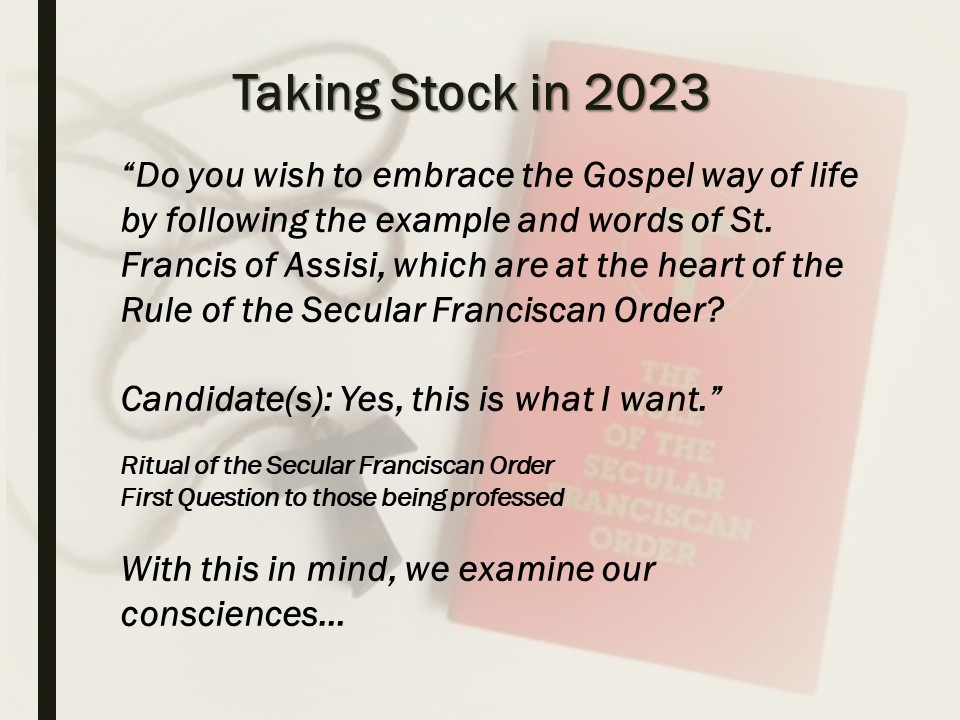
A Litany and Examination of Conscience based on the Rule of the Secular Franciscan Order

Thank you to Judith W. Tyrrell, OFS, for giving us permission to use her work

St. Margaret of Cortona Region

Response: Lord, have mercy.

1. For all the ways I have brought division to my family, my community, my parish, or my fraternity…R:

2. For all the ways I haye not been life-giving, making present the charism of St. Francis to my family, friends, and fraternity brothers and sisters…R:

3. For all the ways I have not appreciated the unique gifts of each individual…R:

4. For all the ways I have failed to strive for holiness…R:

5. For the times I have not looked to St. Francis as a model and source of inspiration…R:

6. For the times I did not strive for perfect charity…R:

7. For the ways I did not live the Gospel in the manner of St. Francis, from Gospel to life and life to the Gospel…R:

8. For the times that Christ-the Way, the Truth and the Life-has not been the center of my life…R:

9. For the times I have not been alive with the Spirit of St. francis …R:

10. For the times the Eucharist has not been my key encounter with the living Chdst, after the example of St. Francis…R:

I l. For the times I have not looked for Christ in the Scriptures, in the Eucharist, in the Sacrament of Reconciliation and other Sacraments and in my brothers and sisters…R:

12. For the times I have not proclaimed Christ by my life and my words…R:

13. For the times I have not responded to the call to ..rebuild the Church”…R:

14. For the ways I have not lived in fuIl communion with the pope, bishops, and priests…R:

I5. For the times I have stifled the interior call to conversion…R:

16. For the times I have neglected the source ofgrace and mercv in the Sacrament of Reconciliation…R:

17. For the times I have failed to worship the Father in prayer…R:

18. For the times I have not showed my love for Mary by imitating her self-giving and confident prayer…R:

19. For the times I have not faithfully fulfilled the duties of my state of life…R:

20. For the times I did not witness like the poor and crucified Christ in difficulties and persecution…R:

To be continued on January 6, 2023


Questions for discussion or to comment on in your journal.

+Which articles of the Rule correspond to each line of the litany?

+Choose two or three of the items above each day and make them the center of your prayer.

+How does our Rule inspire us to daily conversion?

+Come back to this litany throughout 2023. How are you changing in your life as a Catholic and as a Franciscan?

+++++++++++++++++++++++++++++++++++++++++


Letanía y examen de conciencia basados en la Regla de la Orden Franciscana Seglar


Gracias a Judith W. Tyrrell, OFS, por darnos permiso para usar su trabajo.

Región de Santa Margarita de Cortona


Responder: Señor, ten piedad.


1. Por todas las formas en que he traído división a mi familia, mi comunidad, mi parroquia o mi fraternidad … R:


2. Por todas las formas en que no he sido vivificante, haciendo presente el carisma de San Francisco a mi familia, amigos y hermanos y hermanas de la fraternidad … R:


3. Por todas las formas en que no he apreciado los dones únicos de cada individuo … R:


4. Por todas las formas en que he fallado en esforzarme por la santidad … R:


5. Por los tiempos cuando no he visto a San Francisco como modelo y fuente de inspiración … R:


6. Por los tiempos en que no luché por la caridad perfecta … R:


7. Por las formas en que no viví el Evangelio a la manera de San Francisco, pasando del Evangelio a la vida y de la vida al Evangelio… R:


8. Por las veces que Cristo—“Camino, Verdad y Vida”–no ha sido el centro de mi vida … R:


9. Por los tiempos que no he estado vivo con el Espíritu de San Francisco … R:


10. Por las veces que la Eucaristía no ha sido mi encuentro clave con el Cristo vivo, a ejemplo de San Francisco … R:


11. Por las veces que no he buscado a Cristo en las Escrituras, en la Eucaristía, en el Sacramento de la Reconciliación y otros Sacramentos y en mis hermanos y hermanas … R:


12. Por las veces que no he proclamado a Cristo con mi vida y mis palabras … R:


13. Por las veces que no he respondido al llamado de .. reconstruir la Iglesia “… R:


14. Por las formas en que no he vivido en plena comunión con el Papa, los obispos y los sacerdotes … R:


I5. Para las veces que he reprimido la llamada interior a la conversión … R:


16. Por las veces que he descuidado la fuente de la gracia y la misericordia en el Sacramento de la Reconciliación … R:


17. Por las veces que no he adorado al Padre en la oración … R:


18. Por las veces que no he mostrado mi amor a María imitando su oración de entrega y confianza … R:


19. Por las veces que no he cumplido fielmente los deberes de mi estado de vida … R:


20. Por las veces no presencié como el Cristo pobre y reconciliado en las dificultades y persecuciones … R:


Continuará el 6 de enero de 2023


Preguntas para platicar o comentar en su diario.


+ ¿Qué artículos de la Regla corresponden a cada línea de la letanía?

+ Elija dos o tres de los elementos anteriores cada día y conviértalos en el centro de su oración.

+ ¿Cómo nos inspira nuestra Regla a la conversión diaria?

+ Regrese a esta letanía a lo largo de 2023. ¿Cómo está cambiando en su vida como católico y como franciscano?


Diane F. Menditto, OFS
Vice Minister, National Fraternity, Secular Franciscan Order USA
Listen – Discern – Go Forth National Theme 2022-2025
Open post

SHAPING THE FRANCISCAN FOOTPRINT – December 22 – December 28 2022

(PDF copy is attached)

Five Important Spiritual Thoughts from the Liturgy of the Word

…and follow up for the Secular Franciscan

December 22 – December 28


1 — “My soul proclaims the greatness of the Lord.” (Lk 1:46)

…Have I placed anything as more important than God in my life?


2 – “…to guide our feet into the way of peace.” (Lk 1:79)


3 — “Glory to God in the highest and on earth peace to those on whom his favor rests.” (Lk 2:14)

Extended meditation:

PEACE

The man prided himself on bringing peace to the entire world. He held a ceremony that officially closed the shrine of the God of War, a symbol that war had ceased forever. In fact, he looked on himself as more than a man and the people under him began to think of him almost as a god. People were making his birthday to be the first day of a new year because it marked the beginning of good news for all the world. They were calling him the “savior of the whole world.” From that moment on, he knew that his name symbolized peace. His name: Caesar Augustus, ruler of the Roman Empire from 44 BCE till 14 CE.

The evangelist Luke must have had all of that in mind as he wrote the beginning passage describing Jesus in his Gospel. Luke put everything connected with the birth of Jesus into the setting with Caesar Augustus, the emperor who established a temporary peace, and he did it purposely. The facts of chronological time and history do not at all match what Luke says. History does not have any record of Caesar Augustus making any such decree. We know that Quirinius conducted a census, but it was not in Galilee where Joseph was nor was it at a time that matched Jesus’ time of birth. The feeling of many Scripture scholars is that Luke deliberately set up a parallel for us to study. As Caesar Augustus historically was to bring the hope of peace forever, so Jesus was to bring hope of real peace, true peace forever.

Such a peace was going to come with a price. Jesus was to discover that later in his life. As one studies history and the people who really wanted peace in the world, we see what happened to them. In bringing about peace, most of them had to resort to violence, as it did for Caesar Augustus and eventually it was violence that took them out of power. History shows a continual contrast between the force of good and the force of evil.

That force of good, of course, translated to Christianity, is the force of God through Jesus and we are not unlike those who wanted peace for the world. We must decide what to do with the good that we possess even as we also see the possibility of evil in our lives. Every one of us in our own way can bring peace into our personal world.

I suggest that you watch a movie called “War Horse”. As World War I progressed, it destroyed the quality of life of thousands of people and because of the time, horses. The writers of the screenplay present a scene in miniature of the horrors of war and the guide to peace. Joey, the war horse, is thrown onto the field of war known as “No Man’s Land.” Frightened, he rushes through German trenches, eventually heading for British troops. As he does, he pulls up barbed wire fencing until he is totally entangled in it, and is completely immobile. Two soldiers, one British, the other German, collaborate in finally freeing the animal. The scene presents the only remedy for war—people communicating with one another to eliminate the problem, thus bringing about peace.

The peace of Caesar Augustus, of both World Wars and indeed every war, as all of the moments of peace in history, was short-lived. But the peace of Jesus Christ is not, because it has a divine foundation. It is real, just as real as we are and we have the means to bring it about if we want to.


4 – “He came to what was his own, but his own people did not accept him.” (Jn 1:10)

…In what ways have I not accepted the Lord into my life?


5 – “He saw and believed.” (Jn 20:8)

…Do I “see” the Lord by a continual reading of the Gospels; do I show my belief in my actions?


Franciscans invited to Chapter of Mats in Rome Nov. 14-19, 2024

Tibor Kauser

Have you ever dreamed of celebrating in joy and fraternity with Franciscans from around the world?

The opportunity is coming Nov. 14-19, 2024, in Rome, Italy, with the Chapter of Mats for the Secular Franciscan Order and YouFra.

This will follow the XVII Ordinary General Chapter of the Secular Franciscan Order Nov. 9-14, 2024.

Although the event is nearly two years away, those interested are asked to let their regional ministers know by Jan. 15, 2023.  Your indication of interest is non-binding but will help the international council plan for the event.

Participation is not limited to professed members of the OFS.  All Secular Franciscans and their families are invited along with spiritual assistants and YouFra members, according to Tibor Kauser, OFS, the CIOFS minister general.

“In the spirit of our Franciscan charism, the Chapter of Mats will be very simple, and intentionally kept at low costs, so that nobody will have difficulties to pay the necessary costs,” Tibor said.

OFS families will host many participants in Italy while others will be hosted in convents and retreat houses with simple accommodations.  This is to help keep the cost of participation down.  Travel will be organized and paid by each participant.  There will be a solidarity fund to help those who do need it, but financial resources will be limited, said Tibor.

An estimated 3,000 and 10,000 brothers and sisters are expected to attend.

The Chapter of Mats is intended to strengthen Franciscan spirituality, renew our sense of belonging and contribute to celebrating the Franciscan Centenaries that begin in 2023.

Read Tibor’s letter about the Chapter of Mats for more information.

Chapter of Mats English

Chapter of Mats En Espanol

https://www.secularfranciscansusa.org/2022/12/27/franciscans-invited-to-chapter-of-mats-in-rome-nov-14-19-2024/

Open post

Formation Friday December 23, 2022

Thank you to Anne Mulqueen, OFS, Spiritual Assistant to the National Formation Commission


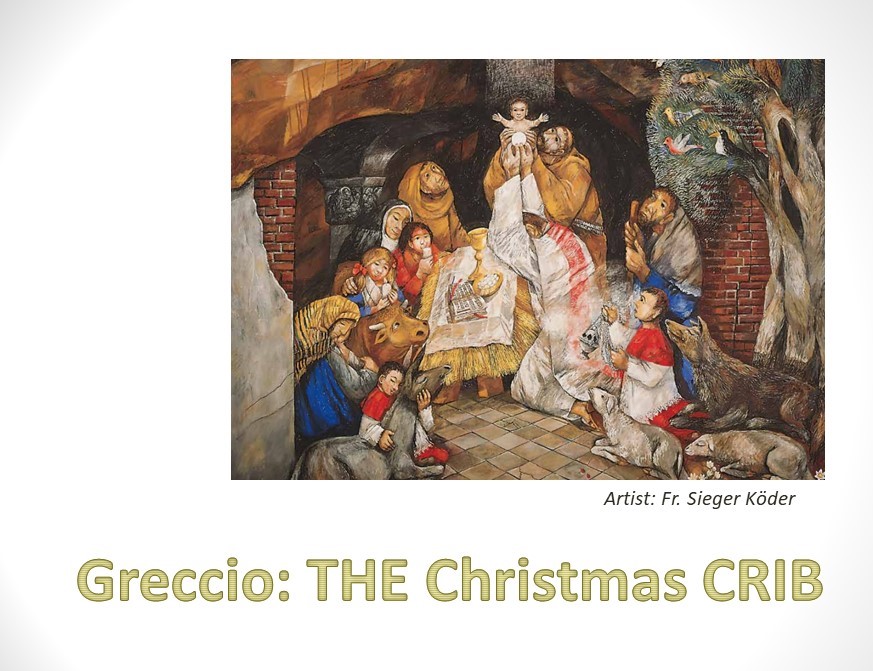
It is said that Christmas is a time for children, but I say Christmas is a time for all who have not lost the wonder, joy and delight in celebrating the gift of the birth of a baby, human and divine, who came to earth to be one of us. On Christmas eve, 1223, our Father Francis made his ardent love for the Incarnation of God tangible through the reenactment of Bethlehem in a cave in Greccio.


In the First Life of St. Francis, Thomas of Celano writes that Francis wanted the birth of Christ to come alive, presenting anew the birth of the baby Jesus in a cave in Greccio. Francis wanted this event to be, noted and recalled with reverent memory. It is almost eight hundred years later, and we continue to display the Christmas creche in our homes and in our churches. And so during this Christmastide, let us set aside time to recall with reverent memory the wonder of the Incarnation as we gaze on the crib that holds Mary’s baby.


What prompted St. Francis to create this scene? St. Bonaventure would say he wanted to rouse the hearts of those weak in the faith. Thomas of Celano would say the child had been forgotten in the hearts of many; but by grace he was brought to life again through St. Francis.


St. Francis was a man of action. So what did he do? He invited his brothers and the people in the village to a cave, filled with animals, straw and a feeding trough, that served as a crib for the infant savior. Francis wanted everyone to experience the humility and poverty of a tender God who was born into the world as a poor and helpless baby. He wanted everyone to experience the love of God poured out in the Incarnation. At the appointed time the people arrived, carrying torches and candles. And their hearts were no longer cold, but filled with love. Everyone gathered in joy around this divine baby, lying in a manger.

While gazing at the crib of the infant Jesus, ponder this quote from Pope Francis. “When, at Christmas, we place the statue of the Infant Jesus in the manger, the nativity scene suddenly comes alive. God appears as a child, for us to take into our arms. Beneath weakness and frailty, he conceals his power that creates and transforms all things. It seems impossible, yet it is true: in Jesus, God was a child, and in this way he wished to reveal the greatness of his love: by smiling and opening his arms to all.” [Admirabile Signum 8]

It is always best to read the original sources on a subject in addition to a reflection or commentary. Therefore, please go to https://www.franciscantradition.org., pray first, then read and meditate on the following accounts of Francis’ reenactment of the nativity at Greccio.

· The Life of Saint Francis by Thomas of Celano, Chapter XXX, [FA:ED, vol. 1, 254-257]

https://www.franciscantradition.org/francis-of-assisi-early-documents/the-saint/the-life-of-saint-francis-by-thomas-of-celano/695-fa-ed-1-page-254


· The Life of Blessed Francis, Legenda Maior, by St. Bonaventure, Chapter 10, [FA:ED, vol. 2, 610-611]

https://www.franciscantradition.org/francis-of-assisi-early-documents/the-founder/the-legends-and-sermons-about-saint-francis-by-bonaventure-of-bagnoregio/the-major-legend-of-saint-francis/the-life-of-blessed-francis/1699-fa-ed-2-page-610


Just one question to discuss or to comment on in your journal:
Has anything you read or meditated upon reawakened your imagination about the WORD made flesh—the invisible God made visible in a baby and has it changed your understanding of the nature of God?


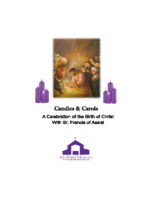
“Candles and Carols: A Celebration of the Birth of Christ with St. Francis of Assisi” (Download PDF here)

Thank you to Layna Maher, Chair, National Formation Commission

+++++++++++++++++++++++++++

Por favor comparta con su fraternidad local


Gracias a Anne Mulqueen, OFS, Asistente Espiritual de la Comisión Nacional de Formación


Se dice que la Navidad es una época de niños, pero yo digo que la Navidad es una época de todos los que no han perdido el asombro, la alegría y el deleite de celebrar el don del nacimiento de un bebé, humano y divino, que vino a la tierra para ser uno de nosotros. En la víspera de Navidad de 1223, nuestro Padre Francisco hizo tangible su ardiente amor por la Encarnación de Dios a través de la recreación de Belén en una cueva en Greccio.


En la Primera Vida de San Francisco, Tomás de Celano escribe que Francisco quiso que el nacimiento de Cristo cobrara vida, presentando de nuevo el nacimiento del niño Jesús en una cueva de Greccio. Francisco quiso que se tomara nota de este evento y que fuera recordado con memoria reverente. Han pasado casi ochocientos años y seguimos exhibiendo el pesebre navideño en nuestros hogares y en nuestras iglesias. Así que durante esta Navidad, dediquemos tiempo para recordar con reverencia la maravilla de la Encarnación mientras contemplamos el pesebre que sostiene al bebé de María.


¿Qué impulsó a San Francisco a crear esta escena? San Buenaventura dijo que quiso despertar los corazones de los débiles en la fe. Tomás de Celano dijo que el niño había quedado olvidado en el corazón de muchos; pero por gracia fue devuelto a la vida a través de San Francisco.


San Francisco fue un hombre de acción. Entonces, ¿qué hizo? Invitó a sus hermanos y a la gente del pueblo a una cueva llena de animales, paja y un comedero, que serviría de cuna al niño salvador. Francisco quería que todos experimentaran la humildad y la pobreza de un Dios tierno que nació en el mundo como un bebé pobre e indefenso. Quería que todos experimentaran el amor de Dios derramado en la Encarnación. A la hora señalada llegó el pueblo portando antorchas y velas. Y sus corazones ya no estaban fríos, sino llenos de amor. Todos se reunieron en alegría alrededor de este divino bebé, acostado en un pesebre.


Mientras contempla el pesebre del niño Jesús, reflexione sobre esta cita del Papa Francisco. “Cuando, en Navidad, colocamos la estatua del Niño Jesús en el pesebre, el pesebre de repente cobra vida. Dios se nos aparece como un niño, para que lo tomemos en nuestros brazos. Debajo de la debilidad y la fragilidad, esconde su poder que crea y transforma todas las cosas. Parece imposible, pero es verdad: en Jesús, Dios era niño, y así quiso revelar la grandeza de su amor: sonriendo y abriendo sus brazos a todos.” [Admirable Signum 8]


Siempre es mejor leer las fuentes originales sobre un tema además de una reflexión o comentario. Por lo tanto, visite http://franciscanos.org/frandp/menup.html , ore primero, luego lea y medite en los siguientes relatos de la recreación de la natividad de Francisco en Greccio.


  • La Vida de San Francisco de Tomás de Celano , Capítulo XXX

http://franciscanos.org/fuentes/1Cel03.html


  • La vida del Beato Francisco, Legenda Maior, de San Buenaventura, Capítulo 10

http://franciscanos.org/fuentes/lma04.html


Solo una pregunta para discutir o comentar en su diario :
¿Algo que leyó o meditó ha vuelto a despertar su imaginación acerca de la PALABRA hecha carne, el Dios invisible hecho visible en un bebé y ha cambiado su comprensión de la naturaleza de Dios?


Diane F. Menditto, OFS
Vice Minister, National Fraternity, Secular Franciscan Order USA
Listen – Discern – Go Forth National Theme 2022-2025
Scroll to top
Juan de Padilla