( A PDF copy of this article is attached)
Five Important Spiritual Thoughts from the Liturgy of the Word
…and follow up for the Secular Franciscan
January 19 – January 25
1 – “I will be their God, and they shall be my people.” (Heb 8:10)
…the Solemn Promise of our God. Are we the type of person who keeps a promise to God?
2 – “ That there be no divisions among you.” (1 Cor 1:10)
…Do I deliberately problems for others for no good reason?
3 — “Repent, for the kingdom of heaven is at hand.” (Mt 4:17)
…Have I taken the time to confess my sinfulness to the Lord?
4 – “Whoever does the will of God is my brother and sister and mother.” (Mk 3:35)
WILL OF GOD
One way of looking
at what
Jesus did as he redeemed us is to consider Jesus following the will of God
perfectly in his life. He was following
his chosen way of living which was nothing less than the good of humankind, as
best as he could. Jesus says in the
Gospel: Here are my mother and brothers (pointing to those in the
circle)—that is all of us and all of humankind.
That was what he was called to do—touch every human being with his
redeeming power.That notion of the will of God is
important for us as well and for us, what is will of God?Each of us have chosen a way of life. A number of factors went into the choice, but
whatever we have become, we are choosing some way of spending our time on this
earth. We are called to live that way of
life following the principles of Jesus Christ.
So the concept of following the will of God means nothing more or less
than actually following Jesus’s directives as we are living the way of life
that we have chosen for ourselves.The student follows what Jesus taught
as she/he studies. The retired person
accepts the virtues that Jesus set up as she/he sets her/his own pattern of
living in retirement. The married person
lives the message of Jesus as she/he interacts with her/his spouse, indeed
something that is quite difficult at times.
The person involved in her/his chosen work in order to make money does
so using the guidelines that Jesus taught us during his time on earth. In short, doing the will of God means that as
we direct the line of activity in our lives that we have chosen–that we do it
with the directives of the Lord as guidelines.The will of God was uppermost in
Jesus mind, leading him to redeem us The will of God should likewise be
uppermost in the follower of Jesus’ minds—you and me, leading us to truly live
our different chosen careers with Christian principles.
5 – “I asked, ‘What shall I do, sir?’” (Acts 22:10)
…Asked of our spiritual lives, Paul’s question is what we should ask of the Lord in our own set of circumstances.
Student Placemats
(This Article originally appeared in the TAU-USA Fall 2022 Issue #107)

Before the first salad was served at the first dinner of the Quinquennial, Franciscans were nourished by the students from the Catholic schools in the Phoenix Diocese. On the table, greeting each attendee, was a laminated placemat depicting Francis, Clare, or one of their followers and decorated by one of 1,500 students.
All Catholic schools in the diocese responded to an invitation to create placemats for the event. Betty Holler, OFS, of the Peace Fraternity in Phoenix, led the project. She explained that, “By doing it, we were given the opportunity to talk to the students about saints Francis and Clare. It was fun. We made a lot of road trips, and appreciated the cooperation of the teachers.”
30 different placemat designs depicted a variety of Franciscan themes including: St. Francis calming the wolf at Gubbio, Clare turning away the Saracens, Francis receiving the Stigmata, and many others.
Once all the placemats were finished and collected, Betty laminated them so attendees could take them home. At times she had five laminators running simultaneously.
While working on the project, the first through eight grade students would ask questions like what color should we make Francis and Clair’s clothes? Betty would tell them that we usually think of Francis dressed in a brown tattered robe. Ultimately, the students used their own imagination when coloring the placemats.
Some students were fascinated to learn that Francis’s original name was John, or Juan in Spanish, and that his father renamed him aYer returning from a trip to France.
On each placemat was the following note: “Your placemats were designed by one of 1,500 kids who participated in making this evening a little more special. Please feel free to save yours as a special giY. All the Catholic schools in the dioceses of Phoenix were invited to spend time with a Secular Franciscan, who taught us about St. Francis and St. Clare and helped with our placemats.” Betty loved the opportunity to work with students and to share the stories of Francis and Clare.
Keynote speaker Lori Hinker, OFS, praised Betty for personally reaching out to the local schools with overwhelming results. She encouraged other fraternities to make it part of their mission to reach out to young people.
___________________________________________________________________________________
For other fraternities who might want to try to the project as a way of spreading the stories of Francis and Clare, Betty suggests:
- Locate the Catholic schools in your
- Send letters or emails to the
- Follow up with a phone
- Find coloring pages of Francis and Clare online at teacher websites or on
- Schedule a time with the schools to work with the children on the
- Arrive ready to tell stories about Francis and
- Schedule a dinner or event to use the placemats, either at the school, church, or your
https://www.secularfranciscansusa.org/2023/01/23/student-placemats/
Formation Friday – Vocations, Communications, Relationships: What is Vocation? January 20, 2023
Vocations, Communications, Relationships: What is Vocation? (Part 1)
At our National Chapter in October 2022, the National Fraternity Council decided that the priorities for 2022-2025 will be Vocations, Communications, and Relationships. For the next several weeks, Formation Friday will take a look at each of the priorities.
Before we can discover and attract vocations, we need to have a good idea of what a vocation is. Part 1 looks at what our formation materials stress about the nature of vocation in general. (Material for this portion is taken from the FUN Manual, The Franciscan Journey, and materials being developed for the OFS USA formation program.)
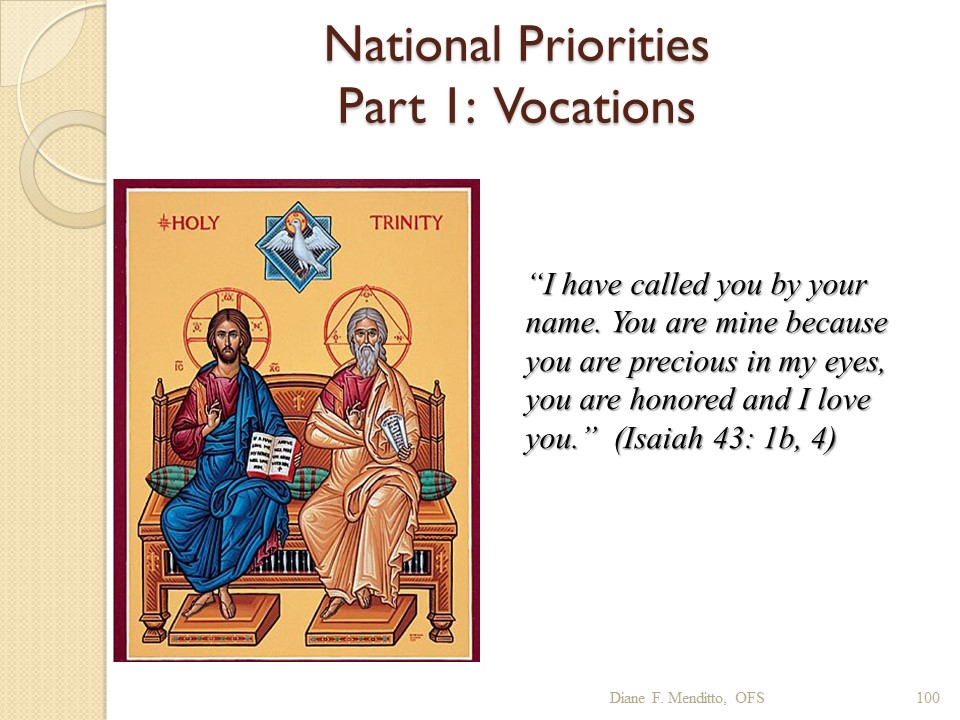
“I have called you by your name. You are mine because you are precious in my eyes, you are honored, and I love you.” (Isaiah 43: 1b, 4)
— Vocation is an invitation to all people to share in the life of the Trinity.
— We all receive three “calls” from God
— Primary call—to all people
— Personal call—personal vocation
— Specific call—vocation to the Secular Franciscan Order
The Primary Call is a call to all people to love—God loves us and we, in turn, are called to love God. Because of love God the Father created us, made a covenant with us and sent the prophets to communicate with us. God loves each one of us personally and unconditionally. Vatican II tells us that we are not called because of our good works but by God’s design and grace. (Documents of Vatican II. The Laity, p. 58)
The Personal Call is initiated by God (or by God through another person). He never forces us to respond. God deals with each of us in a unique, personal way. For example, the Apostles were called to be the first witnesses to Christ’s divinity. They were called to preach and act in Jesus’s name. This was their PERSONAL VOCATION.
We are called to PERFECTION (See the story of the Rich Young Man in Matthew 19:16-30—“Sell what you have…Come, follow me.”); WITNESS (See the story of the Gerasene Demoniac in Mark 5: 1-20; Luke 8:26-29—“Tell what God has done for you.”); TOTAL AVAILABILITY (See the story of Zacchaeus in Luke 19: 5-7—“I must come to your house today.”)
Of course, there are many other examples that we can cite from Scripture.The Specific Call—As professed Secular Franciscans, many of us have answered this call. However, for those who are searching to find what their Specific Call is, it takes many hours, days, and sometimes years to discern in what specific way the Lord is calling us to serve him and spread the good news of his life, death, and resurrection. Here are some general tips for discernment.
Discernment is a decision-making process that honors the place of God’s will in our lives. To discern well in the context of religion, start with prayer to know God’s will. (Perhaps the Prayer Before the Crucifix FA:ED, vol. 1, p. 40, “Most High glorious God, enlighten the darkness of my heart,…). Trust that God has a plan for your life. Find quiet time; tell God what you desire and what you fear; allow God to speak to you; talk to a mentor or someone you respect. Continue to pray and be open to the Holy Spirit, but do not be afraid to explore the options open to you.
Questions for discussion or to answer in your journal:
+ Have you discovered your specific call? If yes, how have you answered it?
+ What gifts and talents given to by God have helped you to make that decision?
+ How do you think you can help others to recognize and answer their call?Next week we will have more on the Specific Franciscan Vocation: How to recognize it and how to call it forth in others.
+++++++++++++++++++++++++++
Por favor comparta con su fraternidad local
Las vocaciones, las comunicaciones, las relaciones personales: ¿Qué es la vocación? (Parte 1)
En nuestro Capítulo Nacional de octubre de 2022, el Consejo Nacional decidió que las prioridades para 2022-2025 serán las vocaciones, las comunicaciones y las relaciones personales. Durante las próximas semanas, Formation Friday analizará cada una de las prioridades.
Antes de que podamos descubrir y atraer vocaciones, necesitamos tener una buena idea de lo que es una vocación. La Parte 1 analiza lo que nuestros materiales de formación enfatizan sobre la naturaleza de la vocación en general. (El material para esta parte se tomó del Manual FUN, La jornada franciscana y los materiales que se están desarrollando para el programa de formación OFS USA).
“Te he llamado por tu nombre. Eres mía porque eres preciosa a mis ojos, eres honrada y te amo”. (Isaías 43: 1b, 4)
— La vocación es una invitación a todas las personas a compartir la vida de la Trinidad.
— Todos recibimos tres “llamados” de Dios
— El llamado principal: a todas las personas
— El llamada personal: vocación personal
— El llamado específico: vocación a la Orden Franciscana Seglar
El llamado principal es un llamado a todas las personas a amar: Dios nos ama y nosotros, a nuestra vez, estamos llamados a amar a Dios. Por amor Dios Padre nos creó, hizo alianza con nosotros y envió a los profetas a comunicarse con nosotros. Dios nos ama a cada uno de nosotros personalmente e incondicionalmente . El Concilio Vaticano II nos dice que no somos llamados por nuestras buenas obras sino por el diseño y la gracia de Dios. (Documentos del Vaticano II. Los Laicos, p. 58)
El Llamado personal es iniciado por Dios (o por Dios a través de otra persona). Él nunca nos obliga a responder. Dios trata con cada uno de nosotros de una manera única y personal. Por ejemplo, los Apóstoles fueron llamados a ser los primeros testigos de la divinidad de Cristo. Fueron llamados a predicar y actuar en el nombre de Jesús. Esta fue su VOCACIÓN PERSONAL .
Estamos llamados a la PERFECCIÓN (Ver la historia del Joven Rico en Mateo 19:16-30—“Vende lo que tienes…Ven, sígueme.”); A ser TESTIGOS (Vea la historia del Endemoniado Gerasene en Marcos 5: 1-20; Lucas 8: 26-29—“Cuéntenme lo que Dios ha hecho por ustedes.”); DISPONIBILIDAD TOTAL (Vea la historia de Zaqueo en Lucas 19: 5-7—“Es necesario que vaya a tu casa hoy”).
Por supuesto, hay muchos otros ejemplos que podemos citar de las Escrituras.El llamado específico— Como franciscanos seglares profesos, muchos de nosotros hemos respondido a este llamado. Sin embargo, para aquellos que están buscando cuál es su llamado específico, se necesitan muchas horas, días y, a veces, años para discernir de qué manera específica el Señor nos está llamando a servirlo y difundir la buena noticia de su vida, muerte, y resurrección. Aquí hay algunos consejos generales para el discernimiento.
El discernimiento es un proceso de toma de decisiones que honra el lugar de la voluntad de Dios en nuestras vidas. Para discernir bien en el contexto de la religión, comience con la oración para conocer la voluntad de Dios. (Quizás la Oración ante el Crucifijo http://franciscanos.org/esfa/orsd.html “Sumo glorioso Dios, ilumina las tinieblas de mi corazón,…). Confía en que Dios tiene un plan para su vida. Encuentre tiempo de tranquilidad; dígale a Dios lo que usted desea y lo que teme; deje que Dios le hable; hable con un mentor o con alguien a quien respete. Continúe orando y esté abierto al Espíritu Santo, pero no tenga miedo de explorar las opciones abiertas para usted.
Preguntas para discutir o responder en tu diario:
+ ¿Ha descubierto su llamado específico? En caso afirmativo, ¿cómo lo ha respondido?
+ ¿Qué dones y talentos dados por Dios le han ayudado a tomar esa decisión?
+ ¿Cómo cree que puede ayudar a otros a reconocer y responder a su llamado?La próxima semana tendremos más información sobre la Vocación Franciscana Específica: cómo reconocerla y cómo invocarla en los demás.
Diane F. Menditto, OFSVice Minister, National Fraternity, Secular Franciscan Order USAListen – Discern – Go Forth National Theme 2022-2025
SHAPING THE FRANCISCAN FOOTPRINT – January 12 – January 18 2023
(pdf copy attached for printing)
Five Important Spiritual Thoughts from the Liturgy of the Word
…and follow up for the Secular Franciscan
January 12 – January 18
1 – “If today you hear his voice, harden not your hearts.” (Ps 95:7c-8)
…How well do I listen to the words of Scripture?
2 — “We have never seen anything like this.” (Mk 2:12)
…Jesus is still a force in Christians’ lives. Has Jesus’s doctrine permeated everything I do?
3 – “The word of God is living and effective.” (Heb 4:12)
…Do I live by the word of God?
4 — “The Sabbath was made for man, not
man for the Sabbath.” (Mk 2:27)Extended meditation:
THE IMPORTANCE OF PEOPLE
‘Amen, I say to you, whatever you did for one of the
least brothers of mine, you did for me.’(Matthew 25:40)
“The Sabbath was made for man, not man for the Sabbath.”
(Mk 2:27)
There is little doubt that one of the great Popes of all time was a most recent one,
St. Pope John Paul II. He was known for trying to bring the whole world
together by his many travels. Perhaps the most inspiring visit that he ever
made was on December 27, 1983 and not to any country, but to an Italian prison.
He made it not to a multitude of people, but to one man by the name of Mehmet
Ali Agca who had tried to kill Pope John Paul two and a half years before. Pope
John Paul, recognizing Jesus in him, completely forgave him. Pope John Paul was
living out what Jesus said in the Gospel. Other people may not act like Jesus,
but they are Jesus. Whatever you do to others, you do to me. These may
be the most radical words that Jesus ever spoke.One of the best ways to improve our spiritual lives is to think about what should
be guiding our behavior at the moment of our deaths. The Hebrew religious mind
would expect Jesus to say that at the judgment at the end of our lives we
should be following the Law of Moses that which was the criterion of everything
the devout Jewish person did in Jesus’s day. When Jesus spoke of the judgment,
he did not mention the Law of Moses.The religious person might expect Jesus to say that we should be thinking of God in
some form, the God whose name was so sacred to the Hebrew people that they
would not even pronounce it. The religious people would have thought that at
the end of our lives, Jesus would say something about that God, their
approaches to God, their lives with God, the name they used for God. Jesus did
not mention God.In fact, Jesus did not mention the Law; he did not mention tradition, he did not
refer to the prophets, the patriarchs, religious practices and prayers,
synagogue, church, none of these. Instead, when it came down to the final
analysis of a person, when judgment had to be made concerning what a person had
done, at that moment, the most sacred of all moments in a person’s whole life,
Jesus says everything depends on how much the person has given to others.
The whole after-life depends on giving to people. That is, how a person gives
to others will be the measure that a person will be measured with for all
eternity. That was an absolutely incredible statement for a Hebrew religious
leader to make.And, as if that was not enough to shock people, Jesus even goes further than that.
He talks about the least brothers and sisters. Perhaps we can define “least” to be the way we view “least” in our
view of things. That is, those who criticize us, those who do not like us,
those who refuse to understand us, those who are evil, those who do bad things,
those who are terrorists, those who are unable to understand the evil of their
actions, those who have serious addiction problems, those who hate our
families, those who are so sick that they do not know what they are doing,
those who have no homes and look so helpless. We must give even to the least
brothers and sisters.
5
– “Looking around at them with anger and grieved at their hardness of heart…”
(Mk 3:5)…In his human nature, Jesus was very upset with those who would not listen to his words… Am I listening and following the way I should?
Centenaries – Part 3 Celebrating Christmas at Greccio 1223-2023
(This article originally appeared in the TAU-USA Fall Issue 2022 #107)
Texts
1 Celano 84-87, FF 466-471; Admonitions I, 16-21, FF 144; Letter to the Entire Order 26: 29, FF 221; Office of the Passion XV, FF 303.
 When Thomas of Celano presents the story of the celebration of Christmas at Greccio, he talks about the reasons Francis of Assisi had for to setting up the manger and celebrating the Mass in a cave. The Poverello stopped at Greccio because he wanted to contemplate the realness of the Incarnation, namely, the simplicity, poverty and humility of the Son of God “who gave Himself for us with supreme and indescribable love” (1 Celano 30: 87, FF 471). We find the same dynamic in his contemplation of the Eucharist. In fact, Francis invites us not only to see with our physical eyes but with our spiritual eyes as well, so that we might contemplate the humility and the real manifestation of divine love present in the Eucharist: “Behold, each day He humbles Himself as when He came from the royal throne into the Virgin’s womb; each day He Himself comes to us, appearing humbly; each day He comes down from the bosom of the Father upon the altar in the hands of a priest” (Admonitions I, 16-18, FF 144).
As the Franciscan Family celebrating the centenary of the Christmas at Greccio, we are invited to pause before the mystery of the Incarnation in order to contemplate the depth of God’s love for humanity. The Son of God becomes the Son of man; he becomes one of us, our brother (cf. Second Version of the Letter to the Faithful 56, FF 201). Our faith in the Incarnation prompts us to discover the seeds of the Word present in all cultures and in contemporary society, so that we might bring to bloom the seeds of humanity we find there. Moreover, it urges us not only to defend life but also to become instruments of life and humanity in our families and fraternities, reaching out to those who are seen as social rejects, who are no longer considered human. The concrete way that Francis of Assisi celebrated the mystery of the Incarnation at Greccio, invites us to more fully realize “that we have been entrusted with a treasure which makes us more human and helps us to lead a new life. There is nothing more precious which we can give to others” (Evangelii gaudium 264).
On Christmas day, the Poverello, together with his brothers, prayed: “This is the day the Lord has made let us rejoice and be glad in it. For the Most Holy Child has been given to us and has been born for us on the way and placed in a manger because he did not have a place in the inn” (Office of the Passion XV, 5-7, FF 303). As we celebrate the centenary of the manger at Greccio, we are invited to think about the place that Jesus occupies in our hearts, and even more, whether we have a place in our hearts for those with whom Jesus wanted to be identified: “Amen, I say to you, whatever you did for one of these least brothers of mine, you did for me” (Mt 25:40). By his Incarnation, Christ Jesus eliminated any distance that separated him from humanity. He calls us to do the same, that is, to be close to our brothers and sisters to welcome them, to touch them with mercy, as the Magisterium of the Church reminds us: “With the simplicity of that sign, Saint Francis carried out a great work of evangelization… In a particular way, from the time of its Franciscan origins, the nativity scene has invited us to ‘feel’ and ‘touch’ the poverty that God’s Son took upon himself in the Incarnation. Implicitly, it summons us to follow him along the path of humility, poverty and self-denial that leads from the manger of Bethlehem to the cross. It asks us to meet him and serve him by showing mercy to those of our brothers and sisters in greatest need” (Admirabile signum 3).
Our being in Christ
“For God so loved the world that he gave his only Son” (Jn 3:16).
Objective
To renew our life of faith so that it can become more incarnational and concrete.
Activities
- Raise our awareness of daily life, with all its joys and difficulties, as a privileged place of encounter with the
- Ensure that adequate importance is placed on the liturgical and sacramental life, in order to progress in the life of
- Reexamine how we celebrate Christmas and other liturgical feasts, ensuring they reflect the simplicity, poverty and humility that Francis of Assisi
Our being brothers and sisters
“Consider, O human being, in what great excellence the Lord God has placed you, for He created and formed you to the image of His beloved Son according to the body and to His likeness according to the Spirit” (Admonitions V, 1, FF 153).
Objective
To develop a more comprehensive view of humankind and its inherent male-female reciprocity, a view that is free of divisions and dichotomies.
Activities
- Ensure that the formation programs in our fraternities implement a formation process that is more comprehensive from a human, spiritual and interpersonal point of
- Encourage concrete initiatives that work toward overcoming discord between men and women or between the laity and priests or consecrated
Our being in communion
“Hail, O Lady, Holy Queen, Mary, holy Mother of God, Who are the Virgin made Church” (Salutation of the Blessed Virgin Mary 1, FF 259).
Objective
To live in minority as members of the Church.
Activities
- Confirm whether our pastoral service in ecclesial communities reflects the maternal dimension of the Church and is characterized by humility and poverty, which are revealed in the Incarnation and in the
- Reexamine our way of celebrating the Eucharist, so that it may be authentically experienced as the source and summit of Christian life and a source of communion and
- Bring the motherly compassion of the Church to our brothers and sisters who find themselves on the existential outskirts of our ecclesial
Our being in the world
“God said: ‘Let us make human beings in our image, after our likeness’” (Gn 1, 26).
Objective
To love and serve every human being, promoting his or her dignity as a person created by God and made in his likeness and image.
Activities
- Set aside time for reflection and discussion on promoting the dig- nity of every human life and make a commitment to defend life from conception until natural
- Promote activities to defend the rights of
- Offer help to parents who are finding it difficult to raise and educate their
- Provide assistance to shelters for orphaned children, street children, young people suffering from any kind of addiction, etc.
Part 1 Posted January 2, 2023 pages 4-6
Part 2 Posted January 9. 2023 Pages 7-9
https://www.secularfranciscansusa.org/2023/01/16/centenaries-part-3-celebrating-christmas-at-greccio-1223-2023/