CNSA- Lent 2023: Interior Cultivation

(This article originally appeared in the Winter 2023 Issue of TAU-USA #108)

by Christopher Panagoplos, TOR

“Listen” – Gardens are attractive by virtue of their beauty and bounty. Gardens delight our senses and ground us in the earth. They are the object of fruitful reflection and hands-on prayer. Gardens can speak to us of promise and hope, of dying/ rising. These carefully tended plots of earth can be an expression of God’s lavish abundance, as well as a challenge of trust as unseen seeds take root and grow. Sometimes when we allow the mystery of a garden to enter into us, it yields forth its secrets.

Brothers and sisters, let us do some interior cultivation in the garden of our hearts. The “Lenten spring” is prime time for “interior cultivation.” With the help of the Holy Spirit, let us dig deeper into the place where our relationship with Jesus grows. St Francis helps us acquire needed garden implements: the yellow-green newness of springtime; the fragrant blossoms adorning our Sister Mother Earth; the restorative warmth of Brother Sun.

“Discern”―Our lives are a running towards something or a running away from something. We repel and avoid. We desire and yearn. As gardeners, we till the soil, we break through the hard surface layer: clumps of resentments, hard rocks of indifference, old roots of grievances. What blocks the way when I try to open my heart to Jesus? What stones am I stumbling on in my Franciscan journey? What old roots am I getting tangled up in as I try to nourish the seed of God’s Word in my heart?

One of those mysterious processes that contribute to the growth of gardens is composting. A compost pile—let’s do some interior cultivation with our own compost pile. My prayer and reflection during these Lenten days have brought me to the conscious recognition of the shadow-side of my personality. I had known for some time that I possess certain personality traits and character flaws that I’d rather not have. I had also been under the illusion that it would be a matter of time before I could eliminate these defects and move on. What I realized was that these pieces and parts of me were integral to who I am, and that I’d never be rid of them. In fact, they are essential to my becoming fully human.

This discovery was depressing, indeed. Also needed for interior cultivation to work in the soil of my heart was my compost pile. What turned things around for me was what I placed on the compost pile that is me: impatience, confusion, doubt with a touch of stubbornness, control, le\over anger, old thinking patterns that don’t work anymore, words spoken in haste without love, unspoken words that contribute to pain and disharmony.

What a compost pile! Humus—of earth, the ground, the soil. Human—an earthly one. I am of earth. My own humus, product of my life’s compost pile, fertilizing the transformation process that allows me to become human. Humus. Human. Humility. I need to remember that I am an earthly one. Yes, I aspire to things of the Spirit. Yes, God chooses to love me and use me—for love, for service, for justice. But God chooses. Like Francis, I am nothing. I am humus. I am human.

Each of us needs to experience the miracle of transformation, especially in these days of Lent, to embrace the pieces and parts that are in need of God’s healing touch. Interior cultivation allows for those personality traits we find most despicable to become integrated, the raw material for personal growth, so that they nourish our lives. When I think of the shadow elements that I want to reject, wisdom teaches that these are valuable—compostable—because they keep me coming back to God and His healing grace, the healing that yields a new kind of energy that revitalizes everyday living.

“Go Forth”

Prayer enriches the soul as compost does the soil. And so, I pray:

Come, Lord Jesus, let me feel Your presence, and hear Your voice.

Open the eyes of my heart,

illuminate within it places of eternal Lent where I have not permitted Your love entry.

Help me to open these places.

Root out that which needs to leave, and make room for the joy of Your resurrection.

Open the eyes of my heart to see You

in those with whom I live and work and share fraternity.

Come to those broken places in me,

in those relationships with others, in the world around me,

in need of reconciliation, with the healing of Your resurrection.

Open the eyes of my heart to see You in those whose walk is long and lonely

through their personal Gethsemane.

Allow me to accompany You in them.

Remain with me, remind me, and lift up into the light,

the dormant confidence of hope in the joy of Your resurrection.

“Changed in mind but not in body, Francis was eager to direct his will to God’s will. Thus, he retired for a short time from the tumult and business of the world and was anxious to keep Jesus Christ in his inmost self.  Like an experienced merchant, he concealed the pearl he had found from the eyes of mockers and, selling all he had, he tried to buy it secretly…. He acted in such a way that no one would know what was happening within. Wisely taking the occasion of the good to conceal the better, Francis consulted God alone about his holy purpose. He prayed with all his heart that the eternal and true God guide his way and teach him to do God’s will. He endured great suffering in his soul, and was not able to rest until he accomplished in action what he had conceived in his heart.” (1Celano 6)

Wooden sign in a garden with Peace and Good Let’s make this opportunity “intentional,” to cultivate the soil of the heart, and to keep Jesus in our inmost self. Let us not rest until Christ comes to birth in the heart. Beauty and bounty, then, will live in the garden of our heart.

https://www.secularfranciscansusa.org/2023/04/10/cnsa-lent-2023-interior-cultivation/
Open post

FORMATION FRIDAY – GOOD FRIDAY – APRIL 7, 2023

Formation Friday – Good Friday, April 7, 2023 (en español abajo)

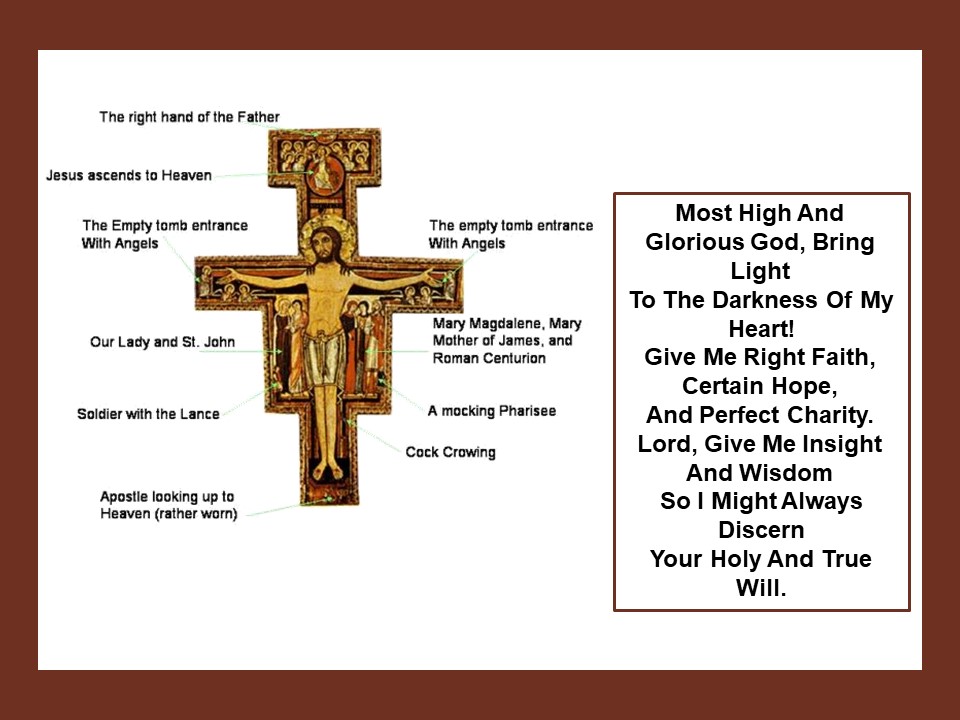
Reflections on The Cross of San Damiano

By Patrick McNamara, OFM, Cap.


I look to the Cross, I gaze upon its figure,

I wait, I listen, I hope.


Will you speak, will you move, will I be moved.


Will you once again touch the heart of one who seeks.

Of one who questions, of one who seems so lost.


Will you embrace the soul, as you did that of Francis.

Will you take it to Yourself.


Will you give it peace, give it comfort, give it love


This soul waits, listens, prays for such grace.

This soul seeks the Love from the Lover.


It wavers. It stumbles. It falls.


Your gaze looks down, embraces all.

Takes all, Loves All. Your Grace heals, accepts.


Again you respond, Again you Love.

Again you speak to a searching and troubled heart. I turn.

I continue the journey. I continue in Hope.

I too have heard you Speak.


Read about the San Damiano Cross

https://www.secularfranciscansusa.org/2020/05/08/the-san-damiano-crucifix/

Learn about the San Damiano Cross

https://secularfranciscansusa.org/wp-content/uploads/The-San-Damiano-Crucifix-8-page-explanation.pdf


Prayer Before the Crucifix (Of San Damiano)

Most High,
glorious God,
enlighten the darkness of my heart
and give me
true faith,
certain hope,
and perfect charity,
sense and knowledge,
Lord,
that I may carry out
Your holy and true command.

Franciscan Intellectual Tradition


+++++++++++++++++++++++++


Reflexiones sobre la Cruz de San Damián

Por Patrick McNamara, OFM, Cap.


Miro a la Cruz, contemplo su figura,

Espero, escucho, espero.


Hablarás, te moverás, me conmoveré.


Volverás a tocar el corazón de quien busca

De quien cuestiona, de quien parece tan perdido.


Abrazarás el alma, como hiciste con la de Francisco.

Te lo llevarás a ti mismo


Le darás paz, consuelo, amor


Esta alma espera, escucha, ora por tal gracia.

Esta alma busca el Amor del Amante.


Vacila. Se tropieza. Se cae.


Tu mirada mira hacia abajo, lo abraza todo.

Toma todo, ama todo. Tu Gracia sana, acepta.


De nuevo respondes, De nuevo amas.

De nuevo le hablas a un corazón que busca y está atribulado. Volteo.

Continúo el viaje. Sigo en la Esperanza.

Yo también te he oído hablar.


Oración ante el crucifijo de San Damián

Sumo, glorioso Dios,
ilumina las tinieblas de mi corazón
y dame fe recta,
esperanza cierta
y caridad perfecta,
sentido y conocimiento, Señor,
para que cumpla tu santo y verdadero mandamiento.


http://franciscanos.org/esfa/orsd.html


Lea sobre el crucifijo de San Damián

http://franciscanos.org/enciclopedia/cruzsandamian.html


Diane F. Menditto, OFS
Vice Minister, National Fraternity, Secular Franciscan Order USA
Listen – Discern – Go Forth National Theme 2022-2025
Open post

SHAPING THE FRANCISCAN FOOTPRINT – March 30 – April 5 2023

Shaping the Franciscan Footprint

Five Important Spiritual Thoughts from the Liturgy of the Word

…and follow up for the Secular Franciscan

March 30 – April 5

 1 — “Take and eat; this is my body.” Then he took a cup, gave thanks, and gave it to them, saying, “Drink from it, all of you.” (Mt 26:26-27)

        The Catholic family lived next door to the Catholic rectory and the relationship between the pastor and the family was a very good one. The family had a four-year-old daughter who, as her father said, “mastered the art of talking very well” and was always inquisitive. One day the four-year-old came over to the rectory with a jar of St. Joseph’s children’s aspirin, gave it to the priest and said, “This is for Jesus because he is sick.” The priest asked, “How do you know that Jesus is sick?” The girl answered, “Daddy said so.”

        The priest could not figure that out, so he called the father at work who was very embarrassed about the whole thing and explained it to the priest. The day before at Sunday Mass he had a conversation with his daughter during Mass, and at the same time was trying to keep his daughter quiet. She pointed to the tabernacle, and said, “What is that?” “That is the place where Jesus lives,” the father said. The girl responded: “Can I ask him to come out and play?” “No,” he said, “I don’t think Jesus wants to come out and play today.” “You mean that Jesus doesn’t like me?” she said. “No,” the father replied, “Jesus just doesn’t want to play today.” The little girl replied, “Why doesn’t he, can I go ask him?” “No,” the father said, “You can’t go ask him.” “Why can’t I go ask him” the little girl wanted to know. And the conversation went on like this for a couple of minutes. Finally, quite exasperated, the father said, “Jesus is sick today, he doesn’t want to be disturbed.” Hence, she wanted to give Jesus the aspirins that her parents used to help her when she was sick.

        The doctrine of the Eucharist is difficult to explain to our younger people, and it is even more complicated than it at first seems. Without really knowing what she was doing, she was speaking what spiritual writers have called the “Jesus and me” theology.

        “Jesus and me” theology is easy theology. Applied to the understanding of the Eucharist, “Jesus and me” theology concentrates on the Eucharist as such. It is not a theology that is wrong; it is simply not enough. It becomes wrong when it does not move us to become what we should be, that is, good people interested in love of God and neighbor.

        The opposite of the “Jesus and me” theology is “Jesus and we.” That is, community is important. In terms of the Eucharist, the “Jesus and we” theology concentrates on the action of the faith community, of the people who receive the body and blood of Jesus, and what I do in my community after I receive the Lord in Communion.

        In a “Jesus and we” theology, we can never receive the Real Presence of Jesus and at the same time hate anyone else or refuse to forgive another or ruin another’s reputation or deliberately be divisive in the church or community or family. The fact is, however, that many times people receive the body of Christ in Communion and do not let it affect the body of Christ next to them in the pew or in the neighborhood.

        The little girl in the story did not know what the Eucharist was all about, but she knew that Jesus was a person and a friend. If Jesus becomes a person and a friend to us, we will not just “keep him” in the tabernacle of our Churches. We will make him active in our lives.

        And maybe even ask him to come out and play with us.

[The Eucharist is central for the Franciscan. Do I go to Mass as often as I can?]

2 — But Jesus cried out again in a loud voice, and gave up his spirit. (Mt 27:50)

…The Lord has redeemed me; do I act like it?

3 – “Mary took a liter of costly perfumed oil…and anointed the feet of Jesus and dried them with her hair.” (Jn 12:3)

…A sincere act of love.  Do I show the love I have on behalf of others?

4 — Jesus answered, “Will you lay down your life for me? Amen, amen, I say to you, the cock will not crow before you deny me three times.” (Jn 13:38)

…We should study the denial of Peter carefully. In what areas of my life has there been a denial of Jesus, and have I completely corrected them?

5 — “Amen, I say to you, one of you will betray me.”
Deeply distressed at this, they began to say to him one after another, “Surely it is not I, Lord?”
(Jn 26:21-22)

…The reason why Judas betrayed Jesus was personal gain or selfishness.  It is only fitting that Lent ends with this thought of selfishness.  Am I?

JPIC – It’s Never Too Late to Love

(This article originally appeared in the TAU-USA Winter 2023 Issue #108)

It’s never too late to love

by Joseph Makley, OFS
Jan Parker, OFS, former National Minister; Louise Sandberg, OFS, 2022 JPIC Award Recipient; Joseph Makley, OFS, Co-Chair, JPIC Commission.

What follows is a brief interview with Louise Sandberg, our JPIC award recipient for 2022.

Louise is currently a counselor and the JPIC animator for Tau Cross Region (The Bronx, Brooklyn, Queens, Nassau, and Suffolk counties.) Her fraternity is Blessed Raymond Lull, in Hewlett, NY.

What inspired you to become a secular Franciscan?

St Francis has inspired me since I was a little girl and read a biography of his life. My friend, Deacon Bob Campbell invited me to come to Franciscans Living in Community (FLIC), originally Secular Experience of Living Franciscanism (SELF). I was the only non- professed person there!! I had never even been to a fraternity gathering. Bill McVernon seemed to be in charge. He came up to me and reprimanded me for not having a Tau Cross! When he heard my story, he gave me one and told me not to tell anyone! He is long gone to heaven. But I found my home with like-minded, loving people. Carolyn Townes was one of them. I attended all her talks and felt her to be a beautiful kindred spirit. I was already a missionary to Ghana, West Africa. With a spiritual director, I had looked into: becoming a religious, getting married, or staying single, because I wanted to follow God’s call, not my will. God seemed to be calling me to a Secular life.

So I started going with Bob to his fraternity gatherings and was professed May 7, 2004.

What keeps you going?

I read the mass readings every day. I keep reading until I am inspired. Then I live that scripture the best I can, with God’s help. I often join my friends on Zoom for prayer, meditation, the Liturgy of the Hours, and fellowship.

I love people. I maintain my connection with my friends in Ghana, Uganda, Mexico, and locally, those I serve, who are women and children in need. I run support groups in English and Spanish, including a group for healing from childhood abuse. I am inspired by the resilience and love of those who are materially poor but rich in love, joy, peace, compassion, generosity, and gratitude. Every day is an adventure and an opportunity to listen with love, serve with humility, and surrender my will and ego living the Gospel.

Can you describe your work as a pediatric nurse?

I am a pediatric Home Care nurse for very vulnerable, fragile children. What they are unable to do, I do for them. I believe in empowering my patients, loving them, and letting them teach me how they want to be cared for. My last few patients I watched grow from young children to mature adolescents and young adults. I even went to college with one!

I do their physical care―washing them, dressing them, helping them move and breathe. They show me how valuable life is by loving their lives, never complaining about their disability, and overcoming every obstacle with their determination and God-given talents, with a little encouragement and support. I cannot say pick up your mat and walk, but I can position their hand on their joystick so they can drive their own motorized wheelchair.

How did you decide to become a JPIC animator?

I feel like Justice, Peace and Integrity of Creation chose me!! I always respond to the cry of the poor with prayer and action. In 1990, when the Jesuits and their housekeeper were killed in El Salvador, I protested at the office of my congressman against the millions of dollars we were sending in military aid to El Salvador. It was being used to kill the people. In my prayer, I saw my tax money was killing innocent people, and I was in a place to safely protest, risking only arrest, while they risked death, mutilation, and disappearance daily. I was arrested and tried with nine other Catholics from Pax Christi. Ray McGrath, our congressman, voted against that aid for the first time during our trial.

When a Ugandan told me about people dying from dirty water, I looked at my access to clean water every day, all day. I decided to help. I raised the money for a protected spring for a small village. I thought this would be my one big contribution. When I went there on mission with Secular Franciscan Stephen Smith, OFS, after meeting him at the 2016 Quinquennial, I was greeted with drumming and dancing, gifts and a presentation. Then as I was ready to leave, I was introduced to another desperate community with dirty water! So with the 2022 JPIC award, look what we did!! (See before and after photos.)

Old unsafe water source - New protected spring in Uganda village

Old unsafe water source in Uganda village & New protected spring providing clean water

https://www.secularfranciscansusa.org/2023/04/03/30313/

Open post

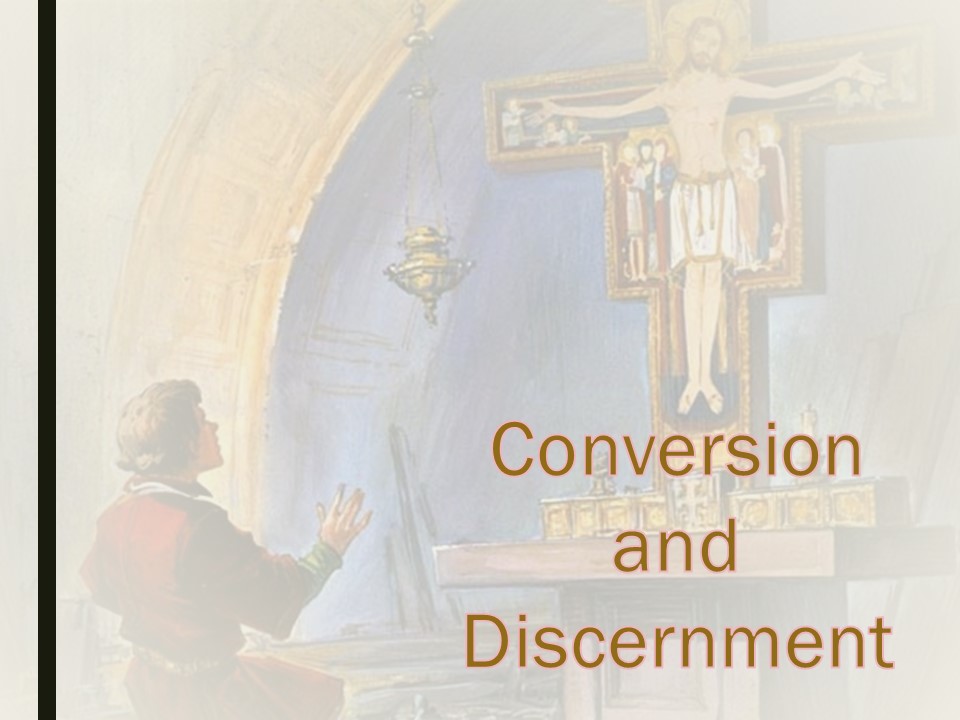
Formation Friday March 31, 2023, Conversion and Discernment

As Lent draws to a close, we focus on St. Francis’s conversion and how it can have a deep effect on our conversion.

If you have read a good biography of St. Francis, it is easy to see the different steps of a conversion process as they apply to different events in the life of Francis. During the time of discernment in the period of initial formation, or as professed members seek to strengthen their vocation, it is important to ponder the events of Francis’ conversion and vocation process and see how these might relate to your own conversion and vocation process.

As a help, you might use the following steps in a conversion process as they apply to the life of St. Francis, and then ask yourself how they might also apply in your own life:

· Darkness that can lead to openness (Questions and ambiguity can propel us

to God) [Think about Francis’ desire to be a knight; his restlessness; his time in prison; his illnesses and dreams]

· Listening and hearing (Prayer) [Think about Francis’ encounter with the leper and how he began to think about the poor Christ; after traveling to Rome, he returns home and prays and waits for an answer] –the voice in the dream; the voice from the San Damiano Cross; the time in solitude listening to the Lord

· Choosing to follow [Think about: Francis realizes that his true bride is Lady Poverty; Hears the voice from the San Damiano cross and responds immediately; Hears the voice in his dream-“Who do you want to follow, the servant or the master?” St. Clare and Bro. Sylvester counsel Francis to preach instead of becoming a hermit]

· Signs which strengthen our decisions and our walk [Kissing the leper; trading clothes with the beggar in Rome; He hears the voice from the San Damiano crucifix]

· Finding new direction [All of the above begin to move him in a new direction. He begins the “rebuilding” process.]

· Life of Christ/Gospel as a point of contact and reference

· Finding support in this newness

· Walking in faith [“The Lord gave me brothers…]

· Trusting even in darkness

· Darkness that can lead to openness

· As conversion is ongoing, we “begin again”, returning to the top

From For Up to Now: Franciscan Movement Part 1 “The Journey of Francis” by Jan Parker, OFS

As you think about each of the above points, comment in your journal or share with your formation group.

Looking for a biography of St. Francis? Here are a few suggestions:

–St. Francis of Assisi: Passion, Poverty, and the Man who Transformed the Catholic Church. by Bret Thoman OFS

St. Francis of Assisi: A Biography by Omer Englebert
Francis: The Journey and the Dream by Murray Bodo O.F.M. and John Michael Talbot
–Francis of Assisi: The Life and Afterlife of a Medieval Saint by André Vauchez

++++++++++++++++++++++


Comparta con su fraternidad local. Conversión y discernimiento


A medida que la Cuaresma llega a su fin, nos enfocamos en la conversión de San Francisco y cómo puede tener un efecto profundo en nuestra propia conversión.


Si ha leído una buena biografía de San Francisco, es fácil ver los diferentes pasos de un proceso de conversión que se aplican a diferentes eventos en la vida de Francisco. Durante el tiempo de discernimiento en el período de formación inicial, o cuando los miembros profesos buscan fortalecer su vocación, es importante reflexionar sobre los eventos del proceso de conversión y vocación de Francisco, y ver cómo estos pueden relacionarse con su propio proceso de conversión y vocación.


Como ayuda, puede utilizar los siguientes pasos en un proceso de conversión según se apliquen a la vida de San Francisco, y luego preguntarse cómo podrían aplicarse también en su propia vida:


• Oscuridad que puede conducir a la apertura (las preguntas y la ambigüedad pueden impulsarnos

a Dios) [Piense en: el deseo de Francisco de ser caballero; su inquietud; su tiempo en prisión; sus enfermedades y sueños]

• Escuchar y oír (oración) [Piense en: el encuentro de Francisco con el leproso y cómo empezó a pensar en el Cristo pobre; después de viajar a Roma, regresa a casa y reza y espera una respuesta] –la voz en el sueño; la voz de la Cruz de San Damián; el tiempo en soledad escuchando al señor

• Elegir seguir [Piense en: Francisco se da cuenta de que su verdadera esposa es Lady Poverty; Oye la voz desde la cruz de San Damiano y responde de inmediato; Oye la voz en su sueño: “¿A quién quieres seguir, al sirviente o al amo?” St. Clare y Bro. Sylvester aconseja a Francisco que predique en lugar de convertirse en ermitaño]

• Señales que fortalecen nuestras decisiones y nuestro caminar [Besar al leproso; intercambiar ropa con el mendigo en Roma; Oye la voz del crucifijo de San Damián]

• Encontrar una nueva dirección [Todo lo anterior comienza a moverlo en una nueva dirección. Comienza el proceso de “reconstrucción”.]

• Vida de Cristo / Evangelio como punto de contacto y referencia

• Encontrar apoyo en esta novedad

• Caminando en fe [“El Señor me dio hermanos…]

• Confiar incluso en la oscuridad

• Oscuridad que puede conducir a la apertura.

• A medida que la conversión está en curso, “comenzamos de nuevo”, volviendo a la parte superior


Desde el hasta ahora: Movimiento franciscano Parte 1 “El viaje de Francisco” por Jan Parker, OFS


Mientras piensa en cada uno de los puntos anteriores, comente en su diario o comparta con su grupo de formación.


¿Busca una biografía de San Francisco? Aqui hay algunas sugerencias:


Biografia de San Francisco de Asis: Francisci Assisensis vita et miracula (Spanish Edition) by Tomás de Celano
San Francisco de Asís (Spanish Edition) by G. K. Chesterton


Diane F. Menditto, OFS
Vice Minister, National Fraternity, Secular Franciscan Order USA
Listen – Discern – Go Forth National Theme 2022-2025


Scroll to top
Juan de Padilla