Open post

SHAPING THE FRANCISCAN FOOTPRINT – March 23 – March 29 2023

Shaping the Franciscan Footprint

Five Important Spiritual Thoughts from the Liturgy of the Word

…and follow up for the Secular Franciscan

March 23 – March 29

  1 — Jesus said: “How can you believe, when you accept praise from one another and do not seek the praise that comes from the only God?(Jn 5:44)

…Do I seek too much the praise from others?

2 – “Mary said, ‘Behold, I am the handmaid of the Lord. May it be done to me according to your word.’” (Lk 1:38)

…Like Mary, I have said “yes” to the Franciscan life. Am I living it out in my life?

MARY’S PRIME DIRECTIVE

        The liturgy often refers to the Blessed Virgin. 

        Quite naturally, we are drawn into what in the study of theology is called “Mariology” or the “Theology of Mary” which is based on the fact that Mary is the earthly Mother of the Incarnate Word of God while he was here on earth with us in person.

        What should it mean for us?  A mother will be someone who both helps a child and acts as a perfect example for the child.  Therefore, there are two things for us to consider here.  They might be considered to be, in Star Trek language, the “prime directive” of the Blessed Virgin Mary.

        First, Mary helps us.  The Church has believed from early on that Mary will intercede for us, much the same way that Mary interceded for the wedding couple at Cana in John’s Gospel.  In the story she was asking her Son to help a couple, asking her Son to relieve their distress, and then offering one of the ten most important lines in Scripture, I believe: saying to the servants, “Do whatever he tells you”.  The way that Mary helps us primarily is to say to us to follow the directives that Jesus gives us.  We do not know how this works in reality, but our faith tells us that the good that we ask of God through Jesus will have Mary’s endorsement.

        Secondly, Mary serves as a perfect example for us as we live our Christian lives on earth.  She recognizes what God wants of her, and in her famous words at the Annunciation, understands that she is called by God —“Let it be done according to God’s word,” – saying “yes, I will do it”.  And she followed through with her “yes.”  Once she had said that she would follow what God wanted of her, she tried to do it.  Without knowing what it meant, she was present for her Son in everything, a lesson for all of us when we say “yes” to our Franciscan faith and the words of Jesus, no matter what happens.

3 — “I am the resurrection and the life; whoever believes in me, even if he dies, will live and everyone who lives and believes in me will never die.” (Jn 11:25)

…Is my faith (belief AND action) as strong as it should be?

It is a good spiritual exercise to write your own eulogy—what you think your friends will say about you at your funeral, and what you would like them to say about you.
Things like:
        – on a scale of 1-10 where 10 is high, how do you score your prayer life;
        – on that same scale, do you think about other people in a good way;
        – or how would you score your taking care of those less fortunate than you are?
        – and so forth…

4 — “Let the one among you who is without sin be the first to throw a stone at her.” (Jn 8:7)

…I too readily judge others. This directive from Jesus concerning the woman should “speak” to me.

5 — He said to them, “You belong to what is below, I belong to what is above.” (Jn 8:23)

…I should spend more time with the Lord, more time with what is above.

Day Away Pilgrimage – Solanus Casey Center

Solanus Casey Center – Bus Tour – Ford’s Garage

By Michael Gath, OFS

The Group on Tour to the Solunas Casey Center

For the day away during the National Chapter event, the Divine Mercy Region hosts treated fraternity members to a bus tour of the City of Detroit. We experienced the Solanus Casey Center, including the celebration of Mass at the St. Bonaventure Chapel connected to the center.

On the way, we crossed Detroit’s Gateway Bridge. This bridge was built in preparation for the 2007 Super Bowl XL, which was evident by the designers incorporating football-like ovals in its structure.

Next, riding along Interstate 96, we passed the biggest tire on the planet―the Uniroyal Giant Tire. It was produced by the United States Rubber Company in 1964 for the New York World’s Fair as a Ferris wheel. Not long after the fair ended, the giant tire was disassembled and shipped to Detroit.

Moving along, we were able to see something unique to Detroit, known to be the third most visited tourist site for city, the Heidelberg Project. This art project was designed around two city blocks to inspire people to use artistic expression to enhance their lives and communities. It is in a neighborhood that suffered deterioration after the 1967 Detroit riots.

Bl. Solunas Casey bigger than life imageOnce at the Solanus Casey Center, we entered through the Creation Garden. Intriguing pieces of art symbolized Sister Water, Moon, Earth, Brother Sun, Fire, Wind, and a four-thousand-year-old piece of dark wood depicting Sister Bodily Death.

Entering the Solanus Casey Center, we were greeted by many seculars from Divine Mercy Region. Sally McCuen, OFS, a co-author of a self-guided prayer booklet about the Center, gave the opening presentation.

Bernard Casey (a.k.a Blessed Solanus Casey) was born and grew up in Prescott, WI. He took on many jobs before considering religious life. AWer working as a logger, prison guard, and streetcar operator, his life changed when he witnessed a murder. In prayer, he heard the words “Go to Detroit,” which he did. He headed to St. Bonaventure Monastery.

In the seminary, he was given the name Solanus as a Capuchin simplex priest. God would grant many with blessings of healing and answered prayers through Blessed Solanus Casey’s intercession for them. The uniqueness of Solanus was that he was sought by everyone. All denominations of faith, and even atheists, would seek him out for help with their intentions. He was known to have a deep desire for the conversion and unity of the world.

During the guided tour, our first exhibit was the Beatitudes of Christ. Here we encountered life-sized bronze statues of those who exemplified the

beatitudes. They included Blessed Mother Theresa, Martin Luther King Jr., and Archbishop Oscar Romero.

We entered the museum section dedicated to Blessed Solanus Casey’s personal artifacts. Immediately on entry, we were able to see what a big family Solanus came from through life size displays of photographs that must have been taken shortly after he entered the order.

On exhibit were items such as his habit, violin, sandals, prayer book, and rosary. Also within this section of the museum is a replica of his humble bedroom. Winding through toward the end of the exhibit, the center has Blessed Solanus Casey’s desk on display.

Moving on, we finally approached the tomb of Blessed Solanus Casey, located at the entrance to St. Bonaventure Chapel. The public can pray next to the exposed crypt containing his coffin, which is covered by glass.

We attended Mass in the St. Bonaventure Monastery Chapel. Beautifully designed, it includes a magnificent painting by Wilhelm Lamprecht of St. Francis receiving the stigmata. It was restored and shipped from St. Francis of Assisi Church in Milwaukee, where Blessed Solanus Casey was ordained. Directly in the rear of the Chapel is a relic of Blessed Solanus Casey.

Before Mass, we heard the testimony of a friar whose family was related to the Caseys. He explained how his brother was involved in a serious accident and was likely to lose his leg. After meeting with Blessed Solanus and asking for prayers, he told them everything would be all right. On the day of surgery, the doctors determined that the boy would not require the surgery. A healing had been granted.

Concluding our visit and celebration of Mass at the Solanus Casey Center and St. Bonaventure Chapel, we boarded the bus for the second part of the Detroit tour. We went to Belle Isle, and as our friendly bus driver, Earnest, kindly pointed out, it was at one time known as Hog Island. At one point the island was infested with snakes. To combat this, a herd of pigs was released on the island. It must have worked, because now the Belle Isle is a beautiful park that hosts a conservatory, nature center, and giant slide.

From Belle Isle, we headed to downtown Detroit. The bus ride through downtown gave us good views of some of Detroit’s well-known landmarks, including:

  • The Spirit of Detroit – A downtown monument displaying a large figure holding a sphere with rays symbolizing God in one hand and family in the
  • The Renaissance Center – A group of seven connected skyscrapers and headquarters of General
  • The Kern’s Clock – A historic clock that once adorned the Ernst Kern Company department store
  • Detroit Professional Sports Venues – Comerica Park, Ford Field, Little Caesar’s Arena

After leaving downtown Detroit, we headed to Ford’s Garage restaurant. We had great fellowship and a good meal to cap the day’s tour. Ford’s Garage gives the sense of being an old-time service station back in the 1920s. On display were vintage Ford automobiles and gas pumps from the early days.

Thanks to the Divine Mercy Region hosts for a fantastic pilgrimage/tour of the gems of the Motor City.

Blessed Solanus Casey

by Donna Hollis, OFS

Sometimes we look at Saints whose actions appear to be beyond our capabilities. Blessed Solanus Casey’s actions are very much within reach as he focused on the relationships with those he encountered.

At the Chapter, the life of Blessed Solanus Casey was portrayed in a most creative way with storytelling, video, music, and song, with audience participation in the play “More Love than Skill: A Saint and His Fiddle” by Br. Al Mascia, OFM.

The ambience of the play touched the heart strings of those of us who attended. The story of Blessed Solanus Casey came alive with the personal touches that the actor shared with enthusiasm. The songs were like chants that gave us time to reflect on who this blessed man was and how he lived by reaching out to the marginalized in our society.

Blessed Solanus embodied the prayer attributed to St. Teresa of Ávila, “Christ has no body now but yours, no hands, no feet but yours. We are the compassion that looks out to the world…”

I left with a sense of what was in Blessed Solanus’s heart and with respect for his ministry to those in need. He was a man of God who changed people’s hearts and lives. We, in turn, can mirror his heart by reaching out with compassion to those most in need.

If you would like to learn more about Br. Al Mascia, OFM, and his ministry, visit: http://brotheral.org/

https://www.secularfranciscansusa.org/2023/03/27/day-away-pilgrimage-solanus-casey-center/

Open post

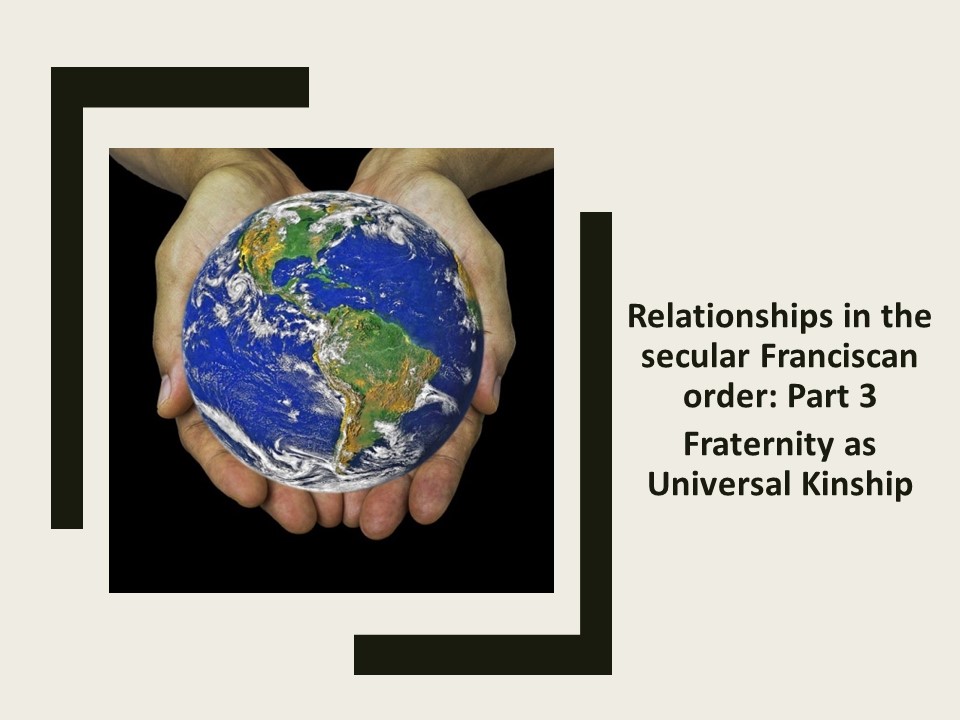
FORMATION FRIDAY – Relationships – Part 3, Fraternity as Universal Kinship

At our National Chapter in October 2022, the National Fraternity Council decided that the priorities for 2022-2025 will be Vocations, Communications, and Relationships. For several weeks, Formation Friday has been exploring each of these priorities.

Relationships in the Secular Franciscan Order: Part 3

Fraternity as Universal Kinship

Prepared by Francine Gikow, OFS, Member, National Formation Commission


Relationship, or what we describe as “fraternity,” is foundational for living our Secular Franciscan charism and is the way we evangelize, going from gospel to life and life to the gospel. In this series of “Relationships in the Secular Franciscan Order,” we discussed:

· Love between each person of the Holy Trinity is our model for fraternity living; to love one another.

· Francis understood that we are all sons and daughters of the same Father and so we are all brothers and sisters, in a kinship relationship, with each other in fraternity.

· Our local fraternity is a school of love where we learn how to develop and sustain relationships. We live “fraternity” with our brothers and sisters within our fraternity, with others with whom we interact, those in our ministries, in our higher fraternities, in our relationships with the members of other Franciscan religious orders and to the whole world.


Francis’ concept of “fraternity,” however, expands even further to encompass all of creation- both animate and inanimate- which we call “universal kinship.” Our Rule, Article 18, states:

“Moreover they should respect all creatures, animate and inanimate, which bear the imprint of the Most High, and they should strive to move from the temptation of exploiting creation to the Franciscan concept of universal kinship.”


Francis saw God reflected in what He created- or in the words of our Rule- the imprint of the Most High who created all things; animate and inanimate. Since we are all created by the same Father in heaven, we are united as brothers and sisters to all creation and thus must treat creation with loving and fraternal care.


We are further instructed by our General Constitutions (Art. 18):

“Following the example of Francis, patron of ecologists, they should actively put forward initiatives that care for creation and should work with others in efforts that both put a stop to polluting and degrading nature and also establish circumstances of living and environment which would not be a threat to a human person.”


Francis’ legacy to us in his “Canticle of the Creatures,” is a song of praise, glory, honor and thanksgiving to God for Brother Sun, Sister Moon and all creation. The Canticle shows reverence for every “thing” created by God- a “kin” relationship. To honor that reverence, we are charged at profession to “build a more fraternal and evangelical world” (in our relationships with creation too) “so that the kingdom of God may be brought about more effectively.”(Rule, Art. 14)


In summary, our former, beloved, National Minister, Tom Bello, OFS, said of our fraternal relationships:

“Fraternity is a call to unity and harmony with all our brothers and sisters, all of whom are children of the same living God.

Fraternity is a call to unity and harmony with all of creation, plant and planet, all created by the same loving God.

Fraternity is a call to build a community of love that reflects Love back to the God of Love: Father, Son and Holy Spirit.” (FUN: Fraternity, p.7)


Reflection Questions:

· Read OFS General Constitutions, Article 18 “For a Just and Fraternal Society” and share what you have learned.

· What inspired you from this article? What drew your attention?

· What description of fraternal relationships challenged you and why. Share your thoughts with another person or in a spiritual journal.

· Bring to prayer the ideas of this article and ask God to help you discern how to use these ideas in your life and in the life of your fraternity.

++++++++++++++++++++++++++

Compartir con su fraternidad local 24 de marzo de 2023

En nuestro Capítulo Nacional en octubre de 2022, el Consejo Nacional decidió que las prioridades para 2022-2025 serán Vocaciones, Comunicaciones y Relaciones. Durante varias semanas, Formation Friday ha estado explorando cada una de estas prioridades.

Relaciones en la Orden Franciscana Seglar: Parte 3

La fraternidad como parentesco universal

Preparado por Francine Gikow, OFS, Miembro, Comisión Nacional de Formación

La relación, o lo que describimos como “fraternidad”, es fundamental para vivir nuestro carisma franciscano seglar y es la forma en que evangelizamos, yendo del evangelio a la vida y de la vida al evangelio. En esta serie sobre “Relaciones en la Orden Franciscana Seglar”, ya discutimos:

  • El amor entre cada persona de la Santísima Trinidad es nuestro modelo de vivencia de la fraternidad; amarnos unos a otros.
  • Francisco entendió que todos somos hijos e hijas del mismo Padre y por lo tanto todos somos hermanos y hermanas, en una relación de parentesco, unos con otros en fraternidad.
  • Nuestra fraternidad local es una escuela de amor donde aprendemos a desarrollar y mantener relaciones. Vivimos “fraternidad” con nuestros hermanos y hermanas dentro de nuestra fraternidad, con otros con quienes interactuamos, aquellos en nuestros ministerios, en nuestras fraternidades superiores, en nuestras relaciones con los miembros de otras órdenes religiosas franciscanas y con el mundo entero.

Sin embargo, el concepto de “fraternidad” de Francisco se expande aún más para abarcar toda la creación, tanto animada como inanimada, a la que llamamos “el parentesco universal”. En nuestra Regla, el artículo 18, establece:

“Sientan, además, respeto por las otras criaturas, animadas e inanimadas, que de ti, Altísimo, llevan significación 30 y procuren con ahínco pasar de la tentación de la explotación al concepto franciscano de la fraternidad universal.”

Francisco vio a Dios reflejado en lo que Él creó -o en las palabras de nuestra Regla- la huella del Altísimo que creó todas las cosas; animado e inanimado. Dado que todos somos creados por el mismo Padre en el cielo, estamos unidos como hermanos y hermanas a toda la creación y, por lo tanto, debemos tratar a la creación con cuidado amoroso y fraterno.

Nuestras Constituciones Generales nos instruyen además (Art. 18.1):

Los franciscanos seglares son llamados a ofrecer su contribución personal, inspirada en la persona y en el mensaje de San Francisco de Asís, en vistas a establecer una civilización en la que la dignidad de la persona humana, la corresponsabilidad y el amor sean realidades vivas.

El legado de Francisco para nosotros en su “Cántico de las Criaturas”, es un canto de alabanza, gloria, honor y acción de gracias a Dios por el Hermano Sol, la Hermana Luna y toda la creación. El Cántico muestra reverencia por cada “cosa” creada por Dios, una relación de “parentesco”. Para honrar esa reverencia, estamos llamados a la profesión a “construir un mundo más fraterno y evangélico” (también en nuestras relaciones con la creación) “a construir un mundo más fraterno y evangélico para la edificación del reino de Dios” (Regla, art. 14).

En resumen, nuestro amado Ministro Nacional de buena memoria, Tom Bello, OFS, dijo sobre nuestras relaciones fraternales:

“La fraternidad es un llamado a la unidad y armonía con todos nuestros hermanos y hermanas, todos hijos del mismo Dios vivo.

La fraternidad es un llamado a la unidad y armonía con toda la creación, planta y planeta, todo creado por el mismo Dios amoroso.

La fraternidad es un llamado a construir una comunidad de amor que refleje el Amor hacia el Dios del Amor: Padre, Hijo y Espíritu Santo”. (DIVERSIÓN: Fraternidad, p.7)


Para platicar con un grupo o en pareja o comentar en su diario.

  • Lea las Constituciones Generales de la OFS, Artículo 18 “Por una Sociedad Justa y Fraterna” y comparta lo que ha aprendido.
  • ¿Qué le inspiró de este artículo? ¿Qué le llamó la atención?
  • ¿Qué descripción de las relaciones fraternales le desafió y por qué? Comparta sus pensamientos con otra persona o en un diario espiritual.
  • Lleve a la oración las ideas de este artículo y pida a Dios que le ayude a discernir cómo usar estas ideas en su vida y en la vida de su fraternidad.



Diane F. Menditto, OFS
Vice Minister, National Fraternity, Secular Franciscan Order USA
Listen – Discern – Go Forth National Theme 2022-2025
Open post

SHAPING THE FRANCISCAN FOOTPRINT – March 16 – March 22 2023

Shaping the Franciscan Footprint

Five Important Spiritual Thoughts from the Liturgy of the Word

…and follow up for the Secular Franciscan

March 16 – March 22

  1 – “But if it is by the finger of God that I drive out demons, then the Kingdom of God has come upon you.” (Lk 11:20)

…Is my behavior the behavior of a person who is a “co-heir” of the Kingdom of God?


2 — Jesus replied, “The first is this: The Lord our God is Lord alone! You shall love the Lord your God with all your heart, with all your soul, with all your mind, and with all your strength.’ The second is this: ‘You shall love your neighbor as yourself.’ There is no other commandment greater than these.”

GETTING IT

         The family of four were coming home from Church one Sunday morning in their car. The young boy and girl of the family were fighting in the back seat. The father said: “Stop that fighting.” The son said: “I hate her.” The father responded: “We just came from Church—you can’t hate your sister, you love God and God says love everyone.” The son said: “I do love God, but God doesn’t stick me with a pencil like she just did.” We tend to place God in a separate category from people. God is out there in charge of creation, etc. We are here—in this car, in our job, in this family, in this situation, and so forth.

        What was Jesus’ understanding of the scribe in the Gospel? Mark the evangelist comments:

        Jesus saw that he answered with understanding.

His understanding was that he “got it” in terms of a popular expression. That is, the scribe recognized what Jesus was doing. Jesus had placed the basic religious law of Israel—the law of Shema—namely to love God with all your heart on the same level as to love your neighbor. He tells that scribe that he was not far from the Kingdom that he was preaching about. It is a remarkable statement for Jesus to make considering the way he felt about the religious leaders of his time. He made the statement because the scribe caught the essence of what Jesus was teaching, that is, he “got it”; he understood his teaching. To truly understand a teaching is to “get it,” that is, to understand it with the thought that goes further than simply knowing some answer.

        One of the great things about the teaching profession is that you come to know about some really wonderful people. I did not actually meet this lady, but after hearing about her, it sort of makes me proud to know that I love to teach when I get the chance. She was an extraordinary lady. Only her banker knew what she had done. Over the years of her life she had set up and contributed to a special fund without withdrawing any of the money. She had been a teacher for 52 years, suffering a stroke and dying when she was 78 years old. She had worked in an elementary school of a small Kansas town for most of her years, and was a person who was known and loved by every child and practically every adult in the community.

        At her death, she had directed the president of the bank to give a $5000 scholarship every year through the counselor at the high school to someone who could not afford to go to college but who wanted to go. No one at the school was to know who had set up the fund. The secret was revealed when the president of the bank finally retired long after the teacher had died, and the fund had been used up. The woman had wanted to serve others, and because she did not have the kind of money that others had, she set it up so that she could serve others for a long time after her death without anyone knowing about it. She “got it.” She understood Christianity.

        Contrast that with the negative campaigning of the candidates for office in our country at any political election. Most of them are Christian people who want to have an office in which they will supposedly help the people of whatever locale. They often viciously attack the person who is running against him/her. What a horrible example of Christianity! It is a total lack of understanding of the application of the law of love of God and neighbor.

        You and I as followers of Jesus are called to a true understanding of the law of love. That is, we are called to “get it.” What does it mean? It means the insight of the scribe: this law—namely, that the love of God AND neighbor is on the same level of importance, and that both are the will of God.

        Worship of God is not the problem, obviously, since we would not be reading a book like this if that were the case. It is the other part of the law that is the problem: the love of neighbor. It is a topic of Scripture all the time. The problem is that in this area, many of us just do not “get it.”

        Proof that we do not “get it” comes from the contradictions that we allow in our individual lives. We say we love neighbor, but we refuse to talk to a relative or we carry a grudge or we hate someone. Sometimes we excuse ourselves, even though we are doing things that hurt other people. Perhaps the Lord is saying to us: “You just don’t get it, do you?”

        What is needed above all in our spiritual lives is personal responsibility. That means that we must put our actions on the line, open them up to criticism, allow our actions to be studied by someone else, like the mirror of Scripture. Only then we will understand enough to see what Jesus is trying to teach. Then we will “get it.” Once we do, our lives will change, or in Jesus’ words, we will not be far from the Kingdom of heaven.


3 – “Everyone who exalts himself will be humbled, and the one who humbles himself will be exalted.” (Lk 18:14)

…Am I a truly humble person?

4 – “He found him and said, “Do you believe in the Son of Man?” (Jn 9:35)

…Jesus has found us, and asks that question.  What does the way I live say is the answer?

5 – “He went down with them and came to Nazareth, and was obedient to them.” (Lk 2:51)

…Jesus gave us an example of acceptance of others’ authority. Am I as respectful as I should be toward those who have authority over me?

Free Gospel-to-life series offers faithful, contemporary look at Jesus

Fr. David B. Couturier, O.F.M. Cap., will present a free online study of “From Gospel to Life:  Jesus in the New Testament.”  This mini-course, offered over three Saturdays in June, will provide Secular Franciscans with a faithful and contemporary view of Jesus, as He is presented in the Letters of Paul and the Synoptic Gospels.

Fr. Couturier will discuss Jesus in His Jewish historical context, providing a fresh look at the stories we know so well. In understanding how Jesus spoke in Jewish terms, we can more deeply appreciate His words, thoughts, and commands. His parables will come alive.  The course will run from 12-1:30 p.m. Eastern Time on June 3, 10, and 17.

Click Here to Register  https://sbu.qualtrics.com/jfe/form/SV_5otr1lQCVYP94eq

The Zoom link will be sent to registrants.

Fr. Couturier is the executive director of Franciscan Institute & Franciscan Institute Publications at St. Bonaventure University.  He gave a popular Quinquennial keynote address last August in Phoenix.

Fr. Couturier also edited the “Gospel of St. Francis” videos and handout for Secular Franciscans that are available on the St. Bonaventure Univerisity website.

For additional information and other summer course offerings, go to:

https://www.secularfranciscansusa.org/2023/03/21/free-gospel-to-life-series-offers-faithful-contemporary-look-at-jesus/

Scroll to top
Juan de Padilla