It is important that we get to know the many writings left to us by our founder. Franciscans are blessed to have many of St. Francis’s and St. Clare’s writings. By reading what they wrote, and praying as they prayed, we allow the Holy Spirit to strengthen our vocation and how we live the Franciscan Charism.
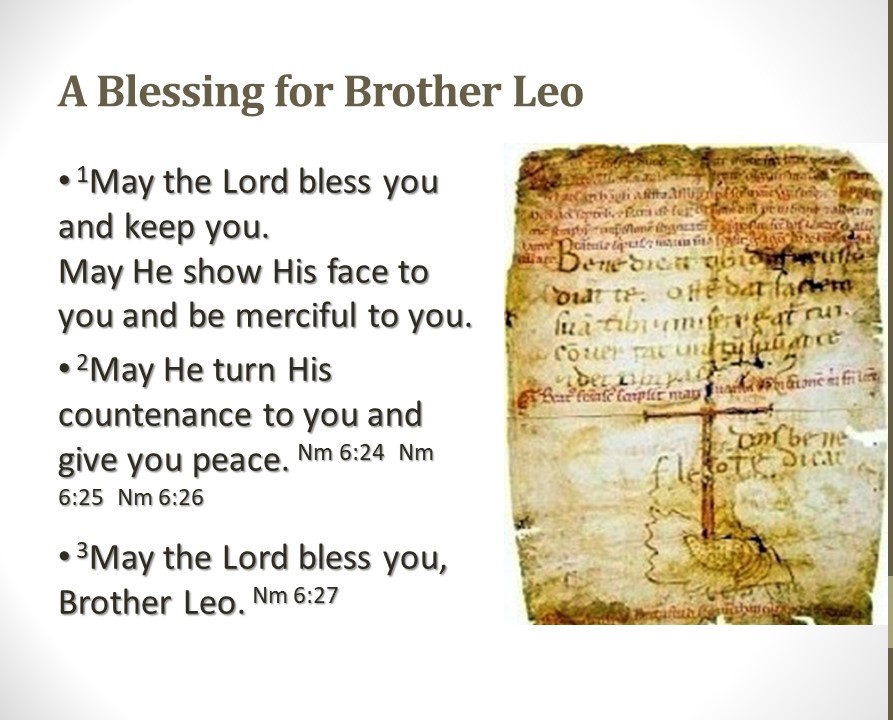
In 1224, after St. Francis had received the Sacred Stigmata on Mt. La Verna, he wrote the Praises of God. These are in his own handwriting. On the other side of that parchment, Francis wrote the Blessing for Bro. Leo who was with him on Mt. Laverna. (See graphic). You can read further background on this writing and read all the early documents at the link below.
The Praises of God
1You are the holy Lord God Who does wonderful things. Ps 77:15 [Vulgate, Ps 76:15] a
2You are strong. You are great. Ps 86:10 [Vulgate, Ps 85:10] You are the most high.
You are the almighty king. You holy Father, Jn 17:11
King of heaven and earth. Mt 11:253You are three and one, the Lord God of gods; Ps 136:2 [Vulgate, Ps 135:2]
You are the good, all good, the highest good,
Lord God living and true. 1 Thes 1:94You are love, charity; You are wisdom, You are humility,
You are patience, You are beauty, You are meekness, Ps 71:5 [Vulgate, Ps 70:5]
You are security, You are rest,
You are gladness and joy, You are our hope, You are justice,
You are moderation, You are all our riches to sufficiency.5You are beauty, You are meekness,
You are the protector, Ps 31:5 [Vulgate, Ps 30:5] You are our custodian and defender,
You are strength, Ps 43:2 [Vulgate, Ps 42:2] You are refreshment. 6You are our hope,
You are our faith, You are our charity,
You are all our sweetness, You are our eternal life:
Great and wonderful Lord, Almighty God, Merciful Savior.Please read the praises above. Read through once. Then prayerfully consider each word and sentence a second time.
- What do the words and phrases that St. Francis wrote about God tell you about his relationship with Him?
- Choose four words or phrases that touch you deeply. Spend some time thinking about why you chose those words.
- How do these ideas about God reflect your personal relationship with Him?
- How do these ideas inspire you to make changes in your own life in order to strengthen your relationship with God?
- Personal challenge: In this season of rejoicing, choose a particular way you can strengthen your relationship with God. See if you can carry it out this week.
+++++++++++++++++
Formation Friday 22 de abril, 2022
Por favor compartir con su fraternidad localEs importante que conozcamos los muchos escritos que nos dejó nuestro fundador. Los franciscanos tienen la bendición de tener muchos de los escritos de San Francisco y Santa Clara. Al leer lo que escribieron y orar como ellos oraron, permitimos que el Espíritu Santo fortalezca nuestra vocación y cómo vivimos el carisma franciscano.
En 1224, después de que San Francisco recibió los Sagrados Estigmas en el Monte La Verna, escribió las ALABANZAS DEL DIOS ALTÍSIMO. Estos son de su puño y letra. En el otro lado de ese pergamino, Francisco escribió la Bendición para el Hno. Leo que estaba con él en el monte Laverna. Puede leer más antecedentes sobre este escrito y leer todos los primeros documentos en el siguiente enlace: http://franciscanos.org/esfa/ald.html Aquí se encuentra la Bendición al Fray León: http://franciscanos.org/esfa/benl.html
Alabanzas del dios altísimo
Tú eres santo, Señor Dios único, que haces maravillas.
Tú eres fuerte, tú eres grande, tú eres altísimo, tú eres rey omnipotente, tú, Padre santo, rey del cielo y de la tierra.
Tú eres trino y uno, Señor Dios de dioses, tú eres el bien, todo el bien, el sumo bien, Señor Dios vivo y verdadero.
Tú eres amor, caridad; tú eres sabiduría, tú eres humildad, tú eres paciencia, tú eres belleza, tú eres mansedumbre, tú eres seguridad, tú eres quietud, tú eres gozo, tú eres nuestra esperanza y alegría, tú eres justicia, tú eres templanza, tú eres toda nuestra riqueza a satisfacción.
Tú eres belleza, tú eres mansedumbre; tú eres protector, tú eres custodio y defensor nuestro; tú eres fortaleza, tú eres refrigerio.
Tú eres esperanza nuestra, tú eres fe nuestra, tú eres caridad nuestra, tú eres toda dulzura nuestra, tú eres vida eterna nuestra: Grande y admirable Señor, Dios omnipotente, misericordioso Salvador.
Por favor, lea las alabanzas de arriba. Léalas una vez. Luego, en oración, considere cada palabra y oración por segunda vez.
• ¿Qué le dicen las palabras y frases que San Francisco escribió sobre Dios acerca de su relación con Él?
• Elija cuatro palabras o frases que te conmuevan profundamente. Dedique algo de tiempo a pensar por qué eligió esas palabras.
• ¿Cómo reflejan estas ideas acerca de Dios su relación personal con Él?
• ¿Cómo le inspiran estas ideas a hacer cambios en su propia vida para fortalecer su relación con Dios?
• Desafío personal: En esta temporada de regocijo, elija una manera particular en la que pueda fortalecer su relación con Dios. A ver si puede llevarlo a cabo esta semana.
Diane F. Menditto, OFSVice Minister, National Fraternity, Secular Franciscan Order USAListen – Discern – Go Forth National Theme 2022-2025

SHAPING THE FRANCISCAN FOOTPRINT – April 13 – April 19 2023
Shaping the Franciscan Footprint
Five Important Spiritual Thoughts from the Liturgy of the Word
…and follow up for the Secular Franciscan
April 13 – April 19
1 – “You are witnesses of these things.” (Lk 24:48)
THE WITNESS WHO “SEES”
The year was 1906. A person who could be described as a normal young man graduated from school after having been educated in Braunau, a little town in Austria. He had a Catholic upbringing, was a Mass server, and as a young man, he struggled to be what he should have been.
About 17 years later, another young man graduated from school not far from Braunau, St. Radegund, Austria. He fooled around in life much more than the first youth. He also was Catholic, but showed little respect for anything. He was into drinking, motorcycling (he was first in his small town to own one), and was into sexual activity. In fact, he had a child out of wedlock after his graduation from school. He finally settled down because of his marriage to a good woman, had three small children, and began to live a “normal” good life. He farmed, worked in a factory, even did some military service, but was released from it temporarily to farm. He slowly began to think. He later was to call it beginning “to see.”
In February 1943, the first youth had become the head of state in Germany, a man by the name of Adolf Hitler. In that same month, the second youth was called into the Hitler’s army. The second was a relatively unknown person who would have remained that way had it not been for someone who wrote a book about him. The name of the book was “In Solitary Witness” by Gordon Zahn; the name of the youth was Franz Jaegerstaetter, now considered a saint in the Catholic Church.
In February 1943 Franz Jaegerstaetter knew that he had a problem because he believed that the war he was drafted into was wrong. Being a good Catholic by that time, he sought advice of priests, even the bishop, and was told to serve. He loved his wife and children. His wife knew what he was going through, and they did not want to separate, but no matter what anyone said, he knew what was right.
One of the major arguments for him to join the army was that his refusal to serve would not make a difference. His neighbors thought he was crazy, that refusing to join would be an act of folly, and more than that, a sin against his family, his community, and even his Church. His death would go unnoticed. It would have no impact on the Nazi movement. It would not bring the end of the war. His action would soon be forgotten. Who would remember or care about an anti-Nazi gesture of an uneducated farmer? He would be just one more filed-away name among the many thousands who were tried and executed with indifference during the Nazi era.
But he did what he had to do because he knew it was right. He went to the military induction center, told them he would not serve, was sent to prison, and executed on August 9, 1943. He was a witness to the truth.
The word “witness” means literally “to know.” It implies that we know this Jesus, and are willing to make him known to others. Jaegerstaetter called it the “grace to see.”
Whether he knew it or not, Franz Jaegerstaetter was a witness. He was given the grace to see Jesus and what he stood for. Franz Jaegerstaetter knew what he did was right. So do we. Our prayer is that we may have the grace to see, and when we see it, that we are willing to act.
2 — “Go into the whole world and proclaim the Gospel to every creature.” (Mk 14:15)
…Francis took this directive quite literally. Do my actions show that I am proclaiming the Gospel?
3 — “Amen, I say to you, unless one is born of water and Spirit he[/she] cannot enter the Kingdom of God.” (Jn 3:5)
…I have been; do I act like it?
4 – “The community of believers was of one heart and mind.” (Acts 4:32)
…In my fraternity, do I try to achieve this ideal?
5 – “God so loved the world that he gave his only-begotten Son, so that everyone who believes in him might not perish but might have eternal life.” (Jn 3:16)
…The miniature Gospel. I should spend some time in Thanksgiving to God today.
We Are All Volunteers
(This article originally appeared in the Winter 2023 TAU-USA Issue #108)
by Jane DeRose-Bamman and Diane Menditto
According to the Google Dictionary/Oxford Languages website: “Volunteer” means:
“a person who freely offers to take part in an enterprise or undertake a task.”
 Each Secular Franciscan is a volunteer of sorts… a volunteer for Jesus. We choose daily to say yes to our vocation, going from Gospel to life and life to the Gospel. Although elected to our positions, the members of the new National Executive Council volunteered to serve in those positions.
There are other volunteers in the Order who serve in appointed positions. The appointees are often behind the scenes. Without those willing to serve in appointed positions, those who were elected would be floundering immediately upon election.
On the national level, these appointments are in the areas of the Commissions (Formation; Justice Peace and Integrity of Creation; and Youth/Young Adult), the National Database, the TAU-USA newsletter, 1-800-Francis vocations line, the national website, archives, historian, public relations specialists and, more recently, those working with social media and accessibility concerns. There are also very task specific appointments, e.g., the Quinquennial Committee, which lasts for five years. Many members of the Database Committee (formerly the Computer Committee) and TAU-USA Committee have served for more than 10 years. Some committee chairs and members have served in various roles as committees have transitioned. We are not sure that people would have said yes to their original appointment if they had known it would last 5+ years. Here are a few of those who have been serving for many years:
Dan Mulholland, OFS, served as a JPIC Commission Co-Chair and transitioned to the Computer Committee, and as an offshoot has helped with the website, social media, TAU-USA, setting up and maintaining email listserv, and many other tasks. He always offers his expertise, as well as sharing his knowledge with others. He is active with his local and regional fraternities. His unending “yes” to volunteer and share his gifts is inspiring.
Bob Herbelin, OFS, has been managing the current database for 20 years. He has been helped by the Computer Committee members, but Bob is the main database manager. Cyl Maljan-Herbelin, OFS, for about eight years now, has been overseeing access to the database. Bob and Cyl create the National Directory based on the database information. Cyl also maintains the mailing list for the Tau-USA. Bob helps with the annual report functions of the database. They are working with the Database Committee to set up the new database (which we hope to roll out in 2023). Thanks to Bob and Cyl for their longtime efforts.
Randy Heinz, OFS, managed the mailing list for many years before Cyl. He was integral in initiating the new website, Twitter, and Facebook pages. Thanks to Randy for helping us evolve with our communication methods.
Jim and Cindy Wesley, OFS, work on key parts of our communication efforts with the Tau-USA newsletter. They have been working on compiling the articles as well as translating them for more than 10 years. Their efforts have produced 32 newsletters in English and Spanish. Their consistent labor of love is a gift for the OFS-USA. Combined with efforts from the website committee members, we have all versions of the newsletter since 1987 posted to the website. https:// www.secularfranciscansusa.org/tau-usa-newsletter/
Unfortunately, we aren’t able to list all the volunteers here by name. Thanks to all who have been and will be willing to accept appointments!
Because an appointment should not be considered a life-long commitment, the NEC is soliciting applications for our Commission Chairs―National Formation, National Justice Peace and Integrity of Creation, and National Youth/Young Adult, and the Tau-USA Editor in this newsletter. The NEC will solicit applications for other appointed positions in future Tau-USA editions.
https://www.secularfranciscansusa.org/2023/04/17/we-are-all-volunteers/

FORMATION FRIDAY – Celebrating 800 Years of the Rule, 2023 – April 14, 2023
Beginning in 2023 the entire Franciscan Family began celebrating the 800th anniversary of the final milestones in the life of our Seraphic Father up until the time of his death in 1226. In 2023 we celebrate the Later Rule (Regula Bullata) and Christmas in Greccio; in 2024, the Stigmata; in 2025 we will celebrate The Canticle of the Creatures; and in 2026, the Easter of St. Francis commemorating his passing from this life to eternal life. Rather than planting ourselves in the past, we will be looking to the future of our Order as we remember these important events in the life of our founder.
Although the Secular Franciscan Order commemorated Memoriale Propositi 1221 (our earliest Rule) in 2021, in 2023 we reflect on the Rule of the Friars Minor, and what our own Rule means to us.
Our Rule and Constitutions guide us in living out the Franciscan charism. We need to take the time to read the Rule
frequently and pray about what the Prologue and each article tell us about our lives as Catholics and Franciscans. This is
one of the big advantages we have over other Catholics. For example, since our prologue is taken from the First Letter to
the Faithful, St. Francis himself is speaking directly to us when he reminds us that we are a people of penance and
conversion.
Chapter One of the Rule has only three articles, but it plants us firmly in the Franciscan family. It tells us that our Rule is
approved by the Holy See and that we are linked down through the centuries to all those who have formed part of the
three orders founded by St. Francis in the 12th century.
Chapter Two contains articles four through nineteen. Here we find the plan of life set out for us as Secular Franciscans.
We learn how we are to pray; how we are to strive for daily conversion; how we are to follow in the footsteps
of St. Francis in showing that the gospel can be lived; how we are to live in simplicity and humility; and how we are to
reach out to all our brothers and sisters and to all of creation. Having this portion of the Rule is especially valuable to
us on our daily journey to the Father. It is an advantage that other Catholics just do not have.
Chapter Three guides us in our fraternity life and tells us about the structure of our worldwide order and the purpose of
our fraternity life.
Please take some time to read our Rule, either alone, with a prayer partner, or with a group of your fraternity members. This does not have to be all at one time. Once you have read the Rule and thought about it, please use the following questions to help you reflect on the importance of the Rule in our lives as Secular Franciscans.
+What portions of the Rule seem most important to you? Why?
+Explain the effect these parts of the Rule have on your daily life.
+Read the Prologue carefully. How does it inspire you to seek daily conversion?
+Choose the articles of the Rule that you feel able to live out each day. Tell how you do this and why they are easier for you to follow.
+Choose the articles of the Rule that you feel present the greatest challenge to you. Tell how you can begin to live these articles more fully.
+Please tell us how our Rule helps us to be better Catholics and better Franciscans.
+++++++++++++++++++++++++++++++++++++
Formation Friday 14 de abril de 2023
Por favor comparta con su fraternidad local
A partir de 2023 toda la Familia Franciscana estará celebrando los 800 años de los últimos hitos en la vida de nuestro Seráfico Padre hasta el momento de su muerte en 1226. En 2023 celebramos la Regla Bulada y la Navidad en Greccio ; en 2024, los Estigmas; en el 2025 celebraremos El Cántico de las Criaturas; y en 2026, la Pascua de San Francisco que conmemora su paso de esta vida a la vida eterna. En lugar de plantarnos en el pasado, estaremos mirando hacia el futuro de nuestra Orden al recordar estos importantes eventos en la vida de nuestro fundador.
Aunque la Orden Franciscana Seglar conmemoró Memoriale Propositi 1221 (nuestra Regla más antigua) en 2021, en 2023 reflexionamos sobre la Regla de los Frailes Menores y lo que significa para nosotros nuestra propia Regla.
Nuestra Regla y Constituciones nos guían en la vivencia del carisma franciscano. Necesitamos tomarnos el tiempo para leer la Regla frecuentemente y rezar sobre lo que el Prólogo y cada artículo nos dicen sobre nuestra vida como católicos y franciscanos. Esto es una de las grandes ventajas que tenemos sobre otros católicos. Por ejemplo, dado que nuestro prólogo está tomado de la Primera Carta a los Fieles, el mismo San Francisco nos habla directamente cuando nos recuerda que somos un pueblo de penitencia y conversión.
El primer capítulo de la Regla tiene sólo tres artículos, pero nos sitúa firmemente en la familia franciscana. Nos dice que nuestra Regla es aprobada por la Santa Sede y que estamos vinculados a lo largo de los siglos a todos los que han formado parte de la tres órdenes fundadas por San Francisco en el siglo XII.
El Capítulo Segundo contiene los artículos cuatro al diecinueve. Aquí encontramos el proyecto de vida trazado para nosotros como franciscanos seglares. Aprendemos cómo debemos orar; cómo debemos luchar por la conversión diaria; cómo vamos a seguir los pasos de San Francisco al mostrar que el evangelio se puede vivir; cómo debemos vivir en sencillez y humildad; y como vamos a alcanzar a todos nuestros hermanos y hermanas y a toda la creación. Tener esta parte de la Regla es especialmente valioso mientras seguimos nuestro camino diario hacia el Padre. Es una ventaja que otros católicos simplemente no tienen.
El Capítulo Tercero nos guía en nuestra vida de fraternidad y nos habla de la estructura de nuestra orden mundial y el propósito de nuestra vida de fraternidad.
Tómese un tiempo para leer nuestra Regla, ya sea solo, con un compañero de oración o con un grupo de miembros de su fraternidad. Esto no tiene que ser todo a la vez. Una vez que haya leído la Regla y haya pensado en ella, utilice las siguientes preguntas para ayudarlo a reflexionar sobre la importancia de la Regla en nuestras vidas como franciscanos seglares.
+¿Qué partes de la Regla le parecen más importantes? ¿Por qué?
+Explique el efecto que estas partes de la Regla tienen en su vida diaria.
+Lea atentamente el Prólogo. ¿Cómo le inspira a buscar la conversión diaria?
+Elija los artículos de la Regla que se sienta capaz de vivir cada día. Diga cómo hace esto y por qué son más fáciles de seguir para usted.
+Elija los artículos de la Regla que le parezcan más desafiantes. Diga cómo puede empezar a vivir estos artículos más plenamente.
+Diga cómo nuestra Regla nos ayuda a ser mejores católicos y mejores franciscanos.
Diane F. Menditto, OFSVice Minister, National Fraternity, Secular Franciscan Order USAListen – Discern – Go Forth National Theme 2022-2025
SHAPING THE FRANCISCAN FOOTPRINT – April 6 – April 12 2023
Shaping the Franciscan Footprint
Five Important Spiritual Thoughts from the Liturgy of the Word
…and follow up for the Secular Franciscan
April 6 – April 12
1 – “If I, therefore, the master and teacher, have washed your feet, you ought to wash one another’s feet.” (Jn 13:14)
…Service. Do I try to be a servant to others?
2 — “Do not be afraid! I know that you are seeking Jesus the crucified. He is not here, for he has been raised just as he said.” (Mt 28:5-6)
…Do I live out the Resurrection of Jesus in my life?
3 – “Jesus met them on their way and greeted them. They approached, embraced his feet, and did him homage.” (Mt 28:9)
…Jesus “meets us” as we run toward Him. How much have we allowed him to influence our lives?
4 – “He saw and believed.” (Jn 20:8)
…My faith should be great. Could people see that I was a believer by my actions yesterday?
5 – “Mary went and announced to the disciples,
“I have seen the Lord”. (Jn 20:18)
INTERPRETING LIFE
“Why do you not know how to interpret the present time?
(Luke 12:56)
“Mary went and announced to the disciples, “I have seen the Lord.”
(John 20:18)
There was a convention of athletic coaches, athletic directors and some accomplished athletes at Estes Park, CO in the mid-70’s. The presence of God is usually not a topic at such gatherings; most of the talk deals with strong schedules, great athletes and coaches and great sports stories. The main speaker for the event was marked on the program “to be announced.”
When it came time for him to speak, the lights were turned off and a movie projector began. It was a film of 1963 super-athlete Brian Sternberg (University of Washington, died in 2013) as he was executing a pole vault that turned out to be the world record for pole vaulting at that time with a commentary by one of the network sports people. As a result of that, Brian Sternberg was recognized at that moment, literally, as the world’s greatest pole vaulter.
That’s all that was shown, took about a minute. Then a spotlight came on stage centered on an empty chair. Someone carried out an obviously handicapped human being and placed him on the chair in the spotlight and gave him a microphone. The handicapped person began to speak in a raspy voice. He said: Hi, I’m Brian Sternberg. And he told his story.
He called himself a selfish person. He knew he was a great pole vaulter. He did most of his practicing on the trampoline as was common with pole vaulting. Not needing others, since he was a natural athlete, he didn’t have much use for others. He worked out alone away from the rest of the young people in the gym. Gradually, he became quite cocky with what he could do. One day he was doing a double somersault twist on the trampoline and he came down off center, landing dangerously on the trampoline, hitting his head in an awkward way.
He was paralyzed him immediately, confined to a wheelchair forever, and quite bitter about life. With the help of a girlfriend, he only gradually came to understand some things.
In his speech, then, he paused so that it became deathly quiet in the auditorium, and said:
“My friends, I pray to God that what has happened to me will never happen to one of you. I pray that you’ll never know the humiliation, the shame of not being able to perform one human act. I pray to God that you will never know the pain that I live with daily…
Then he paused again. And finally continued
“…unless, my friends, that’s what it takes for you to put God in the center of your life.”
Brian Sternberg went on to explain how he had neglected the important things in life. And now he had come to see that God was the only important thing.