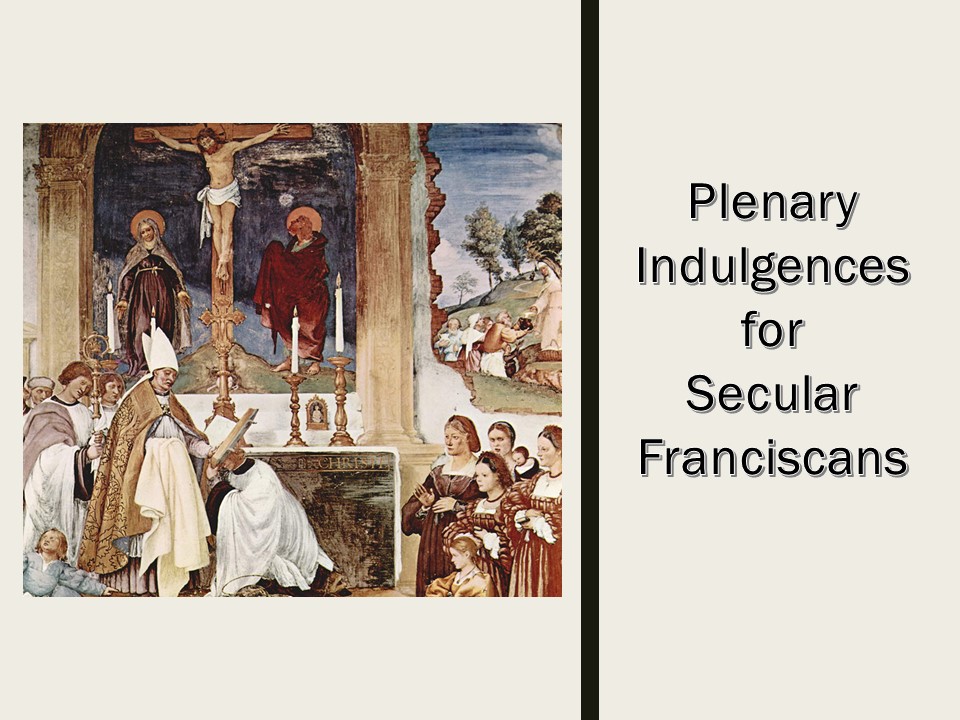
Indulgences
A few weeks ago on August 2, many of us made the effort to visit a Franciscan church or our parish church to obtain the Porziuncola Indulgence. Did you know that as Secular Franciscans, we are eligible to receive a number of other indulgences? We thank Timothy Suspanic, OFS, from St. Kateri Tekawitha Region, for calling this to our attention. He gave us some background information and a list of indulgences special to the Secular Franciscan Order. (The Porziuncola indulgence is not on the list because it is open to everyone, not just OFS.)
Background: “Back in 1967 Pope Paul VI abolished all indulgences prior to that year and published a new Enchiridion (a precise reference book) of Indulgences with all those prayers and works indulgenced from that time forward. He also provided that if any Order, Congregation, Society had their own special indulgences, they should be requested anew. In 1972, the predecessor Council to the Presidency of the International Council requested them and they are in full force and effect to this day.”
Following are the request from the Presidency and the response listing the feast days on which we, as OFS, can receive a Plenary Indulgence:
Holy Father,
The Interobediental General Council (Prior name of the Presidency) of the Secular Third Order of Saint Francis of Assisi (OFS) humbly asks for a revision of the indulgences given by the Holy See to the members of the Secular Third Order, in accordance with the norms of the Apostolic Constitution «Indulgentiarum doctrina» of January 1, 1967, n. 14.
January 22, 1972 (Response received)
The Sacred Penitentiary, by virtue of the special and explicit faculties given by the Holy Father, benignly concedes a plenary Indulgence to the members mentioned above (OFS members), provided they make or renew, at least privately, their promise to observe faithfully the Statutes of their association [ In other words: To obtain the plenary indulgence, the members of the [SFO] OFS should renew their Promise of Evangelical Life (Profession of the [SFO] OFS Rule) in addition to confession, communion and prayer for the intentions of the Pope.]
1. on the day of their admission and of their profession, and at the conclusion of an official visitation;
2. on the feast-days of the Immaculate Conception of the Blessed Virgin Mary; Saint Francis of Assisi; Saint Louis, King; Saint Elizabeth; Blessed Luchesius; Saint Clare; Saint Margaret of Cortona and all the Saints of the Three Orders of Saint Francis.
The present decision will be in force immediately and perpetually, without any time limit. Anything to the contrary notwithstanding. Signed In name of his Eminency by G. Sessolo, Regent; M. Venturi, Secretary
Blessed Luchesius: April 28 Memorial;
Saint Margaret of Cortona: May 16 Feast;
Saint Clare: August 11 Feast;
Saint Louis, King: August 25 Feast;
Saint Francis of Assisi: October 4 Solemnity;
Saint Elizabeth: November 17 Feast;
All the Saints of the Three Orders of Saint Francis: November 29 Feast;
Immaculate Conception of the Blessed Virgin Mary: December 8 Solemnity
If you are interested in reading more about indulgences see:
https://www.scd.org/fatima100/plenary-indulgenceThis is a PDF of the entire 75-page Enchiridion (very interesting!)
http://www.freecatholicebooks.com/books/indulgences.pdf
Questions for discussion or to answer in your journal.
+Were you aware of the indulgences available to us as Secular Franciscans?
+Did you take advantage of the opportunity to receive the Porziuncola Indulgence? Why or why not?
+Of the Indulgences listed above, which ones do you plan to take advantage of?
++++++++++++++++++++++++++++++++++++++++++++++++++
25 de agosto de 2023 Comparta con su fraternidad local
indulgencias
Hace unas semanas, el 2 de agosto, muchos de nosotros hicimos el esfuerzo de visitar una iglesia franciscana o nuestra parroquia para obtener la Indulgencia de la Porciúncula. ¿Sabía que, como franciscanos seglares, somos elegibles para recibir otras indulgencias? Agradecemos a Timothy Suspanic , OFS, de la región de St. Kateri Tekawitha, por llamarnos la atención sobre esto. Nos dio algunos antecedentes y una lista de indulgencias especiales para la Orden Franciscana Seglar. (La indulgencia de la Porciúncula no está en la lista porque está abierta a todos, no solo a OFS).
Antecedentes: “En 1967, el Papa Pablo VI abolió todas las indulgencias anteriores a ese año y publicó un nuevo Enchiridion (un libro de referencia preciso) de Indulgencias con todas aquellas oraciones y obras indulgenciadas desde ese momento en adelante. También dispuso que si alguna Orden, Congregación, Sociedad tuviera sus propias indulgencias especiales, se deberían pedir de nuevo. En 1972, el Consejo predecesor a la Presidencia del Consejo Internacional los solicitó y están en pleno vigor y efecto hasta el día de hoy”.
A continuación se encuentra la solicitud de la Presidencia y la respuesta que enumera los días festivos en los que nosotros, como OFS, podemos recibir una indulgencia plenaria:
Padre Santo,
El Consejo General Interobediencial (nombre anterior de la Presidencia) de la Tercera Orden Seglar de San Francisco de Asís (OFS) pide humildemente la revisión de las indulgencias concedidas por la Santa Sede a los miembros de la Tercera Orden Seglar, de acuerdo con las normas de la Constitución Apostólica «Indulgentiarum doctrina» del 10 de enero de 1967, n. 14
22 de enero de 1972 (Respuesta recibida)
La Sagrada Penitenciaría, en virtud de las facultades especiales y explícitas dadas por el Santo Padre, concede benignamente una Indulgencia plenaria a los miembros antes mencionados (miembros de la OFS), siempre que hagan o renueven, al menos en privado, su promesa de observar fielmente los Estatutos. de su asociación [ En otras palabras: Para obtener la indulgencia plenaria, los miembros de la [OFS] OFS deben renovar su Promesa de Vida Evangélica (Profesión de la [OFS] Regla OFS) además de la confesión, comunión y oración por las intenciones del Papa.]
1. en el día de su admisión y de su profesión, y al final de una visita oficial;
2. en las fiestas de la Inmaculada Concepción de la Santísima Virgen María; San Francisco de Asís; San Luis, Rey; Santa Isabel; Beato Luchesio ; Santa Clara; Santa Margarita de Cortona y todos los Santos de las Tres Órdenes de San Francisco.
La presente decisión tendrá vigencia inmediata y perpetua, sin límite de tiempo. No obstante cualquier disposición en contrario. Firmado en nombre de Su Eminencia por G. Sessolo , Regente; M. Venturi, Secretario
Beato Luchesius : Memoria del 28 de abril;
Santa Margarita de Cortona: Fiesta del 16 de mayo;
Santa Clara: Fiesta del 11 de agosto;
San Luis, Rey: 25 de Agosto Fiesta;
San Francisco de Asís: 4 de octubre Solemnidad;
Santa Isabel: Fiesta del 17 de noviembre;
Todos los Santos de las Tres Órdenes de San Francisco: 29 de noviembre Fiesta;
Inmaculada Concepción de la Santísima Virgen María: Solemnidad del 8 de diciembre
Si está interesado en leer más sobre las indulgencias , consulte:
Este PDF es de todo el Enchiridion en español (¡muy interesante!)
https://www.santateresadejesus.com/wp-content/uploads/Manual-de-Indulgencias.pdf
Preguntas para debatir o para responder en tu diario.
+¿Estaba al tanto de las indulgencias disponibles para nosotros como franciscanos seglares?
+¿Aprovechaste la oportunidad de recibir la Indulgencia de la Porciúncula? ¿Por qué o por qué no?
+De las indulgencias enumeradas anteriormente, ¿cuáles piensa aprovechar?
Diane F. Menditto, OFSVice Minister, National Fraternity, Secular Franciscan Order USAListen – Discern – Go Forth National Theme 2022-2025

National Chapter underway in St. Louis on feast of St. Louis the King
Dear Sisters and Brothers,
 Seventy Franciscans are attending Chapter in St. Louis.
The National Executive Council sends its warm greetings from St. Louis, Missouri, during our National Chapter and on the Feast of our Patron, St. Louis the King.
We have 70 people in attendance to conduct the business of the Order. Providentially, our meeting was scheduled this week – overlapping the Feast Day. What a Godincidence! So today, we will celebrate Mass at the Cathedral Basilica of St. Louis. https://cathedralstl.org/
All things St. Louis. Photos of our afternoon celebrating our Patron will be shared.
St. Louis the King was a good example for us in practicing our theme…Listen, Discern, Go Forth. We discussed actions we can take to further our priorities – Vocations, Communications, and
Relationships. Many decisions will be made on Saturday morning. Please pray for the Holy Spirit to guide us for those deliberations.
Also, we’ve been experiencing a fraternal and pastoral visitation during this chapter. Presidency Councilor Dina Shabalina OFS (Ukraine) and General Spiritual Assistant, Fr. Carlos Campos TOR (Peru) have been with us. They have brought the Franciscan Joy to us, along with ideas for how we may be able to guide our National Fraternity. We appreciate their care and consideration. More on that in another message!
We conclude our Chapter on Saturday afternoon.
Thank you for your prayers.
Peace and all good,
Jane
on behalf of the National Executive Council
https://www.secularfranciscansusa.org/2023/08/25/national-chapter-underway-in-st-louis-on-feast-of-st-louis-the-king/
Sharing the Vision – News from The NEC
(This article originally appeared in the TAU-USA Spring Issue #109)
NEWS FROM THE NATIONAL EXECUTIVE COUNCIL
 100vw, 486px” data-recalc-dims=”1″></p>
<p id=) 2022-2025 OFS-USA Theme
2022-2025 OFS-USA Theme
Daily Boosters for our Vocation through Email
In 2007, our sister, Kathleen White, OFS, of Our Lady of Indiana Regional Fraternity, started sharing daily emails about various OFS-related aspects with other Regional Ministers. After her 2nd term as Regional Minister ended, she learned that many still wanted to receive her daily posts. Thus, the Tau-Daily email list was born. At one point, there were more than 1,000 names on that list serv. A few years ago, Yahoo closed down the list serv features, so Kathleen opened a Google Groups list. Currently 472 have subscribed to receive the daily messages. Topics of the emails include, in monthly rotation:
- The Rule of the Secular Franciscan Order,
- the Admonitions of St. Francis,
- an article from the OFS General Constitutions,
- the USA National Statutes,
- Little Flowers of St. Francis,
- a Franciscan quote, and additionally,
- the Franciscan saint of the
To subscribe, send a blank email to: tau-daily+subscribe@googlegroups.com If you don’t succeed there, send her an email request at kdwofs@gmail.com
If you change your email address, unsubscribe from your old address, then re-subscribe from your new email address.
To end your subscription, there is an UNSUBSCRIBE link at the bottom of each email.
Thanks to Kathleen for those daily boosts of inspiration for our vocations!
Chapter 2023
This year’s annual chapter gathering will be held at the Pallottine Renewal Center in St. Louis, MO., from August 22 through 27, 2023. This is a fraternal and pastoral visitation for the OFS-USA. We will be welcoming Presidency Councilor Dina Shabalina, OFS, (Ukraine) and General Spiritual Assistant Fr. Carlos Campos Julve, TOR (Peru). Fraternal and Pastoral visitations are a wonderful opportunity to deepen our understanding of how to live our vocations. It is so good to receive feedback on what is going well and suggestions for doing some things differently. There are so many ways to correctly serve our Lord. It’s such a gift to receive ideas on what is working well in other parts of the world. We look forward to sharing the experience with you in a variety of ways―Facebook, our website, and TAU-USA. Just like regional and local fraternity visitations, we have a visitation questionnaire to fill out for the visitors. We are just starting to work on that now. Thank you for your prayers so we may continue our journey to effectively animate and guide the OFS-USA.
National Fraternity Council Meetings
Meeting with the National Fraternity Council throughout the year: the NEC is continuing its practice of holding virtual meetings to stay in contact with the Regional Ministers. The National Fraternity Council met on February 8 and April 29, 2023. Virtual meetings allow us to continue the business of the Order throughout the year, as the Regional Ministers are a critical part of the National Fraternity Council.
Connecting with Our Members
Years ago, Jane used to listen to a radio show. The host had a segment when he’d throw a dart at a map of the U.S. He’d get a copy of the phone book from that location (remember phone books?). The next week, he’d call someone from that town during the live broadcast and ask questions to learn about the town. Jane really liked that idea. She also heard that Pope Francis has made random calls to people. So don’t be surprised if you get a call from one of your National Executive Council members. We want to learn about you! 1-How you heard about the Order; 2-Your favorite Article of the Rule or aspect of our vocation that resonates with you strongest; 3-How you serve currently and in the past; and 4-suggestions for the NEC.
Ritual Update
A significant amount of progress is being made on an update to the brown Ritual book. In 2022, the OFS-USA obtained the copyright for the text and began the process for the update. The CNSA and Deacon David and Therese Ream, OFS, worked on the initial update. The NEC is now in the process of reviewing. We will keep you informed of plans for issuing the revised text.
Duns Scotus Board
Requesting applications for OFS members to serve on the Duns Scotus Formation Fund Board. There are two openings for terms starting January 2024-January 2026. Please contact Patricia Serotkin, OFS, DSFF Secretary, to apply by May 31, 2023. Pat’s email: dunsscotustrustfund@gmail.com
https://www.secularfranciscansusa.org/2023/08/21/sharing-the-vision-news-from-the-nec/
Formation Friday August 18, 2023
Formation Friday August 18, 2023 (En español abajo)
When We Gather in Chapter for the Fraternal and Pastoral Visitation Please share with your local fraternity
Next week the National Fraternity Council (all Regional
Ministers and members of the National Executive Council and Commission Chairs)
will meet in in St. Louis for our National Chapter. This year we will host two
international visitors who will carry out the Fraternal and Pastoral visitation
which is held every six years.In the USA, the National (and Regional) Chapters are held
each year and have a profound effect on every Secular Franciscan. On the
regional level, elections and visitations take place every three years. On the
national level, elections take place every three years, but the visitation by
the higher level (CIOFS) takes place every six years.General Constitutions Article 68.1:” The National
Chapter is the representative organ of the Fraternities existing within the
confines of a National Fraternity. It has legislative, deliberative, and
elective powers. In conformity with the Rule and the Constitutions, it may make
legislative decisions and give norms valid within its national confines. The National
Statutes determine the composition of the National Chapter, its frequency, its
powers, and how to convoke it.”“The goal of all
…Chapters is to promote communion of mind and heart, and a renewal of the lives
of each and every brother and sister of the OFS Order. Speaking about renewal,
it is a long and difficult process that makes serious demands of us: the demand to return to the source of our
vocation, the priorities and essential elements of ourgospel way of
life that, over the course of time can become less clear and, in the extreme, no
longer serve to animate and set direction for our Franciscan lives.” (Br.
Michael A. Perry, OFM, former General Minister of the Order of Friars Minor, at
the General Chapter of the Secular Franciscan Order in 2021.)As you can see
in what Br. Michael said, the Chapter is not only for business, although that
is also important. But, probably the most important part of the gathering is
fraternity and ongoing formation. National Chapters (and Regional Chapters) occur
on a three-year cycle. On the regional level, the Elective Chapter is held
every three years. A visitation by the higher fraternity is carried out in the
year following elections and a general business chapter is held during the
third year. On the national level, this schedule varies slightly. Elective
chapters and business chapters are held on the three-year cycle, but the
Chapter of Visitation is held nationally only every six years.In the United
States, all three types of national chapters are held over a 5-day period with
the National Executive Council and Commission Chairs arriving two or three days
early for preparatory meetings. Even if there is to be an election or
visitation, National Chapters follow a certain pattern. We open with a special
Mass; then, each day there are many opportunities for prayer: Daily Mass,
Morning Prayer, Adoration, a Holy Hour, and a Rite of Remembrance for all those
who have died in the past year.Although the
National Executive Council carries out the day-to-day business of the National
Fraternity, when the National Fraternity Council gathers, it is their
responsibility to carry out national business. (See Article 2.1 of the National
Statutes: “The governing body of NAFRA is the National Fraternity Council.
The National Executive Council acts on behalf of the National Fraternity
Council when the members of the entire Council are not in session [cf. General
Constitutions, article #66.1]”. Therefore, during each day of Chapter there
is business: Updates on what our various commissions and committees are doing;
presentation of and approval of the budget for the following year; motions to
approve points brought forward by the Regional Ministers who form the National
Fraternity Council. The National Minister also informs the National Fraternity
Council of the “State of the Order.”This year, the
National Chapter falls in the sixth year of the visitation cycle. Our last
visitation by the International Fraternity was in 2017. So this year our
National Fraternity will be visited by one of the International Councilors and
one of the General Spiritual Assistants. The International Statutes describe
the process:Article 13 1)
Fraternal and pastoral visitations are carried out according to the spirit of
the Rule, the provisions of the General Constitutions (Art. 87.2; 94; 95), the
present Statutes, and the Statutes for Spiritual and Pastoral Assistance to the
OFS. 2) The CIOFS Presidency and the Conference of General Spiritual Assistants
(CSA) carry out the fraternal and pastoral visitations to the National
Councils. 3) To help ensure better fraternal and pastoral visitations, the
visitors prepare for them in advance by taking the following steps: a)
acquiring from their Secretariat copies of the reports of previous visitations
and any other significant information; b) communicating the program and the
purpose of the visitation with the Councils concerned; c) soliciting from the
National Fraternity Council a report in advance on the updated situation of the
Fraternity itself; d) being open to the suggestions of the Fraternity
concerned. 4) The National and Regional Councils undertake to ensure that the
Visitors have the opportunity to meet the local Ordinary. 5) The Visitor will
write a report of the visitation, as a rule, within three months of the
visitation, with his or her recommendations, addressing it to the Council
concerned and to the Council of the higher level. These reports, if not made
jointly, are to be exchanged between the fraternal and pastoral visitors and
properly saved in the archives of the Secretariat.Please keep
your National Fraternity Council and National Executive Council in your prayers
for safe travel and productive meetings.For discussion
or to answer in your journal:
+Have you
attended a National Chapter? What was your impression?+Talk to
someone who has attended and ask them their impressions.+Have you
attended your Regional Chapter? What was your impression?+If you could attend the National Chapter this year, what questions would you
ask the International visitors? What questions would you ask the National
Executive Council?+++++++++++++++++++++++++++++++++
18 agosto, 2023—La visita fraterna y
pastoral
Cuando nos reunimos en Capítulo para la
Visita Fraternal y Pastoral Por favor comparta con su fraternidad localLa próxima semana, el Consejo de la Fraternidad
Nacional (todos los Ministros Regionales y miembros del Consejo Ejecutivo
Nacional y los Presidentes de las Comisiones) se reunirán en St. Louis para
nuestro Capítulo Nacional. Este año recibiremos a dos visitantes
internacionales que realizarán la Visita Fraterna y Pastoral que se realiza
cada seis años.En los Estados Unidos, los Capítulos Nacionales
(y Regionales) se llevan a cabo cada año y tienen un profundo efecto en cada
Franciscano Seglar. A nivel regional, las elecciones y visitas tienen lugar
cada tres años. A nivel nacional, las elecciones se realizan cada tres años,
pero la visita del nivel superior ( CIOFS ) se realiza cada seis años.Constituciones Generales Artículo 68. 1: “El Capítulo nacional es el órgano
representativo de las Fraternidades existentes en el ámbito de una Fraternidad
nacional, con potestad legislativa, deliberativa y electiva. Puede tomar
decisiones legislativas y emanar normas, de conformidad con la Regla y las
Constituciones, válidas en el ámbito nacional. El Estatuto nacional determina
la composición, periodicidad, competencias y modo de convocar el Capítulo nacional.”“El objetivo de todos… los Capítulos es
promover la comunión de mente y corazón, y la renovación de la vida de todos y
cada uno de los hermanos y hermanas de la Orden OFS. Hablando de renovación, es
un proceso largo y difícil que nos plantea serias exigencias: la exigencia de
volver a la fuente de nuestra vocación, a las prioridades y elementos
esenciales de nuestra forma de vida evangélica que, con el paso del tiempo,
puede volverse menos clara y, en el extremo, dejar de servir para animar y
orientar nuestra vida franciscana”. ( Fr. Michael A. Perry, OFM, ex Ministro
General de la Orden de los Frailes Menores, en el Capítulo General de la Orden
Franciscana Seglar en 2021. )
Como se puede ver en lo que el Hno. Michael
dijo, el Capítulo no es solo para negocios, aunque eso también es importante.
Pero, probablemente, la parte más importante del encuentro es la fraternidad y
la formación permanente. Los Capítulos Nacionales (y los Capítulos Regionales)
ocurren en un ciclo de tres años. A nivel regional, el Capítulo electivo se
realiza cada tres años. La visita de la fraternidad mayor se lleva a cabo en el
año siguiente a las elecciones y el capítulo general de negocios se lleva a
cabo durante el tercer año. A nivel nacional, este horario varía ligeramente.
Los capítulos electivos y los capítulos de negocios se llevan a cabo en el
ciclo de tres años, pero el Capítulo de la Visitación se lleva a cabo a nivel
nacional solo cada seis años.
En los Estados Unidos, los tres tipos de
capítulos nacionales se llevan a cabo durante un período de 5 días y los miembros
del Consejo Ejecutivo Nacional y los presidentes de las Comisiones llegan dos o
tres días antes para las reuniones preparatorias. Incluso si va a haber una
elección o visita, los Capítulos Nacionales siguen un cierto patrón. Abrimos
con una Misa especial; luego, cada día hay muchas oportunidades para la
oración: Misa diaria, Oración de la mañana, Adoración, Hora santa y Rito de
recuerdo para todos aquellos que han muerto en el último año.
Aunque el Consejo Ejecutivo Nacional lleva a
cabo los asuntos cotidianos de la Fraternidad Nacional, cuando se reúne el
Consejo de la Fraternidad Nacional, es su responsabilidad llevar a cabo los
asuntos nacionales. (Véase el Artículo 2.1 de los Estatutos Nacionales: “ El
órgano rector de NAFRA es el Consejo de la Fraternidad Nacional. El Consejo
Ejecutivo Nacional actúa en nombre del Consejo de la Fraternidad Nacional
cuando los miembros del Consejo en su totalidad no están en sesión [cf.
Constituciones Generales, artículo #66.1]”. Por lo tanto, durante cada
día del Capítulo hay asuntos que discutir: Actualización de lo que están
haciendo nuestras distintas comisiones y comités; presentación y aprobación del
presupuesto para el año siguiente; mociones de aprobación de puntos presentadas
por los Consejeros Regionales que forman el Consejo de la Fraternidad Nacional.
El Ministro Nacional también informa al Consejo de la Fraternidad Nacional del
“Estado de la Orden”.
Este año, el Capítulo Nacional cae en el sexto
año del ciclo de visitas. Nuestra última visita de la Fraternidad Internacional
fue en 2017. Así que este año nuestra Fraternidad Nacional será visitada por
uno de los Consejeros Internacionales y uno de los Asistentes Espirituales
Generales. Los Estatutos Internacionales describen el proceso:
Artículo 13 1) Las visitas fraterna y pastoral
se realizan según el espíritu de la Regla, las disposiciones de las
Constituciones generales (Art. 87.2; 94; 95), el presente Estatuto y el
Estatuto para la Asistencia Espiritual y Pastoral a la OFS. 2) La Presidencia
del CIOFS y la Conferencia de Asistentes Espirituales Generales (CAS) realizan
las visitas fraternales y pastorales a los Consejos Nacionales. 3) Para un
mejor desarrollo de las visitas, tanto fraterna como pastoral, los visitantes
las preparan con antelación procediendo a: a) adquirir de su Secretariado copia
de los informes de las visitas precedentes y cualquier otro elemento
significativo; b) comunicar el programa y el objeto de la visita a los Consejos
interesados; c) solicitar al Consejo de la Fraternidad nacional un informe
previo sobre la situación actualizada de la Fraternidad misma; d) estar abierto
a las sugerencias de la Fraternidad interesada. 4) El Consejo Nacional y el
Regional se empeñan en procurar que los Visitantes tengan la oportunidad de
conocer al Ordinario del lugar. 5) El Visitador redacta, normalmente en los
tres meses siguientes, un informe de la visita, con sus recomendaciones,
dirigiéndolo al Consejo interesado y al Consejo de nivel superior. Dichos
informes, si no se hacen conjuntamente, deben ser intercambiados entre los
visitantes fraterno y pastoral y debidamente conservados en los archivos del
Secretariado.
Por favor mantenga a su Consejo Nacional de
Fraternidad y Consejo Ejecutivo Nacional en sus oraciones para un viaje seguro
y reuniones productivas.
Para discusión o para responder en su diario:
+¿Ha asistido a un Capítulo Nacional? ¿Cuál fue
su impresión?+Hable con alguien que haya asistido y pídale
sus impresiones.+¿Ha asistido a su Capítulo Regional? ¿Cuál fue
su impresión?+Si usted pudiera asistir al Capítulo Nacional este año, ¿Qué preguntas les
haría a los visitantes internacionales? ¿A los miembros del Consejo Ejecutivo
Nacional?
++++++++++++++++++++++++++++++++++++
Diane F. Menditto, OFSVice Minister, National Fraternity, Secular Franciscan Order USAListen – Discern – Go Forth National Theme 2022-2025—
OFS Quinquennial Museum, Phoenix, Az.
(This article originally appeared in the TAU-USA Spring Issue #109)
Sharon Dale OFS, National Archivist
 Last August’s Quinquennial was indeed a special event. More than 600 attendees from all over the United States participated. We had inspiring speakers, stimulating breakout sessions, multiple opportunities for prayer and singing, perusing our many vendors for books, religious supplies, totes, pictures and what have you, and, of course, there was our OFS Museum.
Tom McNamara, OFS, National Historian, and I collected historical documents that spanned the 100 years we’ve hosted National Congresses. There were agendas, notes of special speakers, newspaper write-ups, and many, many pictures of Qs over the years. Our displays traced the development of the
National Association, the old Province system, and the new autonomous regions, as well as many of the people and events involved. One table showed our collection of TAU-USA publications, including one so old that it doesn’t have an issue number on it! Tom also contributed minutes of early meetings from the St. Thomas More Region.
I drove to New York, where our National Archives are kept and sent more than 250 documents of early history, which included the establishment of regions. We also displayed a few old “habits” that early Tertiaries wore in their fraternity meetings.
Tom had a “mystery box,” a special treat for anyone interested in archiving. It included the exact contents of a typical box arriving at our archives—no special order or organization, ratty- looking onion-skin papers, letters, and hundreds of old staples. That is what every archivist, whether at the local, regional, or national level, is challenged with. Each piece of paper has to be examined, sorted, and scanned into the computer for safe keeping.
A very special display was the beautiful 6-foot banner that was loaned to us from St. Carlo church in Saint Louis dedicated to the Third Order Franciscans. It was very old―we had a “no touch” sign on it because of its delicate nature.
We hope that all who visited our OFS History Museum appreciated the collections on display. It was truly a once-in-a-lifetime experience.
https://www.secularfranciscansusa.org/2023/08/14/ofs-quinquennial-museum-phoenix-az/