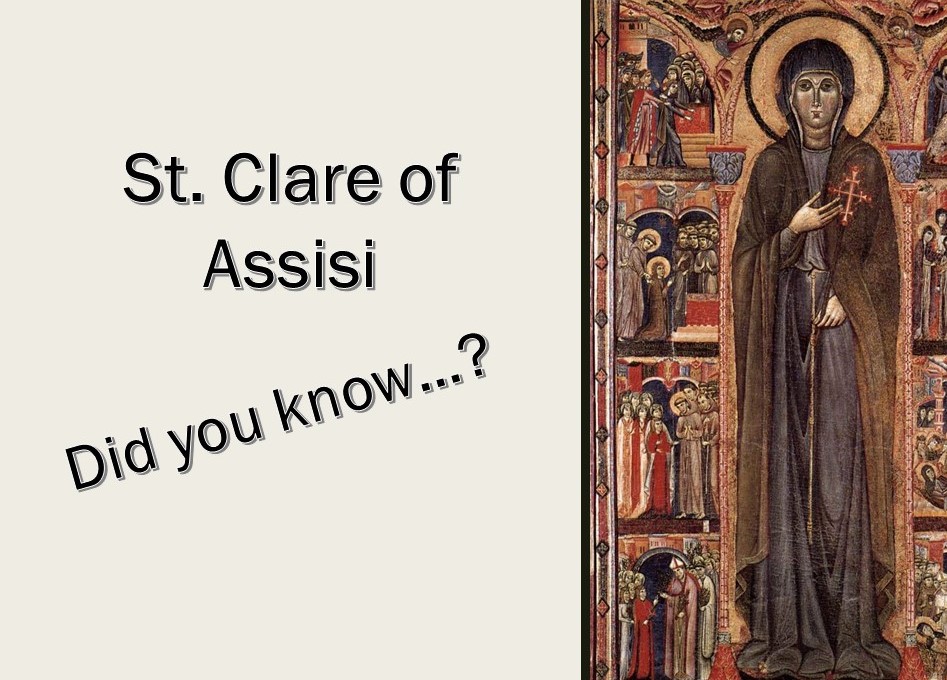
Prepared by Francine Gikow, OFS, member, National Formation Commission, OFS-USA
Did you know that…?
· St. Clare’s family was part of the class known as the Maiores—the upper class (nobility) of society in Assisi.
· Clare’s mother, Ortulana, was a strong, deeply religious woman who made a number of pilgrimages, notably one to the Holy Land. Later, she and Clare’s sister entered the monastery.
· One of the earliest followers of St. Francis was Clare’s cousin Rufino.
· When St. Clare left her family home, she gave away all her considerable worldly goods, dowry and family connections.
· At first she lived in the Benedictine monastery of San Paolo delle Abbadesse.
· She entered penniless, without status, and was considered a servant.
· The “choir nuns” usually came from wealthy families. The lay sisters (“converse”) did all the menial tasks.
· Clare accepted the lowliest status willingly. She wanted no preference given to her.
· San Paolo delle Abbadesse monastery enjoyed a privilege of excommunication for anyone interfering or maltreating its residents thereby protecting St. Clare from her family’s wrath.
· St. Clare outlived St. Francis of Assisi by 27 years and during that time helped to maintain the integrity of the Franciscan charism by contact with St. Francis’ early followers who came to her for advice.
Rule of Life:
· In 1219, Cardinal Ugolino wrote his own Constitutions for the followers of St. Clare and established it following the Rule of St. Benedict. It allowed endowments and property, etc. This order was originally called “the Poor Ladies of the Order of Valley of the Spoleto or of Tuscany.” He tried to have St. Clare accept this Benedictine rule and his own constitutions for her order but she refused since it did not include the “Privilege of Poverty.” However, Cardinal Ugolino was able to convince many monasteries following St. Clare of Assisi, in San Damiano, to accept it. In spite of this, there were still some monasteries loyal to St. Clare who truly lived the “Privilege of Poverty” such as Agnes of Prague’s monastery.
· After Cardinal Ugolino was elected pope (as Gregory IX) In 1228, Cardinal Reinaldo dei Conti di Segni, was appointed the new Cardinal protector for Cardinal Ugolino’s order with its 24 female monasteries,but it was now called the “Order of St. Damian.” St. Clare’s monastery was listed as a member monastery although St. Clare did not approve of Ugolino’s Constitutions. However, it was during this time that St. Clare’s monastery was allowed an exemption for the “Privilege of Poverty,” but it remained the only monastery given this privilege. St. Clare and her sisters were then brought under the Benedictine rule proposed by now pope, Gregory IX.
· Beginning on November 13, 1245, Pope Innocent IV issued a bull that reaffirmed that all monasteries of the Order of St. Damian were to follow the Rule of St. Benedict and Ugolino’s “Form of Life” which required endowments for the monastery.
· Clare was a very strong woman never compromising on her core belief of living only on what God provided (without dowries, property, or regular income) which she called, the Privilege of Poverty..
· St. Clare’s Rule of Life for her sisters was the first canonical “Form of Life” (Rule) written by a woman approved on her deathbed by Pope Innocent IV which at first still included only St. Clare’s monastery in San Damiano, but eventually St. Agnes of Prague’s monastery and a few other monasteries would be allowed to follow it.
· St. Clare’s “Form of Life” for her sisters was very democratic and visionary for the time. Some
of her innovations were:
· election of the abbess by all the sisters with the abbess having term limits rather than a lifelong appointment.
· voting for admission and profession candidates by all of the sisters.
· all sisters would perform menial work and there would be no demarcation between servants and choir nuns. All sisters would be expected to serve. Moreover, serving was seen as a privilege and St. Clare was a model for serving.
Questions for reflection or to answer in your journal
+What did you learn about St. Clare today that you did not know before?
+What about St. Clare’s life inspires you as a Secular Franciscan?
+ Personal Challenge: St. Clare’s love of poverty allowed her to be a collaborative servant leader. This week, examine any leadership positions you hold. How are you collaborative? If collaboration is difficult for you, what is holding you back?For more information:
WIlliam Hugo, OFM Cap. and Joanne Schatzlein, OFS, Studying the Life of Saint Clare of Assisi: A Beginner’s Workbook. Hyde Park N.Y.: New City Press. 2019.
Bret Thoman, OFS, St. Clare of Assisi: Light from the Cloister, Tan Books, Charlotte, North Carolina. 2017.
+++++++++++++++++++
11 de agosto de 2023 (Fiesta de Santa Clara de Asís)
¿Qué sabe usted de Santa Clara de Asís? ( Por favor, comparta con su fraternidad local.)Preparada por Francine Gikow, OFS, miembro, Comisión Nacional de Formación, OFS-USA
Sabía usted que…?
- La familia de Sta. Clara era parte de la clase conocida como Mayores, la clase alta (nobleza) de la sociedad en Asís.
- La madre de Clara, Ortulana, era una mujer fuerte y profundamente religiosa que hizo varias peregrinaciones, en particular una a Tierra Santa. Más tarde, ella y la hermana de Clara entraron en el monasterio.
- Uno de los primeros seguidores de San Francisco fue el primo de Clara, Rufino.
- Cuando Santa Clara dejó el hogar de su familia, regaló todos sus considerables bienes mundanos, dote y conexiones familiares.
- Al principio vivió en el monasterio benedictino de San Paolo delle Abbadesse.
- Entró sin dinero, sin estatus, y fue considerada una sirvienta.
- Las “monjas del coro” solían provenir de familias adineradas. Las hermanas laicas (“converse”) hacían todas las tareas domésticas.
- Clara aceptó de buena gana el estatus más bajo. No quería que se le diera preferencia.
- El monasterio de San Paolo delle Abbadesse disfrutó del privilegio de la excomunión para cualquiera que interfiriera o maltratara a sus residentes, protegiendo así a Santa Clara de la ira de su familia.
- Santa Clara sobrevivió a San Francisco de Asís por 27 años y durante ese tiempo ayudó a mantener la integridad del carisma franciscano mediante el contacto con los primeros seguidores de San Francisco que acudieron a ella en busca de consejo.
Regla de vida:
- En 1219, el Cardenal Ugolino escribió sus propias Constituciones para los seguidores de Santa Clara y las estableció siguiendo la Regla de San Benito. Permitía dotaciones y propiedades, etc. Esta orden se llamaba originalmente “las Damas Pobres de la Orden del Valle de Spoleto o de Toscana”. Trató de que Santa Clara aceptara esta regla benedictina y sus propias constituciones para su orden, pero ella se negó porque no incluía el “Privilegio de la Pobreza”. Sin embargo, el cardenal Ugolino pudo convencer a muchos monasterios que seguían a Santa Clara de Asís, que la aceptaran. A pesar de esto, todavía quedaban algunos monasterios fieles a Santa Clara que verdaderamente vivían el “Privilegio de la Pobreza” como el monasterio de Inés de Praga.
- Después de que el cardenal Ugolino fue elegido papa (como Gregorio IX) en 1228, el cardenal Reinaldo dei Conti di Segni, fue nombrado el nuevo cardenal protector de la orden del cardenal Ugolino con sus 24 monasterios femeninos, pero ahora se llamaba la “Orden de San Damián”. ” El monasterio de Santa Clara figuraba como monasterio miembro, aunque Santa Clara no estaba de acuerdo con las Constituciones de Ugolino. Sin embargo, fue durante este tiempo que al monasterio de Santa Clara se le permitió una exención por el “Privilegio de la Pobreza”, pero siguió siendo el único monasterio que recibió este privilegio. Santa Clara y sus hermanas quedaron bajo la regla benedictina propuesta por el ahora Papa Gregorio IX.
- A partir del 13 de noviembre de 1245, el Papa Inocencio IV emitió una bula que reafirmaba que todos los monasterios de la Orden de San Damián debían seguir la Regla de San Benito y la “Forma de vida” de Ugolino, que requería dotaciones para el monasterio.
- Clare era una mujer muy fuerte que nunca se comprometió con su creencia central de vivir solo con lo que Dios proveyó (sin dotes, propiedades o ingresos regulares), lo que ella llamó el Privilegio de la Pobreza.
- La Regla de Vida de Santa Clara para sus hermanas fue la primera “Forma de Vida” canónica (Regla) escrita por una mujer aprobada en su lecho de muerte por el Papa Inocencio IV, que al principio solo incluía el monasterio de Santa Clara en San Damián, pero eventualmente la Santa Sede permitiría que el monasterio de Inés de Praga y algunos otros monasterios lo siguieran.
- La “Forma de vida” de Santa Clara para sus hermanas fue muy democrática y visionaria para la época. Algunas de sus innovaciones fueron:
· elección de la abadesa por todas las hermanas y la abadesa tenía límites de mandato en lugar de un nombramiento de por vida.
· votación de candidatas de admisión y profesión por parte de todas las hermanas.
· todas las hermanas realizarían trabajos de baja categoría y no habría demarcación entre sirvientas y monjas del coro. Se esperaría que todas las hermanas sirvieran. Además, servir era visto como un privilegio y Sta. Clara era un modelo de servicio.
Preguntas para reflexionar o para responder en su diario
+¿Qué aprendió sobre Santa Clara hoy que no sabía antes?
+¿Cómo le inspira la vida de Santa Clara como franciscano seglar?
+ Desafío personal: El amor de Santa Clara por la pobreza le permitió ser una líder de servicio colaborativa. Esta semana, examine cualquier posición de liderazgo que tenga. ¿Cómo colabora? Si colaborar le es difícil, ¿qué le detiene?Para más información: (en inglés)
William Hugo, OFM Cap. y Joanne Schatzlein, OFS, Studying the Life of Saint Clare of Assisi: A Beginner’s Workbook. Hyde Park New York: New City Press. 2019.
Bret Thoman, OFS, St. Clare of Assisi: Light from the Cloister, Tan Books, Charlotte, NC. 2017.
Diane F. Menditto, OFSVice Minister, National Fraternity, Secular Franciscan Order USAListen – Discern – Go Forth National Theme 2022-2025


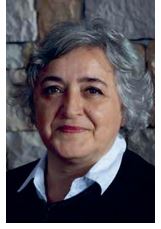 Being a Secular Franciscan means being engaged in a ministry of service, Noemi Paola Riccardi reminded fellow members of the CIOFS Presidency in a Monday morning session.
 Aldo Morocho, OFS, far left, and youth in front of Praça do Comércio in Lisbon preparing for World Youth Day. Aldo and his daughter Dalia Morocho, and Fr. John De La Riva, OFM Cap, are among the Secular Franciscan representatives at the weeklong event.
 As in most families, certain topics “pop up” for discussion every so often and need clarification. Some topics are simply a matter of majority opinion; others are a matter of “tradition” and should we/can we change the tradition; but some are a matter civil or Church law. Whether or not Secular Franciscans “wear a habit” is a topic that falls into the latter category.