For all those who are new to the Order and all those who are long-time members, it’s good to look back at our roots every so often. This week we provide some “Did You Knows” about the OFS in the United States. This post is made possible because of the research done by our former National Historian, William Wicks, OFS. For more, see the FUN Manual chapter on the History of the OFS and its Rules.
Did you know that…?
· Friars serving the immigrant populations that flooded into the US in the middle of the 19th Century, established Third Order (now called Secular Franciscan Order) fraternities in the parishes they served. These fraternities were associated with the province of the friars who established them. At the beginning of the 20th Century, there were more German-speaking fraternities than English Speaking Fraternities in the United States
· In 1921 a USA National Directive Board and a National Executive Board for the Third Order were established. Only friars served on these boards.
· Lay leadership came into the world-wide Order in 1957 with the International Constitutions.
· In the late 1980s the Conference of National Spiritual Assistants was formed with friars of the four obediences (OFM, OFM Cap, OFM Conv., and TOR) forming the conference. One member would serve as a member of the National Executive Council (lay leadership) as the President-in-turn of the conference. (This continues today.)
· The process of REGIONALIZATION was first called for in the Constitutions of 1957 but did not begin in the United States until 1987 and was completed in 1997.
· Before regionalization, the jurisdictional structure of local fraternities was set up according to the provinces of the friars who had established them.
· The basis for regionalization was that the Secular Franciscan Order is ONE order and is not made up of four branches as are the friars.
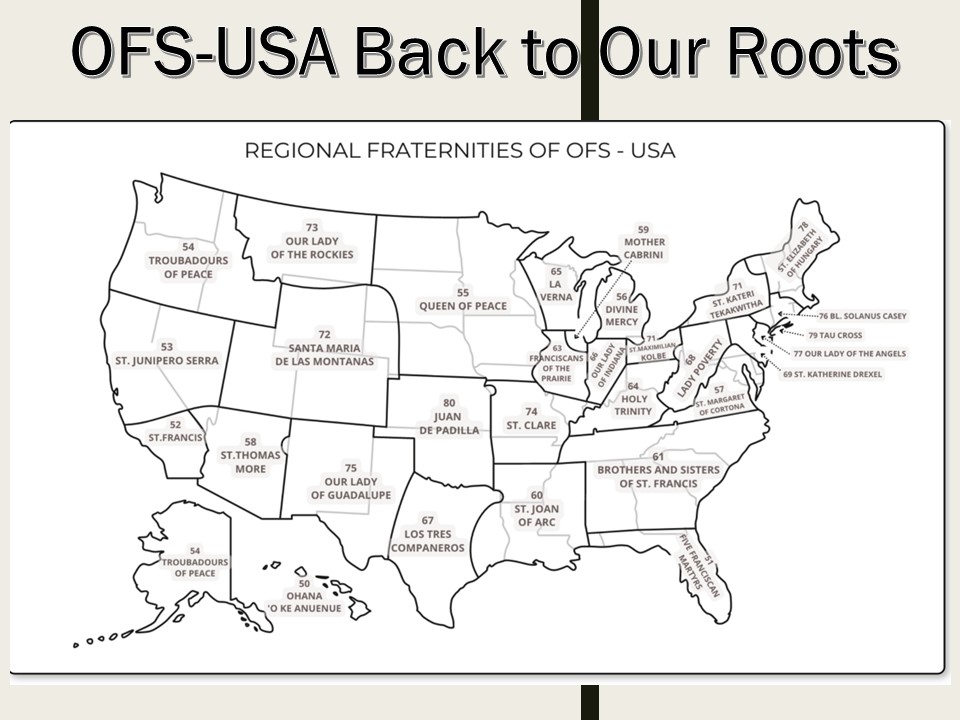
· The regionalization process divided all local fraternities into 31 (now 30) geographic regions. (See map in the graphic and on our website.) https://www.secularfranciscansusa.org/map-of-ofs-usa-regions/
· Although the Secular Franciscan Order is autonomous in its structure and is self-governing, we are still “connected to the First Order through the Altius Moderamen, a Latin term used in Canon 303 to mean that the friars of the First Order and Third Order Regular are to guarantee the fidelity of the OFS to the Franciscan Charism, communion with the Church, and union with the Franciscan Family.”
· Today local fraternities are designated as “bonded” to the friar province that established them.
· The National Statutes of 1995 changed the age for profession from 14 to 21.
· The National Statutes of 2002 established a longer period of formation. (The Time of Initiation: Orientation-no less than 3 months–and Inquiry—no less than 6 months and The Time of Formation—Candidacy: no less than 18 months and no more than 36 months) This replaced the “Novitiate” which had been one year plus one day.
You can find many more interesting historical facts and tidbits about the Secular Franciscan Order in the History books written by William Wicks, OFS, available on our Gospel To Life—OFS-USA bookstore site. Order form at this link:
https://www.secularfranciscansusa.org/wp-content/uploads/Order-Form_October_2023rev.pdfFor discussion with a partner or at a fraternity gathering:
+What surprised you about some aspects of the history given above?
+Do you know to what friar province your local fraternity is bonded? Which one? If not, see if you can find out!
+Does your fraternity have a copy of the history books mentioned? If not, perhaps you can suggest that a set be ordered for the fraternity library. (Only in English)+Challenge: Talk to the older (longest professed) members of your fraternity. When did your fraternity begin? What are some things the older members remember about your fraternity and the Order in general?
Formación 10 de noviembre de 2023 ( es español abajo ) Compártalo con su fraternidad local.
Para todos aquellos que son nuevos en la Orden y para todos aquellos que son miembros desde hace mucho tiempo, es bueno mirar atrás a nuestras raíces de vez en cuando. Esta semana proporcionamos algunos datos sobre la OFS en los Estados Unidos. Esta publicación es posible gracias a la investigación realizada por nuestro ex historiador nacional, William Wicks, OFS. Para obtener más información, consulte el capítulo del Manual FUN sobre la Historia de la OFS y sus Reglas.
¿Sabía usted que…?
- Los frailes que servían a las poblaciones inmigrantes que inundaron los Estados Unidos a mediados del siglo XIX , establecieron fraternidades de la Tercera Orden (ahora llamada la Orden Franciscana Seglar) en las parroquias a las que servían. Estas fraternidades estaban asociadas a la provincia de los frailes que las fundaron. A principios del siglo XX, en Estados Unidos había más fraternidades de habla alemana que de habla inglesa.
- En 1921 se establecieron una Junta Directiva Nacional de EE. UU. y una Junta Ejecutiva Nacional para la Tercera Orden. Sólo los frailes servían en estas juntas.
- El liderazgo laico entró en la Orden mundial en 1957 con las Constituciones Internacionales.
- A finales de la década de 1980 se formó la Conferencia de Asistentes Espirituales Nacionales con frailes de las cuatro obediencias (OFM, OFM Cap, OFM Conv. y TOR) que formaban la conferencia. Un miembro actuaría como miembro del Consejo Ejecutivo Nacional (liderazgo laico) como presidente a su vez de la conferencia. (Esto continúa hoy).
- El proceso de REGIONALIZACIÓN fue solicitado por primera vez en las Constituciones de 1957, pero no comenzó en los Estados Unidos hasta 1987 y finalizó en 1997.
- Antes de la regionalización, la estructura jurisdiccional de las fraternidades locales se establecía según las provincias de los frailes que las habían constituido.
- La base para la regionalización fue que la Orden Franciscana Seglar es UNA orden y no está compuesta de cuatro ramas como lo están los frailes.
- El proceso de regionalización dividió a todas las fraternidades locales en 31 (ahora 30) regiones geográficas. (Ver mapa en el gráfico y en nuestro sitio web). https://www.secularfranciscansusa.org/map-of-ofs-usa-regions/
- Aunque la Orden Franciscana Seglar es autónoma en su estructura y se gobierna a sí misma, todavía estamos “conectados a la Primera Orden a través del Altius Moderamen, un término latino usado en el Canon 303 para significar que los frailes de la Primera Orden y la Tercera Orden Regular garantizan la fidelidad de la OFS al carisma franciscano, la comunión con la Iglesia y la unión con la Familia Franciscana”.
- Hoy en día, las fraternidades locales están designadas como “vinculadas” a la provincia de los frailes que las estableció.
- Los Estatutos Nacionales de 1995 cambiaron la edad de profesión de 14 a 21 años.
- Los Estatutos Nacionales de 2002 establecieron un período de formación más largo. (El Tiempo de Iniciación: Orientación -no menos de 3 meses–e Indagación-no menos de 6 meses y El Tiempo de Formación-Candidatura: no menos de 18 meses y no más de 36 meses) Este plan reemplazó al “Noviciado” que antes era de un año más un día.
Puede encontrar muchos más datos históricos interesantes y otras curiosidades sobre la Orden Franciscana Seglar en los libros de Historia escritos por William Wicks, OFS, disponibles en inglés en nuestro sitio de librería Gospel To Life—OFS-USA. Formulario de pedido en este enlace:
https://www.secularfranciscansusa.org/wp-content/uploads/Order-Form_October_2023rev.pdfPara conversar con un compañero o en una reunión de fraternidad:
+¿Qué le sorprendió de algunos aspectos de la historia mencionada anteriormente?
+ ¿Sabe a qué provincia fraile está vinculada su fraternidad local? ¿Cuál? Si no, ¡A ver si puede descubrirlo!
+¿Tiene su fraternidad una copia de los libros de historia mencionados? Si no, tal vez pueda sugerir que se pida un juego para la biblioteca de la fraternidad. (Solo en inglés)+ Desafío: Hable con los miembros mayores (de profesión más antigua) de su fraternidad. ¿Cuándo comenzó su fraternidad? ¿Cuáles son algunas de las cosas que los miembros mayores recuerdan sobre su fraternidad y la Orden en general?
Diane F. Menditto, OFSVice Minister, National Fraternity, Secular Franciscan Order USAListen – Discern – Go Forth National Theme 2022-2025
Formation Friday November 3, 2023
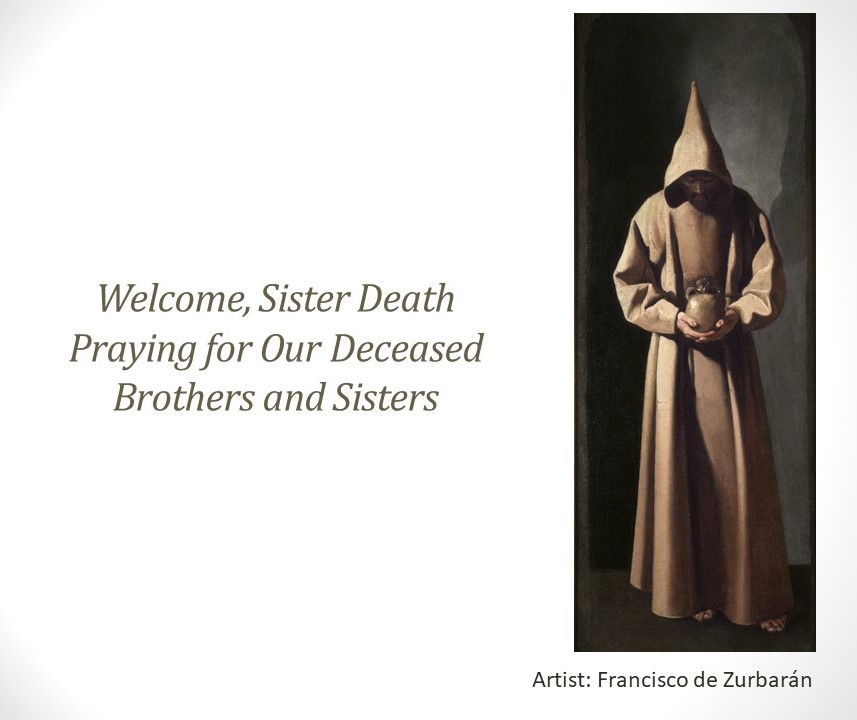
During the month of November, the entire Church prays for the dead. St. Francis meditated on Sister Death throughout his life. Toward the end of his earthly life, he spoke of Sister Bodily Death in the Canticle of the Creatures.
“Praised be You, my Lord, through our Sister Bodily Death, from whom no one living can escape.
Woe to those who die in mortal sin.
Blessed are those whom death will find in Your most holy will,
for the second death shall do them no harm.” [FA: ED vol 1, p. 158]
Our Rule and Constitutions ask us to remain in communion with our deceased brothers and sisters.
Rule, Article 19: Since they are immersed in the resurrection of Christ, which gives true meaning to Sister Death, let them serenely tend toward the ultimate encounter with the Father.
Rule, Article 24: It should adopt appropriate means for growth in Franciscan and ecclesial life and encourage everyone to a life of fraternity42. This communion continues with deceased brothers and sisters through prayer for them.
GC, Article 27.2: Secular Franciscans should commit themselves to create in their environment and, above all, in their fraternities, a climate of faith and hope so that “Sister Death” may be regarded as a passage to the Father, and all may prepare themselves with serenity.
There is a tradition in the Catholic Church dating back to Pope Clement XII in 1736 who encouraged all Catholics to pray Psalm 130, also known as the “De Profundis” followed by the short prayer, “Eternal rest grant unto them, Oh Lord,…” for all of our deceased brothers and sisters in Christ.
Psalm 130 “De profundis clamavi ad te, Domine…”
I
Out of the depths I call to you, LORD; 2Lord, hear my cry! May your ears be attentive to my cry for mercy.
3If you, LORD, keep account of sins, Lord, who can stand? 4But with you is forgiveness and so you are revered.
II
5I wait for the LORD, my soul waits and I hope for his word.c 6My soul looks for the Lord more than sentinels for daybreak.
More than sentinels for daybreak, 7let Israel hope in the LORD, For with the LORD is mercy, with him is plenteous redemption, 8And he will redeem Israel from all its sins.
To ponder and discuss with a prayer partner or in fraternity throughout the month of November:
+How do you remember in prayer the deceased members of your family?
+How does your fraternity (local, regional, and national) remember our deceased members?
+Share some thoughts on how your local fraternity might celebrate a Rite of Remembrance for your deceased members.
Challenge: This month, pray the De Profundis (Psalm 130) for all those who have died, especially those who have no one to pray for them.
Formación 3 de noviembre 2023 Por favor, compartir con la fraternidad local.
Durante el mes de noviembre toda la Iglesia ora por los difuntos. San Francisco meditó sobre la Hermana Muerte durante toda su vida. Hacia el final de su vida terrena habló de la Hermana Muerte Corporal en el Cántico de las Criaturas.
“12Loado seas, mi Señor, por nuestra hermana la muerte corporal,
de la cual ningún hombre viviente puede escapar.13¡Ay de aquellos que mueran en pecado mortal!:
bienaventurados aquellos a quienes encuentre en tu santísima voluntad,
porque la muerte segunda no les hará mal.Nuestra Regla y Constituciones nos piden permanecer en comunión con nuestros hermanos y hermanas fallecidos.
Regla, Artículo 19: Insertos en la resurrección de Jesucristo, que da su verdadero sentido a la Hermana Muerte, se encaminen con serenidad al encuentro definitivo con el Padre.
Regla, Artículo 24: Para incrementar la comunión entre los miembros, el Consejo organice reuniones periódicas y encuentros frecuentes, incluso con otros grupos franciscanos, especialmente de jóvenes, adoptando los medios más adecuados para el crecimiento en la vida franciscana y eclesial, estimulando a todos a la vida de Fraternidad42.
Esta comunión se prolonga con los hermanos difuntos, ofreciendo sufragios por sus almas43.
GGCC, Artículo 27.2: Los franciscanos seglares comprométanse a crear en sus ambientes, y sobre todo en las Fraternidades, un clima de fe y de esperanza, para que “la hermana muerte” sea esperada como paso hacia el Padre y para que todos puedan prepararse con serenidad.
Hay una tradición en la Iglesia Católica que se remonta al Papa Clemente XII en 1736, quien animó a todos los católicos a rezar el Salmo 130, también conocido como “De Profundis”, seguido de la breve oración: “Concédeles el descanso eterno, oh Señor,… ”por todos nuestros hermanos y hermanas en Cristo fallecidos.
Psalm 130 “De profundis clamavi ad te, Domine…”
I
“Desde lo más profundo te invoco, Señor, ¡Señor, oye mi voz! Estén tus oídos atentos al clamor de mi plegaria.
Si tienes en cuenta las culpas, Señor, ¿quién podrá subsistir? Pero en ti se encuentra el perdón, para que seas temido.II
Mi alma espera en el Señor, y yo confío en su palabra. Mi alma espera al Señor, más que el centinela la aurora.
Como el centinela espera la aurora, espere Israel al Señor, porque en él se encuentra la misericordia y la redención en abundancia: él redimirá a Israel de todos sus pecados.”Para reflexionar y discutir con un compañero de oración o en fraternidad durante todo el mes de noviembre:
+¿Cómo recuerda en oración a los miembros fallecidos de su familia?
+¿Cómo recuerda su fraternidad (local, regional y nacional) a nuestros miembros fallecidos?
+Comparta algunas ideas sobre cómo su fraternidad local podría celebrar un Rito de Recuerdo de sus miembros fallecidos.
Desafío: Este mes, rece el De Profundis (Salmo 130) por todos los que han muerto, especialmente aquellos que no tienen a nadie que ore por ellos.
Diane F. Menditto, OFSVice Minister, National Fraternity, Secular Franciscan Order USAListen – Discern – Go Forth National Theme 2022-2025
You Can’t Take It With You

Jane DeRose-Bamman National Minister
The idiom, “You can’t take it with you” encourages all to enjoy life now because we can’t take money or possessions with us when we die. It appears that Jesus in Luke 12:13-21 may be advocating for us to spend our money and use up our possessions. As we see at the end of the parable, stored up possessions and money are meaningless in the grand scheme of things. However, Jesus concludes with the bottom line – we should be focusing on storing up “what matters to God.”
So what do we want to take with us – or what can we take with us? This month of November, there are numerous feast days highlighting those who have figured out what to take with them on their journeys. We remember All Saints (Nov 1), All Souls (Nov 2), Commemoration of All the Deceased of the Seraphic Order (Nov 5), Blessed John Duns Scotus (Nov 8), St. Elizabeth of Hungary, Patroness of the OFS (Nov 17) and all Saints of the Seraphic Order (Nov 29).
Each is a billboard for not hoarding the God-given gifts we have. After all, the songwriter, Marty Haugen reminds us: “the gifts we have, we are given to share.” (We are Many Parts by Marty Haugen). The gifts also should not be obstacles to seeing the needs of others or how we are impacting people or the environment.
Instead of focusing on the accumulation of material goods, we shift our focus to taking with us: a collection of good deeds, opportunities we took to share our possessions, the times when we cared for creation (including moving earthworms from the sidewalk) and the knowledge of God through spending time in prayer. What will you take when you encounter Sister Death?
This is a perfect month to reflect on OFS Rule Article 19. “Since they are immersed in the resurrection of Christ, which gives true meaning to Sister Death, let them serenely tend toward the ultimate encounter with the Father.”
May our eyes, minds and hearts be open to share our many gifts and to grow in our understanding of the ways of God.
Note: We have a “treasure” on our website – a calendar of Franciscan Saints by day compiled by Mary Lou Coffman OFS: https://www.secularfranciscansusa.org/wp-content/uploads/Franciscan-Saints-01-2023.pdf. This information could be used in fraternity newsletters or formation sessions. But give credit to the original sources of information in any publication!

Fwd: NAFRA-FORM Formation Friday October 27, 2023
Please share
with your local fraternities
Initial and Ongoing
Formation
In the near
future, you will be hearing about the “Thematic Guide for Formation Programs”
published by the International Formation Secretariat. We will be taking the
suggestions made in this document into account for any new formation materials
we produce. “The content of the ‘Time of Formation’ (initial formation) should
present the study of the Rule and General Constitutions, as a way of deepening
the specific elements that characterize Secular Franciscanism, so that the
brothers and sisters in formation reach their human, Christian, and Franciscan
maturity.” Ongoing or permanent formation focuses on all of the above plus “continued
study of Franciscan sources; of ecclesial documents that refer to the mission
and vocation of the laity; and other issues that meet the needs of today’s
world.” As you can see below, the USA is in the forefront of what is being
asked of us!
The
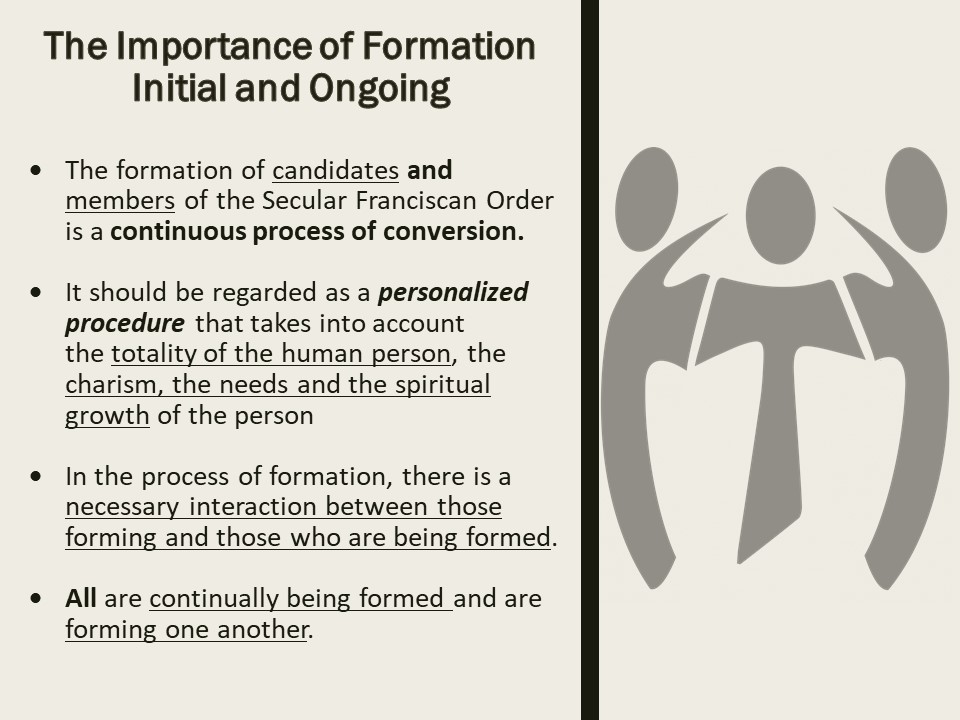
Importance of Initial and Ongoing Formation
- The
formation of candidates AND professed members of the Secular Franciscan
Order is a continuous process of conversion.
- It
should be regarded as a personalized procedure that takes into
account the totality of the human
person, the charism, the needs and the spiritual growth of the person.
- In
the process of formation, there is a necessary interaction between those
forming and those who are being formed.
- All
are continually being formed and are forming themselves and one another.
The Agents
of Formation (for candidates AND professed)
- The
Holy Spirit
- The
Candidate (or the Professed member) him/herself
- The
local fraternity
- The
fraternity council
- The
formation director and formation team
- The
spiritual assistant
- The
sponsor (in the case of a candidate)
- Higher
levels of fraternity
What does
Initial and Ongoing Formation do for us?
- Helps us toward the full realization of our human and
Christian development.
- Helps us to become mature in our faith bringing us to
personal union with the Father in Christ through the Holy Spirit.
- Helps us to experience Church within a community of
faith and love while remaining faithful to the conditions of our secular
state in life.
- Helps us to recognize and follow the example in his
life and through his writings.
- Teaches us to see the Holy Spirit as our source of
strength and light.
Characteristics
of Formation (Initial and Ongoing)Secular Franciscan formation must be:
·
Active, Communal, Centered on Jesus and His
Gospel, Ecclesial, Secular, Franciscan, Joyful, In the spirit of Simplicity, Open-ended[See Guidelines
for Initial Formation in the Secular Franciscan Order in the United States pp. 17-20.]Questions to
ponder, discuss or answer in your journal:+ In what ways
did (does) your initial formation program prepare you for life as a Secular
Franciscan?+ Think about
the on-going formation experience in your fraternity.·
How does the ongoing formation program in your
fraternity strengthen your vocation? (Examples)·
Think about what you would suggest to your
fraternity formation team and let them know!
Formación 27 de octubre de 2023 Por favor
comparta con sus fraternidades locales.Formación inicial y permanente
En un futuro próximo, oirán hablar de la “Guía
temática para programas de formación” publicada por el Secretariado
Internacional de Formación. Tomaremos en cuenta las sugerencias hechas en este
documento para cualquier nuevo material de formación que produzcamos. “El
contenido del “Tiempo de Formación” (formación inicial) debe presentar el
estudio de la Regla y de las Constituciones Generales, como forma de
profundizar en los elementos específicos que caracterizan al Franciscanismo
Seglar, para que los hermanos y hermanas en formación alcancen su dimensión
humana, madurez cristiana y franciscana”. La formación continua o permanente se
centra en todo lo anterior más “el estudio continuo de las fuentes
franciscanas; de documentos eclesiales que se refieren a la misión y vocación
de los laicos; y otras cuestiones que satisfacen las necesidades del mundo
actual”. Como pueden ver abajo, ¡Los Estados Unidos está a la vanguardia de lo
que se nos pide!
La importancia de la formación inicial
y permanente
- La formación de candidatos Y
miembros profesos de la Orden Franciscana Seglar es un proceso continuo de
conversión.- Debe considerarse como un procedimiento
personalizado que tiene en cuenta la totalidad de la persona humana,
el carisma, las necesidades y el crecimiento espiritual de la persona.- En el proceso de formación hay una
interacción necesaria entre quienes forman y quienes se forman.- Todos están continuamente
formándose y se están formando a sí mismos y a los demás.
Los Agentes de Formación (para candidatos
Y profesos)
- El Espíritu Santo
- El propio candidato (o el profeso)
- la fraternidad local
- el consejo de fraternidad
- El director de formación y el
equipo de formación.- el asistente espiritual
- El patrocinador (en el caso de un
candidato)- Los niveles superiores de
fraternidad
¿Qué hace por nosotros la Formación
Inicial y Permanente?
- Nos
ayuda a la plena realización de nuestro desarrollo humano y cristiano.- Nos
ayuda a madurar en nuestra fe llevándonos a la unión personal con el Padre
en Cristo a través del Espíritu Santo.- Nos
ayuda a experimentar la Iglesia dentro de una comunidad de fe y amor,
permaneciendo fieles a las condiciones de nuestro estado de vida seglar.- Nos
ayuda a reconocer y seguir el ejemplo de San Francisco en su vida y a
través de sus escritos.- Nos
enseña a ver al Espíritu Santo como nuestra fuente de fuerza y luz.
Características de la Formación
(Inicial y Permanente)La formación franciscana seglar debe ser:
·
Activo,
comunitario; centrado en Jesús y Su Evangelio; eclesial; Secular; Franciscano; alegre;
en el espíritu de Sencillez; abierto[Ver Guidelines
for Initial Formation in the Secular Franciscan Order in the United States ,
págs. 17-20. En inglés]
Preguntas para reflexionar, discutir o
responder en su diario:+ ¿De qué manera su programa de formación
inicial lo preparó (está preparando) para la vida como franciscanoseglar?+ Piensa en la experiencia de formación
permanente en su fraternidad.
- ¿Cómo fortalece su vocación el
programa de formación permanente de su fraternidad? (Ejemplos)- Piense en lo que sugeriría al
equipo de formación de su fraternidad y dígaselo.Diane F. Menditto, OFSVice Minister, National Fraternity, Secular Franciscan Order USAListen – Discern – Go Forth National Theme 2022-2025
Formation Friday – The Our Father–a source for deeper prayer – October 20, 2023
Please share with your local fraternity
The Our Father–a source for deeper prayer
We know that the Our Father was very important to St. Francis. His beautiful exposition of the prayer shows us his thoughts. In preparation for the meditation that follows, please read it at the link below on the website of the Franciscan International Tradition: https://digitalcollections.franciscantradition.org/document/bx4700-f6f722-1999/francis_of_assisi_early_documents_-_the_saint/1999-00-00?pageNo=158
Saint Teresa of Ávila gave this advice while praying the Lord’s Prayer: “Much more is accomplished by a single word of the Our Father said, now and then, from our heart, than by the whole prayer repeated many times in haste and without attention.”
Keeping Francis’s exposition of the Our Father in mind, and following St Theresa’s advice, we can deepen our prayer lives and our relationship with God the Father by praying parts of the Our Father any time we are in need, when we are happy, and when we want help changing our lives. Use the questions to meditate on each portion of the prayer. The order does not matter because whatever part you choose will lead you to a beautiful prayer.
“Our Father”
How do you picture God the Father?
Do I see God as my loving Father who only wants my good? How am I willing to follow what my Father asks of me?
Jesus calls God his father. Picture Jesus as your brother. What is this like for you?
“Who art in heaven”
How do you picture heaven? Where do we get a picture of how heaven might be?
“Hallowed be thy name”
How do you praise God in words? In your actions? In how you live your life? What are you most grateful for that God has given you? How to you praise and thank him for his gifts to you?
“Thy kingdom come”
How do we express this desire as Franciscans? What is the challenge found in desiring that the kingdom of God is a priority in all things?
“Thy will be done on earth As it is in heaven.”
How difficult is this to accept? When you are praying for something, are you able to say, “Thy will be done?” How does it make you feel?
“Give us this day our daily bread”
How do you express your needs to God?
What does it mean to you to receive Communion? Are you able to receive more than once a week? If not, what stops you?
“Forgive us our trespasses”
How easy is it for you to ask for forgiveness? From God? From others? Do you make frequent use of the Sacrament of Reconciliation? In what ways can you improve?
“as we forgive those who trespass against us”
How easy is it for you to forgive others? How can this present a challenge? How can you overcome the challenge?
“And lead us not into temptation”
Do you turn to God to help you if you are tempted to sin? (Privately) Consider those temptations that are most difficult for you. How can you make the changes that are necessary?
“But deliver us from evil.”
How are you able to be strong in the face of the sadness in the world? How does God help you to seek conversion?
Challenge for this week: Pick a word or phrase from the Our Father and use it for prayer and meditation. Repeat with various words and phrases from the prayer during the week.
++++++++++++++++++++++++++++
20 de octubre de 2023 El Padre Nuestro: una fuente para la oración más profunda
Sabemos que el Padre Nuestro era muy importante para San Francisco. Su hermosa exposición de la oración nos muestra su pensamiento. Como preparación para la meditación que sigue, léala en el siguiente enlace en el sitio web de Franciscanos.org: https://franciscanos.org/esfa/escritossf.html#exppn
Santa Teresa de Ávila daba este consejo mientras rezaba el Padrenuestro: “Se logra mucho más con una sola palabra del Padre Nuestro dicha, de vez en cuando, desde el corazón, que con toda la oración repetida muchas veces apresuradamente y sin atención.”
Teniendo en cuenta la exposición del Padre Nuestro de Francisco y siguiendo el consejo de Santa Teresa, podemos profundizar nuestra vida de oración y nuestra relación con Dios Padre rezando partes del Padre Nuestro en cualquier momento en que lo necesitemos, cuando estemos felices y cuando queremos ayuda para cambiar nuestras vidas. Utilice las preguntas para meditar en cada parte de la oración. El orden no importa porque cualquier parte que elija le llevará a una hermosa oración.
“Padre nuestro”
¿Cómo se imagina a Dios Padre? ¿Veo a Dios como mi Padre amoroso que sólo quiere mi bien? ¿ Cómo estoy dispuesto a seguir lo que mi Padre me pide? Jesús llama a Dios su padre. Imagine a Jesús como su hermano. ¿Cómo es esto para Ud?
“Que estás en el cielo”
¿Cómo se imagina el cielo? ¿De dónde obtenemos una imagen de cómo podría ser el cielo?
“Santificado sea tu nombre ”
¿Cómo alaba a Dios con palabras? ¿En sus acciones? ¿En cómo vive su vida? ¿Qué es lo que más agradece que Dios le ha dado? ¿Cómo lo alaba y le agradece los regalos que le hizo?
“Venga a nosotros tu reino ”
¿Cómo expresamos este deseo como franciscanos? ¿Cuál es el desafío que se encuentra al desear que el reino de Dios sea una prioridad en todas las cosas?
“Hágase tu voluntad en la tierra como en el cielo”.
¿Qué tan difícil es aceptar esto? Cuando está orando por algo, ¿puedes decir: “Hágase tu voluntad?” ¿Cómo le hace sentir?
“Danos hoy nuestro pan de cada día:”
¿Cómo expresa sus necesidades a Dios? ¿Qué significa para usted recibir la Comunión? ¿Puede recibir más de una vez por semana? Si no, ¿qué le detiene?
“Perdona nuestras ofensas”
¿Qué tan fácil le resulta pedir perdón? ¿De Dios? ¿De otros? ¿Hace uso frecuente del Sacramento de la Reconciliación? ¿De qué manera puede mejorar?
“como nosotros perdonamos a los que nos ofenden”
¿Qué tan fácil le resulta perdonar a los demás? ¿Cómo puede presentar esto una dificultad? ¿Cómo puede superar la dificultad?
“ No nos dejes caer en la tentación”
¿Recurres a Dios para que le ayude si es tentado a pecar? (En privado) Considere aquellas tentaciones que le resulten más difíciles. ¿Cómo puede hacer los cambios que sean necesarios?
“Y líbranos del mal.”
¿Cómo puede ser fuerte ante la tristeza del mundo? ¿Cómo le ayuda Dios a buscar la conversión?
Desafío para esta semana : Elija una palabra o frase del Padre Nuestro y úsala para la oración y la meditación. Repita con varias palabras o frases de la oración durante la semana.
Diane F. Menditto, OFSVice Minister, National Fraternity, Secular Franciscan Order USAListen – Discern – Go Forth National Theme 2022-2025