Thank you to National Formation Commission member Francine Gikow, OFS, for contributing this article.
One of the unique areas of JPIC (Justice, Peace and Integrity of Creation) for a Secular Franciscan is our responsibility for work-whether in paid employment, volunteering or working for our own family in childrearing, housework or in many diverse ways. Our use of self, (and God’s work through us) helps to share the “good news” of Jesus in concrete ways to others. We may be the only contact with God’s goodness and grace in certain circumstances, and can draw others to Christ through our relationships, faith, and actions. We can reach people who are “unchurched” where they are, for who they are and be there for them. Our witness, as married and single people, may be seen as credible, relatable and relevant for we are present where the jobs are, and we bring along our faith, joy and compassion. This is how we “evangelize.”
Let’s see what our Rule and Constitutions state about this special JPIC apostolate.
Rule, Article 16: Let them esteem work both as a gift and as a sharing in the creation, redemption, and service of the human community.
Constitutions: Article 21:
1. For Francis, work is a gift and to work is a grace. Daily work is not only the means of livelihood, but the opportunity to serve God and neighbor as well as a way to develop one’s own personality. In the conviction that work is a right and a duty and that every form of occupation deserves respect, the brothers and sisters should commit themselves to collaborate so that all persons may have the possibility to work and so that working conditions may always be more humane.
2. Leisure and recreation have their own value and are necessary for personal development. Secular Franciscans should maintain a balance between work and rest and should strive to create meaningful forms of using leisure time. (See Gaudium et Spes 67: Laborem exercens 16ff.)
Points to ponder:
· Describe how your work is a “gift and grace?” How is it a right and a duty?
· Identify how you share in creation, redemption and service already in your work. In what ways can you improve how you “serve God and neighbor?”
· How do the Rule and Constitutions elevate the importance of your relationships at work and in being a good example in your work environment? Give specific examples.
· Does the concept of “justice” in working conditions impact your work? If so, how? If not, why not?
· Why is leisure and recreation important for your working life? What does it contribute to your job and your spiritual life?
Challenge for this week: During this week, take note of the times your influence as a Catholic and as a Franciscan has had an effect at your job or volunteer position.
++++++++++++++++++++++
El Trabajo: JPIC para Franciscanos Seglares
Gracias a Francine Gikow, OFS, miembra de la Comisión Nacional de Formación, por contribuir con este artículo.
Una de las áreas únicas de JPIC (Justicia, Paz e Integridad de la Creación) para un Franciscano Seglar es nuestra responsabilidad por el trabajo, ya sea en un empleo remunerado, como voluntario o trabajando para nuestra propia familia en la crianza de los hijos, las tareas domésticas o de muchas maneras diversas. Nuestro uso de nosotros mismos (y la obra de Dios a través de nosotros) ayuda a compartir las “buena nueva” de Jesús de manera concreta con los demás. Podemos ser el único contacto con la bondad y la gracia de Dios en ciertas circunstancias, y podemos atraer a otros a Cristo a través de nuestras relaciones, fe y acciones. Podemos llegar a personas que “no asisten a ninguna iglesia” donde están, por quienes son y estar ahí para ellos. Nuestro testimonio, como personas casadas y solteras, puede ser visto como creíble, identificable y relevante porque estamos presentes donde están los trabajos y llevamos nuestra fe, alegría y compasión. Así es como “evangelizamos”.
Veamos qué dicen nuestra Regla y Constituciones sobre este apostolado especial de JPIC.
Regla, artículo 16: Consideren el trabajo como don de Dios y como participación en la creación, redención y servicio de la comunidad humana
Constituciones: Artículo 21:
1. Regla 16. Para San Francisco, el trabajo es un don y el trabajar es una gracia. El trabajo de cada día es no sólo medio de sustento, sino también una ocasión de servicio a Dios y al prójimo, y un camino para desarrollar la propia personalidad. En la convicción de que el trabajo es un derecho y un deber y que toda forma de ocupación merece respeto, los hermanos comprométanse a colaborar para que todos tengan la posibilidad de trabajar y para que los medios de trabajo sean cada vez más humanos.
2. El tiempo libre y el esparcimiento tienen su propio valor y son necesarios para el desarrollo de la persona. Los franciscanos seglares mantengan una equilibrada relación entre trabajo y reposo e interésense en la práctica de formas cualificadas de ocupación del tiempo libre (Ver Gaudium et Spes 67: Laborem ejercicios 16ff.)
Puntos a considerar:
- Describa cómo su trabajo es un “don y gracia”. ¿Cómo es un derecho y un deber?
- Identifique cómo usted comparte la creación, la redención y el servicio ya en su trabajo. ¿De qué manera puede mejorar su forma de “servir a Dios y al prójimo”?
- ¿Cómo elevan la Regla y las Constituciones la importancia de sus relaciones en el trabajo y de ser un buen ejemplo en su entorno laboral? Dé ejemplos específicos.
- ¿El concepto de “justicia” en las condiciones laborales impacta su trabajo? ¿Si es así, cómo? ¿Si no, porque no?
- ¿Por qué el ocio y la recreación son importantes para su vida laboral? ¿Qué aportan a su trabajo y a su vida espiritual?
Desafío para esta semana : Durante esta semana, haga una lista de las veces que su influencia como católico y franciscano ha tenido efecto en su trabajo o puesto de voluntario.
Diane F. Menditto, OFSVice Minister, National Fraternity, Secular Franciscan Order USAListen – Discern – Go Forth National Theme 2022-2025
Formation Friday Some Attributes of St. Francis – October 6, 2023
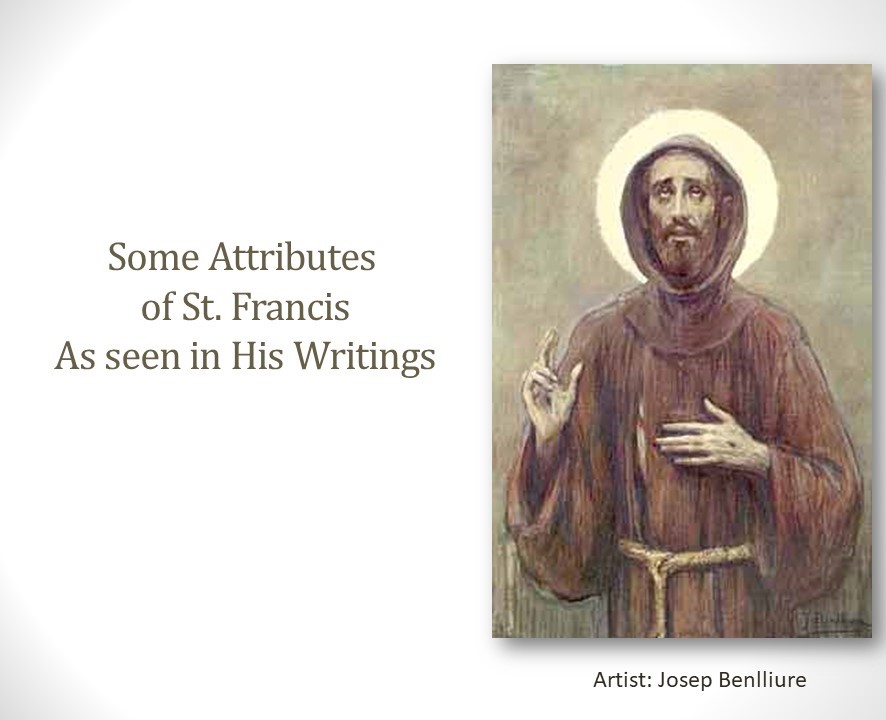
Some Attributes of St. Francis as Seen in his Writings
Contributed by Cathy Chamipon, Minister, St. Clare Fraternity, Asheville, NC
As Secular Franciscans, we look to St. Francis as our example. What did he hold as important in his life? Francis had many things he valued, but mainly he loved God, he adored the Eucharist and he valued all of God’s creation.
“And thou shalt love the Lord thy God with all thy heart and with all thy soul, and with all thy might.”( Deut 6:5)
Through his writings, we can see that St. Francis took these words to heart:
The Praises of God
1You are the holy Lord God Who does wonderful things. Ps 77:15 [Vulgate, Ps 76:15] a
2You are strong. You are great. Ps 86:10 [Vulgate, Ps 85:10] You are the most high.
You are the almighty king. You holy Father, Jn 17:11
King of heaven and earth. Mt 11:253You are three and one, the Lord God of gods; Ps 136:2 [Vulgate, Ps 135:2]
You are the good, all good, the highest good,
Lord God living and true. 1 Thes 1:94You are love, charity; You are wisdom, You are humility,
You are patience, You are beauty, You are meekness, Ps 71:5 [Vulgate, Ps 70:5]
You are security, You are rest,
You are gladness and joy, You are our hope, You are justice,
You are moderation, You are all our riches to sufficiency.5You are beauty, You are meekness,
You are the protector, Ps 31:5 [Vulgate, Ps 30:5] You are our custodian and defender,
You are strength, Ps 43:2 [Vulgate, Ps 42:2] You are refreshment. 6You are our hope,
You are our faith, You are our charity,
You are all our sweetness, You are our eternal life:
Great and wonderful Lord, Almighty God, Merciful Savior. (FA:ED Vol. 1 p. 109)St. Francis adored the Eucharist: “I see nothing corporally of the most high Son of God except His most holy Body and Blood…” (Testament FA:ED Vol 1 p. 125)
The Eucharist is a mystery, it reveals as well as conceals God. Through receiving the Eucharist, we become tabernacles of the Most High. St. Francis was in awe of the humility in which Our Lord, because of love, wants to rest in us.
Lastly, Francis valued other creatures, both man, beasts, and all created things. God created all things and “saw that it was good.” Francis would see Christ in all living things and would greet them as sister and brother.
Franciscan Intellectual Tradition website: https://digitalcollections.franciscantradition.org/pages/early-sources-table-of-contents
Questions to discuss in fraternity, with a partner, or to answer in your journal.
+St. Francis was called the Mirror of Christ because he imitated Christ so closely. How do I imitate Jesus in my daily life?
+St. Francis went away to quiet places to be with God. In what ways do I take time to be with God daily?
+St. Francis loved the Eucharist. Do I believe in the real presence of Jesus in the Eucharist? Do I try to attend mass more than just on Sundays? Do I spend time in Adoration frequently? How do these practices enhance my life as a Secular Franciscan?
+St. Francis valued all creatures. How is my treatment of others changed by remembering that they are created by God? How do I live my life cherishing this planet, by reducing, recycling and reusing resources?
+Challenge for this week: Choose one of the attributes mentioned above and consciously work to include it in your daily life. At the end of the week, observe any changes you have made.
+++++++++++++++++++++++++++++++++++
Algunos atributos de San Francisco de Asís visto en sus escritos
Contribución de Cathy Champon, Ministra, Fraternidad St. Clare, Asheville, NC
Como franciscanos seglares, vemos a San Francisco como nuestro ejemplo. ¿Qué consideraba importante en su vida? Francisco tenía muchas cosas que valoraba, pero principalmente amaba a Dios, adoraba la Eucaristía y valoraba toda la creación de Dios.
“Y amarás al Señor tu Dios con todo tu corazón, y con toda tu alma y con todas tus fuerzas”;. (Deuteronomio 6:5)
A través de sus escritos, podemos ver que San Francisco tomó estas palabras en serio:
Alabanzas del dios altísimo
Tú eres santo, Señor Dios único, que haces maravillas.
Tú eres fuerte, tú eres grande, tú eres altísimo, tú eres rey omnipotente, tú, Padre santo, rey del cielo y de la tierra.
Tú eres trino y uno, Señor Dios de dioses, tú eres el bien, todo el bien, el sumo bien, Señor Dios vivo y verdadero.
Tú eres amor, caridad; tú eres sabiduría, tú eres humildad, tú eres paciencia, tú eres belleza, tú eres mansedumbre, tú eres seguridad, tú eres quietud, tú eres gozo, tú eres nuestra esperanza y alegría, tú eres justicia, tú eres templanza, tú eres toda nuestra riqueza a satisfacción.
Tú eres belleza, tú eres mansedumbre; tú eres protector, tú eres custodio y defensor nuestro; tú eres fortaleza, tú eres refrigerio.
Tú eres esperanza nuestra, tú eres fe nuestra, tú eres caridad nuestra, tú eres toda dulzura nuestra, tú eres vida eterna nuestra: Grande y admirable Señor, Dios omnipotente, misericordioso Salvador. http://franciscanos.org/esfa/ald.html
San Francisco adoraba la Eucaristía: “…nada veo corporalmente en este siglo del mismo altísimo Hijo de Dios, sino su santísimo cuerpo y su santísima sangre,…” (Testamento http://franciscanos.org/esfa/teste.html )
La Eucaristía es un misterio, revela y oculta a Dios. Al recibir la Eucaristía, nos convertimos en tabernáculos del Altísimo. San Francisco estaba asombrado de la humildad en la que Nuestro Señor, por amor, quiere descansar en nosotros.
Por último, Francisco valoraba otras criaturas, tanto hombres, bestias y todas las cosas creadas. Dios creó todas las cosas y “vio que era bueno”;. Francisco veía a Cristo en todos los seres vivos y los saludaba como hermana y hermano.
Preguntas para discutir en fraternidad, con un compañero o para responder en su diario.
+San Francisco fue llamado el Espejo de Cristo porque imitó a Cristo muy de cerca. ¿Cómo imito a Jesús en mi vida diaria?
+San Francisco frecuentaba lugares tranquilos para estar con Dios. ¿De qué manera me tomo el tiempo para estar con Dios diariamente?
+San Francisco amaba la Eucaristía. ¿Creo en la presencia real de Jesús en la Eucaristía? ¿Trato de asistir a misa más que solo los domingos? ¿Paso tiempo en Adoración con frecuencia? ¿Cómo mejoran estas prácticas mi vida como franciscano seglar?
+San Francisco valoraba a todas las criaturas. ¿Cómo cambia mi trato hacia los demás al recordar que son creados por Dios? ¿Cómo vivo mi vida apreciando este planeta, reduciendo, reciclando y reutilizando recursos?
+Desafío para esta semana: Elija uno de los atributos mencionados anteriormente y trabaje conscientemente para incluirlo en su vida diaria. Al final de la semana, observe cualquier cambio que haya realizado.
Diane F. Menditto, OFSVice Minister, National Fraternity, Secular Franciscan Order USAListen – Discern – Go Forth National Theme 2022-2025
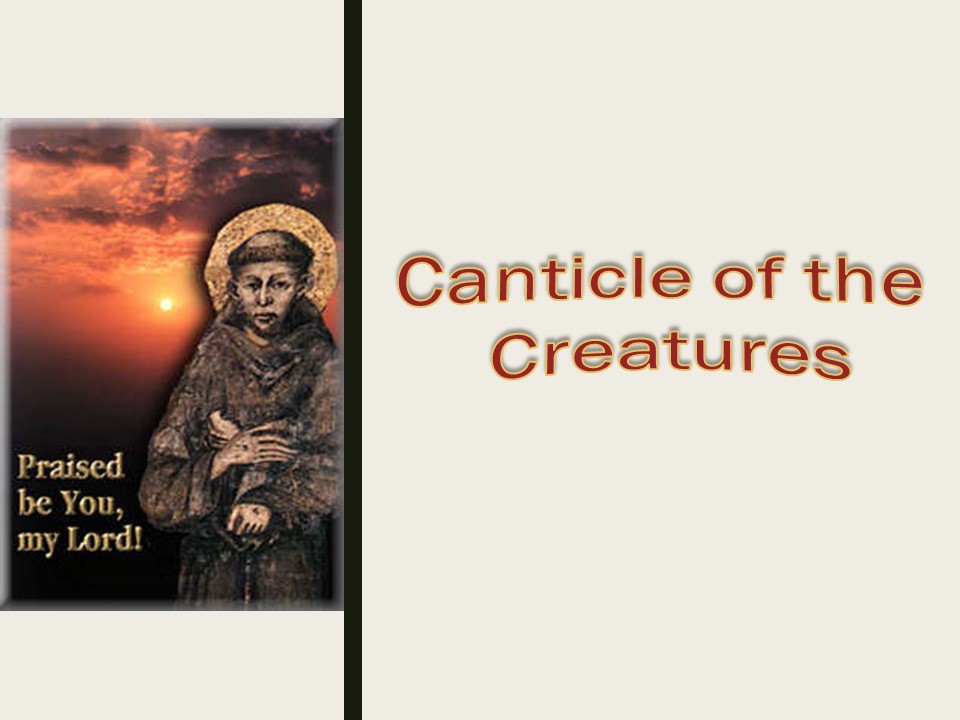
Formation Friday, Canticle of the Creatures September 29, 2023
The Canticle of the Creatures
As we approach the Transitus and Feast Day of our Seraphic Father, we offer his own words as they appear in the Canticle of the Creatures. Composed in 1225 during his last illness, St. Francis gives glory to God through all of creation in the first portion of the canticle. Ever the peacemaker, he added verses 10 and 11 at a time when the political and religious authorities of Assisi were in conflict. Then, right before his death, he added two verses praising God for “Sister Bodily Death,” and, as always, calling us to penance and conversion.
The Canticle of the Creatures
1Most High, all-powerful, good Lord,
Yours are the praises, the glory, and the honor, and all blessing, Rv 4:9 Rv 4:11
2To You alone, Most High, do they belong,
and no human is worthy to mention Your name.d
3Praised be You, my Lord, with all Your creatures, Tb 8:7
especially Sir Brother Sun,
Who is the day and through whom You give us light.e
4And he is beautiful and radiant with great splendor;
and bears a likeness of You, Most High One.
5Praised be You, my Lord, through Sister Moon and the stars, Ps 148:3
in heaven You formed them clear and precious and beautiful.a
6Praised be You, my Lord, through Brother Wind,
and through the air, cloudy and serene, and every kind of weather,
through whom You give sustenance to Your creatures.
7Praised be You, my Lord, through Sister Water, Ps 148:4 Ps 148:5
who is very useful and humble and precious and chaste.
8Praised be You, my Lord, through Brother Fire, Dn 3:66
through whom You light the night, Ps 78:14 [Vulgate, Ps 77:14]
and he is beautiful and playful and robust and strong.
9Praised be You, my Lord, through our Sister Mother Earth, Dn 3:74
who sustains and governs us,
and who produces various fruit with colored flowers and herbs. Ps 104:13 [Vulgate, Ps 103:13] Ps 104:14 [Vulgate, Ps 103:14]10Praised be You, my Lord, through those who give pardon for Your
love, Mt 6:12
and bear infirmity and tribulation.b
11Blessed are those who endure in peace
for by You, Most High, shall they be crowned.12Praised be You, my Lord, through our Sister Bodily Death,
from whom no one living can escape.c
13Woe to those who die in mortal sin.
Blessed are those whom death will find in Your most holy will,
for the second death Rv 2:11 Rv 20:6 shall do them no harm.d14Praise and bless my Lord Dn 3:85 and give Him thanks
and serve Him with great humility.After reading the Canticle, go back and look at the Scripture sources indicated—read the passages—see how Francis was influenced by his intimate knowledge of Scripture.
+What part does Scripture play in your daily life? What does “going from Gospel to life and life to the Gospel” (Article 4 of our Rule) mean to you?
Reread verses 10 and 11 of the Canticle.
+How do you serve as a peacemaker in your family, job, or community?
+In what ways is it difficult for you to “forgive” those who don’t agree with you?
+Verse 10 calls to mind the story of Perfect Joy. What is Francis telling us in that story and in this canticle?Verses 12 and 13 talk about the end of life and how we are to prepare.
+Give some thought to the qualities it takes to accept our eventual death or the death of someone we love.
+Reread the Prologue to the Rule of 1978, especially “Concerning Those Who Do Not Do Penance.” Why are penance and conversion so important to us?Here is a short video about the Transitus of St. Francis celebrated on October 3rd.
https://www.youtube.com/watch?v=lTRzZz0Rmdg+++++++++++++
Por favor compartir con sus fraternidades locales
Cántico de las Criaturas
A medida que nos acercamos al Tránsito y la Fiesta de nuestro Seráfico Padre, ofrecemos sus propias palabras tal como aparecen en el Cántico de las Criaturas. Compuesto en 1225 durante su última enfermedad, San Francisco da gloria a Dios a través de toda la creación en la primera parte del cántico. Siempre pacificador, agregó los versículos 10 y 11 en un momento en que las autoridades políticas y religiosas de Asís estaban en conflicto. Luego, justo antes de su muerte, añadió dos versos alabando a Dios por la “Hermana Muerte Corporal” y, como siempre, llamándonos a la penitencia y la conversión.
ALABANZAS DE LAS CRIATURAS
1Altísimo, omnipotente, buen Señor,
tuyas son las alabanzas, la gloria y el honor y toda bendición.
2A ti solo, Altísimo, corresponden,y ningún hombre es digno de hacer de ti mención.
3Loado seas, mi Señor, con todas tus criaturas,especialmente el señor hermano sol,
el cual es día, y por el cual nos alumbras.
4Y él es bello y radiante con gran esplendor,
de ti, Altísimo, lleva significación.
5Loado seas, mi Señor, por la hermana luna y las estrellas,
en el cielo las has formado luminosas y preciosas y bellas.
6Loado seas, mi Señor, por el hermano viento,
y por el aire y el nublado y el sereno y todo tiempo,
por el cual a tus criaturas das sustento.
7Loado seas, mi Señor, por la hermana agua,
la cual es muy útil y humilde y preciosa y casta.
8Loado seas, mi Señor, por el hermano fuego,
por el cual alumbras la noche,
y él es bello y alegre y robusto y fuerte.
9Loado seas, mi Señor, por nuestra hermana la madre tierra,
la cual nos sustenta y gobierna,
y produce diversos frutos con coloridas flores y hierba.
10Loado seas, mi Señor, por aquellos que perdonan por tu amor,
y soportan enfermedad y tribulación.
11Bienaventurados aquellos que las soporten en paz,
porque por ti, Altísimo, coronados serán.
12Loado seas, mi Señor, por nuestra hermana la muerte corporal,
de la cual ningún hombre viviente puede escapar.
13¡Ay de aquellos que mueran en pecado mortal!:
bienaventurados aquellos a quienes encuentre en tu santísima voluntad,
porque la muerte segunda no les hará mal.
14Load y bendecid a mi Señor,
y dadle gracias y servidle con gran humildad.
http://franciscanos.org/esfa/cant.html
+ ¿Qué papel juegan las Escrituras en su vida diaria? ¿Qué significa para usted “ir del Evangelio a la vida y de la vida al Evangelio” (artículo 4 de nuestra Regla)?
Releer los versículos 10 y 11 del Cántico.
+ ¿Cómo se desempeña como pacificador en su familia, trabajo o comunidad?
+ ¿De qué manera te resulta difícil “perdonar” a los que no están de acuerdo contigo?
+ El versículo 10 recuerda la historia de Perfect Joy. ¿Qué nos dice Francisco en esa historia y en este cántico?
Los versículos 12 y 13 hablan sobre el final de la vida y cómo debemos prepararnos.
+ Piense un poco en las cualidades que se necesitan para aceptar nuestra eventual muerte o la muerte de alguien a quien amamos.
+ Releer el Prólogo de la Regla de 1978, en especial “Sobre los que no hacen penitencia”. ¿Por qué son tan importantes para nosotros la penitencia y la conversión?
Un breve video sobre la vida de San Francisco en español
https://www.youtube.com/watch?v=RTNq9pGF4C0
Diane F. Menditto, OFSVice Minister, National Fraternity, Secular Franciscan Order USAListen – Discern – Go Forth National Theme 2022-2025
https://www.youtube.com/watch?v=lTRzZz0Rmdg&authuser=2
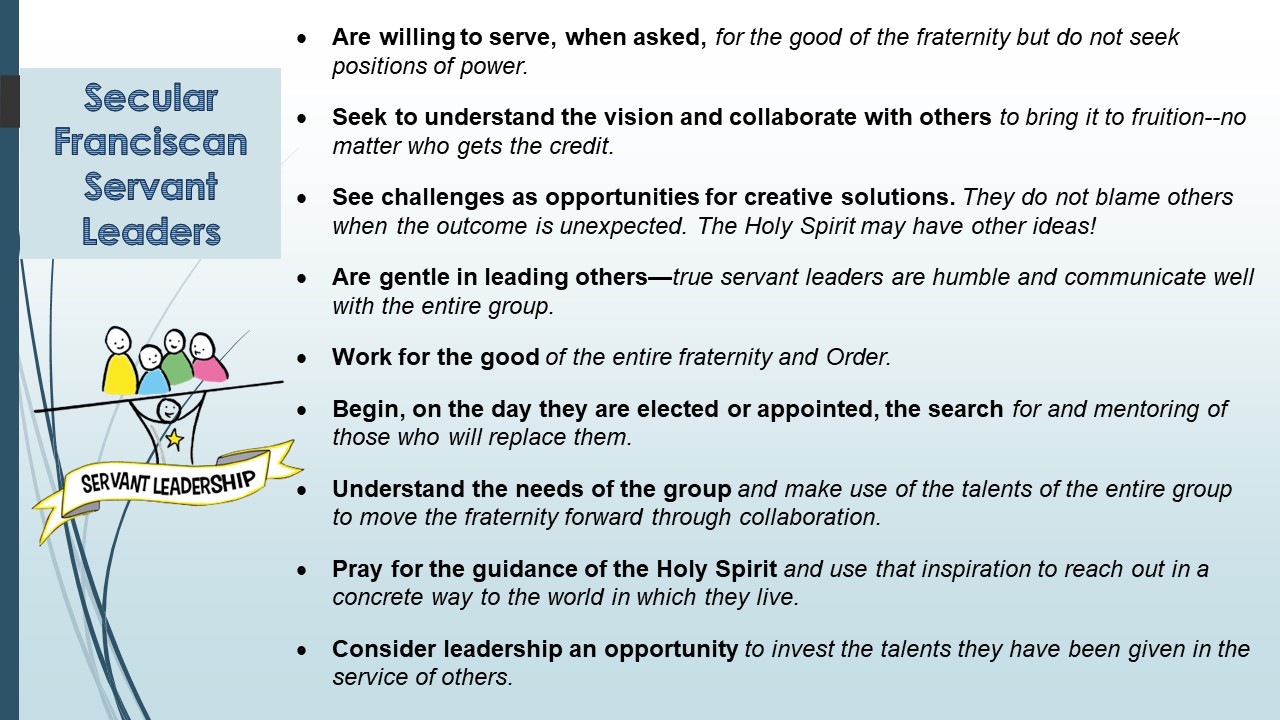
FORMATION FRIDAY – OFS Servant Leaders – September 22, 2023
This month we have been focusing on Servant Leadership. Today we offer the characteristics of good servant leaders (in no particular order). You may be able to add to the list based on the qualities you have observed in the excellent servant leaders you know.
Secular Franciscan Servant Leaders:
· Love the Order and are willing to serve, when asked, for the good of the fraternity but do not seek positions of power. Have enthusiasm for living the Rule.
- Seek to understand the vision and collaborate with others to bring it to fruition–no matter who gets the credit.
- See challenges as opportunities for creative solutions. They do not blame others when the outcome is unexpected. The Holy Spirit may have other ideas!
- Are gentle in leading others—true servant leaders are humble and communicate well with the entire group.
- Work for the good of the entire fraternity and Order.
- Begin, on the day they are elected or appointed, their search for and mentoring of those who will replace them.
- Understand the needs of the group and make use of the talents of the entire group to move the fraternity forward through collaboration.
- Pray for the guidance of the Holy Spirit and use that inspiration to reach out in a concrete way to the world in which they live and serve.
- Consider leadership an opportunity to invest the talents they have been given in the service of others.
- Are generous with their time and willing to make time in their lives to serve.
- Have life experience both in the Order and in the world that can be offered to the fraternity.
- Are willing to listen to others—to ask for and act on input from their brothers and sisters.
Questions for discussion in fraternity, with a partner, or in your journal.
+Think of servant leaders you have known. Which of these characteristics do you see in them?
+Which of these characteristics do you see in yourself?
+Which characteristics do you think you could develop in order to become a servant leader?
+If you presently hold office, which of the above characteristics can you improve in yourself?
+Challenge: This week, read Mt 25:14-30 and consider the talents and abilities God has given you. How will you invest them to serve your fraternity and the Order?+++++++++++++++++++++++++++++++++++++
22 de septiembre de 2023 Comparta con su fraternidad local.
Este mes nos hemos centrado en el Liderazgo de Servicio. Hoy ofrecemos las características de los buenos líderes servidores (sin ningún orden en particular). Es posible que usted pueda ampliar la lista basándose en las cualidades que haya observado en los excelentes líderes servidores que conoce.
Líderes Servidores Franciscanos Seglares:
- Aman la Orden y están dispuestos a servir, cuando se les solicite, por el bien de la fraternidad, pero no busquen posiciones de poder. Tienen entusiasmo por vivir la Regla.
- Tratan de comprender la visión y colaborar con otros para hacerla realidad, sin importar quién se lleve el crédito.
- Ven los desafíos como oportunidades para soluciones creativas. No culpan a los demás cuando el resultado es inesperado. ¡El Espíritu Santo puede tener otras ideas!
- Son gentiles al liderar a otros; los verdaderos líderes servidores son humildes y se comunican bien con todo el grupo.
- Trabajan por el bien de toda la fraternidad y la Orden.
- Inician, el día de su elección o nombramiento, la búsqueda y tutoría de quienes los sustituirán.
- Comprenden las necesidades del grupo y hacen uso de los talentos de todo el grupo para hacer avanzar la fraternidad a través de la colaboración.
- Oran por la guía del Espíritu Santo y usan esa inspiración para llegar de manera concreta al mundo en el que viven y sirven.
- Consideran el liderazgo como una oportunidad para invertir los talentos que se les han otorgado al servicio de los demás.
- Son generosos con su tiempo y están dispuestos a dedicarlo en sus vidas para servir.
- Tienen experiencia de vida tanto en la Orden como en el mundo que pueda ofrecerse a la fraternidad.
- Están dispuestos a escuchar a los demás, a pedir y actuar en función de las aportaciones de sus hermanos y hermanas.
Preguntas para discutir en fraternidad, con un compañero o en su diario.
+Piense en los líderes servidores que ha conocido. ¿Cuáles de estas características ve en ellos?
+¿Cuáles de estas características ve en usted mismo?
+¿Qué características cree que podría desarrollar para convertirse en un líder servidor?
+Si actualmente ocupa un cargo, ¿cuáles de las características anteriores puede mejorar en si mismo?+ Desafío : esta semana, lea Mt 25:14-30 y considere los talentos y habilidades que Dios le ha dado. ¿Cómo los invertirá para servir a su fraternidad y a la Orden?
Diane F. Menditto, OFSVice Minister, National Fraternity, Secular Franciscan Order USAListen – Discern – Go Forth National Theme 2022-2025
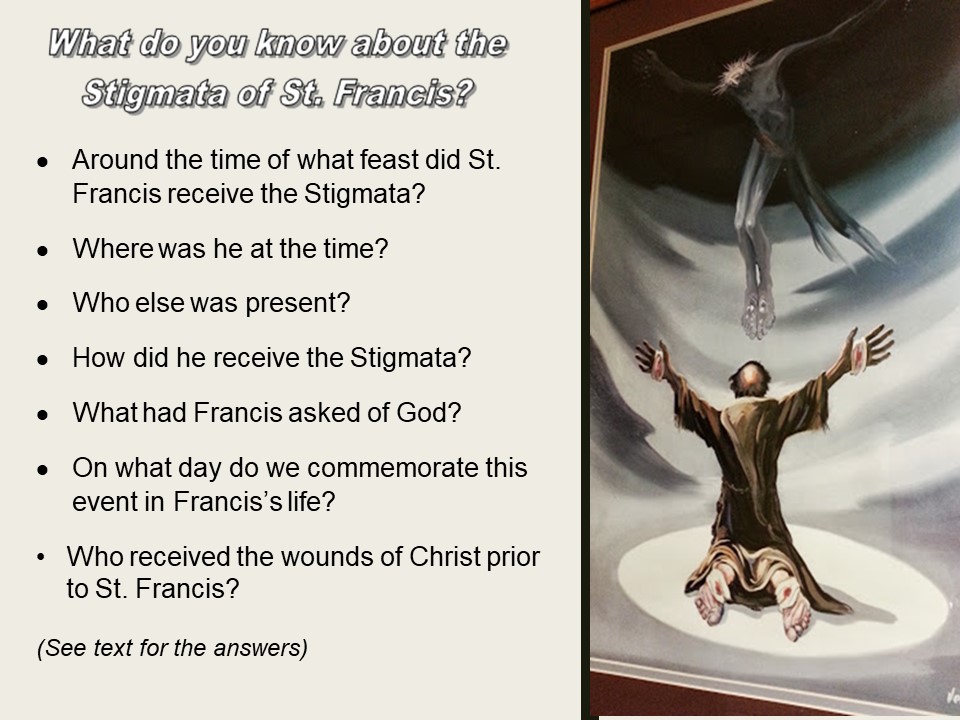
Formation Friday – The Stigmata of St. Francis – Sept. 15th
Formation Friday, September 15, 2023 (En español abajo)The Stigmata of St. Francis September 15th+ St. Francis received the Stigmata around the feast of the Triumph of the Holy Cross in September of 1224–two years before his death.+He was praying on Mt. La Verna preparing for the feast of St. Michael the Archangel. Brother Leo was nearby.+While praying, He asked God for two things. One, to let him experience the suffering Christ endured on the Holy Cross and two, for him to experience the love in which He did it.+ Shortly thereafter, Francis saw a Seraph with six wings. (Seraphs are angels of the highest order who are closest to God and most passionate in praising Him.) Between the wings was the image of a crucified man. When the vision disappeared, Francis was marked with the wounds of Christ. (St. Francis’s encounter with the Seraph and his passion in praising the Father has caused the Franciscan Order to be called the Seraphic Order and Francis our Seraphic Father.+ We celebrate the Feast of the Stigmata on September 17th+ St. Francis is the first person in recorded Christian history to receive the Stigmata.The Stigmata: Inspiration for our spiritual lives as FranciscansThe marks in our lives:–What does it mean to be marked?–What marks us in our lives?–As Catholics, how are we marked?–How do the things that mark us, help us to move forward in our spiritual lives?Now, Gaze at the Cross:–As we gaze at the wounds of Christ, what comes to mind?–As we consider what Jesus suffered for us, how do we respond?–As we contemplate Jesus’s willingness to die for us, what are we willing to do for our brothers and sisters?–As we imitate Jesus in our lives, how are we willing to use our lives in the service of others?Prayer to the Five Wounds of the Lord prayed by St. Clare of AssisiPrayer of Pope St. John Paul II (On a visit to Mt. La Verna in 1983)O St Francis, stigmatized on La Verna, the world longs for you, that icon of the crucified Jesus.It has need of your heart, open to God and to others; of your bare, wounded feet, of your pierced hands raised in supplication.It longs for your voice so frail yet forceful with the power of the Gospel.Francis, help the people of this age to recognize the evil of sin and to seek purification from it in penance.Help them to become free from the very structures of sin that oppress today’s society.Rekindle in the consciousness of those in government an urgent need for peace between nations and peoples.Instill in young people your freshness of life that is capable of withstanding the snares of the many cultures of death.To those injured by every type of evil teach, O Francis, the joy of being able to forgive.To all those crucified by suffering, hunger and war, reopen the doors of hope. Amen.+++++++++++++++++++++++Los estigmas de San Francisco+ San Francisco recibió los estigmas en torno a la fiesta del Triunfo de la Santa Cruz en septiembre de 1224, dos años antes de su muerte.+ Estaba orando en el monte La Verna preparándose para la fiesta de San Miguel Arcángel. El hermano Leo estaba cerca.+ Mientras oraba, le pidió a Dios dos cosas. Una, dejarle experimentar el sufrimiento que Cristo soportó en la Santa Cruz y dos, que experimentara el amor en el que lo hizo.+ Poco después, Francisco vio un Serafín con seis alas. (Los serafines son ángeles del orden más alto que están más cerca de Dios y más apasionados en alabarlo.) Entre las alas estaba la imagen de un hombre crucificado. Cuando la visión desapareció, Francisco quedó marcado con las llagas de Cristo. (El encuentro de San Francisco con el Serafín y su pasión por alabar al Padre ha hecho que la Orden Franciscana sea llamada Orden Seráfica y Francisco nuestro Seráfico Padre.+ Celebramos la Fiesta de los Estigmas el 17 de septiembre+ San Francisco es la primera persona en la historia cristiana registrada en recibir los estigmas.Los estigmas: inspiración para nuestra vida espiritual como franciscanosLas marcas en nuestras vidas:-¿Qué significa estar marcado?-¿Qué nos marca en nuestra vida?-Como católicos, ¿cómo estamos marcados?– ¿Cómo nos ayudan las cosas que nos marcan a avanzar en nuestra vida espiritual?Ahora, mirar la cruz:– Al contemplar las heridas de Cristo, ¿qué nos viene a la mente?-Al considerar lo que Jesús sufrió por nosotros, ¿cómo respondemos?-Al contemplar la disposición de Jesús a morir por nosotros, ¿qué estamos dispuestos a hacer por nuestros hermanos y hermanas?-Al imitar a Jesús en nuestra vida, ¿cómo estamos dispuestos a usar nuestra vida al servicio de los demás?Oración a las cinco llagas del Señor–oración de santa Clara de Asís (en inglés)Oración del Papa San Juan Pablo II (En una visita al Monte La Verna en 1983)Oh, San Francisco, estigmatizado en La Verna, el mundo te anhela, ese icono de Jesús crucificado.Necesita tu corazón, abierto a Dios ya los demás; de tus pies descalzos y heridos, de tus manos traspasadas alzadas en súplica.Anhela tu voz tan frágil pero contundente con el poder del Evangelio.Francisco, ayuda a la gente de esta época a reconocer la maldad del pecado y a buscar la purificación de él en la penitencia.Ayúdalos a liberarse de las mismas estructuras del pecado que oprimen a la sociedad actual.Reavivar en la conciencia de los gobernantes una urgente necesidad de paz entre naciones y pueblos.Inculca en los jóvenes tu frescura de vida que es capaz de resistir las trampas de las muchas culturas de la muerte.A los heridos por todo tipo de mal, enséñales, oh Francisco, la alegría de poder perdonar.A todos los crucificados por el sufrimiento, el hambre y la guerra, reabre las puertas de la esperanza. Amén.Diane F. Menditto, OFSVice Minister, National Fraternity, Secular Franciscan Order USAListen – Discern – Go Forth National Theme 2022-2025