Please share with your local fraternity: Part I
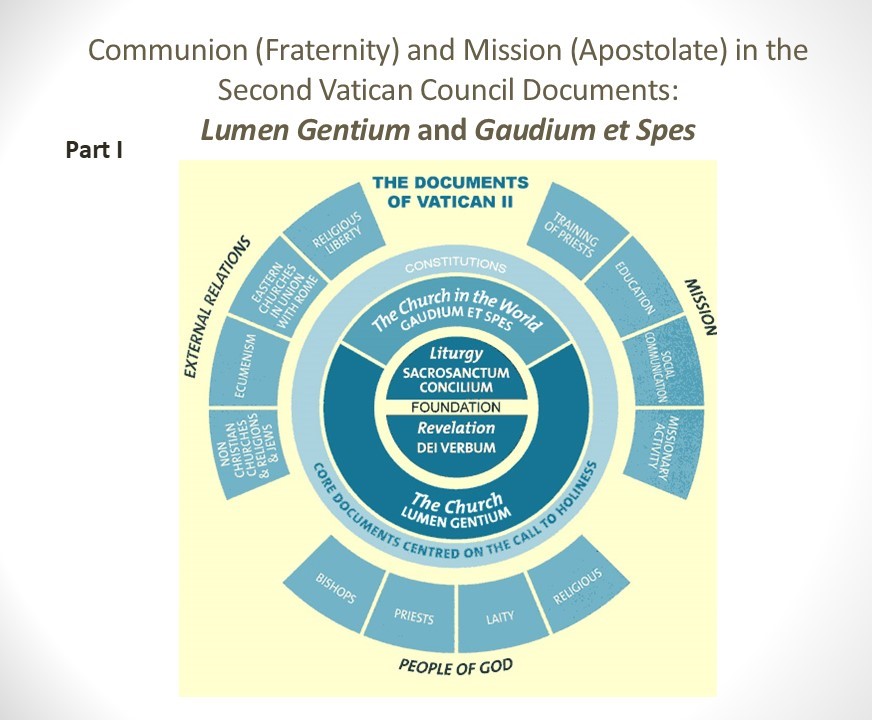
Communion (Fraternity) and Mission (Apostolate) in the Second Vatican Council Documents: Lumen Gentium and Gaudium et Spes
Thank you to Anne Mulqueen, OFS, National Formation Commission
The Second Vatican Council was a pivotal event in the history of the Roman Catholic Church. During the Council, two significant areas of Christian living—communion and mission—were addressed, resulting in a renewed interpretation of the ecclesiology of the Church and the role of the laity in the Church.
Lumen Gentium and Gaudium et Spes address communion and mission in detail. How many of us are familiar with these two key Council documents? We can learn so much by reading and reflecting on them. You’ll notice that many Articles of our Rule came from these two documents. Read them with our Rule in mind and see if you can find comparable passages.
The Second Vatican Council, convened by Pope John XXIII and continued under Pope Paul VI, produced several documents that have significantly shaped the Catholic Church today. Lumen Gentium and Gaudium et Spes stand out for their insights into the nature of the Church and its mission in the world. For this article, I will focus on these two points: (1) our communion (relationship) with God and others and (2) our mission (apostolate).
Lumen Gentium, the Dogmatic Constitution on the Church, presents a vision of the Church’s identity and structure. Central to this vision is the concept of communion. The document emphasizes that the Church is a “sacrament,” a sign and instrument of communion with God and unity among all people.
Gaudium et Spes, the Pastoral Constitution on the Church in the Modern World, complements Lumen Gentium by addressing the Church’s relationship with society. The theme of communion is central to our engagement with the world.
Communion in Lumen Gentium is rooted in the Trinity. The Church is described as a people brought into unity from the unity of the Father, the Son, and the Holy Spirit. The Trinity is the source and the model for the Church’s communion. We are called to participate in the divine life and reflect the unity and love of the Trinity in our relationships with God and each other.
Lumen Gentium also introduces the concept of the Church as the “People of God,” a community of believers bound together by faith. This inclusive vision emphasizes the dignity and equality of all baptized people, regardless of their roles within the Church. The document emphasizes that all members are called to holiness and mission.
The Church is a mystical body that finds unity in a community of believers, the People of God, united in faith.
In Part II, we will reflect on the call to mission as it appears in these two Council documents.
If you are interested in reading these documents, you can do so on the Vatican website:
Lumen Gentium: https://www.vatican.va/archive/hist_councils/ii_vatican_council/documents/vat-ii_const_19641121_lumen-gentium_en.html
Gaudium et Spes: https://www.vatican.va/archive/hist_councils/ii_vatican_council/documents/vat-ii_const_19651207_gaudium-et-spes_en.html
For discussion with your fraternity or a small group:
+Read the above documents individually or as a group.+List the articles of the Rule that were influenced by both documents. Explain your choices to your group.
+How are we as Secular Franciscans called to holiness?Formación 7 de marzo 2025 Por favor, compartir con su fraternidad local
Comunión (fraternidad) y misión (apostolado) en el Concilio Vaticano II Documentos: Lumen gentium y Gaudium et Spes Agradecemos a Anne Mulqueen, OFS, Comisión Nacional de Formación
El Concilio Vaticano II fue un acontecimiento fundamental en la historia de la Iglesia Católica Romana. Durante el Concilio, se abordaron dos áreas significativas de la vida cristiana: la comunión y la misión, lo que resultó en una interpretación renovada de la eclesiología de la Iglesia y del papel de los laicos en la Iglesia.
Lumen Gentium y Gaudium et Spes abordan en detalle la comunión y la misión. ¿Cuántos de nosotros conocemos estos dos documentos fundamentales del Concilio? Podemos aprender mucho leyéndolos y reflexionando sobre ellos. Notará que muchos artículos de nuestra Regla proceden de estos dos documentos. Léalos pensando en nuestra Regla y compruebe si puede encontrar pasajes comparables.
El Concilio Vaticano II, convocado por el Papa Juan XXIII y continuado por el Papa Pablo VI, produjo varios documentos que han configurado significativamente la Iglesia católica actual. Lumen Gentium y Gaudium et Spes destacan por sus reflexiones sobre la naturaleza de la Iglesia y su misión en el mundo. Para este artículo, me centraré en estos dos puntos: (1) nuestra comunión (relación) con Dios y con los demás y (2) nuestra misión (apostolado).
Lumen Gentium, la Constitución Dogmática sobre la Iglesia, presenta una visión de la identidad y la estructura de la Iglesia. Un elemento central de esta visión es el concepto de comunión. El documento subraya que la Iglesia es un «sacramento», un signo y un instrumento de comunión con Dios y de unidad entre todos los hombres.
Gaudium et Spes, la Constitución pastoral sobre la Iglesia en el mundo actual, complementa a Lumen Gentium al abordar la relación de la Iglesia con la sociedad. El tema de la comunión es central en nuestro compromiso con el mundo.
La comunión en la Lumen Gentium tiene sus raíces en la Trinidad. La Iglesia es descrita como un pueblo unido por la unidad del Padre, del Hijo y del Espíritu Santo. La Trinidad es la fuente y el modelo de la comunión de la Iglesia. Estamos llamados a participar en la vida divina y a reflejar la unidad y el amor de la Trinidad en nuestras relaciones con Dios y entre nosotros.
Lumen Gentium introduce también el concepto de Iglesia como «Pueblo de Dios», una comunidad de creyentes unidos por la fe. Esta visión integradora hace hincapié en la dignidad y la igualdad de todos los bautizados, independientemente de su función dentro de la Iglesia. El documento subraya que todos los miembros están llamados a la santidad y a la misión.
La Iglesia es un cuerpo místico que encuentra su unidad en una comunidad de creyentes, el Pueblo de Dios, unidos en la fe.
En la Parte II, reflexionaremos sobre el llamado a la misión tal como aparece en estos dos documentos conciliares.
Si está interesado en leer estos documentos, puede hacerlo en el sitio web del Vaticano:
Lumen Getium: https://www.vatican.va/archive/hist_councils/ii_vatican_council/documents/vat-ii_const_19641121_lumen-gentium_sp.html
Gaudium et Spes: https://www.vatican.va/archive/hist_councils/ii_vatican_council/documents/vat-ii_const_19651207_gaudium-et-spes_sp.html
Para discutir con su fraternidad o un grupo pequeño:
+Leer los documentos anteriores individualmente o en grupo.
+Enumere los artículos de la Regla que fueron influenciados por ambos documentos. Explique sus opciones a su grupo. +¿Cómo estamos llamados a la santidad como franciscanos seglares?Diane F. Menditto, OFSVice Minister, National Fraternity, Secular Franciscan Order USAListen – Discern – Go Forth National Theme 2022-2025
The Stigmata Narrated from the Early Legends
(This article originally appeared in the TAU-USA Fall 2024 Issue #113)
Assembled by Bret Thoman, OFS
Major Life, Bonaventure (1240)
He certainly wanted to conform in everything to Christ crucified, who poor and suffering and naked remained hanging on the cross.
Legend of the Three Companions (1483)
This burning love and the incessant memory of the Passion of Christ, which he hid in his heart, the Lord wished to show to the whole world by means of the stupendous prerogative of an exceptional privilege, with which he decorated him while he was still alive in the flesh.
Major Legend, Bonaventure (1223-1224)
Two years before he gave up his spirit to God, after many and varied labors, divine Providence took him aside and led him to a high mountain called Mount Verna. Here he had begun, according to his custom, to fast during Lent in honor of St. Michael the Archangel, when he began to feel himself inundated with an extraordinary sweetness in contemplation, inflamed by a more vivid flame of heavenly desires, filled with richer divine gifts.
The Little Flowers (1919)
The following day came, that is, the day of the most Holy Cross, and Saint Francis, early in the morning before daybreak, threw himself in prayer before the door of his cell, turning his face toward the east, and prayed in this way: “O my Lord Jesus Christ, I beg you to grant me two graces before I die: the first, that in my life I may feel in my soul and body, as much as possible, that pain which you, sweet Jesus, endured in the hour of your most bitter Passion; the second is that I may feel in my heart, as much as possible, that excessive love with which you, Son of God, were inflamed to willingly endure such a great Passion for us sinners.”
Major Legend, Bonaventure (1228)
Thus the true love of Christ had transformed the lover into the very image of the Beloved.
First Life, Celano (484-485)
[Then,] a man appeared to him, in the form of a Seraph, with wings, hovering above him, with his hands outstretched and his feet together, nailed to a cross. […] While he was in this state of worry and total uncertainty, behold: on his hands and feet began to appear the same marks of the nails that he had just seen on that mysterious crucified man. Francis’ hands and feet appeared to be pierced in the middle by nails, the heads of which were visible in the palms of the hands and on the backs of the feet, while the points protruded from the opposite side. Those marks were round on the inside of the hands, and elongated on the outside, and formed almost a fleshy excrescence, as if they were the points of nails bent and hammered back. Likewise on the feet were imprinted the marks of the nails protruding from the rest of the flesh. The right side was also pierced as if by a spear, with a wide scar, and often bled, wetting the tunic and the undergarments with that sacred blood.
 100vw, 273px”></p>
<p id=) St. Francis with the Stigmata
St. Francis with the Stigmata
Minor Legend, Bonaventure (1377-1378)
[Then,] the angelic man, Francis, came down from the mountain: and he carried with him the image of the Crucified, not depicted on tablets of stone or wood by the hand of an artisan, but written in the members of the flesh by the finger of the living God.
Treatise of Miracles, Celano (830-831)
We have indeed seen these things which we narrate, with the hands with which we write we have touched them, and what we testify with our lips we have seen with moved eyes, confirming for all time what we swore only once by touching the sacred objects.
St Francis with the Stigmata
https://www.secularfranciscansusa.org/2025/03/03/the-stigmata-narrated-from-the-early-legends/
The Fruitfulness of a Vocation

Cherryle Fruge, OFS – NEC Councilor
By Cherryle Fruge, OFS
National Executive Council Member
I want to share with you two things: the fruitfulness of my vocation in the Secular Franciscan Order, and how the call led me to serve as a National Executive Councilor.
I know there have been plenty of topics on vocation covered in formation, but my understanding of what a vocation means became clearer with each step I took towards servant leadership.
Most importantly, I’ve learned that if we allow ourselves to be vulnerable and available for the Holy Spirit to utilize and guide us wherever He so desires, we will discover we are continually being renewed each day.
With the national election of the Secular Franciscan National Executive Council approaching in September, as well as local and regional elections in your areas, I would like to encourage you to listen for the call.
Venturing into leadership brought great challenges, but I wouldn’t trade the experience because it enabled me to follow His Divine will. I tried to live by this profound message: “I, a prisoner in the Lord, urge you therefore to lead a life worthy of the vocation to which you were called. With all humility and gentleness, and with patience, support each other in love. Take every care to preserve the unity of the Spirit by the peace that binds you together.” Eph. 4:1-3
The greatest thing about leadership in the Secular Franciscan Order is that no matter how many struggles you face, you never walk alone. There are many valuable brothers and sisters always ready to lend guidance and support when needed. The Holy Spirit plants gifts along the way, which is His way of showing us how He guides.
The good Lord is always teaching and revealing that if we are patient with God’s Grace in action, we will discover the beautiful tapestry of His love surrounding us every day. Remember, He never sets us up for failure.
Instead, he prepares us to go forth spreading the Good News in the world of how He has been mending our brokenness by meshing His heart into our heart so that we become one with Him in all His goodness.
God bless you abundantly and give you peace. Just say, YES to serve. You won’t regret it.
https://www.secularfranciscansusa.org/2025/03/01/the-fruitfulness-of-a-vocation/
The Gospel Through a Franciscan Lens – 8th Sunday in Ordinary Time – Fr. Christopher
Today, Jesus suggests that our limited insight into each other makes it very difficult to make judgments about others. It can be very tempting to think at times that we see clearly whereas others are blind. Jesus indicates that we are all blind to some degree, and that it is very often the case of the blind leading the blind rather than the enlightened.

https://www.secularfranciscansusa.org/2025/02/28/the-gospel-through-a-franciscan-lens-8th-sunday-in-ordinary-time-fr-christopher/
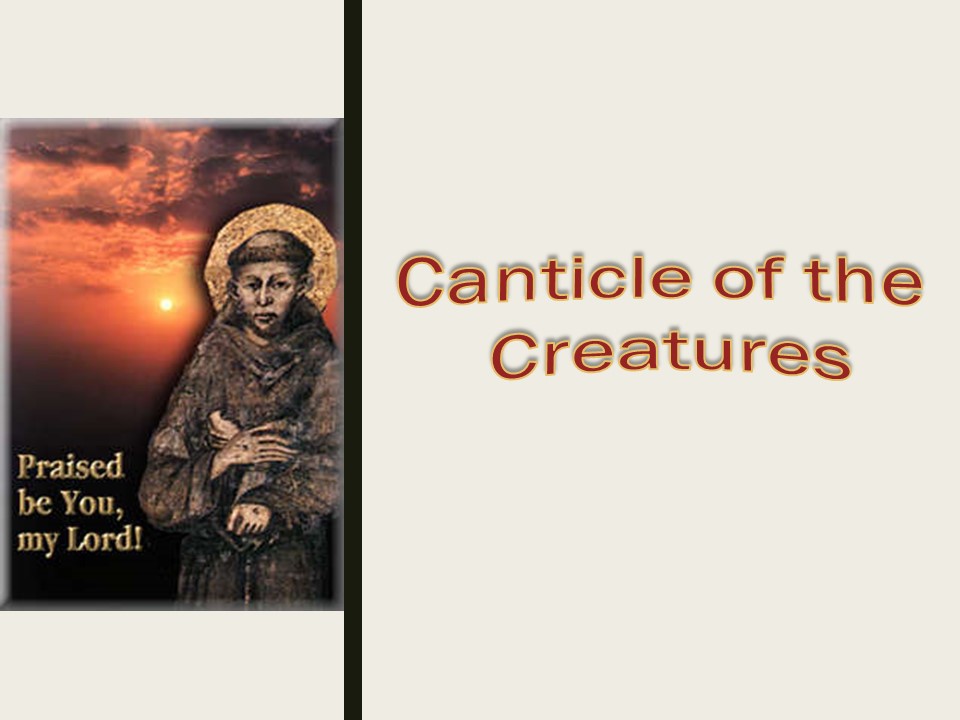
FORMATION FRIDAY – Canticle of the Creatures – February 28, 2025
The Canticle of the Creatures
In 2025 we celebrate the 800th Anniversary of the Canticle of the Creatures. As we begin this year, we offer St. Francis’s own words as they appear in the Canticle. Composed in 1225 during his last illness, St. Francis gives glory to God through all of creation in the first portion of the canticle. Ever the peacemaker, he added verses 10 and 11 at a time when the political and religious authorities of Assisi were in conflict. Then, right before his death, he added two verses praising God for “Sister Bodily Death,” calling us to penance and conversion.
The Canticle of the Creatures
1Most High, all-powerful, good Lord,
Yours are the praises, the glory, and the honor, and all blessing, Rv 4:9 Rv 4:11
2To You alone, Most High, do they belong,
and no human is worthy to mention Your name.d
3Praised be You, my Lord, with all Your creatures, Tb 8:7
especially Sir Brother Sun,
Who is the day and through whom You give us light.e
4And he is beautiful and radiant with great splendor;
and bears a likeness of You, Most High One.
5Praised be You, my Lord, through Sister Moon and the stars, Ps 148:3
in heaven You formed them clear and precious and beautiful.a
6Praised be You, my Lord, through Brother Wind,
and through the air, cloudy and serene, and every kind of weather,
through whom You give sustenance to Your creatures.
7Praised be You, my Lord, through Sister Water, Ps 148:4 Ps 148:5
who is very useful and humble and precious and chaste.
8Praised be You, my Lord, through Brother Fire, Dn 3:66
through whom You light the night, Ps 78:14 [Vulgate, Ps 77:14]
and he is beautiful and playful and robust and strong.
9Praised be You, my Lord, through our Sister Mother Earth, Dn 3:74
who sustains and governs us,
and who produces various fruit with colored flowers and herbs. Ps 104:13 [Vulgate, Ps 103:13] Ps 104:14 [Vulgate, Ps 103:14]10Praised be You, my Lord, through those who give pardon for Your
love, Mt 6:12
and bear infirmity and tribulation.b
11Blessed are those who endure in peace
for by You, Most High, shall they be crowned.12Praised be You, my Lord, through our Sister Bodily Death,
from whom no one living can escape.c
13Woe to those who die in mortal sin.
Blessed are those whom death will find in Your most holy will,
for the second death Rv 2:11 Rv 20:6 shall do them no harm.d14Praise and bless my Lord Dn 3:85 and give Him thanks
and serve Him with great humility.After reading the Canticle, go back and look at the Scripture sources indicated—read the passages—see how Francis was influenced by his intimate knowledge of Scripture.
+What part does Scripture play in your daily life? What does “going from Gospel to life and life to the Gospel” (Article 4 of our Rule) mean to you?
The Canticle speaks of St. Francis’s love for all of creation.
+Using St. Clare’s advice to “Gaze, Contemplate, Meditate, and Imitate, think about your relationship to God’s creation.
+How does your relationship with creation affect your relationship with God and your brothers and sisters?Reread verses 10 and 11 of the Canticle.
+How do you serve as a peacemaker in your family, job, or community?
+In what ways is it difficult for you to “forgive” those who don’t agree with you?
+Verse 10 calls to mind the story of Perfect Joy. What is Francis telling us in that story and in this canticle?Verses 12 and 13 talk about the end of life and how we are to prepare.
+Give some thought to the qualities it takes to accept our eventual death or the death of someone we love.
+Reread the Prologue to the Rule of 1978, especially “Concerning Those Who Do Not Do Penance.” Why are penance and conversion so important to us?+++++++++++++
Formación 28 de febrero 2025 Por favor compartir con sus fraternidades locales
Cántico de las Criaturas
En 2025 celebramos el 800 aniversario del Cántico de las Criaturas. Al comenzar este año, ofrecemos las propias palabras de San Francisco tal como aparecen en el Cántico. Compuesto en 1225 durante su última enfermedad, San Francisco da gloria a Dios a través de toda la creación en la primera parte del cántico. Siempre pacificador, añadió los versículos 10 y 11 en un momento en que las autoridades políticas y religiosas de Asís estaban en conflicto. Luego, justo antes de su muerte, añadió dos versículos alabando a Dios por la “Hermana Muerte Corporal”, llamándonos a la penitencia y a la conversión.
ALABANZAS DE LAS CRIATURAS
1Altísimo, omnipotente, buen Señor,
tuyas son las alabanzas, la gloria y el honor y toda bendición.
2A ti solo, Altísimo, corresponden,y ningún hombre es digno de hacer de ti mención.
3Loado seas, mi Señor, con todas tus criaturas,especialmente el señor hermano sol,
el cual es día, y por el cual nos alumbras.
4Y él es bello y radiante con gran esplendor,
de ti, Altísimo, lleva significación.
5Loado seas, mi Señor, por la hermana luna y las estrellas,
en el cielo las has formado luminosas y preciosas y bellas.
6Loado seas, mi Señor, por el hermano viento,
y por el aire y el nublado y el sereno y todo tiempo,
por el cual a tus criaturas das sustento.
7Loado seas, mi Señor, por la hermana agua,
la cual es muy útil y humilde y preciosa y casta.
8Loado seas, mi Señor, por el hermano fuego,
por el cual alumbras la noche,
y él es bello y alegre y robusto y fuerte.
9Loado seas, mi Señor, por nuestra hermana la madre tierra,
la cual nos sustenta y gobierna,
y produce diversos frutos con coloridas flores y hierba.
10Loado seas, mi Señor, por aquellos que perdonan por tu amor,
y soportan enfermedad y tribulación.
11Bienaventurados aquellos que las soporten en paz,
porque por ti, Altísimo, coronados serán.
12Loado seas, mi Señor, por nuestra hermana la muerte corporal,
de la cual ningún hombre viviente puede escapar.
13¡Ay de aquellos que mueran en pecado mortal!:
bienaventurados aquellos a quienes encuentre en tu santísima voluntad,
porque la muerte segunda no les hará mal.
14Load y bendecid a mi Señor,
y dadle gracias y servidle con gran humildad.
http://franciscanos.org/esfa/cant.html
El Cántico habla del amor de San Francisco por toda la creación.
+Usando el consejo de Santa Clara de “Mirar, Contemplar, Meditar e Imitar, piense en su relación con la creación de Dios.
+¿Cómo afecta su relación con la creación su relación con Dios y con sus hermanos y hermanas?
Releer los versículos 10 y 11 del Cántico.
+ ¿Cómo se desempeña como pacificador en su familia, trabajo o comunidad?
+ ¿De qué manera te resulta difícil “perdonar” a los que no están de acuerdo contigo?
+ El versículo 10 recuerda la historia de Perfect Joy. ¿Qué nos dice Francisco en esa historia y en este cántico?
Los versículos 12 y 13 hablan sobre el final de la vida y cómo debemos prepararnos.
+ Piense un poco en las cualidades que se necesitan para aceptar nuestra eventual muerte o la muerte de alguien a quien amamos.
+ Releer el Prólogo de la Regla de 1978, en especial “Sobre los que no hacen penitencia”. ¿Por qué son tan importantes para nosotros la penitencia y la conversión?
Diane F. Menditto, OFSVice Minister, National Fraternity, Secular Franciscan Order USAListen – Discern – Go Forth National Theme 2022-2025