(This article originally appeared in the TAU-USA Fall 2024 Issue #113)
by Kathleen Molaro, OFS National FY/YA Animator
 100vw, 243px”></p>
<p id=)
A Region of the Secular Franciscan Order
(This article originally appeared in the TAU-USA Fall 2024 Issue #113)
by Kathleen Molaro, OFS National FY/YA Animator
https://www.secularfranciscansusa.org/2025/02/24/servant-leadership-in-youfra/
We will create a PowerPoint with the Canticle and the photos we think best illustrate each stanza and release it on Earth Day, with attribution to the photographer and fraternity.
Anyone associated with a Secular Franciscan fraternity may submit a photo – members, those in formation, family members of fraternity members, “Friends of Francis”, and spiritual assistants at any level.
https://www.secularfranciscansusa.org/2025/02/23/celebrate-the-canticle-with-your-images/
Pope Francis, in his apostolic exhortation “Evangelii Gaudium,” also reflecting on the centrality of mercy in Christian life, notes that “the mercy of God is not an abstract idea, but a concrete reality with which God reveals His love. By calling His disciples to show mercy, Jesus invites them to live in imitation of the Father’s love, which is patient, generous, and forgiving.”

https://www.secularfranciscansusa.org/2025/02/22/the-gospel-through-a-franciscan-lens-7th-sunday-in-ordinary-time-fr-christopher/
Please share with your local fraternity.
At our National Chapter in October 2022, the National Fraternity Council decided that the priorities for 2022-2025 would be Vocations, Communications, and Relationships. For several weeks, Formation Friday has been exploring each of these priorities.
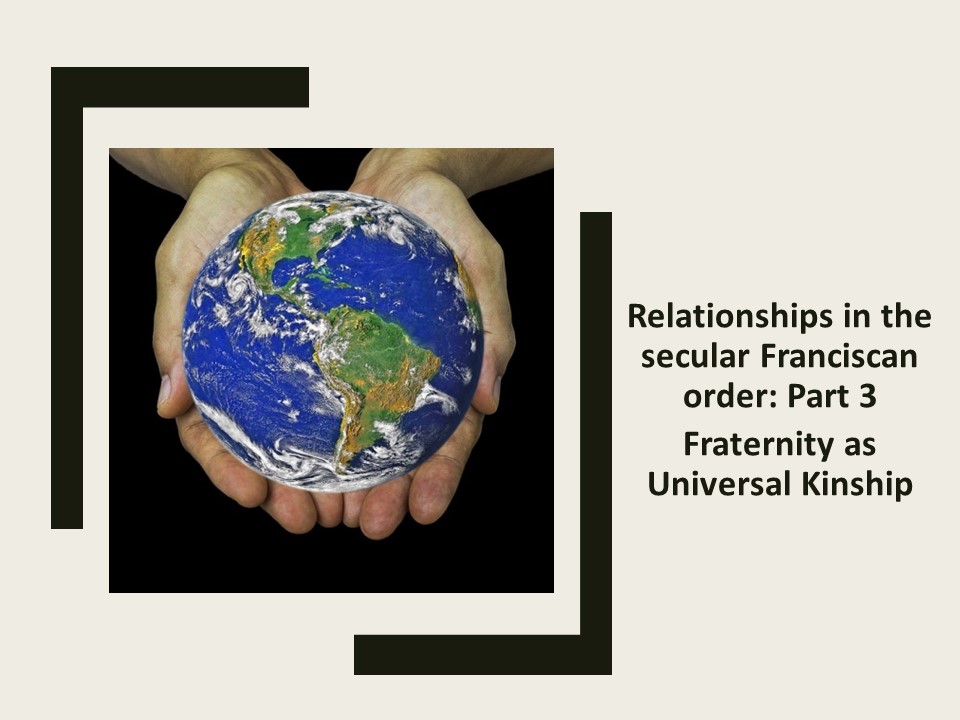
Relationships in the Secular Franciscan Order: Part 3
Fraternity as Universal Kinship
Prepared by Francine Gikow, OFS, Member, National Formation Commission
Relationship, or what we describe as “fraternity,” is foundational for living our Secular Franciscan charism and is the way we evangelize, going from gospel to life and life to the gospel. In this series of “Relationships in the Secular Franciscan Order,” we discussed:
· Love between each person of the Holy Trinity is our model for fraternity living; to love one another.
· Francis understood that we are all sons and daughters of the same Father and so we are all brothers and sisters, in a kinship relationship, with each other in fraternity.
· Our local fraternity is a school of love where we learn how to develop and sustain relationships. We live “fraternity” with our brothers and sisters within our fraternity, with others with whom we interact, those in our ministries, in our higher fraternities, in our relationships with the members of other Franciscan religious orders and to the whole world.
Francis’ concept of “fraternity,” however, expands even further to encompass all of creation- both animate and inanimate- which we call “universal kinship.” Our Rule, Article 18, states:
“Moreover they should respect all creatures, animate and inanimate, which bear the imprint of the Most High, and they should strive to move from the temptation of exploiting creation to the Franciscan concept of universal kinship.”
Francis saw God reflected in what He created- or in the words of our Rule- the imprint of the Most High who created all things; animate and inanimate. Since we are all created by the same Father in heaven, we are united as brothers and sisters to all creation and thus must treat creation with loving and fraternal care.
We are further instructed by our General Constitutions (Art. 18):
“Following the example of Francis, patron of ecologists, they should actively put forward initiatives that care for creation and should work with others in efforts that both put a stop to polluting and degrading nature and also establish circumstances of living and environment which would not be a threat to a human person.”
Francis’ legacy to us in his “Canticle of the Creatures,” is a song of praise, glory, honor and thanksgiving to God for Brother Sun, Sister Moon and all creation. The Canticle shows reverence for every “thing” created by God- a “kin” relationship. To honor that reverence, we are charged at profession to “build a more fraternal and evangelical world” (in our relationships with creation too) “so that the kingdom of God may be brought about more effectively.”(Rule, Art. 14)
In summary, our former, beloved, National Minister, Tom Bello, OFS, said of our fraternal relationships:
“Fraternity is a call to unity and harmony with all our brothers and sisters, all of whom are children of the same living God.
Fraternity is a call to unity and harmony with all of creation, plant and planet, all created by the same loving God.
Fraternity is a call to build a community of love that reflects Love back to the God of Love: Father, Son and Holy Spirit.” (FUN: Fraternity, p.7)
Reflection Questions:
· Read OFS General Constitutions, Article 18 “For a Just and Fraternal Society” and share what you have learned.
· What inspired you from this article? What drew your attention?
· What description of fraternal relationships challenged you and why. Share your thoughts with another person or in a spiritual journal.
· Bring to prayer the ideas of this article and ask God to help you discern how to use these ideas in your life and in the life of your fraternity.
++++++++++++++++++++++++++
Compartir con su fraternidad local 21 de febrero 2025
En nuestro Capítulo Nacional en octubre de 2022, el Consejo Nacional decidió que las prioridades para 2022-2025 serían Vocaciones, Comunicaciones y Relaciones. Durante varias semanas, Formation Friday ha estado explorando cada una de estas prioridades.
Relaciones en la Orden Franciscana Seglar: Parte 3
La fraternidad como parentesco universal
Preparado por Francine Gikow, OFS, Miembro, Comisión Nacional de Formación
La relación, o lo que describimos como “fraternidad”, es fundamental para vivir nuestro carisma franciscano seglar y es la forma en que evangelizamos, yendo del evangelio a la vida y de la vida al evangelio. En esta serie sobre “Relaciones en la Orden Franciscana Seglar”, ya discutimos:
- El amor entre cada persona de la Santísima Trinidad es nuestro modelo de vivencia de la fraternidad; amarnos unos a otros.
- Francisco entendió que todos somos hijos e hijas del mismo Padre y por lo tanto todos somos hermanos y hermanas, en una relación de parentesco, unos con otros en fraternidad.
- Nuestra fraternidad local es una escuela de amor donde aprendemos a desarrollar y mantener relaciones. Vivimos “fraternidad” con nuestros hermanos y hermanas dentro de nuestra fraternidad, con otros con quienes interactuamos, aquellos en nuestros ministerios, en nuestras fraternidades superiores, en nuestras relaciones con los miembros de otras órdenes religiosas franciscanas y con el mundo entero.
Sin embargo, el concepto de “fraternidad” de Francisco se expande aún más para abarcar toda la creación, tanto animada como inanimada, a la que llamamos “el parentesco universal”. En nuestra Regla, el artículo 18, establece:
“Sientan, además, respeto por las otras criaturas, animadas e inanimadas, que de ti, Altísimo, llevan significación 30 y procuren con ahínco pasar de la tentación de la explotación al concepto franciscano de la fraternidad universal.”
Francisco vio a Dios reflejado en lo que Él creó -o en las palabras de nuestra Regla- la huella del Altísimo que creó todas las cosas; animado e inanimado. Dado que todos somos creados por el mismo Padre en el cielo, estamos unidos como hermanos y hermanas a toda la creación y, por lo tanto, debemos tratar a la creación con cuidado amoroso y fraterno.
Nuestras Constituciones Generales nos instruyen además (Art. 18.1):
Los franciscanos seglares son llamados a ofrecer su contribución personal, inspirada en la persona y en el mensaje de San Francisco de Asís, en vistas a establecer una civilización en la que la dignidad de la persona humana, la corresponsabilidad y el amor sean realidades vivas.
El legado de Francisco para nosotros en su “Cántico de las Criaturas”, es un canto de alabanza, gloria, honor y acción de gracias a Dios por el Hermano Sol, la Hermana Luna y toda la creación. El Cántico muestra reverencia por cada “cosa” creada por Dios, una relación de “parentesco”. Para honrar esa reverencia, estamos llamados a la profesión a “construir un mundo más fraterno y evangélico” (también en nuestras relaciones con la creación) “a construir un mundo más fraterno y evangélico para la edificación del reino de Dios” (Regla, art. 14).
En resumen, nuestro amado Ministro Nacional de buena memoria, Tom Bello, OFS, dijo sobre nuestras relaciones fraternales:
“La fraternidad es un llamado a la unidad y armonía con todos nuestros hermanos y hermanas, todos hijos del mismo Dios vivo.
La fraternidad es un llamado a la unidad y armonía con toda la creación, planta y planeta, todo creado por el mismo Dios amoroso.
La fraternidad es un llamado a construir una comunidad de amor que refleje el Amor hacia el Dios del Amor: Padre, Hijo y Espíritu Santo”. (DIVERSIÓN: Fraternidad, p.7)
Para platicar con un grupo o en pareja o comentar en su diario.
- Lea las Constituciones Generales de la OFS, Artículo 18 “Por una Sociedad Justa y Fraterna” y comparta lo que ha aprendido.
- ¿Qué le inspiró de este artículo? ¿Qué le llamó la atención?
- ¿Qué descripción de las relaciones fraternales le desafió y por qué? Comparta sus pensamientos con otra persona o en un diario espiritual.
- Lleve a la oración las ideas de este artículo y pida a Dios que le ayude a discernir cómo usar estas ideas en su vida y en la vida de su fraternidad.
Diane F. Menditto, OFSVice Minister, National Fraternity, Secular Franciscan Order USAListen – Discern – Go Forth National Theme 2022-2025
(This article originally appeared in the TAU-USA Fall 2024 Issue #113)
Dear Brothers and Sisters,
We have heard the question, “Why a new Ritual?”, and it deserves an answer.
The 1985 Ritual is out of print and has been for several years. We are often asked “Where do I get a copy of the Ritual?” Used copies found online were very expensive and the online version from CIOFS is not as comprehensive as the 1985 Ritual book.
 We recognize that a transition from a Ritual that has been in use since 1985 and the expense of purchasing a new Ritual may be difficult for some members. However, the first printing of 2,200 copies of the updated Ritual sold out in 60 days indicating the change was welcomed. Many fraternities have subsidized the cost of the new Ritual for those who cannot afford it.
To assist with this transition, the NEC is not mandating use of the new Ritual and is offering free, customizable downloads of key ceremonies and rites.
In summary, it was necessary to reissue the book. After nearly 40 years, changes were needed, and the cost of printing a book is significantly higher. Simply reprinting the 1985 Ritual would have come close to the cost of this new book.
You can order the new Ritual on our National Website from the link on the home page.

https://www.secularfranciscansusa.org/2025/02/17/why-a-new-ritual-from-the-national-executive-council/
 100vw, 229px”>One charism that defines the spirituality of a Secular Franciscan is that of servant leadership. Our spirituality is based on journeying together as a community of love – a fraternity. To be a leader is to guide and animate the fraternity with hope and joy; to assume responsibility and hold authority, but not power; and to have a collegial relationship with those we serve, always inviting others to share their gifts, talents, and ideas.</p>
<p>The CIOFS Formation Secretariat shared a document recently titled Animation and Servant Leadership in the OFS-YouFra. They point out examples of the servant leadership style we, as Secular Franciscans, are called to imitate.</p>
<p>Jesus “came into the world to serve, to give himself entirely to others.” His life, dedicated to the growth and well-being of all people, attracted others, especially due to his deep connection to our Heavenly Father. Mary led, and still leads, “through her constant presence and necessary proximity.” She trusted, shared what she witnessed, and quietly and eagerly served. Saint Francis “always accompanied the brothers with closeness, dialogue, listening, presence, encounter, and above all, by making every word he proposed a reality.” Saint Clare broke away from stereotypes, a radical move during that era. Others “saw in her the courage to leave her comfortable life and to give herself completely” to God and in service to others. Jesus, Mary, Francis, and Clare also lived what they preached. They didn’t expect of others what they weren’t willing to undertake themselves.</p>
<p>When we speak of servant leadership in the YouFra movement, these ideals can be readily applied. Once a YouFra is established, the young people will be their own animators, with the support of the OFS. They will provide their own servant leadership, along with the connection to the leadership of a local fraternity.</p>
<p>In the meantime, as we walk them toward the eventual formation of a YouFra, are we witnessing to them what it means to be a servant leader? Are we helping them learn how to make valid, well-thought-out Christ-centered decisions? Are we in their presence with a cordial and joyful demeanor? Are we listening, promoting healthy dialogue, and committed to strengthening their sense of community? Are we prayerful? Are we committed to their well-being? If so, we are acting as good servant leaders, and able to pass on the role to our younger generation.</p>
<p>The Franciscan Youth and Young Adult Commission has spent several years helping regions, fraternities, and individuals better understand the needs of youth and young adults. We have periodically held “Core Four” Zoom sessions that cover the basics of working with young people.</p>
<p>Future sessions will highlight ways to plan and implement ideas for reaching out to younger Catholics. These session topics have been determined by five main desires of young people: 1. To be part of a community; 2. Prayer and spiritual growth; 3. To be of service; 4. To determine and strengthen their vocations; and 5. To learn peaceful, Franciscan-hearted conflict resolution.</p>
<p>We know that leadership in the involvement of youth and young adults will ensure a future of folks willing to change the world by living a gospel life. We hope and pray that more of you will join us in this life-giving, courageous journey.</p>
<div id=)
 Praised be You, my Lord, through Sister Water,