Please share with your local fraternity
(en español abajo) Korean translation attached in separate PDF.
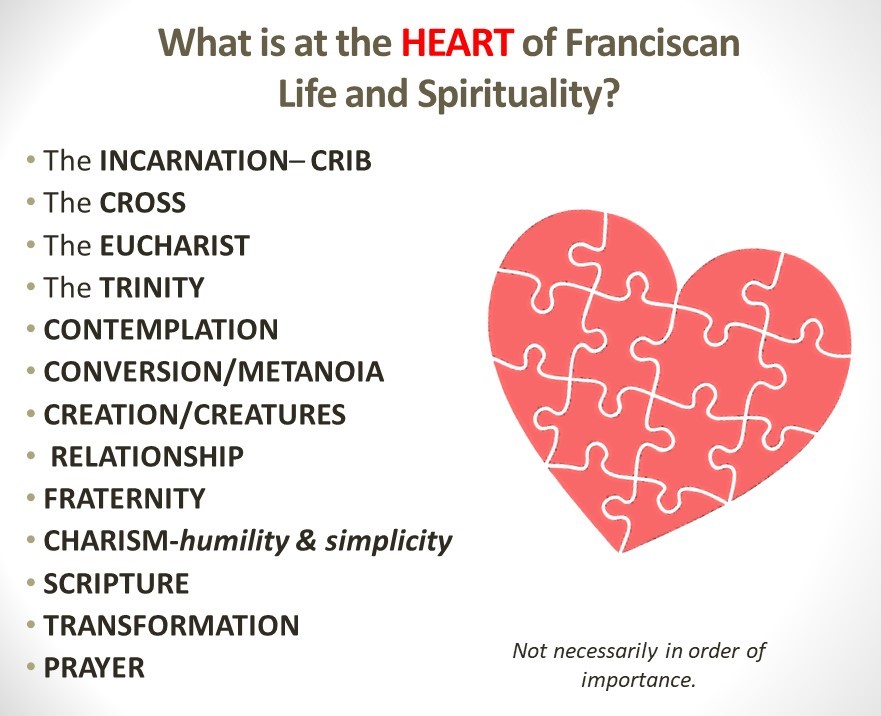
What is at the CORE of Franciscan life and spirituality? Take a look at what was important to St. Francis. There you will find a good roadmap. The words and ideas below are exemplified by our Seraphic Father. Have you noticed how often they are repeated in initial and ongoing formation? (Not necessarily in order of importance.)
· The INCARNATION– the CRIB–we think of the humility of God, of His self-emptying. Francis was in awe of the Incarnation. Meditate on the story of Francis creating the first Nativity scene at Greccio.
· The CROSS – is the sign of God’s love made concrete. What do we see/experience when we GAZE on the cross? Meditate on Francis’s experiences with the Cross of Christ.
· The EUCHARIST- CHALICE/CIBORIUM –– “O sublime humility! O humble sublimity! The Lord of the universe, God and the Son of God, so humbles Himself that for our salvation He hides Himself
under an ordinary piece of bread!” (St. Francis-Letter to the Entire Order)
· TRINITY Franciscan life focuses on the Trinity. Francis saw that God is so generous that his love not only flows among the persons of the Trinity, it overflows to us. And we participate in the life of the Trinity.
· CONTEMPLATION – We spend time with Jesus, and we LISTEN; we desire not only to imitate him. Our goal is to be TRANSFORMED so that we are like him from the inside out.
· CONVERSION/METANOIA – We are people of penance-This means that we strive for daily spiritual improvements and changes that will bring us closer to Christ. “Let us begin, for up to now, we have done little…” (St. Francis quoted in The Life of Blessed Francis: FA:ED, vol. 2, p. 640 by St. Bonaventure)
· CREATION/CREATURES – God is absolute LOVE, BEING AND CREATIVITY. Francis saw all creation as being marked with the imprint of the Father. Creation is God’s great gift and is dependent on Him to exist.
· RELATIONSHIP– Francis saw the relationship of the Father and the Son through the love of the Holy Spirit. We are in relationship with God, our brothers and sisters and with all of creation – UNIVERSAL KINSHIP.
· FRATERNITY springs from the relationship we have with God, our brothers and sisters and all creation. “The Lord gave me some brothers…” (St. Francis)
· CHARISM – Like St. Francis, we strive to make Christ present in the world by living the Gospel in HUMILITY and SIMPLICITY. As Secular Franciscans, we do this while living in the world. “The Rule and life of the Secular Franciscans is this…” (OFS Rule: Article 4)
· SCRIPTURE – In order to live the Gospel, we need to make it part of our lives through reading, meditation and study. “…going from Gospel to life and life to the Gospel.” (OFS Rule: Article 4)
· TRANSFORMATION – We use the gifts God has given us to become more Christlike. The Divine Spark never changes. We cooperate with the grace given us, and we become conformed to Christ.
· PRAYER – none of this is possible without prayer. We pray together, we pray alone, we pray with our voices, we pray silently and without words. (Our prayer is liturgical, personal and communal)
Share with your fraternity—perhaps over the course of a few months—how each aspect of Franciscan spirituality affects you. How do they affect your fraternity? How can they be highlighted personally and in your fraternity?
+++++++++++++++++++++++
Formación 16 de mayo 2025 (Por favor, compartir con su fraternidad local.)
¿Cuál es la esencia de la vida y la espiritualidad franciscanas? Fíjese en lo que era importante para San Francisco. Allí encontrará una buena hoja de ruta. Las palabras e ideas a continuación están ejemplificadas por nuestro Seráfico Padre. ¿Ha notado la frecuencia con la que se repiten en la formación inicial y permanente? (No necesariamente en orden de importancia).
La ENCARNACIÓN – el CUNA – pensamos en la humildad de Dios, en Su auto vaciamiento. Francisco quedó admirado ante la Encarnación. Medite en la historia de Francisco que creó la primera escenificación de un pesebre en Greccio.
La CRUZ – es el signo del amor de Dios hecho concreto. ¿Qué vemos / experimentamos cuando CONTEMPLAMOS la cruz? Medite sobre las experiencias de Francisco con la Cruz de Cristo.
La EUCARISTÍA- CÁLIZ / CIBORIO –– “¡Oh sublime humildad! ¡Oh humilde sublimidad! El Señor del universo, Dios y el Hijo de Dios, se humilla tanto que para nuestra salvación se esconde bajo un pan ordinario! ” (Carta de San Francisco a toda la Orden)
LA TRINIDAD – La vida franciscana se centra en la Trinidad. Francisco vio que Dios es tan generoso que su amor no solo fluye entre las personas de la Trinidad, sino que nos desborda. Y participamos de la vida de la Trinidad.
LA CONTEMPLACIÓN – Pasamos tiempo con Jesús y ESCUCHAMOS; deseamos no solo imitarlo. Nuestro objetivo es ser TRANSFORMADOS para que seamos como él de adentro hacia afuera.
LA CONVERSIÓN / METANOIA – Somos personas de penitencia. Esto significa que nos esforzamos por lograr mejoras y cambios espirituales diarios que nos acerquen más a Cristo. “Comencemos, porque hasta ahora poco hemos hecho…” (San Francisco citado en La vida del beato Francisco: FA: ED, vol. 2, p. 640 de San Buenaventura)
CREACIÓN / CRIATURAS – Dios es AMOR, EXISTENCIA Y CREATIVIDAD absolutos. Francisco vio toda la creación marcada con la huella del Padre. La creación es el gran regalo de Dios y depende de Él para existir.
RELACIÓN– Francisco vio la relación del Padre y el Hijo a través del amor del Espíritu Santo. Estamos en relación con Dios, nuestros hermanos y hermanas y con toda la creación: PARENTESCO UNIVERSAL.
La FRATERNIDAD surge de la relación que tenemos con Dios, nuestros hermanos y hermanas y toda la creación. “El Señor me dio unos hermanos…” (San Francisco)
CARISMA – Como San Francisco, nos esforzamos por hacer a Cristo presente en el mundo viviendo el Evangelio en HUMILDAD y SIMPLICIDAD. Como Franciscanos Seglares, hacemos esto mientras vivimos en el mundo. “La Regla y la vida de los Franciscanos Seglares es esta …” (Regla OFS: Artículo 4)
La ESCRITURA – Para vivir el Evangelio, debemos hacerlo parte de nuestras vidas a través de la lectura, la meditación y el estudio. “… Pasando del Evangelio a la vida y de la vida al Evangelio”. (Regla OFS: artículo 4)
La TRANSFORMACIÓN: usamos los dones que Dios nos ha dado para ser más semejantes a Cristo. La Chispa Divina nunca cambia. Cooperamos con la gracia que se nos ha dado y nos conformamos a Cristo.
La ORACIÓN: Nada de esto es posible sin la oración. Rezamos juntos, rezamos solos, rezamos con nuestra voz, rezamos en silencio y sin palabras. (Nuestra oración es litúrgica, personal y comunitaria)
Comparta con su fraternidad, tal vez en el transcurso de varios meses, cómo le afecta cada aspecto de la espiritualidad franciscana. ¿Cómo afectan a su fraternidad? ¿Cómo se pueden destacar personalmente y en su fraternidad?