Please share with your local fraternity(en español abajo) Korean translation attached in a separate PDF.
St. Francis had great devotion to the Blessed Virgin Mary because of her role in the Incarnation and the example she set for us. He made her the protectress of the Order and thereby of the entire Franciscan family.
“This simple collection of titles forms a litany of greetings describing Mary’s role in the plan of salvation. The manuscript tradition suggests a close tie between this piece and the following, the A Salutation of the Virtues, and, therefore, presents the Virgin Mary as the model for every Christian who responds to God’s virtuous presence in his or her life.” https://www.franciscantradition.org/francis-of-assisi-early-documents/the-saint/writings-of-francis/the-undated-writings/a-salutation-of-the-blessed-virgin-mary/179-fa-ed-1-page-163
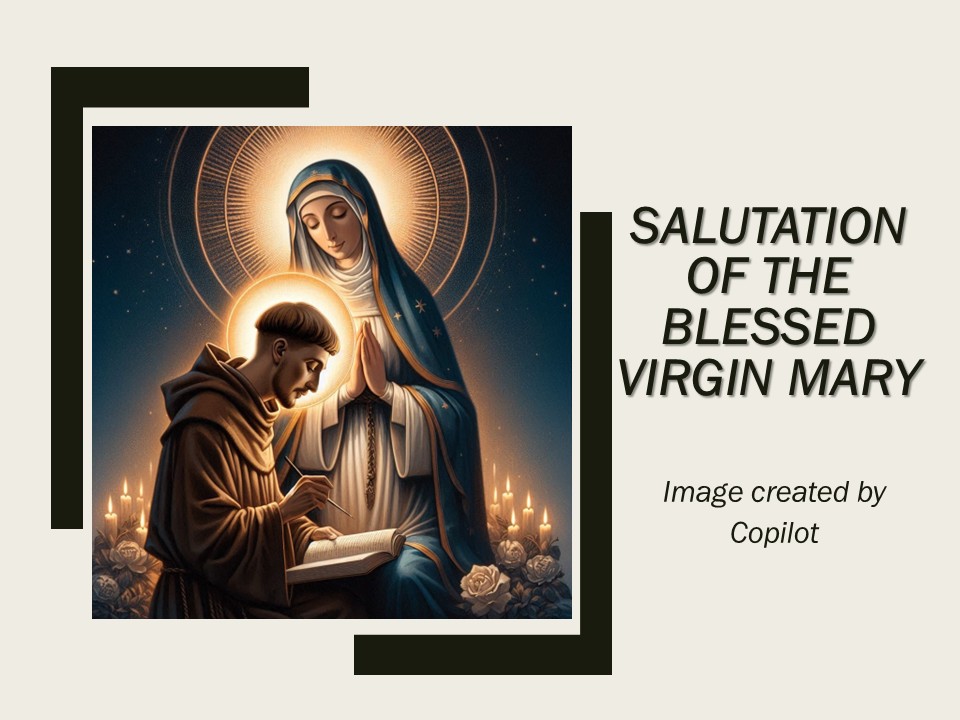
A Salutation of the Blessed Virgin Mary
1Hail, O Lady,
Holy Queen,
Mary, holy Mother of God,
Who are the Virgin made Church,a
2chosen by the most Holy Father in heaven
whom he consecrated with His most holy beloved Son
and with the Holy Spirit the Paraclete,
3in whom there was and is
all fullness of grace and every good.4Hail His Palace!
Hail His Tabernacle!
Hail His Dwelling!
5Hail His Robe!
Hail His Servant!
Hail His Mother!6And hail all You holy virtues
which are poured into the hearts of the faithful
through the grace and enlightenment of the Holy Spirit,
that from being unbelievers,
You may make them faithful to God.bPlease read the references to Mary above. Read through once. Then prayerfully consider each word and sentence a second time.
- According to the phrases St. Francis used to describe the Blessed Mother, what do we learn about how he thought of her?
- Choose four words or phrases that touch you deeply. Spend some time thinking about why you chose those words.
- What does this Salutation, tell us about how St. Francis prayed?
- How do you include the Blessed Mother in your prayers each day? What do you say to her?
- Personal challenge: See if you can write some short phrases/praises of the Blessed Mother that are personal to you.
+++++++++++++++++
Formación 9 de Mayo, 2025
Por favor compartir con su fraternidad localSan Francisco tenía una gran devoción a la Santísima Virgen María por su papel en la Encarnación y el ejemplo que nos dio. La hizo protectora de la Orden y, por tanto, de toda la familia franciscana.
“Esta sencilla colección de títulos forma una letanía de saludos que describen el papel de María en el plan de salvación. La tradición manuscrita sugiere un estrecho vínculo entre esta pieza y la siguiente, El saludo de las virtudes, y, por lo tanto, presenta a la Virgen María como modelo para todo cristiano que responde a la presencia virtuosa de Dios. en su vida.”
Saludo a la bienaventurada Virgen María [SalVM]
http://franciscanos.org/esfa/salvm.html
1Salve, Señora,
santa Reina,
santa Madre de Dios,
María, que eres virgen hecha iglesia
2y elegida por el santísimo Padre del cielo,
a la cual consagró Él con su santísimo amado Hijo
y el Espíritu Santo Paráclito,
3en la cual estuvo y está toda la plenitud de la gracia y todo bien.4Salve, palacio suyo;
salve, tabernáculo suyo;
salve, casa suya.
5Salve, vestidura suya;
salve, esclava suya;
salve, Madre suya
6y todas vosotras, santas virtudes,
que sois infundidas por la gracia e iluminación del Espíritu Santo
en los corazones de los fieles,
para que de infieles
hagáis fieles a Dios.Por favor, lea las referencias a María arriba. Lea una vez. Luego, en oración, considere cada palabra y frase por segunda vez.
• De acuerdo con las frases que usó San Francisco para describir a la Santísima Madre, ¿qué aprendemos acerca de cómo pensaba él en ella?
• Elija cuatro palabras o frases que le conmuevan profundamente. Dedique algo de tiempo a pensar por qué eligió esas palabras.
• ¿Qué nos dice este Saludo sobre cómo rezaba San Francisco?
• ¿Cómo incluye a la Santísima Madre en sus oraciones todos los días? ¿Qué le dice a ella?
• Desafío personal: vea si puede escribir algunas frases breves/alabanzas a la Santísima Madre que sean personales para usted.
Diane F. Menditto, OFSVice Minister, National Fraternity, Secular Franciscan Order USAListen – Discern – Go Forth National Theme 2022-2025
17th OFS General Chapter Rome, November 7-17, 2024
(This article originally appeared in the TAU-USA Winter 2025 Issue #114)
by Mary Frances Charsky, OFS
International Councilor


Welcome to Rome
“You are love” was the theme of the 17th General Chapter of the Secular Franciscan Order held in Rome in November of 2024 during the 8th Centenary of the Stigmata. This idea was expanded upon by fellow Franciscans with explanations that God loved us first. Our Franciscan way of life begins with love. Love of God, love of self, and love of neighbors and our families. Testimonies and examples were shared. Our level of concern was elevated for struggling fraternities and for marginalized people throughout the world.

La-Verna
Our day trip to La Verna, visiting the place where St. Francis received the stigmata, enabled us to meditate on the deep love that Francis had for the poor and crucified Jesus. We reflected on the love and passion that St. Francis had for the Lord Jesus and how we can learn to love all our brothers and sisters.
The most enjoyable part of the General Chapter for me was being with brothers, sisters, and friars from 65 countries around the world. There were 103 brothers and sisters in total which included the voting members, observers, and others who served the Chapter. Many relationships were renewed and precious new ones developed. Participants shared throughout the week, especially in small working groups, at meals, and during the fraternal evenings of songs, dances, and stories that demonstrated their culture, country, and belonging to the Order and to each other. Unity was established among participants and was demonstrated in the approval of the priorities, Statutes, and the budget. This unity was the result of the OFS Presidency members, presentations, and working groups. Stay tuned for future updates!
An essential part of the General Chapter was daily celebration of Holy Mass which gave us the spiritual strength to accomplish our work throughout the day. Holy Mass was alternately presided over by the General Ministers of the First Order and TOR and the four General Spiritual Assistants, reminding us of the life-giving union between the OFS and the rest of the Franciscan Family. The homilies were provided ahead of time in the four languages so that we could follow along.
Three priorities emerged from the week of reflections, discussions and deliberations:
Formation should help us live our Franciscan spirituality in a way that deepens our relationship with God who is love and leads us to become a community of love.
Family life is the essence of our human life. As Secular Franciscans, we are called to live the love of God in the family, either as single or married persons. Family life should help us see the important role that family plays in our Franciscan life. We belong to another family – the Franciscan Family.
Promotion of Vocations is the third priority. Article 45 in our General Constitutions states that promoting vocations to the Order is the duty of all the brothers and sisters. It is a sign of vitality in fraternities. We need to promote the OFS vocation with courage, creativity, and validity of the Franciscan way of life.
For more articles and to view photo and video galleries, go to the CIOFS website: www.ciofs.info/news/gen-chapter/2024-general-chapter/
https://www.secularfranciscansusa.org/2025/05/17th-ofs-general-chapter-rome-november-7-17-2024/
The Gospel Through a Franciscan Lens – Third Sunday of Easter – Fr. Christopher
This Gospel message for today is both comforting and challenging; comforting, because we consider our own inadequacies; challenging, because the greatest commandment is that we are to love one another as Jesus loves us, even when we don’t rise to the highest level.

https://www.secularfranciscansusa.org/2025/05/the-gospel-through-a-franciscan-lens-third-sunday-of-easter-fr-christopher/
Ecumenical Prayer Service on Beatitudes
The Ecumenical/Interfaith Committee of the OFS is offering a prayer service focused on the Beatitudes written by Neil Klotz, at 11 a.m. (ET) on Saturday, May 24.
Klotz is an international author and lecturer on the Aramaic Jesus, Native Middle Eastern Spirituality, the Sufi path, and peace.
You can join this online event by connecting with a link you will receive one week in advance.
If interested or you have questions, contact Marie Bianca, OFS, at mbbsfo@gmail.com
https://www.secularfranciscansusa.org/2025/05/ecumenical-prayer-service-on-beatitudes/
FORMATION FRIDAY – Mary Protectress of the Order – May 2, 2025
(en español abajo) Korean translation attached in separate PDF.
Please share with your local fraternityMary Protectress of the Order
To begin the month of May, we turn our eyes to the Blessed Mother who was so important to St. Francis. Our Rule and Constitutions guide us.
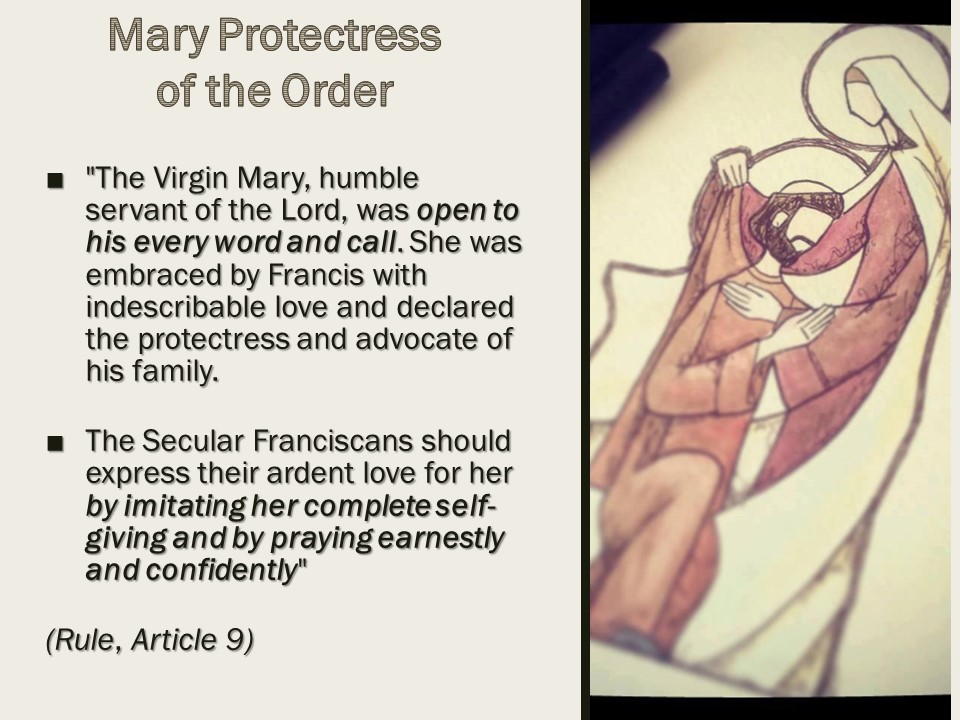
Rule: Article 9: “The Virgin Mary, humble servant of the Lord, was open to his every word and call. She was embraced by Francis with indescribable love and declared the protectress and advocate of his family.
The Secular Franciscans should express their ardent love for her by imitating her complete self-giving and by praying earnestly and confidently“
Mary’s self-giving and prayer are set up as the primary example of gospel living. Devotion to her has always been a hallmark of the Franciscan calling, both as a way of expressing love for her and as an important way of finding Jesus himself. (Commentary on the Rule—white booklet)
OFS Constitutions: Article 16.1, .2: Mary, Mother of Jesus, is the model of listening to the Word and of faithfulness to vocations. We, like Francis, seek all the gospel virtues realized in her.
The brothers and sisters should cultivate intense love for the most holy virgin, imitation, prayer, and filial abandonment. They should manifest their own devotion with expressions of genuine faith, in forms accepted by the Church.
Mary is the model of fruitful and faithful love for the entire ecclesial community. Secular Franciscans and their fraternities should seek to live the experience of Francis, who made the Virgin the guide of his activity. With her, like the disciples at Pentecost, they should welcome the Spirit to create a community of love.
Questions for Sharing and Discussion
- What qualities of Mary are attractive to you?
- What is Mary’s role in our lives and in the life of the Church?
- What is the goal of devotion to Mary? How do you discern whether your devotion to Mary supports your Franciscan life?
- What example does Mary set for us as Secular Franciscans?
Formación 2 de mayo, 2025 (Por favor compartir con su fraternidad local.)
María Protectora de la Orden `
Para comenzar el mes de mayo, dirigimos nuestros ojos a la Santísima Virgen que fue tan importante para San Francisco. Nuestra Regla y nuestras Constituciones nos guían.
Regla, Artículo 9: “La Virgen María, humilde sierva del Señor, siempre atenta a su palabra y a todas sus mociones, fue para San Francisco centro de indecible amor, y por él declarada Protectora y Abogada de su familia.
Los Franciscanos seglares den testimonio de su ardiente amor hacia Ella, por la imitación de su disponibilidad incondicional, y en la efusión de una confiada y consciente oración.”
En primer lugar, la auto entrega y la oración de María se establecen como el principal ejemplo de vivir el Evangelio. La devoción a ella siempre ha sido un sello distintivo de la vocación franciscana, tanto una forma de expresar amor por ella como una forma importante de encontrar a Jesús mismo. (Comentario sobre la Regla: folleto blanco)
Constituciones Generales de la OFS: Artículo 16.1, .2: María, Madre de Jesús, es el modelo para escuchar la Palabra y ser fieles a la vocación: en Ella, como Francisco, vemos realizadas todas las virtudes evangélicas.
Los hermanos cultiven el amor intenso a la Santísima Virgen, la imitación, la oración y la entrega filial. Manifiesten la propia devoción con expresiones de fe genuina en las formas aceptadas por la Iglesia.
María es modelo de amor fecundo y fiel para toda la comunidad eclesial. Los franciscanos seglares y las Fraternidades busquen vivir la experiencia de Francisco, que hizo de la Virgen guía de su vida y de su obra; con Ella, como los discípulos en Pentecostés, acojan el Espíritu para realizarse en comunidad de amor.
Para compartir y discutir
- ¿Qué cualidades de María son atractivas para usted?
- ¿Cuál es el papel de María en nuestras vidas y en la vida de la Iglesia?
- ¿Cuál es el objetivo de la devoción a María? ¿Cómo discernir si su devoción a María apoya su vida franciscana?
- ¿Qué ejemplo nos da María como franciscanos seglares?
Diane F. Menditto, OFSVice Minister, National Fraternity, Secular Franciscan Order USAListen – Discern – Go Forth National Theme 2022-2025