New England Spring Canticle

Susan Ronan, OFS

By Susan Ronan, OFS
National Executive Council Secretary

“Time in New England
Took me away
To long rocky beaches…
I feel the change comin’
I feel the wind blow
I feel brave and daring
I feel my blood flow.
With you I could bring out
All the love that I have.
With you there’s a heaven,
So earth ain’t so bad…”
From “Weekend in New England” – (Written by Randy Edelman/Sung by Barry Manilow)

One of our recent Formation Friday’s offered a beautiful reflection on St. Francis’ Canticle of the Creatures that we’re all celebrating during these centennial years. We were asked to write our own canticle. I offer to you my humble “New England Spring Canticle.”

Praised be You, my Lord, with all Your creatures, especially Sir Brother Sun,
who has graciously returned after his long winter’s nap.
And he is beautiful and radiant but like a playful child,
plays hide and seek with the cold and chilly Spring raindrops.

Praised be You, my Lord, through Sister Moon and the stars.
You wake up our little “peeper” friends
to sing a gentle lullaby throughout the dark night.

Praised be You, my Lord, through Brother Wind.
Ah yes, Brother Wind!
Open the windows and watch him cover every piece of furniture with a light dusting of…pollen!
Time to get those eye drops and antihistamines out of the medicine cabinet!

Praised be You, my Lord, through Sister Water.
April showers…and May showers…and June showers!
Thank you for reminding us that, without you,
God’s gardens full of color and sweet nectar
would not give us His great gifts of Nature to enhance our senses.

https://www.secularfranciscansusa.org/2025/06/new-england-spring-canticle/

Open post

FORMATION FRIDAY – SEVEN GIFTS OF THE HOLY SPIRIT – May 30, 2025

(en español abajo) Korean translation attached in separate PDF.

Gifts of the Holy SpiritPlease share with your local fraternity

In preparation for Pentecost, we meditate on the seven gifts of the Holy Spirit found in the book of the Prophet Isaiah 11:1–2. The Catechism of the Catholic Church tells us:

(CCC 1830) The moral life of Christians is sustained by the gifts of the Holy Spirit. These are permanent dispositions which make man docile in following the promptings of the Holy Spirit.

(CCC 1831) The seven gifts of the Holy Spirit are wisdom, understanding, counsel, fortitude, knowledge, piety, and fear of the Lord. They belong in their fullness to Christ, Son of David.109 They complete and perfect the virtues of those who receive them. They make the faithful docile in readily obeying divine inspirations.

We receive these gifts at our Baptism, and they are strengthened at Confirmation. For those of us who are professed Franciscans, our baptismal commitment and consecration to God is renewed at profession. Therefore, these gifts are strengthened in us for a third time.

Franciscan spirituality emphasizes humility, simplicity, and a deep connection to and relationship with God and our brothers and sisters. The seven gifts of the Holy Spirit play a significant role in shaping our way of life. Here is how they relate to our daily lives:

+ Wisdom: Guides Franciscans in seeing God’s presence in all creation, fostering a spirit of gratitude and reverence.
+
Understanding: Helps us to comprehend the depth of God’s love, leading to a life of compassion and service.
+
Counsel: Directs us in making moral and ethical decisions, especially in serving the poor and marginalized.
+
Fortitude: Strengthens us to endure hardships with joy, much like St. Francis himself.
+
Knowledge: Enables us to see the world through God’s eyes, recognizing the relationship and connections we have with one another and with all of creation.
+
Piety: Helps us to have a deep devotion to God, expressed through prayer and acts of kindness.
+
Fear of the Lord: Instills in us a sense of awe and humility, reminding us to trust in God’s providence.

For discussion in fraternity or to answer in your journal:

+ Which gifts speak most to your heart? How do you exemplify them?

+ How do these gifts help us as Catholics and as Franciscans?

+ Thinking about St. Francis himself, how do these gifts shine forth in him and in his writings?


Next week, we will look at the fruits of the Holy Spirit and how living our Rule helps us to exemplify them.


++++++++++++++++++++++++++


Formación 30 de mayo, 2025 (Por favor compartir con su fraternidad local.)

Los dones del Espíritu Santo


En preparación para Pentecostés, meditamos en los siete dones del Espíritu Santo que se encuentran en el libro del profeta Isaías 11:1-2. El Catecismo de la Iglesia Católica nos dice:


(CIC 1830) La vida moral de los cristianos está sostenida por los dones del Espíritu Santo. Se trata de disposiciones permanentes que hacen al hombre dócil en el seguimiento de los impulsos del Espíritu Santo.


(CIC 1831) Los siete dones del Espíritu Santo son la sabiduría, el entendimiento, el consejo, la fortaleza, el conocimiento, la piedad y el temor del Señor. Pertenecen en su plenitud a Cristo, Hijo de David.109 Completan y perfeccionan las virtudes de quienes las reciben. Hacen que los fieles sean dóciles en obedecer prontamente a las inspiraciones divinas.


Recibimos estos dones en nuestro Bautismo, y se fortalecen en la Confirmación. Para aquellos de nosotros que somos franciscanos profesos, nuestro compromiso bautismal y nuestra consagración a Dios se renuevan en la profesión. Por lo tanto, estos dones se fortalecen en nosotros por tercera vez.


La espiritualidad franciscana enfatiza la humildad, la sencillez y una profunda conexión y relación con Dios y nuestros hermanos y hermanas. Los siete dones del Espíritu Santo juegan un papel importante en la formación de nuestra forma de vida. Así es como se relacionan con nuestra vida diaria:


+ La Sabiduría: Guía a los franciscanos a ver la presencia de Dios en toda la creación, fomentando un espíritu de gratitud y reverencia.

+ La Comprensión: Nos ayuda a comprender la profundidad del amor de Dios, que nos lleva a una vida de compasión y servicio.

+ El Consejo: Nos dirige a tomar decisiones morales y éticas, especialmente al servir a los pobres y marginados. + La Fortaleza: Nos fortalece para soportar las dificultades con alegría, al igual que el mismo San Francisco.

+ El Conocimiento: Nos permite ver el mundo a través de los ojos de Dios, reconociendo la relación y las conexiones que tenemos entre nosotros y con toda la creación.

+ La Piedad: Nos ayuda a tener una profunda devoción a Dios, expresada a través de la oración y los actos de bondad.

+ El Temor del Señor: Infunde en nosotros un sentido de asombro y humildad, recordándonos que debemos confiar en la providencia de Dios.


Para discutir en fraternidad o para responder en su diario:

+ ¿Qué regalos hablan más a su corazón? ¿Cómo los ejemplifica?

+ ¿Cómo nos ayudan estos dones como católicos y como franciscanos?

+ Pensando en el mismo san Francisco, ¿cómo resplandecen estos dones en él y en sus escritos?


La próxima semana, veremos los frutos del Espíritu Santo y cómo vivir nuestra Regla nos ayuda a ejemplificarlos.


Diane F. Menditto, OFS
Vice Minister, National Fraternity, Secular Franciscan Order USA
Listen – Discern – Go Forth National Theme 2022-2025

Regional Roundup – In this issue, five of the 30 regions are highlighted.

(This article originally appeared in the TAU-USA Winter 2025  Issue #114)

St. Thomas More Region

The Region of St. Thomas More covers all of Arizona and Las Vegas, Nevada, and includes 11 active fraternities. The region’s name was chosen after proposals were requested from OFS members. A short list was created and sent to the fraternities for their vote. Thomas More was the favorite and became the name of the region in 1994.

A few years after Arizona became a state in 1912, Secular Provinces banded together to form the North American Federation, which sponsored its first Quinquennial in 1921. When invitations went out to disband the Provincial Councils and form new Regional Councils, St. Thomas More Region, which had begun groundwork ten years earlier, was ready with skilled leaders and an inspiring patron. While it took nine months for the Document of Establishment to travel from Rome and across the U.S. gathering the necessary signatures along the way, the transformation from Provincial to Regional Fraternity was completed in a single year.

St. Thomas More Region has the honor of sending the first woman to serve on the National Directive Board (the precursor of NAFRA). Clyda Markham, OFS, lived all her life in Phoenix and served for almost two years on the National Board before being dismissed for being “the wrong gender.” She returned to Arizona to serve on both fraternity and provincial councils. She had many friends from the days when Arizona was a new state and was asked to write an article about the role of Franciscan friars in the exploration and development of Arizona Territory. Many historical sites have names given by friars, and Secular Franciscan values are woven into Arizona lifestyles. Clyda’s story, published around 1939, was entered into the Congressional Record and can be obtained online from the Library of Congress.

St. Kateri Tekakwitha Region

St. Kateri Tekakwitha

St. Kateri Tekakwitha

St. Kateri Tekakwitha Region covers Eastern, Central and Western New York State, and Erie, Pennsylvania, and includes 18 fraternities. The name was chosen because New York State is known for the Native American tribes that were living there. There is still one active reservation – The Seneca Nation of Indians reservation – in   Cattaraugus County.

St. Kateri Tekakwitha was a Mohawk Indian born near Auriesville, NY. She developed smallpox at the age of four, which left her with a scarred face and very low vision. The translation of the Native American word “Tekakwitha” is “she who bumps into things.” Kateri is a form of Catherine, and she was given this name when she converted to Christianity. She was educated by the Jesuit missionaries and is the patron saint of traditional ecology, Indigenous Peoples, and care for creation. She was not a Secular Franciscan. . . but members like to think she would have been if she had the chance.

There are several other saints that lived in the state of New York including St. Marianne Cope, St. Elizabeth Ann Seton, and St. John Neumann. Blessed Solanus Casey also resided and served in New York State for 20 years.

Troubadours of Peace

The states of Oregon, Washington, Idaho and Alaska are all part of the Troubadours of Peace Region. It includes 13 fraternities, two newly forming groups, and one satellite group.

In 2024 they had a regional retreat which was both live-streamed and recorded. One of our National Spiritual Assistants, Fr. Christopher Panagoplos, TOR, gave the presentations. The topic is “The Stigmata of St. Francis.” There are five sessions of varying lengths which are available on the region’s website. To view the presentations, go to secularfranciscanspacificnorthwest.com; “Stigmata Retreat.”

St. Joan of Arc Region

Mississippi, Louisiana, the southern part of Arkansas and the eastern part of Texas make up the St. Joan of Arc Region, which includes 15 fraternities.

The region’s name was chosen because St. Joan of Arc fought for Orleans, France, and the United States purchased the Louisiana Purchase from France with New Orleans having the first fraternity in the region.

They are a hospitable group that meets as a region four times a year with two on Zoom and two in person. They represent the diversity of five continents. They also have an annual regional retreat where they bond more with one another.

St. Junipero Serra Region

St. Junipero Serra – Apostle of California

St. Junipero Serra – Apostle of California

St. Junipero Serra Region consists of Northern California from the Oregon border at the north to Bakersfield in the south, and one fraternity in Reno, Nevada. They have 25 established fraternities and two emerging groups.

The name for the region was chosen because St. Junipero Serra is the patron saint of California. He founded many of the California missions for the Franciscans.

Within the region there are seven National Parks, a large number of State Parks, and many County Parks in various counties. California spans four climate zones including coastal, inland valley, mountain and dessert.

The region is culturally diverse with four Hispanic fraternities, two Korean fraternities, and one Chinese fraternity, which is the only one in the nation.

https://www.secularfranciscansusa.org/2025/05/regional-roundup-in-this-issue-five-of-the-30-regions-are-highlighted/

The Gospel Through a Franciscan Lens – 6th Sunday of Easter – Fr. Christopher

In St Francis’ last hours, his last will and testament was that the brothers would remain together in spite of their differences. Francis valued relationships above all else. The gift of peace is the true generative gift of the future.

Father’s Homily – video

Father’s Homily – text

https://www.secularfranciscansusa.org/2025/05/the-gospel-through-a-franciscan-lens-6th-sunday-of-easter-fr-christopher/

Open post

FORMATION FRIDAY – Little Flowers of St. Francis – May 23, 2025

(español abajo) Please share with your local fraternity Korean translation attached in a separate PDF

The Little Flowers of St. Francis FA:ED, vol. 3, 566 (FA:ED=Francis of Assisi: Early Documents)

(The background quotes below come from a much longer introduction to the Little Flowers as found on the Franciscan Intellectual Tradition website. You can read all the chapters mentioned and many more at that same link.)

About the “Little Flowers:”

· “The popularity of these preachers [the friars] and the curiosity of the people may well have inspired what quickly became known as The Little Flowers of Saint Francis.”

· “Written between 1328 and 1343 by Hugolino of Monte Giorgio and an unknown collaborator, the Actus Beati Francisci et sociorum ejus [The Deeds of Blessed Francis and His Companions] was a collection of “little flowers” or anecdotes about Francis and his first brothers.”

· “Many of the stories were rooted in both the written and oral Franciscan tradition.”

· “In a sense, the Little Flowers epitomized much of the Franciscan hagiography of the fourteenth century.” (Hagiographies have been written from the 2nd century to instruct and edify readers and glorify the saints.)

· Read the complete introduction to the Little Flowers and all of the stories at the link below.

https://franciscantradition.org/francis-of-assisi-early-documents/the-prophet/the-little-flowers-of-saint-francis/2467-fa-ed-3-page-566

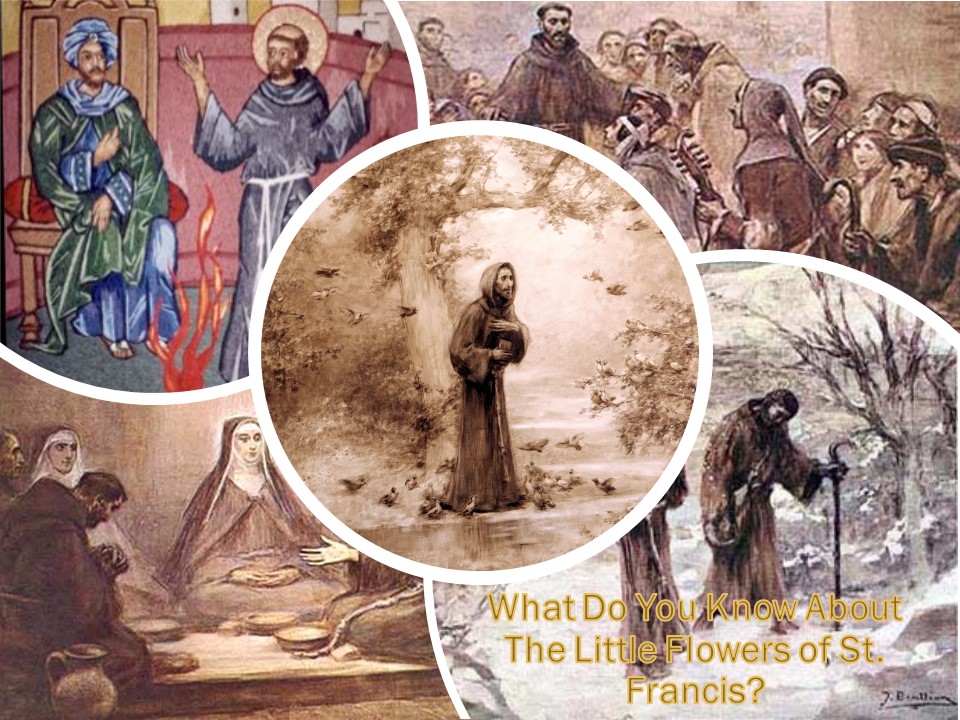
Artwork – Josep Benlliure

The titles of some of the more famous stories about Francis and Clare found in the “Little Flowers” are:

+Chapter 8:O Brother Leo, write that here and in this is perfect joy.” [ FA:ED, vol. 3, 579]

+Chapter 10: “Why after you? Why after you?” (Bro. Masseo to St. Francis) [FA:ED, vol. 3, 583]

+Chapter 15: How Saint Clare ate with Saint Francis and his brother companions in Saint Mary of the Angels.
[ FA:ED, vol. 3, 590]

+Chapter 16: How Saint Francis, counseled by Saint Clare and holy brother Sylvester to preach and convert many people, formed the Third Order, preached to the birds, and made the swallows remain silent. [FA:ED, vol. 3, 591]

+Chapter 21: The story of the Wolf of Gubbio [FA:ED, vol. 3, 601]

+Chapter 24: How Saint Francis converted to the faith the Sultan of Babylon and the prostitute who
invited him to sin. [FA:ED, vol. 3, 605]

+Chapter 33: How Saint Clare, at the Pope’s command, blessed the bread that was on the table; and on every loaf there appeared the sign of the cross. [FA:ED, vol. 3, 624]

+Chapter 35: How Saint Clare while she was ill was miraculously carried to the church of Saint Francis on the night of the feast of Christmas and heard the office there. [FA:ED, vol. 3, 626]

Artwork on the slide – Josep Benlliure

For discussion or to comment on in your journal:

+ How do the stories of the lives of Francis and Clare and their miracles inspire you in your life as a Secular Franciscan?

+ How do these stories line up with biographies of Francis and Clare that you have read?

+ What is the purpose of hagiography?

+++++++++++++++++++++++++++++++

Formación 23 de mayo, 2025 por favor, compartir con su fraternidad local.

Para leer “Las florecillas de San Francisco” en español, visite el enlace abajo:

https://www.ead.pucv.cl/app/uploads/2011/12/Florecillas-de-San-Francisco.pdf (Se puede descargar el archivo completo en este enlace.)

¿Qué son las florecillas de San Francisco?

Pero ¿qué son las florecillas de San Francesco? Los orígenes del original del siglo XIV están envueltos en misterio. Durante mucho tiempo se creyó que se trataba de la traducción del latín de un texto anterior titulado «Floretum», una historia de Francisco y sus primeros compañeros, atribuida a Fraile Ugolino da Montegiorgio, autor de la obra latina medieval «Actus Sancti Francisci et sociorum eius», de la cual las florecillas podrían haber sido la introducción. Otra tradición atribuye la autoría del texto a Giovanni de Marignolli, un fraile menor franciscano que fue obispo y misionero en China.

Aunque el autor permanece incierto, el significado de la obra no cambia, es decir, una colección de historias y leyendas sobre la vida de San Francisco de Asís y sus discípulos, en la que emerge su predicación y ejemplo de vida y fe.

Leer más: https://www.holyart.es/blog/articulos-religiosos/las-florecillas-de-san-francisco-explicadas-brevemente/

Los títulos de algunas de las historias más famosas sobre Francisco y Clara que se encuentran en las “Florecillas” son:

+Capítulo 8: “Oh hermano Leo, escribe que aquí y en esto está la alegría perfecta.”

+Capítulo 10: “¿Por qué después de ti? ¿Por qué después de ti?

+Capítulo 15: Cómo comió Santa Clara con San Francisco y sus hermanos compañeros en Santa María de los Ángeles

+Capítulo 16: Cómo San Francisco, aconsejado por Santa Clara y su santo hermano Silvestre para predicar y convertir a muchas personas, formó la Tercera Orden, predicó a los pájaros e hizo callar a las golondrinas

+Capítulo 21: La historia del lobo de Gubbio

+Capítulo 24: Cómo San Francisco convirtió a la fe al Sultán de Babilonia y a la prostituta que Lo invitó a pecar.

+Capítulo 33: Cómo Santa Clara, por orden del Papa, bendijo el pan que estaba en la mesa; Y en cada pan aparecía la señal de la cruz.

+Capítulo 35: Cómo Santa Clara, mientras estaba enferma, fue llevada milagrosamente a la iglesia de San Francisco en la noche de la fiesta de Navidad y escuchó el oficio allí.


Para platicar o comentar en su diario:

+ ¿Cómo le inspiran las historias de la vida y los milagros de Francisco y Clara en su vida como franciscano seglar?

+ ¿Cómo se alinean estas historias con las biografías de Francis y Clare que ha leído?

+ ¿Cuál es el propósito de la hagiografía? (Las hagiografías se han escrito desde el siglo II para instruir y edificar a los lectores y glorificar a los santos).


 
 
Diane F. Menditto, OFS
Vice Minister, National Fraternity, Secular Franciscan Order USA
Listen – Discern – Go Forth National Theme 2022-2025
Scroll to top
Juan de Padilla