Inclusive Multilingual Communication

(This article originally appeared in the TAU-USA Spring 2025  Issue #115)

Inclusive Multilingual Communication

by Caroline Yandell, OFS

Minister, St. Francis Region

Group of multicultural, multilingual members In the St. Francis Region in Southern CaliforniaA common statement that we have all probably heard is, “The United States is a melting pot.” But that doesn’t really seem right if you think of what a melting pot does and what its contents looks like. A melting pot melts down everything in it into one single entity. I picture a glutinous unicolored mass. Not an attractive site at all.

A salad bowl seems to be a more appropriate visual for the composition of our nation. A salad has a variety of colors, textures and flavors that come together to make something attractive and beneficial, which is much more like our combination of various cultures, backgrounds and skin tones.

People who reside in the United States come from all over the world, including many of the members of our National Fraternity who come from different cultures and speak many languages other than English. Some were born and raised in the U.S., and others immigrated as children or adults. Some have learned to speak and understand English, and some have not.

In the St. Francis Region in Southern California, almost 40% of the members speak Korean. There are two fraternities of Vietnamese speakers, and two Spanish-speaking fraternities. There is also a fraternity that has a majority of members who speak Tagalog.

This has a great impact on how the region communicates and functions. It impacts how plans are made for such events as regional gatherings, fraternal and pastoral visits, and Chapter.

The current Regional Executive Council (REC) includes members who speak Spanish and Korean. The previous REC also had a Vietnamese speaker. Three regional members act as translators for the region, translating important documents. These include part of the quarterly regional newsletter, documents that are distributed at Chapter, and other regional documents.

At Chapters, translated notes are provided so all attendees are aware of what is being covered in the presentations. All the liturgies include parts spoken, and sometimes sung, in all four languages.

It is evident at the regional picnics that language differences are no barrier to eating, playing and laughing together – especially with all the delicious international food that is shared. Members assist in translating prayers as well as activities when needed. One highlight is when each culture group shares their own version of grace before lunch.

At last year’s regional gathering, the topic was the Stigmata of St. Francis. There were two OFM presenters – one English speaker and one Korean. Everyone gathered for an international potluck lunch, followed by a PowerPoint presentation of various Stigmata pictures set to music. There were pre-translated questions for members to discuss after the PowerPoint.

Working in and with a multicultural, multilingual region takes special planning and translation work. It means getting some tasks done sooner so that the translators have time to get their work completed. These are all challenges that are worth addressing, for it states in our Rule, Art. 19:

Mindful that they are bearers of peace which must be built up unceasingly, they should seek out ways of unity and fraternal harmony through dialogue, trusting in the presence of the divine seed in everyone and in the transforming power of love and pardon.

Messengers of perfect joy in every circumstance, they should strive to bring joy and hope to others

https://www.secularfranciscansusa.org/2025/06/inclusive-multilingual-communication/

The Gospel Through a Franciscan Lens – Pentecost – Fr. Christopher

Father Christopher describes how the fruits of the Holy Spirit grow and mature in us.

“Prayer, and your every thought, word, and gesture will reflect the presence of God within you. The presence that is a living, throbbing person, Jesus. The presence that can be powerful if we will only let it happen.”

Father’s Homily – video

“Pentecost” by Jean Restout II (1692–1768). Photo: Web Gallery of Art/Public Domain

https://www.secularfranciscansusa.org/2025/06/the-gospel-through-a-franciscan-lens-pentecost-fr-christopher/

Open post

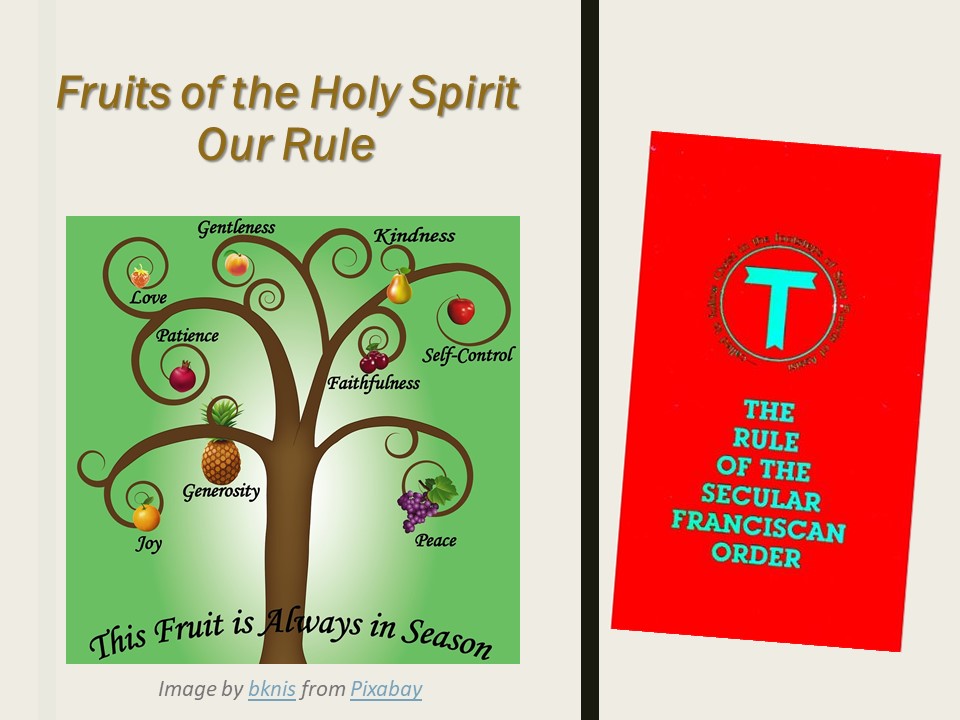
FORMATION FRIDAY – The Fruits of the Spirit emplemplified in our RULE – June 6, 2025

(en español abajo) Korean translation attached in separate PDF.


The Fruits of the Spirit exemplified in our Rule

When we are baptized, we receive the gifts of the Holy Spirit. These gifts are strengthened at our Confirmation. When we are professed as Secular Franciscans, we further strengthen our Baptismal Promises. As a result of the gifts of the Spirit (wisdom, understanding, counsel, fortitude, knowledge, piety, and fear of the Lord), we are able to demonstrate the fruits of the Spirit (love, joy, peace, patience, kindness, goodness, long-suffering, mildness, faith, modesty, self-restraint, and chastity.) By living our rule, we hope to exemplify these fruits in everything we do in our daily lives.

Our Rule

— Spells out the way the Spirit wishes us to do God’s will

— Tells us how God desires us to live

— Faithfulness to the Rule and Constitutions help us to build up God’s Kingdom (as we are called to do through our Baptism).

For your consideration—the Fruits of the Spirit and our Rule

First of all—Articles 4, 14 and 19 ask us to be open to the action of the Holy Spirit. Then:

Love: Articles 5, 13, and 18
+We are asked to encounter the living person of Christ in one another and to be mindful that all creatures bear the “imprint of the Most High.”

Joy: Articles 13 and 19
+We are reminded that a sense of community makes us joyful and that we are “Messengers of perfect joy in every circumstance…”

Peace: Articles 17 and 19
+We are reminded that we are “bearers of peace” and that we should “cultivate peace.”

Patience: Articles 7 and 10
+We seek conversion each day (metanoia) as we place ourselves in the hands of the Father.

Kindness: Articles 13 and 14
+With a “gentle and courteous spirit” we accept “all people as a gift of the Lord and an image of Christ.”

Goodness: Articles 13 and 14
+ “Secular Franciscans, together with all people of good will, are called to build a more fraternal and evangelical world…”

Long-suffering: Articles 10 and 19
+ We follow the “poor and crucified Christ, witness to him even in difficulties and persecutions.”

Mildness: Articles 9 and 11
+We live in the “spirit of the Beatitudes.”

Faith: Articles 4, 5, 10 and 14
+We express our faith in Jesus: “Christ, the gift of the Father’s love, is the way to him, the truth into which the Holy Spirit leads us, and the life which he has come to give abundantly.”

Modesty: Article 11
+We “purify our hearts from every tendency and yearning for possession and power.”

Self-restraint: Article 11, 12
+We “acquire purity of heart” in order to “set ourselves free” in order to “love God and our brothers and sisters.”

Chastity: Articles 6, 12
+We follow the teachings of the Church, “…devote themselves energetically to living in full communion with the pope, bishops, and priests,…”

For discussion or to answer in your journal:

+When people look at you, which fruits of the Holy Spirit are evident? Give an example.
+How does our Rule help you to demonstrate these fruits of the Spirit?
+Which fruits of the Spirit would you like to cultivate? Why?
+Which of the fruits of the Spirit are difficult for you to manifest? Can you pinpoint why that might be?

+++++++++++++++++

Formación 6 de junio de 2025
Los frutos del Espíritu ejemplificados en nuestra Regla

Cuando somos bautizados recibimos los dones del Espíritu Santo. Estos dones se fortalecen en nuestra Confirmación. Cuando profesamos como franciscanos seglares, fortalecemos aún más nuestras promesas bautismales. Como resultado de los dones del Espíritu (sabiduría, entendimiento, consejo, fortaleza, conocimiento, piedad y temor del Señor), podemos demostrar los frutos del Espíritu (amor, gozo, paz, paciencia, bondad, bondad, longanimidad, apacibilidad, fe, modestia, dominio propio y castidad.) Al vivir nuestra regla, esperamos ejemplificar estos frutos en todo lo que hacemos en nuestra vida diaria.

Nuestra Regla:

· Explica la forma en que el Espíritu desea que hagamos la voluntad de Dios.

· Nos dice cómo Dios desea que vivamos

· La fidelidad a la Regla y las Constituciones nos ayuda a construir el Reino de Dios (como estamos llamados a hacer a través de nuestro Bautismo).

Para su consideración: los frutos del espíritu y nuestra regla

En primer lugar, los artículos 4, 14 y 19 nos piden que estemos abiertos a la acción del Espíritu Santo.

El Amor: artículos 5, 13 y 18

+ Se nos pide que encontremos a la persona viva de Cristo en los demás y que tengamos presente que todas las criaturas llevan la “huella del Altísimo”.


El Gozo: artículos 13 y 19

+ Se nos recuerda que el sentido de comunidad nos alegra y que somos “Mensajeros de la alegría perfecta en toda circunstancia …”

La Paz: artículos 17 y 19

+ Se nos recuerda que somos “portadores de paz” y que debemos “cultivar la paz”.


La Paciencia: artículos 7 y 10

+ Buscamos la conversión cada día (metanoia) al ponernos en las manos del Padre.

La Benignidad: artículos 13 y 14

+ Con un “espíritu amable y cortés” aceptamos “a todas las personas como un don del Señor y una imagen de Cristo”.


La Bondad: artículos 13 y 14

+ “Los franciscanos seglares, junto con todas las personas de buena voluntad, estamos llamados a construir un mundo más fraterno y evangélico…”


La Longanimidad: artículos 10 y 19

+ Seguimos al “Cristo pobre y crucificado, testimoniamos de él incluso en las dificultades y persecuciones”.


La Mansedumbre: artículos 9 y 11

+ Vivimos en el “espíritu de las Bienaventuranzas”.

La Fe: artículos 4, 5, 10 y 14

+ Expresamos nuestra fe en Jesús: “Cristo, don del amor del Padre, es el camino hacia él, la verdad a la que nos conduce el Espíritu Santo y la vida que ha venido a dar en abundancia”.


La Modestia: artículo 11

+ “Purificamos nuestro corazón de toda tendencia y anhelo de posesión y poder”.


La Continencia: artículos 11, 12

+ “Adquirimos pureza de corazón” para “liberarnos” para “amar a Dios ya nuestros hermanos”.


La Castidad: artículos 6, 12

+ Seguimos las enseñanzas de la Iglesia, “… se dedican con energía a vivir en plena comunión con el Papa, los obispos y los sacerdotes …”

Para discusión o para responder en su diario:

+ Cuando la gente le mira, ¿qué frutos del Espíritu Santo son evidentes? Dar un ejemplo.

+ ¿Cómo le ayuda nuestra Regla a demostrar estos frutos del Espíritu?
+
¿Cuáles de los frutos le gustaría cultivar? ¿Por qué?

+ ¿Cuáles de los frutos del Espíritu le resultan difíciles de manifestar? ¿Puede señalar por qué podría ser eso?


Diane F. Menditto, OFS
Vice Minister, National Fraternity, Secular Franciscan Order USA
 
Listen – Discern – Go Forth National Theme 2022-2025

Chapter of Mats canceled; Plan for the Quinquennial

Due to unforeseen challenges with the venue, fees, and Italian regulations, the Chapter of Mats event scheduled for 2026 in Rome, Italy, is cancelled.

Plan on attending another way for our Franciscan family to come together.  You are warmly invited to join us at the 21st Quinquennial Congress in Lexington, Kentucky:
Dates: July 29 – August 2, 2026
Location: Lexington, KY

Early registration begins this August—so mark your calendars and begin planning. Here is a link to all of the information about the Q.   

https://www.secularfranciscansusa.org/2025/06/chapter-of-mats-canceled-plan-for-the-quinquennial/

Are You Listening?

(This article originally appeared in the TAU-USA Spring 2025  Issue #115)

by Diane Menditto, OFS

National Vice Minister

Listen! ¡Escuchen!

If I have said that word once, I probably said it thousands of times during my thirty-five-year career as a Spanish teacher. The results varied each time the word was uttered in either language.

When I was asked to write an article on communication for this issue of the TAU-USA, I looked back at the many articles (most recently, a 2023 issue) and presentations I’ve given on the topic. An integral part of those sharings has been listening, which will be the main focus here. How we listen–not only with our ears, but with our eyes, our hearts, and our souls–affects who we are as Secular Franciscans, as family members, and as professionals in whatever field we find ourselves.

What kinds of listening require more than just ears? I’m glad you asked. I consulted Microsoft CoPilot to provide a list of the types of listening in both secular and religious settings. Interestingly, it came up with many of the same terms that I have spoken and written about over the years.

We have active listening, empathic listening, critical listening, and reflective listening. These show up in a classroom, business, medical office, repair shop, coffee shop, or supermarket. Active listening requires us to focus our eyes and ears on the speaker. We lean forward to look at and engage the other person. We need to concentrate on what is being said, and our body language (head nods, smiles) will tell the speaker that we hear and understand what is being said.

Empathic listening requires that our minds and hearts help us to feel what the speaker is saying whether we agree or not. Its cousin, reflective listening, often requires paraphrasing what the speaker is saying without injecting an opinion. These kinds of listening help us to build trust if our empathy and understanding are genuine. Critical listening puts the heart aside and keeps the brain well-engaged. We want to hear everything said, putting our emotions and opinions aside, to make the best decision for our family or our fraternity. This very often takes patience and humility.

Other types of listening that we find more often in fraternal and religious settings are contemplative, pastoral, communal, and discernment listening. Obviously, contemplative listening requires us to sit silently, listening for the Holy Spirit’s whisper. We listen to homilies, spiritual direction, and guidance given during reconciliation. In fraternity, we practice communal listening where the goal is the well-being of the fraternity and our spiritual growth. With discernment, we listen to what God is asking of us by asking the Holy Spirit to guide us, perhaps by listening to a trusted individual or spiritual director, reading our Rule, or reading the writings of our founder.

There are some other key things about listening that Artificial Intelligence forgot to list because it is not human! While listening to each other, we must listen to ourselves. Sometimes we stop paying attention to how we sound when we speak or write. We need to hear what our listeners’ body language tells us. The expression “read the room” is good advice. Knowing our audience, whether giving a talk, having a one-on-one conversation, or writing an email, is key to how our message will be received. Listening internally to how we say something is sometimes all that is necessary to avoid having a simple statement or comment become a contentious issue that can destroy the peace of the family or fraternity.

Listening well often means giving up control. It takes wisdom, patience, and humility to listen well. The Holy Spirit has given us these gifts, but it is up to us to use them.

https://www.secularfranciscansusa.org/2025/06/are-you-listening/

Scroll to top
Juan de Padilla