(en español abajo) Korean translation attached in separate PDF.
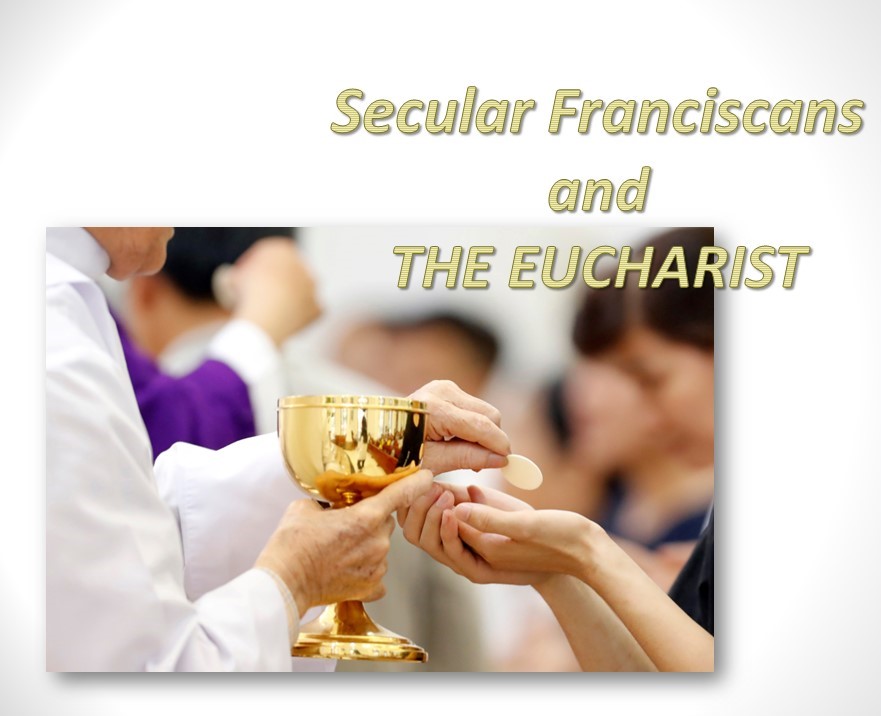
Secular Franciscans and the Eucharist – Please share with your local fraternity.
In anticipation of the Solemnity of the Most Holy Body and Blood of Christ (Corpus Christi) on June 19th (in some dioceses June 22), we examine again our devotion to the Eucharist as followers of St. Francis.
St. Francis was devoted to the Eucharist. In the first Admonition, he says. “This is my Body and the Blood of my new covenant [which will be shed for many] ;{snippet Mk 14:22} 11 and Whoever eats my flesh and drinks my blood has eternal life .{snippet Mk 14:24} 12 It is the Spirit of the Lord,{snippet Jn 6:55} therefore, That lives in Its faithful, That receives the Body and Blood of the Lord. 13 All others who do not share in this same Spirit and presume to receive Him eat and drink judgment on themselves .{snippet 1 Cor 11:29}”(The Admonitions: FA:ED, vol. 1, p. 129)
As we follow in the footsteps of our Seraphic Father, we, too, are devoted to the most precious Body and Blood of our Lord Jesus in the Eucharist. Let’s take a look at our Rule and Constitutions.
Rule Article 8: … “Let them participate in the sacramental life of the Church, above all the Eucharist….”
General Constitutions Article 14.2: (Refers to Art. 8 of the Rule) “The Eucharist is the center of the life of the Church. Christ unites us to himself and to one another as a single body in it. Therefore, the Eucharist should be the center of the life of the fraternity. The brothers and sisters should participate in the Eucharist as frequently as possible, being mindful of the respect and love shown by Francis, who, in the Eucharist, lived all the mysteries of the life of Christ.”
“The Holy Spirit builds up, animates, and sanctifies the Church. He prepares us to go out and bring others to Christ. He opens our minds to understand Christ’s death and Resurrection. He makes present for us the mystery of Christ, especially in the Eucharist, and brings us to communion with God that we may bear much fruit. (Cf. CCC
– no. 737) United States Catholic Catechism for Adults – USCCB – Page 109
GC Article 53.2 & 4 (Refers to Articles 6 & 8 of the Rule) 2.”The fraternity should come together periodically, also as a Church community to celebrate the Eucharist in a climate which strengthens the fraternal bond and characterizes the identity of the Franciscan family. Where, for whatever reason, this particular celebration may not be possible, they should participate in the celebration of the larger Church community.”
N.B. “The Eucharist, celebrated with parish members, draws us to the Church. It keeps us in touch with the local
parish and diocesan community. The fraternity may periodically celebrate Eucharist at their fraternity gatherings.
This celebration is recommended for special occasions – e.g. Professions, jubilees of profession, a memorial Eucharist for the deceased of the SFO or other important occasions.” Cf. Benedict XVI’s quote from Sacramentum
Caritatis on page 184-185 (Franciscan Journey p. 177)
“Within the Church the Eucharist is the center of our lives. Attending a parish Eucharist is highly encouraged. We need to be consistently present at the gathering of the People of God. It reminds us of our union with the Church.”
(Franciscan Journey p. 178)
A good video by Bishop Barron on the Eucharist:
https://www.youtube.com/watch?v=sgy_TFeIyiM&t=126s (Real Presence)
Through our example, we help others to realize that Jesus is truly present in the Eucharist under the appearance of bread and wine. Please think about your relationship with Jesus in the Eucharist as you answer the questions below.
+Why is the Eucharist important to you as a Catholic? As a Franciscan?
+How do you prepare to receive the Body and Blood of Christ?
+How is the Eucharist tied to our Franciscan spirituality?
+Think about what our Rule and Constitutions say about the Eucharist. How are you opened up by these words to allow the Holy Spirit to transform you?
+In what ways can you show special reverence for the Eucharist?
++++++++++++++++++++++++++
Los Franciscanos Seglares y la Eucaristía – Por favor, comparta con su fraternidad local.
En anticipación de la solemnidad del Santísimo Cuerpo y Sangre de Cristo (Corpus Christi) el 19 de junio (en algunas diócesis el 22 de junio), examinamos nuevamente nuestra devoción a la Eucaristía como seguidores de San Francisco.
San Francisco era devoto de la Eucaristía. En la primera Admonición, dice. ”…como lo atestigua el mismo Altísimo, que dice: Esto es mi cuerpo y mi sangre del nuevo testamento, [que será derramada por muchos] (cf. Mc 14,22.24); 11y: Quien come mi carne y bebe mi sangre, tiene vida eterna (cf. Jn 6,55). 12De donde el espíritu del Señor, que habita en sus fieles, es el que recibe el santísimo cuerpo y sangre del Señor. 13Todos los otros que no participan del mismo espíritu y se atreven a recibirlo, comen y beben su condenación (cf. 1 Cor 11,29). (Admoniciones http://franciscanos.org/esfa/adm-ae.html )
Mientras seguimos los pasos de nuestro Seráfico Padre, nosotros también somos devotos del Cuerpo y la Sangre más preciados de nuestro Señor Jesús en la Eucaristía. Echemos un vistazo a nuestra Regla y Constituciones.
Regla Artículo 8: … “Participen de la vida sacramental de la Iglesia, epecialmente la Eucaristía… ”.
Constituciones Generales Artículo 14.2: (Véase Regla Art. 8.) “ La Eucaristía es el centro de la vida de la Iglesia. En ella Cristo nos une a Él y entre nosotros como un único cuerpo. Por lo tanto, la Eucaristía sea el centro de la vida de la Fraternidad; los hermanos participen en la Eucaristía con la mayor frecuencia posible, conscientes del respeto y amor de San Francisco, que en la Eucaristía vivió todos los misterios de la vida de Cristo.”
“El Espíritu Santo edifica, anima y santifica a la Iglesia. Él nos prepara para salir y llevar a otros a Cristo. Él abre nuestras mentes para comprender la muerte y resurrección de Cristo. Nos hace presente el misterio de Cristo, especialmente en la Eucaristía, y nos lleva a la comunión con Dios para que demos mucho fruto. (Cf. CCC
– no. 737) Catecismo Católico de los Estados Unidos para Adultos – USCCB – Página 109
CCGG, artículo 53.2 y 4 (Se refiere a los artículos 6 y 8 de la Regla) 2. (Regla 6; 8). “La Fraternidad se reúna periódicamente, como comunidad eclesial, para celebrar la Eucaristía en un clima que consolide el vínculo fraterno y exprese la identidad de la Familia Franciscana. Donde no sea posible la celebración particular, particípese en la de una más amplia comunidad eclesial.”
NB “La Eucaristía, celebrada con los feligreses, nos acerca a la Iglesia. Nos mantiene en contacto con la
comunidad local parroquial y diocesana. La fraternidad podrá celebrar periódicamente la Eucaristía en sus reuniones de fraternidad. Esta celebración se recomienda para ocasiones especiales, por ejemplo, profesiones, jubileos de profesión, una eucaristía en memoria de los difuntos de la OFS u otras ocasiones importantes”. Cf. Cita de Benedicto XVI de Sacramentum Caritatis en la página 184-185 (Jornada franciscana p. 177)
“Dentro de la Iglesia la Eucaristía es el centro de nuestra vida. Se recomienda encarecidamente asistir a una Eucaristía parroquial. Necesitamos estar constantemente presentes en la reunión del Pueblo de Dios. Nos recuerda nuestra unión con la Iglesia”. (Jornada franciscana p. 178)
Un buen video (en inglés) del obispo Barron sobre la Eucaristía:
https://www.youtube.com/watch?v=sgy_TFeIyiM&t=126s (Presencia real)
A través de nuestro ejemplo, ayudamos a otros a darse cuenta de que Jesús está realmente presente en la Eucaristía bajo la apariencia del pan y el vino. Piense en su relación con Jesús en la Eucaristía mientras responda las siguientes preguntas.
+¿Por qué la Eucaristía es importante para usted como católico? ¿Como franciscano?
+¿Cómo se prepara para recibir el Cuerpo y la Sangre de Cristo?
+¿Cómo se vincula la Eucaristía a nuestra espiritualidad franciscana?
+ Piense en lo que dicen nuestra Regla y Constituciones sobre la Eucaristía. ¿Cómo estas palabras le abren para permitir que el Espíritu Santo lo transforme?
+¿De qué maneras puede mostrar reverencia especial por la Eucaristía?

 The first time I was introduced to the “Canticle of the Creatures,” I was easily captivated by its seemingly all-encompassing spirit of joy and praise of our good God. Without knowing Francis’ story well nor the context of this canticle’s writing, I imagined him frolicking through a vast field of flowers on a bright summer’s day, without a care in the world. Yes, a moment when the true blessings of the Lord can be so obvious, even to the most tepid of believers. What was this setting of inspiration? What treasure could so captivate St. Francis?