Please share with your local fraternity
Korean translation attached in a separate PDF.
What Makes Secular Franciscans Different from Other Catholics? (Part One)
All of us who are Catholics have many things in common. Most of us grew up attending Mass every Sunday. We go to confession every so often. We pray many of the same prayers: the Rosary, the Divine Mercy Chaplet, the Memorare, the Angelus, and prayers asking for the intercession of our favorite saints. Some Catholics read a bit of Scripture every day and attend bible study and some may even pray the Liturgy of the Hours.
So, what makes Secular Franciscans different? Over the next few weeks, we will look at five things about Secular Franciscans that set us apart. (There may even be more than five, but we will tackle five.)
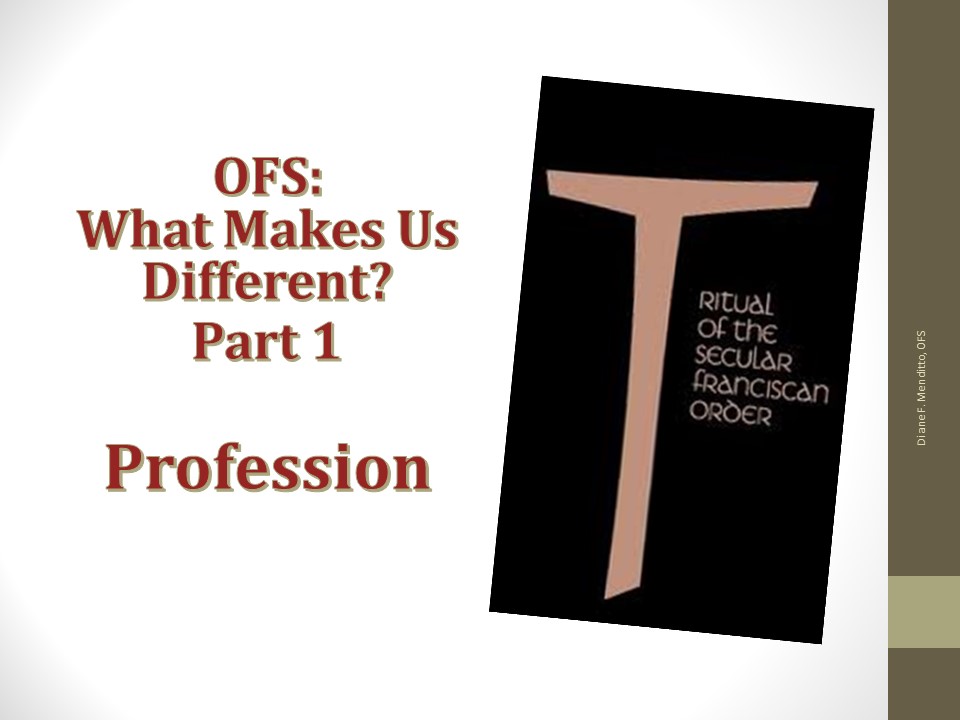
1-OUR PROFESSION—At Baptism we receive the gifts of the Holy Spirit and become part of the Church. At Confirmation, the Holy Spirit prepares us to participate fully in the mission of the Church. Profession, then, is our special opportunity. It is the further strengthening of the promises that were made for us (or that we made) at Baptism. Through the Spirit, we “bind ourselves more closely to the Church and work intently to rebuild the ecclesial community and fulfill its mission among all people.” (See Rite of Permanent Commitment, Ritual p. 29)
If you read the Rite of Permanent Commitment (Profession) (Ritual pp. 29-41), you will see that at Profession, we make a commitment to live the Gospel by following in the footsteps of St. Francis. The special charism given to us by St. Francis is that he showed that the Gospel can be lived. We, as Secular Franciscans, strive to do this in our daily lives. Therefore, we need to be thoroughly familiar with Scripture—especially the Gospels. At the Rite of Profession, we are presented with the book of the Gospels. At the Ceremony of Introduction and Welcoming, we are given a biography of St. Francis, and at the Rite of Admission, we are given a copy of the Rule of Life. All three of these gifts remind us that we are to internalize how St. Francis lived; how Jesus lived and taught; and how we are to live as Secular Franciscans.
At Profession, we promise to build a more fraternal and evangelical world based on the Gospel. We promise to be faithful to our vocation and to practice the spirit of service. We promise to bind ourselves more closely to the Church and to participate more fully in her mission. And, we pledge to make fraternity a visible sign of the Church, a community of faith and love. During the Rite of Profession, the candidates answer, “Yes, this is what I want,” in response to questions asked regarding these promises.
Read and consider the following words taken from the Rite of Profession:
+ The candidates say: “We ask to be admitted to profession of the Rule of the Secular Franciscan Order and to make a permanent commitment to the gospel life. [Our formation] has strengthened us in the conviction that the Lord is callig us to observe the holy gospel of Our Lord Jesus Christ by following the footsteps of St. Francis of Assisi.” (Ritual p. 34)
+ Finally, the WORDS OF PROFESSION are pronounced by the candidates:
“I, __ , by the grace of God, renew my baptismal promises and consecrate myself to the service of his Kingdom. Therefore, in my secular state, (or as a member of the diocesan clergy), I promise to live all the days of my life the gospel of our Lord Jesus Christ in the /secular Franciscan Order by observing its rule of life. May the grace of the Holy Spirit, the intercession of the Blesses Virgin Mary and our holy father St. Francis, and the fraternal bonds of community always be my help, so that I may reach the goal of perfect Christian love.”
For discussion or to answer in your journal:
+After reading the promises of profession outlined above, discuss the ways in which you (if you are professed) are living them out in your daily life. (It would also be helpful to read the entire Rite on pp. 29-41 of the revised brown ritual.)
+Which of these promises have proved to be challenging to you?
+If you are in initial formation, 1-How do you see these promises lived out by the members of your fraternity? 2-Can you picture yourself living out these promises? 3-Please offer a few examples of what you would do both now and after Profession.
Formación 27 de junio 2025 (Comparta con su fraternidad local)
¿Qué diferencia a los franciscanos seglares de otros católicos?
Todos los que somos católicos tenemos muchas cosas en común. La mayoría de nosotros crecimos asistiendo a misa todos los domingos. Nos confesamos de vez en cuando. Rezamos muchas de las mismas oraciones: el Rosario, la Coronilla de la Divina Misericordia, el Memorare (Acordaos), el Ángelus y oraciones pidiendo la intercesión de nuestros santos favoritos. Algunos católicos leen un poco de las Escrituras todos los días y asisten a estudios bíblicos y algunos incluso pueden rezar la Liturgia de las Horas.
Entonces, ¿qué hace que los franciscanos seglares sean diferentes? Durante las próximas semanas, veremos cinco cosas sobre los franciscanos seglares que nos distinguen. (Incluso puede haber más de cinco, pero abordaremos cinco).
1- NUESTRA PROFESIÓN —En el Bautismo recibimos los dones del Espíritu Santo y nos hacemos parte de la Iglesia. En la Confirmación, el Espíritu Santo nos prepara para participar plenamente en la misión de la Iglesia. La profesión, entonces, es nuestra oportunidad especial. Es el fortalecimiento adicional de las promesas que se nos hicieron (o que hicimos) en el Bautismo. A través del Espíritu, “nos vinculamos más estrechamente a la Iglesia y trabajamos intensamente para reconstruir la comunidad eclesial y cumplir su misión entre todos los pueblos.” (Ver Rito de Profesión, Ritual en español PDF pag. 12-16 ) https://ciofs.info/wp-content/uploads/2021/01/ES-Ritual-OFS-s.pdf
Si lee el Rito de la Profesión (Compromiso de la vida evangélica) verá que en la Profesión nos comprometemos a vivir el Evangelio siguiendo los pasos de San Francisco . El carisma especial que nos dio San Francisco es que mostró que el Evangelio se puede vivir. Nosotros, como franciscanos seglares, nos esforzamos por hacer esto en nuestra vida diaria. Por lo tanto, debemos estar completamente familiarizados con las Escrituras, especialmente con los Evangelios. En el Rito de Profesión, se nos presenta el libro de los Evangelios. En la Ceremonia de Introducción y Bienvenida se nos entrega una biografía de San Francisco, y en el Rito de Admisión se nos entrega una copia de la Regla de Vida. Estos tres obsequios nos recuerdan que debemos internalizar cómo vivió San Francisco; cómo Jesús vivió y enseñó; y cómo debemos vivir como franciscanos seglares.
En la Profesión nos comprometemos a construir un mundo más fraterno y evangélico basado en el Evangelio. Prometemos ser fieles a nuestra vocación y practicar el espíritu de servicio . Prometemos vincularnos más estrechamente a la Iglesia y participar más plenamente en su misión. Y nos comprometemos a hacer la fraternidad signo visible de la Iglesia , comunidad de fe y de amor. Durante el Rito de Profesión, los candidatos responden: “Sí, esto es lo que quiero,” en respuesta a las preguntas formuladas con respecto a estas promesas.
Lea y considere las siguientes palabras tomadas del Rito de Profesión:
+ Los candidatos dicen : “Pedimos ser admitidos a la profesión de la Regla de la Orden Franciscana Seglar y hacer un compromiso permanente con la vida evangélica. [Nuestra formación] nos ha fortalecido en la convicción de que el Señor nos está llamando a observar el santo evangelio de Nuestro Señor Jesucristo siguiendo los pasos de San Francisco de Asís”. (Ritual PDF pág. 13)
+ Finalmente, las PALABRAS DE PROFESIÓN son pronunciados por los candidatos :
“Yo, _ _ , por la gracia de Dios, renuevo mis promesas bautismales y me consagro al servicio de su Reino. Por lo tanto, en mi estado seglar (o como miembro del clero diocesano), prometo vivir todos los días de mi vida el evangelio de nuestro Señor Jesucristo en la Orden Franciscana seglar observando su regla de vida. Que la gracia del Espíritu Santo, la intercesión de la Santísima Virgen María y de nuestro santo padre San Francisco, y los lazos fraternales de comunidad sean siempre mi ayuda, para que pueda alcanzar la meta del perfecto amor cristiano”.
Para discusión o para responder en su diario:
+ Después de leer las promesas de la profesión descritas anteriormente, discuta las formas en que usted (si es profeso) las está viviendo en su vida diaria. (También sería útil leer todo el Rito en las páginas 18-26 del ritual marrón).
+ ¿Cuál de estas promesas ha resultado ser un desafío para usted?
+ Si está en formación inicial , 1-¿Cómo ve estas promesas vividas por los miembros de su fraternidad? 2-¿Puede imaginarse viviendo estas promesas? 3-Por favor, ofrezca algunos ejemplos de lo que haría tanto ahora como después de la Profesión.



 I have been blessed to be present for three total solar eclipses. The first, in 1970 when I was about twelve, was underwhelming, as it was overcast in Valdosta, GA, where my family and many others went to, from Florida, to see the eclipse. I remember the darkness of totality shooting up rapidly from the horizon, but that was the extent of it.