
What Makes Secular Franciscans Different from Other Catholics? (Part Three)This week we look at Our RULE OF LIFE AND GENERAL CONSTITUTIONS.Our Rule and Constitutions—We Secular Franciscans are blessed to have a Rule of Life and Constitutions approved by the Church. These documents guide us in living out the Franciscan charism. We need to take the time to read the Rule frequently and pray about what the Prologue and each article tell us about our lives as Catholics and Franciscans. This is one of the big advantages we have over other Catholics. For example, since our prologue is taken from the First Letter to the Faithful, St. Francis himself is speaking directly to us when he reminds us that we are a people of penance and conversion.Chapter One of the Rule has only three articles, but it plants us firmly in the Franciscan family. It tells us that our Rule is approved by the Holy See and that we are linked down through the centuries to all those who have formed part of the three orders founded by St. Francis in the 13th century.Chapter Two contains articles four through nineteen. Here we find the plan of life set out for us as Secular Franciscans. We learn how we are to pray; how we are to we are to strive for daily conversion; how we are to follow in the footsteps of St. Francis in showing that the gospel can be lived; how we are to live in simplicity and humility; and how we are to reach out to all of our brothers and sisters and to all of creation. Having this portion of the Rule is especially valuable to us on our daily journey to the Father. It is an advantage that other Catholics just do not have.Chapter Three guides us in our fraternity life and tells us about the structure of our world-wide order and the purpose of our fraternity life.The General Constitutions form a much longer document because they interpret the Rule and tell us how we are to carry out what is asked in the Rule. This document is also approved by the Holy See, and in promising to follow the Rule, we also promise to follow what is laid out in the Constitutions.Here are the 17 essential elements of our Rule. The questions are to answer in your journal or to discuss with a partner.To live the gospel according to the spirit of St. FrancisTo be converted continually (metanoia)To live as brothers and sisters to all people and all creationTo live in communion with ChristTo follow the poor and crucified ChristTo share in the life and mission of the ChurchTo share in the love of the FatherTo be instruments of peaceTo have a life of prayer that is personal, communal and liturgicalTo live in joyTo have a spirituality of a secular characterTo be pilgrims on the way to the fatherTo participate in the Apostolate of the LaityTo be at the service of the less fortunateTo be loyal to the Church in an attitude of dialogue and collaboration with her ministersTo be open to the action of the SpiritTo live in simplicity, humility, and minority+Which of the elements of our Rule have helped you in your daily life as a Franciscan? Please explain how.+ Which of the elements are challenging for you? Why? How can you work to make them part of your life?+See if you can pinpoint which articles address each of the elements.++++++++++++++++++++++++++++++++++++Formation Friday 13 de mayo de 2022 Comparta con su fraternidad local.¿Qué hace que los franciscanos seglares sean diferentes de otros católicos? (Parte tres)Esta semana nos fijamos en nuestra REGLA DE VIDA Y CONSTITUCIONES GENERALES.Nuestra Regla y Constituciones— Nosotros, los Franciscanos Seglares, tenemos la bendición de tener una Regla de Vida y Constituciones aprobadas por la Iglesia . Estos documentos nos guían en la vivencia del carisma franciscano. Necesitamos tomarnos el tiempo para leer la Regla con frecuencia y orar sobre lo que el Prólogo y cada artículo nos dicen sobre nuestras vidas como católicos y franciscanos. Esta es una de las grandes ventajas que tenemos sobre otros católicos. Por ejemplo, dado que nuestro prólogo está tomado de la Primera Carta a los Fieles , el mismo San Francisco nos habla directamente cuando nos recuerda que somos un pueblo de penitencia y conversión.El Capítulo Primero de la Regla tiene sólo tres artículos, pero nos sitúa firmemente en la familia franciscana . Nos dice que nuestra Regla está aprobada por la Santa Sede y que estamos vinculados a lo largo de los siglos a todos los que han formado parte de las tres órdenes fundadas por San Francisco en el siglo XIII.El Capítulo Segundo contiene los artículos cuatro al diecinueve. Aquí encontramos el proyecto de vida trazado para nosotros como franciscanos seglares. Aprendemos cómo debemos orar; cómo debemos luchar por la conversión diaria; cómo hemos de seguir los pasos de San Francisco mostrando que el evangelio se puede vivir; cómo debemos vivir en sencillez y humildad; y cómo vamos a llegar a todos nuestros hermanos y hermanas ya toda la creación . Tener esta porción de la Regla es especialmente valioso para nosotros en nuestro camino diario hacia el Padre. Es una ventaja que otros católicos simplemente no tienen.El Capítulo Tres nos guía en nuestra vida de fraternidad y nos habla sobre la estructura de nuestro orden mundial y el propósito de nuestra vida de fraternidad.Las Constituciones Generales forman un documento mucho más largo porque interpretan la Regla y nos dicen cómo debemos llevar a cabo lo que se pide en la Regla. Este documento también está aprobado por la Santa Sede , y al prometer seguir la Regla, prometemos también seguir lo dispuesto en las Constituciones.Aquí están los 17 elementos esenciales de nuestra Regla. Las preguntas son para platicar o responder en su diario.Vivir el evangelio según el espíritu de san FranciscoSer convertido continuamente (metanoia)Vivir como hermanos y hermanas de todas las personas y de toda la creación.Vivir en comunión con CristoSeguir a Cristo pobre y crucificadoParticipar en la vida y misión de la IglesiaPara compartir el amor del PadreSer instrumentos de pazTener una vida de oración personal, comunitaria y litúrgicaVivir en la alegríaTener una espiritualidad de carácter secular.Ser peregrinos en el camino hacia el padrePara participar en el Apostolado de los LaicosEstar al servicio de los menos afortunadosSer fieles a la Iglesia en actitud de diálogo y colaboración con sus ministrosEstar abiertos a la acción del Espíritu Vivir en la sencillez, la humildad y la minoridad+¿Cuáles de los elementos de nuestra Regla te han ayudado en tu vida diaria como franciscano? Explique cómo.+ ¿Cuál de los elementos es un desafío para usted? ¿Por qué? ¿Cómo puede trabajar para que formen parte de su vida?+Vea si puede identificar qué artículos abordan cada uno de los elementos.Diane F. Menditto, OFSChair, National Formation Commission
Formation Director, Our Lady of the Angels Region
Formation Director, St. Francis Fraternity, Hackensack, NJ
2021-2022 Annual Reports Available Online
 Do you want to know how many canonically established Franciscan fraternities are in the United States? Or are you curious about the number of permanently professed members? Or do you want to know how many local spiritual assistants are in the Order?
Check out the 2022 Annual National Report to CIOFS just posted on the website. It contains the latest statistics on membership in the United States as well as updates on activities and questions and suggestions for CIOFS. The report is based on information the National Executive Council received from the 30 regional organizations in the Order.
Also available is the 2021 General Chapter Conclusive Document. It contains a full report of the November 2021 General Chapter, details of the audience with Pope Francis, information on the budget, and CIOFS’s priorities for the next three years.
https://www.secularfranciscansusa.org/2022/05/10/22021-2022-annual-reports-available-online/
Award Represents All Working For Justice and Peace – Highlights of National Chapter

(This article originally appeared in the Spring 2022 Issue of the TAU-USA #105)
By SHARON WINZELER, OFS
In true Franciscan fashion, Donna Hollis, OFS, began her JPIC award talk by recognizing others who were nominated for the award.
“This award represents and includes all of us who work tirelessly for Justice and Peace. It is not just me, but many members working together as Franciscans, and people with compassionate hearts showing the love of God through our actions for others in most need,” Hollis said.
The other nominees:
Thomas Michael Fame, MD, St. Margaret of Cortona Region, began a fundraising project for the poor in Haiti.
Stacey Antine, OFS, MS, RDN is the founder of HealthBarn USA. As a registered dietitian she feeds ill children and their families and seniors in need through the Healing Meals programs.
Kelly Lynch, OFS, St. Margaret of Cortona Region – her ministry is called
“Mychal’s Message”, which continues the work of Fr. Mychal Judge, OFM, chaplain for NYC Fire Dept. who died while serving victims of 9-11. Mychal’s Message meets the needs of the homeless and shares Fr. Judge’s message of unconditional love.
Alan Ouimet, OFS, Blessed Solanus Casey Region – Alan’s work is with the Franciscan Family Apostolate and the work they do in India. Through the Franciscan Family Apostolate, individuals, families, and fraternities in the U.S. are privileged with a unique level of connection to their sponsor families in India.
Fr. Emmet Murphy, OFM, Holy Name of Jesus Province – Fr. Murphy conducts outreaches to immigrants in US parishes and travels to developing countries on mission trips.
Valerie Baronkin, OFS, Brothers and Sisters of St. Francis Region. She is the Greenville Deanery Respect Life Coordinator. She attends the March for Life in Washington DC. Valerie’s work in the Pro-Life arena exemplifies her peace efforts.
Fr. Seraphim Wirth, FBP, Franciscan Brothers of Peace in St. Paul, MN. He has provided spiritually, emotionally and materially for the “Karen Refugees” in St. Paul, and in the Region of Myanmar. Fr. Is the chaplain for the Karen community of about 200 families who are the ethnic minority from Burma.
Fr. Murray Bodo, OFM, St. John the Baptist Province – we know and acknowledge Fr. Bodo’s ministry of living the Franciscan life through his writings which have formed our own Franciscan way of life. Through his courageous initiatives, he works to animate compassion and nonviolence in the world.
https://www.secularfranciscansusa.org/2022/05/09/award-represents-all-working-for-justice-and-peace-highlights-of-national-chapter/
FORMATION FRIDAY – What Makes Us Different? (Part 2) – May 6, 2022
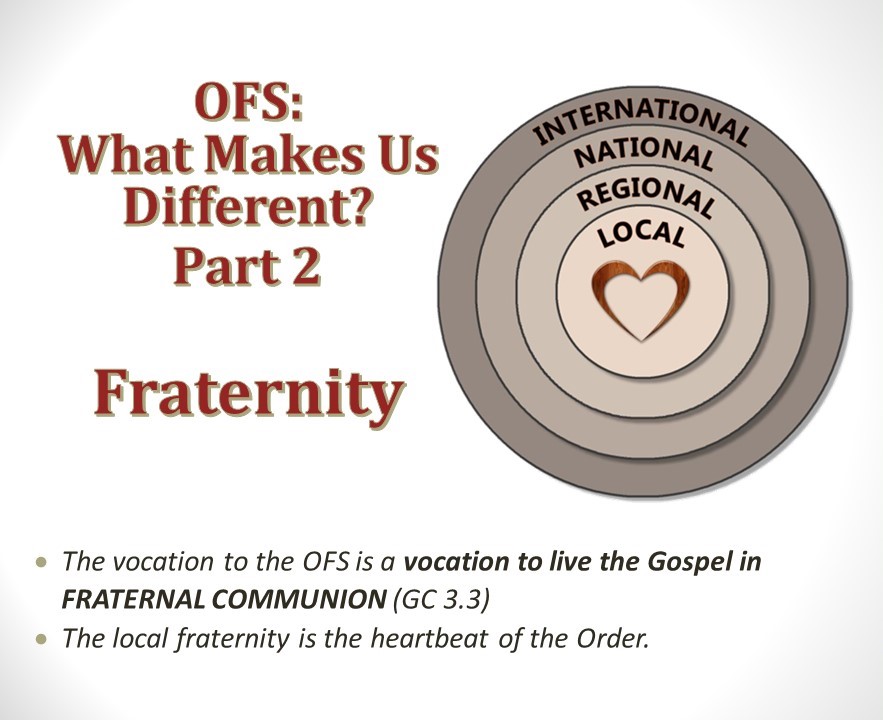
What Makes Secular Franciscans Different from Other Catholics? (Part Two)Over the next few weeks, we will look at five things about Secular Franciscans that set us apart. This week we look at FRATERNITY.Our Fraternity Life—How can anyone be a Franciscan without fraternity? As much as St. Francis loved to find solitary places to pray, he always had friars nearby, and he always returned to fraternity life. He tells us, “The Lord gave me brothers…” (Testament)Article 24 of our OFS Rule speaks of fraternity: “To foster communion among members, the council should organize regular and frequent meetings of the community as well as meeting with other Franciscan groups, especially with youth groups. It should adopt appropriate means for growth in Franciscan and ecclesial life and encourage everyone to a life of fraternity. This communion continues with deceased brothers and sisters through prayer for them.”“Fraternity is…a call to build a community of love in harmony with all of God’s children and all of God’s creation to reflect Love back to the God of Love: Father, Son and Holy Spirit.” (FUN Manual “Fraternity and Francis” by Tom Bello, OFS—former National Minister)For most of us, our experience of fraternity comes at the local level. Although we find fraternity at the regional, national, and international levels, the local fraternity is the heartbeat of the Order. It is where we find mutual support in our faith. It is where we learn to carry out the promises we made at profession. Fraternity is like a workshop where we practice universal kinship; patience; humility; simplicity; and acceptance of others. It is where we keep our vocation alive. If fraternity life is well-lived, we will learn how to pray together and to work together to move the fraternity and the Church forward. We learn what it is to be a Franciscan by how we listen to one another, accept those who are different than we are, and by how we learn about the Franciscan charism together. Fraternity nourishes our vocation and helps us to bring the joy of knowing Christ to others both inside the fraternity and outside in our daily lives.The structure and flow of our gatherings can help us to achieve what is outlined above. Belonging to a club or attending a business meeting is (or should be) a very different experience from participating in a fraternity gathering. In fraternity, we pray together with one another and with the whole church. We strengthen our vocation by learning about the Franciscan charism and the gospel during our ongoing formation sessions; and we experience conversion of heart as we interact with our brothers and sisters and reach out to others through our apostolates. Fraternity life is a gift!For discussion or to answer in your journal+What is your favorite part of your local fraternity gathering? How does it strengthen your life as a Franciscan?+ What suggestions would you make to your local council to make your monthly gatherings even better? Be sure to tell why this would be valuable and how you would get it done.+Thinking about positive experiences you have had of fraternity (remember, fraternity is not only the monthly gathering, but it is found wherever Franciscans gather), list two or three and try to say why they had a special impact on you.+++++++++++++++++++Comparta con su fraternidad local¿Qué diferencia a los franciscanos seglares de otros católicos? (Segunda parte)Durante las próximas semanas, veremos cinco cosas sobre los franciscanos seglares que nos distinguen. Esta semana nos fijamos en la FRATERNIDAD .Nuestra vida de fraternidad: ¿Cómo se puede ser franciscano sin fraternidad? Por mucho que a San Francisco le encantaba encontrar lugares solitarios para orar, siempre tenía frailes cerca y siempre volvía a la vida de fraternidad . Nos dice: “El Señor me dio hermanos…” (Testamento )El artículo 24 de nuestra Regla OFS habla de fraternidad: “Para incrementar la comunión entre los miembros, el Consejo organice reuniones periódicas y encuentros frecuentes, incluso con otros grupos franciscanos, especialmente de jóvenes, adoptando los medios más adecuados para el crecimiento en la vida franciscana y eclesial, estimulando a todos a la vida de Fraternidad.Esta comunión se prolonga con los hermanos difuntos, ofreciendo sufragios por sus almas.”“ Fraternidad es… un llamado a construir una comunidad de amor en armonía con todos los hijos de Dios y toda la creación de Dios para reflejar el Amor hacia el Dios del Amor: Padre, Hijo y Espíritu Santo .” (Manual FUN “Fraternidad y Francisco” por Tom Bello, OFS—ex Ministro Nacional)Para la mayoría de nosotros, nuestra experiencia de fraternidad llega a nivel local. Aunque encontramos fraternidad a nivel regional, nacional e internacional, la fraternidad local es el latido del corazón de la Orden. Es donde encontramos apoyo mutuo en nuestra fe. Es donde aprendemos a cumplir las promesas que hicimos en la profesión. La fraternidad es como un taller donde practicamos el parentesco universal; paciencia; humildad; sencillez ; y aceptación de los demás. Es donde mantenemos viva nuestra vocación. Si la vida de fraternidad se vive bien, aprenderemos a orar juntos y a trabajar juntos para hacer avanzar la fraternidad y la Iglesia. Aprendemos lo que es ser franciscano por cómo nos escuchamos unos a otros, aceptamos a los que son diferentes a nosotros y por cómo aprendemos juntos sobre el carisma franciscano. La fraternidad alimenta nuestra vocación y nos ayuda a llevar la alegría de conocer a Cristo a los demás, tanto dentro como fuera de la fraternidad en nuestra vida cotidiana.La estructura y el flujo de nuestros encuentros pueden ayudarnos a lograr lo descrito anteriormente. Pertenecer a un club o asistir a una reunión de negocios es (o debería ser) una experiencia muy diferente a participar en una reunión de fraternidad. En fraternidad, rezamos juntos unos con otros y con toda la iglesia. Fortalecemos nuestra vocación aprendiendo sobre el carisma franciscano y el evangelio durante nuestras sesiones de formación continua; y experimentamos la conversión del corazón cuando interactuamos con nuestros hermanos y hermanas y nos acercamos a otros a través de nuestros apostolados. ¡La vida de fraternidad es un don de Dios!Para platicar o para responder en su diario+¿Cuál es su parte preferida del encuentro de su fraternidad local? ¿Cómo fortalece su vida como franciscano?+ ¿Qué sugerencias le haría a su consejo local para que sus encuentros mensuales sean aún mejores? Asegúrese de decir por qué esto sería valioso y cómo lo haría.+Pensando en experiencias positivas que haya tenido de fraternidad (recuerde, la fraternidad no es sólo el encuentro mensual, sino que se encuentra dondequiera que se reúnan los franciscanos), enumere dos o tres y trate de decir por qué tuvieron un impacto especial en usted.Diane F. Menditto, OFSChair, National Formation Commission
Formation Director, Our Lady of the Angels Region
Formation Director, St. Francis Fraternity, Hackensack, NJ
She Is on the Margins – Highlights of the National Chapter
(This article originally appeared in the TAU-USA Spring 2022 Issue #105)
By SHARON WINZELER, OFS
 100vw, 300px” data-recalc-dims=”1″></p>
<p id=) Donna Hollis, OFS, with Central American refugee family
Donna Hollis, OFS, with Central American refugee family
Donna Hollis, OFS, is the 2021 recipient of the National Justice, Peace and Integrity of Creation (JPIC) Award presented at the National Chapter. She is a member of the Our Lady of Guadalupe Fraternity in Las Cruces, NM, and serves as a councilor on the National Executive Council.
Carolyn Townes, OFS, JPIC animator, introduced Hollis as a Franciscan living out her call.
“She is on the margins, at the border, taking care of those who have nowhere to lay their heads at night,” Townes said. “She does not judge or question why – only, what can I do to help? How can I love you and care for you – one human being to another? One child of God to another child of God.”
Hollis explained that her work is inspired by Leviticus 19:34, which reminds us to welcome everyone. “You shall treat the alien who resides with you no differently than the natives born among you; you shall love the alien as yourself.”
She works with Project Oak Tree created in 2014 by the Catholic Diocese of Las Cruces to provide hospitality to refugees, who were released from custody to El Paso and the surrounding area to transition to life in the United States. The organization is staffed by volunteers helping unite the immigrants with their families living in the U.S.
The name of the organization is inspired by a passage from Chapter 18 of Genesis, where the Lord appeared to Abraham by the Oak of Mamre; and when Abraham spotted travelers approaching, he offered them food and rest. Later he realized he had been visited by messengers or angels of God.
Within a year, the work at Project Oak Tree surged when refugees began fleeing violence and extreme poverty in Central America and other Latin American countries.
“We, At Holy Cross Retreat Center are just one of the ‘In between places,’ giving them food, clothing, medical care, covid tests, vaccines from the medical team, planning transportation to their families in the US,” Hollis said.
The need has only grown.
“The U.S. government has reported encountering an unprecedented number of migrants at the southwest border. In New Mexico alone there have been 98,409 Border Patrol encounters with people entering the U.S. illegally since October 2020. This count includes unaccompanied children, some of whom are dropped over the wall, pushed through an opening or abandoned somewhere along the international line. Although it is hard to believe, their parents are just trying to save their lives,” Hollis said.
The reasons behind the migration are complex, but the fear that the people have is real.
“People from countries neighboring the U.S. are facing violence, poverty and corruption in the governments that cannot help them. In short, they and their families are not safe,” Hollis said.
Neither is their journey secure.
“From the very moment that a migrant decides to leave home and take off north, all the way until they reach their destination, the threat of death is present on the journey,” she said.
One example was a teenage boy who was found murdered and his body mutilated because he was unable to pay a Mexican gang the ‘crossing fee’ they charged to get into the U.S.
Another was a Mexican woman captured by a border patrol agent.
“She was handcuffed with three others, struggling as she was being forced through a barbed wire fence. The woman slipped her hand from the handcuff and ran. After about 50 feet, she fell from a 20-foot cliff in the dark- ness, smashing her head and dying near the river’s edge,” Hollis said.
She cited statistics from the International Organization for Migration that said 2,191 persons have died along the U.S.-Mexico border since 2014. She added that the U.S. Border Patrol reports that 8,050 migrant deaths occurred along the Southwest border since 1998.
The journey remains incomplete once they reach the U.S. border where they may be sent back to Mexico to await their immigration hearing instead of being released to their sponsors. This is a result of the Migrant Protection Protocol. The MPP requires people who have asked for asylum to return to Mexico to prevent them from spreading Covid in the U.S. It means that the refugees are at risk of further violence and lack access to proper food, shelter and medical treatment, Hollis said.
“Others are detained and live in ‘congregate settings’ that migrants are typically held in. These settings are not set up for social distancing, nor designed to care for people in normal times, let along emergencies. Even those who have demonstrated through a credible fear interview that they merit a U.S. immigration hearing may have to wait for their hearing in Mexico,” she said.
The crisis is compounded by the Afghanistan refugees who were airlifted out of their country to the U.S. after the Taliban took over. Nearly 10,000 Afghan refugees were housed at Ft. Bliss Dona Ana County Range Complex, not far from Las Crucis.
“The relocation of Afghan families into communities across the U.S. creates an opportunity for each of us to stand up and assist people in need. The transition away from the emergency response to the more quality of life response is ongoing. The refugee site may close in the spring once resettlement operations are complete,” Hollis said.
Another 4,000 Afghans resided at Holloman Air Force Base. These were vulnerable contractors and their families who worked with the U.S. during the war in Afghanistan over the past 20 years. They, too, have moved on to resettlement.
“We see the face of Christ in the faces of the refugees. The Divine seed is in everyone. We just have to recognize it. Hopefully, they see God’s love through us,” Hollis said.
Hollis closed her presentation with a reminder of the Gospel’s call to do God’s work among the vulnerable and marginalized.
“So, what do I do with Justice and Peace? I live it out with many, many others who help and support those most vulnerable. We have many Secular Franciscans living out this call to help migrants and refugees in their area of the state. Fraternities seek ways to help and explore ways to be involved with the needs of their areas, including soup kitchens, homeless, the elderly, writing letters to our congressmen and more. We are just being present and much more. We are all living it out.”
“Jesus is telling us where to find Him and where to find God: in the stranger,” Hollis concluded.
“For I was hungry and you gave me food, I was thirsty and you gave me drink. I was a stranger and you welcomed me, naked and you clothed me. I was ill and you comforted me, in prison and you came to visit me. I assure you, as often as you did it for the least among you, you did it for me.”
— Matthew 25:35-40
https://www.secularfranciscansusa.org/2022/05/02/she-is-on-the-margins-highlights-of-the-national-chapter/