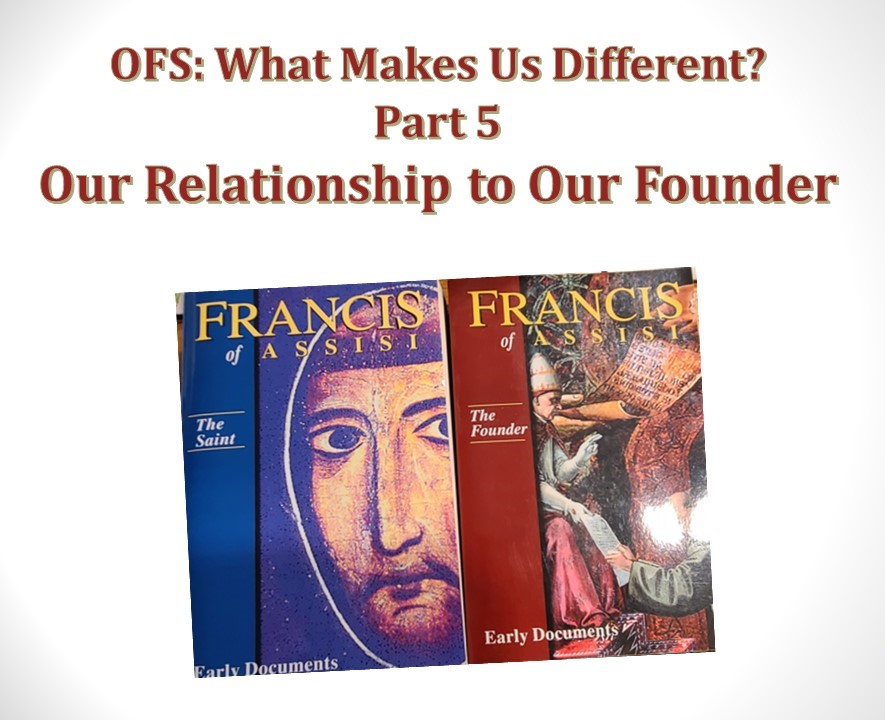
This week we look at Our Relationship to our Founder
Our knowledge of and relationship to our founder is an important part of our lives as Franciscans. We trace the founding of our Order to one of the greatest of the Church’s saints who sets the example for us. As a matter of fact, at our profession, we promise to live the gospel by following in the footsteps of St. Francis. (See Rite of Profession quoted in week #1.) We are blessed to have writings by St. Francis to rely on to ensure that we remain faithful to the Franciscan charism. Reading his prayers and letters gives us years of material for meditation and imitation and makes clear the path we are to follow.
There are some 30 writings known to have been composed by St. Francis or which have been reliably attributed to him. These constitute a real treasure for Franciscans. By comparison, only four writings by Francis’s contemporary St. Dominic, founder of the Dominicans, survive. The writings of St. Francis offer Secular Franciscans an opportunity to encounter him personally. They let St. Francis speak for himself.
Over the course of one’s life as a Secular Franciscan, there is time to read everything written by St. Francis, but to begin, consider the five documents listed below. Each of these, along with a brief and informative introduction, can be accessed in the three-volume set Early Documents or at the Franciscan Intellectual Tradition website, https://franciscantradition.org/ .
- The Prayer Before the Crucifix — This simple and short prayer for conversion is Francis’s plea for God’s mercy to “enlighten the darkness” of his heart and to give him the spiritual gifts necessary to obey God’s command FA:ED, vol. 1, p. 40
- The Earlier Exhortation (The first version of the Letter to the Faithful) serves as the Prologue to the Secular Franciscan Rule of 1978. Addressed to the Brothers and Sisters of Penance, it offers a form of life Francis intended for the lay penitents associated with his movement. Earlier Exhortation: FA:ED, vol. 1, p. 41
- A Letter to a Minister reveals how important mercy and minority were to Francis and presents his own idea of servant leadership. FA:ED, vol. 1, p. 97
- The Admonitions are a collection of undated writings by St. Francis that are a window on how Francis understood the gospel life and how he viewed life in fraternity. FA:ED, vol. 1, p. 128
- A Letter to Brother Leo presents Francis as an intimate and caring brother. There is no way of knowing the circumstances Francis refers to—specifically, a conversation between him and Leo along the road—but there is no mistaking Francis’s love and compassion. FA:ED, vol. 1, p. 122
- The Canticle of Brother Sun is Francis’s great poem of praise to God through his creatures. It makes explicit the connection between Francis and nature (kinship with creation) and establishes Francis as a poet and troubadour of God. CA:ED, p. 391
An irony of our time is that the writing most associated with St. Francis is one he never wrote: the “Prayer of St. Francis,” also called the “Peace Prayer (“Lord, make me an instrument of your peace…”) likely originated in France around 1912, first appearing in a spiritual magazine published in Paris. Although devout, these words were never uttered by Francis and should not eclipse his authentic prayers. Similarly, many sayings attributed to Francis (e.g., “Preach the gospel; if necessary, use words.”) are not found in the documents. The authoritative sources will yield a trove of inspiring quotations more trustworthy and meaningful than those erroneously attributed to him on internet pages and elsewhere.
Along with being thoroughly familiar with our Rule of Life and with the Gospels, we should also know about and internalize the life and writings of St. Francis. In this way, the Franciscan charism becomes firmly implanted in our minds and hearts, and we are more easily able to live out our vocation as Secular Franciscans.
Thank you to National Formation Commission member, Justin Carisio, OFS, for his collaboration on this post.
To discuss or to answer in your journal.
- +Why do you suppose the writings of the founder of an order would be of great assistance to his or her followers? Please explain.
- +Please read some or all of the readings referenced above.
- –Note what touched you.
- –What did you read that will strengthen your vocation? Why?
- –Which one would you choose to share with your fraternity? How would you present it?
+++++++++++++++++++++++
Formation Friday 27 de mayo de 2022 Comparta con su fraternidad local
¿Qué diferencia a los franciscanos seglares de otros católicos? (Parte cinco)Esta semana analizamos Nuestra relación con nuestro Fundador
Nuestro conocimiento y relación con nuestro fundador es una parte importante de nuestras vidas como franciscanos. Remontamos la fundación de nuestra Orden a uno de los más grandes santos de la Iglesia que nos da el ejemplo. De hecho, en nuestra profesión prometemos vivir el evangelio siguiendo los pasos de San Francisco. (Ver Rito de Profesión citado en la semana #1.) Tenemos la bendición de tener escritos de San Francisco en los que confiar para asegurarnos de permanecer fieles al carisma franciscano. La lectura de sus oraciones y cartas nos da muchos años de material para la meditación y la imitación y nos aclara el camino que debemos seguir.
Hay unos 30 escritos que se sabe que fueron compuestos por San Francisco o que se le han atribuido de manera confiable. Estos constituyen un verdadero tesoro para los franciscanos. En comparación, solo sobreviven cuatro escritos de Santo Domingo, contemporáneo de Francisco, fundador de los dominicos. Los escritos de San Francisco ofrecen a los franciscanos seglares la oportunidad de encontrarlo personalmente. Dejaron que San Francisco hablara por sí mismo.
A lo largo de la vida de uno como franciscano seglar, hay tiempo para leer todo lo escrito por San Francisco, pero para comenzar, considere los cinco documentos que se enumeran a continuación. Se puede acceder a cada uno de estos, junto con una introducción breve e informativa, en el conjunto de tres volúmenes Documentos tempranos o en el sitio web, http://franciscanos.org/
La Oración Ante el Crucifijo — Esta sencilla y breve oración por la conversión es la súplica de Francisco pidiendo la misericordia de Dios para que “ilumine las tinieblas” de su corazón y le dé los dones espirituales necesarios para obedecer el mandato de Dios. Oración ante el Crucifijo de San Damián
La Exhortación anterior (la primera versión de la Carta a los Fieles) sirve como Prólogo a la Regla Franciscana Seglar de 1978. Dirigida a los Hermanos y Hermanas de la Penitencia, ofrece una forma de vida que Francisco pretendía para los laicos penitentes asociados con su movimienot. Carta a los Fieles I [CtaF1]
Una carta a un ministro revela cuán importantes fueron la misericordia y la minoridad para Francisco y presenta su propia idea de liderazgo de servicio. Carta a un Ministro
Las Admoniciones son una colección de escritos sin fecha de San Francisco que son una ventana a cómo Francisco entendía la vida evangélica y cómo veía la vida en fraternidad. Admoniciones A Admoniciones B
Una carta a fray León presenta a Francisco como un hermano íntimo y solidario. No hay forma de saber las circunstancias a las que se refiere Francis, específicamente, una conversación entre él y Leo en el camino, pero no hay duda del amor y la compasión de Francis. Carta a fray León
El Cántico del Hermano Sol es de Francisco gran poema de alabanza a Dios a través de sus criaturas. Hace explícita la conexión entre Francisco y la naturaleza (parentesco con la creación) y establece a Francisco como poeta y trovador de Dios. Cántico del Hermano Sol
Una ironía de nuestro tiempo es que el escrito que más se asocia con San Francisco es uno que nunca escribió: la “Oración de San Francisco”, también llamada “Oración de paz” (“Señor, hazme un instrumento de tu paz…”). Probablemente se originó en Francia alrededor de 1912, apareciendo por primera vez en una revista espiritual publicada en París. Aunque devotas, estas palabras nunca fueron pronunciadas por Francisco y no deben eclipsar sus oraciones auténticas. De manera similar, muchos dichos atribuidos a Francisco (p. ej., “Predica el evangelio; si es necesario, usa palabras”) no se encuentran en los documentos. Las fuentes autorizadas brindarán un tesoro de citas inspiradoras más confiables y significativas que las que se le atribuyen erróneamente en las páginas de Internet y en otros lugares.
Además de estar profundamente familiarizados con nuestra Regla de Vida y con los Evangelios, también debemos conocer e interiorizar la vida y los escritos de San Francisco. De esta manera, el carisma franciscano se implanta firmemente en nuestras mentes y corazones, y podemos vivir más fácilmente nuestra vocación como franciscanos seglares.
Gracias al miembro de la Comisión Nacional de Formación, Justin Carisio, OFS, por su colaboración en esta publicación.
Para platicar o responder en tu diario.
+¿Por qué supone que los escritos del fundador de una orden serían de gran ayuda para sus seguidores?
–Por favor explique.+ Lea algunas o todas las lecturas mencionadas anteriormente.
–Fíjese en lo que le impresionó.
–¿Qué leyó que fortalezca su vocación? ¿Por qué?
–¿Cuál elegiría para compartir con su fraternidad? ¿Cómo lo presentaría?
Diane F. Menditto, OFSChair, National Formation Commission
Formation Director, Our Lady of the Angels Region
Formation Director, St. Francis Fraternity, Hackensack, NJ
A Visioning for Formation: As in St. Francis’ Time, Spirit of Age Ultimately Doesn’t Satisfy
(This article originally appeared in the Winter 2018-19 issue of Tau-USA)
By Mary Stronach, OFS
Setting the stage for a weekend of formation visioning, Fr. David Pivonka, TOR, provided a dose of reality.
“The world has profoundly changed in the last 25 years,” said the host of EWTN’s Wild Goose series. “Young people have no safe place. There is a sense of danger infiltrating every part of us.” He said that there are things that want to corrupt, to manipulate the spirit of faith.
He took workshop attendees through an historical view of God.
 In the pre-modern world, pre-1600s, God is the starting point. The world is imbued with God. The truth is rooted in God, he explained.
From the 1600s through to the 1960s, the modern world view has man at the center of all things. “God is pushed off to the side. God might exist but there is no intimate contact. Humanity has the ability to make things better… fix the world’s problems. Right and wrong is based on the human vision.”
In the post-modern world – the last 50 years – there is no center. There is chaos. “The truth is whatever an individual believes to be true.” There are no boundaries. God is not a part of the equation. During this era, he said, many people have no identification with religion.
Youth talk about being “spiritual” but not “religious,” he said. They react to culture mainly by feeling. It is an era when you “can’t offend anybody.” He continued, “This is a non-reflective age. We are so busy, so consumed…We don’t reflect on consequences.” In the 24-hour news cycle, we are “bombarded with noise. Our interior life is suffering. We need to invite people to an interior life.”
“Words like ‘should or should not’ are foreign to this culture,” he added. “Truth and preference are largely the same. If I determine what’s true and someone disagrees, then it reflects on me… The world is so divided, so hostile, we can’t dialogue.” He referred to a quote in a school that said, “We will tolerate all things except what we believe to be intolerant.”
He offered three approaches on how to engage this culture. The first is “accommodation,” accepting that every- thing is OK. But, he said, using this approach “ultimately doesn’t respect the individual.”
The second is not to critique the culture. “This is an escape behind walls, and leads to isolation,” he said. “The church is counter-cultural. We must confront it.”
He provided a more hopeful alternative with the third approach – “Infiltration and transformation.” Engage the culture, he said. “Desire to create a fraternal world. When Francis embraced the leper, he recognized Christ…Recognize and see that, and help other people to see it. There are two conversions into Christ. The first is to leave the world and go to Christ. The second is to go back to the world with Christ to bring to the world what we discover… The power of the Gospel is an encounter of the love of God that changes us… Especially now, in the midst of chaos, they see in us something that can satisfy.”
https://www.secularfranciscansusa.org/2022/05/23/a-visioning-for-formation-as-in-st-francis-time-spirit-of-age-ultimately-doesnt-satisfy/
CNSA and NEC Respond to Questions and Provide Updates – Highlights of National Chapter
(This article originally appeared in the Spring 2022 Issue of TAU-USA #105)
 100vw, 300px” data-recalc-dims=”1″>The Saturday afternoon session with the Spiritual Assistants and the National Executive Council (NEC) tackled questions that attendees submitted.</p>
<p><strong>About spiritual assistants: </strong></p>
<p>Discernment is recommended for those OFS interested in becoming spiritual assistants. The CNSA website offers some direction. More than one interview is necessary. We need to get more familiar with the person and learn about his/her background.</p>
<p><strong>About formation and enrichment for spiritual assistants: </strong></p>
<p>The quality of formation of the spiritual assistant is critical. Mentors should be provided for beginning spiritual assistants. The NAFRA website offers guidelines on how to establish a Spiritual Assistant program. There will be some enrichment at the Q. But also, when the national assistants meet, they often invite local spiritual assistants to join them.</p>
<p><strong>Responsibilities of secular spiritual assistants: </strong></p>
<p>Secular spiritual assistants should not be assigned to serve in their own fraternities. When a Friar Province considers this, we should discourage them. If secular spiritual assistants are assigned to their own fraternity, they must know in advance that they give up their vote when they become a spiritual assistant. The role of the spiritual assistant is to “bridge the divide between the friars and OFS.”</p>
<p><strong>Communication with friars: </strong></p>
<p>Sometimes, the friars do not answer e-mails. If they don’t respond one way, try another way. Don’t presume that e-mails are read and remembered. Be persistent and creative. If you know someone in the province, ask for help or ask the national spiritual assistant of the same obedience.</p>
<p><strong>Canonical establishment document: </strong></p>
<p>Information is available in the revised <em>Spiritual Assistant Handbook </em>which is available digitally on the website.</p>
<p><strong>Establishment of other Third Order Groups: </strong></p>
<p>Encourage members to inform the regional ministers of when other groups are reaching out in their region. Some groups appear to selectively defend Catholic teaching, refuse to dialogue, and may be cult-like in how they engage with the world. However, any friar province may establish other Third Order groups. It is important that we stand firm in what we believe. Recent breakaway groups profess the Leonine Rule. We abrogated that rule. Our profession was made under the Pauline Rule. Let us remember what we professed to and allow ourselves to be challenged by it. Be aware. Educate. Communicate. Be prepared.</p>
<p><strong>Same-sex legal unions:</strong></p>
<p>We follow church teaching even when it is difficult or inconvenient. Therefore, unions outside of those blessed by the church are not compatible with membership in the OFS (for example, same-sex unions). Harmony with the Church is important. The CNSA and NEC can help guide the process of dialogue for the fraternity’s leadership to shepherd the member in such a situation to discern which commitment they will choose to follow; a printed guide is being developed.</p>
<p><strong>Revision of Ritual: </strong></p>
<p>The Council has finally been able to negotiate the purchase of the copyright of the Ritual. This will allow the National Fraternity to begin both the updating of the English version and then the translation into Spanish and other languages. Work has just begun, spearheaded by the CNSA, and we are asking members for anything they may want considered for inclusion.</p>
<p><strong>Duns Scotus: </strong></p>
<p>Modifications were made to the wording of some of the amendments in the Duns Scotus Formation Fund Principles and Procedures document. Nominations should be submitted to the NEC for new members of the board. Any fraternity or fraternity member seeking funding for special formation programs can go on-line to secularfranciscansusa.org under the tab, “Resources: Guidelines, Forms, and Other Resources.”</p>
<p><strong>National Statutes: </strong></p>
<p>A revision of the National Statues is being considered. The ministers were asked to send suggestions and give direction to the Executive Council.</p>
<p>https://www.secularfranciscansusa.org/2022/05/23/cnsa-and-nec-respond-to-questions-and-provide-updates-highlights-of-national-chapter/</p>
</div><!-- .entry-content -->
</article><!-- #post-## -->
<article id=)
FORMATION FRIDAY – What Makes a OFS Different from Other Catholics? (Part 4) – May 20, 2022
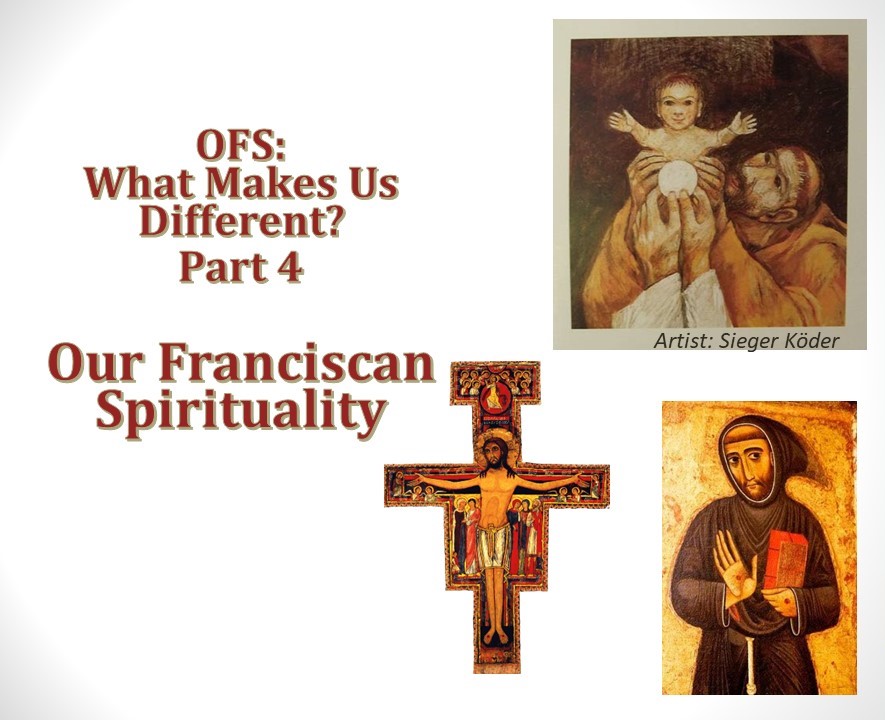
This week we look at Our Franciscan SpiritualityOur Franciscan Spirituality—comes from the spirituality of our founder, St. Francis of Assisi. Franciscan spirituality is incarnational, intensely Eucharistic, and penitential. We often hear the words “crib, cross, and Eucharist” when learning about St. Francis’s spirituality. Francis was in awe of the Incarnation, the Kénosis (self-emptying) shown by God in becoming one of us. His devotion to the Incarnation is most obvious in the recreation at Greccio of the birth of Christ. But it goes much deeper. Francis wanted to imitate Jesus perfectly in all things so that he too would become a son of the Father, so much so that he became known as the “mirror of Christ.”St. Francis’s constant contemplation of the cross is part of his devotion to the Incarnation. Here is God, who was not only born in a lowly manger, but God who was willing to die the worst, most humiliating death possible so that we could spend eternity with him. In order to imitate this death to self, Francis knew that penance and daily conversion (metanoia) were the only way to the Father. As he prayed on Mount La Verna, he asked two things: one, to let him experience the suffering Christ endured on the Holy Cross and two, for him to experience the love in which He did it. Francis’s prayer was granted as he was imprinted with the wounds of Christ in the Stigmata 8.And then, the Eucharist. Jesus is physically present with us every day under the appearances of bread and wine. We hear directly from Francis in the First Letter to the Custodians, “With all that is in me and more I beg you that, when it is fitting and you judge it expedient, you humbly beg the clergy to revere above all else the most holy Body and Blood of our Lord Jesus Christ and His holy names and the written words that sanctify His Body. 3They should hold as precious the chalices, corporals, appointments of the altar, and everything that pertains to the sacrifice. 4If the most holy Body of the Lord is very poorly reserved in any place, let It be placed and locked up in a precious place according to the command of the Church. Let It be carried about with great reverence and administered to others with discernment.”All of this is wrapped in Sacred Scripture. Francis gives us our spiritual focus. He lived by the words of the Gospel, and we imitate him in our reading and praying of and living out the gospel.Rule Article 4. “The rule and life of the Secular Franciscans is this: to observe the gospel of our Lord Jesus Christ by following the example of Saint Francis of Assisi, who made Christ the inspiration and the center of his life with God and people6. Christ, the gift of the Father’s love, is the way to him, the truth into which the Holy Spirit leads us, and the life which he has come to give abundantly7. Secular Franciscans should devote themselves, especially to careful reading of the gospel, going from gospel to life and life to the gospel.”Article 5. “Secular Franciscans, therefore, should seek to encounter the living and active person of Christ in their brothers and sisters, . The faith of Saint Francis, who often said “I see nothing bodily of the Most High Son of God in this world except his most holy body and blood”9, should be the inspiration and pattern of their eucharistic life.“Article 8. “As Jesus was the true worshipper of the Father, so let prayer and contemplation be the soul of all they are and do14. Let them participate in the sacramental life of the Church, above all the Eucharist. Let them join in liturgical prayer in one of the forms proposed by the Church, reliving the mysteries of the life of Christ.”For discussion or to answer in your journal.+What is the center of your Franciscan prayer life? How does this compare to Francis’s example?+After reading the articles of our Rule that talk of our Franciscan spirituality, what might you want to work toward changing or improving how you pray each day?+The Mass, the Gospel, the Liturgy of the Hours—reflect on how each of these fits into your prayer life. Share (or make note) of how they affect your relationship with Jesus and with others.+++++++++++++++++++++++++++++++++++++++++++Formation Friday 20 de mayo de 2022 Comparta con su fraternidad local¿Qué hace que los franciscanos seglares sean diferentes de otros católicos? (Cuarta parte)Esta semana nos fijamos en Nuestra Espiritualidad FranciscanaNuestra Espiritualidad Franciscana —viene de la espiritualidad de nuestro fundador, San Francisco de Asís. La espiritualidad franciscana es encarnacional, intensamente eucarística y penitencial. A menudo escuchamos las palabras “pesebre, cruz, y eucaristía” cuando aprendemos sobre la espiritualidad de San Francisco. Francisco estaba asombrado por la Encarnación, la Kénosis (desprendimiento de sí mismo) mostrada por Dios al convertirse en uno de nosotros. Su devoción a la Encarnación es más evidente en la recreación en Greccio del nacimiento de Cristo. Pero va mucho más profundo. Francisco quiso imitar perfectamente a Jesús en todas las cosas para que él también se convirtiera en hijo del Padre, tanto que llegó a ser conocido como el “espejo de Cristo.”La constante contemplación de la cruz de San Francisco es parte de su devoción a la Encarnación. Aquí está Dios, que no solo nació en un pesebre humilde, sino que estuvo dispuesto a morir de la peor y más humillante muerte posible para que pudiéramos pasar la eternidad con él. Para imitar esta muerte a sí mismo, Francisco sabía que la penitencia y la conversión diaria (metanoia) eran el único camino hacia el Padre. Mientras oraba en el monte La Verna, pidió dos cosas: una, que le permitiera experimentar el sufrimiento que Cristo soportó en la Santa Cruz y dos, que experimentara el amor con el que lo hizo. La oración de Francisco fue concedida ya que estaba impreso con las heridas de Cristo en los Estigmas.Y luego, la Eucaristía. Jesús está físicamente presente con nosotros todos los días bajo las apariencias de pan y vino. Escuchamos directamente de Francisco en la Primera Carta a los Custodios: “Con todo lo que hay en mí y más os ruego que, cuando os convenga y lo juzguéis conveniente, supliquéis humildemente al clero que reverencie sobre todas las cosas al santísimo Cuerpo y Sangre de nuestro Señor Jesucristo y Sus santos nombres y las palabras escritas que santifican Su Cuerpo. 3 Deben tener como preciosos los cálices, los corporales, los arreglos del altar y todo lo que pertenece al sacrificio. 4 Si el santísimo Cuerpo del Señor está muy pobremente reservado en algún lugar, que sea colocado y encerrado en un lugar precioso según el mandato de la Iglesia. Que se lleve con gran reverencia y se administre a otros con discernimiento.”Todo esto está envuelto en la Sagrada Escritura. Francisco nos da nuestro enfoque espiritual. Vivió de acuerdo con las palabras del Evangelio, y nosotros lo imitamos en nuestra lectura, oración, y vivencia del evangelio.Regla Artículo 4. “La Regla y la vida de los Franciscanos seglares es ésta: guardar el santo Evangelio de nuestro Señor Jesucristo siguiendo el ejemplo de San Francisco de Asís, que hizo de Cristo el inspirador y centro de su vida con Dios y con los hombres6.Cristo, don del amor del Padre, es el camino hacia Él, es la verdad en la cual nos introduce el Espíritu Santo, es la vida que Él ha venido a dar abundantemente7.Los Franciscanos seglares dedíquense asiduamente a la lectura del Evangelio, pasando del Evangelio a la vida y de la vida al Evangelio8.”Artículo 5. “Los Franciscanos seglares, pues, busquen la persona viviente y operante de Cristo en los hermanos, en la Sagrada Escritura, en la Iglesia y en las acciones litúrgicas. La fe de San Francisco que dictó estas palabras: “En este mundo nada veo corporalmente del mismo Altísimo Hijo de Dios sino su santísimo cuerpo y sangre”9, sea para ellos inspiración y guía de su vida eucarística.”Artículo 8. “Como Jesucristo fue el verdadero adorador del Padre, del mismo modo los Franciscanos seglares hagan de la oración y de la contemplación el alma del propio ser y del propio obrar14.Participen de la vida sacramental de la Iglesia, especialmente de la Eucaristía, y asóciense a la oración litúrgica en alguna de las formas propuestas por la misma Iglesia, reviviendo así los misterios de la vida de Cristo.”Para platicar o para responder en su diario.+¿Cuál es el centro de su vida de oración franciscana? ¿Cómo se compara esto con el ejemplo de Francisco?+Después de leer los artículos de nuestra Regla que hablan de nuestra espiritualidad franciscana, ¿en qué le gustaría trabajar para cambiar o mejorar su forma de orar cada día?+La Misa, el Evangelio, la Liturgia de las Horas: Reflexione sobre cómo cada uno de estos encaja en su vida de oración. Comparta (o tome nota) de cómo afectan su relación con Jesús y con los demás.Diane F. Menditto, OFSChair, National Formation Commission
Formation Director, Our Lady of the Angels Region
Formation Director, St. Francis Fraternity, Hackensack, NJ
Formation Team Revels Ritual as a Treasure, Highlights of the National Chapter
(This article originally appeared in the Spring 2022 TAU-USA Issue #105)