Dear Brothers and Sisters,August 11th is the feast day of St. Clare. It is a wonderful time to learn more about this great Franciscan saint. Our website has some terrific formation resources on Clare including a couple of beautiful PowerPoints. https://jdpofs.org/resources/formation/clare-poverty/. and https://jdpofs.org/themencode-pdf-viewer/?file=https://jdpofs.org/wp-content/uploads/2018/02/St.-Clare-of-Assisi.pdf#zoom=autoAnother formation on our website for Clare that includes a YouTube video is https://www.franciscanmedia.org/franciscan-spirit-blog/saint-clare-of-assisi-a-little-plant-or-a-mighty-oakA lesson plan from the FUN Manual can be found at: https://jdpofs.org/wp-content/uploads/2017/10/St.Clarelessonguide.pdfYou can find more ideas for formation on Clare such as her Transitus on the Queen of the Angels’ website at https://jdpofs.org/fraternities/queen-of-the-angels-fraternity-buckner-mo/If your fraternity doesn’t have the Early Documents of Clare of Assisi book in your formation library, it is worth adding. Peace, Dona++++++++++++++++++++++++++++++++++++++++++++++++++++++++++++++++++++++++++++++++++++++++++++++++++++++++++++++
Complete Introduction to the Early Documents of Clare of Assisi https://franciscantradition.org/clare-of-assisi-early-documents/clare-of-assisi-early-documents-introduction/189-ca-ed-1-page-13INSPIRED BY ST. CLARE—The Letters to St. Agnes of Prague
As we approach the feast day of St. Clare of Assisi on August 11th, we offer brief quotes below in the hope that you will be encouraged to read the complete background on and text of the correspondence between St. Clare and St. Agnes of Prague. https://franciscantradition.org/clare-of-assisi-early-documents/introduction-to-the-letters-to-agnes-of-prague/215-ca-ed-1-page-39
· “Agnes, the daughter of the king of Bohemia, and Clare began a correspondence in 1234.
· We have St. Clare’s letters but not the responses from St Agnes.
· Pope Gregory’s efforts to lessen the poverty under which the women of San Damiano lived encouraged Clare and Agnes to be more resolute and, through their exchange, brought to light the profound theology at the heart of their lives.
· In the earliest of her writings, the first letter to Agnes of Prague, Clare provides us the most obvious aspect of her prayer: its never-ending FASCINATION WITH THE PERSON OF JESUS.
· …it underscores the profundity of her understanding of life as a CONTINUOUS RELATIONSHIP WITH CHRIST which expresses itself in unceasing prayer.
· She offers very few intellectual or practical formulas for making progress in the life of prayer. Clare consciously wanted to teach her sisters that prayer was a matter of falling and remaining in love,
· …she suggests that the development of a life of prayer comes only through focusing our attention on God.”
GAZE, CONSIDER, CONTEMPLATE, IMITATE
· “Intuere, she writes, that is, pay attention, focus your gaze upon the suffering Christ.
· Considera, consider the mystery upon which you are reflecting
· that you may lose yourself in lovingly contemplating, contemplare, Christ.
· Yet, all the while, she counsels, you should be desiring to imitate Him, desiderans imitari.”
· “Clare repeats it eighteen years later in a much fuller way. ‘Gaze upon that mirror [Jesus] each day,’ she writes in her fourth letter to Agnes, ‘and continually study your face in it, that you may adorn yourself within and without with beautiful robes … Look at the BORDER of that mirror . . .At the SURFACE of that mirror, consider … Then, in the DEPTH of this same mirror, contemplate …’
· By combining the dimensions of the mirror with three different periods in the life of Christ, Clare allows us a glimpse into the bond that exists between her practice of prayer and her pursuit of spiritual growth.”
CLARE’S DESIRE FOR POVERTY
· “Clare’s continuous pursuit of a prayer centered on Christ, then, enables us to appreciate her devotion to the practice of poverty.
· It was the genius of Francis, [Clare realized] … to see that a life without anything of one’s own, sine proprio, frees us to enter into the mystery of God and His kingdom.
· ‘O blessed poverty,’ she proclaims in her first letter to Agnes of Prague, ‘who bestows eternal riches on those who love and embrace her! O holy poverty, to those who possess, and desire you God promises the kingdom of heaven and offers, indeed, eternal glory and blessed life.’
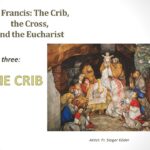
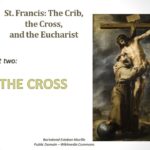
· Clare sees [poverty] as flowing naturally from that contemplative gazing upon the mystery of Christ, ‘. . . the God Who was placed poor in the crib, lived poor in the world, and remained naked on the cross.’”
Questions for discussion or to answer in your journal
Read one or more of the letters written by St. Clare to St. Agnes of Prague, take note of any sentences or entire paragraphs that stand out to you.
· Look back over the passages that you highlighted, what do they tell you about St. Clare?
· What did you learn about prayer as your read the letters?
· Why is getting to know St. Clare important to our prayer lives as Franciscans?
++++++++++++++++++++++++++++++++++++++++++++++++++++++++
A medida que nos acercamos a la fiesta de Santa Clara de Asís el 11 de agosto, ofrecemos breves citas a continuación con la esperanza de que se le anime a leer los antecedentes completos y el texto de la correspondencia entre Santa Clara y Santa Inés de Praga. (Las citas vienen de estas páginas en inglés.)
https://franciscantradition.org/clare-of-assisi-early-documents/introduction-to-the-letters-to-agnes-of-prague/215-ca-ed-1-page-39Aquí encontrarán en español los escritos de Sta. Clara: http://franciscanos.org/estudios/menu.html
INSPIRADOS POR SANTA. CLARA — Las cartas a Santa Inés de Praga
• “Inés, la hija del rey de Bohemia, y Clara comenzaron una correspondencia en 1234.
• Los esfuerzos del Papa Gregorio por paliar la pobreza en la que vivían las mujeres de San Damiano animaron a Clara e Inés a ser más decididas y, a través de su intercambio, sacaron a la luz la teología profunda en el corazón de sus vidas.
• En el más antiguo de sus escritos, la primera carta a Inés de Praga, Clara nos proporciona el aspecto más obvio de su oración: su interminable FASCINACIÓN POR LA PERSONA DE JESÚS.
•… subraya la profundidad de su comprensión de la vida como una RELACIÓN CONTINUA CON CRISTO que se expresa en una oración incesante.
• Ofrece muy pocas fórmulas intelectuales o prácticas para avanzar en la vida de oración. Clara quería conscientemente enseñar a sus hermanas que la oración era cuestión de enamorarse y permanecer enamoradas,
•… ella sugiere que el desarrollo de una vida de oración sólo se logra al enfocar nuestra atención en Dios.”
MIRAR, CONSIDERAR, CONTEMPLAR, IMITAR
• “Intuere, escribe ella, es decir, prestar atención, centrar la mirada en el Cristo sufriente.
• Considera, considerar el misterio sobre el que está reflexionando.
• para que se pierda en contemplar amorosamente, contemplar a Cristo.
• Sin embargo, todo el tiempo, aconseja ella, debe desear imitarlo, desiderans imitari.
• “Clara lo repite dieciocho años más tarde de una forma mucho más completa. ‘Contempla ese espejo [Jesús] todos los días,’ escribe en su cuarta carta a Inés, ‘y estudia continuamente tu rostro en él, para que puedas adornarte por dentro y por fuera con hermosas túnicas … Mira el BORDE de ese espejo . . .En la SUPERFICIE de ese espejo, considera … Luego, en la PROFUNDIDAD de este mismo espejo, contempla … “
• Al combinar las dimensiones del espejo con tres períodos diferentes en la vida de Cristo, Clara nos permite vislumbrar el vínculo que existe entre su práctica de la oración y su búsqueda de crecimiento espiritual ”.
EL DESEO DE CLARA POR LA POBREZA
• “La búsqueda continua de Clara de una oración centrada en Cristo, entonces, nos permite apreciar su devoción a la práctica de la pobreza.
• Fue el genio de Francisco, [Clara se dio cuenta]… ver que una vida sin nada propio, ‘sine proprio,’ nos libera para entrar en el misterio de Dios y Su reino.
• ‘¡Oh bendita pobreza,’ proclama en su primera carta a Inés de Praga, ‘que otorga riquezas eternas a quienes la aman y la abrazan! Oh santa pobreza, a los que te poseen y te desean, Dios promete el reino de los cielos y ofrece, en verdad, gloria eterna y vida bendita.’
• Clara ve [la pobreza] como algo que fluye naturalmente de esa mirada contemplativa sobre el misterio de Cristo ”. . . el Dios que fue puesto pobre en el pesebre, vivió pobre en el mundo y permaneció desnudo en la cruz.”
Preguntas para platicar o para responder en su diario
Lea una o más de las cartas escritas por Santa Clara a Santa Inés de Praga, tome nota de cualquier oración o párrafo completo que le llame la atención.
• Repase los pasajes que destacó, ¿qué le dicen acerca de Santa Clara?
• ¿Qué aprendió sobre la oración al leer las cartas?
• ¿Por qué es importante conocer a Santa Clara para nuestra vida de oración como franciscanos?
Diane F. Menditto, OFSChair, National Formation Commission
Minister, Our Lady of the Angels Region
Category: Formation Friday
FORMATION FRIDAY – Pardon of Assisi – July 30, 2021
St. Francis wanted all of his brothers to get to heaven. He asked the Pope for a special indulgence for all Franciscans. Today, anyone can get this special indulgence! There is an attachment to this email. Peace, Dona++++++++++++++++++++++++++++++++++++++++++++++++++++++++The Pardon of Assisi – The Porziuncola Indulgence (en español abajo)
Please share with your local fraternity
+ The sixteenth-century Basilica of St. Mary of the Angels envelops the tiny chapel known as the Porziuncola.
+ This chapel was one of the churches restored by St. Francis.
+ This is the spot where, while listening to the Gospel, Francis understood what he was called by God to do.
+ Here he founded the Order in 1209.
+ St. Clare received her religious habit from the hands of Francis here in 1211.
+ In 1216 as Francis prayed that everyone could be brought to heaven, he obtained from Jesus in a vision the PARDON OF ASSISI—a plenary indulgence, which was later ratified by Pope Honorius III.
+ This is where the friars’ early general chapters were held—the Chapter of Mats of 1221 was attended by 5,000 friars.
+ Here, on October 3, 1226, St. Francis welcomed Sister Death lying naked on the ground just outside the chapel.
“See to it, my sons, that you never abandon this place. If you are driven out from one side, go back in at the other. For this place is truly holy and is the dwelling place of God. Here, when we were but a few, the Most High gave us increase; here he enlightened the hearts of his poor ones by the light of his wisdom; here he set our wills on afire with the flame of his love. Here he who prays with a devout heart will obtain what he prays for and he who offends will be punished more severely. Wherefore, my sons, consider this dwelling place of God to be worthy of all honor, and with all your, with the voice of joy, and praise, give glory to the Lord in this place.” (Words of the dying St. Francis, Celano 1, n. 106)
The Conditions for Receiving the Pardon
+ Each year from vespers on August 1 through August 2 (Feast of Our Lady of the Angels) you should visit either a Franciscan church or your own church. (At first, the indulgence was only given for the Porziuncola, but it has been widened over the years.)
+ You may obtain the indulgence any day of the year upon visiting the Porziuncola itself.
CONDITIONS TO OBTAIN THE PARDON OF ASSISI
Plenary Indulgence–(for oneself or for a departed soul)
- Sacramental Confession to be in God’s sanctifying grace *(to be received within eight days before or after initiate “appeal” for the Plenary Indulgence);
- *Participation in the Holy Mass with the reception of the Holy Eucharist.
- Visit a Catholic Church, followed by the Profession of FAITH (Nicene Creed or Apostles Creed),
- Recite the OUR FATHER, in order to reaffirm and give witness to one’s Christian dignity, as a child of God, that one received in Baptism;
- Pray for the Pope’s intentions: as Vicar of Christ, Shepherd of the Universal Church, and visible sign of unity among the Faithful
An excellent reference on this topic: http://www.shrinesf.org/pardon-of-assisi.html
Also, if you can read Spanish, the link below has a very interesting article about the Porziuncola.
For discussion and reflection
+ Read Matthew 10: 9-15. This is the gospel that Francis heard read at the Porziuncola. Reflect on its meaning to all Franciscans and to us as Secular Franciscans.
+ On August 1-2, visit a Franciscan or other church and follow the conditions to receive the indulgence.
+ While you are there, spend time with the Blessed Sacrament. Consider your vocation and what God is asking of you.
+++++++++++++++++++++++++
El perdón de Asís – La indulgencia de la porciúncula
Comparta con su fraternidad local.
+ La Basílica de Santa María de los Ángeles del siglo XVI envuelve la pequeña capilla conocida como la Porciúncula.
+ Esta capilla fue una de las iglesias restauradas por San Francisco.
+ Este es el lugar donde, mientras escuchaba el Evangelio, Francisco comprendió lo que Dios le había llamado a hacer.
+ Aquí fundó la Orden en 1209.
+ Santa Clara recibió su hábito religioso de manos de Francisco aquí en 1211.
+ En 1216, mientras Francisco oraba para que todos pudieran ser llevados al cielo, obtuvo de Jesús en una visión el PERDÓN DE ASÍS, una indulgencia plenaria, que luego fue ratificada por el Papa Honorio III.
+ Aquí es donde se llevaron a cabo los primeros capítulos generales de los frailes; al Capítulo de las Esteras de 1221 asistieron 5.000 frailes.
+ Aquí, el 3 de octubre de 1226, San Francisco recibió desnudo a la Hermana Muerte en el suelo a las afueras de la capilla.
“Ocúpense, hijos míos, de que nunca abandonen este lugar. Si son expulsados de un lado, regresen por el otro. Porque este lugar es verdaderamente santo y es la morada de Dios. Aquí, cuando éramos sólo unos pocos, el Altísimo nos dio crecimiento; aquí iluminó el corazón de sus pobres con la luz de su sabiduría; aquí prendió nuestras voluntades con la llama de su amor. Aquí el que ora con corazón devoto obtenga lo que pide y el que ofende será castigado más severamente. Por tanto, hijos míos, consideren esta morada de Dios digna de toda honra, y con toda su voz, con voz de gozo y alabanza, den gloria al Señor en este luga .” (Palabras de San Francisco agonizante, Celano 1, n. 106)
Las condiciones para recibir la indulgencia
+ Cada año, desde las vísperas del 10 de agosto al 20 de agosto (Fiesta de Nuestra Señora de los Ángeles), debe visitar una iglesia franciscana o su propia iglesia. (Al principio, la indulgencia solo se otorgó a la Porciúncula, pero se ha ampliado con los años).
+ Puede obtener la indulgencia cualquier día del año al visitar la propia Porziuncola.
CONDICIONES PARA OBTENER EL PERDÓN DE ASÍS
Indulgencia plenaria – (para uno mismo o para un alma difunta)
• Confesión sacramental para estar en la gracia santificante de Dios * (para ser recibida dentro de los ocho días antes o después de iniciada la “apelación” para la Indulgencia Plenaria);
• * Participación en la Santa Misa con recepción de la Sagrada Eucaristía.
• Visita a una Iglesia Católica, seguida de la Profesión de FE (Credo de Nicea o Credo de los Apóstoles),
• Recitar el PADRE NUESTRO, para reafirmar y dar testimonio de la propia dignidad cristiana, como hijo de Dios, que se recibió en el Bautismo;
• Ore por las intenciones del Papa: como Vicario de Cristo, Pastor de la Iglesia Universal y signo visible de unidad entre los Fieles.
Excelente recurso en español http://franciscanos.org/santuarios/bellucci.htm
Para platicar y reflexionar
+ Lea Mateo 10: 9-15. Este es el evangelio que Francisco escuchó en la Porciúncula. Reflexione sobre su significado para todos los franciscanos y para nosotros como franciscanos seglares.
+ El 10 o el 20 de agosto, visite una iglesia franciscana u otra iglesia; siga las condiciones para recibir la indulgencia.
+ Mientras esté allí, pase tiempo con el Santísimo Sacramento. Considere su vocación y lo que Dios le está pidiendo.
Diane F. Menditto, OFSChair, National Formation Commission
Minister, Our Lady of the Angels Region
FORMATION FRIDAY – July 23, 2021 – Going from Gospel to Life
Today’s lesson goes back to the very beginning of Francis’ vision for his Order to live the Gospels each day. We should study and meditate on the Gospels each day. Fr. Mike has several books that help one meditate on the Gospels each day. Hopefully, we will have some to share at the Summer Gathering. God bless you all. Peace, Dona+++++++++++++++++++++++++++++++++++++++++++++++++++++++++++++++++++++++++++“And after the Lord gave me some brothers, no one showed me what I had to do, but the Most High Himself revealed to me that I should live according to the pattern of the Holy Gospel.”
The Testament – Francis of Assisi – The Saint – Vol I – Page 125
“The rule and life of the Secular Franciscans is this: to observe the gospel of our Lord Jesus Christ by following the example of Saint Francis of Assisi, who made Christ the inspiration and the center of his life with God and people.
Christ, the gift of the Father’s love, is the way to him, the truth into which the Holy Spirit leads us, and the life which he has come to give abundantly.
Secular Franciscans should devote themselves especially to careful reading of the gospel, going from gospel to life and life to the gospel.” OFS Rule Article 4
All Franciscans have a close relationship with Scripture in general and the Gospels in particular. As Secular Franciscans, we are called to show that the gospel can be lived in the world.
In “Come and See,” by Fr. Lester Bach, OFM Cap, and Theresa Baker, OFS, we are set on the path to “go from gospel to life and life to the gospel.” (See page 9 of Come and See)
“We are gospel people and the Sacred Scriptures are vital to our lives. Since we desire to implement the
Gospel, we have to know the Gospel. Bible knowledge does not come magically. It takes work. We
expect such work from Secular Franciscans. We are NOT fundamentalists who can quote chapter and
verse. Instead, we show the implications of the Gospel by the way we live.
Our goal is not to be intellectual biblical scholars but people who practice what we learn from the Bible.
We avoid using the Bible as a club to judge and punish others or win arguments. It is not an exercise to
see how many texts we can memorize. That is not our way. We will never exhaust the full meaning of
Scripture. Hence our lifelong commitment is to continue the journey of learning and applying the Gospel
in daily life.A number of things are required of Secular Franciscans in relation to the Bible:
· Our guidebook is the Bible – we use it!
· Jesus and his words have special value to us. We listen to him.
· In fraternal gatherings, we share insights and reflections for implementing the Gospel in everyday life.
· When we are puzzled about texts, we seek competent help.
· We avoid fundamentalist attitudes that limit the power of Scripture.
· We work to deepen our understanding of Scripture.
· We avoid attitudes that use Scripture to condemn others or identify them as non-salvageable.
· The circle of our love must never become narrow. We seek to include rather than exclude people.
· We use Scripture for prayer as well as study, letting its power touch us and soak into our lives.”
For discussion or to comment on in your journal:
1- Why was Scripture so important to St. Francis?
2-In what ways do you apply the gospels to your life?
3-How has Sacred Scripture helped you in your efforts to achieve daily conversion?
4- Discuss with your formator or formation team ways in which your fraternity can work together to become more familiar with Scripture.
+++++++++++
Del Evangelio a la vida…
“Y después que el Señor me dio algunos hermanos, nadie me mostró lo que tenía que hacer, pero el Altísimo mismo me reveló que debía vivir según el modelo del Santo Evangelio.” Testamento – San Francisco de Asís
“La Regla y la vida de los Franciscanos seglares es ésta: guardar el santo Evangelio de nuestro Señor Jesucristo siguiendo el ejemplo de San Francisco de Asís, que hizo de Cristo el inspirador y centro de su vida con Dios y con los hombres6.
Cristo, don del amor del Padre, es el camino hacia Él, es la verdad en la cual nos introduce el Espíritu Santo, es la vida que Él ha venido a dar abundantemente.
Los Franciscanos seglares dedíquense asiduamente a la lectura del Evangelio, pasando del Evangelio a la vida y de la vida al Evangelio.” Regla OFS Artículo 4
Todos los franciscanos tienen una estrecha relación con la Escritura en general y los Evangelios en particular. Como franciscanos seglares estamos llamados a mostrar que el evangelio se puede vivir en el mundo.
En “Ven a ver,” del P. Lester Bach, OFM Cap, y Theresa Baker, OFS, estamos en el camino de “pasar del Evangelio a la vida y de la vida al Evangelio.” (Consulte la página 9 de Ven a ver)
“Somos gente del evangelio y las Sagradas Escrituras son vitales para nuestras vidas. Dado que deseamos implementar el Evangelio, tenemos que conocer el Evangelio. El conocimiento de la Biblia no viene por arte de magia. Requiere trabajo. Nosotros esperamos tal trabajo de los Franciscanos Seglares. NO somos fundamentalistas que puedan citar capítulos y verso. En cambio, mostramos las implicaciones del Evangelio por la forma en que vivimos.
Nuestro objetivo no es ser eruditos bíblicos intelectuales, sino personas que practican lo que aprendemos de la Biblia.
Evitamos usar la Biblia como un mazo para juzgar y castigar a otros o ganar discusiones. No es un ejercicio para
ver cuántos textos podemos memorizar. Ese no es nuestro camino. Nunca agotaremos el significado completo de
Sagrada Escritura. Por eso, nuestro compromiso de toda la vida es continuar el camino de aprendizaje y aplicación del Evangelio en la vida diaria.
Se requieren varias cosas de los franciscanos seglares en relación con la Biblia:
• Nuestra guía es la Biblia, ¡la usamos!
• Jesús y sus palabras tienen un valor especial para nosotros. Lo escuchamos.
• En los encuentros fraternos compartimos visiones y reflexiones para implementar el Evangelio en la vida cotidiana.
• Cuando nos desconciertan los textos, buscamos ayuda competente.
• Evitamos actitudes fundamentalistas que limitan el poder de las Escrituras.
• Trabajamos para profundizar nuestro entendimiento de las Escrituras.
• Evitamos actitudes que usan las Escrituras para condenar a otros o identificarlos como no salvables.
• El círculo de nuestro amor nunca debe reducirse. Buscamos incluir más que excluir a las personas.
• Usamos las Escrituras tanto para la oración como para el estudio, dejando que su poder nos toque y penetre en nuestras vidas.”
Para platicar o comentar en su diario:
1- ¿Por qué la Escritura era tan importante para San Francisco?
2-¿De qué formas aplicas los evangelios a tu vida?
3-¿Cómo te ha ayudado la Sagrada Escritura en tus esfuerzos por lograr la conversión diaria?
4- Discuta con su formador o equipo de formación las formas en que su fraternidad puede trabajar en conjunto para familiarizarse más con las Escrituras.
Diane F. Menditto, OFSChair, National Formation Commission
Minister, Our Lady of the Angels Region
FORMATION FRIDAY – July 16, 2021 – Admonitions
Dear Brothers and Sisters,Today’s lesson uses the early writings of St. Francis. One of the best ways to learn about the soul of a saint is to read their original writings.Reminder: if you click on the first link to Franciscan Traditions – you will find tons of material for ongoing formation. Just read the material, create questions and you are ready to go to the next gathering with a plan for your members to learn together. Or you can purchase a book with the questions at the end of each Chapter such as For All The Saints: St. Francis’s Five Point Plan for Salvation by Tom Bellos OFS, former National Minister, (Published by Tau Publishing)If you are looking for some ideas, just send an email, and I will get back to you. Peace, Dona++++++++++++++++++++++++++++++++++++++++++++++++++
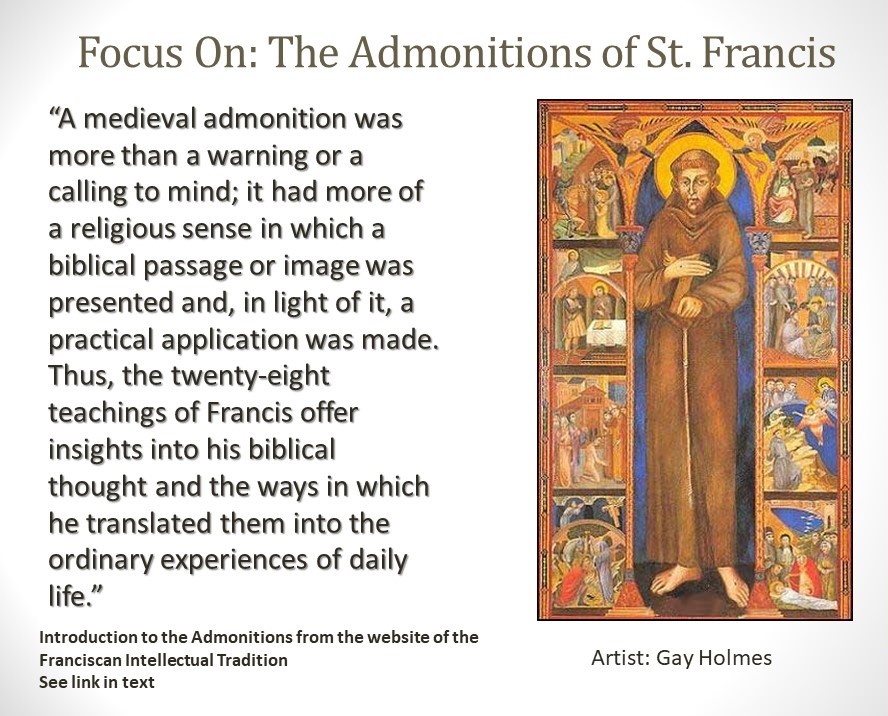
Focus on the Admonitions (#11 and 12)
https://www.franciscantradition.org/francis-of-assisi-early-documents/the-saint/writings-of-francis/the-undated-writings/the-admonitions/149-fa-ed-1-page-133
[XI: Let No One Be Corrupted by the Evil of Another]1Nothing should displease a servant of God except for sin. 2And no matter how another person may sin if a servant of God becomes disturbed and angry because of this and not because of charity, he is storing up guilt for himself. Rom 2:5 3That servant of God who does not become angry or disturbed at anyone lives correctly without anything of his own. a 4Blessed is the one for whom nothing remains except for him to return to Caesar what is Caesar’s and to God what is God’s. Mt 22:21
[XII: Knowing the Spirit of the Lord]
1A servant of God can be known to have the Spirit of the Lord in this way: 2if, when the Lord performs some good through him, his flesh does not, therefore, exalt itself, because it is always opposed to every good. 3Instead he regards himself the more worthless and esteems himself less than all others.
Questions to discuss or to answer in your journal
+ Come, Holy Spirit! Open my mind and heart as I contemplate Admonition XI.
· When have I focused on another person’s sin and judged them because of it?
· What do I find most difficult about not becoming “angry or disturbed at anyone?”
· Why do you think Francis ends this admonition with the sentence from Matthew about “returning to Caesar what is Caesar’s and to God what is God’s?”
+ Admonition XII—Those of us who are, or aspire to be, servant leaders should pay close attention to this one!
· Why do you think St. Francis asks his followers to esteem themselves less when the Lord accomplishes something through them?
· Do you think he wants us to have low self-esteem? Why or why not?
· Do you think he is asking us to stop trying to do great things?
++++++++++++++++++++++++++++++++++++
Enfoque en las admoniciones de San Francisco (Admoniciones 11 y 12)
https://www.franciscanos.org/esfa/escritossf.html#adm
Cap. XI: Que nadie se altere por el pecado de otro
1Al siervo de Dios nada debe desagradarle, excepto el pecado. 2Y de cualquier modo que una persona peque, si por esto el siervo de Dios se turba y se encoleriza, y no por caridad, atesora para sí una culpa (cf. Rom 2,5). 3El siervo de Dios que no se encoleriza ni se conturba por cosa alguna, vive rectamente sin propio. 4Y bienaventurado aquel que no retiene nada para sí, devolviendo al César lo que es del César, y a Dios lo que es de Dios (Mt 22,21).
Cap. XII: De cómo conocer el espíritu del Señor
1Así se puede conocer si el siervo de Dios tiene el espíritu del Señor: 2si, cuando el Señor obra por medio de él algún bien, no por eso su carne se exalta, porque siempre es contraria a todo lo bueno, 3sino que, más bien, se tiene por más vil ante sus propios ojos y se estima menor que todos los otros hombres.
Preguntas para platicar o responder en su diario
+ ¡Ven, Espíritu Santo! Abre mi mente y mi corazón mientras contemplo la Admonición XI.
• ¿Cuándo me he concentrado en el pecado de otra persona y la he juzgado por ello?
• ¿Qué me resulta más difícil de no “enojarme o molestarme con nadie?”
• ¿Por qué cree usted que Francisco termina esta advertencia con la frase de Mateo sobre “devolver al César lo que es del César y a Dios lo que es de Dios?”
+ Admonición XII: ¡Aquellos de nosotros que somos, o aspiramos a ser, líderes siervos debemos prestar mucha atención a esta admonición!
• ¿Por qué cree que San Francisco pide a sus seguidores que se estimen menos a sí mismos cuando el Señor logra algo a través de ellos?
• ¿Cree usted que él quiere que tengamos baja autoestima? ¿Por qué o por qué no?
• ¿Cree que nos está pidiendo que dejemos de intentar a hacer grandes cosas?
Diane F. Menditto, OFSChair, National Formation Commission
Minister, Our Lady of the Angels Region
FORMATION FRIDAY – July 9th, 2021 – ESSENTIAL ELEMENTS OF THE OFS RULE
It is important to know our Rule so that we can better follow Francis in our daily lives. Today let’s have some fun and see if we (or our fraternity) can find the essentials points in our Rule. There are attachments to this post. Peace, Dona+++++++++++++++++++++++++++++++++++++++++++++++++++++++++++++++++++++++++++++++++++++++++++++++++++++++++++++++The Seventeen Essential Elements of the OFS Rule
This list of essential elements was compiled by those who worked on and eventually wrote the Rule of 1978. Read through our Rule and note which articles came out of each of the 17 points. Some elements appear in more than one article. (If you are interested to see the answers a group of those studying the Rule gave, please see below. But, please try it yourself first.)
Which article(s) of the Rule came out of each of the 17 points?
1. To live the gospel according to the spirit of St. Francis ________________________
2. To be converted continually (metanoia) ________________________
3. To live as brothers and sisters to all people and all creation __________________________
4. To live in communion with Christ ___________________________
5. To follow the poor and crucified Christ _________________________
6. To share in the life and mission of the Church _______________________
7. To share in the love of the Father _______________________
8. To be instruments of peace _______________________
9. To have a life of prayer that is personal, communal and liturgical _____________________
10. To live in joy __________________11. To have a spirituality of a secular character ___________________
12. To be pilgrims on the way to the father ______________________
13. To participate in the Apostolate of the Laity ____________________
14. To be at the service of the less fortunate __________________
15. To be loyal to the Church in an attitude of dialogue and collaboration with her ministers _________
16. To be open to the action of the Spirit _______________________
17. To live in simplicity, humility, and minority _____________________
For discussion or to comment on in your journal.
+ Why is it important for us to study our Rule of Life often?
+ Choose three articles from the Rule: How do you live out each article in your daily life? How could you live these articles better?
+ Which articles of the Rule present you with the greatest challenges?
Responses previously given: #1- Articles 1, 2, and 4; #2- Prologue and article 7; #3- Articles 5, 13, and 18; #4- Articles 4, 5, 6, and 8; #5- Articles 4, 10, and 14; #6- Articles 5, 6, and 22; #7- Articles 4 and 12; #8- Articles 17 and 19; #9- Articles 2, 8, and 9; #10- Articles 13 and 19; #11- Articles 5 and 8; #12- Article 11; #13- Articles 1 and 15; #14- Articles 13 and 14; #15- Article 6; #16- Articles 4, 14, and 19; #17- Article 11.
++++++++++++++++++++++++++++
Los diecisiete elementos esenciales de la regla OFS
Esta lista de elementos esenciales fue compilada por aquellos que trabajaron y finalmente escribieron la Regla de 1978.
Lea nuestra Regla y observe qué artículos surgieron de cada uno de los 17 puntos. Algunos elementos aparecen en más de un artículo. (Si tiene interés en ver las respuestas que dio un grupo de los que estudiaban la Regla, consulte a continuación. Pero, primero pruébelo usted mismo).
¿Qué artículo (s) de la Regla surgió de cada uno de los 17 puntos?
1. Vivir el evangelio según el espíritu de San Francisco ________________________
2. Convertirse continuamente (metanoia) ________________________
3. Vivir como hermanos y hermanas de todas las personas y de toda la creación __________________________
4. Vivir en comunión con Cristo ___________________________
5. Seguir al Cristo pobre y crucificado _________________________
6. Participar en la vida y misión de la Iglesia _______________________
7. Para compartir el amor del Padre _______________________
8. Ser instrumentos de paz _______________________
9. Tener una vida de oración personal, comunitaria y litúrgica _____________________
10. Vivir con alegría __________________
11. Tener una espiritualidad de carácter secular ___________________
12. Ser peregrinos en el camino del padre ______________________
13. Participar en el Apostolado de los Laicos ____________________
14. Estar al servicio de los menos afortunados __________________
15. Ser fiel a la Iglesia en actitud de diálogo y colaboración con sus ministros _________
16. Estar abierto a la acción del Espíritu _______________________
17. Vivir con sencillez, humildad y minoría _____________________
Para platicar o comentar en su diario.
+ ¿Por qué es importante para nosotros estudiar nuestra Regla de Vida con frecuencia?
+ Elija tres artículos de la Regla: ¿Cómo vive cada artículo en su vida diaria? ¿Cómo podría vivir mejor estos artículos?
+ ¿Qué artículos de la Regla le presentan los mayores desafíos?
Respuestas dadas anteriormente: #1- Artículos 1, 2 y 4; #2- Prólogo y artículo 7; #3- Artículos 5, 13 y 18; #4- Artículos 4, 5, 6 y 8; #5- Artículos 4, 10 y 14; #6- Artículos 5, 6 y 22; #7- Artículos 4 y 12; #8- Artículos 17 y 19; #9- Artículos 2, 8 y 9; #10- Artículos 13 y 19; #11- Artículos 5 y 8; #12- Artículo 11; #13- Artículos 1 y 15; #14- Artículos 13 y 14; #15- Artículo 6; #16- Artículos 4, 14 y 19; #17- Artículo 11.
Diane F. Menditto, OFSChair, National Formation Commission
Minister, Our Lady of the Angels Region