(Please share with your fraternities)
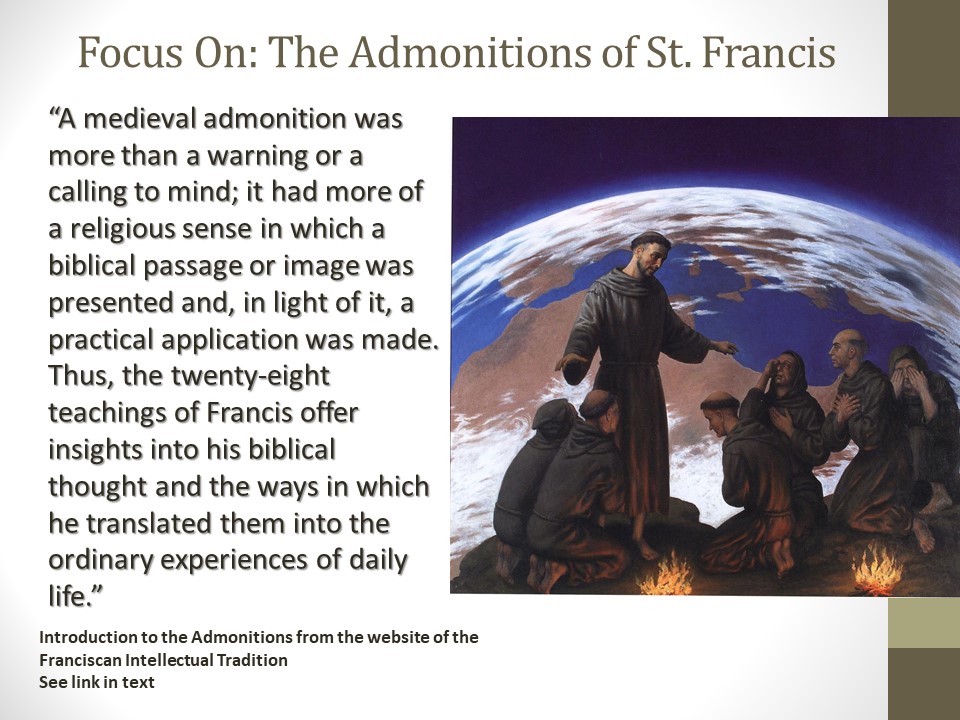
(En español abajo) Korean translation attached in separate PDF.Focus on the Admonitions (V)
[V. Let No One Be Proud, but Boast in the Cross of the Lord]
1Consider, O human being, in what great excellence the Lord God has placed you, for He created and formed you to the image of His beloved Son according to the body and to His likeness according to the Spirit. Gn 1:27
2And all creatures under heaven serve, know, and obey their Creator, each according to its own nature, better than you. 3And even the demons did not crucify Him, but you, together with them, have crucified Him and are still crucifying Him by delighting in vices and sins.
4In what, then, can you boast? 5Even if you were so skillful and wise that you possessed all knowledge, 1 Cor 13:2 knew how to interpret every kind of language, 1 Cor 12:28 and to scrutinize heavenly matters with skill: you could not boast in these things. 6For, even though someone may have received from the Lord a special knowledge of the highest wisdom, one demon knew about heavenly matters and now knows more about those of earth than all human beings.a
7In the same way, even if you were more handsome and richer than everyone else, and even if you worked miracles so that you put demons to flight: all these things are contrary to you; nothing belongs to you; you can boast in none of these things.
8But we can boast in our weaknesses 2 Cor 12:5 and in carrying each day the holy cross of our Lord Jesus Christ. Lk 14:27
For discussion in fraternity, with a partner, or in your journal.
+What is challenging to you about this Admonition?
+Are you able to see your strengths and weaknesses?
+How do you view humility?
+Do you try to hide your strengths in an effort to be humble? +How can you avoid this?Formación 30 de enero de 2026
Enfoque en las admoniciones de San Francisco (V)
http://www.franciscanos.org/esfa/adm-ae.html
[Cap. V: Que nadie se ensoberbezca, sino que se gloríe en la cruz del Señor]
1Considera, oh hombre, en cuán grande excelencia te ha puesto el Señor Dios, porque te creó y formó a imagen de su amado Hijo según el cuerpo, y a su semejanza (cf. Gén 1,26) según el espíritu. 2Y todas las criaturas que hay bajo el cielo, de por sí, sirven, conocen y obedecen a su Creador mejor que tú. 3Y aun los demonios no lo crucificaron, sino que tú, con ellos, lo crucificaste y todavía lo crucificas deleitándote en vicios y pecados. 4¿De qué, por consiguiente, puedes gloriarte? 5Pues, aunque fueras tan sutil y sabio que tuvieras toda la ciencia (cf. 1 Cor 13,2) y supieras interpretar todo género de lenguas (cf. 1 Cor 12,28) e investigar sutilmente las cosas celestiales, de ninguna de estas cosas puedes gloriarte; 6porque un solo demonio supo de las cosas celestiales y ahora sabe de las terrenas más que todos los hombres, aunque hubiera alguno que hubiese recibido del Señor un conocimiento especial de la suma sabiduría. 7De igual manera, aunque fueras más hermoso y más rico que todos, y aunque también hicieras maravillas, de modo que ahuyentaras a los demonios, todas estas cosas te son contrarias, y nada te pertenece, y no puedes en absoluto gloriarte en ellas; 8por el contrario, en esto podemos gloriarnos: en nuestras enfermedades (cf. 2 Cor 12,5) y en llevar a cuestas a diario la santa cruz de nuestro Señor Jesucristo (cf. Lc 14,27).
Para platicar en fraternidad, con un compañero o en su diario.
+¿Qué le resulta difícil de esta admonición?
+¿Es usted capaz de reconocer sus puntos fuertes y débiles?
+¿Cómo ve la humildad?
+¿Intenta ocultar sus puntos fuertes en un esfuerzo por ser humilde? +¿Cómo puede evitarlo?
Diane F. Menditto, OFSVice Minister, National Fraternity, Secular Franciscan Order USA“Go into the world and proclaim the good news.”National Theme 2025-2028
Carolyn Townes, OFS: Peacemaker and Circle Keeper JPIC 2025 Award
(This article originally appeared in the TAU-USA Fall 2025 Issue #117)
By Joe Makley, OFS • JPIC Animator
Our JPIC Award recipient for 2025 is Carolyn Townes, OFS. Carolyn has had a long and impactful history as the National JPIC Animator for over ten years, and currently serves on the boards of several Franciscan organizations. What follows is a brief interview with Carolyn:
Carolyn, how did you become aware of your Franciscan vocation?
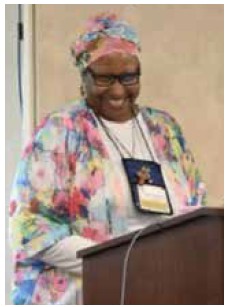
Carolyn Townes, OFS JPIC Award 2025
“The Franciscan Holy Spirit met me at a time in my life when I was unknowingly searching. My Baptist preacher mother would buy these candles to bring good luck to our home. She would always get St. Michael the Archangel, St. Jude, St. Clare, and St. Anthony. I knew who Michael and Jude were, but who were these two in the brown robes? I Googled, even before there was Google, and found out they followed this guy named Francis. So, I went down a rabbit hole to discover who this Francis was. I joined the Catholic Church in 1997, began formation in 1998, and was professed in 2000. So, Francis found me at a time when I needed to be found but had no idea I was lost.”
You’ve described yourself as a circle keeper. Can you explain?
“A circle keeper is one who keeps what goes on in the circle – the stories, the tears, the anger, the uncertainty, the long-held family secrets. As well as making sure those within the circle feels safe, heard, and held. Being a circle keeper embraces the spirituality of “with-ness” – not fixing or having the answers, just being with and listening. Two very difficult things to do sometimes. Circle keeping is in my Cherokee roots and I have had many opportunities to fully embrace it.”
You have worked with Franciscans International, Franciscan Action Network, and other Franciscan organizations. How do we build the bridges with a wider Franciscan Family?
“As Franciscans, we are all one family – friars, sisters, and laity. We all profess the same Gospel written specifically into our own rules of life. We all take the same aspect of Jesus our Brother – as the poor Christ, the Incarnational Christ – and weave that charism into our lives. We are all woven from that same cloth. How can we not stand on the same foundation with one another? When you are standing shoulder to shoulder next to someone, how can you not turn to them and ask, “So, what’s your story? Tell me what breaks your heart!” We have learned to live and move in our own individual silos and that has not been good for building bridges. To build bridges we need to step outside of those silos, turn to one another and get over the fears that separate us. Several of the organizations I work with have never had a Secular Franciscan on their board, team, or committee; let alone a Secular who is a woman of color.”
Can you share any future plans?
“Broken hearts usually dictate my future. As long as there are hearts that are broken, I will always have something to do. I also work to train the trainers for circle processes. Circles are our past, our present, and our future. Circles are what will shift us from fear to love, if we only get out of the way.”
What keeps you going?
“What keeps me going is knowing there are still hearts that are broken and people that are suffering. Those people and hearts need to be tenderly held and allowed the space and the grace to heal. Today’s society is hurting. We live in a world of uncertainty and that uncertainty causes fear. People are living out of their fears and hurts with very few who will listen and hold space for them. I hold space by creating circles. Those circles are spaces for being heard and for the Holy Spirit to begin the healing process.”
https://www.secularfranciscansusa.org/2026/01/carolyn-townes-ofs-peacemaker-and-circle-keeper-jpic-2025-award/
The Gospel Through a Franciscan Lens – 3rd Week in Ordinary Time – Fr. Christopher
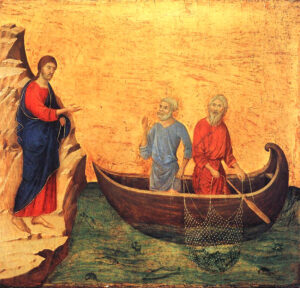
Jesus’ message, “Repent, the Kingdom of Heaven is close at hand.” More than sorrow for sin, repent calls for a change of mind, not just in an intellectual sense, but a change involving a transformation of attitude at a deep, personal level, to be prepared to look at one’s life and one’s hope for the future in a totally new way.
https://www.secularfranciscansusa.org/2026/01/the-gospel-through-a-franciscan-lens-3rd-week-in-ordinary-time-fr-christopher/
Formation Friday – Focus on the Admonitions (IV, VI and IX) -January 23, 2026
(En español abajo) Korean translation attached in a separate PDF. (Please share with your fraternities)
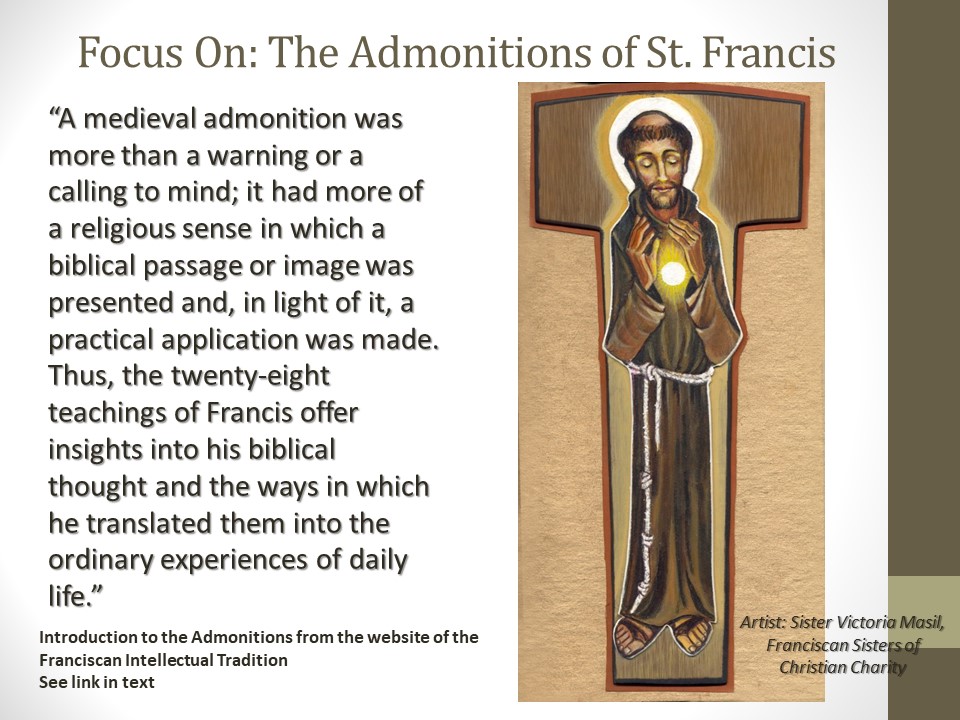
Focus on the Admonitions (IV, VI and IX)
[IV: Let No One Make Being Over Others His Own]
1I did not come to be served, but to serve, says the Lord. Mt 20:28
2Let those who are placed over others boast about that position as much as they would if they were assigned the duty of washing the feet of their brothers. 3And if they are more upset at having their place over others taken away from them than at losing their position at their feet, the more they store up a money bag Jn 12:6 to the peril of their soul.c
[VI: Imitation of Christ]
1Let all of us, brothers, consider the Good Shepherd Who bore the suffering of the cross to save His sheep.
2The Lord’s sheep followed Him in tribulation and persecution, in shame and hunger, in weakness and temptation, and in other ways; and for these things they received eternal life from the Lord.
3Therefore, it is a great shame for us, the servants of God, that the saints have accomplished great things and we want only to receive glory and honor by recounting them.
[IX: Love]
1The Lord says: Love your enemies [do good to those who hate you and pray for those who persecute and slander you]. Mt 5:44
2For that person truly loves his enemy who is not hurt by an injury done to him, 3but, because of love of God, is stung by the sin of his soul. 4Let him show him love by his deeds.
To discuss or answer in your journal:
+How does Admonition IV inspire me in my role as a servant leader in my fraternity?
+What does it say to me as a parent or as a leader in my community?+How does Admonition VI encourage me to be strong in my following of Christ?
+How do I handle suffering for Christ?
+How do I explain my commitment to Christ to others?+When you think about Admonition IX, what is your reaction?
+Are you able to live out this admonition?
+++++++++++++++++++++++
Formación 23 de enero de 2026
Enfoque en las admoniciones de San Francisco (IV, VI y IX)
http://www.franciscanos.org/esfa/adm-ae.html
[Cap. IV: Que nadie se apropie la prelacía]
1No he venido a ser servido, sino a servir, dice el Señor (cf. Mt 20,28). 2Aquellos que han sido constituidos sobre los otros, gloríense de esa prelacía tanto, cuanto si hubiesen sido destinados al oficio de lavar los pies a los hermanos. 3Y cuanto más se turban por la pérdida de la prelacía que por la pérdida del oficio de lavar los pies, tanto más acumulan en la bolsa para peligro de su alma (cf. Jn 12,6).
[Cap. VI: De la imitación del Señor]
1Consideremos todos los hermanos al buen pastor, que por salvar a sus ovejas sufrió la pasión de la cruz. 2Las ovejas del Señor le siguieron en la tribulación y la persecución, en la vergüenza y el hambre, en la enfermedad y la tentación, y en las demás cosas; y por esto recibieron del Señor la vida sempiterna. 3De donde es una gran vergüenza para nosotros, siervos de Dios, que los santos hicieron las obras y nosotros, recitándolas, queremos recibir gloria y honor.
[Cap. IX: Del amor]
1Dice el Señor: Amad a vuestros enemigos, [haced el bien a los que os odian, y orad por los que os persiguen y calumnian] (Mt 5,44). 2En efecto, ama de verdad a su enemigo aquel que no se duele de la injuria que le hace, 3sino que, por amor de Dios, se consume por el pecado del alma de su enemigo. 4Y muéstrele su amor con obras.
Para platicar o contestar en su diario:
+¿Cómo me inspira la Admonición IV en mi papel de líder servidor en mi fraternidad?
+¿Qué me dice como padre o líder en mi comunidad?+¿Cómo me anima la Admonición VI a ser fuerte en mi seguimiento de Cristo?
+¿Cómo manejo el sufrimiento por Cristo?
+¿Cómo explico mi compromiso con Cristo a los demás?+Cuando piensa en la Admonición IX, ¿cuál es su reacción?
+¿Tiene usted éxito en vivir esta Admonición?
Diane F. Menditto, OFSVice Minister, National Fraternity, Secular Franciscan Order USA“Go into the world and proclaim the good news.”National Theme 2025-2028

Voices of the Friars Call Secular Franciscans to Kindness, Peace, and the Cross Part 2
(This article originally appeared in the TAU-USA Fall 2025 Issue #117)
Continued:
Fr. Jerome also cautioned against relying too heavily on niceness and surface gestures, but instead, offering our neighbors true compassion. “You don’t need to be smiling all the time,” he said. “Smiles have their place, but sometimes others need not a smile but an embrace.”
Fr. Jerome’s message underscored that authentic kindness grounded in Christ’s healing love goes deeper than politeness, calling Franciscans to embody humility, compassion, and courage in daily life.
Fr. John De La Riva, OFM Cap., Urges Franciscans to Be Instruments of Peace
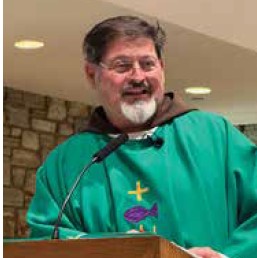 In his homily, Fr. John De La Riva, OFM Cap., reflected on the hymn “Let There Be Peace on Earth and Let It Begin with Me,” calling upon Secular Franciscans to embrace their vocation as peacemakers in a world scarred by violence, division, and suffering.
He acknowledged that justice is not always immediate, yet the Christian response must be to seek peace through humility, sacrifice, and love. “We must sacrifice our pride to clear the air and appreciate someone in their humanity,” he said, reminding listeners that true unity comes from trusting in the Lord and showing genuine love for others.
Fr. John urged Franciscans to “train for the spiritual mission” with the same discipline the military shows in preparing for battle. This training, he said, should form habits of radical love, compassion, and forgiveness – even toward those who oppose us.
“Let yourself be pliable and let the Lord form you,” he said. By embracing the Franciscan charism, Christians can share God’s love and joy, accompany the suffering, and lift the broken.
Fr. Marek Stybor, OFM Conv.: Embrace the Cross, Welcome God’s Surprises
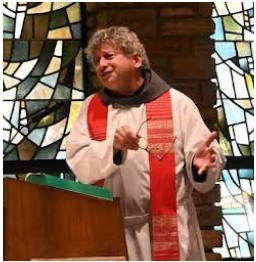 On the closing night of our chapter, Fr. Marek Stybor, OFM Conv., CNSA president-in-turn, offered us a homily filled with both challenge and encouragement. He reminded us that we are not the same people we once were – we have been shaped by the life and witness of St. Francis of Assisi. Our true “habit,” he said, is the Tau cross, the sign of Christ’s love and sacrifice.
Fr. Marek invited us to embrace the cross in our own lives, to touch the wounds of Jesus, and to accept and even welcome our own weaknesses.
“Let yourself be a loser,” he urged with Franciscan boldness, “because in embracing brokenness we also begin to see the hidden beauty of the world. There is power in that vision.” He challenged us not to cling to our hurts or celebrate our wounds, “but instead to forgive, to move forward, and to give God permission to act in surprising ways.”
With his characteristic humor, Fr. Marek shared a story about a woman who won a million dollars in the lottery. Fearing the news might overwhelm her husband, she asked her parish priest to help break it to him gently.
When the priest asked the husband what he would do if he won such a fortune, he replied, “Why, I’d give it to the church.” At that, it was the priest who was overcome by surprise, and who collapsed from a heart attack.
The story drew laughter, but it carried a deeper point: God is over-generous, and His surprises often exceed our imagination. As Secular Franciscans, we are called to live with open hands and open hearts, ready to receive both the cross and the joy that come from following Christ.
https://www.secularfranciscansusa.org/2026/01/voices-of-the-friars-call-secular-franciscans-to-kindness-peace-and-the-cross-part-2/