The Pardon of Assisi – The Porziuncola Indulgence—Celebrated on August 2 (en español abajo)
Please share with your local fraternity Korean Translation attached in a separate PDF
+ The sixteenth century Basilica of St. Mary of the Angels envelops the tiny chapel known as the Porziuncola.
+ This chapel was one of the churches restored by St. Francis.
+ This is the spot where, while listening to the Gospel, Francis understood what he was called by God to do.
+ Here he founded the Order in 1209.
+ St. Clare received her religious habit from the hands of Francis here in 1211.
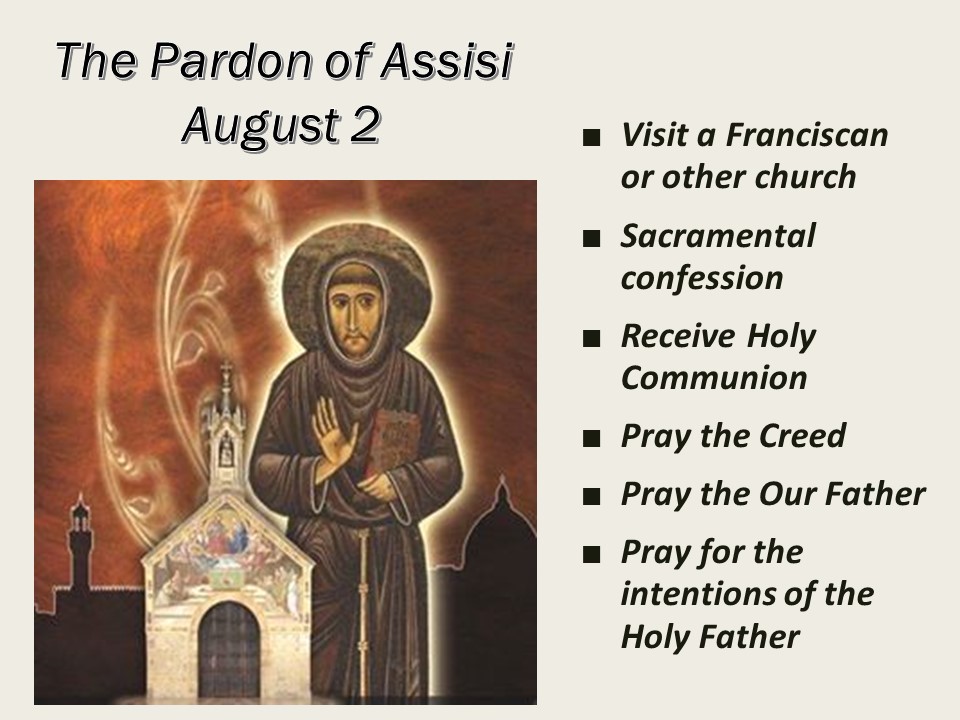
+ In 1216 as Francis prayed that everyone could be brought to heaven, he obtained from Jesus in a vision the PARDON OF ASSISI—a plenary indulgence, which was later ratified by Pope Honorius III.
+ This is where the friars’ early general chapters were held—the Chapter of Mats of 1221 was attended by 5,000 friars.
+ Here, on October 3, 1226, St. Francis welcomed Sister Death lying naked on the ground just outside the chapel.
“See to it, my sons, that you never abandon this place. If you are driven out from one side, go back in at the other. For this place is truly holy and is the dwelling place of God. Here, when we were but a few, the Most High gave us increase; here he enlightened the hearts of his poor ones by the light of his wisdom; here he set our wills on afire with the flame of his love. Here he who prays with a devout heart will obtain what he prays for and he who offends will be punished more severely. Wherefore, my sons, consider this dwelling place of God to be worthy of all honour, and with all your, with voice of joy, and praise, give glory to the Lord in this place.” (Words of the dying St. Francis, Celano 1, n. 106)
The Conditions for Receiving the Pardon
+ Each year from vespers on August 1 through August 2 (Feast of Our Lady of the Angels) you should visit either a Franciscan church or your own church. (At first the indulgence was only given for the Porziuncola, but it has been widened over the years.)
+ You may obtain the indulgence any day of the year upon visiting the Porziuncola itself.
CONDITIONS TO OBTAIN THE PARDON OF ASSISI
Plenary Indulgence–(for oneself or for a departed soul)
- Sacramental Confession to be in God’s sanctifying grace *(to be received within eight days before or after initiate “appeal” for the Plenary Indulgence);
- *Participation in the Holy Mass with reception of the Holy Eucharist.
- Visit to a Catholic Church, followed by the Profession of FAITH (Nicene Creed or Apostles Creed),
- Recite the OUR FATHER, in order to reaffirm and give witness to one’s Christian dignity, as a child of God, that one received in Baptism;
- Pray for the Pope’s intentions: as Vicar of Christ, Shepherd of the Universal Church, and visible sign of unity among the Faithful
Excellent reference on this topic: http://www.shrinesf.org/pardon-of-assisi.html
Also, if you are able to read Spanish, the link below has a very interesting article about the Porziuncola.
For discussion and reflection
+ Read Matthew 10: 9-15. This is the gospel that Francis heard read at the Porziuncola. Reflect on its meaning to all Franciscans and to us as Secular Franciscans.
+ On August 1-2, visit a Franciscan or other church and follow the conditions to receive the indulgence.
+ While you are there, spend time with the Blessed Sacrament. Consider your vocation and what God is asking of you.
+++++++++++++++++++++++++
Formation Friday – 2 de agosto, 2024
El perdón de Asís – La indulgencia de la porciúncula 2 de agosto
Comparta con su fraternidad local.
+ La Basílica de Santa María de los Ángeles del siglo XVI envuelve la pequeña capilla conocida como la Porciúncula.
+ Esta capilla fue una de las iglesias restauradas por San Francisco.
+ Este es el lugar donde, mientras escuchaba el Evangelio, Francisco comprendió lo que Dios le había llamado a hacer.
+ Aquí fundó la Orden en 1209.
+ Santa Clara recibió su hábito religioso de manos de Francisco aquí en 1211.
+ En 1216, mientras Francisco oraba para que todos pudieran ser llevados al cielo, obtuvo de Jesús en una visión el PERDÓN DE ASÍS, una indulgencia plenaria, que luego fue ratificada por el Papa Honorio III.
+ Aquí es donde se llevaron a cabo los primeros capítulos generales de los frailes; al Capítulo de las Esteras de 1221 asistieron 5.000 frailes.
+ Aquí, el 3 de octubre de 1226, San Francisco recibió desnudo a la Hermana Muerte en el suelo a las afueras de la capilla.
“Ocúpense, hijos míos, de que nunca abandonen este lugar. Si son expulsados de un lado, regresen por el otro. Porque este lugar es verdaderamente santo y es la morada de Dios. Aquí, cuando éramos sólo unos pocos, el Altísimo nos dio crecimiento; aquí iluminó el corazón de sus pobres con la luz de su sabiduría; aquí prendió nuestras voluntades con la llama de su amor. Aquí el que ora con corazón devoto obtenga lo que pide y el que ofende será castigado más severamente. Por tanto, hijos míos, consideren esta morada de Dios digna de toda honra, y con toda su voz, con voz de gozo y alabanza, den gloria al Señor en este luga .” (Palabras de San Francisco agonizante, Celano 1, n. 106)
Las condiciones para recibir la indulgencia
+ Cada año, desde las vísperas del 10 de agosto al 20 de agosto (Fiesta de Nuestra Señora de los Ángeles), debe visitar una iglesia franciscana o su propia iglesia. (Al principio, la indulgencia solo se otorgó a la Porciúncula, pero se ha ampliado con los años).
+ Puede obtener la indulgencia cualquier día del año al visitar la propia Porziuncola.
CONDICIONES PARA OBTENER EL PERDÓN DE ASÍS
Indulgencia plenaria – (para uno mismo o para un alma difunta)
• Confesión sacramental para estar en la gracia santificante de Dios * (para ser recibida dentro de los ocho días antes o después de iniciada la “apelación” para la Indulgencia Plenaria);
• * Participación en la Santa Misa con recepción de la Sagrada Eucaristía.
• Visita a una Iglesia Católica, seguida de la Profesión de FE (Credo de Nicea o Credo de los Apóstoles),
• Recitar el PADRE NUESTRO, para reafirmar y dar testimonio de la propia dignidad cristiana, como hijo de Dios, que se recibió en el Bautismo;
• Ore por las intenciones del Papa: como Vicario de Cristo, Pastor de la Iglesia Universal y signo visible de unidad entre los fieles.
Excelente recurso en español http://franciscanos.org/santuarios/bellucci.htm
Para platicar y reflexionar
+ Lea Mateo 10: 9-15. Este es el evangelio que Francisco escuchó en la Porciúncula. Reflexione sobre su significado para todos los franciscanos y para nosotros como franciscanos seglares.
+ El 10 o el 20 de agosto, visite una iglesia franciscana u otra iglesia; siga las condiciones para recibir la indulgencia.
+ Mientras esté allí, pase tiempo con el Santísimo Sacramento. Considere su vocación y lo que Dios le está pidiendo.

 100vw, 150px” data-recalc-dims=”1″></p>
<p id=) Mary Francis Charsky, International Councilor
Mary Francis Charsky, International Councilor
 https://www.secularfranciscansusa.org/2024/07/31/celebrating-the-anniversary-of-our-franciscan-profession/