Regional Roundup – five of the 30 regions are highlighted.

(This article originally appeared in the TAU-USA Spring 2025  Issue #115)

 Regional Roundup

In this issue, five of the 30 regions are highlighted.

Los Tres Compañeros Region

The Los Tres Compañeros Region covers the central swath of Texas from the southern tip in the south to Dallas and Fort Worth in the north and has 18 established fraternities.

When the region was formed, many names were suggested by the members. To “walk with Francis,” the name “Los Tres Compañeros” was decided upon to express the diversity within the great state of Texas. The three portions within the region are Leo, Angelo, and Rufino.

It is a diverse region where members respond to the cultural blessings provided by the various members. They assist with migrant issues and have members that help with many of those needs within their local parishes. Everything they do – they do as Franciscans.

Mother Cabrini Region

The Dioceses of Joliet, Rockford and Chicago are in the northeast corner of Illinois and are within the Mother Cabrini Region. It has 19 established fraternities and one emerging community.

The shrine of Mother Frances Xavier Cabrini is in Chicago. Local lore is that Benet Fonck, OFM, was the Spiritual Assistant, and that he attributed his own medical cure to her intercession. So, her name was chosen for the region.

The fraternities within Mother Cabrini Region are geographically close, allowing members to drive to be together. The usual gathering place for the region is Mayslake Village, which was founded as a retirement home in 1965 by the Franciscans under the direction of Fr. Mark Hegener, OFM, one of the earliest advocates for the needs and rights of the elderly. Over 75% of its residents are in HUD Section 8 housing.

The oldest fraternity in the region was founded in the 1870’s. Mother Cabrini Region is blessed that over 100 people attend their regional formation events.

St. Elizabeth of Hungary Region

The region of St. Elizabeth of Hungary covers all of Northern New England – Maine, New Hampshire, and Vermont, as well as eastern Massachusetts – the Boston area and Cape Cod, and one fraternity in easternmost New York. Within the region are 24 established fraternities and two emerging communities.

After members in the region were asked to submit names, St. Elizabeth of Hungary was selected by the vote of the regionalization committee, and the NEC approved it. St. Elizabeth is the co-patroness of our Order.

The region has over 400 members and is made up of six districts. In the Boston area there is a Cape Verdean fraternity, a Spanish-speaking fraternity, and a Korean fraternity. Multiple members from the region have served and continue to serve at the national level.

St. Katherine Drexel Region

St. Katherine Drexel Region covers southern New Jersey, eastern Pennsylvania (Reading to Philadelphia) and one fraternity in Delaware. It has 23 fraternities and three emerging groups.

When the region was established, Katherine Drexel had been beatified. She was a Philadelphia native, and was the daughter of Francis Drexel. Her mother, Hannah, died five weeks after giving birth to Katherine, who was canonized in 2001. The region is blessed with a strong Franciscan presence of life-giving union: The motherhouse of the Franciscan Sisters of Philadelphia is in Aston, PA; the Franciscan Bernardine Sisters are in Reading, PA; the OFM friars share their ministry to the poor and homeless in Kensington, PA; there are two Franciscan universities nearby (Neumann and Alvernia); there are Poor Clares in Langhorne, PA, Chesterfield, NJ, and Wilmington, DE; and there are Capuchin friars in Wilmington and Center City Philadelphia.

The oldest fraternity dates back to the late 1800’s. Within the region, the Franciscan spirit illuminates six dioceses.

Juan de Padilla Region

The Juan de Padilla Region covers all of Oklahoma and Kansas, and the Kansas City (KS and MO) metro area. There are 14 fraternities within the region.

Fr. Juan de Padilla was a priest and the first Franciscan who came to spread the Gospel and establish the Church in a new area. In 1540 he accompanied Coronado’s expedition to New Mexico. The next year Juan went with the expedition to Kansas, going up through Oklahoma. He met the Quivira Indians and remained to work among them after the explorers returned to Mexico. He was killed by several of the Quivira as he was making his way to the Kaw Indians, traditional enemies of the Quivira. He is the first Christian martyr in what is now the USA.

Juan de Padilla was the last region to be formed. Within the region are the following: a marker at Fort Dodge in Kansas recognizing Coronado’s journey to look for the “Seven Cities of Gold” – Cibola; the Blessed Stanley Rother Shrine in Oklahoma City; the World Center of Prayer for Peace in Beloit, KS; and, until it was removed, there was a marker in Herington, KS, noting Fr. Juan de Padilla’s activities in the area.

There are fraternities in the region that have been established for more than 100 years. Brother Jacoba Fraternity has outreach to First Nations People and members travel hours to Indian Reservations four times each year to deliver goods that have been collected for the tribal people using a large moving van.

Juan de Padilla Region also has an excellent website. Check it out: www.jdpofs.org

https://www.secularfranciscansusa.org/2025/08/42812/
Open post

FORMATION FRIDAY – True and Perfect Joy: Franciscans and Suffering – August 22, 2025

(En español abajo) Korean translation attached in a separate PDF.
 

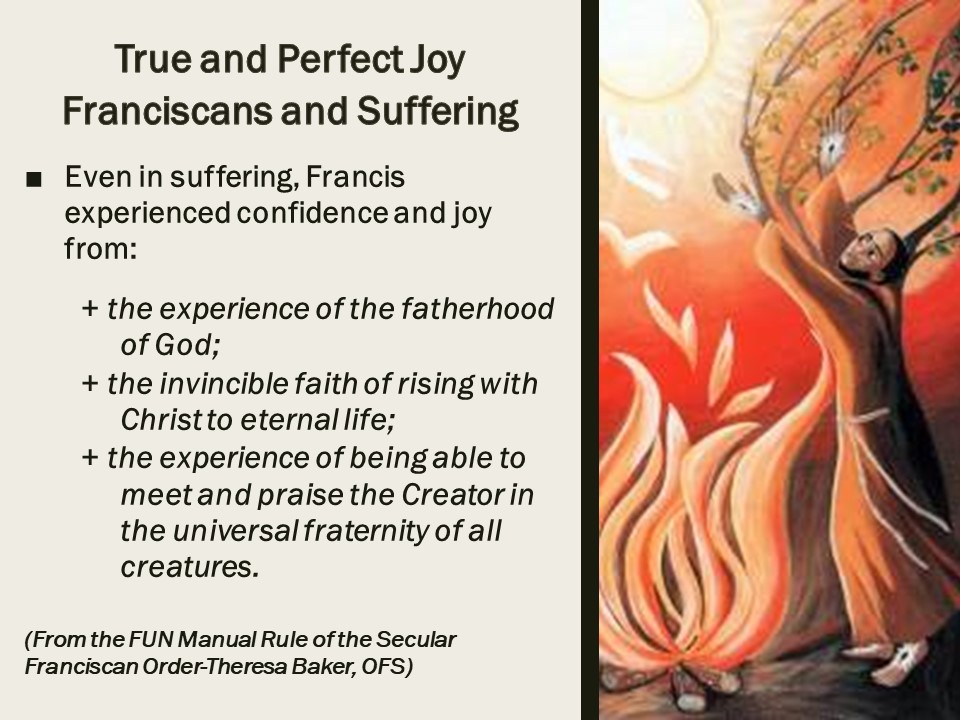
True and Perfect Joy: Franciscans and Suffering

Even in suffering, Francis experienced confidence and joy from:

+ the experience of the fatherhood of God;

+ the invincible faith of rising with Christ to eternal life;

+ the experience of being able to meet and praise the Creator in the universal fraternity of all creatures.

(From the FUN Manual “Rule of the Secular Franciscan Order”-Theresa Baker, OFS)


TRUE AND PERFECT JOY

https://franciscantradition.org/francis-of-assisi-early-documents/the-saint/writings-of-francis/the-undated-writings/true-and-perfect-joy/182-fa-ed-1-page-166


One day at Saint Mary [of the Angels] blessed Francis called Brother Leo and said: “Brother Leo, write.” 2He responded: “Look, I’m ready!” 3“Write,” he said, “what true joy is.”

4“A messenger arrives and says that all the Masters of Paris have entered the Order. Write: this isn’t true joy! 5Or, that all the prelates, archbishops and bishops beyond the mountains, as well as the King of France and the King of England [have entered the Order]. Write: this isn’t true joy!

6Again, that my brothers have gone to the non-believers and converted all of them to the faith; again, that I have so much grace from God that I heal the sick and perform many miracles. I tell you true joy doesn’t consist in any of these things.”

7“Then what is true joy?”

8“I return from Perugia and arrive here in the dead of night. It’s winter time, muddy, and so cold that icicles have formed on the edges of my habit and keep striking my legs and blood flows from such wounds. 9Freezing, covered with mud and ice, I come to the gate and, after I’ve knocked and called for some time, a brother comes and asks: ‘Who are you?’ ‘Brother Francis,’ I answer. 10‘Go away!’ he says. ‘This is not a decent hour to be wandering about! You may not come in!’ 11When I insist, he replies: ‘Go away! You are simple and stupid! Don’t come back to us again! There are many of us here like you—we don’t need you!’

12I stand again at the door and say: ‘For the love of God, take me in tonight!” 13And he replies: ‘I will not! 14Go to the Crosiers’ place and ask there!’ 15“I tell you this: If I had patience and did not become upset, true joy, as well as true virtue and the salvation of my soul, would consist in this.”


Questions to Ponder (for discussion)


+What were some of the sufferings St. Francis endured in his lifetime? What can we learn from his sufferings?

+Would you know how to explain “Perfect Joy?” (Read again about “Perfect Joy” above or in the Little Flowers.)

+What role does suffering play in our lives?

+How do you view suffering?

+Is suffering a punishment or an opportunity?


+++++++++


La alegría verdadera y perfecta: los franciscanos y el sufrimiento


Incluso cuando sufría, Francisco experimentó confianza y alegría en:

+ la experiencia de la paternidad de Dios;

+ la fe invencible de resucitar con Cristo a la vida eterna;

+ la experiencia de poder conocer y alabar al Creador en la fraternidad universal de todas las criaturas.


( FUN Manual “La regla de la Orden Franciscana Seglar”-Theresa Baker, OFS)


DE LA VERDADERA Y PERFECTA ALEGRÍA

https://www.franciscanos.org/esfa/veral.html


1El mismo fray Leonardo refirió allí mismo que cierto día el bienaventurado Francisco, en Santa María, llamó a fray León y le dijo: «Hermano León, escribe». 2El cual respondió: «Heme aquí preparado». 3«Escribe –dijo– cuál es la verdadera alegría. 4Viene un mensajero y dice que todos los maestros de París han ingresado en la Orden. Escribe: No es la verdadera alegría. 5Y que también, todos los prelados ultramontanos, arzobispos y obispos; y que también, el rey de Francia y el rey de Inglaterra. Escribe: No es la verdadera alegría. 6También, que mis frailes se fueron a los infieles y los convirtieron a todos a la fe; también, que tengo tanta gracia de Dios que sano a los enfermos y hago muchos milagros: Te digo que en todas estas cosas no está la verdadera alegría. 7Pero ¿cuál es la verdadera alegría? 8Vuelvo de Perusa y en una noche profunda llegó acá, y es el tiempo de un invierno de lodos y tan frío, que se forman canelones del agua fría congelada en las extremidades de la túnica, y hieren continuamente las piernas, y mana sangre de tales heridas. 9Y todo envuelto en lodo y frío y hielo, llego a la puerta, y, después de haber golpeado y llamado por largo tiempo, viene el hermano y pregunta: ¿Quién es? Yo respondo: El hermano Francisco. 10Y él dice: Vete; no es hora decente de andar de camino; no entrarás. 11E insistiendo yo de nuevo, me responde: Vete, tú eres un simple y un ignorante; ya no vienes con nosotros; nosotros somos tantos y tales, que no te necesitamos. 12Y yo de nuevo estoy de pie en la puerta y digo: Por amor de Dios recogedme esta noche. 13Y él responde: No lo haré. 14Vete al lugar de los Crucíferos y pide allí. 15Te digo que si hubiere tenido paciencia y no me hubiere alterado, que en esto está la verdadera alegría y la verdadera virtud y la salvación del alma.»


Preguntas para reflexionar (y discutir)


+ ¿Cuáles fueron algunos de los sufrimientos que experimentó San Francisco en su vida?

¿Qué podemos aprender de sus sufrimientos?

+ ¿Sabría usted cómo explicar La “Perfecta alegría?” (Lea otra vez “De la verdadera y perfecta alegría arriba) o en Las florecillas).

+ ¿Qué papel juega el sufrimiento en nuestras vidas?

+ ¿Cómo ve el sufrimiento?

+ ¿Es el sufrimiento un castigo o una oportunidad?

 
Diane F. Menditto, OFS
Vice Minister, National Fraternity, Secular Franciscan Order USA
Listen – Discern – Go Forth National Theme 2022-2025

Family Apostolate – JPIC for Secular Franciscans

(This article originally appeared in the TAU-USA Spring 2025  Issue #115)

The Family Apostolate:

JPIC for Secular Franciscans

by Francine Gikow, OFS

National Formation Commission

A JPIC apostolate for Secular Franciscans, essential and unique to our order, is our ministry to our families. Pope St. John Paul II, in his Letter to Families (FC), stated: “…a person normally comes into the world within a family and can be said to owe to the family the very fact of his existing as an individual.” (p.6) From the United States Catholic Catechism for Adults: The family is essential and a prerequisite for a healthy society due to the authority, stability, and loving relationships that are found in families in order to sustain freedom, security, and community responsibility. (USCC-A, p.383)

Our families are not just biological or relational connections. In Lumen Gentium, Family is described as “the domestic church” (LG, 11) because we share common beliefs, purpose, and life, in a family. “…[It] has been a treasure for the Church…[and] grows out of the rich tradition of the old covenant, is completed in the new and finds its fullest symbolic expression in the mystery of the Holy Family in which the divine bridegroom brings about the redemption of all families.” (FC, p. 92)

If married, “…in virtue of the sacrament of Matrimony by which they signify and share the mystery of the unity and faithful love between Christ and the Church, the Christian married couples help one another to attain holiness in their married state and in the rearing of children.” (LG,11) Pope St. John Paul II expands this thought: “[Even] if someone chooses to remain single, the family continues to be, as it were, his existential horizon, that fundamental community in which the whole network of social relations is grounded….Do we not often speak of the “human family” when referring to all people living in the world?” (FC, p.6)

In our Rule, Article 17 states: “In their family they should cultivate the Franciscan spirit of peace, fidelity, and respect for life, striving to make of it a sign of a world already renewed in Christ.”  However, the Church is realistic when she adds: “They need to remember that a family is holy not because it is perfect, but because God’s grace is at work in it.” (USCC-A p. 376)

Our General Constitutions expand this emphasis on the importance of family by saying, “Secular Franciscans should consider their own family to be the first place in which to live their Christian commitment and Franciscan vocation. They should make space within it for prayer, the Word of God, and Christian catechesis. They should concern themselves with respect for all life in every situation from conception until death.” (GC:24)

Article 17 or our Rule continues: “By living the grace of matrimony, husbands and wives in particular, should bear witness in the world to the love of Christ for his Church.” We can be this witness when we joyfully accompany our children on their human and spiritual journey by providing a simple and open Christian education and being attentive to the vocation of each child.

Our Constitution summarizes our family apostolate when it describes the importance of this ministry to our families and its effect on the world: “Participation in the service and sanctification, which the Church exercises through the liturgy, prayer, and works of penance and charity, is put into practice by the brothers and sisters above all in their own family, then in the fraternity and, finally through their active presence in the local church and in society.” (GC:17.4)

Pray silently for 10 minutes and consider:

  • Have you seen ministry to your own family as important for your Secular Franciscan vocation in the past?
  • How has this information changed your understanding of the importance of family ministry?
  • What changes can you make for your family?

https://www.secularfranciscansusa.org/2025/08/family-apostolate-jpic-for-secular-franciscans/

Quinquennial Registration Open

Registration is open for the Quinquennial scheduled for July 29-Aug. 2, 2026, in Lexington, KY.   Keynote speakers are Br. Bill Short, OFM; Darleen Pryds, Phd; and Fr. Wayne Hellmann, OFM Conv.

Brother Short, a popular Franciscan speaker, is Director Collegium S. Bonaventurae-Frati Editori di Quaracchi Collegio S. Isidoro in Rome, Italy, and professor of spirituality at the Franciscan School of Theology.

Dr. Pryds is associate professor of Spirituality and History and Academic Director, MTS-Franciscan Theology online degree, at the Franciscan School of Theology in San Diego; Acquisitions Editor, Franciscan Media

Fr. Hellman is professor emeritus at Saint Louis University, where he had served for forty-five years. He had earned his doctorate in theology from Ludwig-Maximilians-Universität in Munich, Germany, in 1974.  He has published extensively on St. Bonaventure and the Franciscan intellectual tradition.

Title of the Q is “Easter of St. Francis; Rekindle the Flame.”  It will be held at the Lexington Griffin Gate Marriott Golf Resort & Spa.

More information on the speakers, registration information, and other details can be found on the Quinquennial page.

Quinquennial Registration Open

The Gospel Through a Franciscan Lens – 20th Sunday in Ordinary Time – Fr. Christopher

Jesus is the Messiah, sent by the Father, to establish His rule of justice, love and peace.  This will mean good news for the poor, healing for the sick, and liberation for the enslaved and oppressed.  Jesus’ mission was to set the world on fire, not with the fire of hatred and division, but with the fire of an unquenchable and unconquerable love, especially His outreach to the poor and marginalized, with the fire that represented an absolute reversal of the unjust status quo, the powerful religious and political elites of His day.

Father’s Homily – video

Father’s Homily – text

https://www.secularfranciscansusa.org/2025/08/the-gospel-through-a-franciscan-lens-20th-sunday-in-ordinary-time-fr-christopher/

Scroll to top
Juan de Padilla