(en español abajo) Korean translation attached in a separate PDF.
Please share with your local fraternityDiscernment before electing or being elected to a Secular Franciscan Council
National elections are coming up on September 13th. There will also be elections in many regions and in many local fraternities. If you are thinking of nominating or voting for someone, or accepting a nomination yourself, here are some things to think about.
Take into consideration the following items when thinking about your own or someone else’s service:
- Love of the Order and willingness to serve
- Faith in the guidance of the Holy Spirit. Prayer is an important factor in daily life.
- Time– A willingness to make working with the fraternity a priority even if it means leaving other activities, and realizing that we ask nothing in return for our service.
- Experience: At the local level—participation in fraternity activities; at the regional level—prior service on the council at the local level and participation in regional events; at the national level—service on the local and regional levels, especially having served on the council.
- Organizational skills—demonstrates timeliness in completing projects as promised. Shows a willingness to prepare ahead of time.
- Communication skills—ability and desire to keep our members up to date with what is going on at the higher level in a variety of ways including print, verbally, and on social media. On the local level desire and ability to communicate with all members.
- Fraternal dialogue—willingness to listen to others, ask for, and act on their input and suggestions.
- Collaborative spirit—ability to recognize and appreciate the gifts others have and allow them to use their talents to move the Order and its projects forward.
- Ability to support others as they carry out their assigned tasks. If the council works together, the load we carry is much lighter.
- Trust in the abilities and integrity of others in the fraternity.
- Understanding that we can only move forward if we are well-formed as Secular Franciscans. Personal Formation and formation for councils should never end.
- Energy and enthusiasm—councils are called to “animate and guide” the members. Having enthusiasm for living the gift of our Rule and Constitutions and encouraging others to understand how important our documents are to every aspect of our lives as Secular Franciscans is important.
- Desire and willingness to collaborate with our spiritual assistants, friars, and other members of the Franciscan family, and with the Church in general
- Willingness to ask for assistance from the higher level
- Desire and ability to build on what has been accomplished by the prior Council—local, regional, or national.
For discussion in your fraternity, with a prayer partner, or to comment on in your journal.
+Think of the Franciscan servant leaders you have known. Which characteristics above apply to them?
+What kind of effect do these servant leaders have on the fraternity?
+Think about your qualities as a servant leader. How do you measure up?Formación 5 de septiembre de 2025 (Comparta con su fraternidad local)
Discernimiento antes de elegir o ser elegido para un Consejo Franciscano Seglar
Las elecciones nacionales serán el 13 de septiembre. También habrá elecciones en muchas regiones y en muchas fraternidades locales. Si está pensando en nominar o votar por alguien, o aceptar una nominación usted mismo, aquí hay algunas cosas en las que debe pensar.
Tenga en cuenta los siguientes elementos cuando piense en su propio servicio o en el de otra persona:
- Amor a la Orden y voluntad de servicio
- Fe en la guía del Espíritu Santo. La oración es un factor importante en la vida diaria.
- Tiempo: la voluntad de hacer que trabajar con la fraternidad sea una prioridad, incluso si eso significa dejar otras actividades y darse cuenta de que no pedimos nada a cambio de nuestro servicio.
- Experiencia: A nivel local—participación en las actividades de la fraternidad; a nivel regional—servicio previo en el consejo a nivel local y participación en eventos regionales; a nivel nacional— servicio a nivel local y regional, especialmente haber servido en el concilio.
- Habilidades organizativas: demuestra puntualidad en la finalización de los proyectos según lo prometido. Muestra disposición a prepararse con anticipación.
- Habilidades de comunicación: capacidad y deseo de mantener a nuestros miembros actualizados con lo que sucede en el nivel superior en una variedad de formas, que incluyen impresos, verbalmente y en las redes sociales. A nivel local deseo y capacidad de comunicarse con todos los miembros.
- Diálogo fraterno: disponibilidad para escuchar a los demás, pedir y actuar sobre sus aportes y sugerencias.
- Espíritu de colaboración: capacidad de reconocer y apreciar los dones que tienen los demás y permitirles usar sus talentos para hacer avanzar la Orden y sus proyectos.
- Habilidad para apoyar a otros mientras llevan a cabo sus tareas asignadas. Si el consejo trabaja en conjunto, la carga que llevamos es mucho más liviana.
- Confiar en las capacidades y la integridad de los demás en la fraternidad.
- Comprender que solo podemos avanzar si estamos bien formados como franciscanos seglares. La Formación personal y la formación para los consejos nunca debe terminar.
- Energía y entusiasmo: los concilios están llamados a “animar y guiar” a los miembros. Tener entusiasmo por vivir el don de nuestra Regla y Constituciones y alentar a otros a comprender cuán importantes son nuestros documentos para cada aspecto de nuestras vidas como franciscanos seglares es importante.
- Deseo y disposición de colaborar con nuestros asistentes espirituales, frailes y demás miembros de la familia franciscana, y con la Iglesia en general
- Voluntad de pedir ayuda al nivel superior
- Deseo y capacidad de construir sobre lo logrado por el Concilio anterior—local, regional o nacional.
Para discutir en su fraternidad, con un compañero de oración, o para comentar en tu diario.
+Piense en los líderes servidores franciscanos que ha conocido. ¿Qué características anteriores se aplican a ellos?
+¿Qué tipo de efecto tienen estos líderes servidores en la fraternidad?
+Piense en sus cualidades como líder servidor. ¿Cómo se mide?Diane F. Menditto, OFSVice Minister, National Fraternity, Secular Franciscan Order USAListen – Discern – Go Forth National Theme 2022-2025
OFS-USA Governing Documents Cross-Reference Index
 The Essential Documents of the Secular Franciscan Order (2005) is no longer in print.
The Index in this document has been recently updated and has been added to the Home page on the OFS-USA website along with the OFS-USA Governing Documents that are contained within The Essential Documents of the Secular Franciscan Order.
ON THE HOME PAGE
https://www.secularfranciscansusa.org/
OFS GOVERNING DOCUMENTS
- The Rule of the Secular Franciscan Order – 2020 Updated Translation in English & Spanish
- The General Constitutions of the Secular Franciscan Order (2000) – 2020 Updated Translation in English & Spanish
- Statutes of the National Fraternity of the Secular Franciscan Order in the United States of America
- Ritual of the Secular Franciscan Order – 2020 Updated Translation
- Index to OFS Governing Docs (August 2025) – (This Index includes topical cross-references from the Rule 1978, General Constitutions 2000, OFS-USA Statutes 2003, The Ritual 1985, and Statutes for Spiritual and Pastoral Assistance to the Secular Franciscan Order 2002)
https://www.secularfranciscansusa.org/2025/09/ofs-usa-governing-documents-cross-reference-index/
A Dog Bite and Matthew 5:44
(This article originally appeared in the TAU-USA Summer 2025 Issue #116)
by Jane De-Rose Bamman, OFS
National Minister
 Recently, a dog bit me. At our initial encounter, he seemed friendly but as he was passing me, he turned around to bite my leg. Not a nip – a real bite! I did nothing to provoke it. But who really knows … the dog didn’t give me a reason for the action.
That experience made me ponder our relationships, especially with our enemies. Although we don’t always recognize them at first, people who can harm us do exist.
Daily we pray: “… he promised of old that he would save us from our enemies, from the hands of all who hate us.” (Lk 1:70-71). Then in Matt 5:44, Jesus said “… love your enemies, and pray for those who persecute you.”
These scripture passages challenge us to consider what an enemy is and who our enemies are. According to The American Heritage Dictionary, enemy comes from the Latin word inimicus which means “bad friend.”
Do I have any human enemies? Is there anyone in my family, fraternity, community or in the world, I view as an enemy or a bad friend? No one comes to mind. But I do avoid those whose actions irritate me or who are arrogant or rude. Enemies? Sort of.
Does an enemy need to know that they are considered an enemy to truly be one? Does it have to be mutual with each person hating the other? If it is just in my mind, does it meet the definition of an enemy?
Matt 5:44 calls us to love our enemies. In one case, I considered a former coworker, now a competitor, as an enemy. I harbored ill feelings because I felt the coworker had badmouthed my husband, Brian, and me. I did not want to be around that person at all. Instead of killing the relationship, it was time for me to apply Matt 5:44 – a work in progress. People of various cultures may be viewed as enemies because of differences or their impact on the environment. Neighbors may be considered enemies because of noise levels or unkept yards, harming your sense of peace and quiet or property value. Fraternity brothers or sisters may be thought of as enemies because they ask us to do something we don’t agree with, or we don’t feel we are treated with the respect we deserve. Am I willing to love my enemies and pray for those who persecute me – including family members? I am willing to try.
I have been guilty of assuming something about a perceived enemy and come to find out the person had no intent of harm at all. I just needed to get to know the person or the full story behind the circumstances.
The wisdom of the Gospel call to love our enemies is a prompt to be in relationship with these persons. Sometimes when coexisting you can see the benefits of another. Having a relationship with an enemy may actually turn that person into a friend.
Although I choose to try to apply Matt 5:44 instead of harboring ill will towards a “bad friend,” I will still be cautious with stray dogs in the neighborhood.
https://www.secularfranciscansusa.org/2025/09/a-dog-bite-and-matthew-544/
Favorite Article, Scripture or Story : Compilation by NEC Members
By National Executive Committee Members
At the last National Executive Council meeting, minister Jane De-Rose Bamman asked members to share either their favorite article of the Rule, scripture quote or story about St. Francis. This is a compilation of their sacred thoughts.
President-in-turn Conference of National Spiritual Assistants Fr. Marek Stybor, OFM Conv.
-“I am the vine; you are the branches. Whoever abides in me and I in him bears much fruit, for apart from me you can do nothing.” John 15:5
Minister Jane De-Rose Bamman
– “Go into the whole world and tell the Good News.” Mark 16:15
Vice minister Diane Menditto
– But how happy and blessed are those who love God and do as the Lord Himself says in the Gospel: You shall love the Lord your God with all your heart and all your mind, and your neighbor as yourself. (Mt 22:37; Mt 22:39) (St. Francis of Assisi FA:ED, vol. 1, 46 Later Admonition and Exhortation) and The story of St. Francis kissing the leper with the emphasis not only on how it changed Francis, but on how the leper felt and was changed.
Secretary Susan Ronan
–“Praise the Lord for His loving kindness will never fail.” Psalm 136:1
Treasurer Claudia Kauzlarich
– “Be still and know that I am God.” Psalm 46:10
YouFra Commission Chair Kathleen Molaro
– We are called to be “messengers of perfect joy in every circumstance,” and to “strive to bring joy and hope to others.” OFS Rule: Article 19
Councilor Cherryle Fruge
– “Mindful that they are bearers of peace which must be built up unceasingly, they shall seek out ways of unity and fraternal harmony through dialogue, trusting in the presence of the divine seed in everyone and in the transforming power of love and pardon. Messengers of perfect joy in every circumstance, they should strive to bring joy and hope to others. Since they are immersed in the resurrection of Christ, which gives true meaning to Sister Death, let them serenely tend toward the ultimate encounter with the Father.” OFS Rule: Article 19
International Councilor Mary Frances Charsky
– “The Greatest Commandment: Jesus said to him, “You shall love the Lord your God with all your heart, and with all your soul, and with all your mind. This is the greatest and the first commandment. The second is like it: You shall love your neighbor as yourself.” Matthew 22: 37-29 from Matthew 22: 34 to 40
Formation Director Layna Maher
-“Let them, individually and collectively, be in the forefront in promoting justice by the testimony of their human lives and their courageous initiatives.” OFS Rule: Article 14 and “He will answer them, ‘Amen, I say to you, what you did not do for one of these least ones, you did not do for me.’” Matthew 25:45
Councilor Donna Hollis
– Parable of the Good Samaritan
JPIC Commission Chair Joe Makley
– “Come now, let’s put things right.” Isaiah 1:16-17
Councilor Josh Molidor
–”Ready and willing Spirit for the community.” OFS Rule: Article 21
https://www.secularfranciscansusa.org/2025/09/favorit-article-from-rule-compilation-by-nec-members/
FORMATION FRIDAY – Why Tau Cross so Important to St. Francis? Why We Wear the Tau? – August 29, 2025
(en español abajo)
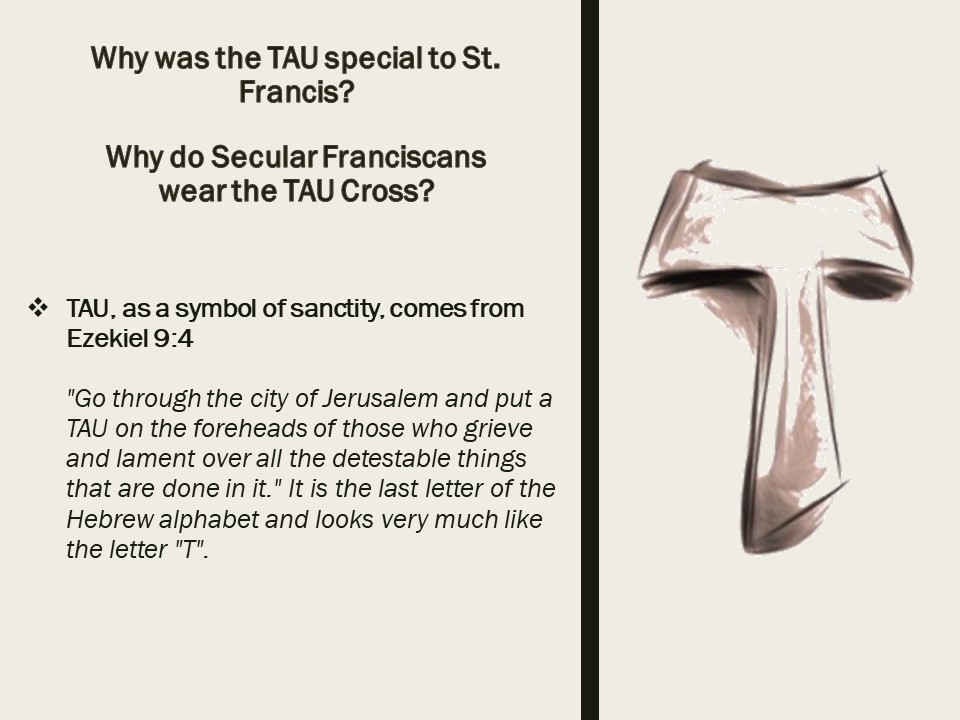
Please share with your local fraternityWhy was the TAU Cross so important to St. Francis? Why do we OFS wear the TAU?The TAU, as a symbol of sanctity, comes from Ezekiel 9:4
- “Go through the city of Jerusalem and put a TAU on the foreheads of those who
grieve and lament over all the detestable things that are done in it.” It is the last
letter of the Hebrew alphabet and looks very much like the letter “T”.- Franciscan scholarship points to St. Francis’s being present at the Lateran Council in 1215
While attending he would have heard Pope Innocent III announce that every Catholic should take the TAU Cross as the symbol of their Passover. “The Pope set forth the Tau as a sign of penance and renewal in Christ. Francis embraced this sign as an expression of Christ’s cross. In hearing the story, Francis experienced a confirmation of the LIFE and MISSION of his new order. The Tau became for him a symbol of exodus and pilgrimage with which he wanted his companions signed as ‘the new and humble people of God.’”
- He would have heard that the elect, the chosen will be marked with the sign of the TAU (Ezekiel 9:4)
- He would have heard the pope say that the TAU has the form of the Cross on which our Lord was crucified and that those who had mortified their flesh and conformed their life to that of Christ crucified will obtain mercy.
- From then on, the TAU became Francis’s own coat of arms and he often used it in his writings as his personal signature.
Why do many Secular Franciscans wear the TAU cross?
· Article 43 of the General Constitutions establishes that: “The distinctive sign of belonging to the Order (the “TAU” or other Franciscan symbol).
· Article 16.4 of the National Statutes of the United States states: “The external sign of the OFS in the United States is the TAU.
“The Tau Cross [adapted from Catch Me A Rainbow Too by Fr. Lester Bach, O.F.M. Cap.] Franciscans use the Tau as a symbol of commitment to Jesus through the O.F.S. Way of Life. The Tau cross is the sign of the O.F.S. in this country, not the San Damiano crucifix, not a medal of St. Francis, not a scapular and cord (such as were mandated under the Rule of 1883), and not a modified religious habit such as the friars wear! The Tau is worn with pride and joy. Francis saw the Tau as a symbol of the cross of Christ. It was the sign of salvation. It was a sign of belonging to God, being chosen and saved. Francis embraced it with love. It was pregnant with meaning for him. Franciscans wear it as a sign of their commitment to Jesus and the Gospel way of life.”
Direct quotes from: Tau Cross Statements by Deacon Dave and Thérèse Ream, OFS
The following questions are for discussion in fraternity, with a prayer partner, or to answer in your journal.
+Do you always wear your TAU cross? Why or why not?
+When you received your TAU at the Rite of Admission, what did it symbolize to you?
+If someone asks you what the TAU is and why you wear it, what is your answer to them?
Formación 29 de agosto de 2025
Comparta con su fraternidad local
¿Por qué la Cruz TAU fue tan importante para San Francisco? ¿Por qué los Seglares franciscanos llevamos la TAU?
- La TAU, como símbolo de santidad, proviene de Ezequiel 9,4
“Pasen por la ciudad de Jerusalén y poned una TAU en la frente de los que
se entristecen y lamentan por todas las cosas detestables que en ella se hacen.” Es la última letra del alfabeto hebreo y se parece mucho a la letra “T.”- La erudición franciscana apunta a la presencia de San Francisco en el Concilio de Letrán en 1215.
Mientras asistía, habría escuchado al Papa Inocencio III anunciar que todos los católicos deberían llevar la Cruz TAU como símbolo de su Pascua. “El Papa planteó la Tau como signo de penitencia y renovación en Cristo. Francisco abrazó este signo como expresión de la cruz de Cristo. Al escuchar la historia, Francisco experimentó una confirmación de la VIDA y MISIÓN de su nueva orden. La Tau se convirtió para él en un símbolo de éxodo y peregrinaje con el que quería que sus compañeros se firmaran como ‘el nuevo y humilde pueblo de Dios.’”
- él hubiera escuchado que los elegidos, los escogidos serán marcados con la señal de la TAU (Ezequiel 9,4)
- él hubiera escuchado al Papa cuando dijo que la TAU tiene la forma de la Cruz en la que nuestro Señor fue crucificado y que aquellos que mortificaran su carne y conformaran su vida a la de Cristo crucificado obtendrían misericordia.
- A partir de entonces, la TAU se convirtió en el escudo de armas de Francisco y a menudo lo utilizó en sus escritos como su firma personal.
¿Por qué muchos franciscanos seglares llevan la cruz TAU?
· El artículo 43 de las Constituciones Generales establece que: “el signo distintivo de pertenencia a la Orden es (la “TAU” u otro símbolo franciscano).
· El artículo 16.4 de los Estatutos Nacionales de los Estados Unidos establece: “El signo externo de la OFS en los Estados Unidos es la TAU.”
“La Cruz Tau [adaptado de Catch Me A Rainbow Too por el Padre Lester Bach, OFM Cap.] Los franciscanos usan la Tau como símbolo de compromiso con Jesús a través del Modo de Vida de la OFS. La cruz Tau es el signo de la OFS en este país, no el crucifijo de San Damián, no es una medalla de San Francisco, no es un escapulario y un cordón (como se ordenó bajo la Regla de 1883), y ¡no es un hábito religioso modificado como los que usan los frailes! La Tau se lleva con orgullo y alegría. Francisco vio la Tau como un símbolo de la cruz de Cristo. Era la señal de la salvación. Era un signo de pertenencia a Dios, de ser elegido y salvado. Francisco lo abrazó con amor. Estaba preñado de significado para él. Los franciscanos lo usan como un signo de su compromiso con Jesús y el estilo de vida del Evangelio.”
Citas directas de: “Tau Cross Statements” del diácono Dave y Thérèse Ream, OFS
Las siguientes preguntas son para discutir en fraternidad, con un compañero de oración, o para responder en su diario.
+¿Siempre lleva su cruz TAU? ¿Por qué sí o por qué no?
+Cuando recibió su TAU en el Rito de Admisión, ¿qué simbolizó para usted?
+Si alguien le pregunta qué es el TAU y por qué lo lleva, ¿cuál es su respuesta?
Diane F. Menditto, OFSVice Minister, National Fraternity, Secular Franciscan Order USAListen – Discern – Go Forth National Theme 2022-2025