We Are Family! OFS Rule Article 1

Jane DeRose-Bamman, OFS
National Minister


Jane DeRose-Bamman
National Minister

How large is your family?  The size of my family has varied over the years.  Biologically speaking, I was raised in a large family (seven children). Lots of cousins on both sides.  In contrast, as an adult, my immediate family has only two.

My experience of Franciscan fraternity families has varied also.  I professed while a member of a large fraternity (probably 80-100 people).  I am now a member of a small fraternity with three professed and seven in formation.

The size of the family or fraternity does not matter. What matters is the connection, the relationships.

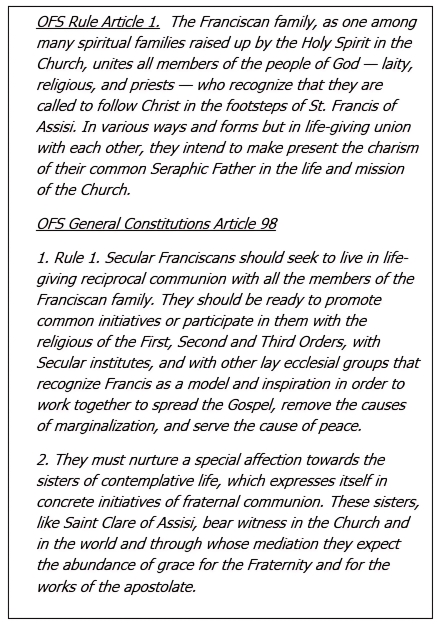
Article 1 of the OFS Rule states we are a part of a family. This family has an important role in the life and mission of the Church. 

Each member has unique gifts and skills. We aren’t clones of each other. St. Francis stressed to his brothers that they were not to copy him, but rather seek what was theirs to do in following the teachings of Jesus Christ.

Article 98 of the OFS General Constitutions expounds on Article 1 of the OFS Rule.

We are called to live in life-giving reciprocal communion with all members of the Franciscan Family. Our family is LARGE – First, Second and Third Orders, Secular Institutes, other lay ecclesial groups who follow Christ in the footsteps of St. Francis. The Franciscan Family is called to work together to spread the Gospel, remove the causes of marginalization, and serve the cause of peace.

Let’s not get overwhelmed, rather let’s embrace the call to connect with our family and further these initiatives as the Holy Spirit is calling us to do. I look forward to building relationships and to hearing how others are doing the same.

Speaking of relationships, since we are family, I look forward to an invitation to come over for dinner soon.

https://www.secularfranciscansusa.org/2025/10/we-are-family/

¡Somos una familia! Artículo 1 de la Regla de la OFS

Jane DeRose-Bamman, OFS
Ministra Nacional


Jane DeRose-Bamman
Ministra Nacional

¿Cuántos miembros hay en su familia? El tamaño de mi familia ha variado a lo largo de los años. Desde el punto de vista biológico, crecí en una familia numerosa (siete hijos). Tengo muchos primos por ambas partes. Por el contrario, como adulto, mi familia inmediata solo tiene dos miembros.

Mi experiencia con las familias de la fraternidad franciscana también ha variado. Me profesé mientras era miembro de una fraternidad grande (probablemente entre 80 y 100 personas). Ahora soy miembro de una pequeña fraternidad con tres profesos y siete en formación.El tamaño de la familia o la fraternidad no importa. Lo que importa es la conexión, las relaciones.

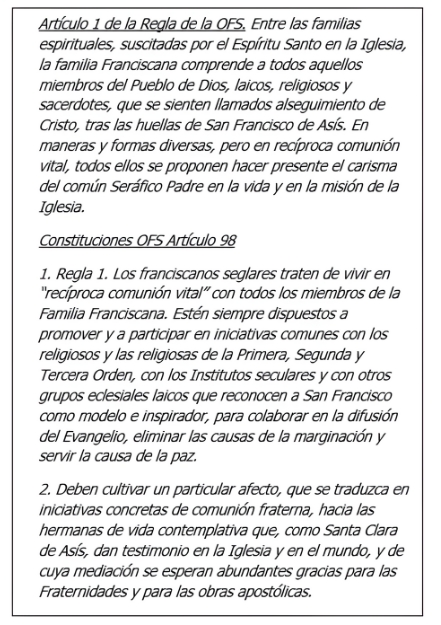
El artículo 1 de la Regla de la OFS establece que formamos parte de una familia. Esta familia tiene un papel importante en la vida y la misión de la Iglesia.

Cada miembro tiene dones y habilidades únicas. No somos clones unos de otros. San Francisco insistió a sus hermanos en que no debían imitarlo, sino buscar lo que les correspondía hacer siguiendo las enseñanzas de Jesucristo.

El artículo 98 de las Constituciones Generales de la OFS expone el artículo 1 de la Regla de la OFS.

Estamos llamados a vivir en comunión recíproca y vivificante con todos los miembros de la Familia Franciscana. Nuestra familia es GRANDE: Primera, Segunda y Tercera Orden, Institutos Seculares, otros grupos eclesiales laicos que siguen a Cristo tras las huellas de San Francisco. La Familia Franciscana está llamada a colaborar para difundir el Evangelio, eliminar las causas de la marginación y servir a la causa de la paz.

No nos sintamos abrumados, sino que aceptemos el llamado a conectarnos con nuestra familia y promover estas iniciativas, tal como nos lo pide el Espíritu Santo. Espero con interés establecer relaciones. y escuchar cómo otros están haciendo lo mismo.

Hablando de relaciones, ya que somos familia, espero recibir pronto una invitación para cenar.

https://www.secularfranciscansusa.org/2025/10/somos-una-familia/

Multicultural Relationships

(This article originally appeared in the TAU-USA Summer 2025  Issue #116)

by Willie Guadalupe, OFS

Multicultural Coordinator

Multicultural relationships involve partners from different cultural backgrounds and can present challenges and opportunities. Effective communication is very important, as language barriers and different cultural expressions can complicate relations. You need to be able to understand the differences. Partners may face differences in standards, beliefs, and behaviors, which require time, patience, and effort. These relationships can lead to a rich exchange of ideas and cultural norms, fostering personal growth for those involved. Overall multicultural relationships can be rewarding but as stated they require patience, understanding, and open communication to be successful.

Multicultural relationships are justice issues that seek the good of the other person(s). As Franciscans, we are known for our dedication to justice. We strive to bring people together in a society that is fair (or just). Each person needs to feel welcomed to create a diverse OFS community. Each person needs to know that their culture is important to others. When we take the time to  connect with people from other cultures, we break down  barriers and challenges that may exist.

The link between justice and relationships moves us to develop personal viewpoints and actions that build on relationships. We cannot tolerate actions that deny basic human dignity to anyone involved. Problems become opportunities when the right people work together.

OFS Rule, Article #15 Let them individually and collectively be in the forefront in promoting justice by the testimony of their human lives and their courageous initiatives.

Especially in the field of public life, we should make definite choices in harmony with our faith. Immigrants or minority groups who speak a different language may face challenges in communicating their ideas, needs, or concerns. This can create feelings of isolation and marginalization, preventing individuals from fully participating in society.

We need to address the language challenges inherent in relating to other cultures. Some may speak English, may read English, may write English, but many may not. We need to be considerate of that and know that many times they will need to receive opportunities in their preparation and instruction in formation in their native language. Even for those who may be bilingual, their native language may be their preferred language for worship, or for prayer, because it is their love language.

Almighty God, through your Holy Spirit you

created unity in the midst of diversity.

We acknowledge that human diversity is an

expression of your manifold love for your creation.

We confess that in our brokenness as human

beings we turn diversity into a source of

alienation, injustice, oppression, and wounding.

Empower us to recognize and celebrate

differences as your great gift to the human family.

Enable us to be the architects of understanding,

of respect and love.

Please fill our hearts with your Love so that your

light may shine through each one of us.

AMEN

From jesuitresource.org

Author Unknown; modified by Wilie Guadalupe

https://www.secularfranciscansusa.org/2025/09/multicultural-relationships/

The Gospel Through a Franciscan Lens – 26th Sunday in Ordinary Time – Fr. Christopher

The rich man and Lazarus – Wealth and luxury in itself are not the problem in the story.  St Luke makes the point in his Gospel that living such a life blinded the man to the need of a fellow human being, pointing to wider social responsibility.

Father’s Homily – text

https://www.secularfranciscansusa.org/2025/09/the-gospel-through-a-franciscan-lens-26th-sunday-in-ordinary-time-fr-christopher-2/

Open post

Formation Friday – St. Francis of Assisi: Trinitarian Man – September 26, 2025

[Recursos en español abajo] (Please share with your local fraternities) Korean translation attached in separate PDF.

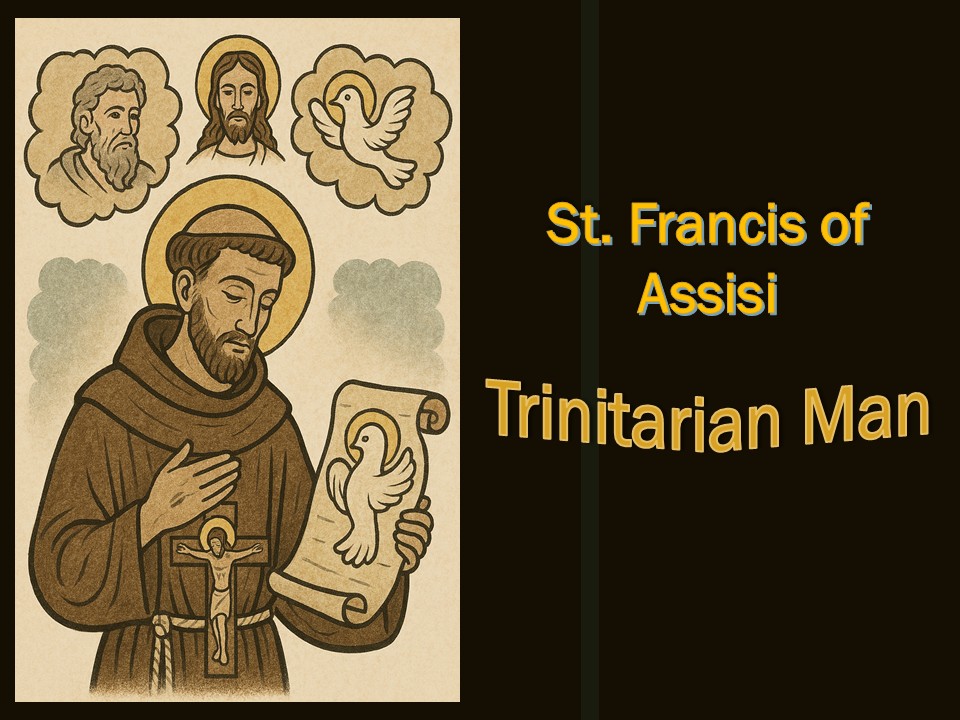
St. Francis of Assisi: Trinitarian Man


St. Francis yearned for relationship with God the Father. His goal was to follow Christ who would guide him to the Father. He wanted to be loved by the Father as Jesus is loved.

FRANCIS: Child of the Father

• Lived in radical trust and dependence on God’s providence

• Saw all creation as a reflection of the Father’s love and generosity

• Embraced poverty as a way to honor the Father’s care for all creatures


FRANCIS: Imitator of the Son

• Modeled his life on Jesus’ humility, compassion, and sacrificial love

• Embraced suffering and service as a path to union with Christ

• Called himself the “Herald of the Great King,” reflecting his devotion to Christ’s kingship


FRANCIS: Bearer of the Spirit

• Radiated joy, peace, and simplicity—fruits of the Holy Spirit

• Discerned God’s will through prayer and contemplation

• Inspired communal life rooted in love, reconciliation, and spiritual renewal


FRANCIS: Trinitarian in Prayer

• Frequently invoked the Trinity in his writings and praises

• Composed prayers that glorified each Person of the Trinity distinctly yet harmoniously

• Experienced mystical union with God, especially through the stigmata—a sign of deep communion with Christ crucified


FRANCIS: Trinitarian in Mission

• Evangelized through presence, humility, and peace rather than domination

• Fostered fraternity among all people and creatures, echoing the unity of the Trinity

• Encouraged his followers to live in fraternity, mirroring the relational love of Father, Son, and Spirit


St. Francis desired to conform himself to the image of Jesus so he might be able to realize that he is also a beloved son and experience as much as possible the wonder of the Father’s love. He saw the Holy Spirit as the source of power and inspiration that opens our hearts to relationship with the Father—and the Blessed Trinity. Francis pursued a vital relationship with all three persons of the Trinity. To be in unity with the Father, Francis is willing to offer himself completely just as Jesus did.


Did you know that in Francis’s writings God is present on each page?

Father (attributed to God) is used 97 times

• Designated by name (God) 219 times

• Designated as Lord 364 times


Take some time this week to read examples of Francis’s relationship with God in his writings. Three of his writings provide a good starting place:


The Earlier Rule—especially chapter 23 “Prayer and Thanksgiving” FA:ED, vol. 1, 81

Admonition I FA:ED, vol. 1, 128

The Praises to be Said at all the Hours FA:ED, vol. 1, 161

A Prayer Inspired by the Our Father: FA:ED, vol. 1, p. 158

Questions to discuss or to answer in your journal.

+ How do you imitate Jesus in your life? Where do you find inspiration?

+ What do the writings of St. Francis tell you about his spirituality?

+ What is your image of God—Father, Son, and Holy Spirit?

Formación 26 de septiembre 2025

San Francisco de Asís: hombre trinitario


San Francisco anhelaba una relación con Dios Padre. Su objetivo era seguir a Cristo, quien lo guiaría hacia el Padre. Quería ser amado por el Padre como Jesús es amado.


FRANCISCO: Hijo del Padre

• Vivió con una confianza y dependencia radicales en la providencia de Dios.

• Veía toda la creación como un reflejo del amor y la generosidad del Padre.

• Abrazó la pobreza como una forma de honrar el cuidado del Padre por todas las criaturas.


FRANCISCO: Imitador del Hijo

• Modeló su vida según la humildad, la compasión y el amor sacrificial de Jesús.

• Abrazó el sufrimiento y el servicio como un camino hacia la unión con Cristo.

• Se llamaba a sí mismo «Heraldo del Gran Rey», lo que reflejaba su devoción por la realeza de Cristo.


FRANCISCO: Portador del Espíritu

• Irradiaba alegría, paz y sencillez, frutos del Espíritu Santo.

• Discernía la voluntad de Dios a través de la oración y la contemplación.

• Inspiró una vida comunitaria arraigada en el amor, la reconciliación y la renovación espiritual.


FRANCISCO: Trinitario en la oración

• Invocaba frecuentemente a la Trinidad en sus escritos y alabanzas.

• Compuso oraciones que glorificaban a cada Persona de la Trinidad de forma distinta pero armoniosa.

• Experimentó la unión mística con Dios, especialmente a través de los estigmas, signo de profunda comunión con Cristo crucificado.


FRANCISCO: Trinitario en la misión

• Evangelizó a través de la presencia, la humildad y la paz, en lugar de la dominación.

• Fomentó la fraternidad entre todas las personas y criaturas, haciéndose eco de la unidad de la Trinidad.

• Animó a sus seguidores a vivir en fraternidad, reflejando el amor relacional del Padre, el Hijo y el Espíritu.


San Francisco deseaba conformarse a la imagen de Jesús para poder darse cuenta de que él también era un hijo amado y experimentar en la medida de lo posible la maravilla del amor del Padre. Veía al Espíritu Santo como la fuente de poder e inspiración que abre nuestros corazones a la relación con el Padre y con la Santísima Trinidad. Francisco buscó una relación vital con las tres personas de la Trinidad. Para estar en unidad con el Padre, Francisco está dispuesto a ofrecerse completamente, tal como lo hizo Jesús.


¿Sabía que en los escritos de Francisco Dios está presente en cada página?

• Padre (atribuido a Dios) se utiliza 97 veces.

• Designado por su nombre (Dios) 219 veces.

• Designado como Señor 364 veces.


Dedique algo de tiempo esta semana a leer ejemplos de la relación de Francisco con Dios en sus escritos. Tres de sus escritos proporcionan un buen punto de partida:

REGLA NO BULADA Capítulo 23 Oración y acción de gracias” https://www.franciscanos.org/esfa/escritossf.html#rnb1r Admonición I https://www.franciscanos.org/esfa/escritossf.html#adm
Alabanzas que se han de decir en todas las Horas https://www.franciscanos.org/esfa/escritossf.html#alhor
Exposición del Padre Nuestro https://www.franciscanos.org/esfa/escritossf.html#exppn

Preguntas para platicar o responder en su diario.
+ ¿Cómo imita a Jesús en tu vida? ¿Dónde encuentra inspiración?
+ ¿Qué le dicen los escritos de San Francisco sobre su espiritualidad?

+ ¿Cuál es su imagen de Dios: ¿Padre, Hijo y Espíritu Santo?

Diane F. Menditto, OFS
Vice Minister, National Fraternity, Secular Franciscan Order USA
Listen – Discern – Go Forth National Theme 2022-2025
Scroll to top
Juan de Padilla