(En español abajo) Korean translation attached in a separate PDF
When We Gather in Chapter for the Fraternal and Pastoral VisitationIn the USA, Regional Chapters are held each year and have a profound effect on that region’s members. On the regional level, elections and visitations take place every three years. On the national level, elections also take place every three years, but the visitation by the higher level (CIOFS) takes place only every six years.
“The goal of all …Chapters is to promote communion of mind and heart, and a renewal of the lives of each and every brother and sister of the OFS Order. Speaking about renewal, it is a long aand difficult process that makes serious demands of us: the demand to return to the source of our vocation, the priorities and essential elements of our
gospel way of life that, over the course of time can become less clear and, in the extreme, no longer serve to animate and set direction for our Franciscan lives.” (Br. Michael A. Perry, OFM, former General Minister of the Order of Friars Minor, at the General Chapter of the Secular Franciscan Order in 2021.)
As you can see in what Br. Michael said, the Chapter is not only for business, although that is also important. But, probably the most important part of the gathering is fraternity and ongoing formation. National Chapters (and Regional Chapters) occur on a three-year cycle. On the regional level, a visitation by the higher fraternity is usually requested by the Regional Minister in the year following elections. The National Executive Council will then schedule the visitation according to the availability of the Minister (or her delegate) and the National Spiritual Assistant who will conduct the visit.
Did you know that…
…That the earliest Rules of our order, right up to the promulgation of the Rule of 1978 and the Constitutions of 1990 (updated in 2000 and 2001), required that the visitor be a friar alone? (You can read about this in the Handbook for Spiritual Assistance—updated in 2012)
…That our present-day Rule in Article 26 and our Constitutions in Articles 92 and 94 give us important insight into the Fraternal and Pastoral Visit?
- “The purpose of both the pastoral and fraternal visits is to revive the evangelical Franciscan spirit, to assure fidelity to the charism and to the Rule, to offer help to fraternity life, to reinforce the bond of the unity of the Order, and to promote its most effective insertion into the Franciscan family and the Church.” (Constitutions: Article 92-1)
- “The fraternal visit is a moment of communion, an expression of the service and concrete interest of the secular leaders at the various levels, so that the fraternity may grow and be faithful to its vocation.” (Constitutions: Article 94-1)
- “Among the various initiatives to achieve the purpose of the visit, the visitor will give special attention to:
+the validity of the formation, both initial and permanent;
+the relations entertained with other fraternities at the different levels, with Franciscan youth, and with the
entire Franciscan family.
+the observance of the directives and of the guidelines of the International Council of the SFO and of the other
councils;
+the presence in the local Church.” (Article 94-2)
- “The visitor will (also) check the report of the previous financial review or verification of the financial and property management of the Council, the register of the accounts and every document pertaining to the property of the fraternity…” (Article 94-3)
…That one of the duties of the fraternity minister at each level is “to request, with the consent of the council, the
pastoral and fraternal visits, at least once every three years.”? (Article 51-2) In the case of visitations of Regions,
the National Fraternity often contacts the Regional Ministers to schedule visitations.
…That your Regional Minister and council prepare ahead of time for this visitation? Executive councils prepare for the Fraternal and Pastoral visitation for many months. They fill out pre-visitation questionnaires, prepare notebooks with paperwork and various reports that the visitors will want to see. (When a local fraternity has a visitation, the local council also has to fill out paperwork and prepare ahead of time!)
…That the National Visitors will meet with the Regional Executive Council on the night before they meet with the Regional Fraternity? At that time, the visitors will examine the regional records and discuss with the Regional Exec all aspects of life in your region. During the meeting with the entire Regional Fraternity council on the following day, after business is concluded, the visitors will ask the Regional Exec to leave the room so that a free and frank discussion can be had with all the local ministers and Spiritual Assistants who attend.
For discussion or to answer in your journal:
+Have you attended a National or Regional Chapter? What was your impression?
+Talk to someone who has attended your regional chapter and ask them their impressions.
+If you could attend your Regional Chapter this year, what questions would you ask the National visitors? What questions would you ask the Regional Executive Council?
+Could you explain to a non-Secular Franciscan what the different levels of the Order are? (All four are mentioned in this article.)
+++++++++++++++++++++++++++++++++
Formación 24 octubre 2025
Cuando nos reunimos en capítulo para la visita fraterna y pastoral
En los Estados Unidos, los capítulos regionales se celebran cada año y tienen un profundo efecto en los miembros de esa región. A nivel regional, las elecciones y las visitas tienen lugar cada tres años. A nivel nacional, las elecciones también se celebran cada tres años, pero la visita del nivel superior (CIOFS) solo tiene lugar cada seis años.
«El objetivo de todos los capítulos es promover la comunión de mente y corazón, y la renovación de la vida de todos y cada uno de los hermanos y hermanas de la Orden OFS. Hablando de renovación, se trata de un proceso largo y difícil que nos exige mucho: la exigencia de volver a la fuente de nuestra vocación, a las prioridades y a los elementos esenciales de nuestro estilo de vida evangélico que, con el paso del tiempo, pueden perder claridad y, en casos extremos, dejar de servir para animar y orientar nuestra vida franciscana». (Fray Michael A. Perry, OFM, exministro general de la Orden de los Hermanos Menores, en el Capítulo General de la Orden Franciscana Seglar en 2021.)
Como se puede ver en las palabras del fray Michael, el Capítulo no es solo para tratar asuntos, aunque eso también es importante. Pero, probablemente, la parte más importante de la reunión es la fraternidad y la formación permanente. Los Capítulos Nacionales (y los Capítulos Regionales) se celebran cada tres años. A nivel regional, el Ministro Regional suele solicitar una visita de la fraternidad superior en el año siguiente a las elecciones. A continuación, el Consejo Ejecutivo Nacional programa la visita en función de la disponibilidad del Ministro (o su delegado) y del Asistente Espiritual Nacional que la llevarán a cabo.
¿Sabías que…
…las primeras Reglas de nuestra orden, hasta la promulgación de la Regla de 1978 y las Constituciones de 1990 (actualizadas en 2000 y 2001), exigían que el visitante fuera un fraile solo? (Puedes leer sobre esto en el Manual de Asistencia Espiritual, actualizado en 2012)
…que nuestra Regla actual, en el artículo 26, y nuestras Constituciones, en los artículos 92 y 94, nos dan una visión importante de la visita fraterna y pastoral?
· «El objetivo de las visitas pastorales y fraternas es revivir el espíritu evangélico franciscano, asegurar la fidelidad al carisma y a la Regla, ofrecer ayuda a la vida fraterna, reforzar el vínculo de la unidad de la Orden y promover su inserción más eficaz en la familia franciscana y en la Iglesia» (Constituciones: Artículo 92-1).
· «La visita fraterna es un momento de comunión, una expresión del servicio y del interés concreto de los líderes seculares en los distintos niveles, para que la fraternidad pueda crecer y ser fiel a su vocación» (Constituciones: Artículo 94-1).
· «Entre las diversas iniciativas para alcanzar el objetivo de la visita, el visitador prestará especial atención a:
+la validez de la formación, tanto inicial como permanente;
+las relaciones mantenidas con otras fraternidades en los distintos niveles, con la juventud franciscana y con
toda la familia franciscana.
+el cumplimiento de las directrices y orientaciones del Consejo Internacional de la OFS y de los demás
consejos;
+la presencia en la Iglesia local». (Artículo 94-2)
· «El visitador (también) comprobará el informe de la anterior revisión o verificación financiera y patrimonial del Consejo, el registro de las cuentas y todos los documentos relativos a los bienes de la fraternidad…»
(Artículo 94-3)
…Que una de las funciones del ministro de la fraternidad en cada nivel es «solicitar, con el consentimiento del consejo, las visitas pastorales y fraternas, al menos una vez cada tres años»? (Artículo 51-2) En el caso de las visitas a las regiones,
la Fraternidad Nacional suele ponerse en contacto con los ministros regionales para programar las visitas.
…¿Que el ministro regional y su consejo preparan con antelación esta visita? Los consejos ejecutivos se preparan durante muchos meses para la visita fraternal y pastoral. Rellenan cuestionarios previos a la visita, preparan cuadernos con la documentación y diversos informes que los visitantes querrán ver. (Cuando una fraternidad local recibe una visita, el consejo local también tiene que rellenar la documentación y prepararse con antelación).
…¿Que los visitantes nacionales se reunirán con el consejo ejecutivo regional la noche antes de reunirse con la fraternidad regional? En ese momento, los visitantes examinarán los registros regionales y discutirán con el ejecutivo regional todos los aspectos de la vida en su región. Durante la reunión con todo el consejo de la fraternidad regional al día siguiente, una vez concluidos los asuntos, los visitantes pedirán al ejecutivo regional que abandone la sala para poder mantener una discusión libre y franca con todos los ministros locales y asistentes espirituales que asistan.
Para debatir o responder en su diario:
+¿Ha asistido a un capítulo nacional o regional? ¿Cuál fue su impresión?
+Hable con alguien que haya asistido a su capítulo regional y pídale sus impresiones.
+Si pudiera asistir a su capítulo regional este año, ¿qué preguntas haría a los visitantes nacionales? ¿Qué preguntas haría al consejo ejecutivo regional?
+¿Podría explicar a un no franciscano seglar cuáles son los diferentes niveles de la Orden? (Los cuatro se mencionan en este artículo).
Diane F. Menditto, OFSVice Minister, National Fraternity, Secular Franciscan Order USAGo into the world and proclaim the good news.” National Theme 2025-2028
Embracing All Brothers and Sisters: Building an Accessible Franciscan Community
 An introduction to learning how your fraternity or region can welcome and accommodate aspirants and members living with a range of disabilities will be offered on Zoom on Sunday, October 26.
Accessibility Committee members will share experiences and guidance as professed seculars on the benefits of accommodating their and others’ OFS journeys.
Register in advance at the following link to receive login information. https://us02web.zoom.us/meeting/register/t3Lu11OISZ6c_SQda0mbtQ
Register soon, as the session is limited to 100 attendees. Times are 4 p.m. EDT/3 p.m. CDT/2 p.m. MDT/1 p.m. PDT. Ample time will be provided for questions during the 60-minute session.
Closed Caption and ASL Interpreting will be available for Deaf and Hard of Hearing participants. If you need the ASL interpreter, please be sure to write “Yes” in the request box on the registration form.
https://www.secularfranciscansusa.org/2025/10/embracing-all-brothers-and-sisters-building-an-accessible-franciscan-community/
Justice, Peace, and Integrity of Creation Retreat
(This article originally appeared in the TAU-USA Summer 2025 Issue #116)
by Joe Makley, OFS
JPIC Animator
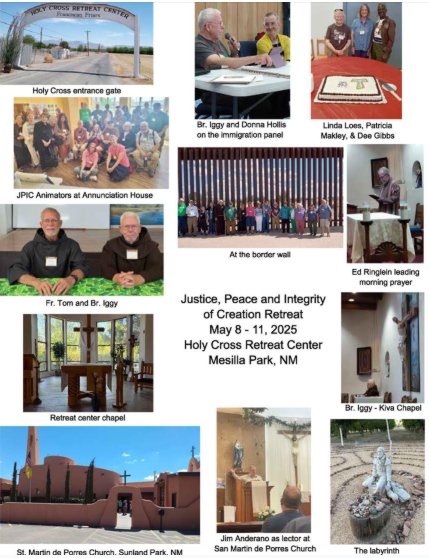
Last May, JPIC animators from around the US gathered at Holy Cross Retreat Center near Las Cruces, NM, to pray, to learn, to build, and to renew connections and commitment. Fr. Ignatius Harding, OFM, (who prefers to be called Br. Iggy) served as our spiritual assistant. On May 9, after morning prayer and a hasty breakfast, we boarded vans to El Paso for an interview with Ruben Garcia at Annunciation House. Ruben, the founder of this ministry, gave an impassioned talk about the realities of border life. He explained that it is one thing to say, “they should not come,” and another to hear a young mothers’ story of a desperate attempt to save her child from violence and see the cuts of the razor wire on her hands and feet. Ruben also decried the latest government actions, in particular the cancellations for people who had already been approved for entry. “We broke our word.” He asked for help with advocacy.
Next, we drove to San Martin de Porres Church in Sunland Park, New Mexico, where we met three local OFS fraternities for a beautiful Mass, and a bilingual gathering with flautas and guacamole. Marco Raposo, Director of Peace and Justice for the diocese of El Paso, shared the challenges of serving immigrants, and holding the annual cross-border mass under increasing restrictions. Robust discussion followed. Many thanks to Sofia and Arturo Villarreal, OFS, Louis Galvan, OFS and Br. Iggy, for joining the dialogue.
We then drove to the border wall for a prayer service, to honor the dignity of the many who lost their lives in the desert crossing, and those affected on both sides.
The next day began with a panel discussion, including Fr. Tom Smith, OFM Conv., director of Holy Cross RC, which has offered hospitality to immigrants for years, Bob Kee, from Tucson Samaritans, a desert rescue organization, Donna Hollis, OFS, who spoke about the children who arrived at Holy Cross, and Br. Iggy, who worked in a shelter in El Paso and with the Network for Migrants.
All the panelists described good people, families and individuals who bear no likeness to the horrific, dehumanized picture that has become normalized in our public discourse. We can help hold the line against this hurtful rhetoric.
The second session focused on JPIC leadership, with veteran animators Patricia Grace, Mike Huck, Jim Andreano, Susan Tabor, and Lynn Freeman sharing ideas, knowledge, wisdom, concerns, and affirmation for the difficult but rewarding work of JPIC. Mike and Susan demonstrated a Sister Water formation resource from the Care for Creation focus group.
In the afternoon, we were lifted up by Fr. Henry Beck, OFM, from Holy Cross RC, speaking on the Franciscan Spirituality of Beauty. Br. Iggy concluded the program connecting immigration justice to the integral ecology of Laudato Si. After mass, dinner and reflection, Donna Hollis, OFS, national councilor, spoke earnestly about choosing a life of service, both at Holy Cross RC, and in the OFS, inspiring all of us.
Holy Cross RC is an oasis of pecan groves and bird song in the Chihuahuan Desert. It is Franciscan, visually and in the heart, where friars and staff offer the warmest hospitality. We could not have picked a spot more conducive to the prayer and reflection that accompanied these visits and discussions.
Special thanks to Br. Iggy Harding, OFM, Donna Hollis at Holy Cross RC, Gigi Gregory in El Paso, and Brother David Buer, OFM, who were indispensable to the planning and the success of this retreat. Thanks also for the help of OFS members Mike Huck, Susan Tabor, Elenita Lesperance, Patricia Makley, and Ed and Noreen Ringlein.
https://www.secularfranciscansusa.org/2025/10/justice-peace-and-integrity-of-creation-retreat/
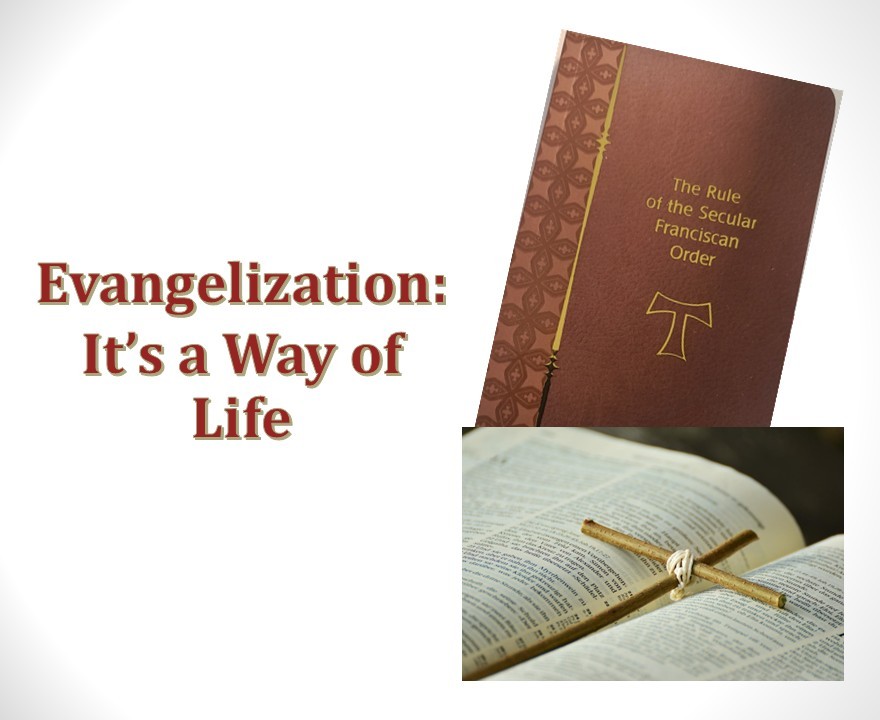
Formation Friday – Evangelization & Evangelist – October 17, 2025
(en español abajo) Korean translation attached in separate PDF.
Evangelization and Evangelist
Last week we presented the new 2025-2028 National Theme, “Go into the world and proclaim the good news.” (Mk 16:15). This week, we answer a question that is implied in that theme. “Define for us as Secular Franciscans the words “evangelize” and “evangelist.”
For us as Roman Catholics and Secular Franciscans, the words evangelize and evangelist carry rich spiritual and practical meaning, deeply rooted in both the Gospel and the Franciscan tradition. To evangelize is to share the Good News; it means to proclaim the Gospel — the life, death, and resurrection of Jesus Christ — in word and deed. For a Secular Franciscan, this is not limited to preaching or formal teaching. It’s a way of life. As we have said many times, as Secular Franciscans, it is not only what we do that defines us, it is who we are.”
– Living the Gospel–Evangelization, begins with personal witness. A quote attributed to St. Francis (which he did not actually say in these words) is, “Preach the Gospel at all times. When necessary, use words.” Many of us believe that the “quote” came about more from observation of the way he preached and lived rather that what he actually said on the topic.
Personal witness encompasses:
+Our daily actions — kindness, humility, care for creation, solidarity with the poor — we become a living sermon.
+Creative Outreach: Whether we’re designing flyers, preparing formation lessons, or assembling gift bags for fraternity outreach, we’re evangelizing by making the Gospel visible, tangible, and accessible.
+Joyful Presence: Evangelizing as a Franciscan means radiating joy, simplicity, and peace — inviting others into a deeper relationship with Christ and with others through our presence.
The person who evangelizes—Evangelist — A Bearer of the Gospel— An evangelist is someone who actively brings the Good News to others. In the Catholic tradition, this includes the four Gospel writers — Matthew, Mark, Luke, and John — but it also applies to anyone who shares Christ with others.
For a Secular Franciscan, being an evangelist means:
+ Being a bridge between the Church and the world, especially in secular spaces — workplaces, neighborhoods, social media, and community events.
+Translating faith into action, integrating spiritual values into practical initiatives as called for in our Rule.
+Accompanying others in their spiritual journey, especially through formation, reflection, and compassionate listening.
In short, evangelizing as a Secular Franciscan is less about loud proclamation and more about quiet transformation — making the Gospel visible through beauty, service, and love. You’re not just telling people about Christ; you’re showing them what it looks like when Christ lives in someone.
For Discussion or to Answer in your journal.
+Read article 4 of our Rule. What does it mean to “go from Gospel to life and life to the Gospel?”
+How do you personally witness to the Gospel in your daily life?
+What are some ways that we can spread the good news of the Gospel as a fraternity?
+Why is it sometimes difficult to “be a bridge” between the Church and the world?Formación 17 de octubre 2025
Evangelización y evangelizador
La semana pasada presentamos el nuevo tema nacional para 2025-2028: «Id por todo el mundo y proclamad la buena nueva» (Mc 16, 15). Esta semana respondemos a una pregunta que se desprende de ese tema: «Defina para nosotros, como franciscanos seglares, las palabras evangelizar y evangelizador».
Para nosotros, como católicos romanos y franciscanos seglares, las palabras evangelizar y evangelizador tienen un rico significado espiritual y práctico, profundamente arraigado tanto en el Evangelio como en la tradición franciscana. Evangelizar es compartir la Buena Nueva; significa anunciar el Evangelio —la vida, muerte y resurrección de Jesucristo— con palabras y obras. Para un franciscano seglar, esto no se limita a la predicación o la enseñanza formal. Es una forma de vida. Como hemos dicho muchas veces, como franciscanos seglares, no es solo lo que hacemos lo que nos define, sino quiénes somos».
– Vivir el Evangelio: la evangelización comienza con el testimonio personal. Una cita atribuida a San Francisco (que en realidad él no dijo con estas palabras) dice: «Predica el Evangelio en todo momento. Cuando sea necesario, utiliza palabras». Muchos de nosotros creemos que la «cita» surgió más bien de la observación de la forma en que predicaba y vivía, más que de lo que realmente dijo sobre el tema.
El testimonio personal abarca:
+Nuestras acciones cotidianas —bondad, humildad, cuidado de la creación, solidaridad con los pobres— nos convierten en un sermón viviente.
+Divulgación creativa: Ya sea diseñando folletos, preparando lecciones de formación o preparando bolsas de regalo para la divulgación de la fraternidad, evangelizamos haciendo que el Evangelio sea visible, tangible y accesible.
+Presencia alegre: Evangelizar como franciscanos significa irradiar alegría, sencillez y paz, invitando a otros a una relación más profunda con Cristo y con los demás a través de nuestra presencia.
Para un franciscano seglar, ser evangelizador significa:
+ Ser un puente entre la Iglesia y el mundo, especialmente en los espacios seculares: lugares de trabajo, vecindarios, redes sociales y eventos comunitarios.
+ Traducir la fe en acción, integrando los valores espirituales en iniciativas prácticas, tal y como lo exige nuestra Regla.
+ Acompañar a los demás en su camino espiritual, especialmente a través de la formación, la reflexión y la escucha compasiva.
En resumen, evangelizar como franciscano seglar no consiste tanto en proclamar en voz alta como en transformar silenciosamente, haciendo visible el Evangelio a través de la belleza, el servicio y el amor. No se trata solo de hablar a las personas sobre Cristo, sino de mostrarles cómo es cuando Cristo vive en alguien.
Para debatir o responder en tu diario.
+Lea el artículo 4 de nuestra Regla. ¿Qué significa «pasar del Evangelio a la vida y de la vida al Evangelio»?
+¿Cómo da usted testimonio del Evangelio en su vida cotidiana?
+¿De qué maneras podemos difundir la buena nueva del Evangelio como fraternidad?
+¿Por qué a veces es difícil «ser un puente» entre la Iglesia y el mundo?
Diane F. Menditto, OFSVice Minister, National Fraternity, Secular Franciscan Order USAGo into the world and proclaim the good news.” National Theme 2025-2028
What Is a Spiritual Assistant?
(This article originally appeared in the TAU-USA Summer 2025 Issue #116)
by Jerome Wolbert, OFM
National Spiritual Assistant
How would you describe spiritual assistance to someone who is not a Secular Franciscan? I have to answer this even for a lot of the friars that I try to recruit to serve. To help someone understand quickly, we have to be nearly complete, very concise, and entirely correct. Think of a priest you know who has never served as a spiritual assistant – what would you say to try to recruit him?
What
You might start with the things you see a spiritual assistant do – attend meetings of the fraternity, its council, and initial formation sessions; serve on the council but not voting in elections or financial issues; provide spiritual input and oversee formation and the spiritual/liturgical life of the fraternity. But the most important role is to “guarantee” the Franciscan charism of the fraternity, which speaks to how we serve as much as what we do.
How
Spiritual assistants are not supposed to be directive, although sometimes they must direct. They should support the fraternity, but they also have to challenge its members. Spiritual and pastoral assistance has to be kind, but there are times when the lost sheep has to be found, and there are times they don’t want to be told they are wandering away, especially when they drag or push others.
Listening is an important part of spiritual and pastoral assistance. Therefore, the assistant listens and helps others to listen – and to voice their messages in a way that they are more likely to be heard.
Who
Part of the role of the spiritual assistant is the relationship. We think immediately of someone to make sure the fraternity is connected with the friars, but this relationship is more than facilitating a connection. Canon Law (CIC 303) requires the friars to provide an altius moderamen for each fraternity, a “higher moderation” or outside perspective.
Have you ever been part of a group that got waylaid by one charismatic member? I know this never happens in our fraternities (smile), but maybe in a different type of group. The Church insists that every association of the faithful needs this outside moderation, someone to come in from outside to provide a check to “guarantee the Franciscan charism.” Just as a referee can’t be part of a team on the field, the assistant is someone outside the fraternity who walks with the fraternity. The shepherd is not a sheep but walks with them. This is part of our answer to “who” can be a spiritual assistant.
Accountability
The “outside” part of this requirement shows that this is a kind of accountability – checks and balances. Where only one group is “ruling,” there is less chance to catch mistakes or make sure that different voices are heard. We not only see this in government, but in the Church, as well. We have checks and balances – or outside moderation.
Relationships
In March, the CNSA set forth instructions for the implementation of one of the international statutes that has implications for around three dozen local fraternities and half of our regional fraternities: A Secular Franciscan cannot be appointed Spiritual Assistant to his/her own Fraternity at any level (IS 78.2).
While some people have argued this disrespects the service of many OFS members, I hope you see in this article that the question of “who” and the relationships we have are important and should not be set aside just because we lack a friar. In fact, IS 78.1 sets in law that it is permissible for an OFS member to serve as a spiritual assistant – something which the General Spiritual Assistants were hesitant to allow ten years ago.
https://www.secularfranciscansusa.org/2025/10/what-is-a-spiritual-assistant/