“If Today You Would Hear His Voice, Do Not Harden Your Hearts”

(This article originally appeared in the Fall 2020 Issue of TAU-USA #101)

Formation Commission

by Francine Gikow, OFS

National Commissioner


“IF TODAY YOU WOULD HEAR HIS VOICE, DO NOT HARDEN YOUR HEARTS[1]

As a Secular Franciscan during this time of coronavirus, I have been forced to confront my own racial biases and the inequality that exists in our society based on race. From the earliest days in initial formation, we are told “go from gospel to life and life to the gospel” with a careful reading of the gospel.[2] But what do the gospels say to us at this time? How do we act/react as Secular Franciscans? How can I make sure that I do not “harden my heart”?

Since Vatican II, the Church has directed us in this essential element of our vocation: “At all times the Church carries the responsibility of reading the signs of the times and of interpreting them in the light of the gospel…”[3]

“… [the Church] can draw from the Gospel the most profound reasons and ever new incentives to promote the generous dedication to the service of all [people], the poor especially, the weak and the oppressed – and to eliminate the social consequences of sin which are translated into unjust social and political structures… the Church…leads toward freedom under all its forms — liberation from sin, from indwelling or collective selfishness—and to full communion with God and with [people] who are like brothers [and sisters].”[4]

The message is clear. The Church invites me—no, actually demands of me—as a secular, professed Franciscan, to work toward the equality of all people in our society. Of course, depending on our particular gifts and personalities, what I do may be different than your response to the call of the Holy Spirit. But we are all the body of Christ, here on earth. What DO scripture and the gospels say? In search of the answer, I have compiled some of my favorite passages for your prayer, meditation, and consideration. They are not a complete listing; for that you would need to read/meditate on the ENTIRE Bible! However, they are a start. You may want to take a different specific passage each day to prayer and meditation. You may want to share at your fraternity meeting which passages “spoke” to you and why. You may want to cut up all the Bible citations, put them into a bowl and pray a different one each day.

Make an effort to be open to the Word of God and not “harden your heart,” let go of any pre-conceived ideas and see where God leads you, then act on it. Make a decision to change a behavior. Decide what you can do differently. Do penance. Ask forgiveness. Open a respectful dialog. The list is endless. As Francis said to his brothers:

“I have done what is mine; May Christ teach you yours.” (Lmj14:3)

Scripture Citations:

Essence of the Law (Deut 10:17-20)

The Beatitudes (Mt.5 1-10 or Lk 6 20-26)

Sheep Amidst the Wolves (Mt 10”16-23)

Parable of the Sower (Mt 13: 1-17)

Forgiveness (Mt 18:21-22)

The Rich Young Man (Mt 19:23-27)

The Greatest Commandment (Mt 22:34-40)

Persecutions Foretold (Mt 24:9-14)

Welcoming a Stranger (Mt 25:31-40)

Judgment of the Nations (Mt 26:31-36)

Woman at the Well (Jn 4: 4-42)

Love for Enemies (Lk 6:27-36)

Do Not Judge… (Lk 6:37-38)

The Good Samaritan (Lk 10:25-37)

The Rich Man and Lazarus (Lk 16:19-31)

Woman Caught in Adultery (Jn 8:1-11)

Transformation (Romans 12:2)

Mutual Love (Heb 13:1-3)

Mercy and Judgment (James 2: 12-13)

Justification By Works (James 2:22-24)

Judging Others (James 4:11)

—————————————————————

[1] Psalm 95:7b-11. (NAB)

[2] OFS Rule: Art.4

[3] Guadium et Spes, 4.

[4] Synod of Bishops, “Evangelization of the Modern World,” Third General Assembly, October 26, 1974, in The Gospel of Peace and Justice: Catholic Social Teaching Since Pope John (Maryknoll , NY: Orbis Books, 1976. p.597

https://secularfranciscansusa.org/2021/01/11/if-today-you-would-hear-his-voice-do-not-harden-your-hearts/
Open post

FORMATION FRIDAY – JAN 8, 2021

Dear Brothers and Sisters, 

The New Year and the time we generally resolve to do better in some areas.  This year, as we strive to be better Secular Franciscans, let’s start with our prayer life.  One of the benefits of doing this is that this step will help improve your inner peace.  Peace is always important, but today it is critical.  

Today’s lesson discusses;

  • St Bonaventure’s spiritual direction to the Poor Clare nuns – way of ‘descent’.
  • A Prayer Journal is a beneficial tool to help you reflect as you contemplate your life.

The New Year is also a great time to make a General Confession.  This is not the monthly regular confession, it is a review of your life and your major sins.  This usually necessitates an appointment (retired priests usually have time to do this confession which takes an hour or more).    Peace, Dona

Please share with your local fraternity.

+++ ++++++++++++++++++++++++++++++++++++++++++++++++++++++++++++++++++++++++++++++++++++++++++++++++

Taking Stock 2021 #2 Our Lives of Prayer as Secular Franciscans

“As Minister General of a large Order, St. Bonaventure provided, among other things, spiritual direction for those seeking God. In a letter to Poor Clare nuns, he offered directives as to how we might enter into prayer by way of ‘descent.’

“The steps are summarized as follows:

·        Return to yourself; Enter into your heart;

·        Ponder what you were, are, should have been, called to be;

·        What you are by nature;

·        What you are through sin;

·        What you should have been through effort;

·        What you can still be through grace;

·        Meditate in your heart;

·        Let your spirit brood. (Are you resentful, angry, jealous?);

·        Plow this field, work on yourself;

·        Strive for freedom within, the freedom that leads to relationship with God, realizing that God will never force us to love him;

·        Lack of self-knowledge and failure to appreciate one’s own worth make for faulty judgment in all other matters;

·        If you are not able to understand (and accept) your own self, you will not be able to understand (or accept) what is beyond you.”

Bonaventure, Perfectione vitae ad sorores (Perf. Vit.) 1.5 (VIII, 109). Engl. trans. Jose de Vinck, “On the Perfection of Life, Addressed to Sisters,” in The Works of Bonaventure, vol. 1, Mystical Opscula (Paterson, N.J.: Saint Anthony Guild Press, 1960), 214.

Quoted in: Delio, Ilia. Franciscan Prayer (Kindle Locations 613-616). Kindle Edition.

For our Prayer Journey as Secular Franciscans

       We take as our “book” the poor and crucified Christ

       Our “inspiration” the writings of Francis, Clare, Bonaventure

       Our “guide” the Holy Spirit

       Our “model” Mary

       Our “core” the gospel

       Our “focus” the life of penance we profess to live

       Our “sustenance” the Eucharist, Sacraments, and prayer.

FUN Manual The rule of the SFO page 27 of 46

Questions for discussion or to comment on in your journal

+How has your prayer life changed over the years?

+If you are a Secular Franciscan, how does your prayer reflect who you are as a member (or candidate) of the Order?

+Does prayer influence how you live your life?

+Based on St. Bonaventure’s directives above, how can you strengthen your prayer life?


++++++++++++++++++++++++++++++++++++++++++++++++++++++++++++++++++++++++++++++++++++++++++++++

2021 #2 Momento de examinar nuestras vidas de oración como franciscanos seglares


“Como Ministro General de una Orden grande, San Buenaventura proporcionó, entre otras cosas, dirección espiritual para quienes buscaban a Dios. En una carta a las monjas Clarisas, ofreció directivas sobre cómo podríamos entrar en oración a través de la ‘descendencia.’ “


“Los pasos se resumen a continuación:


• Regrese a usted mismo; Entre en su corazón;

• Reflexione sobre lo que usted fue, es, debería haber sido llamado a ser;

• Lo que usted es por naturaleza;

• Qué es usted por el pecado;

• Lo que debería haber sido a través del esfuerzo;

• Lo que aún puede ser gracias a la gracia;

• Medite en su corazón;

• Deje que su espíritu se dé vueltas. (¿Está resentido, enojado, celoso?);

• Are este campo, trabaje en sí mismo;

• Luche por la libertad interior, la libertad que conduce a la relación con Dios, reconociendo que Dios nunca nos obligará a amarlo;

• La falta de autoconocimiento y la incapacidad de apreciar el valor propio dan lugar a un juicio erróneo en todos los demás asuntos;

• Si no puede entenderse (y aceptarse) a sí mismo, no podrá comprender (o aceptar) lo que está más allá de usted.”


Buenaventura, Perfectione vitae ad sorores (Perf. Vit.) 1.5 (VIII, 109). Engl. trans. José de Vinck, “Sobre la perfección de la vida, dirigida a las hermanas”, en Las obras de Buenaventura, vol. 1, Mystical Opscula (Paterson, Nueva Jersey: Saint Anthony Guild Press, 1960), 214.

Citado en: Delio, Ilia. Oración franciscana (ubicaciones de Kindle 613-616). Versión Kindle.


Por nuestro viaje de oración como franciscanos seglares

• Tomamos como nuestro “libro” al Cristo pobre y crucificado

• Nuestra “inspiración” los escritos de Francisco, Clara, Buenaventura

• Nuestro “guía” el Espíritu Santo

• Nuestra “modelo” María

• Nuestro “núcleo” el evangelio

• Nuestro “enfoque” la vida de penitencia que profesamos vivir

• Nuestro “sustento” la Eucaristía, los Sacramentos y la oración.


FUN Manual La regla de la OFS página 27 de 46


Preguntas para platicar o comentar en su diario


+ ¿Cómo ha cambiado su vida de oración a lo largo de los años?

+ Si es un franciscano seglar, ¿cómo refleja su oración quién es como miembro (o candidato) de la Orden?

+ ¿Influye la oración en cómo vive su vida?

+ Según las directivas de San Buenaventura ya mencionadas, ¿cómo puede fortalecer su vida de oración?


Diane F. Menditto, OFS

Chair, National Formation Commission

Minister, Our Lady of the Angels Region


St. Anthony & the Blessed Virgin Mary

(This article originally appeared in the TAU-USA Fall 2020 Issue #101)

by Christopher Shorrock, OFM Conv., CNSA
This year marks the Eighth Centenary of the “Franciscan vocation of St. Anthony of Padua” as Pope Francis remarked in his letter to Carlos Trovarelli, Minister General of the Friars Minor Conventual commemorating this event, dated February 15, 2020.

On January 16, 1220, the young Augustinian Canon Regular, Fernando Martins de Bulhões, on hearing of the martyrdom of five Franciscans in Morocco, decided to enter the Franciscan Order and became known to the world as Anthony of Padua.

Anthony died on June 13, 1231, at the Poor Clare monastery at Arcella (now part of  Padua), aged 35, and was canonized by Pope Gregory IX on May 30, 1232, at Spoleto, Italy, less than one year after his death.

Pope Pius XII proclaimed Anthony a Doctor of the Church on January 16, 1946, and gave him the title Doctor Evangelicus [“Evangelical Doctor”] since the freshness and beauty of the Gospel emerge from his writings.

St. Anthony is a popular saint, a wonderful preacher, and a great miracle worker; only a few have looked upon him as a deep theologian or a learned teacher.

Perhaps one lesser known fact about St. Anthony is his great devotion to the Blessed Virgin Mary and, on account of the many references to Mary in his sermons and expressive passion with which he speaks of her, he might well be called, like St. Bernard of Clairvaux, whom he so frequently quotes, a second “Marian Doctor.”

With regards to the sources for his doctrine on Mary, we possess eight sermons1 of St. Anthony on the Blessed Virgin Mary: one on the Birth of Mary, three on the Annunciation, three on the Purification, and one on the Assumption.

These are numbered among his Sermones Mariales. Besides these, however, we find references to the Blessed Virgin Mary in many of his Sunday and Feast Day sermons, especially in his sermon for the Third Sunday of Lent, which says: “Blessed is the womb that bore thee, and the breasts that nursed thee” (Luke 11:27).

These are known as his Sermones Dominicales [Sunday sermons]. Among his Sermones Solemnitatum or Sanctorales [Sermons for Solemnities or Feasts] there are four other sermons or outlines for the Purification, and six additional outlines for the feast of the Annunciation.

Furthermore, all the sermons on the mysteries of our Lord’s life highlight Mary; for example, his sermons for the Feasts of the Nativity of our Lord, of the Epiphany, and of the Resurrection.

One writer stresses the fact that the St. Anthony’s whole life seems to revolve around the Blessed Virgin Mary, which he styles a Vita Mariana [Marian life].

He is said to have been born on the feast of the Assumption, August 15, 1195, in Portugal, a country known since the end of the 12th Century as the “Land of Mary,” to whom it was dedicated by Alphonse I after the victory over the Moors.

The cathedral of his native city, Lisbon, was sacred to the memory of the Assumption; his mother, Donna Maria, offered her infant son to Mary before a statue of Mary’s Immaculate Heart while chanting the Magnificat; Anthony was baptized on August 22, the octave of the Feast of the Assumption, which today is dedicated to the Queenship of Mary.

An ancient tradition tells us that Anthony’s first words were an invocation to Mary–Maria; his last words were a final salutation to his Lady Queen in his O gloriosa Domina [O glorious Lady] to whom as a child he dedicated his virginity.

St. Anthony’s later sermons on the Blessed Virgin Mary are substantially and theologically so exhaustive and so complete, that one Belgian Franciscan felt he could stake his reputation as a scholar by asserting that “St. Anthony’s sermons give us a complete Mariological theology”; whereas an Italian biographer of St. Anthony writes:

There is not a trait in the life of Mary to which he [St. Anthony] did not dedicate a page or two; not a mystery in her life that he did not study profoundly and correspondingly expound to his listeners. He allowed no occasion to escape on which he might dedicate his ardent zeal to inculcate devotion to her or propagate her cult. And if there is no Catholic doctrine he did not illustrate, it must be admitted that he preferred to treat those which referred to Mary.

Although the sources of St. Anthony’s Mariology were both the Sacred Scriptures and Tradition, he quotes the former so frequently that one might call his Mariology Biblical. Pope Gregory IX aptly called him an “Ark of the Covenant,” for within were kept the Sacred Books. One author, writing of the Mariology of the Evangelical Doctor states that this:

Reveals his ability as an interpreter of Sacred Scripture. In it we may observe excellent use of the literal sense of the Bible, and some of the richest types that are to be found in his sermons. When he speaks of Mary, St. Anthony does not spare himself in his efforts to sing her praises. To him the Blessed Virgin is the Queen of all creatures, and her prerogatives were constantly in his mind when he spoke to others. The Scriptures furnish him with the phrases that he sought to describe Mary’s pre-eminence just as they had been his inspiration in other matters.

In arguments taken from tradition, St. Anthony borrows especially from the great Marian doctors: St. Augustine, St. John Damascene, St. Bede the Venerable, and St. Anselm, but above all, from St. Bernard of Clairvaux.

His Mariology not only embraces all the accepted beliefs of medieval scholastics, but reaching far beyond his own times, sufficiently indicates other doctrines that only centuries later were either defined as dogmas (the Immaculate Conception of Mary, the Assumption of the Blessed Virgin Mary) and are definitely accepted today as Catholic doctrine and common theological teaching; or form a part of the present liturgical system of the Church as embodied in the devotion to Mary under various new titles which, like so many recently detected stars in the firmament, have been added in the form of new jewels to Mary’s crown, such as the doctrine of Mary’s being the Co-Redemptrix of the world, the Mediatrix of all graces, etc.

The fundamental principle of St. Anthony’s Mariology, around which everything else revolves, is Mary’s Divine Maternity and the Virginal Birth of the Saviour. This once established as the final cause, St. Anthony proceeds to develop all the other privileges of Mary either introductory to it or subsequent upon it.

Let us conclude with the word of our holy father, Pope Francis, “may his [St Anthony] example of sharing in the difficulties of families, the poor and disadvantaged, as well as his passion for truth and justice, still arouse in us today a generous commitment to give of ourselves as a sign of fraternity.”

This article is part of the introductory remarks for a much larger work on the Mariology of St. Anthony that Fr. Chris is working on. Fr. Chris holds a Doctorate in Theology and is currently an adjunct lecturer at Sacred Heart Seminary and School of Theology, Hales Corners, WI.

_____________________________

See the 4-volume series on Saint Anthony of Padua, Sermons for Sundays, and Festivals, translated by Paul Spilsbury (Padova: Messaggero Di Sant’Antonio, 2007).

https://secularfranciscansusa.org/2021/01/04/st-anthony-the-blessed-virgin-mary/

Open post

Formation Friday – January 1, 2020

Dear Brothers and Sisters,  

Today our lesson is about Strengthening our Fraternity Life.  This email contains resources to use for formation for the coming year.  There are several attachments to this email, including two videos. In one of the two attached videos, Diane invites us to virtually attend one of her fraternity meetings.  That is a pretty great opportunity to see her in action!  

It is pretty amazing to see the amount of hard work the National Formation Commission devotes to the Order.   All of you on formation teams should consider incorporating some of these resources into your fraternity’s formation program.  All of the resources support our National theme which is Fraternity Life-Living Fraternal Communion.   Wishing you a Holy New Year as we pray to grow closer to God.  Peace, Dona

+++++++++++++++++++++++++++++++++++++++++++++++++++++++++++++++++++++++++       

Please share with your local fraternity (Recursos en español abajo)    


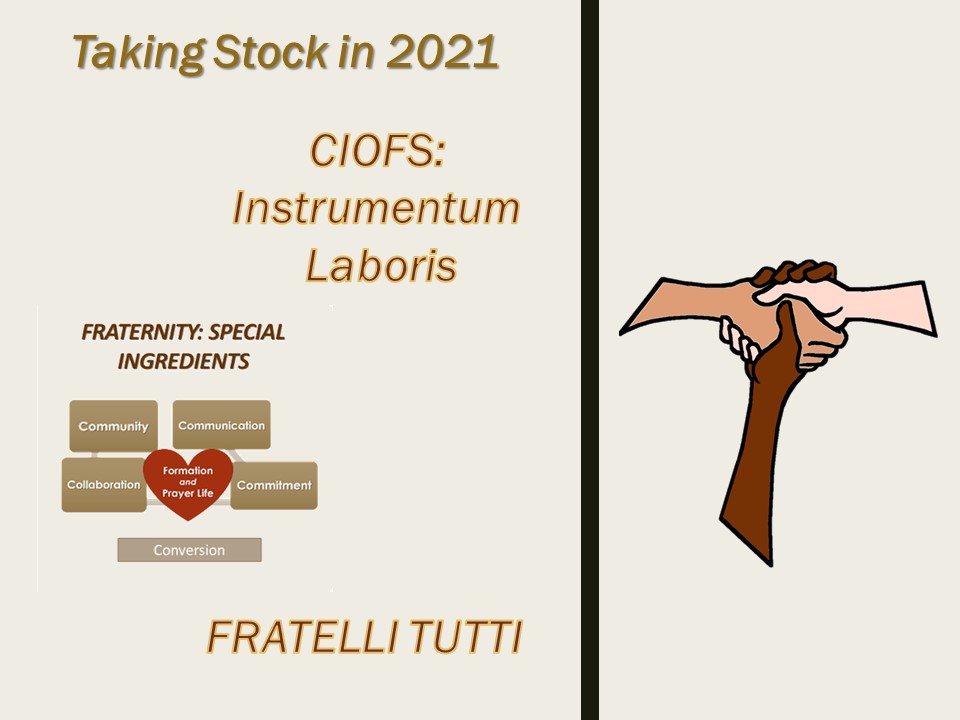
As we begin 2021, it is a good time to take stock and to plan our fraternity and personal ongoing formation programs for the year. The OFS National Priority through 2021 is Fraternity Life–Living Fraternal Communion. What a wonderful way to begin the new year by strengthening our commitment to fraternal life both in the Order and in the world.

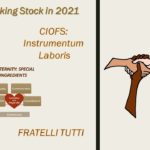
Below you will find links to resources regarding fraternity life, Fratelli Tutti, and the CIOFS Instrumentum Laboris that should be helpful to you. The information provided is sufficient for many months, if not years, of personal and fraternity ongoing formation.

+Fraternity Life Formation Materials on the OFS USA website
https://secularfranciscansusa.org/resources-for-national-priority-2018-2021-fraternity-life/

+Fratelli Tutti—many resources on OFS USA website
https://secularfranciscansusa.org/ongoing-formation-resources/

+Fratelli Tutti- resources from the Vatican-Excellent Infographic from the Vatican
http://www.humandevelopment.va/content/dam/sviluppoumano/special-fratelli-tutti/risorse/infografiche/pdf-infografiche/EN-Infografica-FRATELLITUTTI.pdf

Video on Fratelli Tutti  from the Vatican
https://youtu.be/pFTTk5Vo-0Q

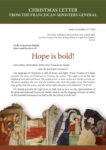
+Christmas letter from the four Ministers Generalbeautiful reflection on Fratelli Tutti (attached to this email)

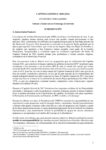
+The Instrumentum Laboris from CIOFS: Animate and Guide with Servant Leadership
https://secularfranciscansusa.org/wp-content/uploads/Instrumentum-Laboris-2020.docx

Formation talk on Fraternity: Our Way of Life  given at the 2020 National Chapter (link below)
https://www.youtube.com/watch?v=1NpSOiv6e6Q&feature=youtu.be


Once you have read and listened to some of the material above, here are some questions to discuss or to comment on in your journal.

1- Why is fraternity life important to you as a Secular Franciscan? How do you contribute to fraternity life?

2-How does the concept of fraternity apply to daily life in the world?

3-Reflect on how the letter from the Ministers General adds to your understanding of Fratelli Tutti and is enhanced by the other papal documents mentioned.

4- How does the Instrumentum Laboris from CIOFS help you to be a better servant leader, both in your fraternity and in the world?

++++++++++++++++++++++++

Al comenzar el año 2021, es un buen momento para examinar y planificar nuestros programas de  formación continuada personales y de la fraternidad para el año. La Prioridad Nacional de la OFS hasta el 2021 es la Vida de Fraternidad – Vivir en comunión fraternal. Qué manera tan maravillosa de comenzar el nuevo año fortaleciendo nuestro compromiso con la vida fraterna tanto en la Orden como en el mundo.

A continuación, encontrará enlaces a recursos relacionados con la vida fraternal, Fratelli Tutti y el Instrumentum Laboris de CIOFS que deberían serle útiles.

Fratelli Tutti- recursos del Vaticano en español

Fratelli Tutti- El documento en español
http://www.vatican.va/content/francesco/es/encyclicals/documents/papa-francesco_20201003_enciclica-fratelli-tutti.html

Excelente infografía procedente del Vaticano
http://www.humandevelopment.va/content/dam/sviluppoumano/special-fratelli-tutti/risorse/infografiche/pdf-infografiche/EN-Infografica-FRATELLITUTTI.pdf

Vídeo en español sobre Fratelli Tutti procedente del Vaticano
https://youtu.be/pFTTk5Vo-0Q

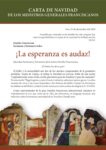
+Carta de Navidad de los cuatro Ministros Generales—bella reflexión sobre Fratelli Tutti (adjunta a este correo)

+ El Instrumentum Laboris de CIOFS: Animar y guiar con liderazgo de servicio (adjunto a este correo)

Una vez que haya leído y escuchado parte del material anterior, aquí hay algunas preguntas para discutir o comentar en su diario.


1- ¿Por qué es importante para usted la vida de fraternidad como franciscano seglar? ¿Cómo contribuye a la vida de fraternidad?

2-¿Cómo se aplica el concepto de fraternidad a la vida en el mundo?

3- Reflexione sobre cómo la carta de los Ministros Generales (adjunta) aumenta su comprensión de Fratelli Tutti y se ve reforzada por los otros documentos papales mencionados.

4- ¿Cómo le ayuda el Instrumentum Laboris del CIOFS a ser un mejor líder servidor, tanto en su fraternidad como en el mundo?


https://www.youtube.com/watch?v=1NpSOiv6e6Q     This video is Diane, herself discussing formation

 
Diane F. Menditto, OFS

Chair, National Formation Commission

Minister, Our Lady of the Angels Region


Moving Forward: It’s Up To Us

Kathleen Molaro, OFS

Many feel unable to move forward, stifled by current world problems that seem insurmountable. Feelings of depression, division, greed, fear, or apathy thwart our efforts to live our vocation authentically. Secular Franciscans have a choice: either to hide from troubles or, with the help of our Rule and Gospel, to seek ways of moving forward in spite of difficulties.

Young people face the same dilemma. Will they turn to God or have a crisis in faith? Will they joyfully serve or become stagnant with despair? Will they work for justice or wallow in selfishness? Secular Franciscans are called to inspire young people with the message that God cherishes them and desires to draw them into His embrace. Our witness and support will help them grow in an awareness that God is present and active in their torn world and has infused them with divine purpose.

In Called and Gifted for the Third Millennium, our bishops remind us that the mission of the Church is to form people who, “led by the spirit of the Gospel, might contribute to the sanctification of the world.” None of us need be alone in this challenge. By walking with young people in their journey towards holy maturity, we are gifted by their energy and enthusiasm. The bishops go on to say, “Our presence within the web of society can be a source of solace and strength in the face of enormous human need.” We can bring hope, especially to young people who want so badly for things to change. It is up to us to invite them into a Christ-centered life, which gives them the ability to influence the world with Gospel values.

Franciscan Youth and Young Adult (FY/YA) Animators or delegates from almost every OFS Region have been participating all summer in weekly Zoom gatherings for the purpose of discovering how we can fulfill this challenge. Presentations and conversations are lively, Spirit filled, supportive and enlightening. Those attending know we must reach out to our young people in solidarity as we all traverse the trials facing us, and we are discussing how best to do so. The FY/YA commission hopes our virtual gatherings have provided inspiration and tools to equip Regions with a common purpose and the skills necessary for undertaking this task.

We are encouraged that FY/YA Animators are confidently stepping into the world of youth and young adults, searching for ways to build relationships, open hearts, and share their gifts. If you are interested in (or are already) working with youth or young adults, the Commission and your Regional Animator would love to hear from you!

As this year’s NAFRA theme states, we must “Journey together in love and compassion.” It’s time to move forward, and it’s up to all of us. Thank you for praying for our young people and for those who are walking with them.

The bishops have determined that successful outreach to young people will connect them

with:

1) Jesus Christ;

2) The Church, by inviting and welcoming their presence in the Christian community;

3) The mission of the Church in the world; and

4) A peer community in which their faith is nurtured and strengthen.

(Sons and Daughters of Light: A Pastoral Plan for Ministry with Young Adults, USCCB)

https://secularfranciscansusa.org/2020/12/28/moving-forward-its-up-to-us/

Scroll to top
Juan de Padilla