Today’s lesson again focuses upon the document Instrumentum Laboris. This is a document written in preparation for the upcoming celebration of the 2021 General Chapter, which constitutes the highest governing body of our OFS. This work is a compilation of input from all members of the Order. The full document is attached to this email along with PowerPoint slide #2.Lent is a great time to reflect along with our fraternities, our responsibilities as a member of our Order.If you do take this to heart and discuss it within your fraternities, it will help all of us understand the responsibilities of each member so that we all can become united in prayer and in living the Gospel Life together.Peace, Dona++++++++++++++++++++++++++++++++++++++++++++++++++++++++++++++++++++++++++++++++++++++++++++Instrumentum Laboris—Part 2Animate and Guide: Challenges in Fraternal Life February 19, 2021 (Continued from February 12th) Please share with your local fraternities
These posts (1-3) are intended to serve as a summary and guide to this important document. It is also intended to assist in the individual study of the document and presentations made to our fraternities.
We encourage you to read the entire document at this link:
https://secularfranciscansusa.org/wp-content/uploads/Instrumentum-Laboris-2020.docx
- Through FRATERNAL SERVICE we bear each other’s burdens
- Our service mirrors Jesus’s service—he gave his life for others
- Humility and suffering
- We carry our brothers and sisters
- Servant Leaders help the brothers and sisters to:
- Understand that our plan of life must be centered on Christ and in following him. (See GC 9.1)
- Help the brothers and sisters to understand that all (the entirety) of the brothers and sisters make up the fraternity.
- Pray—recognize the word and message of Jesus and know what God wishes to say to the world with your life.
- Promote participation in the field of justice and public life with courageous initiatives and using one’s own life as an example. (Rule Art. 14) Political debate—a source of tension—must be avoided in the fraternity.
- Form the brothers and sisters through the example of what is called for in Chapter 2 of the General Constitutions: “Active Presence in the Church and in the World.”
- Grow within the Franciscan family making the charism of St. Francis present in the Church and in the world. (Rule Article 1)
- Understand the importance of the Rule, General Constitutions, and Statutes regarding the orderly development of our fraternity life and of the communion of all fraternities in the Order.
- Participate unconditionally in the life of one’s fraternity.
- Understand and distinguish between: “not being able to participate in fraternity life;” “not wanting to participate;” or being “too lazy to participate.”
- Accept with serenity, humility, and the spirit of obedience the decisions of the General Chapters which are the highest expression of responsibility of our Order.
- When preparing for elections, the following must be taken into account:
- To be elected to serve it is necessary to be familiar with the Rule and the General Constitutions
- Prospective servant leaders must have and make available the time to carry out their service.
- Fraternity gatherings respond to the needs of the members.
- Brothers and sisters should participate in the fraternity gatherings. Having a large membership with little or no participation is “useless.”
- They need to maintain a dialogue with the brothers and sisters and care for and engage “non-compliant” members.
- They should give due importance to Article 50.1 of the General Constitutions, developing the life of the fraternity, its presence in the world, and adoption of courageous measures in the apostolic life of the fraternity.
Questions for discussion or to answer in your journal.
+ According to the items above, how do your local and regional councils serve the membership?
+ Which characteristics mentioned above do you see in yourself?
+ How might you serve your fraternity now or in the future?
To be continued on February 26th
+++++++++++++++++++++++
Instrumentum Laboris — Parte 2 Animar y guiar: Desafíos en la vida fraterna
19 de febrero de 2021 (Continuación del 12 de febrero) Comparta con sus fraternidades locales
Estas publicaciones (1-3) están destinadas a servir como resumen y guía de este importante documento. También está destinado a ayudar en el estudio individual del documento y en las presentaciones realizadas a nuestras fraternidades.
Le animamos a leer el documento completo en este enlace:
https://secularfranciscansusa.org/wp-content/uploads/ES-Instrumentum-Laboris.pdf• A través del SERVICIO FRATERNAL llevamos las cargas de los demás
• Nuestro servicio refleja el servicio de Jesús: dio su vida por los demás
o Humildad y sufrimiento
o Cargamos a nuestros hermanos y hermanas
• Los líderes servidores ayudan a los hermanos y hermanas a:
o Comprender que nuestro proyecto de vida debe estar centrado en Cristo y en seguirlo. (Ver CCGG 9.1)
o Ayudar a los hermanos y hermanas a comprender que todos (la totalidad) de los hermanos y hermanas forman la fraternidad.
o Orar: reconocer la palabra y el mensaje de Jesús y saber lo que Dios desea decirle al mundo con su vida.
o Promover la participación en el campo de la justicia y la vida pública con iniciativas valientes y tomando como ejemplo la propia vida. (Art. 14 de la Regla) El debate político, fuente de tensión, debe evitarse en la fraternidad.
o Formar a los hermanos y hermanas con el ejemplo de lo que pide el Capítulo 2 de las Constituciones Generales: “Presencia activa en la Iglesia y en el mundo”.
o Crecer en la familia franciscana haciendo presente el carisma de San Francisco en la Iglesia y en el mundo. (Artículo 1 de la regla)
o Comprender la importancia de la Regla, de las Constituciones Generales y de los Estatutos para el desarrollo ordenado de nuestra vida fraterna y de la comunión de todas las fraternidades de la Orden.
o Participar incondicionalmente en la vida de la fraternidad.
o Comprender y distinguir entre: “no poder participar en la vida de fraternidad;” “No querer participar” o ser “demasiado vago para participar.”
o Aceptar con serenidad, humildad y espíritu de obediencia las decisiones de los Capítulos Generales que son la máxima expresión de responsabilidad de nuestra Orden.
• Al prepararse para las elecciones, se debe tener en cuenta lo siguiente:
o Para ser elegido para servir es necesario conocer la Regla y las Constituciones Generales.
o Los líderes servidores potenciales deben tener y hacer disponible el tiempo para llevar a cabo su servicio.
o Las reuniones de fraternidad responden a las necesidades de los miembros.
o Los hermanos y hermanas deben participar en los encuentros de fraternidad. Tener una gran cantidad de miembros con poca o ninguna participación es “inútil.”
o Necesitan mantener el diálogo con los hermanos y hermanas y cuidar e involucrar a los miembros “no cumplidores”.
o Dar la debida importancia al artículo 50.1 de las Constituciones Generales, desarrollando la vida de la fraternidad, su presencia en el mundo y la adopción de medidas valientes en la vida apostólica de la fraternidad.
Preguntas para platicar o para responder en su diario.
+ De acuerdo con los puntos anteriores, ¿cómo sirven sus concilios locales y regionales a los miembros?
+ ¿Qué características mencionadas arriba ve en sí mismo?
+ ¿Cómo podría servir a su fraternidad ahora o en el futuro?
Continuará el 26 de febrero
Diane F. Menditto, OFSChair, National Formation Commission
Minister, Our Lady of the Angels Region
Reclaming the Bay!
(This article originally appeared in the TAU-USA Fall 2020 Issue #101)
How one fraternity rebuilds an ecosystem.
Spirituality, fraternity, science, and some good old elbow grease work together in an apostolate sponsored by the St. Francis of Assisi Fraternity on Long Beach Island, New Jersey.
Taking a page from St. Francis’s love of the environment and Laudato Si, the fraternity works to improve the fragile ecosystem of Barnegat Bay-Little Egg Harbor by raising tens of thousands of clams each year.
Fraternity members participate in the nonprofit Reclam the Bay project sponsored by Rutgers Cooperative Extension. To date, the project has deposited upwards of 10 million clams in the bay since its inception in 2005.
The fraternity joined the effort three years ago after a presentation by Rick Bushnell, president of Reclam the Bay, and we became one of 11 groups in the bay area to host the project.
“We saw it as good volunteer effort, and we liked being able to see a beginning and an end to the project,” said Jim Collery, OFS, one of the team of fraternity members who volunteers on the project.
Work begins in June when 50,000-60,000 clams the size of a pencil head are delivered to the upwellers located on the campus of St. Francis of Assisi Catholic Church on Long Beach Island. Some oysters are also included.
Upwellers are a sort of nursery for clams, which are housed in silo-shaped tanks that have a steady supply of bay water. A sump pump siphons water from the bay, and the clams extract food from it, returning cleaner water back into the bay, said Jim Heimlich, OFS, who organizes the project for the fraternity.
The weekly job of the volunteers is to clean the clam excretions and other debris from the upweller. Some members work cleaning the tubs and cylinders where the clams reside. Others help record statistics such as the temperature and salinity of the water, as well as measuring the size of the clams.
Besides the weekly cleaning and data collection, fraternity members also check regularly to make sure that the water pump is operating. As long as the clams have fresh water, they will continue to breathe and filter the water. If the pump stopped because of a power outage or other factor, the water would lose its oxygenation and the clams would suffocate
The cleaning occurs after 9:30 a.m. Mass on Tuesdays.
Project members welcome children and relish the opportunity to describe how the ecosystem works. They explain how upwellers replenish the clam population, which has been on the decline since the 1980s, when nutrients like nitrogen and phosphorus from sewers and farms flooded the bay and stimulated algae growth. Other factors such as overharvesting also contributed to the decline.
In Laudato Si, Pope Francis states that, “There can be no renewal of our relationship with nature without a renewal of humanity itself” and that is working amidst this project.
“Interfacing with the environment certainly helps build fraternity,” said Heimlich.
Fr. John Frambes, OFM, agreed, “These are good times for fellowship and lots of laughter.”
Fr. Frambes is the fraternity’s spiritual assistant and has a daily view of the upweller from his office window. He regularly volunteers to help clean the upweller.
Fr. Frambes is also called on to the bless the clams at the traditional blessing of the animals each Oct. 4, the Feast of St. Francis of Assisi.
Heimlich says the reclamming project is a way to help the ecosystem.
“The health of the bay clams and oysters are important to the health of the bay. They clean up the chemicals and debris that make it unhealthy for the fish,” he said.
“One oyster filters 40 gallons of water per day. A clam will filter 10 gallons of water per day. Their presence contributes to the health of the environment and helps others in the bay environment thrive,” said Heimlich.
By November, the clams have grown large enough to remove from the upweller and turn over to other volunteers from the Reclam the Bay project, who plant them in protected plots in the bay. The clams are covered by mesh nets to keep crabs, mollusks, and birds from eating them.
A year later, when the clams are 1.5 inches wide, they are distributed in secret locations throughout the bay, where they will continue to grow and reproduce. Any clammers and fishermen lucky enough to find them can harvest them.
Unfortunately, the reclamming project was put on hold this season because of Covid-19 and a storm that damaged a structure next to the upweller that limited access to the area. The fraternity is looking forward to continuing the project next summer.

https://secularfranciscansusa.org/2021/02/15/reclaming-the-bay/
Formation Friday – 2/12/2021 – Preparing for the 2021 General Chapter
The NFC is now preparing us for the coming 2021 General Chapter whose theme is “Animate and Guide with Servant Leadership”. The attached document discusses our responsibility to work to support our leaders as a team and also the responsibility of our leaders to serve all with humility. We are asked to reflect upon ourselves, our fraternity and region. Do we support and cooperate with each other in our respective roles? These are important matters to consider with prayer and discernment, especially during Lent.There is a link to a 15 page report as well as a download for the same document. There is another title page download as well – that one is only 1 page. Peace, Dona+++++++++++++++++++++++++++++++++++++++++++++++++++++++++++++++++++++ +++++++++++++++++++++++++++++++++++++++++++++++++++++++++++++Instrumentum Laboris—Part 1 Animate and Guide with Servant Leadership February 12, 2021
Please share with your local fraternities
These posts (1-3) are intended to serve as a summary and guide to this important document. It is also intended to assist in individual study of the document and in presentations made to our fraternities.We encourage you to read the entire document at this link:
https://secularfranciscansusa.org/wp-content/uploads/Instrumentum-Laboris-2020.docx
· Instrumentum Laboris means “Working Instrument.”
· Usually refers to a Vatican document produced before a Synod
· In our case it is a document produced by our International Presidency (CIOFS) in preparation for the triennial Chapter
o “This Instrumentum Laboris should serve as preparation for the celebration of the 2021 General Chapter, which constitutes the highest governing body of our OFS.”· Theme for the General Chapter of 2021: “Animate and Guide with Servant Leadership”
· In the OFS our brothers and sisters have to be properly served and formed in order to strengthen our vocation
· Councils must be “responsible servants” who know their jobs
· Each member must remember their commitment to work as a team alongside the servant leaders
· The leadership style chosen by St. Francis for his brothers is modeled on the service of Jesus—“…you must wash each other’s feet.”
· “… the greatest among you must behave as if he were the youngest, the leader as if he were the one who serves.” (Luke 22:25-26)
· To be a servant-leader, in the image and likeness of Christ, the fundamental attitude of listening and discerning is essential.
o Listening to God through prayer
o Listening to the members, especially those in difficulty
o Discerning through dialog
o Discerning the Divine Will in the signs of the times
· St. Francis desired that Ministers would be servants to the brothers so that the brothers could talk to them [the Ministers] and truly treat them as brothers. This takes humility.
· Our style of service is that exemplified by the washing of the feet.
· Service is based on fraternity and fraternal relationships.
· This style of leadership requires “prophetic creativity” for the realization of the Secular Franciscan life.
· Both individuals and the entire fraternity act according to the Gospel and the Magisterium of the Church.
· The responsibility to animate and guide our fraternities (at whatever level) requires leadership based on FRATERNAL SERVICE, in which we bear each other’s burdens.
· Our service mirrors Jesus’s service—he gave his life for others
o For us as servant leaders this implies renunciation, humiliation, and suffering.
o Our brothers and sisters are not objects to be dominated—they are to be carried—they weigh down on the shoulders of others.
Questions for discussion or to answer in your journal.+ How does the Council in your fraternity exemplify the characteristics given above?
+ If you are, or aspire to be, a servant leader in the OFS, how do you (or will you) live up to what is asked?
+ How can this type of leadership be lived out in the world outside of the Order?
To be continued on February 19th
+++++++++++++++++++++++++++++++++
Instrumentum Laboris — Primera parte Animar y guiar: Liderazgo de servicio 12 de febrero de 2021
Comparte con sus fraternidades locales.
Estas publicaciones (1-3) están destinadas a servir como resumen y guía de este importante documento. También está destinado a ayudar en el estudio individual del documento y en las presentaciones realizadas a nuestras fraternidades. Le animamos a leer el documento completo en este enlace:https://secularfranciscansusa.org/wp-content/uploads/ES-Instrumentum-Laboris.pdf
• Instrumentum Laboris significa “Instrumento de trabajo”.
• Generalmente se refiere a un documento del Vaticano elaborado antes de un Sínodo.
• En nuestro caso es un documento elaborado por nuestra Presidencia Internacional (CIOFS) en preparación para el Capítulo trienal
o “Este Instrumentum Laboris debe servir de preparación para la celebración del Capítulo General 2021, que constituye el máximo órgano de gobierno de nuestra OFS”.
• Tema para el Capítulo General de 2021: “Animar y Guiar con Liderazgo de Servicio”
• En la OFS nuestros hermanos y hermanas deben ser debidamente atendidos y formados para fortalecer nuestra vocación.
• Los concejales deben ser “servidores responsables” que conozcan su trabajo
• Cada miembro debe recordar su compromiso de trabajar en equipo junto con los líderes de servicio.
• El estilo de liderazgo elegido por San Francisco para sus hermanos se inspira en el servicio de Jesús: “… deben lavarse los pies unos a otros”.
• “… el más grande entre ustedes debe comportarse como si fuera el menor, el líder como si fuera el que sirve”. (Lucas 22: 25-26)
• Para ser un líder-servidor, a imagen y semejanza de Cristo, es fundamental la actitud fundamental de escuchar y discernir.
o Escuchar a Dios a través de la oración
o Escuchar a los miembros, especialmente a los que tienen dificultades
o Discernir a través del diálogo
o Discernir la Divina Voluntad en los signos de los tiempos
• San Francisco deseaba que los Ministros fueran servidores de los hermanos para que los hermanos pudieran hablar con ellos [los Ministros] y tratarlos verdaderamente como hermanos. Esto requiere humildad.
• Nuestro estilo de servicio es el ejemplificado por el lavado de pies.
• El servicio se basa en la fraternidad y las relaciones fraternales.
• Este estilo de liderazgo requiere “creatividad profética” para la realización de la vida franciscana seglar.
• Tanto las personas como toda la fraternidad actúan según el Evangelio y el Magisterio de la Iglesia.
• La responsabilidad de animar y guía a nuestras fraternidades (a cualquier nivel) requiere un liderazgo basado en el SERVICIO FRATERNO, en el que llevamos las cargas de los demás.
• Nuestro servicio refleja el servicio de Jesús: dio su vida por los demás
o Para nosotros, como líderes servidores, esto implica renuncia, humillación y sufrimiento.
o Nuestros hermanos y hermanas no son objetos para ser dominados, deben ser cargados, pesan sobre los hombros de otros.
Preguntas para platicar o para responder en su diario.
+ ¿Cómo ejemplifica el Concilio en su fraternidad las características dadas arriba?
+ Si usted es, o aspira a ser, un líder servidor en la OFS, ¿cómo llega (o llegará) a la altura de lo que se le pide?
+ ¿Cómo se puede vivir este tipo de liderazgo en el mundo fuera de la Orden?
Continuará el 19 de febrero
Diane F. Menditto, OFSChair, National Formation Commission
Minister, Our Lady of the Angels Region
—
Ecumenical Interfaith Committee Joint Committee on Franciscan Unity
(This article originally appeared in the TAU-USA Fall Issue #101)
CADEIO 2020 INTERRELIGIOUS SUMMER INSTITUTE
By Kelly Moltzen, OFS
As a representative of the OFS-USA Ecumenical Interfaith Committee, I had the opportunity to participate in the 2020 Interreligious Summer Institute with CADEIO, the Catholic Association of Diocesan Ecumenical and Interreligious Officers. As Catholics, we are called to ecumenical and interreligous dialogue in the foundational Vatican II documents of the Decree on Ecumenism (Unitatis Redintegratio) and the Declaration on the Relation of the Church to Non-Christian Religions (Nostra Aetate). We focused this summer on the call to interreligious dialogue in Nostra Aetate. While the institute was held virtually instead of in person due to the pandemic, it was a rich experience with much wisdom shared about the traditions of Judaism, Islam, Hinduism, and Buddhism. It is with my understandings and additional thoughts from John Borelli, Ph.D., Special Assistant to the President for Catholic Identity and Dialogue at Georgetown University and coordinator of the CADEIO summer institute, that I offer to you the teachings given at the 2020 CADEIO.
These traditions have been practiced for millennia, developed by their founders mainly to provide guidance for living in the world. Although they each contain multiple theological traditions, which differ significantly from Christian theology, they provide spiritual sustenance for half the world’s inhabitants. Nostra Aetate focused on sharing the spiritual, moral and cultural values we hold in common with the followers of these traditions through dialogue and collaboration, although mutual enrichment through theological dialogue is also encouraged. Citizenship is viewed as a contract, and contracts are sacred throughout the world where religion and society interpenetrate. Like Christianity, Judaism and Islam spell out practical realities of law and history and are guides and inspiration for putting belief in action, as they emphasize living according to the divine law. Jews and Muslims also believe their guidelines should be subject to changes based on circumstances that arise over time. Doctrines and practices change, as we observe with them, and as Vatican II taught in so many ways.
Muslims believe Muhammad was the last prophet, in line with the Abrahamic prophets who came before him. Muhammad, once he was established with his wife as a successful merchant, withdrew from society for meditation on the One God and heard a profound spiritual call that motivated him to warn people about their actions. Muslims honor Mary and are strongly monotheistic: the first Muslims preached monotheism to the polytheistic Meccans and other Arab tribal peoples of the Arabian Peninsula. They even worry that Christians can be polytheistic, because their Qur’an presents the Christian trinity as three different gods, divine father, mother and son. Muslim scholars point out that the trinity in the Qur’an is not the trinity in which Christians believe; however, their warning is helpful to Christians to understand that Father, Son and Spirit are all substantiations of the one God. But even so, in line with the unifying call in John 17:21 “That they all may be one,” Muslims call on Jews and Christians to come together to serve God: “O People of the Book! come to common terms as between us and you: That we worship none but Allah (God in Arabic)” (Qur’an 3:64). Further, the goal of Islam is to establish peace and stop oppression: [“Whoever saves one—it is as if he had saved mankind entire” Qur’an 5:32). The Qur’an includes rules that promote democracy, human rights, healthy interactions with neighbors, women, rights of minorities, finance, and equality. Nostra Aetate acknowledges that over the centuries there have been not a few conflicts and clashes between Christians and Muslims, despite the call of both traditions for greater unity in love and service, due largely to the integration of religion with the civilizations of the past.
Hinduism is also monotheistic, despite the many forms of gods and sectarian groups devoted to different gods. The characterization that Hinduism is polytheistic came about when India was colonized by the British, who tended to view Hindus from their British perspective as Christians and to focus on the scriptural traditions rather than to understand the rich devotional life of Hindus. There is a movement among Hindu scholars to find “decolonized epistemologies,” that is, to come to an internalized understanding of the tradition apart from the theories of outsiders and return Hinduism to its original meaning. Their murti (images, statues) are symbolic icons–the embodiment, manifestation, incarnation, or personification of a deity. Their belief is one of panentheism, that there is an essence of the divine that abides in all, and that there is an “Ishvara” (God, the Lord, the Supreme Being). Hindus believe in simple living and high thinking, have “Sanskaras” (rites of passage), which parallel the Christian sacraments; and believe the environment is sacred and deserves protection, though many Hindus, like Christians, are not environmentalists.
In Buddhism, there are the Four Noble Truths, the basic teaching of the Buddha: there is suffering in the world; suffering has an origin, which is craving/thirst; the way to get rid of suffering is to extinguish the thirst; and there is a path that leads to the end of suffering (the Eightfold Path). To crave another re-birth is to not have achieved nirvana (enlightenment). Our lives are never satisfactory as long as we crave more and more and fail to understand that ceaseless craving leads ultimately to sorrow. Similar to the teaching from St. Augustine, who said in the opening passage of his Confessions, “You have created us for yourself, and our hearts are restless until they rest in You,” to achieve nirvana and the end of suffering is to escape the cycle of rebirth. The concept of the impermanence of worldly things is strong in Buddhism, as everything is constantly changing. One can achieve enlightenment with or without a body, because the body of the Buddha was once on earth, though the truth body of the Buddha has never ceased. Similarly, the body of Jesus is not here on Earth anymore, but the body of Christ is. Thus, as Buddhists believe that nirvana is the one and only reality, for them true resurrection is not the soul’s escape from the body, but allowing oneself to settle into nirvana, while for Christians the resurrection is an embodied experience of oneness with the resurrected Christ. For Buddhists and for Christians, we are more than a soul, we are physically embodied beings; however, the ultimate condition of resurrection and salvation are understood quite differently.
While we can examine the similarities between these traditions and Christianity, the richness of dialogue may come in examining the differences. There are four forms of interreligious dialogue: dialogue of everyday life; dialogue of action; dialogue of theological exchange; and dialogue of religious experience. The main goal of interreligious dialogue should not be about doctrine, but about building social solidarity, and we can build solidarity by acknowledging differences. This has been the emphasis of Pope Francis—dialogue is about accompaniment, journeying together, each in our own religious ways, but building solidarity for the greater moral and religious values we share. John Borelli of Georgetown University says, “dialogue is not a strategy but a way of salvation and friendship.” Borelli, who once worked at the U. S. Bishops’ Conference and served as a consulter to the Vatican, draws this quote from the teachings of John Paul II and Pope Francis. Both took the message of Nostra Aetate into their ministry as popes to provide example and leadership for Catholics. Interreligious dialogue should be a lifestyle, and something we approach with humility. By participating in grassroots interfaith dialogue, we can connect with others on a human level. There are important lessons for us to learn from practitioners of other traditions, which can even help us deepen our own understanding of Christianity and Catholicism. This can allow us to create new, interreligious rituals and prayer services. Further, by learning the practices of other traditions, such bowing one’s head in a Buddhist temple or taking one’s shoes off in a mosque, we can demonstrate our respect for those whose model of worship is different from our own. Interreligious dialogue can be a powerful way of promoting peace as well, as St. Francis demonstrated when he approached Sultan al-Kamil during the Crusades.
There is a great need to offer opportunities for religion education to young Catholics, in high schools, seminaries and formation houses. One way of doing this could be through bringing in different faith perspectives on ecology during a study of Laudato Si. We can also get involved in interreligious dialogue through local interfaith councils, by sharing meals together, and through Interfaith Power and Light chapters, which are affiliated with CADEIO.
https://secularfranciscansusa.org/2021/02/08/ecumenical-interfaith-committee-joint-committee-on-franciscan-unity/
FORMATION FRIDAY – February 5, 2021
Dear Brothers and Sisters, This week our formation lesson will help us focus this Lent upon ongoing conversion. I like the simplicity of the plan below. Peace, Dona
_________________________________________________________________________________-
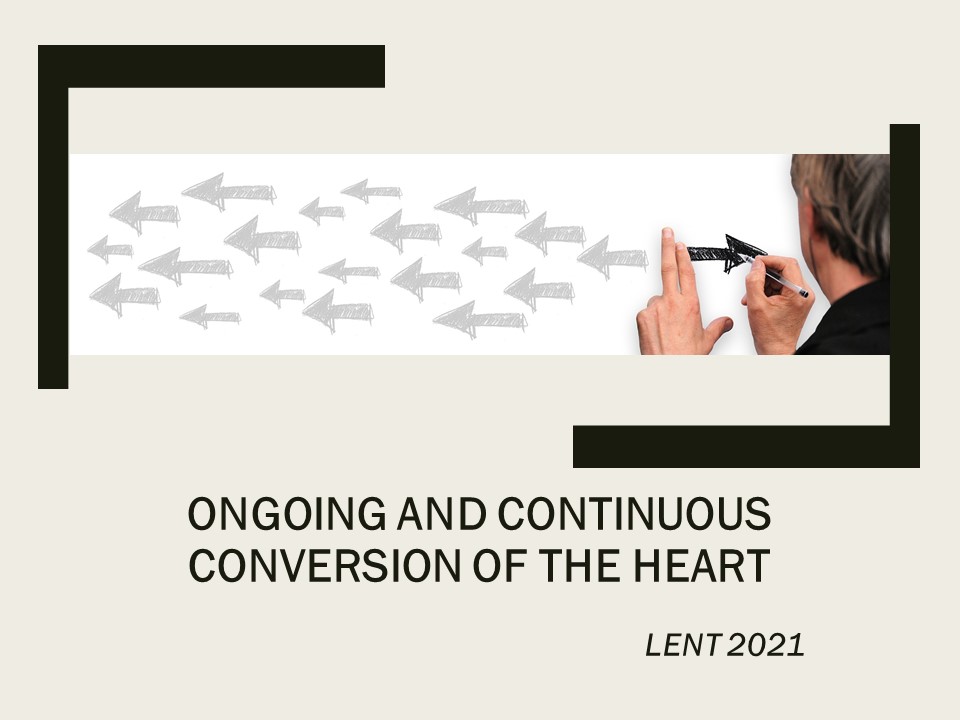
The Conversion Process: Ongoing and continuous conversion of the heart
For each week of Lent focus on one action item below that, you would like to cultivate especially as part of your Lenten journey.
1. Make an act of reparation or a modification of behavior to show sorrow for sin.
2. Be willing to recognize and accept suffering as the consequence of separating yourself from God. (Offer sufferings for the benefit of others.)
3. Commit to a plan for prayer, fasting, almsgiving. (See: Joel 2:12-18)
4. Intentionally evangelize a lukewarm or nonbeliever.
5. Ask the Holy Spirit to make me aware of a specific moral shortcoming and for the grace to change.
6. Consciously live the Beatitudes.
7. Seek personal conversion through deeper prayer.
8. Radically commit to the Gospel life centered on the person of Jesus.
9. Savor God’s mercy, experiencing the love of God which unceasingly calls us back to Himself.
10. Accept me as I am now and strive to reach a deeper level of conversion.
11. Journal on my spiritual journey made up of failures and falls and also made up of new beginnings, new discoveries.
12. Use St. Francis’s paraphrase of the Lord’s Prayer for meditation.
Questions for discussion or to answer in your journal.
+Explain how you plan to carry out the items you chose from the list above.
+Which of all the statements above might be most beneficial to your personal conversion?
+Which of the statements are the most challenging for you?
Thank you to the National Formation Commission for collaborating on this piece.
++++++++++++++++++++
El proceso de conversión:
Conversión continua y continua del corazón
Para cada semana de Cuaresma, concéntrese en un elemento de acción a continuación que le gustaría cultivar de una manera especial como parte de su jornada de Cuaresma.
1. Hacer un acto de reparación o una modificación de comportamiento para mostrar dolor por el pecado.
2. Estar dispuesto a reconocer y aceptar el sufrimiento como consecuencia de separarse de Dios. (Ofrezca sufrimientos en beneficio de otros).
3. Comprometerse a un plan de oración, ayuno, limosna. (Ver: Joel 2: 12-18)
4. Evangelizar intencionalmente a un tibio o no creyente.
5. Pídale al Espíritu Santo que lo haga consciente de una deficiencia moral específica y que tenga la gracia de cambiar.
6. Viva conscientemente las Bienaventuranzas.
7. Busque la conversión personal a través de una oración más profunda.
8. Comprometerse radicalmente con la vida evangélica centrada en la persona de Jesús.
9. Saborear la misericordia de Dios, experimentar el amor de Dios que incesantemente nos llama a Él.
10. Aceptarme tal como soy ahora y esforzarme por alcanzar un nivel más profundo de conversión.
11. Escribir un diario sobre mi jornada espiritual compuesto de fracasos y caídas y también compuesto de nuevos comienzos, nuevos descubrimientos.
12. Utilizar la paráfrasis de San Francisco del Padre Nuestro para la meditación.
Preguntas para platicar o para responder en su diario.
+ Explique cómo planea realizar los elementos que eligió de la lista anterior.
+ ¿Cuál de todas las declaraciones anteriores podría ser más beneficiosa para su conversión personal?
+ ¿Cuáles de las afirmaciones son las más desafiantes para usted?
Gracias a la Comisión Nacional de Formación por colaborar en esta pieza.
Diane F. Menditto, OFSChair, National Formation Commission
Minister, Our Lady of the Angels Region