Open post

FORMATION FRIDAY – Scripture & the Secular Franciscan – January 21, 2022

 
Dear Brothers and Sisters,
Today’s formation lesson explains compares studying the Bible and praying the Scriptures. A table that compares Lectio Divina and Clare’s Gazing is included. Please check out the two attachments videos that clarify the difference. As always, at the end of the lesson are questions that help formators facilitate discussions and check for understanding of the material. I always learn so much with our Formation Fridays and hope you enjoy them as well. Peace, Dona
++++++++++++++++++++++++++++++++++++++++++++++++++++++++++++++++++++++++++++++++++++++++++++++
“And after the Lord gave me some brothers, no one showed me what I had to do, but the Most High Himself revealed to me that I should live according to the pattern of the Holy Gospel.” The Testament – Francis of Assisi – The Saint – Vol I – Page 125
 
“Secular Franciscans should devote themselves especially to careful reading of the gospel, going from gospel to life and life to the gospel.” OFS Rule Article 4
 
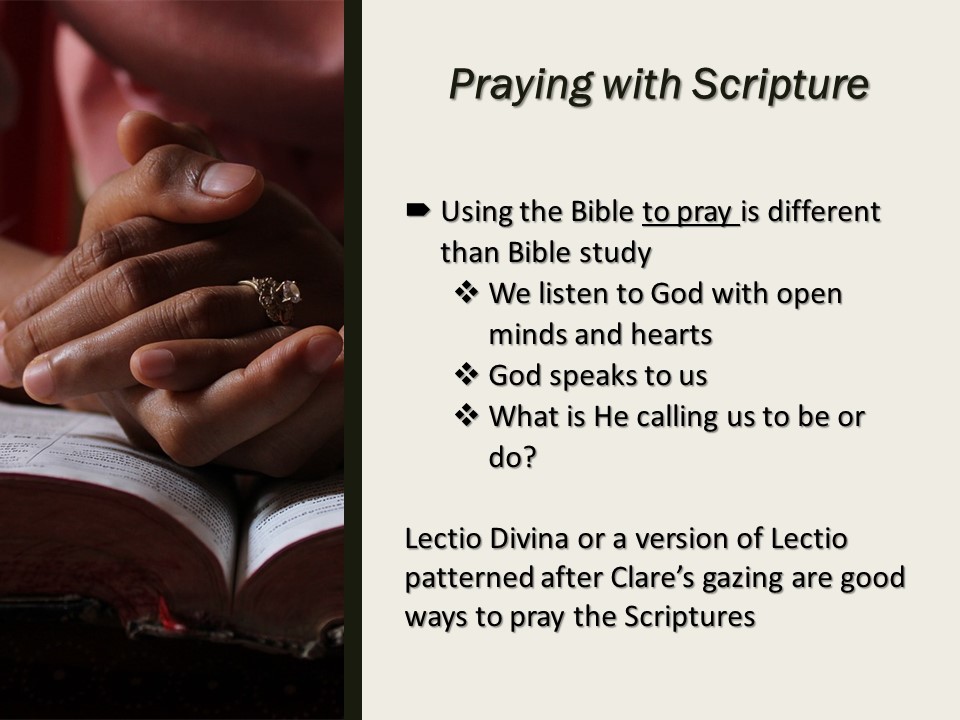
Praying the Scriptures
Studying the Bible is not prayer
It is a wonderful idea to participate in a Catholic Bible study or to study a passage of Scripture (the history/background) with your fraternity, but…
 
 Using the Bible to pray is different
 We listen to God with open minds and hearts
 God speaks to us
 What is He calling us to be or do?
 Lectio Divina or a version of Lectio patterned after Clare’s gazing are good ways to pray the Scriptures
 
We can pray the Scriptures alone or with our fraternities. A good way to get started with this is to read the daily readings whether we can attend daily Mass or not. You can find the readings of the day online at the United States Bishops’ website: https://bible.usccb.org/daily-bible-reading They give you the readings of the day plus a podcast and a reflection. You can also subscribe so that the readings are sent to your email each day. The readings are also available in Spanish.
 
Lectio Divina
Lectio (Read slowly and thoughtfully)
Meditatio (Reflect on what Scripture has to say to you in your life.)
Oratio (Respond to the reading—talk to God about your response)
Contemplatio (Receive quietly what God has to give to you.)
 
Lectio based on Clare’s gazing
 
Gaze (Read the reading—perhaps two or three times)
Consider (Hear from the heart; imagine)
Contemplate (Allow the Spirit to transform you through the reading)
Imitate (Move to action—carry out the message in my own life and dealings with others)
 
At the link below, you can view two videos by Fr. Casey Cole, OFM, describing how to pray with Scripture. Both are worthwhile to get you started praying with Scripture.
 
 
For discussion or to comment on in your journal:
1- Why was Scripture so important to St. Francis?
2-In what ways do you apply the gospels to your life?
3-How has Sacred Scripture helped you in your efforts to achieve daily conversion?
4- If you watched the videos, were you able to put the “Incarnational” method into practice?
5- Discuss with your formator or formation team ways in which your fraternity can work together to become more familiar with Scripture.
 
++++++++++++++++
 
Las escrituras y el franciscano seglar
 
“Y después que el Señor me dio algunos hermanos, nadie me mostró lo que tenía que hacer, pero el Altísimo mismo me reveló que debía vivir según el modelo del Santo Evangelio.” Testamento – San Francisco de Asís
 
Los Franciscanos seglares dedíquense asiduamente a la lectura del Evangelio, pasando del Evangelio a la vida y de la vida al Evangelio.” Regla OFS Artículo 4
 
Orar las escrituras
• Estudiar la Biblia no es orar
Es una idea maravillosa participar en un estudio bíblico católico o estudiar un pasaje de la Escritura (la historia/antecedentes) con tu fraternidad, pero…
 
• Usar la Biblia para orar es diferente
o Escuchamos a Dios con mente y corazón abiertos
o Dios nos habla
o ¿Qué nos está llamando a ser oa hacer?
o La Lectio Divina o una versión de Lectio inspirada en la mirada de Clara son buenas formas de rezar las Escrituras.
 
Podemos rezar las Escrituras solos o con nuestras fraternidades. Una buena manera de comenzar con esto es leer las lecturas diarias ya sea que podamos asistir a Misa todos los días o no. Puede encontrar las lecturas del día en línea en el sitio web de los obispos de los Estados Unidos: https://bible.usccb.org/es/bible/lecturas/011322.cfm Le brindan las lecturas del día. También puede suscribirse para que las lecturas sean enviadas a su correo cada día.
 
Lectio Divina
 
Lectio (Leer despacio y con atención)
Meditatio (Reflexionar sobre lo que las Escrituras tienen que decirle en su vida).
Oratio (Responder a la lectura, hablar con Dios sobre su respuesta)
Contemplatio (Recibir en silencio lo que Dios tiene para darle).
 
Lectio basada en la mirada de Clara
 
Mirar (leer la lectura, tal vez dos o tres veces)
Considere (Escuchar del corazón; imagine)
Contemplar (Permitir que el Espíritu le transforme a través de la lectura)
Imitar (Pasar a la acción: llevar a cabo el mensaje en mi propia vida y trato con los demás)
 
En español—El Papa Francisco explica cómo rezar la Biblia.
 
Salmos y cánticos
 
 
Para platicar o para comentar en su diario:
1- ¿Por qué la Escritura era tan importante para San Francisco?
2-¿De qué manera aplicas los evangelios a tu vida?
3-¿Cómo te ha ayudado la Sagrada Escritura en tu esfuerzo por lograr la conversión diaria?
4- Discuta con su formador o equipo de formación las formas en que su fraternidad puede trabajar en conjunto para familiarizarse más con las Escrituras.
 
Diane F. Menditto, OFS
Chair, National Formation Commission
Formation Director, Our Lady of the Angels Region
Formation Director, St. Francis Fraternity, Hackensack, NJ


The Spirit Is A Movin’

(This article originally appeared in the TAU-USA Fall Issue #104)

By Kathleen Molaro, OFS

National Franciscan Youth and Young Adult Commission Chair

“The Spirit is a movin’ all o-o-ver, all o-o-ver this land.” Remember that lovely song from back in the day? Admitting this will give evidence to the age of most of us—but it’s still a great song, and very appropriate for our times.

The Franciscan Youth and Young Adult Commission (FYYA) has spent this past year and a half introducing Regional FYYA Animators to the whys, ways, and means of reaching out to young people. Eleven virtual training sessions and monthly follow-up presentations have strengthened regions and fraternities in their understanding of what is necessary to fulfill our responsibility in spreading the Gospel to our younger Catholics. The Spirit is definitely moving us in the right direction.

Many have shared, however, that they simply don’t know what they should do next with all the information. We claim formation is a process — we start with information; tackle the task of formation, in the hopes of experiencing transformation. That transformation cannot happen if we don’t invite the Holy Spirit for help and guidance. We’ve shared a basic sequence of stages in stepping into the world of youth and young adults, but a sense of fear and a lack of confidence still linger. Perhaps what’s missing is a dependence on the Holy Spirit as our navigator in this adventure!

Living a Gospel life is not easy. We pray the words from Francis in our fraternity gatherings, that we be “cleansed and enlightened interiorly, and fired with the flame of the Holy Spirit.” I’m sure that was the goal of the Memoriale Propositi 800 years ago. Penitents were expected to follow a detailed list of rules to take the desire for holiness and gospel living seriously. Upon reflection, we can relate what is found in the antiquated list of instructions to the essentials from our 1978 Rule. Perhaps the clothing rules apply to the call for humility and detachment; rules about fasting, partaking of the Sacraments, and stringent prayer point us to the need for a deep relationship with God; and instructions relating to care of the sick and burying the dead, even in our times, lead us to an understanding of service and the love of neighbor.

We can especially appreciate nowadays this plea to the Holy Spirit in our endeavors toward living our vocation and sharing it with young people. Pope Francis encourages us in the Apostolic Exhortation, Christus Vivit, addressed to young people and the entire people of God, to ask the Holy Spirit for guidance every day. He reminds us that what we need will come, if we let ourselves be prompted by the Holy Spirit.1

The theme of calling on the Spirit is also evident for our young people preparing for the YouFra International Gathering and World Youth Day in Portugal in August 2023. The theme is “Mary rose up and went with haste” (Lk 1:39), which recalls the “yes” of Our Lady and her rush to meet her cousin Elizabeth. “Há Pressa no Ar” the event’s theme song, means “There’s a rush in the air,” and the lyrics express the joy we experience in allowing God’s Spirit to lead the way.

Pope Francis says of the theme chosen that the words and the truths of faith grow “under the action of the Holy Spirit. Mary’s “yes” led her to total availability to receive the Son of God in her life, which allowed her to be transformed. “Our simple prayer should be, ‘Lord, what you want, when you want, how you want.’”2

We are called to answer “yes” in reaching out to young people. Those who rely on the Lord “Shall renew their strength…shall run and not be weary…” (Is 40:31) In your endeavors, “may the grace of the Lord Jesus be with all.” (Rev. 22: 21)

1 Pope Francis, Christus Vivit, To Young People and the Entire People of God, (Libreria Editrice Vaticana, 2019)

2 Pope Francis, General Audience, Nov. 18, 2020

https://secularfranciscansusa.org/2022/01/17/the-spirit-is-a-movin/

Open post

FORMATION FRIDAY – Discerning a Vocation – Janaury 14, 2022


Dear Brothers and Sisters,  

We are often charged with helping a person discern if s/he has a vocation to the Secular Franciscan Order.  This is a critical task for both the fraternity and the individual involved.  (The FUN manual and Franciscan Journey offer lessons on how to make these determinations) 

Today’s lesson focuses upon what to look for as a person goes through the initial formation process.  

  • Qualities such as; being aware of the needs of others, demonstrating attributes of peace, is authentic in relationships. shows inner joy.  trust, listening, prayer life, knowledge of the Scriptures, humility, perseverance, discipline, and more.  
  • Concerns would be individuals who demonstrate anxiety, sadness, depression, inner turmoil, vanity, or arrogance.  A spouse or family member who is not supportive of the individual’s vocation or a person with tremendous family responsibilities that they are very exhausted might have too much to overcome.  Individuals who are overextended in clubs, activities and groups is also not able to devote much of themselves to the fraternity. 
The decision to allow someone to profess has consequences.  If there is a question, it is best to ask if this person would be helpful and able to fully give themselves to relationships and life in the fraternity. The Secular Franciscan Order is not for everyone.  There are many ways to serve the Lord for sure!
There are two attachments to this email that will help you to refresh your commitment and help a person in initial formation discern his or her path.  Please share this with your fraternity.  Peace, Dona
 
+++++++++++++++++++++++++++++++++++++++++++++++++++++++++++++++++++++++++++++++++++++++
 
Lately, we have been examining our own lives as Secular Franciscans. Perhaps, as a result of self-examination, others may have come to us or to our fraternities discerning a vocation to the Order. How do we help them? What do we look for?
There are some qualities that help us discern God’s invitation to a Secular Franciscan vocation.
Primary among them:
 
+Trust: The book of Proverbs tells us to trust in the Lord with all our hearts and not to lean on our understanding. If we do this, God will direct the path. To trust we must believe that God is truly present, and that God desires to speak to us. Our trust is in a loving and merciful God who promises that all will work out for good for those who seek and love him. (See Romans 8:28)
 
+Listening: God can speak to us through anything—pain and pleasure, emotions, and senses. We must listen with open hearts and open minds, especially to what we do not wish to hear. Listening requires periods of silence. Elijah heard God in a still, small voice—not a rushing wind. (1 Kings 19:11-13)
 
+Prayer and Waiting: Samuel prayed, “Speak, Lord, for your servant is listening” (1 Sam. 3:10). Samuel waited for an answer. Prayer for discernment involves waiting and listening with total attention on God. God wants us to know his will, and if we truly believe this, our prayer is centered on waiting for direction from the Lord.
 
+Knowledge of Sacred Scripture: Scripture contains a multitude of relationships between God and his people. The more familiar we are with these relationships, the more the Word of God speaks to us and leads us in the right direction.
 
+Humility: Humility is based on self-knowledge. A humble person is neither too self-confident nor too modest. Humility is one of the foundation stones for discernment because a humble heart accepts the limits of human knowledge and is willing to depend on God and others for help.
 
+Discipline, Perseverance, Patience, Perspective: These four attributes are essential in discerning a vocation. Impulses are controlled by discipline. Uncertainty is mastered by perseverance. Patience replaces irritation. And perspective reminds us that God is in charge and our part is to respond.
 
Here is a convenient list to use as a jumping off point in the discernment process.
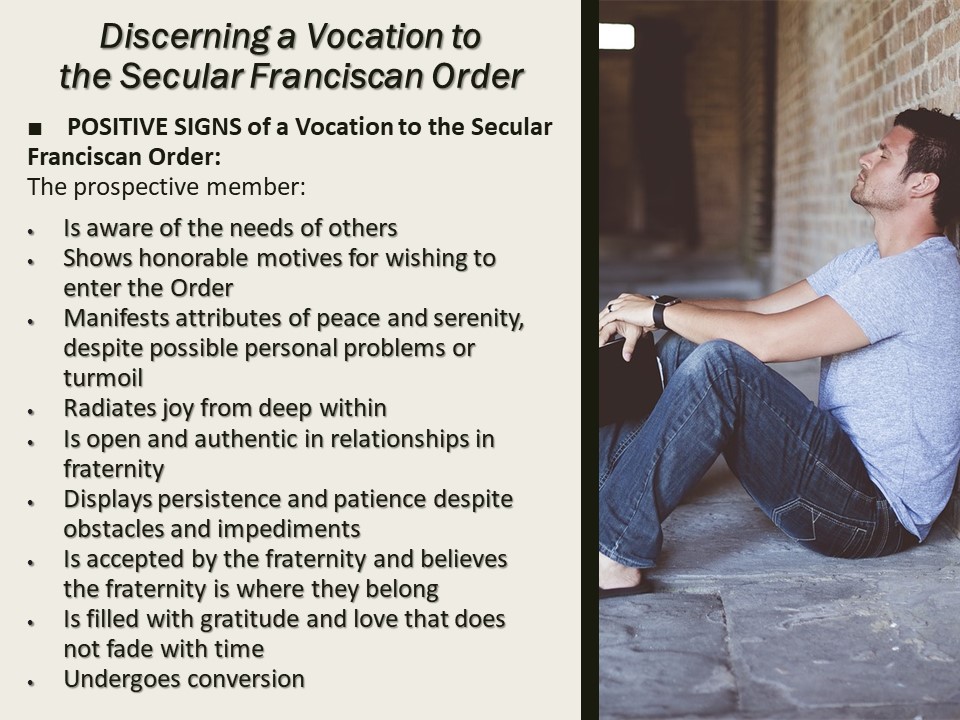
POSITIVE SIGNS of a Vocation to the Secular Franciscan Order:
The prospective member:
• Is aware of the needs of others
• Shows honorable motives for wishing to enter the Order
• Manifests attributes of peace and serenity, despite possible personal problems or turmoil
• Radiates joy from deep within
• Is open and authentic in relationships in fraternity
• Displays persistence and patience despite obstacles and impediments
• Is accepted by the fraternity and believes the fraternity is where they belong
• Is filled with gratitude and love that does not fade with time
• Undergoes conversion
 
NEGATIVE SIGNS OR CAUTIONS
The prospective member:
• Is overextended and exhausted
• Experiences inner turmoil, disturbances, sadness, or depression
• Has pressing previous commitments that demand serious consideration, especially to children and spouse
• Is experiencing anxiety or obsessions and is not in touch with God’s presence
• Exhibits attitudes of absolute certainty, arrogance, superiority, vanity, anxiety, irritability, resentment, condemnation, or condescension
 
Taken from the FUN Manual “What is Formation” by Anne Mulqueen, OFS
 
Questions to discuss or to answer in your journal
  • +Do you recall your discernment process before you entered the Order? How can your experience help you in guiding someone else?
  • +Which of the items above are most helpful in helping someone discern? Which are least helpful? (Give reasons)
+++++++++++++++++++++
 
Comparta con su fraternidad local.
 
Discernir una vocación
 
Últimamente, hemos estado examinando nuestras propias vidas como franciscanos seglares. Quizás, como resultado del autoexamen, otros puedan haber venido a nosotros o a nuestras fraternidades discerniendo una vocación a la Orden. ¿Cómo les ayudamos? ¿Que estamos buscando?
 
Hay algunas cualidades que nos ayudan a discernir la invitación de Dios a una vocación franciscana seglar. Primario entre ellos:
 
+Confianza: El libro de Proverbios nos dice que confiemos en el Señor con todo nuestro corazón y no nos apoyemos en nuestro entendimiento. Si hacemos esto, Dios dirigirá el camino. Para confiar debemos creer que Dios está verdaderamente presente y que Dios desea hablarnos. Nuestra confianza está en un Dios amoroso y misericordioso que promete que todo saldrá bien para aquellos que lo buscan y lo aman. (Ver Romanos 8:28)
 
+La escucha activa: Dios puede hablarnos a través de cualquier cosa: dolor y placer, emociones y sentidos. Debemos escuchar con corazones abiertos y mentes abiertas, especialmente lo que no deseamos escuchar. Escuchar requiere períodos de silencio. Elías escuchó a Dios con una voz suave y apacible, no con un viento impetuoso. (1 Reyes 19: 11-13)
 
+Oración y espera: Samuel oró: “Habla, Señor, que tu siervo escucha” (1 Sam. 3:10). Samuel esperó una respuesta. La oración por el discernimiento implica esperar y escuchar con total atención a Dios. Dios quiere que conozcamos su voluntad, y si realmente creemos esto, nuestra oración se centra en esperar la dirección del Señor.
 
+Conocimiento de la Sagrada Escritura: La Escritura contiene una multitud de relaciones entre Dios y su pueblo. Cuanto más familiarizados estemos con estas relaciones, más nos habla la Palabra de Dios y nos conduce en la dirección correcta.
 
+Humildad: la humildad se basa en el autoconocimiento. Una persona humilde no es ni demasiado segura de sí misma ni demasiado modesta. La humildad es una de las piedras angulares del discernimiento porque un corazón humilde acepta los límites del conocimiento humano y está dispuesto a depender de Dios y de los demás para recibir ayuda.
 
+Disciplina, perseverancia, paciencia, perspectiva: estos cuatro atributos son esenciales para discernir una vocación. Los impulsos están controlados por la disciplina. La incertidumbre se domina con la perseverancia. La paciencia reemplaza la irritación. Y la perspectiva nos recuerda que Dios está a cargo y nuestra parte es responder.
 
Aquí hay una lista conveniente para usar como punto de partida en el proceso de discernimiento.
 
SIGNOS POSITIVOS de una vocación a la Orden Franciscana Seglar:
El miembro potencial:
• Es consciente de las necesidades de los demás.
• Muestra motivos honorables para desear ingresar a la Orden.
• Manifiesta atributos de paz y serenidad, a pesar de posibles problemas personales o agitación
• Irradia alegría desde lo más profundo
• Es abierto y auténtico en las relaciones en fraternidad.
• Muestra perseverancia y paciencia a pesar de los obstáculos e impedimentos
• Es aceptado por la fraternidad y cree que la fraternidad es donde pertenecen.
• Está lleno de gratitud y amor que no se desvanece con el tiempo.
• Se somete a conversión
 
SEÑALES O PRECAUCIONES NEGATIVAS
El miembro potencial:
• Está sobrecargado y agotado
• Experimenta confusión interior, disturbios, tristeza o depresión.
• Tiene compromisos previos urgentes que exigen una seria consideración, especialmente con los hijos y el cónyuge
• Está experimentando ansiedad u obsesiones y no está en contacto con la presencia de Dios.
• Muestra actitudes de absoluta certeza, arrogancia, superioridad, vanidad, ansiedad, irritabilidad, resentimiento, condena o condescendencia.
 
Tomado del manual FUN “¿Qué es la formación?” Por Anne Mulqueen, OFS
 
Preguntas para discutir o responder en su diario
+ ¿Recuerda su proceso de discernimiento antes de entrar en la Orden? ¿Cómo puede su experiencia ayudarlo a guiar a otra persona?
+ ¿Cuáles de los elementos anteriores son más útiles para ayudar a alguien a discernir? ¿Cuáles son menos útiles? (Dar razones)
 
 
Diane F. Menditto, OFS

Chair, National Formation Commission

Formation Director, Our Lady of the Angels Region
Formation Director, St. Francis Fraternity, Hackensack, NJ


Memoriale Propositi: Going home. A Formation Project That Renews Us

(This article originally appeared in the TAU-USA Fall Issue #104)

By Mary Stronach, OFS

National Formation Commission

The following formation project can be experienced individually, perhaps even in Eucharistic Adoration, or in small groups at a fraternity gathering. It will take you back in time–to our roots and our early family. The materials needed for this activity: the accompanying chart, a copy of Memoriale Propositi (https://franciscan-archive.org/documenta.html), a copy of our present rule (the Rule of 1978).

Step One: Preliminary Questions

At the beginning of the session, consider the following questions. (If this activity is done individually, you may want to write your thoughts in your journal. If it is done with a group, you may want to discuss these questions at the beginning of the session):

Have you ever had the experience of finding old letters in the attic that our grandparents wrote? What treasures! To peek into the lives of those whose DNA we carry is a wonderful gift. Did you try to see yourself in that old picture of your great-grandmother or great-grandfather? How did you feel when you discovered them? Why did it mean so much when you found them?

Step Two: Background

As Secular Franciscans, our forefathers also left us some amazing treasures. Among them is the Memoriale Propositi, our inspirational document, which dates back to 1221. It was written by Cardinal Hugolino dei Conti di Segni at the request of St. Francis of Assisi. Cardinal Hugolino later became Pope Gregory IX, who canonized Francis of Assisi in 1228, two years after his death.

A quick review of the Memoriale Propositi of 1221 may give us a better perspective of who our early brothers and sisters were and how they lived. As importantly, it will connect us with them and, perhaps, even strengthen our focus on how we can live more completely in the footsteps of St. Francis.

Step Three:

Activity: Read Memoriale Propositi and reflect on its message. How does it speak to us? What does it tell us about our forefathers? How is it different and how is it similar to our present Rule? Are there some parts of it on which we too can act? (Note: You may want to use the chart at the end of this article to help organize your thoughts and to compare our present Rule with Memoriale Propositi.)

(Note for Formation Leaders: This activity can also be used at your Fraternity Gathering–in small groups or the large group. You may want to give each group about 30 minutes to discuss two or three topics and then invite each group to summarize its discussion in the large group):

Summary statement: While our brothers and sisters of 1221 lived different lives, the essence of who we are as Secular Franciscans has never changed. We follow Christ in the footsteps of St. Francis… from Gospel to life and life to Gospel. The Rule of 1978 reflects our foundational and inspirational document and reminds us of the gift and treasure Francis gave us when he asked Cardinal Hugolino to write the first Franciscan guide for the “Brothers and Sisters of Penance.”

https://secularfranciscansusa.org/2022/01/10/memoriale-propositi-going-home-a-formation-project-that-renews-us/

Open post

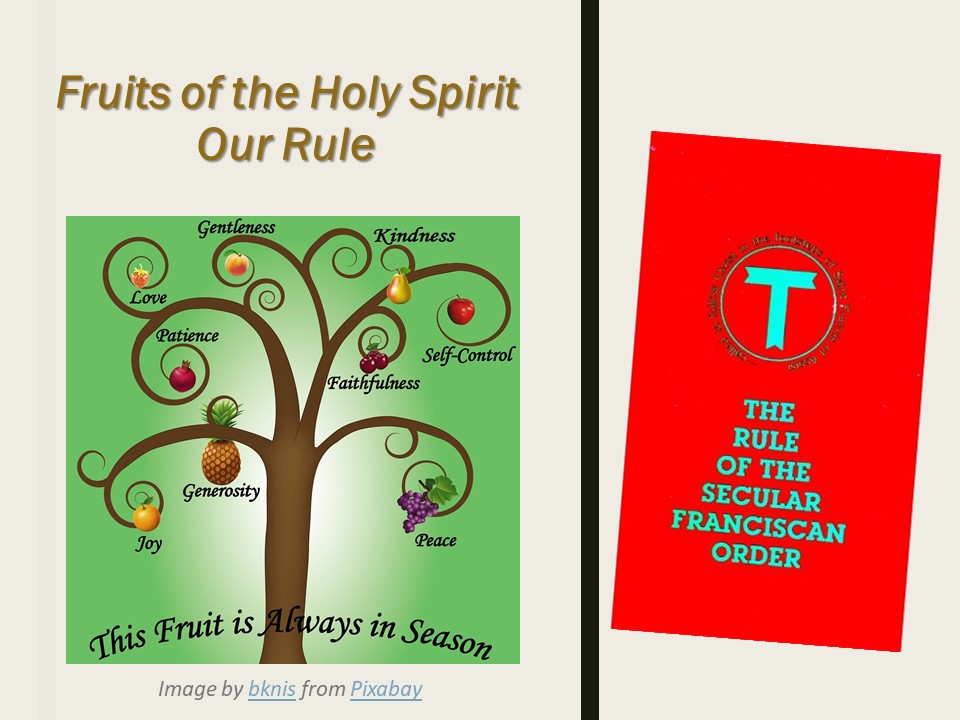
FORMATION FRIDAY – Fruits of the Spirit & the Rule – January 6,2022

 
Dear Brothers & Sisters,
Secular Franciscans received the Gifts of the Holy Spirit at Baptism (wisdom, understanding, counsel, fortitude, knowledge, piety, and fear of the Lord). These gifts are strengthened at Confirmation and again when we profess as Secular Franciscans to live the Rule.
Today’s lesson focuses upon how we live the RULE each day. Does our life reflect the Fruits of the Holy Spirit (love, joy, peace, patience, kindness, goodness, long-suffering, mildness, faith, modesty, self-restraint, and chastity)? Let us renew our commitment to live the Gospel life as we begin a New Year in Christ.
Come, Holy Spirit,
fill the hearts of your faithful,
and en-kindle in us the fire of your love.
Send forth your Spirit and we shall be created,
and you shall renew the face of the earth.
Amen.


. Hope you enjoy the lesson and please share it with your fraternity. Peace, Dona
__________________________________________________
The Fruits of the Spirit exemplified in our Rule
When we are baptized we receive the gifts of the Holy Spirit. These gifts are strengthened at our Confirmation. When we are professed as Secular Franciscans, we further strengthen our Baptismal Promises. As a result of the gifts of the Spirit (wisdom, understanding, counsel, fortitude, knowledge, piety, and fear of the Lord), we can demonstrate the fruits of the Spirit (love, joy, peace, patience, kindness, goodness, long-suffering, mildness, faith, modesty, self-restraint, and chastity.) By living our rule, we hope to exemplify these fruits in everything we do in our daily lives.
 
Our Rule
+Spells out the way the Spirit wishes us to do God’s will
+Tells us how God desires us to live
+Faithfulness to the Rule and Constitutions help us to build up God’s Kingdom (as we are called to do through our Baptism).
 
For your consideration—the Fruits of the Spirit and our Rule
 
First of all—Articles 4, 14, and 19 ask us to be open to the action of the Holy Spirit
 
Love: Articles 5, 13, and 18
+We are asked to encounter the living person of Christ in one another and to be mindful that all creatures bear the “imprint of the Most High.”
 
Joy: Articles 13 and 19
+We are reminded that a sense of community makes us joyful and that we are “Messengers of perfect joy in every circumstance…”
 
Peace: Articles 17 and 19
+We are reminded that we are “bearers of peace” and that we should “cultivate peace.”
 
Patience: Articles 7 and 10
+We seek conversion each day (metanoia) as we place ourselves in the hands of the Father.
 
Kindness: Articles 13 and 14
+With a “gentle and courteous spirit” we accept “all people as a gift of the Lord and an image of Christ.”
 
Goodness: Articles 13 and 14
+ “Secular Franciscans, together with all people of goodwill, are called to build a more fraternal and evangelical world…”
 
Long-suffering: Articles 10 and 19
+ We follow the “poor and crucified Christ, witness to him even in difficulties and persecutions.”
 
Mildness: Articles 9 and 11
+We live in the “spirit of the Beatitudes.”
 
Faith: Articles 4, 5, 10 and 14
+We express our faith in Jesus: “Christ, the gift of the Father’s love, is the way to him, the truth into which the Holy Spirit leads us, and the life which he has come to give abundantly.”
 
Modesty: Article 11
+We “purify our hearts from every tendency and yearning for possession and power.”
 
Self-restraint: Article 11, 12
+We “acquire purity of heart” in order to “set ourselves free” in order to “love God and our brothers and sisters.”
 
Chastity: Articles 6, 12
+We follow the teachings of the Church, “…devote themselves energetically to living in full communion with the pope, bishops, and priests,…”
 
For discussion or to answer in your journal:
+When people look at you, which fruits of the Holy Spirit are evident? Give an example.
+How does our Rule help you to demonstrate these fruits of the Spirit?
+Which of the fruits of the Spirit are difficult for you to manifest? Can you pinpoint why that might be?
 
+++++++++++++++++
 
Los frutos del Espíritu ejemplificados en nuestra Regla
Cuando somos bautizados recibimos los dones del Espíritu Santo. Estos dones se fortalecen en nuestra Confirmación. Cuando profesamos como franciscanos seglares, fortalecemos aún más nuestras promesas bautismales. Como resultado de los dones del Espíritu (sabiduría, entendimiento, consejo, fortaleza, conocimiento, piedad y temor del Señor), podemos demostrar los frutos del Espíritu (amor, gozo, paz, paciencia, bondad, bondad, longanimidad, apacibilidad, fe, modestia, dominio propio y castidad.) Al vivir nuestra regla, esperamos ejemplificar estos frutos en todo lo que hacemos en nuestra vida diaria.
 
Nuestra Regla:
• Explica la forma en que el Espíritu desea que hagamos la voluntad de Dios.
• Nos dice cómo Dios desea que vivamos
• La fidelidad a la Regla y las Constituciones nos ayuda a construir el Reino de Dios (como estamos llamados a hacer a través de nuestro Bautismo).
Para su consideración: los frutos del espíritu y nuestra regla
En primer lugar, los artículos 4, 14 y 19 nos piden que estemos abiertos a la acción del Espíritu Santo.
El Amor: artículos 5, 13 y 18
+ Se nos pide que encontremos a la persona viva de Cristo en los demás y que tengamos presente que todas las criaturas llevan la “huella del Altísimo”.
 
El Gozo: artículos 13 y 19
+ Se nos recuerda que el sentido de comunidad nos alegra y que somos “Mensajeros de la alegría perfecta en toda circunstancia …”
 
La Paz: artículos 17 y 19
+ Se nos recuerda que somos “portadores de paz” y que debemos “cultivar la paz”.
 
La Paciencia: artículos 7 y 10
+ Buscamos la conversión cada día (metanoia) al ponernos en las manos del Padre.
 
La Benignidad: artículos 13 y 14
+ Con un “espíritu amable y cortés” aceptamos “a todas las personas como un don del Señor y una imagen de Cristo”.
 
La Bondad: artículos 13 y 14
+ “Los franciscanos seglares, junto con todas las personas de buena voluntad, estamos llamados a construir un mundo más fraterno y evangélico…”
 
La Longanimidad: artículos 10 y 19
+ Seguimos al “Cristo pobre y crucificado, testimoniamos de él incluso en las dificultades y persecuciones”.
La Mansedumbre: artículos 9 y 11
+ Vivimos en el “espíritu de las Bienaventuranzas”.
 
La Fe: artículos 4, 5, 10 y 14
+ Expresamos nuestra fe en Jesús: “Cristo, don del amor del Padre, es el camino hacia él, la verdad a la que nos conduce el Espíritu Santo y la vida que ha venido a dar en abundancia”.
 
La Modestia: artículo 11
+ “Purificamos nuestro corazón de toda tendencia y anhelo de posesión y poder”.
 
La Continencia: artículos 11, 12
+ “Adquirimos pureza de corazón” para “liberarnos” para “amar a Dios ya nuestros hermanos”.
 
La Castidad: artículos 6, 12
+ Seguimos las enseñanzas de la Iglesia, “… se dedican con energía a vivir en plena comunión con el Papa, los obispos y los sacerdotes …”
 
Para discusión o para responder en su diario:
+ Cuando la gente te mira, ¿qué frutos del Espíritu Santo son evidentes? Dar un ejemplo.
+ ¿Cómo te ayuda nuestra Regla a demostrar estos frutos del Espíritu?
+ ¿Cuáles de los frutos del Espíritu te resultan difíciles de manifestar? ¿Puedes señalar por qué podría ser eso?
 
Diane F. Menditto, OFS
Chair, National Formation Commission
Formation Director, Our Lady of the Angels Region
Formation Director, St. Francis Fraternity, Hackensack, NJ
 
Scroll to top
Juan de Padilla