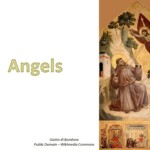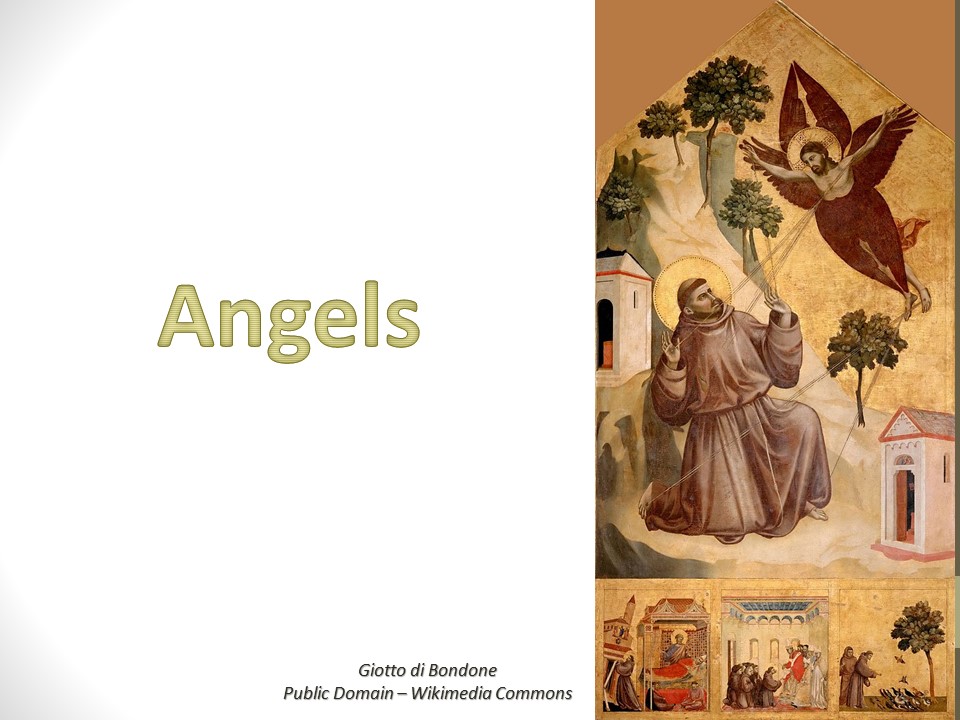
Formation Friday is the work product of the National Formation Commission of the Secular Franciscan Order-USA. Please keep all citations and references intact. (This statement should be included with any posts in emails, on websites, or on social media.)Do you ever wonder about angels?• The existence of the spiritual, non-corporeal beings that Sacred Scripture usually calls “angels” is a truth of faith. The witness of Scripture is as clear as the unanimity of Tradition. (CCC 328 )• St. Augustine says: “‘Angel’ is the name of their office, not of their nature…..'”188 (CCC 329)• With their whole beings the angels are servants and messengers of God. Because they “always behold the face of my Father who is in heaven” they are the “mighty ones who do his word, hearkening to the voice of his word”.189 (CCC 329)• As purely spiritual creatures angels have intelligence and will: they are personal and immortal creatures, surpassing in perfection all visible creatures, as the splendor of their glory bears witness.190 (CCC 330)• Angels have been present since creation and throughout the history of salvation, announcing this salvation from afar or near and serving the accomplishment of the divine plan: … (CCC 332)• From its beginning until death, human life is surrounded by their watchful care and intercession.202 “Beside each believer stands an angel as protector and shepherd leading him to life.”203 Already here on earth the Christian life shares by faith in the blessed company of angels and men united in God. (CCC 336)For complete entries see # s 328-336 in the Catechism of the Catholic Church.CCC is online at CATECHISM OF THE CATHOLIC CHURCH (searchable)• Traditionally the angels are classified into what are called nine “choirs” or “ranks.” This division is based on nine names of angels found in Sacred Scripture. This is an accepted Catholic belief but is not dogma. The names do not appear in the Catechism. According to these rankings, only Archangels and “regular” angels have contact with humans. Two of the exceptions to this are: a Seraph touched a burning ember to the lips of the Prophet Isaiah, and St. Francis was visited in a vision by a Seraph on Mt. La Verna.(See Aleteia: ALETEIA: CHOIRS OF ANGELS )• St. Thomas Aquinas devotes an entire question to the angels in the Summa Theologiae. (See New Advent: https://www.newadvent.org/summa/1108.htm )• The names of the nine choirs of angels are: Seraphim, Cherubim, Thrones, Dominions, Virtues, Powers, Archangels, Principalities, Angels. (For a description of each choir see Catholic.org CATHOLIC.ORG: CHOIRS OF ANGELS)• In case you were wondering—”The Bible and the Church recognize seven archangels, although just three are known by name, Michael, Gabriel, and Raphael.” Other, non-biblical sources mention four other names, but they are not recognized by the Church.• The highest order of angels is the SERAPHIM. This is particularly significant for Franciscans.• The Seraphim are closest to God, and they praise him day and night. Seraphim means “the burning ones.”• St. Francis was visited by a Seraph in a vision on Mt. La Verna. This is why he is called our Seraphic Father.• Thomas of Celano mentions the six wings of the Seraph.• In The Soul’s Journey Into God, St. Bonaventure uses “the imagery of the six wings of the Seraph as indicators and reminders of the comprehensive and full spirituality of St. Francis, and of anyone who would follow his inspiration.” (see link below)• Read a full description of St. Bonaventure’s explanation of the six wings of the Seraph in an excellent article on “The Seraphic Vision on Mt. La Verna” by Fr. John Sullivan, OFM, (topic 18) on the OFS-USA website here: OFS-USA WEBSITE ARTICLE BY FR. JOHN SULLIVAN, OFMQuestions for discussion or to answer in your journal.+ Think about angels. What role do they play in your life?+ Read the article about “The Seraphic Vision on Mt. La Verna.” Think about St. Francis’s vision of the Seraph. What did you learn about this experience? What effect does seeing this event in the life of St. Francis more clearly have on your spiritual life?++++++++++++++++++++++++Por favor-compartir con la fraternidad localFormation Friday es el producto del trabajo de la Comisión Nacional de Formación de la Orden Franciscana Seglar-EE.UU. Mantenga todas las citas y referencias intactas. (Esta declaración debe incluirse con cualquier publicación en correos electrónicos, sitios web o redes sociales).¿Alguna vez se ha preguntado acerca de los ángeles?• La existencia de los seres espirituales, incorpóreos, que la Sagrada Escritura suele llamar “ángeles”, es una verdad de fe. El testimonio de la Escritura es tan claro como la unanimidad de la Tradición. (CIC 328 )• San Agustín dice: “‘Ángel’ es el nombre de su oficio, no de su naturaleza…”188 (CIC 329)• Con todo su ser, los ángeles son servidores y mensajeros de Dios. Porque ellos “miran siempre el rostro de mi Padre que está en los cielos” son los “poderosos que cumplen su palabra, escuchando la voz de su palabra”.189 (CIC 329)• Como criaturas puramente espirituales, los ángeles tienen inteligencia y voluntad: son criaturas personales e inmortales, superando en perfección a todas las criaturas visibles, como lo atestigua el esplendor de su gloria.190 (CIC 330)• Los ángeles han estado presentes desde la creación y a lo largo de la historia de la salvación, anunciando esta salvación de lejos o de cerca y sirviendo a la realización del plan divino: … (CIC 332)• Desde su comienzo hasta la muerte, la vida humana está rodeada por su cuidado vigilante e intercesión.202 “Al lado de cada creyente está un ángel como protector y pastor que lo lleva a la vida”.203 Ya aquí en la tierra, la vida cristiana comparte por la fe en el bienaventurado compañía de ángeles y hombres unidos en Dios. (CIC 336)Para las anotaciones completas, vea los números 328-336 en el Catecismo de la Iglesia Católica.• Tradicionalmente los ángeles se clasifican en lo que se llama nueve “coros” o “rangos.” Esta división se basa en nueve nombres de ángeles que se encuentran en la Sagrada Escritura. Esta es una creencia católica aceptada pero no es un dogma. Los nombres no aparecen en el Catecismo. De acuerdo con estas clasificaciones, solo los Arcángeles y los ángeles “regulares” tienen contacto con los humanos. Dos de las excepciones a esto son: un Serafín tocó una brasa ardiente en los labios del Profeta Isaías, y San Francisco fue visitado en una visión por un Serafín en el Monte La Verna.(Ver JERARQUÍA ANGÉLICA )• Santo Tomás de Aquino dedica toda una pregunta a los ángeles en la Summa Theologiae. (Ver https://hjg.com.ar/sumat/ en particular SUMA THEOLÓGICA EN ESPAÑOL )• Los nombres de los nueve coros de ángeles son: Serafines, Querubines, Tronos, Dominaciones, Virtudes, Potestades, Arcángeles, Principados, Ángeles. (Para obtener una descripción de cada coro, consulte Catholic.net en español https://es.catholic.net/op/articulos/9763/cat/123/la-jerarquia-angelica.html )• En caso de que se lo pregunte: “La Biblia y la Iglesia reconocen siete arcángeles, aunque sólo tres son conocidos por su nombre: Miguel, Gabriel y Rafael”. Otras fuentes no bíblicas mencionan otros cuatro nombres, pero no son reconocidos por la Iglesia.”• El orden más alto de ángeles es el SERAFÍN. Esto es particularmente significativo para los franciscanos.• Los Serafines son los más cercanos a Dios y lo alaban día y noche. Serafín significa “los ardientes.”• San Francisco fue visitado por un Serafín en una visión en el Monte La Verna. Por eso se le llama nuestro Seráfico Padre.• Tomás de Celano menciona las seis alas del Serafín.• En “El viaje del alma hacia Dios,” San Buenaventura usa “las imágenes de las seis alas del Serafín como indicadores y recordatorios de la espiritualidad integral y plena de San Francisco, y de cualquiera que siga su inspiración.” (ver enlace abajo)• Lea una descripción completa de la explicación de San Buenaventura de las seis alas del Serafín en un excelente artículo sobre “La Visión Seráfica en el Monte La Verna” por el Padre. John Sullivan, OFM, (tema 18) en el sitio web de OFS-USA aquí: ARTÍCULO EN INGLÉS SOBRE EL SERAFÍNPreguntas para platicar o para responder en su diario.+ Piense en los ángeles. ¿Qué papel juegan en su vida?+ Lea el artículo sobre “La Seráfica Visión en el Monte La Verna.” (el artículo es en inglés)Piense en la visión de San Francisco del Serafín. ¿Qué aprendiste de esta experiencia? ¿Qué efecto tiene ver más claramente este evento en la vida de San Francisco en su vida espiritual?Diane F. Menditto, OFSChair, National Formation Commission
Formation Director, Our Lady of the Angels Region
Formation Director, St. Francis Fraternity, Hackensack, NJ
Franciscan Living: See, Hear, Become
(This article originally appeared in the TAU-USA Fall Issue #104)
By Francine Gikow, OFS
I love St. Francis’ ability to find joy in everything! Francis used his senses to experience God’s love. He looked at a bird and understood; he heard the bird’s call and experienced the handiwork of God through the bird. What joy!
Being quite sensual, Francis had a unique way of seeing and hearing. Francis saw and heard God’s beauty in creation―but to Francis, it was not just creation, rather it bore “the imprint of the Most High…” (Art. 18). Francis experienced LOVE incarnate in the everyday. For Francis, nothing was observed, heard, or experienced apart from God.
God was Francis’ context. Every sound, every image, and every thought brought him into God’s presence. Francis’ profound relationship with God colored everything he viewed, heard, and experienced. Francis was able to remain in the presence of God throughout the day, night, and at all times.
So how can we live in the presence of God with everything that we see, hear, and experience? How can we bring this Presence into the commonplace? How do we “see deeply, hear deeply, and experience deeply” through the eyes of God?
As always, prayer is essential to retain God’s presence in our lives―particularly praying with scriptures. As St. Clare instructs us, consider how Jesus gazed upon creation and other people. He saw past the outer trappings and peered into their eyes with His mercy, kindness, and love. Meditate on how Jesus listened intently to sinners, lepers, and even to the needs of the little children in scripture. Enter into each scene―when Jesus encountered the rich young man, (Matt 19:16-30) when he calls Mary Magdalene by name after the resurrection, (Jn 20:16), or looked into the eyes of Zacchaeus (Lk19: 1-10). See how Jesus loved them with his eyes and with his voice. See how he touched their hearts with compassion.
Then, as St. Clare continues her instruction: “contemplate Him!” Stay with God and rest in Him. Allow Him to heal you, to comfort you, and live in your soul.
Ask God to mold your heart and guide you as you interact with others so God’s “Presence” can overtake you as you look, hear, and become a vessel of God for others. Allow God to empty yourself so that you become lesser and He becomes greater. As you finish your prayer time, pray that you may imitate what you have seen and heard so your heart might soften and be attuned to what you see and hear. Finally, at the end of each day, review your seeing, listening, and “being” in the Presence of the Holy One.
Being contemplative and mindful as we go through our day is bringing Christ into the world through our very lives. We become an instrument of God’s love. This is what our Rule describes as “trusting in the Divine Seed in everyone and in the transforming power of love and pardon.” (Art. 19)
I have often heard Secular Franciscans describe our way of life as “it is who we are and be” ―understanding that we do not have a unifying apostolate or “work.” Rather, we use ourselves and our lives to rebuild the church by bringing Christ into the world.
We bring Christ to the world if we see, hear, and become Christ bearers so others can experience God through us and give glory to God. As Secular Franciscans, we evangelize from the “bottom up,” meaning we evangelize not by preaching or apologetics but from our very “being,” which proclaims Christ personally to a hurting world.
Jan Novotka’s song, “Presence,” sums up what our lives as Secular Franciscans should become by bringing Christ to others:
It’s not what you do, but how you do it.
It’s not what you see, but how you see.
It’s not what you say, what you know or achieve
It’s the Presence, the Presence you are!
“…that we have seen and heard we proclaim also to you, so that you may have fellowship with us…that our joy may be complete.” 1Jn: 3-4.
https://secularfranciscansusa.org/2022/02/07/franciscan-living-see-hear-become/
FORMATION FRIDAY – CHARISM & OUR IDENTITY AS SECULAR FRANCISCAN, February 4, 2022
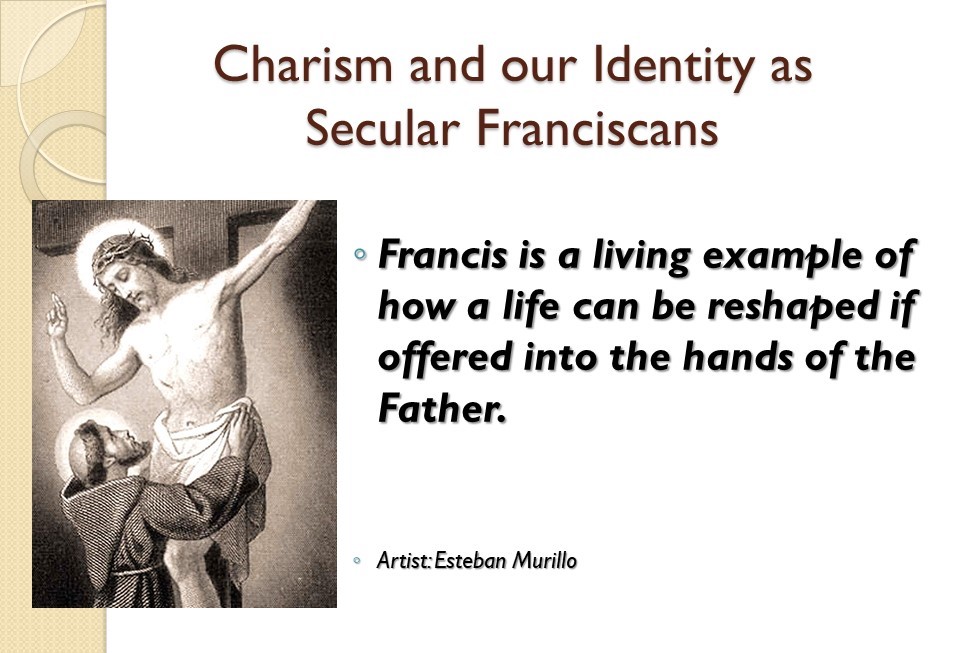
Formation Friday is the work product of the National Formation Commission of the Secular Franciscan Order-USA. Please keep all citations and references intact. (This statement should be included with any posts in emails, on websites, or on social media.)CHARISM AND OUR IDENTITY AS SECULAR FRANCISCANS(See FUN Manual chapter “Vocation, Charism, and Mission of the Secular Franciscan Order,” pp. 11-15. This chapter is based on the work of Benedetto Lino, OFS, former coordinator of the International Formation Commission.)OFS Rule, Chapter I, #1 “The Franciscan Family, as one among many spiritual families raised up by the Holy Spirit in the Church, unites all members of the People of God—laity, religious and priests—who recognize that they are called to follow Christ in the footsteps of St. Francis of Assisi.In various ways and forms but in life-giving union with each other, they intend to make present the charism of their common Seraphic Father in the life and mission of the Church.”Prior to Vatican II, CHARISM solely referred to the graces of the Holy Spirit needed to build up the Church.• SINCE VATICAN II, the Catechism of the Catholic Church tells us:o “Whether extraordinary or simple and humble, charisms are graces of the Holy Spirit which directly or indirectly benefit the Church, ordered as they are to her building up, to the good of men, and to the needs of the world.” (799)o “Charisms are to be accepted with gratitude by the person who receives them and by all members of the Church as well.” “…provided that they really are genuine gifts of the Holy Spirit and are used in full conformity with authentic promptings of this same Spirit, that is, in keeping with charity, the true measure of all charisms.” (800)o “Discernment of charisms is always necessary. …so that all the diverse and complimentary charisms work together for the common good. (801)• In the case of a PARTICULAR CHARISM, for example, a founder, charism refers to:o Gifts granted by God to a believer (In our case, St. Francis of Assisi)o Leads to the foundation of an Institute or religious movement (the Franciscan Order/Franciscan movement—First, Second, and Third Orders)o Includes a specific way of being (poverty, chastity, obedience, humility, simplicity, minority, fraternity, penitential life, etc.) Francis’s very special gift was that he showed that the Gospel could be lived.o Specific spiritual experiences (Our spirituality is linked to our way of being. Franciscan spirituality is incarnational, intensely Eucharistic, and penitential.) Francis was in awe of the humility of God—God’s kénosis or self-emptying. Much of Franciscan spirituality goes back to this.• Francis is a living example of how a life can be reshaped if offered into the hands of the Father. Through grace Francis came to think with the mind of the Son, see with the eyes of the Son, love with the heart of the Son, and act with the abandonment and dedication of the Son.• As we follow Francis, we find that our mission, like the mission of the entire Franciscan Family, is to repair the church. We are called to enhance and support the mission of the Church to the whole world.HOW?• Through: reconciliations, alleviating sufferings, accompanying the lonely, consoling those in despair, fighting marginalization, solidarity with the poor, respecting human life and all of God’s creation, loving and accompanying youth, catechizing, animating liturgies, supporting Christian communities in anything they might need.Questions for discussion or to answer in your journal+ Secular Franciscans have a unique opportunity to show that the gospel can be lived in the world. (See OFS Rule Article 4). How do you live the gospel in your daily life? How can you do better at this?+ Of the items listed under HOW above, give examples of how you “enhance and support the mission of the Church to the whole world.” (Thereby helping to “repair the Church.”) Instead of just giving a list, explain how you carry these items out in your daily life.+++++++++++++++Por favor comparta con su fraternidadFormation Friday es el producto del trabajo de la Comisión Nacional de Formación de la Orden Franciscana Seglar-EE.UU. Haga favor de mantener todas las citas y referencias intactas. (Esta declaración debe incluirse con cualquier publicación en correos electrónicos, sitios web o redes sociales).CARISMA Y NUESTRA IDENTIDAD COMO FRANCISCANOS SEGLARES(Véase el capítulo del Manual FUN “Vocación, carisma y misión de la Orden Franciscana Seglar,” págs. 11-15. Este capítulo está basado en el trabajo de Benedetto Lino, OFS, ex coordinador de la Comisión de Formación Internacional.)Regla OFS Artículo 1:“Entre las familias espirituales, suscitadas por el Espíritu Santo en la Iglesia2, la familia Franciscana comprende a todos aquellos miembros del Pueblo de Dios, laicos, religiosos y sacerdotes, que se sienten llamados al seguimiento de Cristo, tras las huellas de San Francisco de Asís3. En maneras y formas diversas, pero en recíproca comunión vital, todos ellos se proponen hacer presente el carisma del común Seráfico Padre en la vida y en la misión de la Iglesia4.“• DESDE EL VATICANO II, el Catecismo de la Iglesia Católica nos dice:o “Sean extraordinarios o simples y humildes, los carismas son gracias del Espíritu Santo que directa o indirectamente benefician a la Iglesia, ordenados como están a su edificación, al bien de los hombres y a las necesidades del mundo”. (799)o “Los carismas deben ser aceptados con gratitud por la persona que los recibe y también por todos los miembros de la Iglesia”. “…siempre que sean realmente dones genuinos del Espíritu Santo y se utilicen en plena conformidad con los impulsos auténticos de este mismo Espíritu, es decir, según la caridad, la verdadera medida de todos los carismas”. (800)o “Siempre es necesario el discernimiento de los carismas. …para que todos los carismas diversos y complementarios trabajen juntos por el bien común. (801)• En el caso de un CARISMA PARTICULAR, por ejemplo, un fundador, carisma se refiere a:o Dones otorgados por Dios a un creyente (En nuestro caso, San Francisco de Asís)o Conduce a la fundación de un Instituto o movimiento religioso (la Orden Franciscana/movimiento Franciscano—Primera, Segunda y Tercera Órdenes)o Incluye un modo de ser específico (pobreza, castidad, obediencia, humildad, sencillez, minoridad, fraternidad, vida penitencial, etc.) El don muy especial de Francisco fue que mostró que el Evangelio se podía vivir.o Experiencias espirituales específicas (Nuestra espiritualidad está ligada a nuestra forma de ser. La espiritualidad franciscana es encarnada, intensamente eucarística y penitencial). Francisco estaba asombrado de la humildad de Dios: la kénosis de Dios o el vaciado de sí mismo. Gran parte de la espiritualidad franciscana se remonta a esto.• Francisco es un ejemplo vivo de cómo se puede reformar una vida si se ofrece en las manos del Padre. Por la gracia Francisco llegó a pensar con la mente del Hijo, a ver con los ojos del Hijo, a amar con el corazón del Hijo ya actuar con el abandono y la entrega del Hijo.• Al seguir a Francisco, encontramos que nuestra misión, como la misión de toda la Familia Franciscana, es reparar la iglesia. Estamos llamados a realzar y apoyar la misión de la Iglesia en todo el mundo.¿CÓMO?• Mediante: reconciliaciones, aliviar los sufrimientos, acompañar a los solitarios, consolar a los desesperados, luchar contra la marginación, solidarizarse con los pobres, respetar la vida humana y toda la creación de Dios, amar y acompañar a los jóvenes, catequizar, animar las liturgias, apoyar a las comunidades cristianas en todo lo que podría necesitar.Preguntas para platicar o para responder en su diario+ Los franciscanos seglares tienen una oportunidad única de mostrar que el evangelio se puede vivir en el mundo. (Ver Regla OFS Artículo 4). ¿Cómo vive usted el evangelio en su vida diaria? ¿Cómo puede hacerlo mejor?+ De los elementos enumerados en “CÓMO” arriba, dé ejemplos de cómo “usted mejora y apoya la misión de la Iglesia en todo el mundo.” (Ayudando así a “reparar la Iglesia.”) En lugar de simplemente dar una lista, explique cómo lleva a cabo estos elementos en su vida diaria.Diane F. Menditto, OFSChair, National Formation Commission
Formation Director, Our Lady of the Angels Region
Formation Director, St. Francis Fraternity, Hackensack, NJ
OFS-USA Accessibility Committee Established

(This article originally appeared in the TAU-USA Fall Issue #104)
By Janice Benton, OFS and Susan Tabor, OFS
It all started when Susan Tabor, OFS, and Janice Benton, OFS, shared a dream with each other. That dream, based on their shared vision of fully accessible events and materials, such as Braille and large print, and inspired by our call to value the inherent dignity of every person, led to an idea of how we might help others in this area.
Susan and Janice met at a book study led by Carolyn Townes, chair of the national JPIC Commission. They were on the phone discussing an inquiry they were working on concerning accessible materials for someone in formation. As they talked, their shared vision was born. The vision was offered to our National Minister, Jan Parker, who shared it with the National Executive Council (NEC), which immediately voted to make the OFS-USA Accessibility Committee a standing committee.
In the meantime, Mark Banschbach, OFS, was busy working on developing resources for the Five Franciscan Martyrs Regional website in different languages, and in Braille, in response to a new inquirer who was blind. He reached out to Multicultural Councilor Willie Guadalupe, and then to Connie Wild, OFS, Janice, and then Susan. Calls were made and fellowship soared.
A virtual Meet and Greet for the new committee was held on Friday evening, August 20, 2021, so the NEC could officially welcome and talk with the members. The response of the NEC to the formation of this committee has been very warm and enthusiastic.
Janice and Susan are co-chairs of this newly-formed committee. The other committee members are: Consuelo Wild, OFS, of St. Margaret of Cortona Region; Mark Banschbach, OFS, of the Five Franciscan Martyrs Region; and Mike Freeman, OFS, of the St. Joan of Arc Region.
Janice, Susan, Connie, and Mike have had many years of experience working in the disability access field: Janice as a long-time director of the National Catholic Partnership on Disability, retiring in 2019; Susan as a social worker; Connie working with the deaf community; and Mike as a special education teacher and special education program specialist. Mike served as Minister of St. Maximilian Kolbe Fraternity in Houston for six years, is a member of the local Council, and also serves as the JPIC animator for his region. Susan lives with blindness due to a congenital condition; namely retinopathy on prematurity. She is a member of the National JPIC Commission and serves as JPIC animator for the Juan De Padilla Region. Mark is relatively new to the field of accessibility but brings experience in areas of technology and in software development. He serves as Minister of St. John Capistrano Fraternity, as Area/Family Councilor in the Five Franciscan Martyrs Region, Spiritual Assistant for The Encounter Fraternity in Lake Wales, Florida, and Regional Webmaster. His enthusiasm is inspiring and contagious! Connie lives with profound deafness and serves as Minister of her local fraternity, St. Francis of Assisi Deaf Fraternity in the St. Margaret of Cortona Region. It is the only known alldeaf OFS fraternity in the world. Connie is also a former director of the National Catholic Office for the Deaf. Janice serves as Minister of the St. Francis Fraternity in Washington, DC, and is an area councilor for the St. Margaret of Cortona Region.
As local and regional fraternities encounter access issues and questions pertaining to any disability, we want to hear from you! We will help you find resources and provide guidance concerning any other accessibility-related questions you may have. In time, we will be reaching out to each region, to help develop resources at the regional level, including an accessibility contact person who can work with your region to ensure that your websites, forms, documents, and events are accessible for all our brothers and sisters throughout the entire NAFRA area. As one of the first projects, this committee will be working with the 2022 Quinquennial (Q) Committee, to ensure that the Q is accessible to all participants.
We would like to hear from you! The email addresses for the co-chairs are: Janice Benton jbentonsfo@gmail.com Susan Tabor souljourner@sbcglobal.net We are here to serve you!
Note from the National Executive Council: We recognize that for many years local and Regional fraternities have made efforts to assist those who have accessibility challenges. What a joy and blessing to now have a national committee to serve as an umbrella and a source for all such efforts. We warmly welcome the OFS-USA Accessibility Committee members and look forward to the many ways they will serve our national OFS family.
https://secularfranciscansusa.org/2022/01/31/ofs-usa-accessibility-committee-established/
FORMATION FRIDAY – FOCUS ON THE ADMONITIONS (VII AND VIII) – January 28.2022
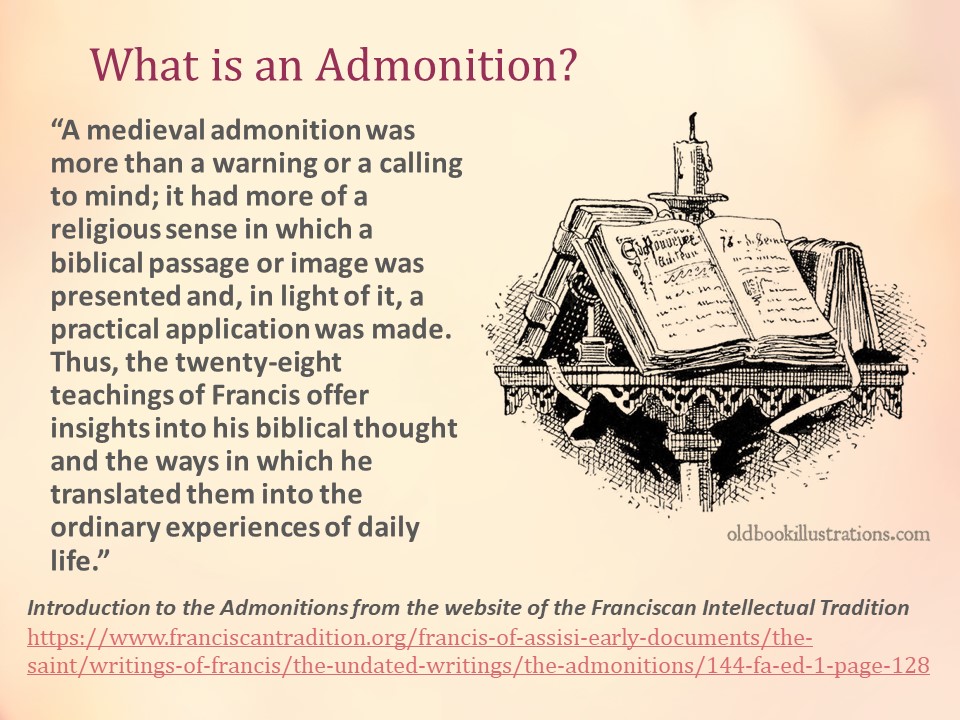
Formation Friday is the work product of the National Formation Commission of the Secular Franciscan Order-USA. Please keep all citations and references intact. (This statement should be included with any posts in emails, on websites, or on social media.)Focus on the Admonitions (VII and VIII)[VII: Let Good Action Follow Knowledge]1The apostle says: The letter kills, but the spirit gives life. 2 Cor 3:62Those people are put to death by the letter who only wish to know the words alone, that they might be esteemed wiser than others and be able to acquire great riches to give to their relatives and friends.3And those religious are put to death by the letter who are not willing to follow the spirit of the divine letter but, instead, wish only to know the words and to interpret them for others.4And those people are brought to life by the spirit of the divine letter who do not attribute every letter they know, or wish to know, to the body but, by word and example, return them to the most high Lord God to Whom every good belongs.[VIII. Avoiding the Sin of Envy]1The apostle says: No one can say: Jesus is Lord, except in the Holy Spirit; 1 Cor 12:3 2and: There is not one who does good, not even one. Rom 3:123Therefore, whoever envies his brother the good that the Lord says or does in him incurs a sin of blasphemy because he envies the Most High Himself Who says and does every good thing. Mt 20:15Questions to discuss or to answer in your journal+ Come, Holy Spirit! Open my mind and heart as I contemplate Admonition VII.• How do we get sidetracked in our lives by the “letter of the law” (the literal words) as opposed to the spirit of the law (the intent of the law)?• What are some ways that we can come to understand the spirit of what is asked of us in Scripture?• Try to give an example of where “the letter” and “the spirit” affect us as Secular Franciscans.+ Admonition VIII—Holy Spirit, help us to increase our humility as we consider Admonition VIII.• First, take a look in the Catechism to see what it says about sinful envy is. (2538-2540) (2553)• When we see the gifts of others, what are some ways that we can avoid the sin of envy?• Spend some time thinking about the gifts that the Holy Spirit has given you. How can you make the most of these gifts in your spiritual life? In your family life? In your life in fraternity?++++++++++Formation Friday es el producto del trabajo de la Comisión Nacional de Formación de la Orden Franciscana Seglar-EE.UU. Mantenga todas las citas y referencias intactas. (Esta declaración debe incluirse en cualquier publicación en correos, en sitios web o en redes sociales).Enfoque en las Admoniciones VII y VIII[Admonición VII: Que el buen obrar siga a la ciencia]1Dice el Apóstol: La letra mata, pero el espíritu vivifica (2 Cor 3,6). 2Son matados por la letra aquellos que únicamente desean saber las palabras solas, para ser tenidos por más sabios entre los otros y poder adquirir grandes riquezas que dar a consanguíneos y amigos. 3Y son matados por la letra aquellos religiosos que no quieren seguir el espíritu de la divina letra, sino que desean más bien saber únicamente las palabras e interpretarlas para los otros. 4Y son vivificados por el espíritu de la divina letra aquellos que no atribuyen al cuerpo toda la letra que saben y desean saber, sino que, con la palabra y el ejemplo, la devuelven al altísimo Señor Dios, de quien es todo bien.[Admonición VIII: Del pecado de envidia, que se ha de evitar]1Dice el Apóstol: Nadie puede decir: Señor Jesús, sino en el Espíritu Santo (1 Cor 12,3); 2y: No hay quien haga el bien, no hay ni siquiera uno (Rom 3,12). 3Por consiguiente, todo el que envidia a su hermano por el bien que el Señor dice y hace en él, incurre en el pecado de blasfemia, porque envidia al mismo Altísimo (cf. Mt 20,15), que dice y hace todo bien.Preguntas para platicar o responder en su diario+ ¡Ven, Espíritu Santo! Abre mi mente y mi corazón mientras contemplo la Admonición VII.• ¿Cómo nos desviamos en nuestras vidas por la “letra de la ley” (las palabras literales) en oposición al espíritu de la ley (la intención de la ley)?• ¿Cuáles son algunas formas en que podemos llegar a comprender el espíritu de lo que se nos pide en las Escrituras?• Trate de dar un ejemplo de dónde “la letra” y “el espíritu” nos afectan como franciscanos seglares.+ Admonición VIII—Espíritu Santo, ayúdanos a aumentar nuestra humildad mientras consideramos la Admonición VIII.• Primero, eche un vistazo al Catecismo para ver lo que dice acerca de la envidia pecaminosa. (2538-2540) (2553) https://www.vatican.va/archive/catechism_sp/p3s2c2a0_sp.html• Cuando vemos los dones de los demás, ¿cuáles son algunas formas en que podemos evitar el pecado de la envidia?• Dedique algún tiempo a pensar en los dones que el Espíritu Santo le ha dado. ¿Cómo puede aprovechar al máximo estos dones en tu vida espiritual? ¿En su vida familiar? ¿En su vida en fraternidad?Diane F. Menditto, OFSChair, National Formation Commission
Formation Director, Our Lady of the Angels Region
Formation Director, St. Francis Fraternity, Hackensack, NJ