Strengthening Our Faith Journey

(This article originally appeared in the Spring TAU-USA Issue #105)

by Kathleen Molaro, OFS

National Franciscan Youth and Young Adult Commission Chair

I recently enjoyed conversing after Mass with several young adults who were home for the semester break from college. One of them shared that he felt a bit lost off at school without his family and the friends he’d grown up with. He was especially concerned that his faith life had come to a standstill.

“It’s hard to talk myself into going to Mass by myself,” he admitted. “I spent my life going to Church on Sundays, and now I feel like a deer without my herd.”

“I know what you mean,” his friend added. “Our family attended everything! Mass, Reconciliation, pancake breakfasts, Lenten soup suppers… you name it. I can tell you all the Catholic Church rules and rites, and I still go to Mass, but I get so bogged down during the week, that I’m not sure what Church has to do with real life! I feel like it’s just an obligation.”

“I had an interesting experience,” a third young person shared. “One of my new friends invited me to her church service. There were lots of people our age. They had awesome music and a great sermon. The pastor asked us to think back to when we last talked to God. That made me uncomfortable. I guess I haven’t really been praying on my own. My friend talks about her ‘personal relationship’ with God. What does that even mean?”

The comments I heard from these college-age Catholics validated one of concepts the Franciscan Youth and Young Adult (FYYA) Commission promotes: that if we focus on only one aspect of faith, we deprive ourselves of the fullness of faith. We need a personal life of faith; a formal system of belief; and shared faith experiences. None of us can survive in our faith if we grow in and strengthen only one area. For young people, this is especially important, considering their lack of experience, a bombardment of overwhelming changes, and a new, more mature look at faith’s role in their lives.

This is one of the topics the FYYA Commission will address at the Quinquennial in August. We will also shed light on why we need to connect with young people and how best to approach that challenge. We will also give you a chance to participate in a multigenerational activity. Jesse Manibusan, a popular musician and speaker, will offer a session for the young adults in attendance and entertain us all with an evening concert. Young adult YouFra members will conduct the service project and one of the evening prayer experiences. We invite you to join us and relish the gift of their presence with us. “Come to the Q; Celebrate and Renew!” Use the event to practice our Franciscan call to bring the gospel to our younger Catholics.

https://www.secularfranciscansusa.org/2022/07/04/strengthening-our-faith-journey/

Open post

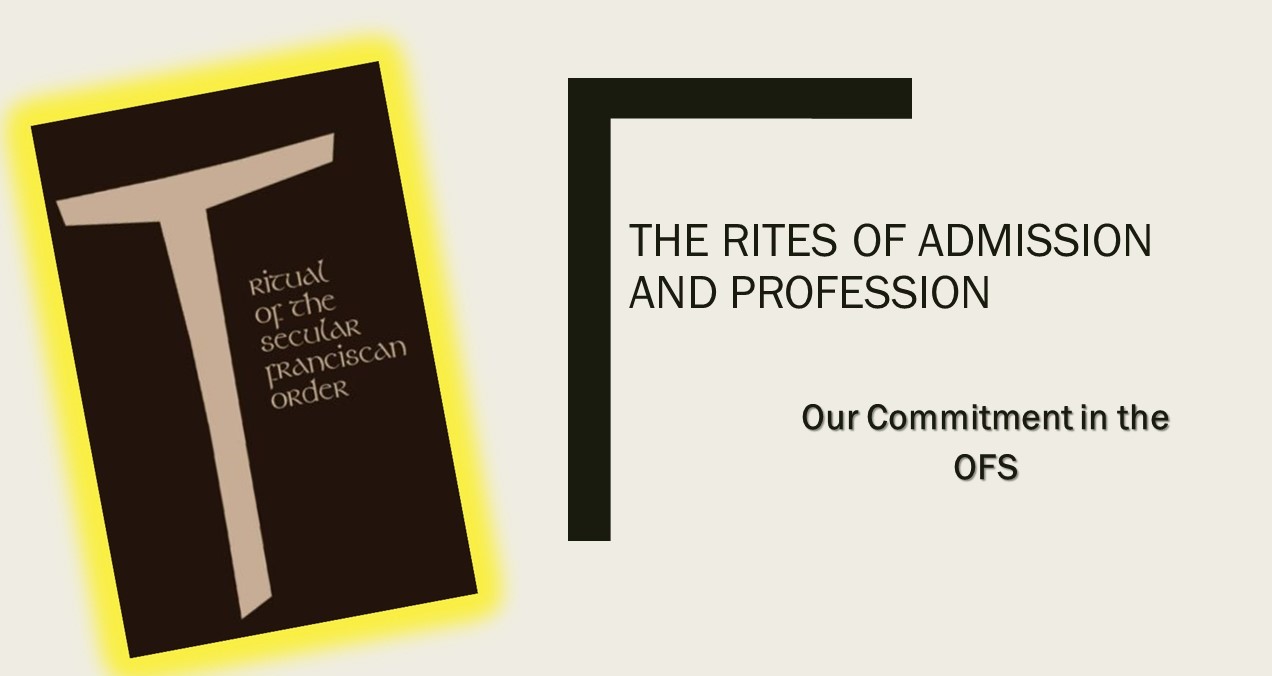
FORMATION FRIDAY – Rites of Admission & Profession – July 1, 2022

Please share with your local fraternity (En español abajo)
 
Although formation is a life-long process, those who are inquirers and candidates are in a period of discernment called initial formation. During this time their formators guide them in their initial journey of discernment toward a permanent commitment in the Secular Franciscan Order.
 
This period is marked by certain milestones:
1- The Ceremony of Introduction and Welcoming (before Inquiry)
2- The Rite of Admission (before Candidacy)
3- The Rite of Profession—permanent commitment to the Secular Franciscan Order
This week we focus on the Rites of Admission and Profession
 
The rites celebrated in the formation of a Secular Franciscan signify the desire to become a member of the order and to make a permanent commitment to the Gospel life.
• The Rite of Admission is the moment when we become members of the Order—We are attached to the Order although we have not yet made a permanent commitment. We wear the TAU and may write OFS after our name.
 
After about nine months of orientation and the period of Inquiry, the Inquirer writes to the Council of the local fraternity requesting admission to Candidacy. The members of the Council should have come to know this person quite well. After reading the letter and interviewing the Inquirer, the Council votes on acceptance to Candidacy.
 
During the Rite of Admission the Inquirers ask to enter the Secular Franciscan Order so that they may live more intensely and faithfully the grace of their Baptism. The Minister receives the new Candidate into the OFS so that they may begin their period of initial formation and continue to prepare for their permanent commitment.
 
After about eighteen months of Candidacy, the candidates again approach the Council in writing to request profession of the rule of the Secular Franciscan Order and to make a permanent commitment to the gospel life.
 
With the Rite of Profession, we make our perpetual (life-long) commitment to live the Gospel life according to our Rule. Profession does not make us Secular Franciscans—it celebrates the commitment we make to live the Gospel life.
 
The celebration of Profession is God’s action and a saving event: it is a moment when salvation reaches the faithful. It enables them to make a promise to live the Franciscan gospel life and produces in them particular effects of grace, by which they are called to specific tasks within the People of God. The liturgical act of Profession makes the connection with Baptism clear—it connects us with the Church. The Rite of Profession is a “confession of faith.” Our words and actions show that we are true followers of Christ and His Gospel.
 
The Rites do not transform us into Franciscans. They celebrate the change that has already taken place in us throughout our discernment. We celebrate the fact that God has called us from the time of our Baptism to live out our lives as Catholics and as Franciscans. God delights in our acts of love for him. He calls us first. The Holy Spirit has planted the seed of our vocation in us from the very beginning.
 
Please read the Rites of Admission and Profession in the Ritual. The following questions can be answered in fraternity groups, with a prayer partner, or in your journal.
+ For you, what are the four most outstanding parts of the Rites of Admission and Profession?
+ In the promises we make at Admission and Profession, what might present a challenge to you?
+The Holy Spirit speaks to each of us in a very personal way. As you read the Rites of Admission and Profession, how did they touch and change you and bring you closer to God? Give examples.
 
++++++++++++++++++++
Los ritos de admisión y profesión 10 de julio de 2022
Comparta con su fraternidad local
 
Aunque la formación es un proceso de toda la vida, quienes son indagadores y candidatos se encuentran en un período de discernimiento llamado la formación inicial. Durante este tiempo sus formadores los guían en su camino inicial de discernimiento hacia un compromiso permanente en la Orden Franciscana Seglar. Este período está marcado por ciertos hitos:
1- La ceremonia de presentación y bienvenida (antes de “Inquiry”)
2- El Rito de Admisión (antes de la Candidatura)
3- El Rito de la Profesión—compromiso permanente en la Orden Franciscana Seglar
 
Esta semana nos enfocamos en los Ritos de Admisión y Profesión
Los ritos que se celebran en la formación de un franciscano seglar significan el deseo de hacerse miembro de la orden y de comprometerse permanentemente con la vida evangélica.
 
• El Rito de Admisión, es el momento en que nos convertimos en miembros de la Orden. Estamos adscritos a la Orden aunque todavía no hemos hecho un compromiso permanente. Usamos la TAU y podemos escribir OFS después de nuestro nombre.
 
Después de unos nueve meses de orientación y el período de Pre-candidatura, el pre-candidato escribe al Consejo de la fraternidad local solicitando la admisión a la Candidatura. Los miembros del Consejo deberían haber llegado a conocer bastante bien a esta persona. Después de leer la carta y entrevistar al Pre-candidato, el Consejo vota sobre la aceptación a la Candidatura.
 
Durante el Rito de Admisión los Pre-candidatos piden ingresar en la Orden Franciscana Seglar para vivir más intensa y fielmente la gracia de su Bautismo. El Ministro recibe al nuevo Candidato en la OFS para que inicie su período de formación inicial y continúe preparándose para su compromiso permanente.
 
Después de unos dieciocho meses de Candidatura, los Candidatos se dirigen de nuevo al Consejo por escrito para solicitar la profesión de la regla de la Orden Franciscana Seglar y hacer un compromiso permanente con la vida evangélica.
 
• Con el Rito de Profesión, hacemos nuestro compromiso perpetuo (de por vida) de vivir la vida del Evangelio según nuestra Regla. La profesión no nos convierte en franciscanos seglares, sino que celebra el compromiso que hacemos de vivir la vida del Evangelio.
 
La celebración de la Profesión es acción de Dios y acontecimiento salvífico: es un momento en que la salvación alcanza a los fieles. Les permite hacer la promesa de vivir la vida evangélica franciscana y produce en ellos efectos particulares de gracia, por los cuales son llamados a tareas específicas dentro del Pueblo de Dios. El acto litúrgico de la Profesión deja clara la conexión con el Bautismo, nos conecta con la Iglesia. El Rito de Profesión es una “confesión de fe.” Nuestras palabras y acciones muestran que somos verdaderos seguidores de Cristo y Su Evangelio.
 
Los Ritos no nos transforman en franciscanos. Celebran el cambio que ya se ha producido en nosotros a lo largo de nuestro discernimiento. Celebramos el hecho de que Dios nos ha llamado desde el momento de nuestro Bautismo a vivir nuestra vida como católicos y franciscanos. Dios se deleita en nuestros actos de amor por él. Él nos llama primero. El Espíritu Santo ha plantado en nosotros la semilla de nuestra vocación desde el principio .
 
Por favor lea los Ritos de Admisión y Profesión en el Ritual. Las siguientes preguntas pueden responderse en grupos de fraternidad, con un compañero de oración o en su diario.
+ Para usted, ¿cuáles son las cuatro partes más destacadas de los Ritos de Admisión y Profesión?
+ En las promesas que hacemos en Admisión y Profesión, ¿qué podría representar un desafío para usted?
+El Espíritu Santo nos habla a cada uno de nosotros de una manera muy personal. Al leer los Ritos de Admisión y Profesión, ¿cómo le tocaron y cambiaron y lo acercaron a Dios? Dar ejemplos.
 
 
Diane F. Menditto, OFS

Chair, National Formation Commission

Formation Director, Our Lady of the Angels Region
Formation Director, St. Francis Fraternity, Hackensack, NJ
 

State of the Order Spring 2022, National Minister, Jan Parker, OFS

(This article originally appeared in the Spring 2022 Issue of the TAU-USA #105 with many inspirational images)

by Jan Parker, OFS, National Minister

Open post

FORMATION FRIDAY – The Admonitions XIV and XVI – June 24, 2022

The Admonitions: XIV and XVI
The Admonitions: FA:ED, vol. 1, p. 128
 
…these twenty-eight teachings of Francis offer insights into his biblical thought and the ways in which he translated them into the ordinary experiences of daily life.”
 
[Admonition XIV: Poverty of Spirit] FA:ED, vol. 1, p. 133
1Blessed are the poor in spirit, for theirs is the kingdom of heaven. Mt 5:3
2There are many who, while insisting on prayers and obligations, inflict many abstinences and punishments upon their bodies. 3But they are immediately offended and disturbed about a single word which seems to be harmful to their bodies or about something which might be taken away from them. 4These people are not poor in spirit, for someone who is truly poor one who is truly poor in spirit hates himself and loves those who strike him on the cheek. Mt 5:39
 
From our Rule
Article 11. Trusting in the Father, Christ chose for himself and his mother a poor and humble life19, even though he valued created things attentively and lovingly. Let the Secular Franciscans seek a proper spirit of detachment from temporal goods by simplifying their own material needs. Let them be mindful that according to the gospel they are stewards of the goods received for the benefit of God’s children.
Thus, in the spirit of “the Beatitudes”, and as pilgrims and strangers on their way to the home of the Father, they should strive to purify their hearts from every tendency and yearning for possession and power20.
 
[Admonition XVI: Cleanness of Heart] FA:ED, vol. 1, p. 134
1Blessed are the clean in heart, for they will see God. Mt 5:8
2The truly clean of heart are those who look down upon earthly things, seek those of heaven, and, with a clean heart and spirit, never cease adoring and seeing the Lord God living and true.
 
From our Rule
Article 12. Witnessing to the good yet to come and obliged to acquire purity of heart because of the vocation they have embraced, they should set themselves free to love God and their brothers and sisters21.
 
Please read and think about Admonitions 14 and 16 and the articles of our Rule that correspond to them.
The questions are for discussion in fraternity, with a prayer partner, or to comment on in your journal.
+What does it mean to you to be “pilgrim and a stranger?”
+How does understanding this attitude about life help us to understand what it is to be “poor in spirit?”
+In our Rule we are asked to “set ourselves free to love God and our brothers and sisters.” How does this lead us to be “clean of heart?”
+What possessions or attitudes might be holding you back from truly adoring God.
+How can we open our hearts to the Holy Spirit to ask for conversion in this area?
 
++++++++++++++++++++++++++++++++++++++++++
 
Las admoniciones (Por favor, comparta con su fraternidad.)
 
“…estas veintiocho enseñanzas de Francisco ofrecen información sobre su pensamiento bíblico y las formas en que las tradujo a las experiencias ordinarias de la vida diaria.”
 
[Admoniciones: Cap. XIV: De la pobreza de espíritu]
1Bienaventurados los pobres de espíritu, porque de ellos es el reino de los cielos (Mt 5,3). 2Hay muchos que, perseverando en oraciones y oficios, hacen muchas abstinencias y mortificaciones corporales, 3pero, por una sola palabra que les parezca injuriosa para sus cuerpos o por alguna cosa que se les quite, escandalizados enseguida se perturban. 4Estos no son pobres de espíritu, porque quien es de verdad pobre de espíritu, se odia a sí mismo y ama a aquellos que lo golpean en la mejilla (cf. Mt 5,39).
 
De nuestra regla: Artículo 11
Cristo, confiado en el Padre, aún apreciando atenta y amorosamente las realidades creadas, eligió para Sí y para su Madre una vida pobre y humilde19; del mismo modo, los Franciscanos seglares han de buscar en el desapego y en el uso una justa relación con los bienes terrenos, simplificando las propias exigencias materiales; sean conscientes, en conformidad con el Evangelio, de ser administradores de los bienes recibidos, en favor de los hijos de Dios.
Así, en el espíritu de las “Bienaventuranzas”, esfuércense en purificar el corazón de toda tendencia y avidez de posesión y de dominio, como “peregrinos y forasteros” en el camino hacia la casa del Padre20.
 
[Admoniciones: Cap. XVI: De la limpieza del corazón]
1Bienaventurados los limpios de corazón, porque ellos verán a Dios (Mt 5,8). 2Son verdaderamente limpios de corazón quienes desprecian las cosas terrenas, buscan las celestiales y no dejan nunca de adorar y ver, con corazón y alma limpios, al Señor Dios vivo y verdadero.
 
De nuestra regla: Artículo 12
Testigos de los bienes futuros y comprometidos con la vocación abrazada a la adquisición de la pureza de corazón, se harán libres para el amor de Dios y de los hermanos21.
 
Por favor, lea y reflexione sobre las Admoniciones 14 y 16 y los artículos de nuestra Regla que les corresponden.
 
Las preguntas son para platicar en fraternidad, con un compañero de oración o para comentarlas en su diario.
 
+¿Qué significa para usted ser “peregrino y forastero”?
+¿Cómo nos ayuda esta actitud ante la vida a entender lo que es ser “pobre de espíritu?”
+En nuestra Regla se nos pide que “nos hagamos libres para el amor de Dios y de los hermanos.” ¿Cómo nos lleva esto a ser “limpios de corazón?”
+Qué posesiones o actitudes podrían estar impidiéndole adorar verdaderamente a Dios.
+¿Cómo podemos abrir nuestro corazón al Espíritu Santo para pedir conversión en esta área?
 
 
Diane F. Menditto, OFS

Chair, National Formation Commission

Formation Director, Our Lady of the Angels Region
Formation Director, St. Francis Fraternity, Hackensack, NJ
 

From Roswell to Rome for a Fraternity Gathering

(This article originally appeared in the Spring 2022 TAU-USA Issue #105)

by Jane DeRose-Bamman, PSF

National Secretary and Alternate International Councilor

[1], who were working at the Chapter in various capacities.

There was a buzz in the lobby. No matter the language, the enthusiasm was evident. Participants from five continents were so excited to be together after a year-long delay, and it wasn’t just because of the access to Italian gelato!

The Instrumentum Laboris[2] inspired the Chapter theme: “Animating and Guiding with Servant Leadership.” The talks, homilies, and keynotes[3] were focused on this challenging but appropriate theme. It is difficult to be brief about the events of the nine-day gathering, so I direct you to the summaries, the presentations and photo galleries for each day at: https://ciofs.info/news/gen-chapter/  2020-general-chapter/.[4]  Thanks  to  Bob and Mary Stronach, OFS, for the wonderful summary of  the days’ events along with the collection of snapshots. This article contains the impressions from my participation in the gathering.

The number of participants was impressive. A total of 57 of 70 National Fraternities were represented, along with the wider Franciscan Family. I met brothers and sisters from Mexico, Central America, South America, Europe, Asia, Africa, and the Middle East. The four Ministers General participated in the Chapter (Amando Trujillo- Cano, TOR; Fr. Massimo Fusarelli, OFM; Fr. Roberto Genuin, OFM Cap; and Fr. Carlos Trovarelli, OFM Conv).  Our former General  Minister (2002-2014), Encarnacion del Pozo, OFS, also attended the Chapter.

It was a relief to learn that this Chapter followed the same format as the Chapters for the OFS-USA National fraternity and regional fraternities: prayer (daily Mass and Evening Prayer), business meeting, formation, and hospitality. It wasn’t a surprise that the meeting schedule was packed running from 7:30 a.m. until 10:00 p.m. most days. I had to get used to the European meal schedule (lunch at 1:00 p.m. and dinner at 8:00 p.m.).

Because this was an international gathering, materials were provided in the four major languages of the Order (Italian, English, French, and Spanish). Real-time translation was provided for presentations and discussions in the large group meeting hall. Individuals had handsets with earphones to dial into the appropriate translation channel. Presenters and those in the audience with questions had to speak slowly so the translators had time to translate. As you can imagine, the team of translators worked very hard the entire week.

The business topics for this chapter included: changes to the geographic groupings for the Presidency Councilors, triennial budget, and proposed revisions to the International Statutes. Voting was done by raising green, red, or white cards. To generate discussion on those topic and suggested priorities prior to voting, participants met in small groups by language. My working groups included the representative from the Netherlands, Bosnia Herzegovina, Republic of Czechoslovakia, Sweden, Slovenia, Germany, and Korea.  I learned that we all struggle with similar issues: aging membership, few wanting to serve on councils, limited numbers of vocations, shortage of spiritual assistants, and limited formation materials.  Several mentioned they experienced challenges with translating – especially lengthy, complex documents. We are blessed in the United States to have access to very good formation materials and strong teams for translation.

I did my best to take notes and pay attention – not just because I needed to report back to our fraternity council, but also because I was appointed to the committee to develop the final “Message to the Order” or Conclusive Document from the Chapter.[5]  General Vice-Minister, Chelito  Nunez  ( Venezuela),  Michel  Versteegh (International Councilor from the Netherlands), and I were appointed to this committee. This was a labor of love during my first International Chapter.

Highlights of the trip include a private audience with Pope Francis on November 15, 2021, and the Chapter of Elections on November 17, 2021 (the Feast of St. Elizabeth of Hungary). The Holy Father challenged us to do penance and to “Let the Gospel, that is, Jesus Himself, shape your lives.” We were so delighted that each participant was able to personally greet the Pontiff. I will never forget the experience.

Elections, no matter the fraternity level, are always exciting to me. This one was exciting because we didn’t get the slate until the afternoon before the elections, several candidates were added before the elections on Wednesday, and during the elections several positions went to the third ballot for the decision. (Does this ever happen in the elections in which you’ve participated?) All candidates were wonderfully qualified and dedicated, so the Holy Spirit truly was needed. Also, this was an historic election, as a member from the United States (Mary [Maria Teresa] Stronach) was elected as Vice-Minister General. We pray that the Holy Spirit leads the newly elected Presidency members as they form as a Council and digest the outcome from the Chapter. Our new Presidency representative is Ana Maria Raffo from Peru. She is representing Northern  and  Central America.

Thanks to outgoing Presidency members: Chelito Núñez (Venezuela), Ana Fruk (Croatia), Attilio Galimberti (Italy), Michel Janian (Lebanon), Jenny Harrington (South Africa), Augustine Young Hak Yoon (Korea), and Andrea Karlovic (Bosnia and Herzegovina). Their efforts in serving the Order over the last seven years (some longer) have been monumental.

Another fascinating point was related to YouFra. There was a general discussion on how to incorporate YouFra members into the OFS. Many (20+) participants revealed they had been part of YouFra in their countries (European, Central and South American). I had never lived in an area where YouFra groups were strong – so I was quite surprised to learn how extensive they are in other parts of the world. Many of those people responding were in their 40s. It was very impressive to see that those people who started as YouFra members were very active as adults.

Bonzica Loncar, OFS, International Councilor from Bosnia Herzegovina, expressed that at first, we were all strangers, but by the end of Chapter, we were one fraternity although from different backgrounds. We knew each other’s names and our countries of origin. We learned a little bit about how each applied their vocations and the challenges of doing it in their specific cultures. These individuals were so excited about doing what Pope Francis exhorted us to do – let Jesus shape our lives. I returned to Roswell[6] to be reunited with my husband a few pounds heavier because of all the pasta, but energized to continue with ongoing conversion so that I can allow Jesus to shape my life and be open to His holy will.

If you haven’t participated in a regional or national chapter gathering, I encourage you to attend if there is room. These events are an energy boost for our vocation. The Quinquennial is scheduled for August; you’ll be able to meet members of your National and International fraternities there. I am planning to attend. I hope to meet you there.

[1] Mary Stronach serves as a translator and Bob Stronach serves as a photographer and editor of several publications for CIOFS.

[2] A copy of the Instrumentum Laboris from 2020 can be downloaded in English or Spanish at: https://secularfranciscansusa.org/ongoing-formation-resources/.

[3] Make sure to review the talk by Br. Michael Perry, OFM: https://ciofs.info/wp-content/uploads/2021/12/EN-The-Gift-and-Responsibility-of-Minister-as-Servant-fr.- Michael-Perry-OFM.pdf

[4] Note: the link is correct with “2020” instead of “2021.”

[5] The Conclusive Document can be found at: https://ciofs.info/wp-content/uploads/2021/12/EN-XVI-General-Chapter-Conclusive-document.pdf

[6] I was quite astounded by how many people from all over the world knew about little Roswell, New Mexico. The people would joke with me about the 1947 crash landing.

https://www.secularfranciscansusa.org/2022/06/20/from-roswell-to-rome-for-a-fraternity-gathering/

Scroll to top
Juan de Padilla