Open post

FORMATION FRIDAY – The TAU – Why so Important to St. Francis? – July 22, 2022


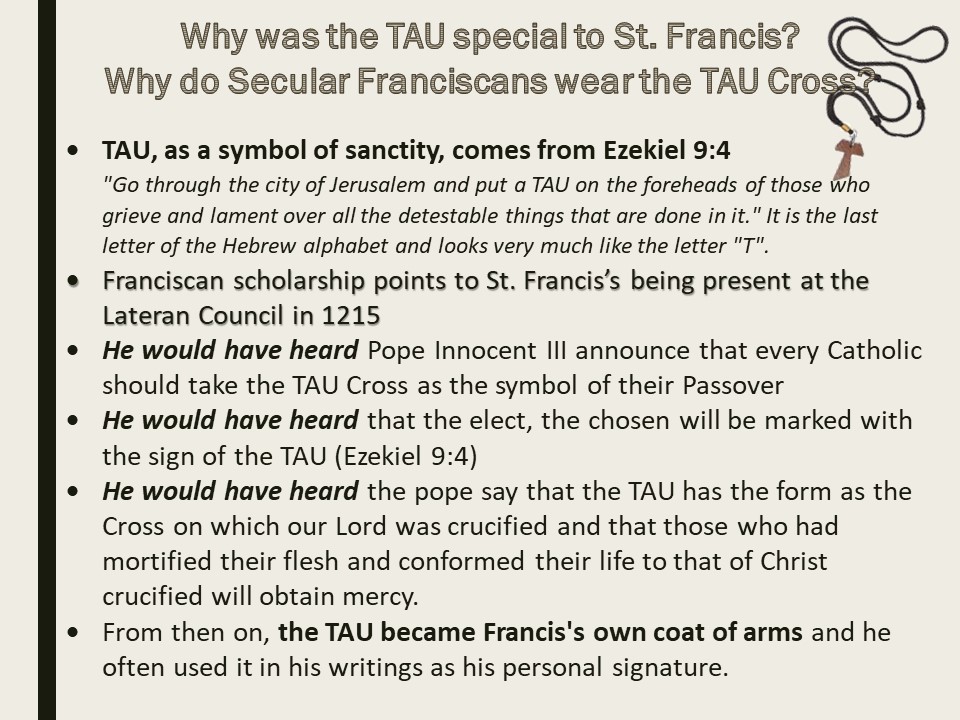
Why was the TAU Cross so important to St. Francis? Why do we OFS wear the TAU?

  • The TAU, as a symbol of sanctity, comes from Ezekiel 9:4
    “Go through the city of Jerusalem and put a TAU on the foreheads of those who
    grieve and lament over all the detestable things that are done in it.” It is the last
    letter of the Hebrew alphabet and looks very much like the letter “T”.
  • Franciscan scholarship points to St. Francis’s being present at the Lateran Council in 1215

While attending he would have heard Pope Innocent III announce that every Catholic should take the TAU Cross as the symbol of their Passover. “The Pope set forth the Tau as a sign of penance and renewal in Christ. Francis embraced this sign as an expression of Christ’s cross. In hearing the story, Francis experienced confirmation of the LIFE and MISSION of his new order. The Tau became for him a symbol of exodus and pilgrimage with which he wanted his companions signed as ‘the new and humble people of God.’”

  • He would have heard that the elect, the chosen will be marked with the sign of the TAU (Ezekiel 9:4)
  • He would have heard the pope say that the TAU has the form of the Cross on which our Lord was crucified and that those who had mortified their flesh and conformed their life to that of Christ crucified will obtain mercy.
  • From then on, the TAU became Francis’s own coat of arms and he often used it in his writings as his personal signature.

Why do many Secular Franciscans wear the TAU cross?

· Article 43 of the General Constitutions establishes that: “The distinctive sign of belonging to the Order (the “TAU” or other Franciscan symbol).

· Article 16.4 of the National Statutes of the United States states: “The external sign of the OFS in the United States is the TAU.

“The Tau Cross [adapted from Catch Me A Rainbow Too by Fr. Lester Bach, O.F.M. Cap.] Franciscans use the Tau as a symbol of commitment to Jesus through the O.F.S. Way of Life. The Tau cross is the sign of the O.F.S. in this country, not the San Damiano crucifix, not a medal of St. Francis, not a scapular and cord (such as were mandated under the Rule of 1883), and not a modified religious habit such as the friars wear! The Tau is worn with pride and joy. Francis saw the Tau as a symbol of the cross of Christ. It was the sign of salvation. It was a sign of belonging to God, being chosen and saved. Francis embraced it with love. It was pregnant with meaning for him. Franciscans wear it as a sign of their commitment to Jesus and the Gospel way of life.”


Direct quotes from: Tau Cross Statements by Deacon Dave and Thérèse Ream, OFS


The following questions are for discussion in fraternity, with a prayer partner, or to answer in your journal.

+Do you always wear your TAU cross? Why or why not?

+When you received your TAU at the Rite of Admission, what did it symbolize to you?

+If someone asks you what the TAU is and why you wear it, what is your answer to them?


++++++++++++++++++++++++

Formation Friday 22 de julio de 2022

Comparta con su fraternidad local
¿Por qué la Cruz TAU fue tan importante para San Francisco? ¿Por qué los Seglares franciscanos llevamos la TAU?

  • La TAU, como símbolo de santidad, proviene de Ezequiel 9,4
    “Pasen por la ciudad de Jerusalén y poned una TAU en la frente de los que
    se entristecen y lamentan por todas las cosas detestables que en ella se hacen.” Es la última letra del alfabeto hebreo y se parece mucho a la letra “T.”
  • La erudición franciscana apunta a la presencia de San Francisco en el Concilio de Letrán en 1215.

Mientras asistía, habría escuchado al Papa Inocencio III anunciar que todos los católicos deberían llevar la Cruz TAU como símbolo de su Pascua. “El Papa planteó la Tau como signo de penitencia y renovación en Cristo. Francisco abrazó este signo como expresión de la cruz de Cristo. Al escuchar la historia, Francisco experimentó una confirmación de la VIDA y MISIÓN de su nueva orden. La Tau se convirtió para él en un símbolo de éxodo y peregrinaje con el que quería que sus compañeros se firmaran como ‘el nuevo y humilde pueblo de Dios.’”

  • él hubiera escuchado que los elegidos, los escogidos serán marcados con la señal de la TAU (Ezequiel 9,4)
  • él hubiera escuchado al Papa cuando dijo que la TAU tiene la forma de la Cruz en la que nuestro Señor fue crucificado y que aquellos que mortificaran su carne y conformaran su vida a la de Cristo crucificado obtendrían misericordia.
  • A partir de entonces, la TAU se convirtió en el escudo de armas de Francisco y a menudo lo utilizó en sus escritos como su firma personal.

¿Por qué muchos franciscanos seglares llevan la cruz TAU?

· El artículo 43 de las Constituciones Generales establece que: “el signo distintivo de pertenencia a la Orden es (la “TAU” u otro símbolo franciscano).

· El artículo 16.4 de los Estatutos Nacionales de los Estados Unidos establece: “El signo externo de la OFS en los Estados Unidos es la TAU.”

“La Cruz Tau [adaptado de Catch Me A Rainbow Too por el Padre Lester Bach, OFM Cap.] Los franciscanos usan la Tau como símbolo de compromiso con Jesús a través del Modo de Vida de la OFS. La cruz Tau es el signo de la OFS en este país, no el crucifijo de San Damián, no es una medalla de San Francisco, no es un escapulario y un cordón (como se ordenó bajo la Regla de 1883), y ¡no es un hábito religioso modificado como los que usan los frailes! La Tau se lleva con orgullo y alegría. Francisco vio la Tau como un símbolo de la cruz de Cristo. Era la señal de la salvación. Era un signo de pertenencia a Dios, de ser elegido y salvado. Francisco lo abrazó con amor. Estaba preñado de significado para él. Los franciscanos lo usan como un signo de su compromiso con Jesús y el estilo de vida del Evangelio.”

Citas directas de: “Tau Cross Statements” del diácono Dave y Thérèse Ream, OFS


Las siguientes preguntas son para discutir en fraternidad, con un compañero de oración, o para responder en su diario.

+¿Siempre lleva su cruz TAU? ¿Por qué sí o por qué no?

+Cuando recibió su TAU en el Rito de Admisión, ¿qué simbolizó para usted?

+Si alguien le pregunta qué es el TAU y por qué lo lleva, ¿cuál es su respuesta?


Diane F. Menditto, OFS

Chair, National Formation Commission

Formation Director, Our Lady of the Angels Region
Formation Director, St. Francis Fraternity, Hackensack, NJ
 

Open post

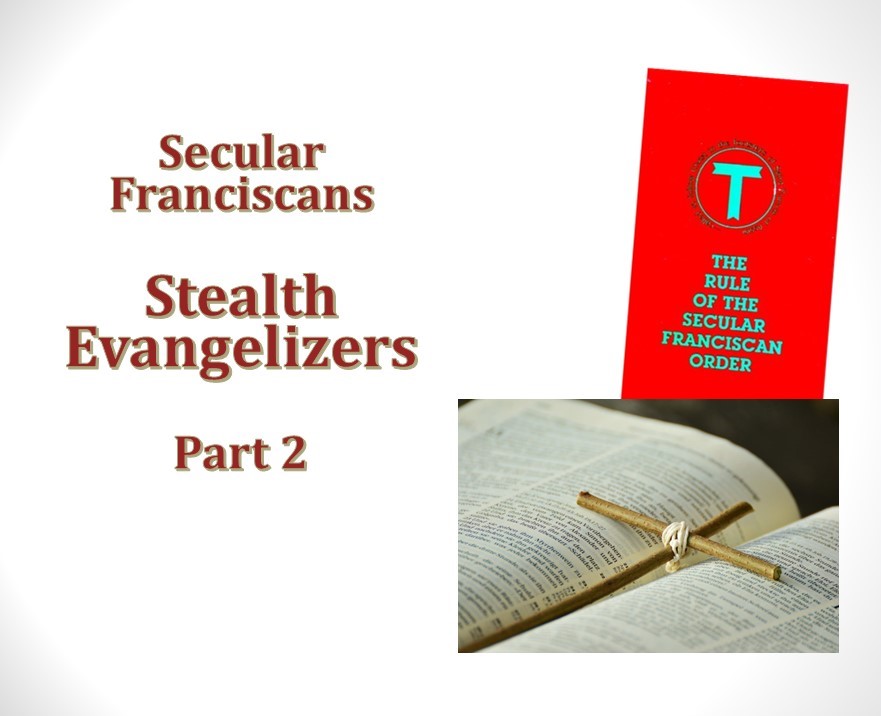
FORMATION FRIDAY – Secular Franciscans are Stealth Evangelizers (Part 2) – July 15, 2022

When we are professed, Secular Franciscans deepen our baptismal commitment. We are called to be at the forefront of evangelization. We may not be knocking on doors or preaching sermons, but if we live our Rule authentically, we are evangelizing, nonetheless. We are STEALTH EVANGELIZERS.

The questions following each article can be used for discussion with a small group, with a prayer partner, or answered in your journal

Article 12 “…set themselves free to love God and their brothers and sisters…”

+What attachments prevent us from keeping our relationship with God and others strong and healthy?

Article 13 “…so the Secular Franciscans with a gentle and courteous spirit accept all people as a gift of the Lord and an image of Christ.” 23

+Think about how our relationships…family, fraternity, colleagues, friends, and those who encounter us online…affect our mission as evangelizers. Give examples of helpful/unhelpful

Article 14 “…are called to build a more fraternal and evangelical world….”

” …let them exercise their responsibilities competently in Christian spirit of service.” 2

+What are your particular responsibilities?

+ How do they affect the message you bring to others?

Article 15 ” Let them individually and collectively be in the forefront in promoting justice by the testimony of their human lives and their courageous initiatives.”

+What are the ways we can promote justice individually and with our fraternities?”

Article 16. “Let them esteem work both as a gift and as a sharing in the creation, redemption, and service of the human community.27

+How do you witness through your work?

+How does this witness evangelize others?


Article 17 “In their family they should cultivate the Franciscan spirit of peace, fidelity, and respect for life, striving to make of it a sign of a world already renewed in Christ.” 28

By living the grace of matrimony, husbands and wives, in particular, should bear witness in the world to the love of Christ for his Church.”

As lay people, we have the opportunity to evangelize in the family.

+Give some examples of how our Rule helps you in your family relationship.

+How do you set the example for your spouse and children or your parents and siblings?

Article 18 “Moreover they should respect all creatures, animate and inanimate, which “bear the imprint of the Most High…”

+What contribution do you make to keeping our world safe for future generations?

+How do you see the “imprint of the most high” in nature?

Article 19 “Mindful that they are bearers of peace which must be built up unceasingly, they should seek out ways of unity and fraternal harmony through dialogue, trusting in the presence of the divine seed in everyone and in the transforming power of love and pardon.31 Messengers of perfect joy in every circumstance, they should strive to bring joy and hope to others.” 32

+How do you evangelize in your workplace or your volunteer activities?

+How do you help to promote peace and harmony in groups where you encounter division?

+Give some examples of how you bring joy and hope to others.

Tip (perhaps for a fraternity ongoing formation project): Read “The Joy of the Gospel” by Pope Francis and compare it to our Rule. It’s quite a formational experience!

+++++++++++++

Formation Friday 15 julio 2022
Comparta con su fraternidad local
Los franciscanos seglares son evangelizadores “sigilosos” (Parte 2)

Cuando profesamos, los franciscanos seglares profundizamos nuestro compromiso bautismal. Estamos llamados a estar en la vanguardia de la evangelización. Puede que no estemos tocando puertas o predicando sermones, pero si vivimos nuestra Regla auténticamente, estamos evangelizando, no obstante. Somos EVANGELIZADORES STEALTH (“sigilosos”).

Las preguntas que siguen a cada artículo se pueden usar para la discusión con un grupo pequeño, con un compañero de oración o se pueden responder en su diario.

Artículo 12 “…se harán libres para el amor de Dios y de los hermanos.21

+¿Qué apegos nos impiden mantener nuestra relación con Dios y con los demás fuerte y saludable?

Artículo 13 “…los Franciscanos seglares acojan a todos los hombres con ánimo humilde y cortés, como don del Señor23 e imagen de Cristo. “

+Piense en cómo nuestras relaciones… familiares, de fraternidad, de colegas, de amigos, de quienes nos encuentran en la red… afectan nuestra misión como evangelizadores. Dar ejemplos útiles/no útiles.

Artículo 14 “Llamados, juntamente con todos los hombres de buena voluntad, a construir un mundo más fraterno y evangélico para la edificación del reino de Dios, … cumplan con competencia las propias responsabilidades con espíritu cristiano de servicio.”25

+¿Cuáles son sus responsabilidades particulares ?

+ ¿Cómo afecta a los demás el mensaje que usted les lleva?


Artículo 15 “Estén presentes con el testimonio de su vida y también con iniciativas eficaces, tanto individuales como comunitarias, en la promoción de la justicia, particularmente en el ámbito de la vida pública, empeñándose en opciones concretas y coherentes con su fe.”26

+¿Cuáles son las formas en que podemos promover la justicia individualmente y con nuestras fraternidades?

Artículo 16. Consideren el trabajo como don de Dios y como participación en la creación, redención y servicio de la comunidad humana.27

+¿Cómo da testimonio a través de su trabajo?

+¿Cómo evangeliza a otros este testimonio?


Artículo 17
Vivan en la propia familia el espíritu franciscano de paz, fidelidad y respeto a la vida, esforzándose en convertirlo en el signo de un mundo ya renovado en Cristo.28
Los casados, particularmente, viviendo la gracia del matrimonio, den testimonio en el mundo del amor de Cristo a su Iglesia.
…”
Como laicos, tenemos la oportunidad de evangelizar en la familia.

+Dé algunos ejemplos de cómo nuestra Regla le ayuda en su relación familiar.

+¿Cómo da el ejemplo a su cónyuge e hijos o a sus padres y hermanos?


Artículo 18 “Sientan, además, respeto por las otras criaturas, animadas e inanimadas, que “de ti, Altísimo, llevan significación…”

+¿Qué contribución hace para mantener nuestro mundo seguro para las generaciones futuras?

+¿Cómo ve la “huella del altísimo ” en la naturaleza?


Artículo 19 “Como portadores de paz y conscientes de que ésta ha de construirse incesantemente, indaguen los caminos de la unidad y del entendimiento fraterno, mediante el diálogo, confiando en la presencia del germen divino que hay en el hombre y en la fuerza transformadora del amor y del perdón.31 Mensajeros de la perfecta alegría, esfuércense permanentemente en llevar a los demás el gozo y la esperanza.”32

+¿Cómo evangeliza en su lugar de trabajo o en sus actividades de voluntariado?

+¿Cómo ayuda a promover la paz y la armonía en grupos donde encuentra división?

+Da algunos ejemplos de cómo trae alegría y esperanza a los demás.


Consejo (quizás para un proyecto de formación permanente de una fraternidad): Lea “La alegría del Evangelio” del Papa Francisco y compárelo con nuestra Regla. ¡Es toda una experiencia formativa!


Diane F. Menditto, OFS

Chair, National Formation Commission

Formation Director, Our Lady of the Angels Region
Formation Director, St. Francis Fraternity, Hackensack, NJ
 

Franciscan Living – Take Delight in the Lord

 By Francine Gikow, OFS

I remember when each of my children was placed in my arms for the first time! I examined each one, marveling over every finger and toe, with their eyes gazing upon me! My children heard my voice and were comforted. I delighted in them, and they delighted in me.

Psalm 37, verse 4, tells us to “Take delight in the Lord and He will give you the desires of your heart.” If the desire we have is to love God, then we must learn to delight in Him. How then do we do this?

Delight, I suppose, is closely aligned with wonder and awe. However, I believe there is a difference. Wonder and awe arise in our hearts spontaneously as we view a rainbow, a beautiful sunset, or some other unexpected occurrence. We take extreme pleasure and satisfaction in the rainbow, sunset, etc.

In comparison, delight, when used as a verb, means “to please someone greatly.[1]” It could mean that I please someone else, or it could be reversed: when someone else pleases me. Delight, therefore, can be active and reciprocal: My God delights in me, and I take delight in him. This circle of delight allows joy to permeate our relationship…and with God, isn’t that the mystery of God living within us? After all, Love (God, himself) is fertile, abundant, and never-ending.

In scripture there are numerous citations of God’s delighting in us: “…I daily was his delight” (Prov 8:30) and “…delighting in the sons of men.” (Prov 8:31). But how do we take delight in him? How do we make a connection with God to do this?

To find delight in God is intentional―we must make some effort. We have to slow down and allow the God of our delight into our lives. We can find this delight as we gaze upon God through our persistence in prayer, scriptural encounters, and our availability to Him in the sacraments (especially the Eucharist). In this way, we not only intellectually “know” God but we also have the ability to encounter him viscerally―in our body, heart, and soul. We begin to understand how to take delight in Him as scripture points to those who pursue the wisdom of God as “an unfailing treasure for men; those who get it obtain friendship with God …” (Wis.7:14) “and in friendship with her [wisdom], pure delight…” (Wis 7:18).

You may want to read in Solomon’s book of Wisdom, (Chapter 7) the attributes of wisdom, which is really another name for the Holy Spirit. Read and meditate upon it. Take one attribute each day and stay with it and let it speak to you. Let it become your prayer of praise for the attributes of the Holy Spirit: “…irresistible, beneficent … penetrating through all spirits… pure and most subtle” and is a “pure emanation of the glory of the Almighty… a reflection of eternal light, a spotless mirror of the working of God and an image of his goodness.” (Wis 7:25-26)

As we contemplate, we make ourselves available to God so he can touch our hearts in order that we delight in him. If we stay with this delight, then the second half of Psalm 37:4 becomes evident: “…he will give you the desires of your heart.” God IS the ultimate desire of our hearts. I pray that we do not lose our delight and desire for him.

As our father, St. Francis says:

“Therefore,

let us desire nothing else,

let us want nothing else,

let nothing else please us and cause us delight, except our

Creator, Redeemer, and Savior, the one true God…” (ER: 23:9)


[1] https://languages.oup.com/google-dictionary-en/

https://www.secularfranciscansusa.org/2022/07/11/franciscan-living-take-delight-in-the-lord/

Did You Know – Regionalization, A History

Regional Fraternities of NAFRA- USA

The Map of the Regions of the OFS in the United States

 Interactive Map of Local Fraternities and Regional Contacts

Willian Wicks, OFS, gives us a complete history of Regionalization – moving to geographical structuring and governing away from friar provincial jurisdictional structuring – in A History of the Secular Franciscan Order in the United States. These volumes will be available for purchase at the Q 2022.

Presented here are only excerpts copied directly from Vol. III, Chapter 12, pages 277- 316.

No one can tell the story better than William Wicks.  The rest of the story, the details which mention talks dating back to “1934 and probably before,” can be found in these volumes.

Chapter 12

Regionalization

The Secular Franciscan Order is divided into fraternities of various levels:
Local, regional, national and international
Rule of 1978, para. 20

The process of Regionalization began at the 1987 Directive Board meeting. At that meeting, five friars recommended that the process of Regionalization be revisited, which led to the forming of a Regionalization Committee. Regionalization was completed ten years later, a relatively short time span for such a challenge: the restructuring of the SFO in the United States.

So, what is Regionalization? Regionalization is a process of restructuring the Secular Franciscan Order such that divisional boundaries are written according to geography in place of the previously arranged friar provincial jurisdictional structuring.

This restructuring was called for by the SFO Rule promulgated in 1978 [1] the Ritual,[2] published in 1985, and is detailed in the International Constitutions,[3] promulgated in 1990.

A foundational argument for a move to break away from the provincial jurisdictional structure was presented very well by Fr. Terence Pescatore, O.F.M. Conv. Excerpts of his treatise are presented here. Perspective on Secular Franciscan Order Autonomy Terence Pescatore O.F.M. Conv.

“… The Secular Franciscan Order is one by decree of the Holy See, since 1978 [Re: the Rule of the SFO]. Its members cannot be identified as Friars Minor, Capuchins, Conventuals or Friars of the Third Order Regular.

“… the Secular Franciscans do not derive their charism from the friars. Their charism is not even mediated to them through the friars. By their God-given Franciscan vocation, they share the charism of St. Francis, which is mediated to them through the Roman Catholic Church, through their Rule approved by the Holy See. The friars assist them to develop the Franciscan charism.

“Consequently, we cannot distinguish different Franciscan charisms among the Secular Franciscans. They share one charism only, regardless of who assists their fraternities spiritually. There is no question of a representation of different Franciscan charisms in the fraternity councils, especially when the ‘difference’ is being determined by the different obediences or orders of friars involved in assisting the Secular Franciscans.

“I feel that we friars do a grave disservice to the Secular Franciscan Order by introducing a distinction among the secular members which is based on the distinction between the four Orders of friars. Such a practice belongs to the past, before 1978, when the Third Order of St. Francis was structured according to its Rule only in local fraternities. That practice is inadmissible in the Secular Franciscan Order with the Rule of Paul VI, which has introduced the structures of regional, national and international fraternities and councils.

“The Secular Franciscans are free to elect into office those members whom they judge to be best qualified to fulfill the offices, regardless of which Order of friars happens to assist the candidates in their local fraternities within the regional, national or international fraternity.” [4]

Back to the Future – The 1968 Proposal

Nineteen years before the Order “officially” began the process of Regionalization, a Committee was formed to revise the National Constitutions. One of the recommendations was a restructuring of the Secular Franciscan Order based on geographic boundaries, not province juridical boundaries. That “quest” was thwarted in 1968 by members of the Directive Board.

“As part of the presentation given by the Constitution Committee, the Board members were polled on the matters recommended by the Committee to those Board members. The vast majority were in favor of juridical autonomy of the Third Order organization [ideally and eventually], as opposed to the present provincial jurisdictional organization. The organization of the Third Order by geographic regions was unanimously recommended.

Virtual Rejection of the Committee Conclusion

“Fr. Sigmund [Hafermann] of the New York Capuchin province objected to Jerry’s report as being too subjective, lacking objectivity, which in my [Fr. Philip Marquard’s] estimation totally misunderstood the effort.

“A beginning of the failure [of the recommendation to restructure] occurred at this point, when the assembly voted to accept the report with thanks, but to refer the recommendations to a Resolution Committee to refine and present them for definite action.” [5]

Excepts Taken from the 1968 Lemont Meeting [6]

A Negative View: “Although Third Order leaders have been talking about this being a laymen’s Order since 1934, and possibly before that, it has just been in the last few years that the concept of Juridical Autonomy has really come to the fore. Here again there isn’t complete agreement on this issue, as indicated by the following statement: ‘I believe that the question of complete juridical autonomy is grossly misrepresented and misunderstood. Is it possible? I believe it is not possible and still remain Franciscan, Catholic. Much study of this problem is needed before coming to a workable solution.’

“But there is no question that the vast majority of us believe that, eventually, Juridical Autonomy must come.”

Positive Views: “We think Fr. Brendan’s [Mitchell, O.F.M.] comment defines the type of Juridical Autonomy desired: ‘I think the T.O. should have the same or similar kind of juridical autonomy that other religious congregations and associations of the faithful within the Church have. They should be free to constitute and formulate and conduct their own community, responsible radically neither to First Order superiors nor to bishops, but to the Holy See.

There is almost complete agreement that eventually all traces of jurisdictional lines or distinctions should be eliminated in the N.A.F. and in the entire Third Order.

“. . . Fr. Ulric’s [Buening, O.F.M. Cap.] comment: ‘would be wonderful’ reflects the feeling and thinking of all of us.”

The 1968 proposal for Jurisdictional Autonomy was not approved by the North American Federation; it was an idea whose time had not yet come. But in 1978, the Rule of the Secular Franciscan Order, and the International Constitutions that followed, validated those forward thinking Constitution committee members who had proposed this idea at the Lemont meeting in 1968.

Regionalization — Resurfacing in 1987

“At the October 22-24, 1987 meeting of the Directive Board of the National Fraternity of the Secular Franciscan Order in the United States, a request was presented from five friars asking the Directive board to re-open the dialogue on the topic of Regionalization. After some discussion, the board members, working in small groups developed a list of the pros and cons for structuring the National Fraternity into geographical regions. A charter was then developed for a Regionalization Committee.

Unity Days

Unity days were an important event in the process of forming a sense of community among the various local fraternities that were to become invested in a particular Region. The separation of fraternities, and members, that was inherent by virtue of the Provincial structure had to be addressed, and alleviated.

In time, the sense of being rigidly attached to a friar province was alleviated which, in turn, led to a better understanding that the Secular Franciscan Order was one Order, dispelling the notion of the four branches that the Provincial structure presented. However, it should be emphasized here, and this was stressed during the Unity Days event, that the Secular Franciscans were not severed from their First Order and Third Order Regular connection; the need for this connection remained vital.

In the paragraph below, Fr. Benet Fonck, O.F.M., explains Altius Moderamen, as applied in Article 303 of Canon Law (1883), as it relates to the relationship between the Secular Franciscan Order and the First Order and the Third Order Regular.

“The fourth characteristic, the phrase used to describe this special relationship with the religious institute is ‘sub altiore eiusdem instituti moderamine.’ At first glance this seems like quite a negative, restrictive and authoritative concept, but this is not really so. ‘Moderamen’ is a broadly used and open-ended term. It is not just the intervention of ‘direction’ of the government of the Third Order. Nor is it just juridical supervision. Rather, ‘moderamen’ means the vital participation of the secular members in the religious institute’s fulfillment of this spirit and charism and the guarantee by the religious institute of an authentic and faithful sharing of the seculars in such a charism by an official connection to the religious institute. Here we have the delicate balance between ‘autonomy’ and ‘co-responsibility,’ This is the interaction between self-governance on the part of the seculars and guidance on the part of the religious. It is the same concept that is woven throughout the SFO Rule, especially in articles 1, 2 and 26.”[7]

Regionalization Completed

What was begun in 1987, what was originally proposed and rejected in 1968, was completed in 1997. The Secular Franciscan Order in the United States was restructured such that the divisional boundaries were written according to geography, in place of the previously arranged friar province jurisdictional structure. This was a glorious moment for those, both friars and Seculars, who understood the benefit of this autonomy, to the Order and to the Church, as it was in the beginning.

——-

[1] ‘Rule of the Secular Franciscan Order, approved by Pope Paul VI, promulgated in 1978, paragraph 20

[2] Ritual of the Secular Franciscan Order, International Franciscan Liturgical Commission, Benet A. Fonck, O.F.M., General Spiritual Assistant, Chairman and Editor, St. Anthony Messenger Press, 3

[3] The General Constitutions of the Secular Franciscan Order, 99(), Ordo Franciscanus

Secularis, Consilium International, Chapter Ill, Article 29

[4] Loose Papers, Terence Pescatore, C).F.M. Conv., (believed to be from “Letter to the Assistants” circa 1989)

[5] Report of the Constitution Committee

[6] Ibid

[7] Fonck, Benet A., O.F.M., Loose Paper, SFO Archives, St. Bonaventure University.

https://www.secularfranciscansusa.org/2022/07/09/did-you-know-regionalization-a-history/

Open post

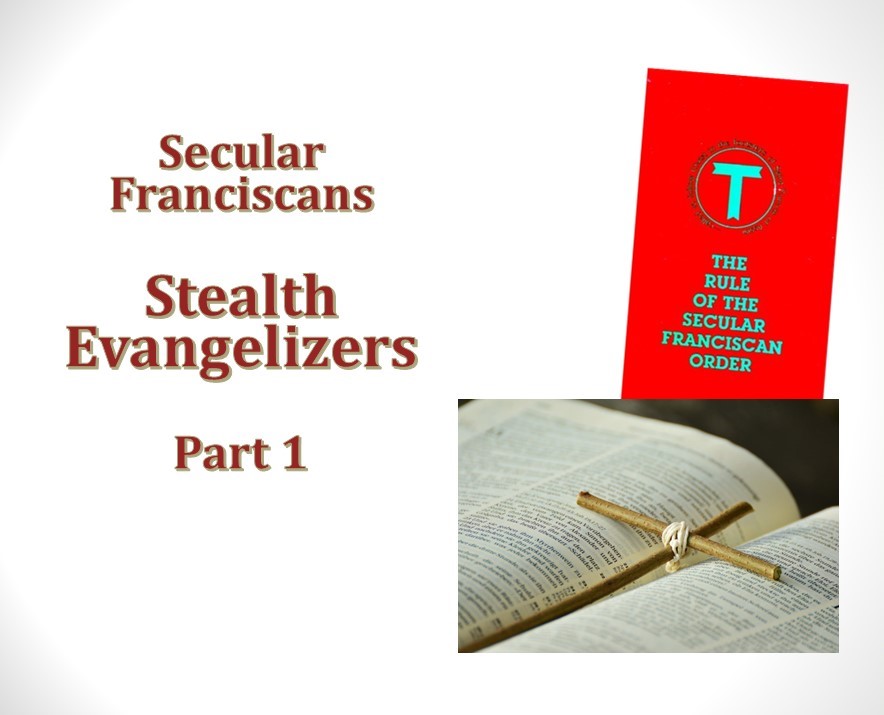
FORMATION FRIDAY – Secular Franciscans are Stealth Evangelizers (Part 1) – July 8, 2022

Please share with your local fraternity

Through our baptism, all Christians are called to be “priests, prophets, and kings.” We are called to proclaim the gospel every day of our lives. In a recent homily, a local pastor spoke about prophets as being the “mouthpieces” of God. As prophets we are to hear God’s word and spread the Gospel.

When we are professed, Secular Franciscans deepen our baptismal commitment. We are called to be in the forefront of evangelization. We may not be knocking on doors or preaching sermons, but if we live our Rule authentically, we are evangelizing, nonetheless. We are STEALTH EVANGELIZERS.

After reading the call to conversion in the Prologue to our Rule, take a good look at the snippets of key articles of our Rule below. The Rule helps us to reorder our lives so that we become effective evangelizers.

The questions following each article can be used for discussion with a small group, with a prayer partner, or answered in your journal.

Article 2 ” By their profession they pledge themselves to live the gospel in the manner of St. Francis by means of this rule approved by the Church.”5

+How often do you read our Rule?
+Give an example of how you can make the Rule part of your prayer life.

Article 4 Secular Franciscans should devote themselves especially to careful reading of the gospel, going from gospel to life and life to the gospel8.”

+How often do you read Scripture besides what you hear at Mass?

+Give some examples of how you go from gospel to life and life to the gospels.

Article 5 “…should seek to encounter the living and active person of Christ in their brothers and sisters, in Sacred Scripture, in the Church, and in liturgical activity.”

+How do you find the “living and active person of Christ in someone you do not like?”

+How do you treat those who are “difficult?” How are you evangelizing this person?

Article 6 ” Therefore, they should go forth as witnesses and instruments of her [the Church’s] mission among all people, proclaiming Christ by their life and words.”

+What are some ways your life makes you an instrument of the Church’s mission?

+How can our actions and words turn people away from the mission of the Church?

Article 10 …”let them faithfully fulfill the duties proper to their various circumstances of life.17 Let them also follow the poor and crucified Christ, witness to him even in difficulties and persecutions…”

+What duties are “proper” to your life? (Not the same for everyone)

+How do you fulfill your duties and responsibilities in a way that gives good witness?

Article 11 “Let them be mindful that according to the gospel they are stewards of the goods received for the benefit of God’s children.”

+What are our responsibilities in being good stewards of the goods we have received from God?

+How does our relationship with material things help to evangelize others?”

Part 2 next week

Formation Friday 8 de julio de 2022
Los franciscanos seglares son evangelizadores “sigilosos” (Parte 1)
Comparta con su fraternidad local

A través de nuestro bautismo, todos los cristianos estamos llamados a ser “sacerdotes, profetas y reyes.” Estamos llamados a proclamar el evangelio todos los días de nuestras vidas. En una homilía reciente, un pastor local habló de los profetas como los “portavoces” de Dios. Como profetas, debemos escuchar la palabra de Dios y difundir el Evangelio.

Cuando profesamos, los franciscanos seglares profundizamos nuestro compromiso bautismal. Estamos llamados a estar en la vanguardia de la evangelización. Puede que no estemos tocando puertas o predicando sermones, pero si vivimos nuestra Regla auténticamente, estamos evangelizando, no obstante. Somos EVANGELIZADORES STEALTH (“sigilosos”).

Después de leer el llamado a la conversión en el Prólogo de nuestra Regla, eche un vistazo a los fragmentos de artículos clave de nuestra Regla a continuación. La Regla nos ayuda a reordenar nuestra vida para convertirnos en evangelizadores eficaces.

Las preguntas que siguen a cada artículo se pueden usar para la discusión con un grupo pequeño, con un compañero de oración o se pueden responder en su diario.

Artículo 2 “se comprometen con la Profesión a vivir el Evangelio a la manera de San Francisco con la ayuda de la presente Regla confirmada por la Iglesia.” 5

+ ¿Con qué frecuencia lee nuestra Regla?
+Dé un ejemplo de cómo puede hacer que la Regla sea parte de su vida de oración.

Artículo 4 “Los Franciscanos seglares dedíquense asiduamente a la lectura del Evangelio, pasando del Evangelio a la vida y de la vida al Evangelio8.”

+ ¿Con qué frecuencia lees las Escrituras además de lo que escuchas en la Misa?

+ Da algunos ejemplos de cómo pasas del evangelio a la vida y de la vida a los evangelios.


Artículo 5 “Los Franciscanos seglares, pues, busquen la persona viviente y operante de Cristo en los hermanos, en la Sagrada Escritura, en la Iglesia y en las acciones litúrgicas.”

+ ¿Cómo encuentra usted a la “persona viviente y operante de Cristo” en alguien que no le gusta?

+ ¿Cómo trata a los que son “difíciles?” ¿Cómo evangeliza usted a esta persona?


Artículo 6 “…háganse testigos e instrumentos de su misión entre los hombres, anunciando a Cristo con la vida y con la palabra.”

+ ¿Cuáles son algunas formas en que su vida le convierte en un instrumento de la misión de la Iglesia?

+¿Cómo pueden nuestras acciones y palabras alejar a la gente de la misión de la Iglesia?


Artículo 10 “…cumplan fielmente las obligaciones propias de la condición de cada uno en las diversas circunstancias de la vida17, y sigan a Cristo, pobre y crucificado, testimoniándolo aún en las dificultades y persecuciones18.

+ ¿Qué obligaciones son “propias ” a su vida? (No son iguales para todos)

+ ¿Cómo cumple con sus obligaciones y responsabilidades de una manera que da buen testimonio?


Artículo 11 “…sean conscientes, en conformidad con el Evangelio, de ser administradores de los bienes recibidos, en favor de los hijos de Dios.”

+ ¿Cuáles son nuestras responsabilidades para ser buenos administradores de los bienes que hemos recibido de Dios?

+ ¿Cómo nuestra relación con las cosas materiales ayuda a evangelizar a los demás?”


Segunda parte la semana próxima

 
Diane F. Menditto, OFS

Chair, National Formation Commission

Formation Director, Our Lady of the Angels Region
Formation Director, St. Francis Fraternity, Hackensack, NJ
 

Scroll to top
Juan de Padilla