(Article attached for printout in pdf format) Five Important Spiritual Thoughts from the Liturgy of the Word
…and follow up for the Secular Franciscan
July 28 – August 3
1 – “Like clay in
the hand of the potter, so are you in my hand,
house of Israel.” (Jeremiah 18:6)…Do I honestly try
to let the Lord shape my thoughts, words, and actions?
2 — “Do
you understand all these things?” (Mt 13:51) **…Do
I try to understand the Lord’s words in the Gospels?
Extended meditation
In
Matthew’s Gospel, Jesus was a perfect teacher. He wanted his students, that is,
his disciples and consequently his followers, to learn well what he was trying
to teach. He asks them as he teaches them the important question of whether
they understood what he was teaching.For
coach Jim White of McFarland High School in the small city of McFarland,
California, that understanding happened in two ways, the first with himself,
and the second, as he directed his student-athletes.With
himself, he saw that his previous teaching experiences had not been totally
what he wished. And after he began
teaching in the McFarland School District, he slowly became aware of what his
job of teaching was all about.His understanding as a teacher began to
mature only when he began to see his students to be people, not unlike himself,
who needed to be taught different values than the ones they knew. It is a fact of California high school sports
history that with his help, his “runners” all became successful in their lives.
(Movie: McFarland USA)Understanding usually happens in our
human natures with two ends in mind, the first being a shaping and forming of ourselves. It comes about only when we maturely accept
the principles which Jesus gives to us in his words of the Gospels. Indeed, the Franciscan vows to make the
Gospel her/his life.Secondly and simultaneously, the other accomplishment
of understanding comes with the same principles of the Gospel as they relate to
other people. Such an understanding
directs us to recognize the “personal world view” of another with the intention
of helping them as much as we can. As
the Secular Franciscan Rule phrases, it, “As the Father sees in every person
the features of his Son, …so the Secular Franciscans with a gentle and courteous
spirit accept all people as a gift of the Lord and an image of Christ. A sense of community will make them joyful
and ready to place themselves on an equal basis with all people, especially
with the lowly for whom they shall strive to create conditions of life worthy
of people redeemed by Christ.” (Rule of the Secular
Franciscans, 13)
3 — “I am the resurrection and the life; whoever believes in me, even if he dies,
will live, and anyone who lives and
believes in me will never die. Do you
believe this?” (John 11:26)**…We readily
answer the Lord that we believe that he is the resurrection and the life. How can
I show that belief a little more during the upcoming days?
Extended
meditationPerhaps more than any other
doctrine, the Christian belief in life after death depends solely on
faith. No human being has ever returned
from the dead. We have stories from
people who claim to have experienced life after death in “near death
experiences,” but there is no proof that there is life after death except for
what Scripture offers. But Scripture is
very clear. This life that we are living
is merely “part one” of life. “Part two”
is what we choose while we are involved in “part one.” If we choose the path of good, we will have
our eternal reward in heaven; those who choose evil will have an eternal
punishment.A person familiar with the
Christian Scriptures knows that Jesus raised Lazarus from the dead. But the important fact of the story of
Lazarus and his sisters is that it did not matter whether Jesus brought Lazarus
back to earthly life or not; what mattered was that Lazarus was already alive
in the eyes of God. As Jesus tells
Martha, whoever believes in him will never die.An interesting thought from
our belief in part two of life, or eternal life, is that part one, our life
here on earth, can be better because of our belief in heaven. The thought is cleverly portrayed in the
movie “Hereafter.”Psychic George Lonegun knew
that he had a gift of communicating with the dead. He called the gift a curse because inevitably
he discovered many people who wanted to know about their past, but the
knowledge often did nothing more than make them miserable. At her persistent request, however, George
finally listened to Marie Lelay about her experience.The movie’s philosophical
conclusion is portrayed in the present life of George and Marie as they fall in
love. They are drawn together by their
knowledge of the afterlife, and the unwritten statement is that they will live
happily together. Their life “part one”
is better because of their mutual belief in life “part two.” (Movie, “Hereafter”)Such a conclusion is, more
or less, the conclusion of Christianity and therefore Franciscanism: once we
understand that the afterlife—or in Christian terms, “heaven”—exists,
our present life here on earth should take on a different and more profitable
meaning.Further, and a negative
thought that must accompany the thought of eternal happiness, as we experience
life “part one” here on earth, we must be very much aware that although our
present life can be enhanced by our belief in the “afterlife,” we believe that
we can also choose the opposite. We
still possess a free will. We may choose
to have “eternal death” if we refuse to live that good life.Knowledge of a good ending
is an incentive to work diligently toward such an end. If we do God’s work, and do it well, living a
truly Christian life, a happy life on earth will be ours, as well as the
“afterlife” in heaven.
4 — “His
heart was moved with pity for them.” (Mt 14:14)**…In my life, in general, do I look at others with a desire to
help them if they need it?
5 – “Woman,
great is your faith.” (Mt 15:28)**…In what ways can I show my faith in a
stronger way?
** One of the most
important passages of the Gospels
Pardon of Assisi at Q
For all Quinquinnial attendees seeking the Pardon of Assisi Indulgence: There will be a 5 p.m. Mass on Tuesday, Aug. 2, at the St. Mary’s Basilica, Phoenix. For 100vw, 138px” data-recalc-dims=”1″> more information on this indulgence, see <a href=)
https://www.secularfranciscansusa.org/2022/08/02/27124/
The Pardon of Assisi – The Porziuncola Indulgence – August 2
Diane F. Menditto, OFS
Chair, National Formation Commission
Formation Director, Our Lady of the Angels Region
Formation Director, St. Francis Fraternity, Hackensack, NJ
Formation Friday July 29, 2022
 100vw, 171px” data-recalc-dims=”1″>The Pardon of Assisi – The Porziuncola Indulgence—Celebrated on August 2 (en español abajo)</p>
<p>Please share with your local fraternity</p>
<p>+ The sixteenth century Basilica of St. Mary of the Angels envelops the tiny chapel known as the Porziuncola.</p>
<p>+ This chapel was one of the churches restored by St. Francis.</p>
<p>+ This is the spot where, while listening to the Gospel, Francis understood what he was called by God to do.</p>
<p>+ This is the spot where, while listening to the Gospel, Francis understood what he was called by God to do.</p>
<p>+ St. Clare received her religious habit from the hands of Francis here in 1211.</p>
<p>+ In 1216 as Francis prayed that everyone could be brought to heaven, he obtained from Jesus in a vision the PARDON OF ASSISI—a plenary indulgence, which was later ratified by Pope Honorius III.</p>
<p>+ This is where the friars’ early general chapters were held—the Chapter of Mats of 1221 was attended by 5,000 friars.</p>
<p>+ Here, on October 3, 1226, St. Francis welcomed Sister Death lying naked on the ground just outside the chapel.</p>
<p><em>“See to it, my sons, that you never abandon this place. If you are driven out from one side, go back in at the other. For this place is truly holy and is the dwelling place of God. Here, when we were but a few, the Most High gave us increase; here he enlightened the hearts of his poor ones by the light of his wisdom; here he set our wills on afire with the flame of his love. Here he who prays with a devout heart will obtain what he prays for and he who offends will be punished more severely. Wherefore, my sons, consider this dwelling place of God to be worthy of all honour, and with all your, with voice of joy, and praise, give glory to the Lord in this place.” </em>(Words of the dying St. Francis, Celano 1, n. 106)</p>
<p>The Conditions for Receiving the Pardon</p>
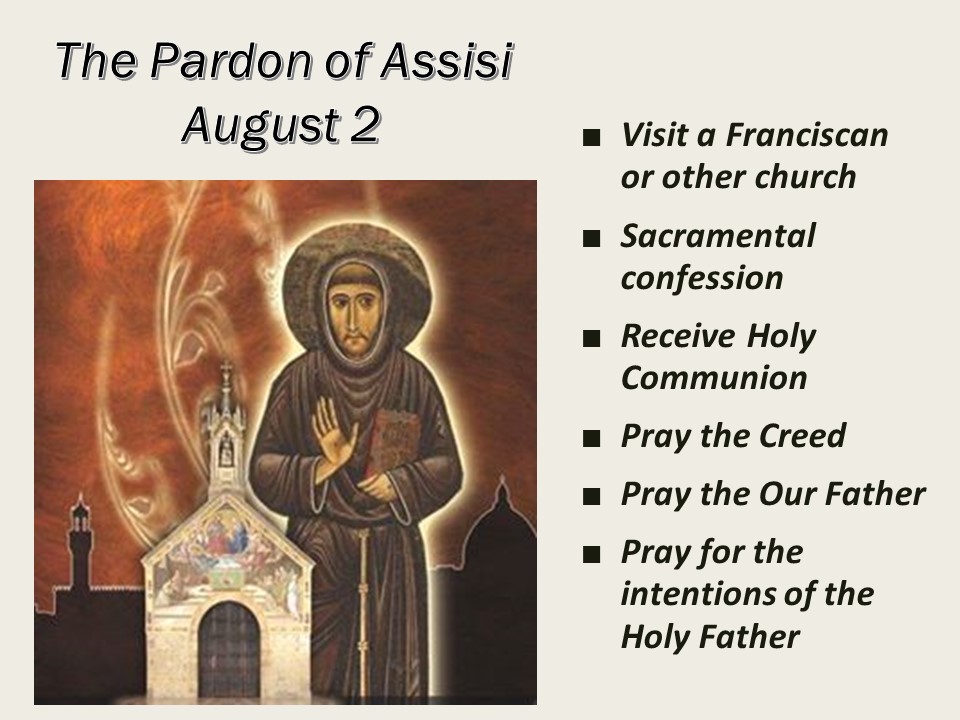
<p>+ <strong>Each year from vespers on August 1 through August 2</strong> (Feast of Our Lady of the Angels) you should visit either a Franciscan church or your own church. (At first the indulgence was only given for the Porziuncola, but it has been widened over the years.)</p>
<p>+ You may obtain the indulgence any day of the year upon visiting the Porziuncola itself.</p>
<p><strong>CONDITIONS TO OBTAIN THE PARDON OF ASSISI<br />Plenary Indulgence–</strong><em>(for oneself or for a departed soul)</em></p>
<ul>
<li><strong>Sacramental Confession</strong> to be in God’s sanctifying grace *(to be received within eight days before or after initiate “appeal” for the Plenary Indulgence);</li>
<li>*Participation in the <strong>Holy Mass</strong> with reception of the <strong>Holy Eucharist</strong>.</li>
<li>Visit to a Catholic Church, followed by the <strong>Profession of FAITH</strong> (Nicene Creed or Apostles Creed),</li>
<li>Recite <strong>the OUR FATHER</strong>, in order to reaffirm and give witness to one’s Christian dignity, as a child of God, that one received in Baptism;</li>
<li><strong>Pray for the Pope’s intentions:</strong> as Vicar of Christ, Shepherd of the Universal Church, and visible sign of unity among the Faithful</li>
</ul>
<p>Excellent reference on this topic: <a href=)
Also, if you are able to read Spanish, the link below has a very interesting article about the Porziuncola.
For discussion and reflection
+ Read Matthew 10: 9-15. This is the gospel that Francis heard read at the Porziuncola. Reflect on its meaning to all Franciscans and to us as Secular Franciscans.
+ On August 1-2, visit a Franciscan or other church and follow the conditions to receive the indulgence.
+ While you are there, spend time with the Blessed Sacrament. Consider your vocation and what God is asking of you.
+++++++++++++++++++++++++
Formation Friday – 29 de julio, 2022
El perdón de Asís – La indulgencia de la porciúncula 2 de agosto
Comparta con su fraternidad local.
+ La Basílica de Santa María de los Ángeles del siglo XVI envuelve la pequeña capilla conocida como la Porciúncula.
+ Esta capilla fue una de las iglesias restauradas por San Francisco.
+ Este es el lugar donde, mientras escuchaba el Evangelio, Francisco comprendió lo que Dios le había llamado a hacer.
+ Aquí fundó la Orden en 1209.
+ Santa Clara recibió su hábito religioso de manos de Francisco aquí en 1211.
+ En 1216, mientras Francisco oraba para que todos pudieran ser llevados al cielo, obtuvo de Jesús en una visión el PERDÓN DE ASÍS, una indulgencia plenaria, que luego fue ratificada por el Papa Honorio III.
+ Aquí es donde se llevaron a cabo los primeros capítulos generales de los frailes; al Capítulo de las Esteras de 1221 asistieron 5.000 frailes.
+ Aquí, el 3 de octubre de 1226, San Francisco recibió desnudo a la Hermana Muerte en el suelo a las afueras de la capilla.
“Ocúpense, hijos míos, de que nunca abandonen este lugar. Si son expulsados de un lado, regresen por el otro. Porque este lugar es verdaderamente santo y es la morada de Dios. Aquí, cuando éramos sólo unos pocos, el Altísimo nos dio crecimiento; aquí iluminó el corazón de sus pobres con la luz de su sabiduría; aquí prendió nuestras voluntades con la llama de su amor. Aquí el que ora con corazón devoto obtenga lo que pide y el que ofende será castigado más severamente. Por tanto, hijos míos, consideren esta morada de Dios digna de toda honra, y con toda su voz, con voz de gozo y alabanza, den gloria al Señor en este luga .” (Palabras de San Francisco agonizante, Celano 1, n. 106)
Las condiciones para recibir la indulgencia
+ Cada año, desde las vísperas del 10 de agosto al 20 de agosto (Fiesta de Nuestra Señora de los Ángeles), debe visitar una iglesia franciscana o su propia iglesia. (Al principio, la indulgencia solo se otorgó a la Porciúncula, pero se ha ampliado con los años).
+ Puede obtener la indulgencia cualquier día del año al visitar la propia Porziuncola.
CONDICIONES PARA OBTENER EL PERDÓN DE ASÍS
Indulgencia plenaria – (para uno mismo o para un alma difunta)
- Confesión sacramental para estar en la gracia santificante de Dios * (para ser recibida dentro de los ocho días antes o después de iniciada la “apelación” para la Indulgencia Plenaria);
- * Participación en la Santa Misa con recepción de la Sagrada Eucaristía.
- Visita a una Iglesia Católica, seguida de la Profesión de FE (Credo de Nicea o Credo de los Apóstoles),
- Recitar el PADRE NUESTRO, para reafirmar y dar testimonio de la propia dignidad cristiana, como hijo de Dios, que se recibió en el Bautismo;
- Ore por las intenciones del Papa: como Vicario de Cristo, Pastor de la Iglesia Universal y signo visible de unidad entre los Fieles.
Excelente recurso en español http://franciscanos.org/santuarios/bellucci.htm
Para platicar y reflexionar
+ Lea Mateo 10: 9-15. Este es el evangelio que Francisco escuchó en la Porciúncula. Reflexione sobre su significado para todos los franciscanos y para nosotros como franciscanos seglares.
+ El 10 o el 20 de agosto, visite una iglesia franciscana u otra iglesia; siga las condiciones para recibir la indulgencia.
+ Mientras esté allí, pase tiempo con el Santísimo Sacramento. Considere su vocación y lo que Dios le está pidiendo.
+++++
https://www.secularfranciscansusa.org/2022/07/30/the-pardon-of-assisi-the-porziuncola-indulgence-august-2/
FORMATION FRIDAY- The Pardon of Assisi- The Poziuncola Indulgence – August 2 – July 29, 2022
Please share with your local fraternity
+ The sixteenth century Basilica of St. Mary of the Angels envelops the tiny chapel known as the Porziuncola.
+ This chapel was one of the churches restored by St. Francis.
+ This is the spot where, while listening to the Gospel, Francis understood what he was called by God to do.
+ Here he founded the Order in 1209.
+ St. Clare received her religious habit from the hands of Francis here in 1211.
+ In 1216 as Francis prayed that everyone could be brought to heaven, he obtained from Jesus in a vision the PARDON OF ASSISI—a plenary indulgence, which was later ratified by Pope Honorius III.
+ This is where the friars’ early general chapters were held—the Chapter of Mats of 1221 was attended by 5,000 friars.
+ Here, on October 3, 1226, St. Francis welcomed Sister Death lying naked on the ground just outside the chapel.
“See to it, my sons, that you never abandon this place. If you are driven out from one side, go back in at the other. For this place is truly holy and is the dwelling place of God. Here, when we were but a few, the Most High gave us increase; here he enlightened the hearts of his poor ones by the light of his wisdom; here he set our wills on afire with the flame of his love. Here he who prays with a devout heart will obtain what he prays for and he who offends will be punished more severely. Wherefore, my sons, consider this dwelling place of God to be worthy of all honor, and with all your, with the voice of joy, and praise, give glory to the Lord in this place.” (Words of the dying St. Francis, Celano 1, n. 106)
The Conditions for Receiving the Pardon
+ Each year from vespers on August 1 through August 2 (Feast of Our Lady of the Angels) you should visit either a Franciscan church or your own church. (At first the indulgence was only given for the Porziuncola, but it has been widened over the years.)
+ You may obtain the indulgence any day of the year upon visiting the Porziuncola itself.
CONDITIONS TO OBTAIN THE PARDON OF ASSISI
Plenary Indulgence–(for oneself or for a departed soul)
- Sacramental Confession to be in God’s sanctifying grace *(to be received within eight days before or after initiate “appeal” for the Plenary Indulgence);
- *Participation in the Holy Mass with reception of the Holy Eucharist.
- Visit to a Catholic Church, followed by the Profession of FAITH (Nicene Creed or Apostles Creed),
- Recite the OUR FATHER, in order to reaffirm and give witness to one’s Christian dignity, as a child of God, that one received in Baptism;
- Pray for the Pope’s intentions: as Vicar of Christ, Shepherd of the Universal Church, and visible sign of unity among the Faithful
Excellent reference on this topic: http://www.shrinesf.org/pardon-of-assisi.html
Also, if you are able to read Spanish, the link below has a very interesting article about the Porziuncola.
For discussion and reflection
+ Read Matthew 10: 9-15. This is the gospel that Francis heard read at the Porziuncola. Reflect on its meaning to all Franciscans and to us as Secular Franciscans.
+ On August 1-2, visit a Franciscan or other church and follow the conditions to receive the indulgence.
+ While you are there, spend time with the Blessed Sacrament. Consider your vocation and what God is asking of you.
+++++++++++++++++++++++++
Formation Friday – 29 de julio, 2022
El perdón de Asís – La indulgencia de la porciúncula 2 de agosto
Comparta con su fraternidad local.
+ La Basílica de Santa María de los Ángeles del siglo XVI envuelve la pequeña capilla conocida como la Porciúncula.
+ Esta capilla fue una de las iglesias restauradas por San Francisco.
+ Este es el lugar donde, mientras escuchaba el Evangelio, Francisco comprendió lo que Dios le había llamado a hacer.
+ Aquí fundó la Orden en 1209.
+ Santa Clara recibió su hábito religioso de manos de Francisco aquí en 1211.
+ En 1216, mientras Francisco oraba para que todos pudieran ser llevados al cielo, obtuvo de Jesús en una visión el PERDÓN DE ASÍS, una indulgencia plenaria, que luego fue ratificada por el Papa Honorio III.
+ Aquí es donde se llevaron a cabo los primeros capítulos generales de los frailes; al Capítulo de las Esteras de 1221 asistieron 5.000 frailes.
+ Aquí, el 3 de octubre de 1226, San Francisco recibió desnudo a la Hermana Muerte en el suelo a las afueras de la capilla.
“Ocúpense, hijos míos, de que nunca abandonen este lugar. Si son expulsados de un lado, regresen por el otro. Porque este lugar es verdaderamente santo y es la morada de Dios. Aquí, cuando éramos sólo unos pocos, el Altísimo nos dio crecimiento; aquí iluminó el corazón de sus pobres con la luz de su sabiduría; aquí prendió nuestras voluntades con la llama de su amor. Aquí el que ora con corazón devoto obtenga lo que pide y el que ofende será castigado más severamente. Por tanto, hijos míos, consideren esta morada de Dios digna de toda honra, y con toda su voz, con voz de gozo y alabanza, den gloria al Señor en este luga .” (Palabras de San Francisco agonizante, Celano 1, n. 106)
Las condiciones para recibir la indulgencia
+ Cada año, desde las vísperas del 10 de agosto al 20 de agosto (Fiesta de Nuestra Señora de los Ángeles), debe visitar una iglesia franciscana o su propia iglesia. (Al principio, la indulgencia solo se otorgó a la Porciúncula, pero se ha ampliado con los años).
+ Puede obtener la indulgencia cualquier día del año al visitar la propia Porziuncola.
CONDICIONES PARA OBTENER EL PERDÓN DE ASÍS
Indulgencia plenaria – (para uno mismo o para un alma difunta)
• Confesión sacramental para estar en la gracia santificante de Dios * (para ser recibida dentro de los ocho días antes o después de iniciada la “apelación” para la Indulgencia Plenaria);
• * Participación en la Santa Misa con recepción de la Sagrada Eucaristía.
• Visita a una Iglesia Católica, seguida de la Profesión de FE (Credo de Nicea o Credo de los Apóstoles),
• Recitar el PADRE NUESTRO, para reafirmar y dar testimonio de la propia dignidad cristiana, como hijo de Dios, que se recibió en el Bautismo;
• Ore por las intenciones del Papa: como Vicario de Cristo, Pastor de la Iglesia Universal y signo visible de unidad entre los Fieles.
Excelente recurso en español http://franciscanos.org/santuarios/bellucci.htm
Para platicar y reflexionar
+ Lea Mateo 10: 9-15. Este es el evangelio que Francisco escuchó en la Porciúncula. Reflexione sobre su significado para todos los franciscanos y para nosotros como franciscanos seglares.
+ El 10 o el 20 de agosto, visite una iglesia franciscana u otra iglesia; siga las condiciones para recibir la indulgencia.
+ Mientras esté allí, pase tiempo con el Santísimo Sacramento. Considere su vocación y lo que Dios le está pidiendo.
Diane F. Menditto, OFSChair, National Formation Commission
Formation Director, Our Lady of the Angels Region
Formation Director, St. Francis Fraternity, Hackensack, NJ
SHAPING THE FRANCISCAN FOOTPRINT – July 21- July 27 2022
(Article attached for printout in pdf format) Five Important Spiritual Thoughts from the Liturgy of the Word
…and follow up for the Secular Franciscan
July 21-27
1 – They have dug themselves cisterns, broken cisterns,
that hold no water. (Jeremiah 2:13)…We tend to dig broken cisterns that hold no water, that is,
we tend to look at solutions which are really not solutions. Do I turn to God
enough as I seek solutions to the problems I have?
2 – Mary Magdalene “saw
two angels in white sitting there, one at the head and one at the feet where
the body of Jesus had been.” (Jn 20:12)…There are people in
my life who are “my” angels. Who are they and have I thanked them for what they
have done?
Extended
meditationIt’s interesting to study the “empty
tomb” as theologians call the beginning of the Resurrection experience in the
various evangelists. Each one gives a
different rendition of the empty tomb.
In John’s Gospel, there are two angels who make the announcement to Mary
Magdalen.We can only prove the existence of
angels by reading the Scriptures and in every instance, they are presented as
workers or messengers of God. But there
are many instances of angels in human form.Chloe needed an angel that night, and
the angel came in the guise of a rather large African American man by the name
of Donovan. She had lost her husband
because of what her neighbors called “The Chicago Violence,”—a drive-by
shooting that happened all too often in her neighborhood, and her husband was a
victim. Chloe was completely distraught.
At the hospital while she was awaiting
the horrible news, Pastor Donovan who called himself a “street pastor” came to
her and prayed with her. He prayed for
love and peace and unity. And he came
back to her home a couple times the following month. He was the angel she needed.Pastor Donovan is a real person who has
made it his mission to care for the survivors of gun violence around the troubled
spots of Chicago. NBC News heard about
him, and followed him around one evening.
“I’ve been blessed to be loved,” he said in the interview, “it’s
important that I love now.” He said that
he has cared for over a thousand different survivors of families that had a
homicide due to gun violence.One of the frequent names that is given
Francis of Assisi in the stories known as “The Little Flowers of Francis of
Assisi” is that of an “angel.” He spoke
like an angel, he helped like an angel, and so forth.A follower of Francis must take note of
that calling. There are people all
around us who need an angel who will deliver the message of God to them. Maybe we can find a mission in helping those
people.
3 – “What father among you would hand his son a snake when he asks for
a fish? Or hand him a scorpion when he asks for an egg?”
(Lk 11:11-12)…God knows more than I do. In
my prayer of petition, I may be asking for things that would have been harmful
to me.
4 – “…the great ones make their authority over them felt.But it shall not be so among you.” (Mt 20:25-26)
…How strong is my self-pride?
Extended
meditationAccording
to St. Thomas Aquinas, a capital sin is that which has an exceedingly
desirable end so that in one’s desire for it, the person goes on to the commission
of many sins, all of which are said to originate in that sin as their
chief source. And first and foremost among the capital sins is the sin of
pride or vainglory. It was the sin which transformed Lucifer into Satan, and is
called the sin of sins.And
so, Jesus calls attention to it often.
Here, Jesus’s disciples suddenly had power that they never expected to
have, and their human natures wanted to exercise that power. Quite naturally, they wanted to exploit their
authority. Human nature has been
predictable since the day God created humankind: we always want more than
others. Here, quite directly, the Lord
says to them and to us: “It shall not be so among you.”In
our history, American historians have ranked the 1960’s in the southern United
States to be one of the most painful moments in American history. Black Americans
found themselves in a state of desiring freedom from the oppression that had
been accepted behavior up to that time in that part of the world. (see Movie:
“The Help”)Part
of that moment in history resonates with the sin of pride because the American
white person probably without knowing what he/she was doing thought themselves to
be more than the black servants who were employed in various jobs. Did they know what they were doing? After all, a College Study had recently
stated that blacks were inferior to whites.A
recent song described that pride to be “noise.” Singing of a person who is
taken up with self, and therefore a victim of pride, the person who feels less than
another says, “You don’t know the way that you look when [your] steps make that
much noise.” (Song: “Cooler Than Me”)If
we want to be truly Christian, that is a member of a group who are called to be
“Christianity squared,” we must face the feeling of always wanting more. We naturally try to be better and better at
what we do, but too often we find ourselves judging others to be “less.” We
feel superior over others who don’t do as well as we do. It is but a short step then to make them “slaves.”The
noise of pride is loud. It tends to
drown out any attempt to do good.
5 –
“…sells all that he has…” (Mt 13:44, 46)…”Sells
all that he has” is central to Jesus’s stories here. Obviously it cannot be taken literally
because I need things to live. But as a
Franciscan, what things in my life should I give up to show my dedication to
the Lord in a better way?