Eucharistic Revival Starts on Corpus Christi Sunday, June 20

Announcement of 2022-2024 Eucharistic RevivalA National Eucharistic Revival intended to nurture devotion to the presence of Jesus Christ in the Eucharist begins on June 20, 2022, the solemnity of the Most Holy Body and Blood of Christ, as known as Corpus Christi.

Auxiliary Bishop Andrew H. Cozzens of St. Paul and Minneapolis, chairman of the U.S. Conference of Catholic Bishops’ Committee on Evangelization and Catechesis, anticipates the revival will reawaken the understanding of the sacrament of the Eucharist.

Dioceses throughout the nation are planning to open the revival with processions and other events of adoration.   The revival will continue until a National Eucharistic Congress convenes July 17-21, 2024, in Indianapolis.  This will be the first time in 45 years that a Eucharistic Congress has been held in the United States.

Parishes will be encouraged to help increase Catholics’ understanding of the Eucharist in their lives.  In addition, a team of 50 priests and friars will travel the country preaching about the meaning of the Eucharist in the lives of Catholics.  Included among them will be Fr. Edgardo Jaro, OFM, from the Holy Name Province.

The bishops cited one of the catalysts of the revival as a recent Pew Research Study on the Eucharist.  Carol L. Gentile, OFS, former national minister explains the results of the study and our responsibility as Franciscans in the following letter.

During a recent fraternity meeting, one of our members mentioned that 70% of Catholics do not believe that the Eucharist is the body and blood of our Lord Jesus Christ. Shocked at the startling statistic, I decided to conduct my own research. To be clear, I had no reason to question the colleague who volunteered the information. Rather, I was simply in a state of disbelief, saddened by the fact that it actually may be true. Much to my dismay, the preliminary research confirmed that the information conveyed during the meeting was accurate.

Gregory A. Smith, in an article published on August 5, 2019 referenced information collected in a Pew Research Center survey, citing the fact that only one-third Of U.S. Catholics agree that the Eucharist is actually the body and blood of Christ. Smith writes: “Nearly seven in ten (69%) Catholics say they personally believe that during the Catholic mass, the bread and wine used in communion are symbols of the body and blood of Jesus Christ.”

As Franciscans, I believe we are compelled to put forth an effort to educate as many Catholics as possible, particularly those in your own respective parishes. In doing so I thought that one tactic would be to make available to everyone information about the Miracle of Lanciano, Italy which clearly validates the legitimacy of our core belief. I have attached a copy of the article.

In my heart, I believe Saint Francis would expect no less from us. Tragically, the trend in the United States appears to be digressing towards a more secular society. Let us all do our best so that at the very least we could educate those of our faith about the realities of the body and blood of our Lord Jesus Christ.

With peace and love, Carol L Gentile OFS

Former National Minister, 2003

We asked Jan Parker, OFS, our national minister, to explain what the Eucharist means to her.

When I think of how Christ’s presence in the Eucharist has touched my life, two thoughts come to mind.  First, when I receive Christ’s Body and Blood I feel enormous gratitude for how Christ has poured himself out, humbling himself to fill me with his presence.  I think of Francis’s praises of God, “You are all sweetness. You are our eternal life.”   I must empty myself as well,  in order to be filled, and so each time I approach the Eucharistic table, I pray for inner conversion and a transformation that allows me to love as deeply as Jesus does.

Secondly, I am keenly aware that we are all one body in Christ.  “The bread that we break, is it not a participation in the body of Christ?” (1 Corinthians 10:16)   Long ago, in a conversation with my spiritual director, I shared how much I missed a dear friend and spiritual companion who had moved away, making it more difficult for us to connect.  I will never forget his words to me: “You are never closer to someone than when you receive the Eucharist.”  Truly, we are all one, and connected in Christ!  This applies not only to those we hold close.  Our communion in the Eucharist reminds us of our call to  “…accept all people as a gift of the Lord and an image of Christ.” (OFS Rule, Art. 13)

Please explain to others what the Eucharist means to you.  How has Christ’s presence in the Eucharist touched your life?

Please type your response to the question by clicking on ‘comments’ below.

https://www.secularfranciscansusa.org/2022/06/19/eucharistic-revival-starts-on-corpus-christi-sunday-june-20/
Open post

FORMATION FRIDAY – Documents of the Secular Franciscan Order – June 17,2022

Please share with your local fraternity

Documents of the Secular Franciscan Order

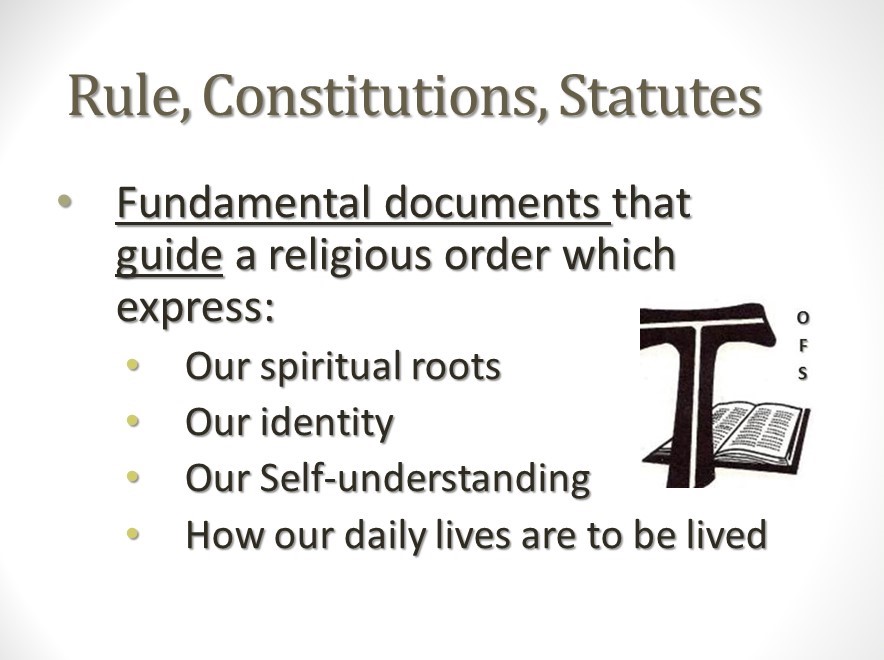
Over the last several months, the National Formation Commission has received a number of questions about why we have a Rule, Constitutions, and Statutes. These questions bring out some very important points that will help us to better understand our way of life and what we promise at our profession.

  • + Do we have one Rule or 26 “rules” to follow?

Religious orders and institutes follow the charism of their founders. Generally, the founder writes or inspires the Rule of a particular community. The intention of a Rule is that the members of the order will have the inspiration of the founder to live by when he or she is no longer among them. The Rules of religious communities, although requiring approval by the Holy See, are general, most of the time without the specifics that will be necessary to govern a religious community and to live out the Rule authentically.

“The word ‘rule’ (Latin: regula, Greek: kanon) literally means a standard by which something can be tested. In the case of religious or secular institutes it establishes the spiritual foundation and identity of the community. It is the norm which all the other documentation of the institutes – constitutions, statutes, etc. – are measured. Approbation of rules for religious and secular institutes in the Church is reserved to the Holy See.” (See Michael Higgins, TOR, “Importance of Familiarization with the Documents of the Secular Franciscan Order.”)

A Rule is not a list or set of “rules” but the outline of a plan or way of life to help us live out the vision of the founder which is put forth in 26 articles.

  • +Why do we have Constitutions? What is the relationship between the Rule and Constitutions?

The Constitutions (also approved by the Holy See) are much more specific about the way the Rule should be interpreted and carried out. Here is an explanation by Fr. Lester Bach, OFM Cap., in the Franciscan Journey p. 106:

“The SFO (OFS) Constitutions contain comments on the Rule and insights for understanding the Rule. The Constitutions point out structures to help the Rule come alive in community life. The Constitutions spell out things like canonical procedures and structural developments. They deal with issues of lukewarm members and the role of the servant leaders
of fraternity life (councils). The Constitutions present ways and means to deal with issues that may arise in fraternity life. In a sense, the Constitutions become a wide-ranging commentary on the secular Franciscan rule and life.”

  • +What are National Statutes?

Article 29.3 of the General Constitutions call for each national fraternity to develop its own statutes. “National Statutes should indicate the criteria for the organization of the OFS in the nation. The application of these criteria is left to the prudent judgement of those responsible for the Fraternities concerned and of the National Council.” National Statutes are not approved by the Holy See but must be approved by the council of the higher level. (CIOFS) The statutes of a particular country take into account the culture and customs of that country and add further particulars to what is laid out in the Constitutions. Statutes may be more restrictive than the Constitutions, but not less restrictive.

Every member should have access to the Rule, Constitutions, and Statutes. You may order the Essential Documents book from Smoky Valley Printing (Order form often appears in the TAU newsletter.) You may also find our documents in their latest translations on our national website and on the CIOFS website.

OFS Governing Documents: https://www.secularfranciscansusa.org/ongoing-formation-resources/#38871d71653d8dcec

Official Documents of the OFS https://ciofs.info/library/official-documents/

Questions for discussion or to answer in your journal:

  1. +When was the last time you read our Rule and Constitutions? Please take some time to read them: Choose two or three areas to focus on in the next week. Continue this practice until you have read both documents completely.
  2. +List some of the items that stood out to you as you were completing the above “labor of love.”
  3. +How does your fraternity use the Rule and Constitutions for ongoing formation? Make a list of ideas for their use and submit it to your local council or fraternity formation team.
  4. +Resolve to pray one article of the Rule each day!

+++++++++++++++++++++++++++++++++++++

Formation Friday 17 de junio de 2022 Por favor comparta con su fraternidad local

Documentos de la Orden Franciscana Seglar

En los últimos meses, la Comisión Nacional de Formación ha recibido una serie de preguntas sobre por qué tenemos una Regla, Constituciones y Estatutos. Estas preguntas resaltan algunos puntos muy importantes que nos ayudarán a comprender mejor nuestra forma de vida y lo que prometemos en nuestra profesión.

+ ¿Tenemos una Regla o 26 “reglas” a seguir?

Las órdenes e institutos religiosos siguen el carisma de sus fundadores. Generalmente, el fundador escribe o inspira la Regla de una determinada comunidad. La intención de una Regla es que los miembros de la orden tengan la inspiración del fundador para vivir cuando él o ella ya no esté entre ellos. Las Reglas de las comunidades religiosas, aunque requieren la aprobación de la Santa Sede, son generales, la mayoría de las veces sin las especificidades que serán necesarias para gobernar una comunidad religiosa y vivir auténticamente la Regla.

“La palabra ‘regla’ (latín: regula , griego: kanon ) literalmente significa un estándar por el cual algo puede ser probado. En el caso de institutos religiosos o seglares establece el fundamento espiritual y la identidad de la comunidad. Es la norma por la que se mide toda la demás documentación de los institutos – constituciones, estatutos, etc. La aprobación de las normas para los institutos religiosos y seglares de la Iglesia está reservada a la Santa Sede”. (Ver Michael Higgins, TOR, “Importancia de la familiarización con los documentos de la Orden Franciscana Seglar”).

Una Regla no es una lista o un conjunto de “reglas,” sino el esquema de un plan o forma de vida para ayudarnos a vivir la visión del fundador que se presenta en 26 artículos.

+ ¿Por qué tenemos Constituciones? ¿Cuál es la relación entre la Regla y las Constituciones?

Las Constituciones (también aprobadas por la Santa Sede) son mucho más específicas sobre la forma en que debe interpretarse y llevarse a cabo la Regla. Aquí hay una explicación del P. Lester Bach, OFM Cap., en La jornada franciscana p. 106:

“Las Constituciones OFS (OFS) contienen comentarios sobre la Regla e ideas para comprender la Regla. Las Constituciones señalan estructuras para ayudar a que la Regla cobre vida en la vida comunitaria. Las Constituciones explican cosas como procedimientos canónicos y desarrollos estructurales. Se ocupan de cuestiones de los miembros tibios y el papel de los líderes servidores de la vida de la fraternidad (consejos). Las Constituciones presentan formas y medios para tratar los problemas que pueden surgir en la vida de la fraternidad. En cierto sentido, las Constituciones se convierten en un amplio comentario sobre la vida franciscana seglar. regla y vida.”

+ ¿Qué son los Estatutos Nacionales?

El artículo 29.3 de las Constituciones Generales llama a cada fraternidad nacional a desarrollar sus propios estatutos. “Los Estatutos nacionales deben indicar los criterios de organización de la OFS en la nación. La aplicación de estos criterios se deja al prudente juicio de los Responsables de las Fraternidades interesadas y del Consejo nacional.” Los Estatutos Nacionales no son aprobados por la Santa Sede sino que deben ser aprobados por el consejo del nivel superior. (CIOFS) Los estatutos de un país en particular tienen en cuenta la cultura y las costumbres de ese país y añaden más detalles a lo dispuesto en las Constituciones. Los Estatutos pueden ser más restrictivos que las Constituciones, pero no menos restrictivos.

Todo miembro debe tener acceso a la Regla, Constituciones y Estatutos. Puede solicitar el libro Documentos esenciales de Smoky Valley Printing (el formulario de pedido suele aparecer en el boletín de TAU). También puede encontrar nuestros documentos en sus últimas traducciones en nuestro sitio web nacional y en el sitio web de CIOFS.

Documentos rectores de la OFS : https://www.secularfranciscansusa.org/ongoing-formation-resources/#38871d71653d8dcec

Documentos Oficiales de la OFS: https://ciofs.info/es/library/official-documents/

Preguntas para discutir o responder en tu diario:

+¿Cuándo fue la última vez que leyó nuestra Regla y Constituciones? Tómese un tiempo para leerlos: elija dos o tres áreas en las que concentrarse la próxima semana. Continúe con esta práctica hasta que haya leído ambos documentos por completo.

+ Enumere algunos de los elementos que se destacaron para usted mientras completaba el “trabajo de amor” anterior.

+¿Cómo utiliza su fraternidad la Regla y las Constituciones para la formación permanente? Haga una lista de ideas para su uso y envíela a su consejo local o al equipo de formación de la fraternidad.

+ ¡Resuelva rezar un artículo de la Regla cada día!


Diane F. Menditto, OFS

Chair, National Formation Commission

Formation Director, Our Lady of the Angels Region
Formation Director, St. Francis Fraternity, Hackensack, NJ
 

A Message From Pope Francis

(This article originally appeared in the Spring 2022 Issue of the TAU-USA #105)

  • Not all of us are great “organizers” of Yet we are each called to nurture hope. How does our fraternity help to nurture hope and exercise compassion and closeness, for each other and for those outside our fraternity as well?
  • https://www.secularfranciscansusa.org/2022/06/13/a-message-from-pope-francis/

    Did You Know – Franciscan Saints, Blesseds & Holy Days

    [fusion_builder_container type=”flex” hundred_percent=”no” equal_height_columns=”no” menu_anchor=”” hide_on_mobile=”small-visibility,medium-visibility,large-visibility” class=”” id=”” background_color=”” background_image=”” background_position=”center center” background_repeat=”no-repeat” fade=”no” background_parallax=”none” parallax_speed=”0.3″ video_mp4=”” video_webm=”” video_ogv=”” video_url=”” video_aspect_ratio=”16:9″ video_loop=”yes” video_mute=”yes” overlay_color=”” video_preview_image=”” border_color=”” border_style=”solid” padding_top=”” padding_bottom=”” padding_left=”” padding_right=””][fusion_builder_row][fusion_builder_column type=”1_1″ layout=”1_1″ background_position=”left top” background_color=”” border_color=”” border_style=”solid” border_position=”all” spacing=”yes” background_image=”” background_repeat=”no-repeat” padding_top=”” padding_right=”” padding_bottom=”” padding_left=”” margin_top=”0px” margin_bottom=”0px” class=”” id=”” animation_type=”” animation_speed=”0.3″ animation_direction=”left” hide_on_mobile=”small-visibility,medium-visibility,large-visibility” center_content=”no” last=”true” min_height=”” hover_type=”none” link=”” border_sizes_top=”” border_sizes_bottom=”” border_sizes_left=”” border_sizes_right=”” first=”true”][fusion_text]

    Franciscan Saints Blesseds & Holy Days

    can be found on the MENU under PRAY WITH US.

    Sources for Franciscan Saints, Blesseds & Holy Days 

    • Franciscan Saints, Blesseds & Feasts– a catalog created by Mary Lou Coffman, OFS
    • Saint of the Daywith Audio Player from Franciscan Media*, including a calendar of saints and feasts and alphabetical listing.
    *Franciscan Media, formerly St. Anthony Messenger Press and a ministry of the Franciscan friars of St. John the Baptist Province, is a multimedia company comprising St. Anthony Messenger magazine, Franciscan Media and Servant books, Catholic Greetings, Saint of the Day, Minute Meditations, and AmericanCatholic.org.

    Reminder: All the Did You Know Blogs can be found by clicking on the Category “Did You Know” at the end of one of the Did you Know Blogs.

    [/fusion_text][/fusion_builder_column][/fusion_builder_row][/fusion_builder_container]
    https://www.secularfranciscansusa.org/2022/06/11/did-you-know-franciscan-saints-blesseds-holy-days/

    Open post

    FORMATION FRIDAY – IN HONOR OF THE BLESSED TRINITY: FRANCISCANS & the TRINITY

    Please share with your local fraternities


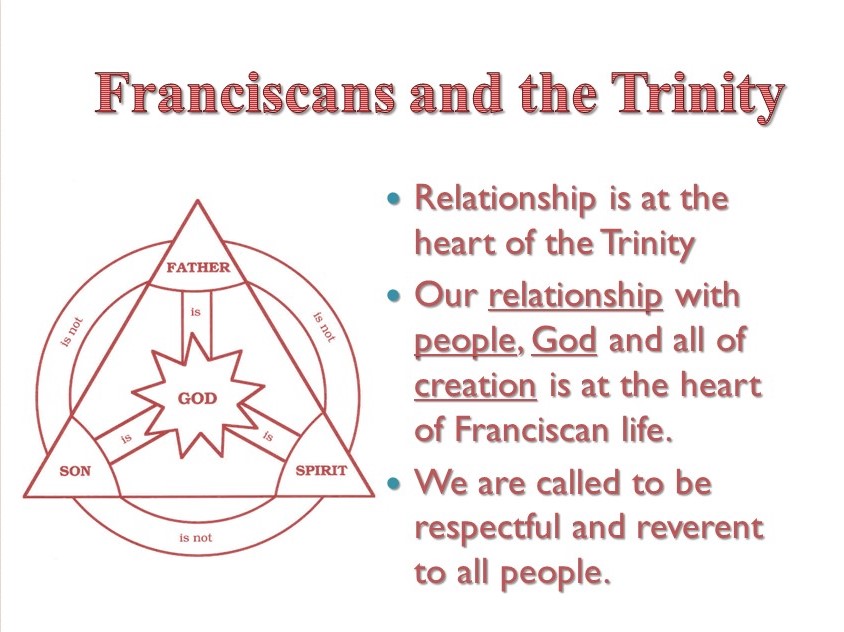
    Franciscan life focuses on the Trinity. Francis saw that God is so generous that his love not only flows among the persons of the Trinity, it overflows to us. And we participate in the life of the Trinity. We might even say that the Trinity is the first “fraternity.”

    Trinitarian spirituality colors our Franciscan Spirit. The Trinity models what love does best – it makes us one! It is through Jesus that St. Francis came to recognize the role of the Trinity in his life. Relationship is at the heart of the Trinity. Our relationship with people, God and all of creation is at the heart of Franciscan life. Our call to be respectful and reverent to all people and all of creation comes from the Trinity.

    “Since Francis understands that the Holy Spirit is the source of power and inspiration that opens our hearts to relationship with the Father (and the Trinity), Francis pursues a vital relationship with all three Persons of the Most Holy Trinity, that are distinguishable but never separate and to whom he turns because singularly they transform him, in order for him to live his relationship of love in the heart of the Life, the perfect Trinity and simple Unity of God to the fullest.”


    “Francis’s most common expression for God is “Perfect Trinity and Simple Unity,” and this is the reality Francis charges all his family to recognize and hold dear in all they do.” (See FUN Manual “St. Francis and His Approach to Divinity”)


    The life of the Trinity as presented in the OFS Rule.

    God is not a solitary God, haughty and distant, always the “judge.” The Rule shows us “God-in-Family,” “God-Communion of Persons,” in their own relationships, in their action with people, hence a God near to them, God-Emmanuel, God-with-us.


    The FATHER is LOVE. He gives us his own Son (OFS Rule, Article 4). He is mercy in the face of our weakness; he gives us the grace of strength (OFS Rule, Article 7). In every person, the Father sees the features of his Son (OFS Rule, Article 13). The Father calls all people to build a more fraternal and evangelical world which proclaims his kingdom (OFS Rule, Article 14), and all creation bears the imprint of the Most High (OFS Rule, Article 18).

    The SON JESUS CHRIST is the GIFT of the Father and becomes for all people the WAY to the Father, their LIFE, their TRUTH. Therefore, Christ must be the inspiration and center of their life (Article 4). Christ has risen and lives and works in our brothers and sisters (Article 5). He makes us members of his Body, the Church (Article 6).

    The HOLY SPIRIT is TRUTH and opens the Rule. Already the first line speaks of the Spirit’s action. The Holy Spirit gives rise to spiritual families in the Church (OFS Rule, Article 1); calls the faithful to follow Christ (Article 1); prompts them to strive for the perfection of charity (Article 2); and introduces them to the Truth (Article 4).

    [Guidelines for Initial Formation p. 39]

    Questions for discussion or to answer in your journal

    + Read the articles of the Rule mentioned above. How do they apply to your life as a Secular Franciscan?

    + Give some examples of Francis’s devotion to the Trinity in his writings and in how he prayed. (To read the writings of St. Francis visit: https://franciscantradition.org/early-sources#francis-the-saint

    + How does your life demonstrate a devotion to the Blessed Trinity?


    +++++++++++++++++++++++++

    Formation Friday 10 de junio de 2022
    En Honor a la Santísima Trinidad: Los Franciscanos y la Trinidad
    Por favor comparta con sus fraternidades locales

    La vida franciscana se centra en la Trinidad. Francisco vio que Dios es tan generoso que su amor no sólo fluye entre las personas de la Trinidad, sino que se desborda hacia nosotros. Y participamos de la vida de la Trinidad. Incluso podríamos decir que la Trinidad es la primera “fraternidad.”

    La espiritualidad trinitaria tiñe nuestro espíritu franciscano. La Trinidad modela lo que el amor mejor hace: ¡nos hace uno! Es a través de Jesús que San Francisco llegó a reconocer el papel de la Trinidad en su vida. La relación está en el corazón de la Trinidad. Nuestra relación con las personas, Dios, y toda la creación está al corazón de la vida franciscana. Nuestro llamado a ser respetuosos y reverentes con todas las personas y toda la creación proviene de la Trinidad.

    “Dado que Francisco entiende que el Espíritu Santo es la fuente de poder e inspiración que abre nuestros corazones a la relación con el Padre (y la Trinidad), Francisco busca una relación vital con las tres Personas de la Santísima Trinidad, que son distinguibles, pero nunca separados y a los que se vuelve porque singularmente lo transforman, para que viva en plenitud su relación de amor en el corazón de la Vida, Trinidad perfecta y Unidad sencilla de Dios.”

    “La expresión más común de Francisco para Dios es “Trinidad Perfecta y Unidad Simple,” y esta es la realidad que

    Francisco exhorta que toda su familia reconozca y aprecie en todo lo que hacen ”. (Ver Manual FUN “San Francisco y Su Acercamiento a la Divinidad”)

    La vida de la Trinidad tal como se presenta en la Regla OFS.

    Dios no es un Dios solitario, altivo y distante, siempre el “juez.” La Regla nos muestra “Dios-en-Familia,” “Dios-Comunión de las Personas,” en sus propias relaciones, en su acción con las personas, por tanto, un Dios cercano a ellas, Dios-Emmanuel, Dios-con-nosotros.

    El PADRE es AMOR. Él nos da a su propio Hijo (Regla OFS, Artículo 4). Él es misericordia ante nuestra debilidad; nos da la gracia de la fuerza (Regla OFS, artículo 7). En cada persona, el Padre ve los rasgos de su Hijo (Regla OFS, artículo 13). El Padre llama a todos los hombres a construir un mundo más fraterno y evangélico que proclame su reino (Regla OFS, artículo 14), y toda la creación lleva la huella del Altísimo (Regla OFS, artículo 18).

    El HIJO JESUCRISTO es el DON del Padre, y se convierte para todos los hombres en CAMINO al Padre, en su VIDA, en su VERDAD. Por tanto, Cristo debe ser la inspiración y el centro de su vida (artículo 4). Cristo ha resucitado y vive y obra en nuestros hermanos y hermanas (artículo 5). Él nos hace miembros de su Cuerpo, la Iglesia (artículo 6).

    El ESPÍRITU SANTO es VERDAD y abre la Regla. Ya la primera línea habla de la acción del Espíritu. El Espíritu Santo suscita familias espirituales en la Iglesia (Regla OFS, artículo 1); llama a los fieles a seguir a Cristo (artículo 1); los impulsa a esforzarse por la perfección de la caridad (artículo 2); y los introduce en la Verdad (artículo 4).

    [Orientaciones para la Formación Inicial]

    Preguntas para platicar o para responder en su diario

    + Lea los artículos de la Regla antes mencionados. ¿Cómo se aplican a su vida como franciscano seglar?

    + Dar algunos ejemplos de la devoción de Francisco a la Trinidad en sus escritos y en su forma de orar. (Para leer los escritos de San Francisco, visite: http://franciscanos.org/frandp/menup.html

    + ¿Cómo demuestra su vida una devoción a la Santísima Trinidad?


    Diane F. Menditto, OFS

    Chair, National Formation Commission

    Formation Director, Our Lady of the Angels Region
    Formation Director, St. Francis Fraternity, Hackensack, NJ
     
    Scroll to top
    Juan de Padilla