Open post

SHAPING THE FRANCISCAN FOOTPRINT – August 17 – August 24 2022


(Article attached for printout in pdf format)

Five Important Spiritual Thoughts from the Liturgy of the Word

…and follow up for the Secular Franciscan

August 17 – August 24


1 — “You shall be my people, and I will
be your God.”
(Ezekiel 36:28)

…As I study my life
yesterday, is it clear that I have truly chosen God?


2 – “Many
are invited, but few are chosen.”
(Mt 22:14)**

Extended meditation

In
his story, Jesus tells those who have not put on the wedding garment that they
are not “chosen.” What does it mean “to
be chosen”? Looked at as the ending of
Jesus’s story, it might mean that those who are “chosen” will celebrate eternal
life with God. Looked at from the point
of view of “right now,” it probably means that the person who is “chosen” will
do the best that he/she can do given the circumstances, the definition of the
spiritual life, and therefore the Franciscan’s way of life.

The minister called
it the most interesting story that he had ever heard. He was a part-time chaplain at a local
hospital. A person whose profession was
a rodeo clown had come into the emergency room and had been immediately
hospitalized with an extremely serious infection in his leg. Having suffered it during a performance in
another town, he finally had to come to the hospital to try to have it
treated. Unfortunately, the infection
was so pronounced that the man died within a matter of days. Since the man had no family according to the
records, the minister located the rodeo which had already moved to another
town, informing them of the death. One
person, likewise a rodeo clown came back to his funeral. He was the only mourner as they buried the
man.

He
told the minister the story. The mourner
who came back to the funeral had been a policeman, a man very talented in law
enforcement who had managed to destroy a major drug operation in a southern
United States city. But he paid the
price. Although his family was in
protection, the drug cartel had managed to murder them all—his wife and two
children—burned their home, and left the policeman despondent and ready to end
his life.

He
had already given notice that he would retire from the police force, and really
had no plans for the future except to live his life in misery. His captain had given him easy duty on his
last day—watching a stoplight at a major intersection in the city. What happened at that stoplight changed his
life, and inspired him to become a person who “made people laugh while saving
lives” as he described it.

A
comedy magician in a crazily painted car approached that stoplight during the
policeman’s last day at work. The
magician was late for a performance, and had already put his oversize shoes on
as he approached the intersection. When
he went to brake the car, suddenly his shoe caught, then slipped off the brake
and hit the accelerator. The car went
flying through the intersection. Luckily
there were no other cars at that time, but the policeman knew that he had to
approach the vehicle which had suddenly stopped when the man finally found the
brakes.

When
he approached the car, he saw a thoroughly distraught man made up as a clown
for his performance. Because of his
sudden stop after his flight through the intersection, a number of his gimmicks
that he used in his show had “gone off.”
There were plastic snakes moving all over the car, shot out of a two toy
guns which had been discharged when the guns hit the floor. There was wild music coming out of the tape recorder
in the back seat that had been programmed to play when there was a sudden jerk
to the machine. And when the policeman
had asked the man to roll down the window, the comedian knew what would happen
with the tape recorder because after the wild music, it was set up to deliver
the sentence, “You are the most handsome man on the face of the earth.”

The
policeman-turned-rodeo clown told the minister that he began to laugh for the
first time since his family’s death. He
laughed so hard that he barely could tell the comedy magician to leave. He began to understand some things about his
life. He later found the magician, and
thanked him for saving his life. He told
him that he had inspired him to save people’s lives while making them
laugh. He later became a rodeo clown to
do exactly that.

In
fact, both of them became close friends and joined the rodeo together as rodeo
clowns. The man who died was the comedy
magician rodeo clown, and the policeman attested that the man had saved his
life. At the end of their lives both
policeman and magician had moved into a path of love and chosen a future of
showing love toward others.

They
both understood what it meant “to be chosen.”


3 — The greatest among you must be your servant. Whoever exalts himself will be humbled;
but whoever humbles himself will be exalted.”
(Mt 23:11-12)**

Extended meditation:

In this chapter in Matthew’s Gospel,
Jesus is speaking about the hypocrisy of the religious leaders of his day. Hypocrisy is an interesting phenomenon to
talk about. It is an automatic trap or problem area for anyone who gives
direction to others: priests, ministers, teachers, parents, legislators, anyone
showing leadership of others. In our case as Franciscans, it is anyone who
chooses to do something good that others see, and therefore anyone understands
the importance of God in our lives. For whatever reason, we say to the world:
“I believe in God through Jesus Christ.” We must listen to Jesus in the Gospel
today. It is possible to say ‘I believe’, and not put it into practice.

We should be very interested in what we
say in Church. We say strong words during the service, words like, we believe,
we will, we do. We must truly listen to what we say and do. We
receive the Lord in the words of the Gospel and in the Eucharist. How can
someone receive the Lord and with the same mouth tear down someone else or
allow foul language to come out of it? How can someone receive the Lord and
continue a life-style that makes a shambles of a marriage or parenting? How can
we miss the sacredness of life itself by being bitter and angry most of the
time? Or refusing to see the good in life?

How?—according to Jesus, we have
allowed religion to be nothing more than something to be seen or performed.

What’s the antidote to hypocrisy, how
do we stay away from it? This Gospel gives us that as well. Jesus says:

The greatest among you must be your
servant.

Service—we have
heard that before from Jesus, in fact a number of times. The way to keep
ourselves from the hypocrisy of saying one thing and doing another is to work
on behalf of others. Serve people, give to them without expecting anything in
return, make others feel important because they are—really.

By the very fact that we say we believe
in God, by the very fact that we have professed to be a Franciscan, we are
making a statement to the world outside. We must realize that we could be
hypocrites… or if we carry through, we could be people who are helping this
world.


4 — “Strive
to enter through the narrow gate”
(Luke 13:24)**

…Is
daily discipline of some type part of my Franciscan life?


5 — “Woe to you, scribes and
Pharisees, you hypocrites.”
(Mt 23:13)**

…Do
I tend to criticize others when I’m doing the same thing myself?


** one of the most
important passages of the Gospels

Lay Leadership Webinar Scheduled

A dialogue featuring Synodality and Lay Leadership will be held Thursday, Aug. 25.

Entitled “Toward Participation:  Unpacking Leadership of the Laity,” the webinar will feature five panelists– Bishop Daniel E. Flores of Brownsville and the Chairman of the USCCB Doctrine Committee; Mark Erdosy of Marian University in Indianapolis; Matthew Manion of the Center for Church Management at Villanova University in Philadelphia; Helen Osman of SIGNIS Worldwide Catholic Association for Communication; Rosie Chinea Shwaver of the Catholic Association of Latino Leaders (CALL); and Paul Jarzembowski of the USCCB, who will facilitate the dialogue.

The event will explore themes of leadership throughout the Church. Included in this webinar is a discussion on engaging the laity in leadership positions, co-responsibility with priests and the laity, and promoting shared work as part of the mission of the Church.

Hosting the webinar are the United States Council of Catholic Bishops Secretariat of Laity, Marriage, Family Life and Youth and the Catholic Apostolate Center 

The webinar will begin at 2 p.m. ET; 1 p.m. CT; 12 p.m. MT; 11 a.m. PT; 10 a.m. AKT; and 8 a.m. HT.

CLICK HERE TO REGISTER FOR THIS WEBINAR

https://www.secularfranciscansusa.org/2022/08/23/lay-leadership-webinar-scheduled/

Sharing the Vision – News From REC

(This article originally appeared in the TAU-USA Summer Issue #106)

News from the National Executive Council

Terms Extended for Commission and Committee Chairs

The appointments for National Commissions Chairs or Committees Chairs or individual positions typically are made until one year after a scheduled NEC election. The appointment terms are set in such a manner, so a new council won’t have to appoint new commission or committee chairs immediately after being elected.

Due to the postponement of the October 2021 National Elections, the National Fraternity Council requested that the current NEC serve an additional year. The NEC agreed. In turn, the NEC asked the current Commission and Committee Chairs to also extend their appointments until Chapter 2023. The individuals agreed to serve for the additional year.

Commissions:

  • National Formation Commission Chair: Diane Menditto, OFS (Our Lady of the Angels Region)
  • National Youth/Young Adult Commission Chair: Kathleen Molaro, OFS (St. Junipero Serra Region)
  • National Justice, Peace and Integrity of Creation Commission Chair: Carolyn Townes, OFS (Brothers and Sisters of Francis Region)

Committees:

  • National Bequests/Endowment Committee Chair: Mary Frances Charsky, OFS (St. Kateri Tekakwitha Region)
  • National Database Committee Chair: William Mussatto, OFS (St. Francis Region)
  • National Website Committee Co-Chairs: Sharon Winzeler, OFS (Brothers and Sisters of Francis Region) and James Thomas, OFS (Blessed Solanus Casey Region)
  • National Public Relations Committee Chair: Sharon Winzeler, OFS (Brothers and Sisters of Francis Region)

Individual Appointments:

  • National Archivist: Sharon Dale. OFS (La Verna Region)
  • National Historian: Tom McNamara, OFS (St. Thomas More Region)
  • TAU-USA Editor: James Wesley, OFS (St. Junipero Serra Region)
  • 1-800-Francis Coordinator: Theresa Leone, OFS (St. Katharine Drexel Region)

A Note About NEC Meetings

With the restrictions due to COVID, the NEC shifted to virtual meetings to conduct business. (See chart in Fall 2020 TAU-USA newsletter.) The NEC met virtually 42 times between November 29, 2019 and December 20, 2021. After a two-year period, the NEC met face-to-face in March 2022 and ratified those meeting minutes as required in National Statutes Article 5.6. The ratification was documented in the minutes for that face-to-face meeting. Although the provision is specific to the NEC, it is a good practice for regional and local fraternities to follow, should you have to resort to virtual meetings.

https://www.secularfranciscansusa.org/2022/08/22/sharing-the-vision-news-from-rec/

Open post

FORMATION FRIDAY – But What Do You Do? – August 19, 2022

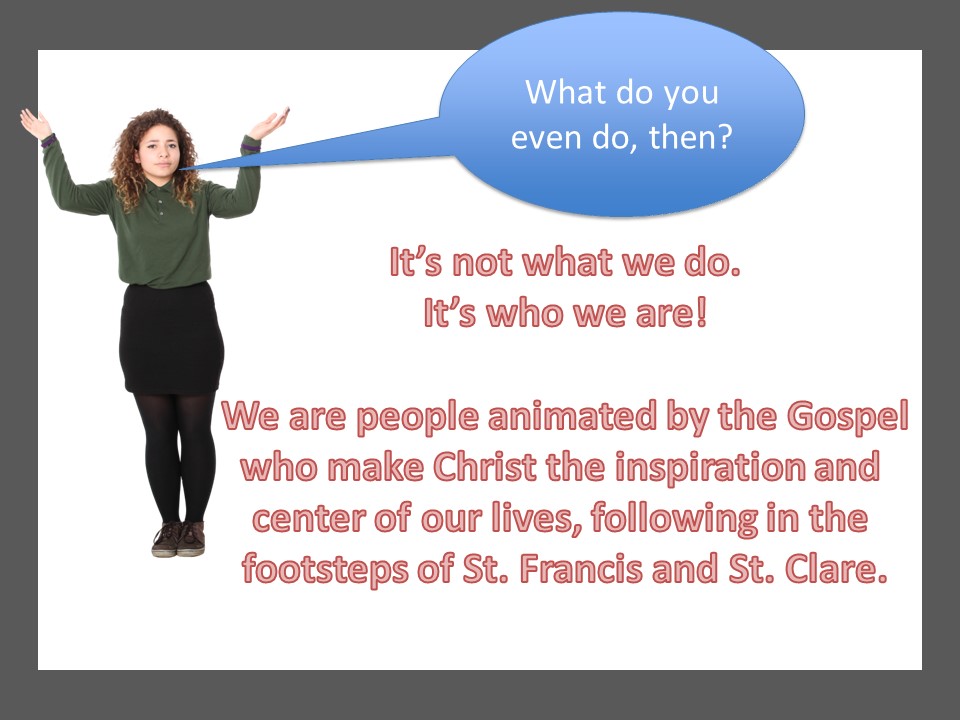
One of the most common questions we Secular Franciscans hear from those just getting to know us is: “But what do you do?” How do we answer this question if we want people who live in an action=oriented society to have a good understanding of what we are about?

We can start with, “It’s not what we do but who we are.” We live the Gospel by following the example of St. Francis. We make a life-long promise to live out our Baptismal commitment. But, the question persists, “WHAT DO YOU DO?”

  • We are peacemakers: We listen to both sides; we do not sow discord.
  • We care for creation: More than loving animals, we are stewards of all that God created. We see that it is good and beautiful and encourage others to do the same by our example and actions.
  • We stand with the poor: We not only serve, but we work to make their lives better.
  • We look for the good in others: We try to treat everyone with patience and kindness, even those we don’t like.
  • We are people of relationship: we love to pray together and to collaborate in our fraternities and at work, school, and in family life.
  • We are welcoming: we seek to see what is lovable in those who may seem unlovable
  • We are people of prayer and conversion: we try to deepen our relationship with Jesus each day by spending time with him and by being willing to change what needs to be changed in our lives.
  • We are people focused on the Incarnation: the Crib, the Cross, and the Eucharist. We frequently meditate on the Passion, Death, and Resurrection of Christ, coming to know him well through the Gospels. We receive communion frequently because we know he is present in the Eucharist.
  • We use our God-given gifts in the service of others, but we don’t seek recognition.
  • We live simple lives: we are not “showy.”
  • We live the spirit of poverty: We esteem work and work hard to support ourselves and our families, but money and possessions are not our goal.
  • We live detachment: we are focused on Christ rather that on possessions or personal recognition. We don’t cling to the world, to possessions, or to a personal agenda.
  • We are generous: we are not addicted to wealth, pleasure, power, position, or honor. We serve when asked, but we serve gratuitously.
  • We are joyful, kind, gentle, and merciful: Franciscans are willing to forgive; when we need to correct others, we do so gently and with love.
  • We support the mission of the Church: we help to move it forward by our participation and collaboration
  • We evangelize through our example: we also evangelize through our service to others (our apostolates)

So, what we do, is to bring our baptismal commitment to life with a Franciscan flavor. We have promised this with all our hearts. How about you, what do YOU do?

For discussion in a group, with a prayer partner, or to answer in your journal.


+Give some concrete examples of how you live out your baptismal commitment by following our Rule.

+How do your fraternity’s active apostolates exemplify the characteristics mentioned above?

+How would you explain to others “what Franciscans do?”

++++++++++++

Formation Friday 19 de agosto de 2022 Comparta con su fraternidad local.

¿PERO QUÉ ES LO QUE USTEDES HACEN?

Una de las preguntas más comunes que los franciscanos seglares escuchamos de aquellos que recién nos conocen es: “¿Pero, qué hacen?” ¿Cómo respondemos a esta pregunta si queremos que las personas que viven en una sociedad orientada a la acción tengan una buena comprensión de lo que somos?

Podemos comenzar con, “No es lo que hacemos, sino quiénes somos.” Vivimos el Evangelio siguiendo el ejemplo de San Francisco. Hacemos una promesa perpétua de vivir nuestro compromiso bautismal. Pero, la pregunta persiste, “¿QUÉ HACEN?”

  • Somos pacificadores: escuchamos a ambos lados; no sembramos discordia.
  • Cuidamos la creación: Más que amar a los animales, somos mayordomos de todo lo que Dios creó. Vemos que es bueno y hermoso y animamos a otros a hacer lo mismo con nuestro ejemplo y acciones.
  • Estamos con los pobres: no solo servimos, sino que trabajamos para mejorar sus vidas.
  • Buscamos el bien en los demás: Tratamos de tratar a todos con paciencia y amabilidad, incluso a aquellos que no nos gustan.
  • Somos personas de relación: nos encanta orar juntos y colaborar en nuestras fraternidades y en el trabajo, la escuela, y la vida familiar.
  • Somos acogedores: buscamos ver lo amable en aquellos que pueden parecer desagradables.
  • Somos personas de oración y conversión: tratamos de profundizar nuestra relación con Jesús cada día pasando tiempo con él y estando dispuestos a cambiar lo que necesita ser cambiado en nuestras vidas.
  • Somos personas enfocadas en la Encarnación: el Pesebre, la Cruz y la Eucaristía. Con frecuencia meditamos sobre la Pasión, Muerte, y Resurrección de Cristo, llegando a conocerlo bien a través del Evangelio. Recibimos la comunión con frecuencia porque sabemos que Jesús está presente en la Eucaristía.
  • Usamos nuestros dones dados por Dios al servicio de los demás, pero no buscamos reconocimiento.
  • Llevamos vidas sencillas: no somos “ostentosos.”
  • Vivimos el espíritu de pobreza: Valoramos el trabajo y trabajamos duro para mantenernos a nosotros mismos y a nuestras familias, pero el dinero y las posesiones no son nuestra meta.
  • Vivimos el desapego: estamos más centrados en Cristo que en las posesiones o el reconocimiento personal. No nos aferramos al mundo, a las posesiones, o a una agenda personal.
  • Somos generosos: no somos adictos a la riqueza, el placer, el poder, la posición, o el honor. Servimos cuando se nos pide, pero servimos gratuitamente.
  • Estamos alegres, bondadosos, gentiles y misericordiosos: los franciscanos están dispuestos a perdonar; cuando necesitamos corregir a otros, lo hacemos con delicadeza y amor.
  • Apoyamos la misión de la Iglesia: ayudamos a hacerla avanzar con nuestra participación y colaboración
  • Evangelizamos por nuestro ejemplo: también evangelizamos a través de nuestro servicio a los demás (nuestros apostolados).

Entonces, lo que hacemos es dar vida a nuestro compromiso bautismal con un sabor franciscano. Lo hemos prometido con todo nuestro corazón. ¿Y USTED, qué hace?


Para platicar en un grupo, con un compañero de oración, o para responder en su diario.

+Dé algunos ejemplos concretos de cómo vive su compromiso bautismal siguiendo nuestra Regla.

+¿Cómo ejemplifican los apostolados activos de su fraternidad las características arriba mencionadas?

+¿Cómo explicaría a los demás “lo que hacen los franciscanos?”


Diane F. Menditto, OFS

Chair, National Formation Commission

Formation Director, Our Lady of the Angels Region
Formation Director, St. Francis Fraternity, Hackensack, NJ
Open post

SHAPING THE FRANCISCAN FOOTPRINT – August 10 – August 17 2022

Five Important Spiritual Thoughts from the Liturgy of the Word

…and follow up for the Secular Franciscan

August 10 – August 17


1 — “So will my heavenly Father do to
you [handed over to torturers], unless each of you forgives his brother from
his heart.”
(Mt 18:35)**


Extended meditation

As Franciscans try to follow the way
and life of Jesus, we will be guided by Jesus’s thoughts on love. It was how he thought; it was what he wanted
us to do. Among the actions of love in
our consideration must be the whole thought of what it means to forgive.

A
couple of years ago the General Board of the Mennonite Church released a statement
on violence. They reminded their members
that “No violence committed against us,
or those we love, justifies our committing violence in return. No suffering, not even death, can separate us
from the love of God. Jesus calls us not
to resist evil with violence, to forgive rather than to seek revenge, and to be
peacemakers.”
The statement was a
statement accepted by all Mennonites as well as a reform of the Mennonites
known as Amish.

Not
too long after the statement, a non-Amish gunman shocked the nation when he
entered an Amish schoolhouse and systematically killed five Amish children,
wounded a number of others, and then killed himself. The reaction of the Amish community likewise
shocked the nation. An
Amish spokesperson released this statement to the press: “I don’t think there’s anybody here that
wants to do anything but forgive and not only reach out to those who have
suffered a loss but to reach out to the family of the man who committed these
acts.”

They indeed reached out to that family, comforting them only
hours after the shooting and extending forgiveness to them. In fact, the Amish who do not usually accept
donations set up a charitable fund for the family of the killer.

The “Lord’s Prayer” is the most common prayer in Christian
churches. The prayer is significant for
the Christian because of a number of reasons, one of them being the stress that
Jesus placed on forgiveness. As he
verbalized the prayer, Jesus said that a principal part of our prayer to God
must be asking for forgiveness, and at the same time, saying to our God that we
will forgive others. Then he repeated
the idea in his own words after he taught the prayer.

Jesus knew that we must ask for forgiveness of God and
others and he wanted us to recognize that words alone were not enough. We must prove by our actions that we mean
what we say.


2 – Turn back and
live!
(Ezekiel 18:32)

Have I sufficiently turned away from
sin and chosen what God wants of me?


3 – “Persevere in running the race…while keeping
our eyes fixed on Jesus.”
(Hebrews 12:1-2)

…Remembering that we profess
the Gospel as Franciscans.


4 —“My soul proclaims the greatness of
the Lord;
my
spirit rejoices in God my Savior.”
(Lk 1:46-7)**

…Is
there too much self-pride in my life?

5 – “For
God all things are possible.”
(Mt 19:26)**

…Do I place my trust in God in as complete a way as humanly
possible?


** One of the most
important passages of the Gospels


Scroll to top
Juan de Padilla