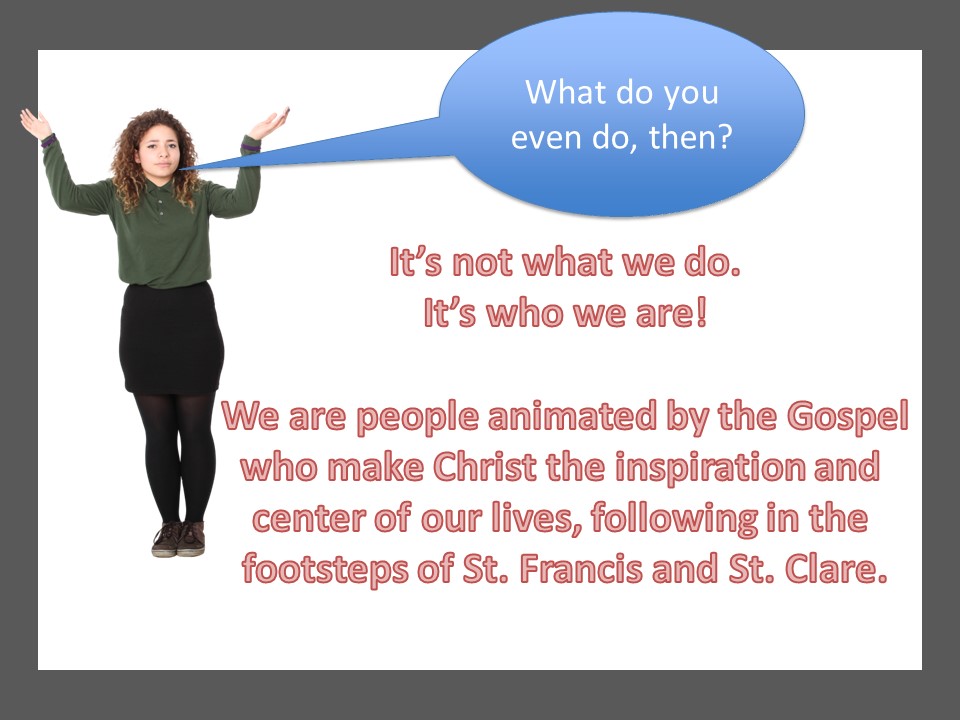
One of the most common questions we Secular Franciscans hear from those just getting to know us is: “But what do you do?” How do we answer this question if we want people who live in an action=oriented society to have a good understanding of what we are about?
We can start with, “It’s not what we do but who we are.” We live the Gospel by following the example of St. Francis. We make a life-long promise to live out our Baptismal commitment. But, the question persists, “WHAT DO YOU DO?”
- We are peacemakers: We listen to both sides; we do not sow discord.
- We care for creation: More than loving animals, we are stewards of all that God created. We see that it is good and beautiful and encourage others to do the same by our example and actions.
- We stand with the poor: We not only serve, but we work to make their lives better.
- We look for the good in others: We try to treat everyone with patience and kindness, even those we don’t like.
- We are people of relationship: we love to pray together and to collaborate in our fraternities and at work, school, and in family life.
- We are welcoming: we seek to see what is lovable in those who may seem unlovable
- We are people of prayer and conversion: we try to deepen our relationship with Jesus each day by spending time with him and by being willing to change what needs to be changed in our lives.
- We are people focused on the Incarnation: the Crib, the Cross, and the Eucharist. We frequently meditate on the Passion, Death, and Resurrection of Christ, coming to know him well through the Gospels. We receive communion frequently because we know he is present in the Eucharist.
- We use our God-given gifts in the service of others, but we don’t seek recognition.
- We live simple lives: we are not “showy.”
- We live the spirit of poverty: We esteem work and work hard to support ourselves and our families, but money and possessions are not our goal.
- We live detachment: we are focused on Christ rather that on possessions or personal recognition. We don’t cling to the world, to possessions, or to a personal agenda.
- We are generous: we are not addicted to wealth, pleasure, power, position, or honor. We serve when asked, but we serve gratuitously.
- We are joyful, kind, gentle, and merciful: Franciscans are willing to forgive; when we need to correct others, we do so gently and with love.
- We support the mission of the Church: we help to move it forward by our participation and collaboration
- We evangelize through our example: we also evangelize through our service to others (our apostolates)
So, what we do, is to bring our baptismal commitment to life with a Franciscan flavor. We have promised this with all our hearts. How about you, what do YOU do?
For discussion in a group, with a prayer partner, or to answer in your journal.
+Give some concrete examples of how you live out your baptismal commitment by following our Rule.
+How do your fraternity’s active apostolates exemplify the characteristics mentioned above?
+How would you explain to others “what Franciscans do?”
++++++++++++
Formation Friday 19 de agosto de 2022 Comparta con su fraternidad local.
¿PERO QUÉ ES LO QUE USTEDES HACEN?
Una de las preguntas más comunes que los franciscanos seglares escuchamos de aquellos que recién nos conocen es: “¿Pero, qué hacen?” ¿Cómo respondemos a esta pregunta si queremos que las personas que viven en una sociedad orientada a la acción tengan una buena comprensión de lo que somos?
Podemos comenzar con, “No es lo que hacemos, sino quiénes somos.” Vivimos el Evangelio siguiendo el ejemplo de San Francisco. Hacemos una promesa perpétua de vivir nuestro compromiso bautismal. Pero, la pregunta persiste, “¿QUÉ HACEN?”
- Somos pacificadores: escuchamos a ambos lados; no sembramos discordia.
- Cuidamos la creación: Más que amar a los animales, somos mayordomos de todo lo que Dios creó. Vemos que es bueno y hermoso y animamos a otros a hacer lo mismo con nuestro ejemplo y acciones.
- Estamos con los pobres: no solo servimos, sino que trabajamos para mejorar sus vidas.
- Buscamos el bien en los demás: Tratamos de tratar a todos con paciencia y amabilidad, incluso a aquellos que no nos gustan.
- Somos personas de relación: nos encanta orar juntos y colaborar en nuestras fraternidades y en el trabajo, la escuela, y la vida familiar.
- Somos acogedores: buscamos ver lo amable en aquellos que pueden parecer desagradables.
- Somos personas de oración y conversión: tratamos de profundizar nuestra relación con Jesús cada día pasando tiempo con él y estando dispuestos a cambiar lo que necesita ser cambiado en nuestras vidas.
- Somos personas enfocadas en la Encarnación: el Pesebre, la Cruz y la Eucaristía. Con frecuencia meditamos sobre la Pasión, Muerte, y Resurrección de Cristo, llegando a conocerlo bien a través del Evangelio. Recibimos la comunión con frecuencia porque sabemos que Jesús está presente en la Eucaristía.
- Usamos nuestros dones dados por Dios al servicio de los demás, pero no buscamos reconocimiento.
- Llevamos vidas sencillas: no somos “ostentosos.”
- Vivimos el espíritu de pobreza: Valoramos el trabajo y trabajamos duro para mantenernos a nosotros mismos y a nuestras familias, pero el dinero y las posesiones no son nuestra meta.
- Vivimos el desapego: estamos más centrados en Cristo que en las posesiones o el reconocimiento personal. No nos aferramos al mundo, a las posesiones, o a una agenda personal.
- Somos generosos: no somos adictos a la riqueza, el placer, el poder, la posición, o el honor. Servimos cuando se nos pide, pero servimos gratuitamente.
- Estamos alegres, bondadosos, gentiles y misericordiosos: los franciscanos están dispuestos a perdonar; cuando necesitamos corregir a otros, lo hacemos con delicadeza y amor.
- Apoyamos la misión de la Iglesia: ayudamos a hacerla avanzar con nuestra participación y colaboración
- Evangelizamos por nuestro ejemplo: también evangelizamos a través de nuestro servicio a los demás (nuestros apostolados).
Entonces, lo que hacemos es dar vida a nuestro compromiso bautismal con un sabor franciscano. Lo hemos prometido con todo nuestro corazón. ¿Y USTED, qué hace?
Para platicar en un grupo, con un compañero de oración, o para responder en su diario.+Dé algunos ejemplos concretos de cómo vive su compromiso bautismal siguiendo nuestra Regla.
+¿Cómo ejemplifican los apostolados activos de su fraternidad las características arriba mencionadas?
+¿Cómo explicaría a los demás “lo que hacen los franciscanos?”
Diane F. Menditto, OFSChair, National Formation Commission
Formation Director, Our Lady of the Angels Region
Formation Director, St. Francis Fraternity, Hackensack, NJ

SHAPING THE FRANCISCAN FOOTPRINT – August 10 – August 17 2022
Five Important Spiritual Thoughts from the Liturgy of the Word
…and follow up for the Secular Franciscan
August 10 – August 17
1 — “So will my heavenly Father do to
you [handed over to torturers], unless each of you forgives his brother from
his heart.” (Mt 18:35)**
Extended meditation
As Franciscans try to follow the way
and life of Jesus, we will be guided by Jesus’s thoughts on love. It was how he thought; it was what he wanted
us to do. Among the actions of love in
our consideration must be the whole thought of what it means to forgive.A
couple of years ago the General Board of the Mennonite Church released a statement
on violence. They reminded their members
that “No violence committed against us,
or those we love, justifies our committing violence in return. No suffering, not even death, can separate us
from the love of God. Jesus calls us not
to resist evil with violence, to forgive rather than to seek revenge, and to be
peacemakers.” The statement was a
statement accepted by all Mennonites as well as a reform of the Mennonites
known as Amish.Not
too long after the statement, a non-Amish gunman shocked the nation when he
entered an Amish schoolhouse and systematically killed five Amish children,
wounded a number of others, and then killed himself. The reaction of the Amish community likewise
shocked the nation. An Amish spokesperson released this statement to the press: “I don’t think there’s anybody here that
wants to do anything but forgive and not only reach out to those who have
suffered a loss but to reach out to the family of the man who committed these
acts.”They indeed reached out to that family, comforting them only
hours after the shooting and extending forgiveness to them. In fact, the Amish who do not usually accept
donations set up a charitable fund for the family of the killer.The “Lord’s Prayer” is the most common prayer in Christian
churches. The prayer is significant for
the Christian because of a number of reasons, one of them being the stress that
Jesus placed on forgiveness. As he
verbalized the prayer, Jesus said that a principal part of our prayer to God
must be asking for forgiveness, and at the same time, saying to our God that we
will forgive others. Then he repeated
the idea in his own words after he taught the prayer.Jesus knew that we must ask for forgiveness of God and
others and he wanted us to recognize that words alone were not enough. We must prove by our actions that we mean
what we say.
2 – Turn back and
live! (Ezekiel 18:32)…Have I sufficiently turned away from
sin and chosen what God wants of me?
3 – “Persevere in running the race…while keeping
our eyes fixed on Jesus.” (Hebrews 12:1-2)…Remembering that we profess
the Gospel as Franciscans.
4 —“My soul proclaims the greatness of
the Lord; my
spirit rejoices in God my Savior.” (Lk 1:46-7)**…Is
there too much self-pride in my life?5 – “For
God all things are possible.” (Mt 19:26)**…Do I place my trust in God in as complete a way as humanly
possible?
** One of the most
important passages of the Gospels
Franciscan Jubilee – Minister’s Message Summer 2022
(This article originally appeared in the TAU-USA Summer Issue #106)
A message from Jan Parker, OFS, National Minister – OFS-USA
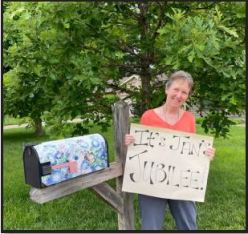 I will never forget my 50th birthday. My daughter, aware of the significance of this 50-year mark, made a sign that she hung on my mailbox. It simply said, “It’s Jan’s Jubilee!” I still have that sign. It now hangs on a wall in my garage as an important reminder to always turn to God, where I find joy and peace beyond all I could ask or imagine.
It was not my idea that the theme of the 2022 Quinquennial Congress would be “Jubilee,” but when Br. Bob Brady, OFM, suggested it, I was thrilled.
I celebrated a personal Jubilee when I turned 50 and found it to be a life-changing year-long experience of discovering again who I am called to be and the power of God’s love and mercy. My hope, and the hope of our entire Q Committee, is that this Jubilee Quinquennial will be a life- changing experience of conversion for everyone in our national fraternity, as well as each one who attends.
The history of Jubilee goes back to the law given to the Israelites in Leviticus 25: “You will declare this fiftieth year to be sacred….You will keep this as a Jubilee….” God called his people to an economic, cultural, environmental, and communal reset, when the land and people rest, and all those who are in slavery are set free to return to their communities. Jubilee law addresses the wellbeing of the community and calls God’s people to live in ways that reflect good relationships with God, with each other, and with creation.[1] Jubilee law tells us something about God’s intention for his people.
Fast forward to Luke’s gospel, and we see Jesus at the beginning of his ministry, declaring a time of Jubilee―“the year of the Lord’s favor”―but wait, there’s something more here. Jesus closes the scroll, looks at us, and says, “Today this scripture has been fulfilled….” Today! Not just every 50 years, not just every seventh year, but today, and every today! The kingdom is now―JUBILEE is now.
In the life, death, and resurrection of Jesus, we see Jubilee’s objective: freedom and release from sin, restoration with God, a reset for all of creation. Have we realized this? Internalized it? We find a full description in 2 Corinthians 5, a passage that declares our new creation in Christ, and the call to be re- made to become that new creation. I look at this passage and rejoice in this call to conversion. God’s people―the church―are meant to be a foretaste of what God wants to do for the entire creation. Sisters and brothers, we are meant to not only live Jubilee for ourselves, but to be Jubilee for others. The love of God impels us.
God’s command for Jubilee says, “Stop. Step back. Look at what you are doing.” A Jubilee moment exposes human greed and brings to light the selfishness in society. The law didn’t have the capacity to change those things, it only showed them. But God said, I will pour out my Spirit upon you and the lawwill be written in your heart[2]. Jubilee is no longer just a law. Christ has fulfilled the law and has sent us his Spirit to implant this law in our hearts. As members of this Spirit-filled Church, to which we are bonded more closely by profession, we commit ourselves to a living discipleship that entails both generosity and sacrifice. We constantly call on the Spirit of God to empower and enable us to be a part of God’s mission to reset all areas of life, bring release and restoration―to be Jubilee.
As bearers of peace and messengers of joy and hope, we must announce the kingdom of God is now. How do we do this? By remembering “who we are”―our identity as Franciscans―and being who we are called to be. Our Quinquennial mission statement calls us to “celebrate and renew our Franciscan calling in the spirit of conversion.” At this Quinquennial moment, and every day going forward, we must live this, tending to our own daily conversion, as well as the conversion of society.
Can we bring about the changes that are needed, both in ourselves and in our world? We have spoken a lot this year about prophetic creativity. Let’s align ourselves with the creativity of God who says, “I make all things new” and dare to be creative. Let us incarnate and enact the certain hope of this new creation, and be the change we long to see.
This is my hope―that what I celebrated in my 50th year will always remain with me, and that this new focus on Jubilee will be a time for all of us to once again celebrate God’s mercy and forgiveness, know God‘s love in a new way, and to start again. To forgive others. To love all people and all creation as sister and brother. To accept our humanness. To rejoice in how God is working in our lives, and how he is working right now in this time of Jubilee. God truly is at work among us, making all things new!
I have often talked of the trajectory we are on. There is a new day ahead. New leaders will be called forth. There will be new opportunities to share God‘s love. But let’s not just look ahead. Let’s look to today―to right now for now is the acceptable time.
Many will be drawn to the Quinquennial to experience Jubilee, but here’s the good news―you don’t have to be at the Q to experience it. Jubilee joy is ours whenever and wherever we pause to acknowledge God’s presence with us. Jubilee joy is in every Franciscan heart and is palpable in every experience of fraternity―in every moment of fraternal communion. The world needs this Jubilee joy. Let’s share it!
Jubilee Song of Restoration
Psalm 126
When the LORD restored the fortunes of Zion, we thought we were dreaming.
Our mouths were filled with laughter; our tongues sang for joy.
Then it was said among the nations, “The LORD had done great things for them.”
The LORD has done great things for us! We are filled with joy!
Restore again our fortunes, LORD, like the dry stream beds of the Negeb.
Those who sow in tears, will reap with cries of joy.
Those who go forth weeping, carrying sacks of seed,
Will return with cries of joy, carrying their bundled sheaves.
Jubilee was a recovery of identity, especially for the poor. It is not about simply correcting economic problems, which is very important; not even just caring for the poor because they’re poor; but it is restoring identity, which is a part of their history and very important for them.
– CB Samuel
[1] See tearfund.org.au/stories/jubilee-in-the-bible Tearfund is a Chris.an agency working for a just and compassionate 1 world.
[2] Jeremiah 31:31
https://www.secularfranciscansusa.org/2022/08/15/franciscan-jubilee-ministers-message-summer-2022/
St. Michael’s Lent August 15th to September 29th
 “In the writings of St. Francis, such as the Volterra text (Letter to All the Faithful) which is included in The Rule of the OFS, we are reminded again and again that Franciscans are called to be penitents, to pray and fast. For these reasons this ancient tradition is important to us. St. Michael’s Lent is a period of 40 days, honoring Mary and St. Michael the Archangel. It begins on the Feast of the Assumption and ends on The Feast of the Archangels.
[H]e wished along with the most faithful Brothers . . . to celebrate the Assumption of the Blessed Virgin (August 15) and then prepare himself by a forty days’ fast for the Feast of St. Michael (September 29). In common with the rest of the people of the Middle Ages, Francis nourished a special devotion to this Archangel, signifer santus Michaelis, the standard-bearer of the Heavenly Host, and the one who with his trumpet was to wake the dead in their graves on the last day . . . .”
(From: St. Francis of Assisi by Jorgensen)
From Jan Parker’s Ministers Message, Contemplating the Cross and the Lent of St. Michael of August 2017:
In my experience as a Franciscan this “second Lent” has not been widely practiced, but perhaps as Brothers and Sisters of Penance we should seriously consider its merits. My own resolve to enter this Lent has deepened, and so for me a 40+ day journey starts [August 15th]. I’m already trying to get my mind around the fact of Lent right here in the midst of Ordinary Time. I know I will be led, but it will be interesting to see just how this works out in practice. I invite you to consider this Lent, too, as a way to be united in prayer and action – but of course it is only one way among many.
Always, in the various ways that the Holy Spirit leads each of us, we remain united – one in our prayer and in our actions, one in our common Franciscan journey and one in our call to live the Gospel. For these bonds of fraternity, we are can be ever thankful! May the Cross which spoke to Francis, continue to speak to us and, in fact, be our very way of life (see Luke 9:23).
St. Maximilian Kolbe, and all holy Franciscan saints, pray for us!
Holy Mary, Mother of God, protectress of our Order and of the Americas, pray for our country, and for us, that we might bear your Son to the world!
Peace and love, (and Happy Lent!)
Your sister, Jan
Days for Franciscans to Remember
Noon August 1 – Midnight August 2nd, The Portiuncular Indulgence
August 2 – The Feast of Our Lady of the Angels
August 2 – August 10 Novena to St. Clare
August 11 – The Feast of St. Clare
August 14 – The Feast of St. Maximillian Kolbe
August 15 – The Assumption
August 15 To September 29 – The Lent of St. Michael
August 26 or 27 – The Seven Joys of Mary
September 8 – The Feast of the birthday of Our Lady
September 12 – Holy Name of Mary
September 14 – The Feast of the Triumph of the Cross
September 14, 1224 St. Francis receives the Stigmata
September 15 – Our Lady of Sorrows
September 17 – Feast of the Stigmata of Our Holy Father Francis
September 22 – Queenship of Mary
September 29 – The Feast of the Archangels
October 2 – The Feast of the Angels
October 3 – The Transitus
October 4 – The Feast of St. Francis
Other sites for more information:
What is St. Michael’s Lent https://www.catholiccompany.com/getfed/what-is-st-michaels-lent/
St. Michael’s Lent – A Period of Fasting Observed by St. Francis of Assisi https://aleteia.org/2019/08/14/st-michaels-lent-a-period-of-fasting-observed-by-st-francis-of-asissi/
https://www.secularfranciscansusa.org/2022/08/13/st-michaels-lent-august-15th-to-september-29th/
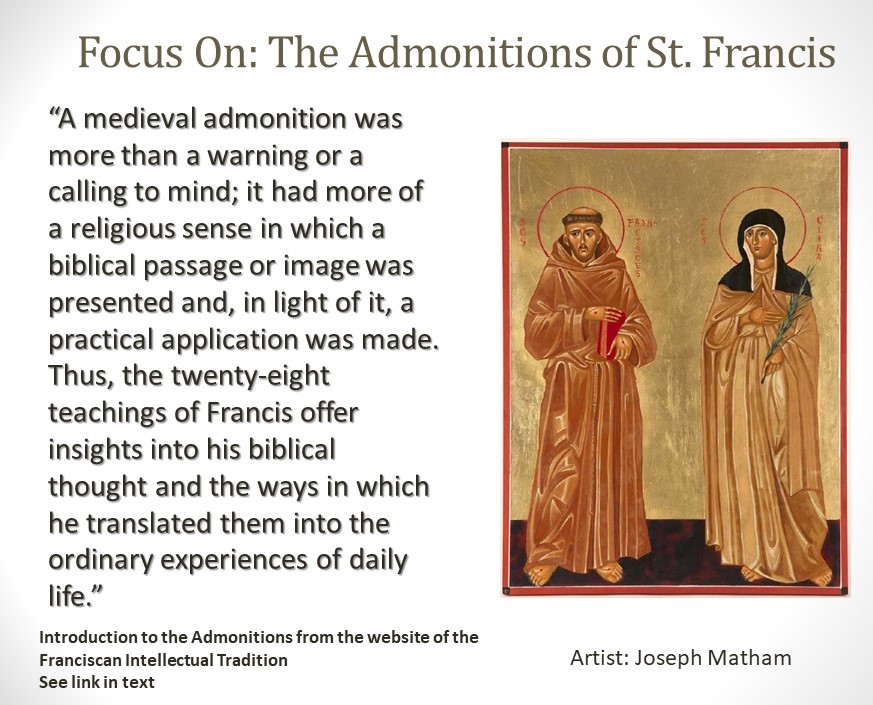
FORMATION FRIDAY – Focus on the Admonitions (XIX and XXIII) – August 12, 2022
Focus on the Admonitions (XIX and XXIII)
[XIX: A Humble Servant of God]
1Blessed is the servant who does not consider himself any better when he is praised and exalted by people than when he is considered worthless, simple, and looked down upon, 2for what a person is before God, that he is and no more.
3Woe to that religious who has been placed in a high position by others and [who] does not want to come down by his own will.
4Blessed is that servant Mt 24:46 who is not placed in a high position by his own will and always desires to be under the feet of others.
[XXIII: Humility]
1Blessed is the servant who has been found as humble among his subjects as he was among his masters.
2Blessed is the servant who always remains under the rod of correction.
3Faithful and prudent is the servant Mt 24:45 who does not delay in punishing himself for all his offenses, inwardly through contrition and outwardly through confession and penance for what he did.
Francis and Clare as our Servant Leader Models
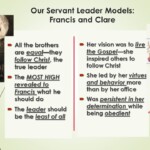
Francis’s style of leadership: All the brothers are equal—they follow Christ, the true leader. The MOST HIGH revealed to Francis what he should do. The leader should be the least of all.
Clare’s style of leadership: Her vision was to live the Gospel—she inspired others to follow Christ. She led by her virtues and behavior more than by her office. She was persistent in her determination while always being obedient to the Church.
Questions to discuss or to answer in your journal
As you read Admonitions 19 and 23, think about the times you have served in a leadership position. Think about those you know (in fraternity or in everyday life) who fill positions of leadership or any prominent position.
+How do they fit (or not fit) St. Francis’s description of the “servant” in the two quoted Admonitions?
+The “servant” mentioned in the Admonitions may or may not be in a position of leadership. How do you act in your fraternity, on your team at work, or in your family?
+ When you find yourself in a position of leadership, give examples of how you would follow the example of Francis and Clare?
+ How difficult is it for you to “let go of” a position you have held for some time? Give examples of how you mentor others and work toward a smooth transition.
++++++++++++++
Enfoque en las Admoniciones [XIX and XXIII]
http://franciscanos.org/esfa/adm-ae.html
[Cap. XIX: Del humilde siervo de Dios]
1Bienaventurado el siervo que no se tiene por mejor cuando es engrandecido y exaltado por los hombres, que cuando es tenido por vil, simple y despreciado, 2porque cuanto es el hombre delante de Dios, tanto es y no más. 3¡Ay de aquel religioso que ha sido puesto en lo alto por los otros, y por su voluntad no quiere descender! 4Y bienaventurado aquel siervo (Mt 24,46) que no es puesto en lo alto por su voluntad, y siempre desea estar bajo los pies de los otros.
[Cap. XXIII: De la humildad]
1Bienaventurado el siervo a quien se encuentra tan humilde entre sus súbditos, como si estuviera entre sus señores. 2Bienaventurado el siervo que permanece siempre bajo la vara de la corrección. 3Es siervo fiel y prudente (cf. Mt 24,45) el que, en todas sus ofensas, no tarda en castigarse interiormente por la contrición y exteriormente por la confesión y la satisfacción de obra.
Francisco y Clara como nuestros modelos de líderes servidores
El estilo de liderazgo de Francisco: Todos los hermanos son iguales: siguen a Cristo, el verdadero líder. El ALTÍSIMO le reveló a Francisco lo que debía hacer. El líder debe ser el menor de todos.
El estilo de liderazgo de Clara: Su visión era vivir el Evangelio: inspiró a otros a seguir a Cristo. Lideró por sus virtudes y comportamiento más que por su oficio. Fue persistente en su determinación siempre siendo obediente a la Iglesia.
Preguntas para platicar o responder en su diario
Mientras lee las Admoniciones 19 y 23, piense en las veces que ha servido en una posición de liderazgo. Piense en aquellos que usted conoce (en la fraternidad o en la vida cotidiana) que ocupan puestos de liderazgo o cualquier posición destacada.
+¿Cómo encajan (o no encajan) con la descripción de San Francisco del “siervo” en las dos Admoniciones citadas?
+El “siervo” mencionado en las Admoniciones puede o no estar en una posición de liderazgo. ¿Cómo actúa usted en su fraternidad, en su equipo de trabajo o en su familia?
+ Cuando se encuentre en una posición de liderazgo, dé ejemplos de cómo seguiría el ejemplo de Francisco y Clara.
+ ¿Qué tan difícil es para usted “despegarse” de una posición que ha ocupado por algún tiempo? Dé ejemplos de cómo asesora a otros y trabaja para lograr una transición fluida.
Diane F. Menditto, OFSChair, National Formation Commission
Formation Director, Our Lady of the Angels Region
Formation Director, St. Francis Fraternity, Hackensack, NJ