Open post

Formation Friday, April 23, 2021


Dear Brothers and Sisters, it is always important to review our goals and consider how we are living our lives.  Today is Part I that discusses the basics of what Secular Franciscans are supposed to be about.  Please share and discuss with your fraternity.  Peace, Dona

+++++++++++++++++++++++++++++++++++++++++++++++++++++++++++++++++  

Secular Franciscans: Who Do We Say We Are? (PART ONE—Articles 4-9)

According to the Rule of the Secular Franciscan Order:

       We are followers of the gospel. (Art. 4)

       We are seekers of Christ  (Art. 5)

       We are witnesses and instruments of Christ’s mission (Art. 6)

       We are penitential people seeking daily conversion (Art. 7)

       We are prayerful and contemplative (Art. 8)

       We are givers of ourselves…(Art. 9)

       We are witnesses to the poor and crucified Christ even in difficulties and persecutions. (Art. 10)


       We are followers of the gospel. (Art. 4)

Going from Gospel to Life and life to the Gospel is not just a saying. We read the Gospel seriously and see how it applies to our lives. Following what Jesus asks in the Gospel is not particularly easy because it requires risk.


       We are seekers of Christ  (Art. 5)

Seekers of Christ—does the Communion on our tongues lead us to open our hearts to Christ and to others?

Do we seek Jesus in our brothers and sisters—even in those who appear not to “deserve” it?


       We are witnesses and instruments of Christ’s mission (Art. 6)


  • +We proclaim Christ’s mission through our words and actions—we need to THINK about what we say to others and what we post online.


       We are penitential people seeking daily conversion (Art. 7)


  • + We are the “brothers and sisters of penance”…this is the hallmark of the Secular Franciscan. We are on a road and the fuel that propels us is DAILY CONVERSION. Everything we say and do should be opening us to the transforming power of the Holy Spirit.  


       We are prayerful and contemplative (Art. 8)


  • +Eucharist, daily prayer—l
  • liturgy of the hours—spending time with God—allowing the Holy Spirit to act on us and in us—give us softened hearts.
  •  The Trinity is the perfect example of RELATIONSHIP in love. This love is given to us through the Holy Spirit. 
  • But, we must actively ask and listen for His presence in our lives. How? We are called to take time out for prayer and quiet time with God.


        We are givers of ourselves…(Art. 9)


  • + We are (or should be) willing to give of ourselves. But do we give as Jesus gave, as Mary his mother gave?
  • This is a self-emptying—It is not a giving that asks for thanks or waits for recompense.


       We are witnesses to the poor and crucified Christ even in difficulties and persecutions. (Art. 10)

  • +“Our friends, therefore, are all those who unjustly inflict upon us distress and anguish, shame and injury, sorrow and punishment, martyrdom and death. 4We must love them greatly for we shall possess eternal life because of what they bring us.”  St. Francis, Earlier Rule  FA:ED, vol. 1, 79


Questions for discussion or to answer in your journal:


  1. + In what ways do I follow articles 4-10 of the OFS Rule?
  2. + Which of these articles do I find most difficult?
  3. + Through my living of the Rule, how do others recognize me as a follower of Christ and St. Francis? Give examples from articles 4-10.


 ++++++++++++++++++++++++++++++++++++++++++++++++++++++++++

Los Franciscanos seglares: ¿Quiénes decimos que somos? (Primera parte—Artículos 4-10)

Según la Regla de la Orden Franciscana Seglar:

• Somos seguidores del evangelio. (Art. 4)

• Somos buscadores de Cristo (Art. 5)

• Somos testigos e instrumentos de la misión de Cristo (Art. 6)

• Somos personas penitenciales que buscan la conversión diaria (Art. 7)

• Somos orantes y contemplativos (Art. 8)

• Somos dadores de nosotros mismos… (Art. 9)

• Somos testigos del Cristo pobre y crucificado incluso en las dificultades y persecuciones. (Art. 10)


• Somos seguidores del evangelio. (Art. 4)

+ Pasar del Evangelio a la Vida y de la vida al Evangelio no es solo un dicho. Necesitamos leer el Evangelio con seriedad y ver cómo se aplica a nuestras vidas. Seguir lo que Jesús pide en el Evangelio no es particularmente fácil porque requiere riesgo. Es posible que tengamos que estar en desacuerdo con algunos de nuestros amigos y familiares.


• Somos buscadores de Cristo (Art. 5)

+ Buscadores de Cristo: ¿La Sagrada Hostia en nuestra lengua nos lleva a abrir nuestro corazón a Cristo y a los demás?

¿Buscamos a Jesús en nuestros hermanos y hermanas, incluso en aquellos que parecen no “merecerlo?”


• Somos testigos e instrumentos de la misión de Cristo (Art. 6)

+ Proclamamos la misión de Cristo a través de nuestras palabras y acciones; necesitamos PENSAR en lo que les decimos a los demás y en lo que publicamos en línea.

• Somos personas penitenciales que buscan la conversión diaria (Art. 7)

+ Somos los “hermanos y hermanas de la penitencia”… este es el sello del Franciscano Seglar. Estamos en un camino y el combustible que nos impulsa es la CONVERSIÓN DIARIA. Todo lo que decimos y hacemos debería abrirnos al poder transformador del Espíritu Santo.


• Somos orantes y contemplativos (Art. 8)

+ La eucaristía, la oración diaria, la liturgia de las horas, pasar tiempo con Dios, permitir que el Espíritu Santo actúe sobre nosotros y en nosotros, nos da corazones ablandados. La Trinidad es el ejemplo perfecto de la RELACIÓN en el amor. Este amor se nos da el Espíritu Santo. Pero debemos pedir y escuchar activamente Su presencia en nuestras vidas. ¿Cómo? Tómese un tiempo para orar y estar a solas con Dios.


• Somos dadores de nosotros mismos… (Art. 9)

+ Estamos (o deberíamos estar) dispuestos a dar de nosotros mismos. Pero, ¿damos como dio Jesús, como dio María su madre? Esto es un auto vaciamiento, no es un dar que pide gracias o espera una recompensa.

• Somos testigos del Cristo pobre y crucificado incluso en las dificultades y persecuciones. (Art. 10)

+ “3Por lo tanto, son amigos nuestros todos aquellos que injustamente nos acarrean tribulaciones y angustias, afrentas e injurias, dolores y tormentos, martirio y muerte; 4a los cuales debemos amar mucho, porque, por lo que nos acarrean, tenemos la vida eterna.” San Francisco de Asís, Regla no bulada, Cap. XXII, https://www.franciscanos.org/esfa/escritossf.html#rnb1r


Preguntas para platicar o para responder en su diario:

+ ¿De qué manera sigo los artículos 4-10 de la Regla OFS?

+ ¿Cuál de estos artículos me resulta más difícil?

+ A través de mi vivir la Regla, ¿cómo me reconocen los demás como seguidor de Cristo y de San Francisco? Dé ejemplos procedentes de los artículos 4-10.

 
Diane F. Menditto, OFS
Chair, National Formation Commission
Minister, Our Lady of the Angels Region
 
 
Open post

FORMATION FRIDAY – APRIL 16,2021


Dear Brothers and Sisters, Today’s formation lesson is a beautiful analysis of the Our Father, the prayer given to us by Jesus, Himself.  Let us meditate and study this with our fraternities. There are PDF attachments to download and print that will help with your lesson.  Peace, Dona

++++++++++++++++++++++++++++++++++++++++++++++++++++++++++++++++++++++++++++++++++++++++++++++++++++++++++++++++


Please share with your local fraternities.  The entire piece is attached in PDF for easy printing.

A Prayer Inspired by the Our Father

“Two thirteenth-century examples of this type of commentary on the Lord’s Prayer suggest that this style of prayer forms a “catechism of prayer” offering strong attitudes toward, as well as images of, God. In fact, this writing is perhaps the only instance in which we find an example of how Francis responded to his brothers’ request to teach them how to pray.” FA: ED, vol. 1, 158  https://franciscantradition.org/francis-of-assisi-early-documents/the-saint/writings-of-francis/the-undated-writings/a-prayer-inspired-by-the-our-father/174-fa-ed-1-page-158 


1Our Father Mt 6:9 most holy:
Our Creator, Redeemer, Consoler, and Savior:

2Who are in heaven: Mt 6:9
In the angels and the saints,
enlightening them to know, for You, Lord, are light; 1 Jn 1:5
inflaming them to love, for You, Lord, are love;
dwelling in them and filling them with happiness,
for You, Lord, are Supreme Good, the Eternal Good,
from Whom all good comes
without Whom there is no good.

3Holy be Your Name: Mt 6:9
May knowledge of You become clearer in us
that we may know
the breadth of Your blessings,
the length of Your promises,
the height of Your majesty,
the depth Eph 3:18 of Your judgments.

4Your kingdom come: Mt 6:10
That You may rule in us through Your grace
and enable us to come to Your kingdom Lk 23:42
where there is clear vision of You,
perfect love of You,
blessed companionship with You,
eternal enjoyment of You.

5Your will be done on earth as in heaven: Mt 6:10 
That we may love You

with our whole heart by always thinking of You, Dt 6:5
with our whole soul by always desiring You,
with our whole mind by always directing all our intentions to You,
and by seeking Your glory in everything,
with all our whole strength by exerting
all our energies and affections of body and soul Lk 10:27
in the service of Your love and of nothing else;
and we may love our neighbor as ourselves
by drawing them all to Your love with our whole strength,
by rejoicing in the good of others as in our own,
by suffering with others at their misfortunes,
and by giving offense to no one. 2 Cor 6:3


6Give us this day: Mt 6:11
in remembrance, understanding, and reverence
of that love which [our Lord Jesus Christ] had for us
and of those things that He said and did and suffered for us.

Our daily Bread: Mt 6:11
Your own beloved Son, our Lord Jesus Christ.

7Forgive us our trespasses: Mt 6:12
through Your ineffable mercy
through the power of the passion of Your beloved Son
and through the merits and intercession
of the ever-blessed Virgin and all Your elect.

8As we forgive those who trespass against us: Mt 6:12
And what we do not completely forgive,
make us, Lord, forgive completely
that we may truly love our enemies because of You
and we may fervently intercede for them before You,
returning no one evil for evil 1 Thes 5:15
and we may strive to help everyone in You.
9And lead us not into temptation: Mt 6:13
hidden or obvious,
sudden or persistent.

10But deliver us from evil: Mt 6:13
past,
present,
and to come.

++++++++++++++++++++++++++++++

Read the meditation twice alone or with a prayer partner.


Questions to discuss or to answer in your journal.


·        How does Francis regard God the Father? How do I think of God the Father? What effect does this have on me?

·        How does he wish to behave in order to be closer to the Father? What part of this is difficult for me?

·        How are we to treat others? How can I improve my efforts to love myself and others?

·        How does Francis regard Jesus? How do I think of Jesus? What surprises me about what Jesus said and did?

·        Are there times when I have difficulty forgiving? How can I overcome this difficulty?

·        From what evil tendency do you pray that God will deliver you?


+++++++++++

EXPOSICIÓN DEL PADRE NUESTRO  http://www.franciscanos.org/esfa/escritossf.html#exppn

“Dos ejemplos del siglo XIII de este tipo de comentario sobre el Padrenuestro sugieren que este estilo de oración forma un “catecismo de oración” que ofrece fuertes actitudes hacia Dios, así como imágenes de él. De hecho, este escrito es quizás el único caso en el que encontramos un ejemplo de cómo Francisco respondió a la solicitud de sus hermanos de enseñarles a orar.” (véase el enlace de arriba)

1Oh santísimo Padre nuestro:
creador, redentor, consolador y salvador nuestro.


2Que estás en el cielo:
en los ángeles y en los santos; iluminándolos para el conocimiento, porque tú, Señor, eres luz; inflamándolos para el amor, porque tú, Señor, eres amor; habitando en ellos y colmándolos para la bienaventuranza, porque tú, Señor, eres sumo bien, eterno bien, del cual viene todo bien, sin el cual no hay ningún bien.


3Santificado sea tu nombre:
clarificada sea en nosotros tu noticia, para que conozcamos cuál es la anchura (cf. Ef 3,18) de tus beneficios, la largura de tus promesas, la sublimidad de la majestad y la profundidad de los juicios.


4Venga a nosotros tu reino:
para que tú reines en nosotros por la gracia y nos hagas llegar a tu reino, donde la visión de ti es manifiesta, la dilección de ti perfecta, la compañía de ti bienaventurada, la fruición de ti sempiterna.


5Hágase tu voluntad en la tierra como en el cielo:
 
para que te amemos con todo el corazón (cf. Lc 10,27), pensando siempre en ti; con toda el alma, deseándote siempre a ti;

con toda la mente, dirigiendo todas nuestras intenciones a ti, buscando en todo tu honor;

y con todas nuestras fuerzas, gastando todas nuestras fuerzas y los sentidos del alma y del cuerpo en servicio de tu amor y no en otra cosa;

y para que amemos a nuestro prójimo como a nosotros mismos, atrayéndolos a todos a tu amor según nuestras fuerzas, alegrándonos del bien de los otros como del nuestro y compadeciéndolos en sus males y no dando a nadie ocasión alguna de tropiezo (cf. 2 Cor 6,3).


6Danos hoy nuestro pan de cada día:
 tu amado Hijo, nuestro Señor Jesucristo: para memoria e inteligencia y reverencia del amor que tuvo por nosotros, y de lo que por nosotros dijo, hizo y padeció.


7Perdona nuestras ofensas:
por tu misericordia inefable, por la virtud de la pasión de tu amado Hijo y por los méritos e intercesión de la beatísima Virgen y de todos tus elegidos.


8Como también nosotros perdonamos a los que nos ofenden:
 y lo que no perdonamos plenamente, haz tú, Señor, que lo perdonemos plenamente, para que, por ti, amemos verdaderamente a los enemigos, y ante ti por ellos devotamente intercedamos, no devolviendo a nadie mal por mal (1 Tes 5,15), y nos apliquemos a ser provechosos para todos en ti.


9No nos dejes caer en la tentación:

oculta o manifiesta, súbita o importuna.


10Y líbranos del mal:
pasado, presente y futuro. 
Gloria al Padre, etc.


++++++++++++++++++++++++

Lea la meditación dos veces solo o con un compañero de oración.


Preguntas para platicar o responder en su diario.


• ¿Cómo considera Francisco a Dios Padre? ¿Cómo pienso yo en Dios Padre? ¿Qué efecto tiene esto en mí?

• ¿Cómo quiere Francisco comportarse para estar más cerca del Padre? ¿Qué parte de esto me resulta difícil?

• ¿Cómo debemos tratar a los demás? ¿Cómo puedo mejorar mis esfuerzos por amarme a mí mismo y a los demás?

• ¿Cómo considera Francisco a Jesús? ¿Cómo pienso yo en Jesús? ¿Qué me sorprende de lo que dijo e hizo Jesús?

• ¿Hay momentos en los que tengo dificultades para perdonar? ¿Cómo puedo superar esta dificultad?

• ¿De qué tendencia maligna ora Ud. para que Dios le libere?


Diane F. Menditto, OFS

Chair, National Formation Commission

Minister, Our Lady of the Angels Region


Open post

FORMATION FRIDAY – April 9, 2021 – Encountering Jesus in the Gospel

Dear Brothers and Sisters,  
Today’s formation lesson is a little sample of what is in store for us in the National Formation Commission’s new formation materials.  I hope you think it is as wonderful as I do.  You can use lesson this right now as your ongoing formation lesson.  
We want to thank the National Formation Commission for their tremendous efforts in creating an exciting curriculum for us. (see attachment below) Peace, Dona
+++++++++++++++++++++++++++++++++++++++++++++++++++++++++++++++++
 

St. Francis came to know Christ by becoming “fluent” in Scripture, especially the Gospels. As Secular Franciscans, we are called to make Scripture an integral part of our prayer life.


Thomas of Celano, Francis’ first biographer, wrote, Francis used to recall with regular meditation the words of Christ and recollect His deeds with most attentive perception. Indeed, so thoroughly did the humility of the Incarnation and the charity of the Passion occupy his memory that he scarcely wanted to think of anything else. (FA:ED Vol.1, p. 254)

Articles 4 and 5 of the Secular Franciscan Rule


4. The rule and life of the Secular Franciscans is this: to observe the gospel of our Lord Jesus Christ by following the example of Saint Francis of Assisi, who made Christ the inspiration and the center of his life with God and people.


Christ, the gift of the Father’s love, is the way to him, the truth into which the Holy Spirit leads us, and the life which he has come to give abundantly.  
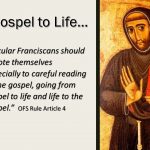
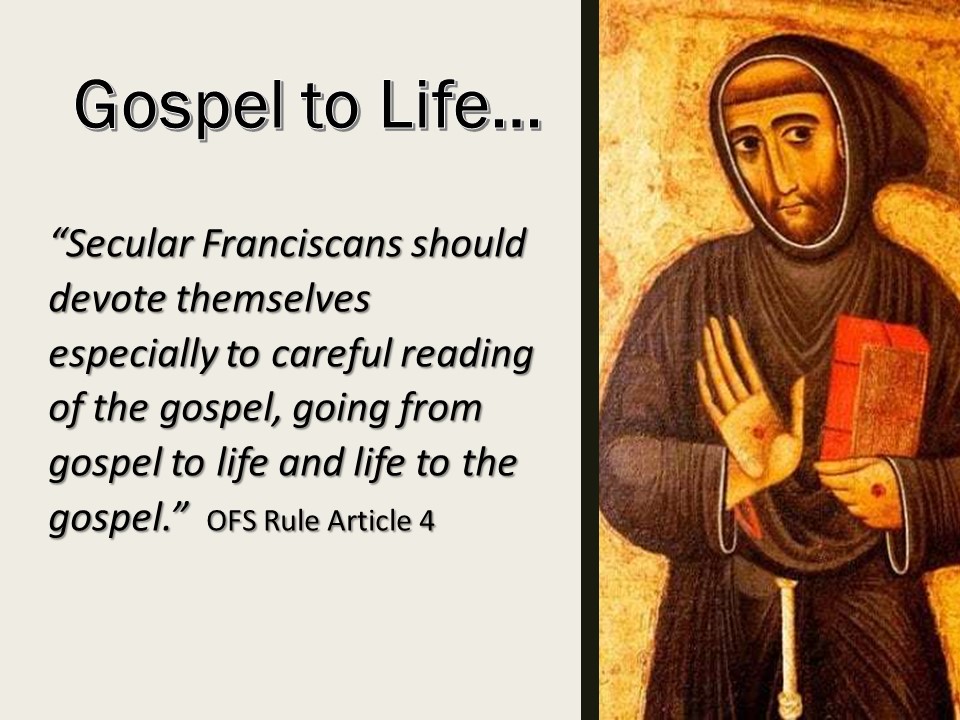
Secular Franciscans should devote themselves especially to careful reading of the gospel, going from gospel to life and life to the gospel.

5. Secular Franciscans, therefore, should seek to encounter the living and active person of Christ in their brothers and sisters, in Sacred Scripture, in the Church, and in liturgical activity. The faith of Saint Francis, who often said “I see nothing bodily of the Most High Son of God in this world except his most holy body and blood”, should be the inspiration and pattern of their eucharistic life.


+The following is a wonderful way to get to know Jesus better. You can do it alone during your prayer time; with a prayer partner; with your fraternity as an ongoing formation series.


+Read one of the synoptic gospels (Matthew, Mark, or Luke). While reading, focus on the person of Jesus and then discuss or answer these questions in your journal:
 

  1. With whom did Jesus spend his time?
  2. How did he relate with the apostles, the Pharisees, and Sadducees, the poor and suffering? His friends and family?
    What message did he give to each?
  3. How did these different groups of people respond to Him?
  4. What did Jesus talk about most?
  5. How did Jesus refer to God?  How frequently?
  6. What were Jesus’ deepest desires? What made him angry?
  7. What is one thing that surprised you about Jesus?


Thank you to the National Formation Commission for sharing an activity that will be found in our new formation materials.

++++++++++++++++++++


Formation Friday  9 de Abril de 2021

Encontrando a Jesús en el Evangelio (Por favor, comparta con su fraternidad local)

San Francisco llegó a conocer a Cristo adquiriendo “fluidez” en las Escrituras, especialmente en los Evangelios. Como franciscanos seglares, estamos llamados a hacer de las Escrituras una parte integral de nuestra vida de oración.


Tomás de Celano, el primer biógrafo de Francisco, escribió: “Francisco solía recordar con meditación regular las palabras de Cristo y recordar sus hechos con la más atenta percepción. De hecho, la humildad de la Encarnación y la caridad de la Pasión ocuparon tan profundamente su memoria que apenas quiso pensar en otra cosa.” (FA:ED Vol.1, p. 254)


Artículos 4 y 5 de la Regla Franciscana Seglar


4. La Regla y la vida de los Franciscanos seglares es ésta: guardar el santo Evangelio de nuestro Señor Jesucristo siguiendo el ejemplo de San Francisco de Asís, que hizo de Cristo el inspirador y centro de su vida con Dios y con los hombres.


Cristo, don del amor del Padre, es el camino hacia Él, es la verdad en la cual nos introduce el Espíritu Santo, es la vida que
Él ha venido a dar abundantemente.

Los Franciscanos seglares dedíquense asiduamente a la lectura del Evangelio, pasando del Evangelio a la vida y de la vida al Evangelio.

 5. Los Franciscanos seglares, pues, busquen la persona viviente y operante de Cristo en los hermanos, en la Sagrada Escritura, en la Iglesia y en las acciones litúrgicas. La fe de San


Francisco que dictó estas palabras: “En este mundo nada veo corporalmente del mismo Altísimo Hijo de Dios sino su santísimo cuerpo y sangre”, sea para ellos inspiración y guía de su vida eucarística.


 + La siguiente es una manera maravillosa de conocer mejor a Jesús. Puede hacerlo solo durante su tiempo de oración; con un compañero de oración; con su fraternidad como serie de formación permanente.


+Lea uno de los evangelios sinópticos (Mateo, Marcos o Lucas). Mientras lees, concéntrese en la persona de Jesús y luego platique o responda a estas preguntas en su diario:

1. ¿Con quién pasó Jesús su tiempo?

2. ¿Cómo se relacionaba con los apóstoles, los fariseos y saduceos, los pobres y los que sufrían? ¿Sus amigos y familiares? ¿Qué mensaje les dio a cada uno?

3. ¿Cómo le respondieron estos diferentes grupos de personas?

4. ¿De qué habló más Jesús?

5. ¿Cómo se refería Jesús a Dios? ¿Con que frecuencia?

6. ¿Cuáles eran los deseos más profundos de Jesús? ¿Qué le hizo enojar?

7. ¿Qué es lo que le sorprendió de Jesús?


Diane F. Menditto, OFS
Chair, National Formation Commission
Minister, Our Lady of the Angels Region


Open post

Formation Friday – Good Friday, April 2, 2021


Dear Brothers and Sisters, 

I hope that your Lent went well and that you are now able to attend the holy ceremonies during these last holy days before Easter.  Today, Good Friday is a perfect time to remember St. Clare and her beautiful way of contemplation and “Gazing” on the cross of our Lord, Jesus Christ.  Fortunately, our formation lesson for today discusses this timely topic.  Peace, Dona

++++++++++++++++++++++++++++++++++++++++++++++++++++++++++++++++++++++++++++++++++

Since today is Good Friday, it is an extra special time to follow Saint Clare’s Gazing on the cross of our Lord Jesus Christ as found in her second letter to Saint Agnes of Prague.

19“Look upon Him Who became contemptible for you, and follow Him, making yourself contemptible in this world for Him.


20Most noble Queen, gaze, consider, contemplate desiring to imitate Your Spouse,

[Who] though more beautiful than the children of men became, for your salvation, the lowest of men, was despised, struck, scourged untold times throughout  His entire body,   and then died amid the suffering of the  Cross.

21If you suffer with Him, you will reign with Him. weeping with Him, you will rejoice with Him; dying on the cross of tribulation with Him, you will possess heavenly mansions with Him among the splendor of the saints


22and in the Book of Life your name will be called glorious among the peoples.”

CA:ED, 49: 19-22  https://franciscantradition.org/clare-of-assisi-early-documents/the-second-letter-to-agnes-of-prague/225-ca-ed-1-page-49

  • GAZE: Take some time to gaze at Jesus on the cross.
  • CONSIDER: Put yourself there with Jesus. What was he thinking, feeling? What did he see? Hear?
  • CONTEMPLATE: Inspired by the Holy Spirit, how are you transformed, made different, by this experience?
  • IMITATE: What do you resolve to do in response to this transformation?


For Discussion or to comment on in your journal.

1. As you use St. Clare’s “gaze, consider, contemplate and imitate” describe its impact on your life.


2. In what ways have you been drawn to Imitate the Crucified? In what ways has this transformed your life?


3. How do you see Christ in your “mirror?”   (See Fourth Letter to Agnes of Prague  CA:ED, 55: 15-32 https://franciscantradition.org/clare-of-assisi-early-documents/the-fourth-letter-to-agnes-of-prague/231-ca-ed-1-page-55 )


4. How are you a “mirror” of Christ?


+++++++++++++++++++++++++++++++++++++++++++++++++++++++++++


Formation Friday – 2 de abril de 2021 (En español abajo)
Por Favor compartir con su fraternidad local

Dado que hoy es Viernes Santo, es un momento especial para seguir la mirada de Clara en la cruz de nuestro Señor Jesucristo como se encuentra en su segunda carta a Santa Inés de Praga.

19Míralo hecho despreciable por ti
y síguelo, hecha tú despreciable por Él en este mundo. 
20Reina nobilísima,
mira atentamente,
considera,
contempla,
deseando imitarlo, a tu Esposo,

El más hermoso de los hijos de los hombres (cf. Sal 44,3), que, por tu salvación, se ha hecho el más vil de los hombres, despreciado, golpeado y flagelado de múltiples formas en todo su cuerpo, muriendo en medio de las mismas angustias de la cruz.

21Si sufres con Él, reinarás con Él;
si lloras con Él, gozarás con Él;
si mueres con Él en la cruz de la tribulación,
poseerás con Él las mansiones celestes
en el esplendor de los santos (cf. Rom 8, 17; 2 Tim 2,12.11; 1 Cor 12,26; Sal 109,3), 
22y tu nombre será inscrito en el libro de la vida (cf. Flp 4,3; Ap 3,5), y será glorioso entre los hombres. 

http://www.franciscanos.org/esscl/ctacla2.html

  • MIRAR ATENTAMENTE: Tómese un tiempo para mirar atentamente a Jesús en la cruz.
  • CONSIDERAR: Póngase ahí con Jesús. ¿Qué estaba pensando, sintiendo? ¿Qué vio? ¿Qué oyó?
  • CONTEMPLAR: Inspirado por el Espíritu Santo, ¿está transformado, hecho diferente, por esta experiencia?
  • IMITAR: ¿Qué decide hacer en respuesta a esta transformación?

Para platicar o para comentar en su diario.

1. Al usar la idea de “mirar atentamente, considerar, contemplar e imitar” de Santa Clara, describa el impacto que tiene en su vida.

2. ¿De qué manera se ha sentido atraído a imitar al Crucificado? ¿De qué manera ha transformado esto su vida?

3. ¿Cómo ve a Cristo en su “espejo?”
(Véase la cuarta carta a Inés de Praga http://www.franciscanos.org/esscl/ctacla4.html)

4. ¿Cómo es usted un “espejo” de Cristo?


Diane F. Menditto, OFS
Chair, National Formation Commission
Minister, Our Lady of the Angels Region


Open post

Formation Friday – March 26, 2021 – The Value of Prayer and Comtemplation

 
Dear Brothers and Sisters,  Today’s lesson comes at the most important time, the start of Holy Week, when Our Lord suffered and died for us.  
We are reminded of the value and importance of keeping our prayer life strong.  Prayer and contemplation are our lifelines to peace and calm during these turbulent times.  They are essential to the salvation of our souls.  Please discuss with your fraternities.  Peace, Dona
+++++++++++++++++++++++++++++++++++++++++++++++++++++++++++++++++++++++++++++++++++++++++++++++++++++++++++++ 
 

The Value of Prayer and Contemplation—What do you think?

Please share with your local fraternities

As we enter Holy Week, let us take some time to be inspired in our prayer and in thinking about why we pray and the result that it has. We can use our Rule as inspiration and then answer the questions below from your heart.

OFS Rule Article 4

The rule and life of the Secular Franciscans is this: to observe the gospel of our Lord Jesus Christ by following the example of Saint Francis of Assisi, who made Christ the inspiration and the center of his life with God and people.

Christ, the gift of the Father’s love, is the way to him, the truth into which the Holy Spirit leads us, and the life which he has come to give abundantly.

Secular Franciscans should devote themselves especially to careful reading of the gospel, going from gospel to life and life to the gospel.


OFS Rule Article 8

As Jesus was the true worshipper of the Father, so let prayer and contemplation be the soul of all they are and do.

Let them participate in the sacramental life of the Church, above all the Eucharist. Let them join in liturgical prayer in one of the forms proposed by the Church, reliving the mysteries of the life of Christ.


Questions for discussion or to answer in your journal

       What is the practical result of taking time for contemplation?

       What is the value of using the Liturgy of the Hours?

       What is the value of praying Scripture?

       Why is the Eucharist so important to us as Catholics and Franciscans?

       What is your definition of the purpose of prayer?

       How does your prayer overflow into your actions? (How are you transformed?)


Resources on prayer and contemplation

+Franciscan Prayer—Sr. Ilia D’Elio, OSF

+ Prayer: Our Deepest Longing—Fr. Ronald Rolheiser, OMI

+ Breath of God—Fr. Dave Pivonka, TOR

+Eucharistic Adoration: Reflections in the Franciscan Tradition—Franciscan Sisters of Perpetual Adoration

 ++++++++++++++++++++++++++++++++++++++++++++++++++++++++++++++++++++++++++++++++++++++++


 Formation Friday, March 26, 2021


El valor de la oración y la contemplación— ¿Qué opina?

Por favor, comparta con sus fraternidades locales

Al entrar en la Semana Santa, tomemos un tiempo para inspirarnos en nuestra oración y en pensar en por qué oramos y el resultado que tiene. Se puede usar nuestra regla como inspiración y luego responder desde su corazón a las preguntas a continuación.

Artículo 4 de la Regla OFS

La Regla y la vida de los Franciscanos seglares es ésta: guardar el santo Evangelio de nuestro Señor Jesucristo siguiendo el ejemplo de San Francisco de Asís, que hizo de Cristo el inspirador y centro de su vida con Dios y con los hombres.

Cristo, don del amor del Padre, es el camino hacia Él, es la verdad en la cual nos introduce el Espíritu Santo, es la vida que Él ha venido a dar abundantemente.

Los Franciscanos seglares dedíquense asiduamente a la lectura del Evangelio, pasando del Evangelio a la vida y de la vida al Evangelio.

Artículo 8 de la Regla OFS

Como Jesucristo fue el verdadero adorador del Padre, del mismo modo los Franciscanos seglares hagan de la oración y de la contemplación el alma del propio ser y del propio obrar14.

Participen de la vida sacramental de la Iglesia, especialmente de la Eucaristía, y asóciense a la oración litúrgica en alguna de las formas propuestas por la misma Iglesia, reviviendo así los misterios de la vida de Cristo.

Preguntas para platicar o responder en su diario

       ¿Cuál es el resultado práctico de tomarse un tiempo para  la contemplación?

       ¿Cuál es el valor  de utilizar la  Liturgia de las Horas?

       ¿Cuál es el valor  de orar las  Escrituras?  

       ¿Por qué la Eucaristía es tan importante para nosotros como católicos y franciscanos?

       ¿Cuál es su definición del propósito de la oración?

       ¿Cómo se desborda su oración en sus acciones? (¿Cómo le transforma la oración?)


Recursos para la oración y la contemplación

+ La oración franciscana (recursos) http://www.franciscanos.org/oracionfcana/menu.html

+ La espiritualidad franciscans (recursos) http://www.franciscanos.org/espiritualidad/menu.html

+ Temas de estudio y meditación (recursos) http://www.franciscanos.org/temas/menu.html


Diane F. Menditto, OFS
Chair, National Formation Commission
Minister, Our Lady of the Angels Region


Scroll to top
Juan de Padilla