(en español abajo) Korean translation attached in a separate PDF.
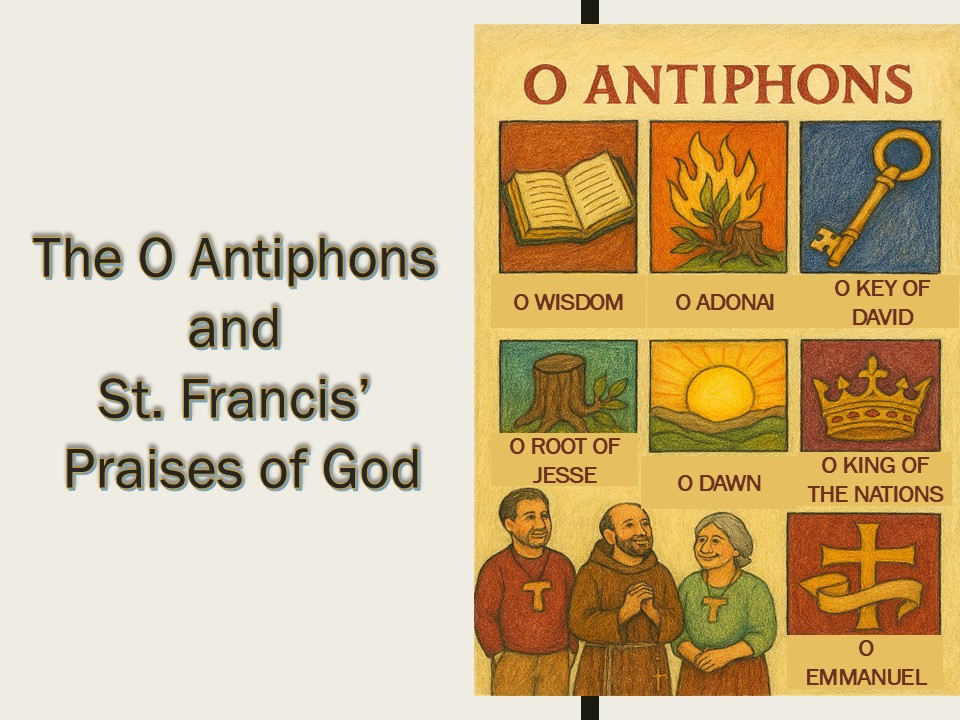
St. Francis’s Praises of God and the O AntiphonsIf you have ever read St. Francis’s Praises of God, you may have noticed that they mirror the O Antiphons which we pray starting December 17th each year. You will notice these Antiphons appear each day for the Canticle of Mary from December 17th to the 23rd.
The Praises of God
You are the holy Lord God Who does wonderful things.
You are strong. You are great. You are the most high.
You are the almighty king. You holy Father,
King of heaven and earth.You are three and one, the Lord God of gods;
You are the good, all good, the highest good,
Lord God living and true.You are love, charity; You are wisdom, You are humility,
You are patience, You are beauty, You are meekness,
You are security, You are rest,
You are gladness and joy, You are our hope, You are justice,
You are moderation, You are all our riches to sufficiency.You are beauty, You are meekness,
You are the protector, You are our custodian and defender,
You are strength, You are refreshment. 6You are our hope,
You are our faith, You are our charity,
You are all our sweetness, You are our eternal life:
Great and wonderful Lord, Almighty God, Merciful Savior.Each day, meditate on the relationship between the antiphons and Francis’s writings.
December 17: O Sapientia (O Wisdom)
PRAISES OF GOD: “You are love, charity; You are wisdom,
You are patience, You are beauty, You are meekness,…”December 18: O Adonai (O Lord)
PRAISES OF GOD: “You are the holy Lord God Who does wonderful things.
You are strong. You are great. You are the most high.
You are three and one, the Lord God of gods;
You are the good, all good, the highest good,
Lord God living and true…”December 19: O Radix Jesse (O Root of Jesse)
PRAISES OF GOD: “You are security, You are rest,
You are gladness and joy, You are our hope, You are justice,
You are moderation, You are all our riches to sufficiency.”
December 20: O Clavis David (O Key of David)
PRAISES OF GOD: “You are the protector, You are our custodian and defender,
You are strength…”December 21: O Oriens (O Dayspring)
PRAISES OF GOD: “You are beauty, You are meekness,
You are refreshment. 6You are our hope,
You are our faith, You are our charity,…”December 22: O Rex Gentium (O King of the Nations)
PRAISES OF GOD: “You are the almighty king. You holy Father,
King of heaven and earth.”
December 23: O Emmanuel (God is with us.)
PRAISES OF GOD: “You are all our sweetness, You are our eternal life:
Great and wonderful Lord, Almighty God, Merciful Savior.”As Advent draws to a close, use the Praises of God above to enhance your meditations on the coming of our Lord Jesus,
++++++++++++++++++++
Formación 12 de diciembre, 2025 (Compartir con su fraternidad local)
Las Alabanzas del Dios Aaltísimo de San Francisco y las Antífonas OSi alguna vez ha leído las Alabanzas a Dios de San Francisco, habrá notado que reflejan las Antífonas O que rezamos a partir del 17 de diciembre de cada año. Verá que estas Antífonas aparecen cada día en las Vísperas en el Cántico de María, del 17 al 23 de diciembre.
Las alabanzas del Dios altísimo
Tú eres santo, Señor Dios único, que haces maravillas.
Tú eres fuerte, tú eres grande, tú eres altísimo, tú eres rey omnipotente, tú, Padre santo, rey del cielo y de la tierra.
Tú eres trino y uno, Señor Dios de dioses, tú eres el bien, todo el bien, el sumo bien, Señor Dios vivo y verdadero.
Tú eres amor, caridad; tú eres sabiduría, tú eres humildad, tú eres paciencia, tú eres belleza, tú eres mansedumbre, tú eres seguridad, tú eres quietud, tú eres gozo, tú eres nuestra esperanza y alegría, tú eres justicia, tú eres templanza, tú eres toda nuestra riqueza a satisfacción.
Tú eres belleza, tú eres mansedumbre; tú eres protector, tú eres custodio y defensor nuestro; tú eres fortaleza, tú eres refrigerio.
Tú eres esperanza nuestra, tú eres fe nuestra, tú eres caridad nuestra, tú eres toda dulzura nuestra, tú eres vida eterna nuestra: Grande y admirable Señor, Dios omnipotente, misericordioso Salvador.
https://franciscanos.org/esfa/ald.html [Forma C]
Cada día, medite sobre la relación entre las antífonas y los escritos de Francisco.
17 diciembre: O Sapientia (O Sabiduría)
ALABANZAS DE DIOS: “Tú eres amor, caridad; tú eres sabiduría,
tú eres paciencia, tú eres belleza, tú eres mansedumbre,”18 diciembre: O Adonai
ALABANZAS DE DIOS: “Tú eres santo, Señor Dios único, que haces maravillas.
Tú eres fuerte, tú eres grande, tú eres altísimo,.
Tú eres trino y uno, Señor Dios de dioses,
tú eres el bien, todo el bien, el sumo bien,
Señor Dios vivo y verdadero.”19 diciembre: O Radix Jesse (O Raíz de Jesé)
ALABANZAS DE DIOS: “tú eres seguridad, tú eres quietud,
tú eres gozo, tú eres nuestra esperanza y alegría, tú eres justicia,
tú eres templanza, tú eres toda nuestra riqueza a satisfacción.”20 de diciembre: O Clavis David (O Llave de David)
ALABANZAS DE DIOS: “tú eres protector, tú eres custodio y defensor nuestro;
tú eres fortaleza,”21 de diciembre: O Oriens (O Amancecer)
ALABANZAS DE DIOS: tú eres belleza, tú eres mansedumbre,
Tú eres refrigerio..
Tú eres esperanza nuestra, tú eres fe nuestra, tú eres caridad nuestra,22 de diciembre: O Rex Gentium (O Rey de las naciones)
ALABANZAS DE DIOS: “Tú eres rey omnipotente, tú, Padre santo,
rey del cielo y de la tierra.”23 de diciembre: O Emmanuel (Dios está con nosotros)
ALABANZAS DE DIOS: “Tú eres toda dulzura nuestra, tú eres vida eterna nuestra:
Grande y admirable Señor, Dios omnipotente, misericordioso Salvador.”A medida que el Adviento llega a su fin, utilice las alabanzas a Dios anteriores para mejorar sus meditaciones sobre la venida de nuestro Señor Jesucristo.
Diane F. Menditto, OFSVice Minister, National Fraternity, Secular Franciscan Order USAGo into the world and proclaim the good news.” National Theme 2025-2028
Category: Formation Friday
FORMATION FRIDAY – OFS People of Conversion – Faith & Hope – December 5, 2025
(en español abajo) Korean translation attached in a separate PDF.
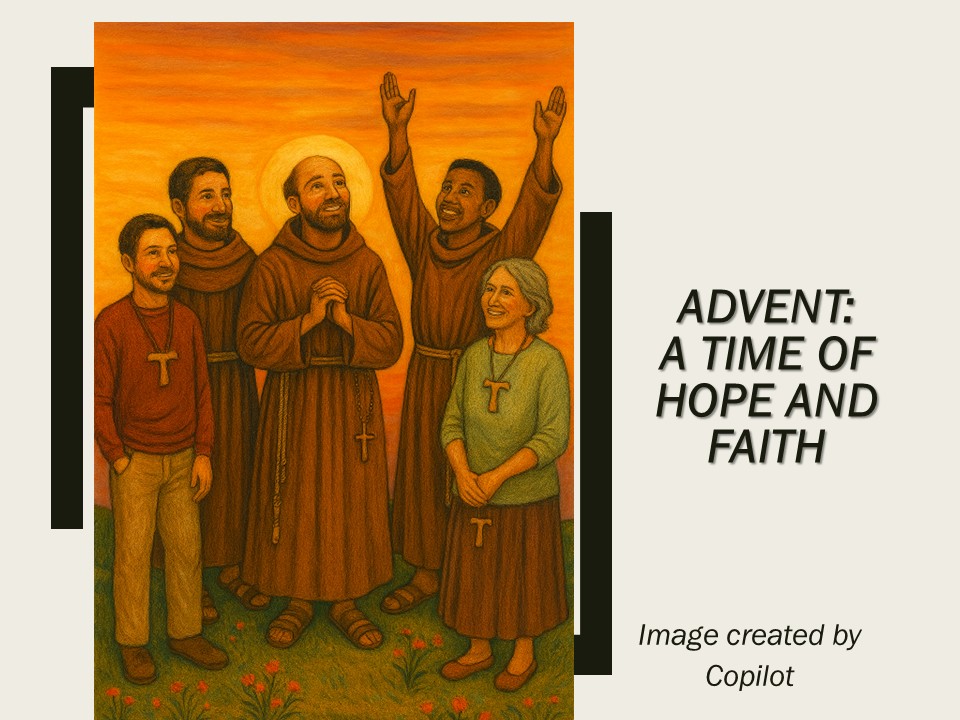
Advent a time of Hope and FaithSecular Franciscans are people of conversion. Looking through this lens during Advent, we realize that seeking conversion requires hope and faith.
CONSIDER:
+ Our Rule: Article 19—”Mindful that they are bearers of peace which must be built up unceasingly, they should seek out ways of unity and fraternal harmony through dialogue, trusting in the presence of the divine seed in everyone and in the transforming power of love and pardon.
Messengers of perfect joy in every circumstance, they should strive to bring joy and hope to others.”
+ Our Rule: Article 9—”The Virgin Mary, humble servant of the Lord, was open to his every word and call. She was embraced by Francis with indescribable love and declared the protectress and advocate of his family15. The Secular Franciscans should express their ardent love for her by imitating her complete self-giving and by praying earnestly and confidently16.”
+Admonition XXVII: Virtue Puts Vice to Flight
1Where there is charity and wisdom, there is neither fear nor ignorance.
2Where there is patience and humility, there is neither anger nor disturbance.
3Where there is poverty with joy, there is neither greed nor avarice.a
4Where there is restb and meditation, there is neither anxiety nor restlessness.
5Where there is fear of the Lord to guard an entrance, Lk 11:21 there the enemy cannot have a place to enter.
6Where there is a heart full of mercyc and discernment, there is neither excess nor hardness of heart.+ During Advent, we strive to imitate our Blessed Mother who brought joy and hope to the world through her “YES.” Now is the time to ask ourselves if we are saying yes to what the Lord is asking of us and to what we promised at our Profession.
Questions for discussion or to answer in your journal+ How do you build peace in your fraternity and in your family? What are the most challenging times/topics that you encounter during family or fraternity gatherings, and how do you handle them?
+Which characteristics of the Blessed Mother do you strive to imitate? Consider Mary’s role in the Incarnation. What does it take to say YES to God?
+The Prayer Before the Crucifix occurred before the Admonitions were written. According to Admonition XXVII, how did God answer Francis’s prayer?
Thank you to Anne Mulqueen, OFS, for her inspiration.
Formación 5 de diciembre, 2025 (compartir con su fraternidad local)
Adviento: Temporada de fe y esperanza
Los franciscanos seglares somos personas de conversión. Al mirar a través de esta lente durante el Adviento, nos damos cuenta de que buscar la conversión requiere esperanza y fe.
CONSIDERE:
+Nuestra Regla: Artículo 19—“Como portadores de paz y conscientes de que ésta ha de construirse incesantemente, indaguen los caminos de la unidad y del entendimiento fraterno, mediante el diálogo, confiando en la presencia del germen divino que hay en el hombre y en la fuerza transformadora del amor y del perdón31.
Mensajeros de la perfecta alegría, esfuércense permanentemente en llevar a los demás el gozo y la esperanza32.”
+Nuestra Regla: Artículo 9—”La Virgen María, humilde sierva del Señor, siempre atenta a su palabra y a todas sus mociones, fue para San Francisco centro de indecible amor, y declarada Protectora y Abogada de su familia15. Los Franciscanos seglares den testimonio de su ardiente amor hacia Ella con la imitación de su disponibilidad incondicional, y en la efusión de una confiada y consciente oración16.”
+Admonición XXVII: De la virtud que ahuyenta al vicio
“1Donde hay caridad y sabiduría, allí no hay temor ni ignorancia.
2Donde hay paciencia y humildad, allí no hay ira ni perturbación.
3Donde hay pobreza con alegría, allí no hay codicia ni avaricia.
4Donde hay quietud y meditación, allí no hay preocupación ni vagancia.
5Donde está el temor de Dios para custodiar su atrio (cf. Lc 11,21), allí el enemigo no puede tener un lugar para entrar.
6Donde hay misericordia y discreción, allí no hay superfluidad ni endurecimiento.”http://franciscanos.org/esfa/adm-ae.html
+ Durante el Adviento, nos esforzamos por imitar a nuestra Santísima Madre que trajo alegría y esperanza al mundo a través de su “SÍ.” Ahora es el momento de preguntarnos si estamos diciendo SÍ a lo que el Señor nos pide y a lo que prometimos en nuestra Profesión.
Preguntas para platicar o para responder en su diario
+ ¿Cómo fomenta la paz en su fraternidad y en su familia? ¿Cuáles son los momentos / temas más desafiantes que encuentra durante las reuniones familiares o de fraternidad, y cómo los maneja?
+ ¿Qué características de la Santísima Virgen se esfuerza por imitar? Considere el papel de María en la Encarnación. ¿Qué se necesita para decirle que SÍ a Dios?
+ La oración ante el crucifijo ocurrió antes de que se escribieran las Admoniciones. Según la Admonición XXVII, ¿cómo respondió Dios a la oración de Francisco?
Le agradecemos a Anne Mulqueen, OFS, por su inspiración.
Diane F. Menditto, OFSVice Minister, National Fraternity, Secular Franciscan Order USAGo into the world and proclaim the good news.” National Theme 2025-2028

Formation Friday – Advent, Time of Waiting & Meditation – Nov. 28, 2025
Please share with your fraternity. (En español abajo)
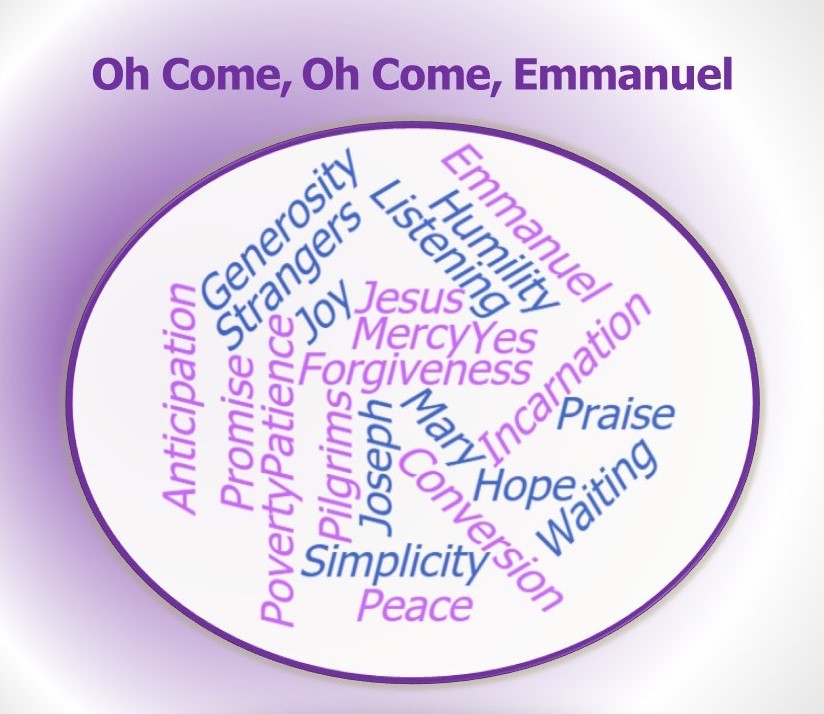
Advent is a time of waiting and meditation. We think about the coming of our Lord and Savior in the Incarnation and the part that Mary and Joseph played in his life. During this month we can use the words in the graphic (or the word bank below) in our prayer and meditation to focus on the meaning of this season. St. Francis was devoted to the Incarnation. This devotion came out in his prayer, his writings and in his actions.
Here are some ideas to put a Franciscan flavor in your Advent meditations:
· Choose a word or two from the word bank each day and see where those words or ideas come up in our Rule.
· Choose a word or two and see where they come up in Scripture—perhaps in the readings of the day or in the psalms as you pray the Liturgy of the Hours.
· Think of stories in Scripture and in the writings by and about Francis and Clare that typify hope and patience.
· Read online or in books that you have at home:
1 Celano chapter 30 (The story of the first Nativity scene at Greccio) (FA:ED, vol. 1, 254)
https://digitalcollections.franciscantradition.org/document/bx4700-f6f722-1999/francis_of_assisi_early_documents_-_the_saint/1999-00-00?pageNo=254A Salutation of the Blessed Virgin Mary (FA:ED, vol. 1, 163)
The Praises of God (FA:ED, vol. 1, 109)
St. Clare’s Fourth Letter to Agnes of Prague (CA:ED, 56)
The references above (FA:ED and CA:ED) refer to Francis of Assisi: Early Documents and Clare of Assisi: Early Documents. These and many more writings of and about Francis and Clare can be found on the Franciscan Intellectual Tradition website:
https://franciscantradition.org/
Word Bank
Poverty, Peace, Emmanuel, Promise, Yes, Joy, Hope, Anticipation, Waiting, Praise, Generosity, Humility, Simplicity, Mary, Jesus, Joseph, Forgiveness, Mercy, Listening, Patience, Pilgrims, Strangers, Conversion, Incarnation, Greccio,
Manger
+++++++++++++++++++++
Formación 28 de noviembre, 2025 (Comparta con su fraternidad.)
El Adviento es una temporada de espera y meditación. Pensamos en la venida de nuestro Señor y Salvador en la Encarnación y el papel que María y José desarrollaron en su vida. Durante este mes podemos usar las palabras del banco de palabras abajo en nuestra oración y meditación para enfocarnos en el significado de esta temporada. San Francisco se dedicó a la Encarnación. Esta devoción se manifestó en su oración, sus escritos y sus acciones.
Aquí hay algunas ideas para darle un toque franciscano a sus meditaciones de Adviento:
• Elija una palabra o dos del banco de palabras cada día y vea dónde esas palabras o ideas aparecen en nuestra Regla.
• Elija una palabra o dos y vea dónde aparecen en las Escrituras, tal vez en las lecturas del día o en los salmos mientras reza la Liturgia de las Horas.
• Piense en historias en las Escrituras y en los escritos de Francisco y Clara y sobre ellos que tipifican la esperanza y la paciencia.
• Lea en Internet o en libros que tenga en casa:
1 Celano capítulo 30 (La historia del primer pesebre de Greccio) (FA: ED, vol. 1, 254)
Capítulo XXX (30)
http://www.franciscanos.org/fuentes/1Cel03.html (en español)Un saludo de la Santísima Virgen María (FA: ED, vol. 1, 163)
https://www.franciscanos.org/esfa/salvm.htmlLas alabanzas del Dios altísimo (FA: ED, vol. 1, 109)
http://www.franciscanos.org/esfa/ald.htmlCuarta carta de Santa Clara a Agnes de Praga (CA: ED, 56)
http://www.franciscanos.org/esscl/ctacla4.htmlLas referencias anteriores en inglés (FA: ED y CA: ED) se refieren a Francisco de Asís: Primeros documentos y Clara de Asís: Primeros documentos. Estos y muchos más escritos de Francisco y Clara se pueden encontrar en el sitio web de la Tradición Intelectual Franciscana: (en inglés)
https://franciscantradition.org/
Excelente sitio en español: http://www.franciscanos.org/frandp/menup.html
Banco de palabras
Pobreza, Paz, Emanuel, Promesa, Sí, Alegría, Esperanza, Anticipación, Espera, Alabanza, Generosidad, Humildad, Sencillez, María, Jesús, José, Perdón, Misericordia, Escucha, Paciencia, Peregrinos, Extranjeros, Conversión, Encarnación, Greccio, Pesebre
Diane F. Menditto, OFSVice Minister, National Fraternity, Secular Franciscan Order USAGo into the world and proclaim the good news.” National Theme 2025-2028

FORMATION FRIDAY – Characteristics of Good Servant Leaders – November 21, 2025
(en español abajo) Korean translation attached in a separate PDF.
Please share with your local fraternityThis month we have been focusing on Servant Leadership. Today we offer the characteristics of good servant leaders (in no particular order). You may be able to add to the list based on the qualities you have observed in the excellent servant leaders you know.
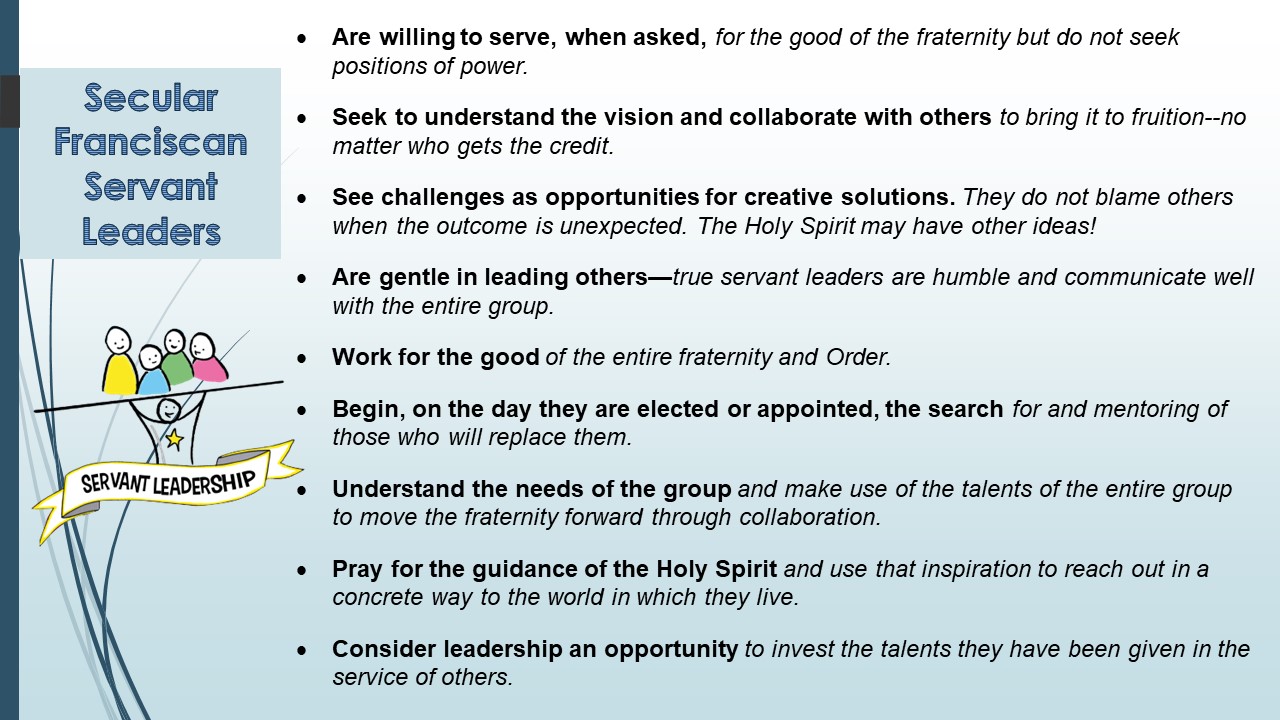
Secular Franciscan Servant Leaders:
· Love the Order and are willing to serve, when asked, for the good of the fraternity but do not seek positions of power. Have enthusiasm for living the Rule.
- Seek to understand the vision and collaborate with others to bring it to fruition–no matter who gets the credit.
- See challenges as opportunities for creative solutions. They do not blame others when the outcome is unexpected. The Holy Spirit may have other ideas!
- Are gentle in leading others—true servant leaders are humble and communicate well with the entire group.
- Work for the good of the entire fraternity and Order.
- Begin, on the day they are elected or appointed, their search for and mentoring of those who will replace them.
- Understand the needs of the group and make use of the talents of the entire group to move the fraternity forward through collaboration.
- Pray for the guidance of the Holy Spirit and use that inspiration to reach out in a concrete way to the world in which they live and serve.
- Consider leadership an opportunity to invest the talents they have been given in the service of others.
- Are generous with their time and willing to make time in their lives to serve.
- Have life experience both in the Order and in the world that can be offered to the fraternity.
- Are willing to listen to others—to ask for and act on input from their brothers and sisters.
Questions for discussion in fraternity, with a partner, or in your journal.
+Think of servant leaders you have known. Which of these characteristics do you see in them?
+Which of these characteristics do you see in yourself?
+Which characteristics do you think you could develop in order to become a servant leader?
+If you presently hold office, which of the above characteristics can you improve in yourself?
+Challenge: This week, read Mt 25:14-30 and consider the talents and abilities God has given you. How will you invest them to serve your fraternity and the Order?+++++++++++++++++++++++++++++++++++++
21 de noviembre 2025 Comparta con su fraternidad local.
Este mes nos hemos centrado en el Liderazgo de Servicio. Hoy ofrecemos las características de los buenos líderes servidores (sin ningún orden en particular). Es posible que usted pueda ampliar la lista basándose en las cualidades que haya observado en los excelentes líderes servidores que conoce.
Líderes Servidores Franciscanos Seglares:
- Aman la Orden y están dispuestos a servir, cuando se les solicite, por el bien de la fraternidad, pero no busquen posiciones de poder. Tienen entusiasmo por vivir la Regla.
- Tratan de comprender la visión y colaborar con otros para hacerla realidad, sin importar quién se lleve el crédito.
- Ven los desafíos como oportunidades para soluciones creativas. No culpan a los demás cuando el resultado es inesperado. ¡El Espíritu Santo puede tener otras ideas!
- Son gentiles al liderar a otros; los verdaderos líderes servidores son humildes y se comunican bien con todo el grupo.
- Trabajan por el bien de toda la fraternidad y la Orden.
- Inician, el día de su elección o nombramiento, la búsqueda y tutoría de quienes los sustituirán.
- Comprenden las necesidades del grupo y hacen uso de los talentos de todo el grupo para hacer avanzar la fraternidad a través de la colaboración.
- Oran por la guía del Espíritu Santo y usan esa inspiración para llegar de manera concreta al mundo en el que viven y sirven.
- Consideran el liderazgo como una oportunidad para invertir los talentos que se les han otorgado al servicio de los demás.
- Son generosos con su tiempo y están dispuestos a dedicarlo en sus vidas para servir.
- Tienen experiencia de vida tanto en la Orden como en el mundo que pueda ofrecerse a la fraternidad.
- Están dispuestos a escuchar a los demás, a pedir y actuar en función de las aportaciones de sus hermanos y hermanas.
Preguntas para discutir en fraternidad, con un compañero o en su diario.
+Piense en los líderes servidores que ha conocido. ¿Cuáles de estas características ve en ellos?
+¿Cuáles de estas características ve en usted mismo?
+¿Qué características cree que podría desarrollar para convertirse en un líder servidor?
+Si actualmente ocupa un cargo, ¿cuáles de las características anteriores puede mejorar en si mismo?+ Desafío : esta semana, lea Mt 25:14-30 y considere los talentos y habilidades que Dios le ha dado. ¿Cómo los invertirá para servir a su fraternidad y a la Orden?
FORMATION FRIDAY – Jesus As a Leader – November 14, 2025
(en español abajo) Korean translation attached in a separate PDF.
Please share with your local fraternity
The Handbook for Servant Leadership, published by OFS-USA in 2010, contains a wealth of information that can guide us in being or becoming excellent servant leaders. This week we are inspired by our models: Jesus, Francis and Clare. (See Handbook for Secular Franciscan Servant Leadership pp. 4-7)
Jesus as a leader: points to ponder:
· Jesus tells us that “no pupil outranks his teacher” (Matthew 10:24).
o If we want to be followers, we must deny ourselves, take up our cross and follow (Luke 9 23).
o Through his strong appeal and quiet persuasion, he enlisted others in his mission.
· He was patient and attempted to foster collaboration among the disciples, binding them together through love and the Spirit.
· He prepared them to carry out his work.
· He taught them the meaning of servant leadership. After washing their feet, he said, “What I just did was to give you an example: as I have done, so you must do” (John 13:15).
· He makes it clear that true leadership is grounded in love, which results in service
· Jesus did not have the whole future planned. He gave Peter and the Apostles the keys to the kingdom, allowing the Church to unfold through the leadership of committed people.
St. Francis as a servant leader: Points to ponder
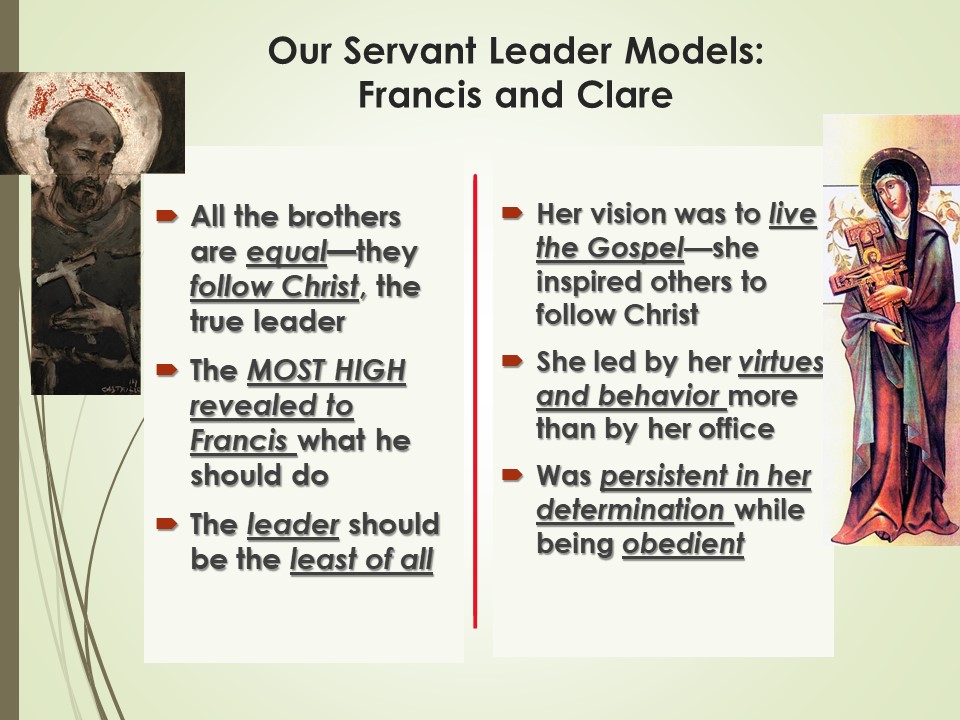
· “And after the Lord gave me some brothers, no one showed me what I had to do, but the Most High Himself revealed to me that I should live according to the pattern of the Holy Gospel.” (The Testament of St. Francis FA:ED Vol 1 124 )
o The brothers are all equal. Everyone follows Jesus.
o The leader is the servant of all—washes the feet of the others.
· “We must never desire to be above others, but, instead, we must be servants and subject to every human creature for God’s sake.” (Later Admonition and Exhortation To the Brothers and Sisters of Penance FA: ED Vol 1 48)
· “Let no one be called superior but let everyone in general be called a lesser brother. And let one wash the feet of the other.” (St. Francis of Assisi, The Earlier Rule, VI:3-4).
· “Let the one to whom obedience has been entrusted and who is considered the greater be the lesser and the servant of the other brothers.”(St. Francis of Assisi, Later Admonition and Exhortation, FA:ED Vol 1 42)
· “I did not come to be served, but to serve, says the Lord. Let those who are placed over others boast about that position as much as they would if they were assigned the duty of washing the feet of their brothers.” (Admonition #4 FA:ED Vol 1 130)
St. Clare as a servant leader: Points to ponder
· “Let whoever is elected reflect upon the kind of burden she has undertaken on herself and to Whom she must render an account of the flock committed to her. Let her also strive to preside over the others more by her virtues and holy behavior than by her office, so that, moved by her example, the sisters may obey her more out of love than out of fear.” CA:ED, 114 (Form of Life)
· Clare never hesitated to work right alongside the sisters taking some of the more distasteful tasks for herself.
Questions for discussion in a group or with a partner or to answer in your journal:
+After reading the quotes above, what stands out to you as the leadership style of Jesus, Francis, and Clare?
+As a present or future servant leader, why is it important that we “wash the feet” of others?
+Which of the quotes above presents the greatest challenge to you?
+Challenge: This week take each of the quotes above to prayer. Ask the Holy Spirit to strengthen your skills as a present or future servant leader. Think about the service you can provide to your fraternity and to the Order.
14 de noviembre de 2025 Por favor comparta con su fraternidad local.
El Manual para el liderazgo de servicio, publicado por OFS-USA en 2010, contiene una gran cantidad de información que puede guiarnos para ser o convertirnos en excelentes líderes servidores. Esta semana nos inspiramos en nuestros modelos: Jesús, Francisco y Clara. (Ver Manual para el Liderazgo de Servicio Franciscano Seglar, págs. 4-7 en inglés)
Jesús como líder: puntos para reflexionar
- Jesús nos dice que “ningún alumno supera en rango a su maestro” (Mateo 10:24).
- Si queremos ser seguidores, debemos negarnos a nosotros mismos, tomar nuestra cruz y seguir (Lucas 9, 23).
- Mediante su fuerte llamamiento y su silenciosa persuasión, consiguió que otros se unieran a su misión.
- Fue paciente e intentó fomentar la colaboración entre los discípulos, uniéndolos mediante el amor y el Espíritu.
- Los preparó para realizar su obra.
- Les enseñó el significado del liderazgo de servicio. Después de lavarles los pies, dijo: “Lo que acabo de hacer es darles ejemplo: como yo he hecho, así también ustedes hagan” (Juan 13:15).
- Deja claro que el verdadero liderazgo se basa en el amor, que resulta en servicio.
- Jesús no tenía todo el futuro planeado. Le dio a Pedro y a los Apóstoles las llaves del reino, permitiendo que la Iglesia se desarrollara a través del liderazgo de personas comprometidas.
San Francisco como líder servidor: puntos para reflexionar
- “Y después que el Señor me dio algunos hermanos, nadie me mostró lo que tenía que hacer, sino que el Altísimo mismo me reveló que debía vivir según el modelo del Santo Evangelio”. (El Testamento de San Francisco)
- Los hermanos son todos iguales. Todos siguen a Jesús.
- El líder es el servidor de todos: lava los pies de los demás.
- “Nunca debemos desear estar por encima de los demás, sino que debemos ser servidores y sujetos a toda criatura humana por amor de Dios”. (Admonición y exhortación posterior a los hermanos y hermanas de la Penitencia)
- “Nadie sea llamado superior, sino que todos, en general, sean llamados hermano menor. Y que uno lave los pies del otro”. (San Francisco de Asís, La Regla anterior, VI:3-4).
- “Aquel a quien se ha confiado la obediencia y es considerado mayor, sea el menor y el servidor de los demás hermanos.” ( San Francisco de Asís, Admonición y exhortación posteriores)
- “No vine a ser servido, sino a servir, dice el Señor. Que los que están por encima de los demás se jacten de esa posición tanto como lo harían si se les asignara el deber de lavar los pies de sus hermanos”. (Admonición #4)
Santa Clara como líder servidora : puntos para reflexionar
· “Quien sea elegida reflexione sobre el tipo de carga que ha asumido sobre sí misma y a quién debe rendir cuentas del rebaño que le ha sido encomendado. Procure también presidir a las demás más con sus virtudes y santa conducta que con su oficio, para que, movidas por su ejemplo, las hermanas la obedezcan más por amor que por temor”. (Forma de vida)
· Clare nunca dudó en trabajar junto a las hermanas, encargándose ella misma de algunas de las tareas más desagradables.
Preguntas para discutir en grupo o con un compañero o para responder en su diario:
+Después de leer las citas anteriores, ¿qué destaca para usted como el estilo de liderazgo de Jesús, Francisco y Clara?
+Como líder servidor actual o futuro, ¿por qué es importante que “lavemos los pies” de los demás?
+¿Cuál de las citas anteriores presenta el mayor desafío para usted?
+Desafío: Esta semana lleve cada una de las citas anteriores a la oración. Pídale al Espíritu Santo que fortalezca sus habilidades como líder servidor actual o futuro. Piense en el servicio que puede prestar a su fraternidad y a la Orden.
Diane F. Menditto, OFSVice Minister, National Fraternity, Secular Franciscan Order USAGo into the world and proclaim the good news.” National Theme 2025-2028all