Who Is My Neighbor

CNSA LogoNote: Guest Writer contributor Fr. Robert Barbato, OFM Cap. (newly appointed Rector of the National Shrine of St. Francis of Assisi located in San Francisco Ca.), is writing for Fr. John DeLaRiva, OFM Cap. (newly appointed National Spiritual Assistant to the OFS).

A  scribe  asked  Jesus,  after  being  told  to  love  his neighbor, “And just who is my neighbor?” Jesus replied, as we know, with the parable of the Good Samaritan. Jesus turned the question around, “Who was neighbor to the man in trouble?” The answer, of course, was the Samaritan, who treated the man with true love and concern. Jesus said, “Go, and do likewise.” He challenged the scribe (and all of us) not to think of how other people are neighbors to us, but how we can become neighbors by the way we treat them, even our enemies.

When Francis of Assisi started calling himself “Brother Francis,” he wasn’t just picking a title. He was expressing the relationship he wanted to have with the world. In his youth, Francis would never have thought of lepers as “neighbors,” let alone brothers and sisters. He loathed them and avoided them. It was the Lord who led him among them, as he himself tells us, and turned what was bitter into sweetness of soul and body. In other words, Francis learned to see not “lepers,” but Christian brothers and sisters, not a repugnant disease, but a person created in the image of God.

Francis tried to live out what it meant to call himself “brother,” even when it was difficult. To consider those who ridiculed him, belittled him, and called him a fool as brother, was not easy. It took Francis much prayer and patience to learn how to be brother. This was true even when Francis found himself living with some of his friars who disagreed with him or who were simply difficult to live with. As he struggled to learn to be brother to other people, he also came to the insight that he was a brother to all creatures, since every being is made by the same Creator. This, of course, led Francis to compose the “Canticle of the Creatures,” praising God in, through, and for all God’s creatures, like Brother Sun and Sister Moon.

As followers of Francis, we emphasize the importance of fraternity, of being brothers and sisters to one another and to the world. It is true that God calls us into fraternity to support one another and find strength in our brothers and sisters. But frankly, God also calls us into fraternity to learn to put up with one another, to be patient with one another, to learn to thank God for that brother or sister who is the most annoying. Fraternity begins with our prayer for one another and our openness to the idea that each person is made in the image and likeness of God, no matter how hard that may be to imagine in real life! Like Francis, if we call ourselves “brother” or “sister” and try to live out what that title means, we will be led by the Spirit into deep solidarity with all creation and find true joy, for the Lord can turn what is bitter into sweetness of soul and body. Is it easy? No. Is it worth it? Definitely.

May the Lord bless and keep you always!

https://www.secularfranciscansusa.org/2023/02/25/who-is-my-neighbor/
Open post

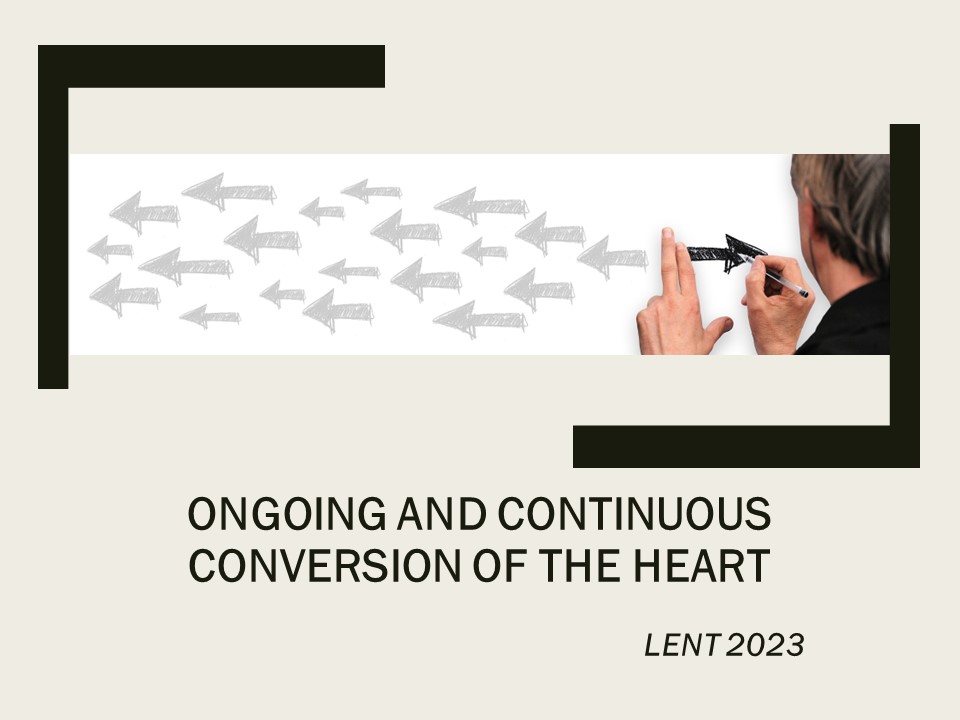
Formation Friday – February 24, 2023 – The Conversion Process: Ongoing & Continuous Conversion of the Heart

We have interrupted our series on the National Priorities for some Lenten inspiration. We hope the resources below will help everyone to focus on penance and conversion, so important in the life of a Secular Franciscan.


Thank you to the National Formation Commission for collaborating on this piece.


The Conversion Process: Ongoing and continuous conversion of the heart

For each week of Lent focus on one action item below that you would like to cultivate in a special way as part of your Lenten journey.


1. Make an act of reparation or a modification of behavior to show sorrow for sin.

2. Be willing to recognize and accept suffering as the consequence of separating myself from God. (Offer sufferings for the benefit of others.)

3. Commit to a plan for prayer, fasting, and almsgiving. (See: Joel 2:12-18)

4. Intentionally evangelize a lukewarm or nonbeliever.

5. Ask the Holy Spirit to make me aware of a specific moral shortcoming and for the grace to change.

6. Consciously live the Beatitudes.

7. Seek personal conversion through deeper prayer.

8. Radically commit to the Gospel life centered on the person of Jesus.

9. Savor God’s mercy, experiencing the love of God which unceasingly calls us back to Himself.

10. Accept myself as I am now and strive to reach a deeper level of conversion.

11. Journal on my spiritual journey made up of failures and falls and also made up of new beginnings, new discoveries.

12. Use St. Francis’s paraphrase of the Lord’s Prayer for meditation.


Questions for discussion or to answer in your journal.


+Explain how you plan to carry out the items you chose from the list above.

+Which of all the statements above might be most beneficial to your personal conversion?

+Which of the statements is the most challenging for you?


++++++++++++++++++++


El proceso de conversión: La conversión continua y permanente del corazón


Interrumpimos nuestra serie sobre las Prioridades Nacionales para inspirarnos en la Cuaresma. Esperamos que los recursos a continuación ayuden a todos a centrarse en la penitencia y la conversión, tan importantes en la vida de un franciscano seglar.


Gracias a la Comisión Nacional de Formación por colaborar en esta pieza.


Para cada semana de Cuaresma, concéntrese en un elemento de acción a continuación que le gustaría cultivar de una manera especial como parte de su jornada de Cuaresma.


1. Hacer un acto de reparación o una modificación de comportamiento para mostrar dolor por el pecado.

2. Estar dispuesto a reconocer y aceptar el sufrimiento como consecuencia de separarse de Dios. (Ofrezca sufrimientos en beneficio de otros).

3. Comprometerse a un plan de oración, ayuno, limosna. (Ver: Joel 2: 12-18)

4. Evangelizar intencionalmente a un tibio o no creyente.

5. Pídale al Espíritu Santo que lo haga consciente de una deficiencia moral específica y que tenga la gracia de cambiar.

6. Viva conscientemente las Bienaventuranzas.

7. Busque la conversión personal a través de una oración más profunda.

8. Comprometerse radicalmente con la vida evangélica centrada en la persona de Jesús.

9. Saborear la misericordia de Dios, experimentar el amor de Dios que incesantemente nos llama a Él.

10. Aceptarme tal como soy ahora y esforzarme por alcanzar un nivel más profundo de conversión.

11. Escribir un diario sobre mi jornada espiritual compuesto de fracasos y caídas y también compuesto de nuevos comienzos, nuevos descubrimientos.

12. Utilizar la paráfrasis de San Francisco del Padre Nuestro para la meditación.


Preguntas para platicar o para responder en su diario.


+ Explique cómo planea realizar los elementos que eligió de la lista anterior.

+ ¿Cuál de todas las declaraciones anteriores podría ser más beneficiosa para su conversión personal?

+ ¿Cuáles de las afirmaciones son las más desafiantes para usted?


Diane F. Menditto, OFS
Vice Minister, National Fraternity, Secular Franciscan Order USA
Listen – Discern – Go Forth National Theme 2022-

Franciscan Lenten Resources

By Carolyn Townes, OFS

National Animator,  Justice, Peace and Integrity of Creation

It is that wondrous time of year again! Our Seraphic Father Francis said that for us.  Lent is all year round. And for these six weeks, Holy Mother Church will share it with us!

As with most years, we enter into this holy season during a time of violence and unrest with more mass shootings. Let us lift up to the Lord all victims of violence and all those who mourn the loss of life and liberty due to violence. Let our prayers rise up like incense as they fall afresh on those of us who are prepared to mobilize and take action on gun violence and violence of any type.

Loving and gracious God, help us to reflect on what is ours to do, repent of what we have failed to do, and restore our broken relationships this Lenten season. We ask you to grant us listening hearts and wise discernment as we go forth to bring about peace and justice in this world you have bestowed upon us. In Jesus’ name, we humbly and joyfully pray. Amen. 

During Lent, we are asked to devote ourselves to doing three things: to seek the Lord in prayer and Scripture reading, to serve by giving alms, and to exercise self-control through fasting. I humbly invite us to faithfully and mindfully observe all three, to the best of our ability.

In your journey to being conformed to Christ, please find attached some goodies to assist you during these six weeks. Again, I include my Lenten Season of Peace  for you and your fraternity members to mindfully fast and feast. I also include Lenten calendars and resources from the USCCB (also available in Spanish), Creation Justice Ministries, and the DC Interfaith Power and Light, who have created a Creation Care calendar.  I invite you to check out more Lenten resources from the USCCB and the ever-faithful Catholic Rice Bowl from Catholic Relief Services.

“… I was thirsty and you gave me drink…” (Matthew 25:35)

Article 15 of our Holy Rule states: “Let them individually and collectively be in the forefront in promoting justice by the testimony of their human lives and their courageous initiatives. Especially in the field of public life, they should make definite choices in harmony with their faith.”

Our Holy Father exhorts: “Almsgiving, whereby we escape from the insanity of hoarding everything for ourselves in the illusory belief that we can secure a future that does not belong to us. And thus to rediscover the joy of God’s plan for creation and for each of us, which is to love him, our brothers and sisters, and the entire world, and to find in this love our true happiness.”

One such courageous initiative where we can give alms is our annual Lenten H2O Project, an international project to promote Christian solidarity, advocacy and financial support for poor communities who have no access to clean drinking water.

For two weeks in Lent, I invite you to abstain from drinking any beverage except water, and set aside any money normally spent on sodas and coffees.  In solidarity with our brothers and sisters who do not have clean water to drink, we increase our connections, awareness and responsibility to poor communities and God’s Creation. You can choose to give individually or collectively with your families, fraternities, or faith communities. Last year, your generous donations helped bring clean water to communities here in the US and abroad. On behalf of those communities, we thank you most kindly.

Please send all contributions to the H2O Lenten Project 2022, c/o Claudia Kauzlarich, 2007 Maverick Trail  Harrisonville, MO 64701-1545. Make the check payable to OFS-USA; with H20 Project in the memo line. And thank you for your generous contributions.

https://www.secularfranciscansusa.org/2023/02/24/29513/

Open post

SHAPING THE FRANCISCAN FOOTPRINT – February 16 – February 22 2023


Five Important Spiritual Thoughts from the Liturgy of the Word

…and follow up for the Secular Franciscan

February 16 – February 22


1 — “Whoever wishes to come after me must deny himself, take up his cross, and follow me.” (Mk 8:34)

DISCIPLE

(given to you before)

“Follow me.”

(Matthew 9:9)


In the same way, every one of you who does not
renounce all his possessions cannot be my disciple.

(Luke 14:33)


“Whoever wishes to come after me must deny himself, take up his cross, and follow me.”

(Matthew 16:24) / (Mark 8:34)


Perhaps this is the most important
teaching of Jesus on how to achieve a strong spiritual life.

There are three elements to the
following of Jesus: denial of self, taking up the cross each day, and following
Jesus’ steps. If one of the three is
missing, then the following of Jesus is imperfect and incomplete and may bring
about evil rather than good.

It is intriguing to look at the
scenario if one of the three is missing for a Christian disciple.

+ If we leave out the denial of self, what happens?

The chances are that even as we take up
the cross and follow Jesus’ thoughts, we will do it in a selfish way. We become very self-righteous in our approach
to what should be and will not admit the possibility of any involvement in evil
on our parts. We become judgmental of
others and refuse to admit any fault ourselves.
We justify ourselves since we argue that we are taking up the cross and
following Jesus.

If we do not attack selfishness (the
number 1 cause of sin), we will create evil, no matter how Christian we might
think we are.

+ What happens if we leave out “taking up the cross”?

The chances are here, that even though
we admit our selfishness and try to follow Jesus’ ways, we will not face the
crosses that are part of this world, that is, the pain and suffering which are
always present in one form or another.
And we go into the “pity party”—the “poor me” syndrome—criticizing God
and everyone else for making us suffer.
We won’t look on the every-day living as something that we must work at,
and accept the crosses which are there every day, and work with them.

There was a great line in the true life
adventure of the movie “Apollo 13”. When
everything was going wrong, the Director of Operations, Gene Frantz said, we
have to “work the problem.” He took everything that the trapped
astronauts had in their capsule, threw them on a table in front of his
engineers, and said those words—work the problem—figure out from what you have,
exactly what they have to do. That is, “Do your Christian best with the
circumstances that you are given
—what might be called the prime directive
of the spiritual life.
(Television series: Star Trek)

The person who is not accepting the
crosses of daily life are not “working the problems” of daily living.

+ And, what if we leave out “following Jesus’ steps”?

Here, we have denied ourselves, and we
have taken up the crosses of every-day living, but we don’t have a guide.

We will not consciously do this since
we are indeed Christians, but it is something that happens because of our busyness. We just don’t take the time that we
should. We don’t do the meditation; we
don’t do the spiritual reading that we should.

Bishop Weisenburger a couple of years
ago in one of his writings said that we are spending the majority of our time
pursuing these five things, and therefore following them instead of following
the Lord:

busyness—we follow our work, play, the things that make up day-to-day living;

materialism—we want more and more things even though we do not need them at all;

revenge—we follow the thought of getting back at people;

individualism—I follow what I want;

entitlement—I want what I think I deserve in life.

Another problem in our Christian world
is ignorance. We don’t do the spiritual reading that we
should. We should be reading the
thoughts about spiritual development and Christian theology every day in one
form or another, and from every point of view, conservative as well as
progressive.

The exaggeration of John the Evangelist
to close his Gospel is a great one to think about as we think of the reading
that we must do: “There are also many other things that Jesus
did, but if these were to be described individually, I do not think the whole
world would contain the books that would be written.


2 – “It is good that we are here!” (Mk 9:5)

…In what areas can I be a little more positive in my thinking?


3 – “This is my beloved Son. Listen to him.” (Mk 9:7)

…Have I made the reading of the Gospels a significant part of every day?


4 – “Offer no resistance to one who is evil.” “Love your enemies and pray for those who persecute you.” (Mt 5:39, 44)

…As I think of the person(s) with whom I have the most trouble, how am I acting toward them?


5 – “They had been discussing among themselves on the way who was the greatest.” (Mk 9:33)

…Is pride one of my faults?

Quinquennal Reflections

(This article originally appeared in the TAU-USA Fall 2022 Issue #107)

From Sandal Prints, the newsletter of the St. Clare Fraternity Portland, Ore

“First, it is so amazing gathering with at least 600 other Secular Franciscans! We celebrated Mass together every day in St. Mary’s Basilica, a block down the street from the hotel. The church was completely filled with Franciscans, and when we sang the first hymn, I was bowled over by the beauty of the voices of my sisters and brothers absolutely filling the church! The organist/cantor was wonderfully talented—and it turns out (if I got this right), he is a member of YouFRA (people up to age 30 or so can belong). “

Clare Reidy, OFS

The Q was like looking through a telescope and seeing a galaxy of Secular Franciscans. Some were older and limited physically, some were middle aged with an energetic acute interest, and all seemed driven by a love for the principles of St. Francis. Each one was trying to bring into focus their mission in these challenging times. The love for Jesus Christ was conveyed through discussions on social justice, care for creation, reaching and showing dignity to the marginalized and the poor in spirit.

Cheri Lorenzo, OFS

The first people I talked to (at the Q) were from Franciscan Missionary Service. Rhonda told me about her experience with people crossing the border and needing to be rescued.

“That night, I left for my campsite in Apache Junction. I arrived around 10 pm and set up my tent. It was 99 degrees with thunderstorms on the horizon. I lay there in a pool of sweat wondering if people were crossing the desert that night. The next day, I went back to the mission table and asked if people actually crossed the desert in August. I was told yes, “that is the most affordable time because the coyotes charge a lot less”. I am forever changed by my experience and grateful that God would allow me that small suffering. I have a picture in my living room now from the Q that reminds me of the people who die in the desert in search of a better life for their family.”

Ralph Anderson, OFS

This was the second Quinquennial I have attended, and again, it did not disappoint! I am hard pressed to choose a favorite moment. I urge everyone to watch the keynote addresses on the NAFRA website—they are rich and filled with encouragement for all of us to live our fraternal lives wholeheartedly and then to go out into the world and transform it.

Barbara Allen, OFS

Additional Reflections

After the days we spent in Phoenix, we can only say what an awesome time we spent with our family from the OFS USA. Having come together to the talk sessions, hearing, learning and hopefully applying this to our way of life. I can truly say that you will not forget this grand reunion. If this was your first Q Congress, it will stay in your heart and in your mind.

Sofia Villeareal, Regional Minister, Our Lady of Guadalupe, Empress of the Americas

Our first speaker (Fr. David Courturier) was excellent. He covered an area I thought I was an expert in, and that was economics. He explained it in a way that was so Franciscan and made so much sense that I believe we would have a better world if we would adopt what he told us to do.

Bill Parras, OFS, Our Lady of Guadalupe, Empress of the Americas

What we heard was necessary. We are all thinking about it, and nobody is talking about it. We need to be treating each other as brother and sister everywhere we go. How would you treat a brother or sister? Not with violence. Not with anger. We need to show the world how to live as brothers and sisters. It’s a huge issue, and we can each start living it in our corner of the world—in our homes and in our fraternities.

Esperanza Nugent, OFS, Blessed Solanus Casey

I am again reminded that we are a much larger organization.

Sometimes, we forget that we are international, and the little fraternities were a gift because we could talk openly and honestly about what we thought. The dialogue was very good. I must look at Pope Francis’s call to be a fraternity to the world. I knew he said that in his writings, but I need to look more closely at how I can make that happen at my local and regional levels. It is amazing that he is talking to us in each writing, but we don’t seem to be engaging in putting some of it into practice. I want to try harder to do that.

Rosemarie LeClerq, OFS, Tempe, AZ, St. Thomas More


https://www.secularfranciscansusa.org/2023/02/20/quinquennal-reflections/

Scroll to top
Juan de Padilla